BUCC 2017 Shared Task: a First Attempt Toward a Deep Learning
Framework for Identifying Parallel Sentences in Comparable Corpora
Francis Gr´egoire RALI - DIRO Universit´e de Montr´eal
Philippe Langlais RALI - DIRO Universit´e de Montr´eal [email protected]
Abstract
This paper describes our participation in BUCC 2017 shared task: identifying parallel sentences in comparable corpora. Our goal is to leverage continuous vector representa-tions and distributional semantics with a min-imal use of external preprocessing and post-processing tools. We report experiments that were conducted after transmitting our results.
1 Introduction
Traditional approaches for parallel sentence iden-tification from comparable corpora rely on ma-chine learning models with the use of features measured by statistical machine translation (SMT) systems. Munteanu and Marcu (2005) present how to extract parallel sentences from newspaper articles using general and alignment features to train a binary maximum entropy classifier. Abdul-Rauf and Schwenk (2009) use an SMT-based sys-tem on comparable corpora to translate the source language side to detect corresponding parallel sen-tences on the target language side. While continu-ous vector representations of words and sentences estimated by neural language models and neural networks (Bengio et al.,2003;Collobert and We-ston,2008) have been successfully applied to a va-riety of natural language processing tasks, rang-ing from handwritrang-ing generation (Graves, 2013) to machine translation (Sutskever et al., 2014), few efforts have been devoted to parallel sentence identification. Ferrero et al. (2017) successfully use word embeddings for cross-language plagia-rism detection, which can be considered a similar task to ours.
The primary objective of our proposed approach is to assess whether we are able to identify paral-lel sentences using a scalable and flexible method by relying on recent advances in neural language modeling and deep learning architectures to
elim-inate the need for any domain specific feature en-gineering. We want to evaluate the feasibility of a model learnt from distributional semantics alone in a “pure” setting by using as few external tools as possible. Our approach can be considered as a first attempt to accomplish the proposed task us-ing a deep learnus-ing framework. Our aim is not to attain state-of-the-art performance, but to open interesting directions to enable researchers to ad-vance research with this important task.
In fact, in the following sections we report the approach of our two-day effort to participate on this year’s shared task. Due to the short limit of time, we used models pretrained on a standard par-allel corpus. The details of our approach will be described elsewhere. In this paper we report what we learned so far and few experiments that were conducted after submitting our results.
2 Approach
2.1 Model
Our model architecture is a bidirectional recur-rent neural network with gated recurrecur-rent units (Bi-GRU) (Cho et al.,2014) built for both the source language and target language sentences. The Bi-GRU encodes each sentence in both directions to generate two continuous vector representation of the sentence, −→hi and←h−i. The forward network processes the input sentence and updates its recur-rent state from the first token until the last one. The backward network processes the input sen-tence in reverse direction. The concatenation of the final recurrent state in both directions is the sentence representationhi= [−→hi ;←−hi].
Once both source and target sentence represen-tations have been encoded, hS
i andhTi , we mea-sure the semantic similarity between the two sen-tences to estimate the probability that they are
allel:
p(yi= 1|hSi,hTi ) =σ(hS >
i MhTi +b) (1)
whereMandbare model parameters,σis the sig-moid function,yi = 1if the sentence pair is par-allel andyi = 0otherwise. The model outputs a positive instance if a sentence pair gets a probabil-ity score higher than a decision thresholdλ:
ˆ yi=
(
1 ifp(yi = 1|hSi,hTi )≥λ
0 otherwise (2)
We train our model by minimizing the cross en-tropy of our labeled sentence pairs (xS
i ,xTi , yi) that we feed in our BiGRU, where xS
i =
(wS
i,1, . . . ,wSi,|xS
i|)is a source sentence andx
T i = (wT
i,1, . . . ,wTi,|xT
i|) is a target sentence. w
S i,t and
wT
i,tare the continuous word representation (word embeddings) of the words in the source and tar-get sentences, respectively. We use a parallel cor-pus made of N parallel sentence pairs(xS
i,xTi ), for i ∈ {1, . . . , N}. For every pair of parallel sentences we add negative examples by randomly selecting 5 negative sentence pairs (xS
i,xTj), for j6=i.
2.2 Candidate filtering
Very often, identifying parallel sentences in com-parable corpora is an extremely unbalanced classi-fication task because the number of sentence pairs to be examined is potentially the Cartesian prod-uct between sentence pairs in the corpora. This is not an issue for small comparable corpora, e.g. two Wikipedia articles. However, in our case we are given two monolingual corpora of approxi-mately 370,000 and 270,000 sentences, for a po-tential of 9.99e10 pairs of sentences to evalu-ate. To reduce the size and the noise of the can-didate sentence pairs, traditional approaches ap-ply candidate filters such as sentence length ratio, bilingual dictionary word overlap, word alignment conditions from SMT and information retrieval systems (Resnik and Smith,2003;Munteanu and Marcu,2005;Abdul-Rauf and Schwenk,2009).
Following our idea to evaluate the feasibility of an approach using only distributional representa-tions, for each sentence we learned its continu-ous vector representation and created our set of candidate sentence pairs by using the n-best co-sine similarity score between each source sentence
and every target sentences. Since we are work-ing with vector representations, dowork-ing the Carte-sian product is tractable. To estimate the vec-tor representation of each sentence, sS
i and sTi , we employ a distributional bag-of-words approach where word embeddings have been mapped to a shared vector space, i.e. cross-lingual word em-beddings (Gouws et al.,2015). The sentence rep-resentation is the normalized sum over the word embeddings present in it:
sSi = P
twSi,t
|PtwS
i,t|2 (3)
3 Experiments
In this section we present experiments that were conducted after the submission of our results. First, we describe the resources used to perform the shared task, the training settings and the eval-uation metrics.
3.1 Dataset
We only participated to the fr-en language pair, making use only of our models pretrained on the Europarl v7 English to French parallel corpus from WMT’151. To create our training set, 500K
parallel sentence pairs are randomly selected. The vocabulary sizes range between 103K to 119K for English and 126K to 140K for French depend-ing on the digit preprocessdepend-ing method (see Sec-tion4.2). We tokenize the dataset with the scripts from Moses2and all words are lowercased. Empty
sentence pairs are removed.
For the shared task, we replaced all digits with 0 (e.g. 1982→0000).
3.2 Training settings
We use TensorFlow3 (Abadi et al.,2016) to train
our models. The dimension of the BiGRU recur-rent state is 200 in each direction with word em-beddings of dimension 300. We train our mod-els using a mini-batch size of 128 and Adam opti-mizer (Kingma and Ba,2014) with a learning rate of 2e-4 for a total of 10 epochs. We augment our training examples with new negative examples by sampling 5 negative sentence pairs for each paral-lel sentence pair. We apply gradient clipping to a value of 5.
Cross-lingual word embeddings used for candi-date filtering are trained for 10 epochs with the BilBOWA toolkit4 (Gouws et al.,2015) by using
the 2M sentence pairs of Europarl both as mono-lingual and parallel training data. We use the de-fault parameters with word embedding dimension of 300 and a subsampling rate of value 1e-4.
3.3 Evaluation metrics
For the evaluation of our models we present the precision, recall and F1scores as mentioned on the
shared task website5.
3.4 Details
Candidate filtering To obtain our candidate sen-tence pairs we apply ourn-best cosine similarity filter as described in Section 2.2. For the shared task we applied the filter on the shared task test set, but for the experiment reported here we applied it to the shared task training set. A lownvalue will result in fewer candidate sentence pairs to evaluate and can be detrimental to the recall score. On the other hand, a high value can lead to an undesirable number of candidate sentence pairs and potentially a lower precision score due to a higher number of false positive examples. We evaluate the loss of parallel sentences in the training set with respect to the value ofn.
Digits preprocessing While observing our sys-tem’s outputs during the shared task we noticed a substantial number of false positive examples due to digits being replaced to 0. Consequently, we an-alyze our approach by measuring the impact of the following preprocessing choices for training and evaluating our model: (i) keep digits; (ii) replace digits to 0; (iii) remove digits. For this experiment we create validation sets by using the 9,086 pairs of parallel sentences from the shared task train-ing set and addtrain-ing 50M randomly selected nega-tive sentence pairs. Hence, 0.018% of the sentence pairs are considered parallel.
Model evaluation Whereas in the previous exper-iment we report results on experexper-imental noisy val-idation sets matching the optimal decision thresh-oldλ, in this experiment we evaluate our approach in a real inference setting on the shared task train-ing set ustrain-ing a 40-best cosine similarity filter and a fixedλvalue of 0.99.
4https://github.com/gouwsmeister/bilbowa 5
https://comparable.limsi.fr/bucc2017/bucc2017-task.html
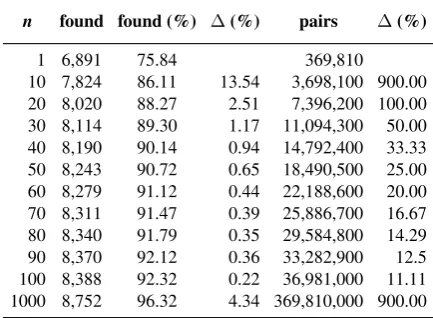
n found found (%) ∆(%) pairs ∆(%)
1 6,891 75.84 369,810
[image:3.595.307.524.64.223.2]10 7,824 86.11 13.54 3,698,100 900.00 20 8,020 88.27 2.51 7,396,200 100.00 30 8,114 89.30 1.17 11,094,300 50.00 40 8,190 90.14 0.94 14,792,400 33.33 50 8,243 90.72 0.65 18,490,500 25.00 60 8,279 91.12 0.44 22,188,600 20.00 70 8,311 91.47 0.39 25,886,700 16.67 80 8,340 91.79 0.35 29,584,800 14.29 90 8,370 92.12 0.36 33,282,900 12.5 100 8,388 92.32 0.22 36,981,000 11.11 1000 8,752 96.32 4.34 369,810,000 900.00
Table 1: Parallel sentences found from then-best cosine similarity filter. The∆columns are the per-centage increase in number of parallel sentences found and candidate sentence pairs.
4 Results
4.1 Candidate filtering
In Table 1 we present the information regarding the number of parallel sentences and number of candidate sentence pairs obtained by augmenting the value ofn for our candidate filtering method described in2.2. We see that our cosine similarity filter is able to capture most of the parallel sen-tence pairs, even for lownvalues. Forn= 1, we are surprised to see that such a simple approach us-ing pretrained cross-lus-ingual word embeddus-ings on the Europarl dataset is able to capture 75.84% of the parallel sentence pairs found in the shared task training set. By looking at the∆columns, we an-ticipate that there is a precision-recall trade-off by increasingn. For example, if we increase from a 30-best to a 40-best filter, we increase the recall score at most by 0.94%. On the other hand, we augment the number of candidate sentence pairs to evaluate by 33.33%, increasing the risk of false positive examples and a lower precision score. For the shared task we naively usedn= 100.
4.2 Digits preprocessing
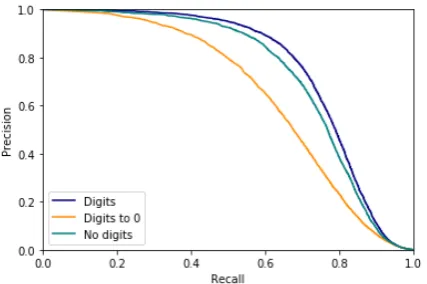
In this experiment we trained two new models on Europarl; by keeping or removing digits. In Ta-ble2we report the precision, recall and F1scores
Model Precision (%) Recall (%) F1(%)
Digits 83.25 65.86 73.54
[image:4.595.84.277.66.124.2]Digits to 0 71.41 56.38 63.01 No digits 79.65 63.86 70.89
Table 2: Performance of our models trained on Europarl with three different digits preprocessing method and evaluated on our validation sets made from the shared task training set.
Figure 1: Precision-Recall curve for our models trained on Europarl with three different digits pre-processing method and evaluated on our validation sets made from the shared task training set.
naively replacing the digits to 0, as we did for the shared task, is actually the worst option.
4.3 Model evaluation
Equipped with a filter that seems to work well and a better model trained on a parallel corpus with digits, we expect to obtain a performance in the range of those presented in Section4.2. Unfortu-nately for us, it is not the case. Table3 presents the results we obtained by using our model trained on Europarl with digits, using the 40-best list and λ = 0.99. One may wonder what happened to our surprisingly low precision score. The prob-lem arises from a combination of how the model is trained on negative examples and how we filtered our candidate sentence pairs. Since our model out-puts a positive instance for two sentences shar-ing an high level of semantic similarity, by filter-ing the 40 nearest target sentences for each source sentence, we created a pool of candidate sentence pairs that our model outputted as positive most of the time. That being said, those sentence pairs still exist in the Cartesian product of the training set. Thus, the proposed training procedure adding
neg-Decision Threshold Precision (%) Recall (%) F1(%)
0.99 12.10 70.95 20.67
Table 3: Performance of our models trained on Eu-roparl with digits using the 40-best cosine similar-ity filter.
ative examples randomly selected from the train-ing set is definitely not adequate and needs to be replaced by a more effective procedure. For fu-ture work, instead of random sampling, we pro-pose to apply then-best cosine similarity filter on our model’s training set in a way to select negative examples from then-best list to train it. A post-processing step could also be useful.
5 Discussion
The idea toward an end-to-end sentence driven approach using deep neural networks for parallel sentence identification is compelling. However, there is much room for improvement. We pre-sented that our initial approach learned on distri-butional semantics alone has weak points that need to be addressed. With its current architecture and setting, the main issue is the low precision score due to the large amount of false positive exam-ples our system outputs, acting more as a quasi-parallel sentences extractor. The source of this is-sue comes from the random sampling procedure used to add negative examples to the training set. We have seen that even for a low valuen, our sim-ple distributional bag-of-wordsn-best filter is ca-pable of capturing most parallel sentences found in the comparable corpora, leading to a potentially good recall score. A promising next step would be to use the samen-best filter on our training set and to select negative examples from the n-best list to train our model. We anticipate that select-ing negative examples that are similar to the source sentence will allow our approach to capture finer semantic granularities and to have a better preci-sion score. Furthermore, a model trained on neg-ative examples of higher quality should allow us to use a lower optimal decision thresholdλ, which increases the recall score.
References
[image:4.595.75.289.204.346.2]Sanjay Ghemawat, Geoffrey Irving, Michael Isard, Manjunath Kudlur, Josh Levenberg, Rajat Monga, Sherry Moore, Derek G. Murray, Benoit Steiner, Paul Tucker, Vijay Vasudevan, Pete Warden, Martin Wicke, Yuan Yu, and Xiaoqiang Zheng. 2016. Ten-sorflow: A system for large-scale machine learning. In 12th USENIX Symposium on Operating Systems Design and Implementation (OSDI 16). pages 265– 283.
Sadaf Abdul-Rauf and Holger Schwenk. 2009.
On the use of comparable corpora to im-prove smt performance. In Proceedings of the 12th Conference of the European Chapter of the Association for Computational Linguis-tics. Association for Computational Linguistics, Stroudsburg, PA, USA, EACL ’09, pages 16–23.
http://dl.acm.org/citation.cfm?id=1609067.1609068. Yoshua Bengio, Rjean Ducharme, Pascal Vincent, and
Christian Jauvin. 2003. A neural probabilistic lan-guage model. JOURNAL OF MACHINE LEARN-ING RESEARCH3:1137–1155.
Kyunghyun Cho, Bart van Merrienboer, Caglar Gul-cehre, Dzmitry Bahdanau, Fethi Bougares, Holger Schwenk, and Yoshua Bengio. 2014. Learning phrase representations using rnn encoder–decoder for statistical machine translation. InProceedings of the 2014 Conference on Empirical Methods in Nat-ural Language Processing (EMNLP). Association for Computational Linguistics, Doha, Qatar, pages 1724–1734.
Ronan Collobert and Jason Weston. 2008. A uni-fied architecture for natural language process-ing: Deep neural networks with multitask learn-ing. In Proceedings of the 25th International Conference on Machine Learning. ACM, New York, NY, USA, ICML ’08, pages 160–167.
https://doi.org/10.1145/1390156.1390177.
J´er´emy Ferrero, Fr´ed´eric Agn`es, Laurent Besacier, and Didier Schwab. 2017. Using word embed-ding for cross-language plagiarism detection.CoRR
abs/1702.03082. http://arxiv.org/abs/1702.03082. Stephan Gouws, Yoshua Bengio, and Greg Corrado.
2015. Bilbowa: Fast bilingual distributed represen-tations without word alignments. In Proceedings of the 32Nd International Conference on Interna-tional Conference on Machine Learning - Volume 37. JMLR.org, ICML’15, pages 748–756.
Alex Graves. 2013. Generating sequences with re-current neural networks. CoRR abs/1308.0850.
http://arxiv.org/abs/1308.0850.
Diederik P. Kingma and Jimmy Ba. 2014. Adam: A method for stochastic optimization. CoRR
abs/1412.6980. http://arxiv.org/abs/1412.6980. Dragos Stefan Munteanu and Daniel Marcu.
2005. Improving machine translation
per-formance by exploiting non-parallel
cor-pora. Comput. Linguist. 31(4):477–504.
https://doi.org/10.1162/089120105775299168.
Philip Resnik and Noah A. Smith. 2003. The web as a parallel corpus.Comput. Linguist.29(3):349–380.
https://doi.org/10.1162/089120103322711578. Ilya Sutskever, Oriol Vinyals, and Quoc V. Le.
2014. Sequence to sequence learning with neural networks. In Proceedings of the 27th International Conference on Neural Informa-tion Processing Systems. MIT Press, Cam-bridge, MA, USA, NIPS’14, pages 3104–3112.