Constructing narrative using a generative model
and continuous action policies
Emmanouil Theofanis Chourdakis and Joshua D. Reiss∗ Queen Mary University of London
Mile End Road, E1 4NS London, UK
{e.t.chourdakis,joshua.reiss}@qmul.ac.uk
Abstract
This paper proposes a method for learning how to generate narrative by recombining sen-tences from a previous collection. Given a cor-pus of story events categorised into 9 topics, we approximate a deep reinforcement learn-ing agent policy to recombine them in order to satisfy narrative structure. We also propose an evaluation of such a system. The evalua-tion is based on coherence, interest, and topic, in order to figure how much sense the gen-erated stories make, how interesting they are, and examine whether new narrative topics can emerge.
1 Introduction
In this work reinforcement learning is used in con-junction with a shallow generative artificial neural network (ANN) to generate novel stories. First, a SkipGram (Mikolov et al., 2013) based model is de-rived that generates parts of the narrative in a local neighbourhood (a few consecutive events at time). An artificial agent is then used to extend its use to the whole narrative while globally adhering to the story structure learned by that model.
2 Previous Work
Data-driven approaches for story generation can be found in (McIntyre and Lapata, 2009; Li et al., 2013). In (McIntyre and Lapata, 2009), the au-thors present an end-to-end system to generate sto-ries by deriving models of interest and coherence
∗
Correspondence should be sent to the first author. This paper has been sponsored by RPPtv Ltd.
data driven approach for story generation to learn how to construct narratives from a collection of sto-ries.
3 Methodology
3.1 Event Representation
We used 519 stories from the SCHEHERAZADE sys-tem (Li et al., 2013)1 which contains simple sto-ries pertaining to 9 topics with an average length of 7-16 events per story per topic. These stories consist of simple sentences, each describing a sin-gle event. Using the Stanford NLP parser, we ex-tract the Universal Dependencies (Chen and Man-ning, 2014; Nivre et al., 2016) of each sentence as a list of relations in the formrel(head, modif ier)
whererel is the relation type andhead, modif ier
are literals. We further lemmatize each head and
modif ierusing WordNet (Miller, 1995) in order to reduce the total number of literals we have to deal with. Narratives are sequences of events which in turn are simple sentences that describe a character action or a stative. We use universal dependencies and a shallow ANN in order to derive a useful and compact representation for each event. Having de-rived a set of all the dependencies found in the cor-pus each event is represented as a vector vk of the form[Hdep1 Hdep2 . . . Mdep1 Mdep2]T whereHdep
corresponds to the head of dependency dep, Mdep
to the modifier and each of those elements can take as values an integer that serves as the index for the literals found in the corpus.
After we extract a vector vk for each event kin
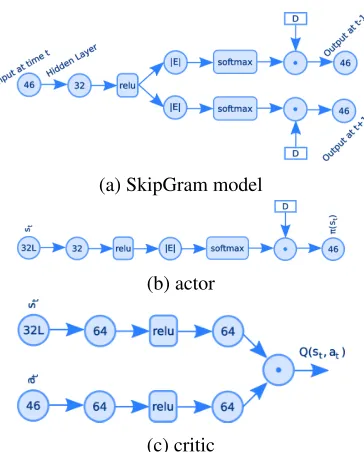
our corpus, we use an ANN to learn a compact rep-resentation of our events such that two similar events have similar representations. Instead of measuring grammatical similarity as in (Li et al., 2013) we con-sider as similar events the ones that are used in a sim-ilar context. For this we use a model simsim-ilar to the SkipGram (Mikolov et al., 2013). This model de-rives a low-dimensional fixed-length representation space that maps events that are used similarly, close in that space thus implicitly ”grouping” them to-gether. It also gives probabilities of each event hap-pening, based on previous events. The SkipGram model can be seen in Figure 1a.
1
http://boyangli.co/openstory.php
Choosing such a model allows us to capture rela-tions between neighbouring events, in a similar way to that of the original SkipGram that captures analo-gies of words in language. We can then use these learned relations to generate events that satisfy them and thus create ”coherent” narratives. It also allows us to implicitly group events. This means that, in the process of generating a narrative, when choosing on an event to include, we do have a probability of in-cluding a different, but similar, event. Finally, we can use it with events not found in the corpus it has been trained with. As long as we can feed it a vector representation of the new event it will be mapped close to similar events in the corpus. We will see that by using the model generatively to predict the context from a starting event we can already make sensible narratives.
3.2 Generative Model
In Section 3.1 we introduced our SkipGram Model. This model has been trained to give an approxima-tion of the context of an event, given that event. The context of an event in our case consists of the events that immediately surround it. By starting from a ran-dom event that can begin a narrative, the model gives the probability of the next event. An example of a narrative generated can be seen in Figure 2b. Gener-ating narratives this way, while it appears adequate, suffers from a serious limitation. Since the model is trained on an event and its immediate surroundings, it is not possible to capture longer distance depen-dencies in the narrative. In other words, we cannot interrupt a coherent sequence of events and come at it later so the model is ”forced” to keep very close to the corpus in order to maintain coherence.
3.3 Deep Reinforcement Learning
Reinforcement learning is the field that studies how an abstract mathematical entity, called anagent, can interact with an environmentEin order to maximise a numerical quantity (Sutton and Barto, 1998). We call an instance of the environment at timetastate
st, the quantity to maximise autilityUt. The agent
interacts with the environment by executing a series ofactionsaiand receiving a series of immediate re-wards rt. The utility Ut is related to the
immedi-ate rewards rt by the expression: Ut = Ptn=1rn.
state of the environment is modelled by apolicyπ. The policy can be seen as a probability distribution
π(at=ai|st). The problem of reinforcement
learn-ing therefore is to find a policy that maximises the utility for the agent in a given environment. In or-der to generate policies, RL algorithms usually ap-proximate avalue functionV(st)or anaction-value function Q(st, at). V(st) gives a measure of how
beneficial is for the agent to exist at the statestand Q(st, at)how beneficial it is for the agent to be at
statestand execute actionat. Deep Reinforcement
Learning (DRL) approximatesQ, V, E, or π with a Deep Neural Network. A popular approach for training agents works by suggesting an actionat
us-ing a model called an actor and evaluates it using a model called acritic. The method we use in this work is called Deep Deterministic Policy Gradient (Lillicrap et al., 2016) with the actor and critic mod-els being the deep neural networks that appear in Figures 1b and 1c respectively. The model of the critic is inspired by the Deep Reinforcement Rele-vance Network given in (He et al., 2016). The actor approximates an event to be included in the narrative and the critic evaluates it based on the current state of the narrative. The state of the narrative is at ev-ery point a simple concatenation of the embeddings (as given by the hidden layer in 1a) of the events in-cluded in that narrative until that point. At every step the reward is calculated based on the distance of the expected action-event to the selected event so that it awards adding events to the narrative when those are close to the ones we expect to see, and punishes by a small amount unexpected events. Punishing unex-pected events might appear counter-intuitive at first glance since story generation systems are expected to generate unexpected events. This is compensated by the stochastic nature of policies found by actor-critic methods which will also assign a small proba-bility to an unexpected event happening.
4 Evaluation
In order to evaluate the system’s capability to gen-erate interesting narratives human evaluation is nec-essary. Towards this goal, an evaluation experiment has been designed which is based on similar eval-uation approaches found in data-driven story gen-eration approaches (Li et al., 2013; McIntyre and
Lapata, 2010) and asks 20 subjects to evaluate 40 narratives from which 10 are from our corpus of human-made narratives, 10 narratives generated by randomly combining events from the corpus, 10 are narratives generated by the SkipGram Model given in Figure 1a and 10 by the DDPG agent. Each sub-ject evaluates 8 narratives based on number of ed-its (rearranging, deleting, or adding new events) re-quired to make the narrative more coherent, interest rated on a scale from 1 to 5 (1 being ”Not at all in-teresting” and 5 being ”Very Inin-teresting”) as well as asked to give one word that better describes the topic of the narrative. This last task can helps us figure out whether new topics emerge from our system by combining events from different topics. Since this is work in progress, we lack experiment results. In the absence of human evaluation results we could do some qualitative examining of generated narra-tives. Figures 2a and 2c show narratives found in our original corpus and in Figures 2b and 2d narratives generated by the generative model and the DDPG agent respectively. We can see that the narrative in 2b tries to follow the narrative found in 2c however it deviates in its conclusion. Instead of kneeling in front of Sally and proposing, the narrative ends with John kissing Sally. An important note here is that for the most first part of the narrative, the genera-tive model followed almost exactly the story found in the corpus. This is a weakness of the model that arises from learning relations only between neigh-bouring events. A more interesting narrative is the one found in 2d. This narrative combines events from the narrative in Figure 2a, the one in 2c, as well as others found in the corpus. Narratives gener-ated by the DDPG agent tend to explore more events while narratives generated by the generative model tend to stick to the corpus.
5 Discussion/Future Work
(a) SkipGram model
(b) actor
[image:4.612.95.277.66.292.2](c) critic
Figure 1: The Skipgram model, and the models for the actor and the critic. Circles represent fully connected neuron layers with the number of neurons being the num-ber inside the circle. The smoothed rectangles represent the activation functions withrelubeing the linear rec-tifier andsoftmaxa softmax output.|E|is the number of events in our database, andDthe narrative corpus as a matrix of features. The dot symbolises the dot product.L
is the number of the events making up the narrative,π(st)
the policy at statest,Q(st, at)the state-action value for
the policyπ.
between the heads and modifiers of the same depen-dencies is used to cluster events. This requires sim-ilar sentence structure for different events in order for such similarity to be meaningful. We get past this limitation by deriving a fixed length represen-tation by using the model in Figure 1a and thus we are able to compare sentences of variable structure. Since our similarity is based on how events are used in a narrative, we can interchangeably use two sen-tences that refer to the same event but are grammat-ically different (e.g. ”Sally agreed to marry John.” and ”Sally said yes.”).
The second is that the use of an agent allows for complex relations in the narrative, unknown in ad-vance, to be captured as showcased by (Narasimhan et al., 2015; He et al., 2016), as well as arbitrary au-thorial goals when carefully introduced in the reward function. One could for example augment the cor-pus of available events with information about emo-tions (Francisco and Herv´as, 2007) and then reward
“ John loved Sally John wanted to marry Sally John bought an engagement ring John took Sally to the park John and Sally enjoyed a picnic John got down on one knee John presented the ring to Sally Sally started to cry John asked Sally to marry John Sally agreed Sally put on the ring John and Sally hugged ”
(a) An example narrative from the corpus.
“ John entered Sally’s house. John and Sally entered the living room. John and Sally sat on the sofa. John picked up Sally’s hand. John kissed Sally’s hand. Sally smiled at John. John let go of Sally’s hand. John stood up. John kissed Sally. ”
(b) An example narrative generated by using the SkipGram Model generatively.
“ Sally opened the door. John entered Sally’s house. John and Sally entered the living room. John and Sally sat on the sofa. John picked up Sally’s hand. John kissed Sally’s hand. Sally smiled at John. John let go of Sally’s hand. John stood up. John kneeled in front of Sally. John took a ring box out of his pocket. Sally pressed both hands against her cheeks. John proposed to Sally. Sally took the ring box from John. Sally opened the ring box. Sally took the ring out of the ring box. John took the ring from Sally. John put the ring on Sally’s left third finger. ”
(c) An example narrative from the corpus.
“ John loved Sally. John presented the ring to Sally. John let go of Sally’s hand. Sally and John laughed. Sally and John kissed. John told Sally how beautiful she is. Sally blushed.”
(d) An example narrative generated by using the DDPG agent.
Figure 2: Examples of narratives.
The current research leaves some things to be de-sired. While he have designed an experiment for the evaluation of the system, we have yet to run it through human subjects, who are the ones who can judge if a system exhibits creativity. We can-not therefore have a discussion about whether our system is creative. The narrative generation capac-ity is limited among other things by the corpus it-self. We can only make as many novel stories as can be made by recombining the available events. Given that the vectors of the events (Section 3.1) in the corpus constitute only a limited subset of values in that vector space we should be able to generate novel events mapped from within that space once we had a way to map from narrative to surface text. In (Kumagai et al., 2016), the authors present a sys-tem that can generate language given syntactic struc-ture as well as semantic information. Our event vec-tor representation maintains syntactic structure data which could be combined with that work to generate surface text. Another issue is that learning is done exclusively on the narrative-structure level without taking into account any consideration any extra in-formation in the stories. One could use character-isation of story events and heuristics of narration similar to theSTellAsystem presented in (Le´on and Gerv´as, 2014). We speculate that such heuristics can be used as rewards in the context of reinforcement learning and thus guide learning. More technical is-sues relate to problems that can be met both in re-inforcement and in deep learning. Training the net-works and the agent is sensitive to hyper-parameters as well as network architecture. Since this is work in progress both the architecture and the hyperpa-rameters have been chosen intuitively by hand and by no means we can claim these are optimal. Bet-ter design parameBet-ters can be chosen in a robust way through exhaustive cross validation.
References
Danqi Chen and Christopher Manning. 2014. A Fast and Accurate Dependency Parser using Neural Net-works. In Proceedings of the 2014 Conference on Empirical Methods in Natural Language Processing, EMNLP 2014, pages 740–750. ACL.
Virginia Francisco and Raquel Herv´as. 2007. Emotag: Automated mark up of affective information in texts.
InProceedings of Doctoral Consortium at the 8th EU-ROLAN summer school, pages 5–12.
Ji He, Jianshu Chen, Xiaodong He, Jianfeng Gao, Lihong Li, Li Deng, and Mari Ostendorf. 2016. Deep Rein-forcement Learning with a Natural Language Action Space. InProceedings of the 54th Annual Meeting of the Association for Computational Linguistics, pages 1621–1630. ACL.
Kaori Kumagai, Ichiro Kobayashi, Daichi Mochihashi, Hideki Asoh, Tomoaki Nakamura, and Takayuki Na-gai. 2016. Human-like Natural Language Genera-tion Using Monte Carlo Tree Search. In The INLG 2016 Workshop on Computational Creativity in Natu-ral Language Generation, pages 11–18. ACL.
Carlos Le´on and Pablo Gerv´as. 2014. Creativity in story generation from the ground up: Nondeterministic sim-ulation driven by narrative. InProceedings of the 5th International Conference on Computational Creativ-ity, ICCC 2014.
B. Li, , S. Lee-Urban, , G. Johnston, and M. O. Riedl. 2013. Story Generation with Crowdsourced Plot Graphs. InProceedings of the Twenty-Seventh AAAI Conference on Artificial Intelligence, pages 598–604. AAAI Press.
Timothy Paul Lillicrap, Jonathan James Hunt, Alexander Pritzel, Nicolas Manfred Otto Heess, Tom Erez, Yu-val Tassa, David Silver, and Daniel Pieter Wierstra. 2016. Continuous control with deep reinforcement learning. InProceedings of 4th International Confer-ence on Learning Representations, ICLR 2016.
Mihai Lintean and Vasile Rus. 2009. Paraphrase iden-tification using weighted dependencies and word se-mantics. InProceedings of the Twenty-Second Inter-national Florida Artificial Intelligence Research Soci-ety Conference, FLAIRS 2009. AAAI Press.
Neil McIntyre and Mirella Lapata. 2009. Learning to tell tales: A data-driven approach to story generation. In
Proceedings of the Joint Conference of the 47th An-nual Meeting of the ACL and the 4th International Joint Conference on Natural Language Processing of the AFNLP, pages 217–225. ACL.
Neil McIntyre and Mirella Lapata. 2010. Plot induction and evolutionary search for story generation. In Pro-ceedings of the 48th Annual Meeting of the Associa-tion for ComputaAssocia-tional Linguistics, pages 1562–1572. ACL.
Tomas Mikolov, Kai Chen, Greg Corrado, and Jeffrey Dean. 2013. Efficient estimation of word represen-tations in vector space. In ArXiv e-prints, volume abs/1301.3781.
Volodymyr Mnih and others. 2015. Human-level con-trol through deep reinforcement learning. Nature, 518(7540):529–533.
Karthik Narasimhan, Tejas Kulkarni, and Regina Barzi-lay. 2015. Language understanding for text-based games using deep reinforcement learning. In Proceed-ings of the 2015 Conference on Empirical Methods in Natural Language Processing, pages 1–11. ACL. Joakim Nivre, Marie-Catherine de Marneffe, Filip Ginter,
Yoav Goldberg, Jan Hajic, Christopher D. Manning, Ryan McDonald, Slav Petrov, Sampo Pyysalo, Na-talia Silveira, Reut Tsarfaty, and Daniel Zeman. 2016. Universal dependencies v1: A multilingual treebank collection. InProceedings of the Tenth International Conference on Language Resources and Evaluation, LREC 2016. ELRA.
Mark O Riedl and Brent Harrison. 2016. Using stories to teach human values to artificial agents. InPapers from the 2016 AAAI Workshop on AI, Ethics, and Society. AAAI Press.