Proceedings of NAACL-HLT 2018, pages 225–230
Semantic Pleonasm Detection
Omid Kashefi Andrew T. Lucas
School of Computing and Information University of Pittsburgh
Pittsburgh, PA, 15260
{kashefi, andrew.lucas, hwa}@cs.pitt.edu
Rebecca Hwa
Abstract
Pleonasms are words that are redundant. To aid the development of systems that detect pleonasms in text, we introduce an anno-tated corpus of semantic pleonasms. We val-idate the integrity of the corpus with inter-annotator agreement analyses. We also com-pare it against alternative resources in terms of their effects on several automatic redundancy detection methods.
1 Introduction
Pleonasm is the use of extraneous words in an expression such that removing them would not significantly alter the meaning of the expression (Merriam-Webster,1983;Quinn,1993;Lehmann,
2005). Although pleonastic phrases may serve literary functions (e.g., to add emphasis) (Miller,
1951;Chernov,1979), most modern writing style guides caution against them in favor of con-cise writing (Hart et al., 1905; Williams, 2003;
Turabian,2013;Gowers,2014;Strunk,1920). An automatic pleonasm detector would be beneficial for natural language processing (NLP) applications that support student writ-ing, such as grammar error correction (GEC) (Han et al., 2006; Rozovskaya and Roth, 2010;
Tetreault et al., 2010; Dahlmeier and Ng, 2011), automatic essay grading (Larkey,1998;Landauer,
2003; Ong et al., 2014), and intelligent writing tutors (Merrill et al., 1992; Aleven et al., 2009;
Atkinson, 2016). Pleonastic phrases may also negatively impact NLP applications in general because they introduce an unnecessary complexity to the language. Their removal might facilitate NLP tasks such as parsing, summarization, and machine translation. However, automated pleonasm detection is a challenging problem, in parts because there is no appropriate resources to support the development of such systems. While
some GEC corpora do annotate some words or phrases as “redundant” or “unnecessary,” they are typically a manifestation of grammar errors (e.g., we still have room to improve for our current welfare system) rather than a stylistic redundancy (e.g., we aim to better improve our welfare system).
This paper presents a new Semantic Pleonasm Corpus (SPC), a collection of three thousand sen-tences. Each sentence features a pair of potentially semantically related words (chosen by a heuris-tic); human annotators determine whether either (or both) of the words is redundant. The corpus offers two improvements over current resources. First, the corpus filters for grammatical sentences so that the question of redundancy is separated from grammaticality. Second, the corpus is fil-tered for a balanced set of positive and negative ex-amples (i.e., no redundancy). The negative exam-ples may make useful benchmark data – because they all contain a pair of words that are deemed to be semantically related, a successful system can-not rely on simple heuristics, such as semantic dis-tances, for discrimination. We evaluate the cor-pus in terms of inter-annotator agreement, and in terms of its usefulness for developing automatic pleonasm detectors.
2 Semantic Pleonasm
Although pleonasm is generally a semantic and rhetorical concept, it could have different aspects and be formed in different layers of language, in-cluding morphemic (e.g., “irregardless” (Berube,
1985)) and syntactic layers (e.g., “the most un-kindest cut of all”). Detecting and correcting morphemic and syntactic pleonasms are more in the scope of GEC research, especially when they cause errors. Semantic pleonasm, on the other hand, is “a question of style or taste, not
mar” (Evans and Evans,1957). It occurs when the meaning of a word (or phrase) is already implied by other words in the sentence. For example, the following is a grammatical sentence that has a re-dundant word:I received afreegift. While writers might intentionally include the redundant word for emphasis, the overuse of pleonasm may weaken the expression, making it “boring rather than strik-ing the hearer.” (Fowler,1994).
3 A Semantic Pleonasm Corpus
Semantic pleonasm is a complex linguistic phe-nomenon; to develop a useful corpus for it, we need to make some design decisions in terms of a trading off between the breadth and depth of our coverage.
3.1 Data Source
We want to start from a source that is likely to con-tain semantic redundancies. Because good writers are trained to guard against redundant phrasings, professionally written text from Project Gutenberg or the Wall Street Journal would not be appropri-ate. Because we want to separate the issues of grammaticality from redundancy, learner corpora would also not be appropriate. A data source that seems promising is amateur product reviews. The writers tend to produce more emotional prose that are at times exasperated or gushing; the writing is more off-the-cuff and casual, and may contain more redundancy. Ultimately, we chose to work with restaurant reviews from Round Seven of the Yelp Dataset Challenge1because it is widely dis-tributed.
3.2 Filtering
Although redundant words and phrases occur fre-quently enough that exhortations to excise them is a constant refrain in writing guides, most sen-tences still skew toward not containing pleonasms. Annotating all sentences would dilute the impact of the positive examples, further complicate the annotation scheme, and increase the cost of the corpus creation. Thus, we opt to construct a bal-anced corpus of positive and negative examples for a specific kind of redundancy in a specific config-uration. In particular, we extract all sentences that contained a pair of adjacent words that are likely to be semantically similar. We restrict our atten-tion to adjacent word pairs to increase the chance
1https://www.yelp.com/dataset/challenge
of finding redundancy, since semantically related words that are farther apart are more likely to have different syntactic and semantic roles. To de-termine semantic similarity, we use the TextBlob Python interface2, which, for a given word, pro-vides access to WordNet synsets (Miller, 1995) corresponding to each of the word’s senses. We compare each pair of adjacent words in the dataset to see whether they share any synsets. Since WordNet serves as a coarse filter, we need to fur-ther improve recall. We select any sentences that contains a pair of adjacent words such that one of the words has a synset that is similar toa synset of the other word. TextBlob provides this “simi-lar to” functionality, which finds synsets that are close to a given synset in WordNet’s taxonomy tree. (note, however, that these words may not be used in those senses in the sentence). Apply-ing these filterApply-ing rules, we are able to eliminate a large percentage of sentences that do not con-tain semantic redundancy; the method also help us identify a pair of words in each sentence that is likely to have a redundancy. In the second step of filtering, we manually removed sentences that contained obvious grammatical mistakes.
3.3 Annotation
We set up a Amazon Mechanical Turk service to determine whether the potentially redundant word pairs are actually redundant. Because we want to build a balanced corpus, we first perform a quick internal first pass, marking each sentence as ei-ther “possibly containing redundancy” or “prob-ably not containing redundancy” so that we can distribute the instances to the Turkers with equal probability (they do not see our internal annota-tions). The Turkers are given six sentences at a time, each containing a highlighted pair of words. The workers have to decide whether to delete the first word, the second word, both, or neither. Then, they indicate their confidence: “Certain,” “Some-what certain,” or “Uncertain.” Lastly, they are given the opportunity to provide additional expla-nations. Each sentence has been reviewed by three different workers. For about ninety percent of the sentences, three annotations proved sufficient to achieve a consensus. We collect a fourth annota-tion for the remaining sentences, and are then able to declare a consensus.
Consensus Level Fleiss’s Kappa Word Level 0.384 Sentence Level 0.482
Table 1: Inter-Annotator Agreement
A Few Examples
• Sentence:Freshly squeezed and no additives, justplain purefruit pulp.
Consensus: plain is redundant.
• Sentence: It is clear that I will never have anotherprime firstexperience like the one I had at Chompies.
Consensus: neither word is redundant.
• Sentence:The dressing is absolutely incred-ibly fabulouslyflavorful!
Consensus: both words are redundant.
3.4 Inter-Annotator Agreement
Because our corpus is annotated by many Turk-ers, with some labeling only a handful of sen-tences while others contributed hundreds, the typ-ical pair-wise inter-annotated agreement is not ap-propriate. Instead, we compute Fleiss’s Kappa (Fleiss, 1971), which measures the degree of agreement in classification over what would be ex-pected by chance for more than two annotator.
We analyze agreements at two levels of gran-ularity: word level indicates the consensus on whether the first, second, both, or neither of the candidates is pleonastic; sentence level indi-cates the consensus on whether a sentence has a pleonastic construction.
Table 1 shows that annotators are more likely to agree whether a sentence contains a pleonasm than exactly which words should be considered re-dundant. In many cases, a majority consensus is achieved with one annotator disagreeing with the others. The result suggests that when there is a sin-gle word redundancy, removing either of the syn-onyms could be appropriate.
3.5 Properties
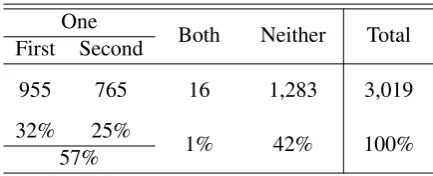
The final dataset consists of 3,019 sentences. Their final labels are based on a majority consen-sus: 1,283 sentences are marked as not having a redundant word; 1,720 sentences are marked as containing a single word redundancy; and for 16
One Both Neither Total First Second
955 765 16 1,283 3,019 32% 25%
1% 42% 100%
[image:3.595.95.272.63.124.2]57%
Table 2: Statistics of the Semantic Pleonasm Corpus
sentences, both words are marked as redundant. Table2. shows the statistics of annotators consen-sus. The corpus, including all annotations and the final consensus, is available in JSON format from
http://pleonasm.cs.pitt.edu
4 Automatic Pleonasm Detection
Given our design choices, the current SPC is not a large corpus; we posit that it can nonetheless serve as a valuable resource for developing systems to detect semantic pleonasm. For example, the ear-lier work ofXue and Hwa(2014) might have ben-efited from this resource. They wanted to detect the word in a sentence that contributes the least to the meaning of the sentence; however, their ex-periments were hampered by a mismatch between their intended domain and the corpus they eval-uated on – while their model estimated a word’s semantic redundancy, their experiments were per-formed on NUCLE (Dahlmeier et al., 2013), a learner corpus that focused more on grammatical errors. Moreover, since their detector always re-turned the word with the lowest meaning contri-bution score, they only evaluated their model on sentences known to contain an unnecessary word; without appropriate negative examples, it is not clear how to apply their system to sentences with no redundancy. These are two use-case scenarios that the SPC may address. To verify our claim, we will first compare the performances of several word redundancy metrics, including a replication of the metric of Xue and Hwa, on our corpus with their performances on NUCLE. We will then show that the SPC can train a classifier that predicts whether a sentence contains semantic pleonasm.
4.1 Pleonastic Word Detection
NUCLE. Note that our experimental goal is not to obtain a method that reports a high accuracy on SPC (we do not want a corpus that overfits to some particular method). Rather, it is to demonstrate that the human-annotated SPC captures aspects of semantic redundancy that are not available in other resources.
In order to shed lights on the differences be-tween SPC and NUCLE, we compare them using detectors that are formulated from different strate-gies. First, we have replicated the metric pro-posed by Xue and Hwa, which consists of two main components: a language model and a word meaning contribution model that is derived from word alignments from machine translation3. This method is the most focused on lexical semantic, so we expect it to be better at detecting redundant words on the SPC. Next, we have implemented three simple metrics: SIM computes the seman-tic similarity between a full sentence and that sen-tence with the target word removed4; GEN esti-mates the degree to which a word is general (there-fore more likely to be redundant) by its number of synonyms; andSM P estimates the simplicity of a word based on an implementation of the Flesch-Kincaid readability score (Kincaid et al., 1975). Of these, onlySIMdirectly models semantics; we expect it to be better at detecting redundant words on the SPC than the two other, more general, met-rics. Finally, as a point of contrast, we consider a GECsystem usinglanguagetools5(Naber,2003); we expect theGECsystem to be better at detecting grammar error related redundancy found on NU-CLE than cases of semantic redundancy found in the SPC.
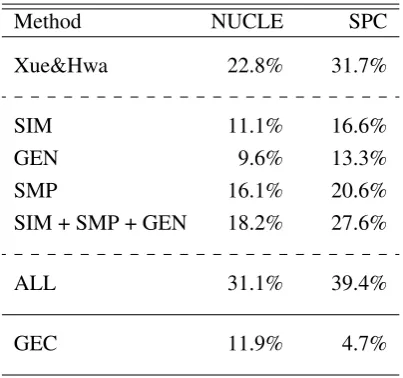
To conduct the experiment, we selected 1,140 NUCLE sentences that contain one local redun-dancy (RLOC) error; for SPC, 1,720 sentences with one semantic pleonasm are used. Table 3
shows the accuracy of each method under both corpora. Our implementation of Xue and Hwa’s model replicates their reported outcome with NU-CLE, and, as expected, their method is more suc-cessful on the SPC. All three simple metrics are more successful at picking out redundant word on the SPC than NUCLE, withSIMshowing a bigger
3In our re-implementation, the language model is trained on a portion of English Gigaword (Graff et al.,2003) using KenLM (Heafield,2011); the word alignments are derived from Bing’s English-French Translator
4usingsense2vecword-embeddings (Trask et al.,2015) 5https://languagetool.org/
Method NUCLE SPC
Xue&Hwa 22.8% 31.7%
SIM 11.1% 16.6%
GEN 9.6% 13.3%
SMP 16.1% 20.6%
SIM + SMP + GEN 18.2% 27.6%
ALL 31.1% 39.4%
[image:4.595.316.518.61.250.2]GEC 11.9% 4.7%
Table 3: The accuracy of detecting the redundant word in sentences with different methods under two corpora: NUCLE and SPC.ALLis a composite metric from the other four:Xue&Hwa+SIM+SM P+GEN.
difference than the other two. Comparing the four methods’ between corpora differences, we see that the method of Xue&Hwa has the most to gain, perhaps because it has the strongest domain mis-match. Yet, a combination of all four metrics re-sults in an improved accuracy of 39.4%, suggest-ing that the four strategies capture different aspect of semantic redundancy. That this highest achiev-ing accuracy is still quite low suggests that there is ample room for improvement in terms of word de-tector development. In contrast, theGECmethod performed much better on NUCLE (11.9%) than on the SPC (4.7%). Taken as a whole, these re-sults suggest that the SPC, while small, is a better fit for the task of detecting semantic redundancy than NUCLE.
4.2 Sentential Pleonasm Detection
Feature Description
UG the one-hot representation (Harris and Harris, 2010) of unigrams of the sentence
TG the one-hot representation of tri-grams of the sentence
TFIDF the one-hot representation of smoothed TFIDF tuples of trigrams of the sentence
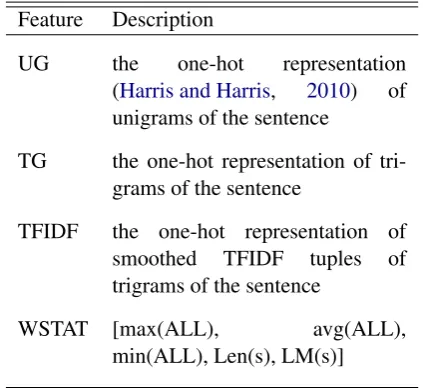
[image:5.595.75.287.62.256.2]WSTAT [max(ALL), avg(ALL), min(ALL), Len(s), LM(s)]
Table 4: Features for sentential level pleonasm detec-tion.ALLrepresents the collection of word-level
met-rics: Xue&Hwa,SIM,GEN, andSM P; Len(s) is the number of words in sentences; LM(s) is the trigram proba-bility for sentences.
Baseline MaxEnt Naive BayesSPC
UG 79.2 88.4
TG 79.9 88.8
TFIDF 83.0 90.5
WSTAT 63.1 53.2
WSTAT+UG 82.3 89.2
WSTAT+TG 83.7 89.3
[image:5.595.76.288.332.492.2]WSTAT+TFIDF 84.5 92.2
Table 5: The accuracy of a binary classifier using dif-ferent feature set to predict whether a sentence contains a pleonastic construction.
be redundant by human annotators. In this exper-iment, we use SPC to train a binary classifier; our feature set is summarized in Table4.
To train the classifiers, we performed 5-fold cross-validation on the full SPC corpus. We ex-perimented with both a Maximum Entropy and a Binomial Naive Bayes binary classifier. We considered the number of features from χ2 test,
regularization coefficient, the choice of penalty function and solver as hyperparameters and opti-mized them using the Particle Swarm algorithm (Clerc and Kennedy,2002) in the Optunity6 opti-mizer package.
Table 5 presents the results. We observe that
6https://github.com/claesenm/optunity
the three features that directly encode the words of the sentence are more relevant (U G, T G, T F IDF) than the group of statistics over the word redundancy metrics (W ST AT). For our corpus size, Naive Bayes seems to converge faster to the minimum error rate than MaxEnt (Ng and Jordan,
2002). In combination, W ST AT+T F IDF gave the highest accuracy, at around 92%. This result also reinforces our inter-annotator agreement rate, suggesting that determining whether a sentence contains a semantic pleonasm is easier than deciding which word is pleonastic.
5 Conclusion
We have introduced a semantic pleonasm corpus in which each sentence contains a word pair that is potentially semantically related. These sentences are reviewed by human annotators, who determine whether any of the words are redundant. Our pus offers two main contributions. First, as a cor-pus that focuses on semantic similarity, it provides a more appropriate resource for systems that aim to detect stylistic redundancy rather than gram-matical errors. Second, as a balanced corpus of positive and near-miss negative examples, it al-lows systems to evaluate their ability to detect ”no redundancy.”
Acknowledgments
We would like to thank the anonymous review-ers for their helpful comments. This material is based upon work supported by the National Sci-ence Foundation under Grant Number #1735752.
References
Vincent Aleven, Bruce M Mclaren, Jonathan Sewall, and Kenneth R Koedinger. 2009. Example-Tracing Tutors: A New Paradigm for Intelligent Tutoring Systems. International Journal of Artificial Intel-ligence in Education19(2):105–154.
Robert Kenneth Atkinson. 2016. Intelligent tutor-ing systems: Structure, applications and challenges. Nova Science Publishers, Inc.
Margery Berube. 1985. The American Heritage Dic-tionary: Second College Edition. Houghton Mifflin.
Maurice Clerc and James Kennedy. 2002. The parti-cle swarm-explosion, stability, and convergence in a multidimensional complex space. IEEE Transac-tions on Evolutionary Computation6(1):58–73.
Daniel Dahlmeier and Hwee Tou Ng. 2011. Grammat-ical Error Correction with Alternating Structure Op-timization. InProceedings of the 49th Annual Meet-ing of the ACL-HLT. pages 915–923.
Daniel Dahlmeier, Hwee Tou Ng, and Siew Mei Wu. 2013. Building a Large Annotated Corpus of Learner English: The NUS Corpus of Learner En-glish. InProceedings of the Eighth Workshop on Innovative Use of NLP for Building Educational Ap-plications. pages 22–31.
Bergen Evans and Cor Nelia Evans. 1957. A Dictio-nary of Contemporary American Usage. Random House, Inc.
Joseph L Fleiss. 1971. Measuring Nominal Scale Agreement Among Many Raters. Psychological Bulletin76(5):378.
Henry Watson Fowler. 1994. A Dictionary of Modern English Usage. Wordsworth Editions.
Ernest Gowers. 2014. Plain Words. Penguin UK.
David Graff, Junbo Kong, Ke Chen, and Kazuaki Maeda. 2003. English Gigaword. Linguistic Data Consortium, Philadelphia4:1.
Na-Rae Han, Martin Chodorow, and Claudia Leacock. 2006. Detecting errors in English article usage by non-native speakers. Natural Language Engineer-ing12(02):115–129.
David Harris and Sarah Harris. 2010. Digital Design and Computer Architecture. Morgan Kaufmann.
Horace Hart, James Augustus Henry Murray, and Henry Bradley. 1905. Rules for Compositors and Readers at the University Press, Oxford.
Kenneth Heafield. 2011. Kenlm: Faster and smaller language model queries. InProceedings of the Sixth Workshop on Statistical Machine Translation. pages 187–197.
J Peter Kincaid, Robert P Fishburne Jr, Richard L Rogers, and Brad S Chissom. 1975. Derivation Of New Readability Formulas (Automated Readability Index, Fog Count And Flesch Reading Ease For-mula) For Navy Enlisted Personnel.
Thomas K Landauer. 2003. Automatic Essay Assess-ment. Assessment in Education: Principles, Policy & Practice10(3):295–308.
Leah S Larkey. 1998. Automatic Essay Grading Using Text Categorization Techniques. InProceedings of the 21st Annual International ACM SIGIR Confer-ence on Research and Development in Information Retrieval. ACM, pages 90–95.
Christian Lehmann. 2005. Pleonasm and Hyperchar-acterisation. Yearbook of Morphology 2005pages 119–154.
Inc Merriam-Webster. 1983. Webster’s Ninth New Col-legiate Dictionary. Merriam-Webster.
Douglas C Merrill, Brian J Reiser, Michael Ranney, and J Gregory Trafton. 1992. Effective Tutoring Techniques: A Comparison of Human Tutors and Intelligent Tutoring Systems. The Journal of the Learning Sciences2(3):277–305.
George A Miller. 1995. WordNet: A Lexical Database for English. Communications of the ACM 38(11):39–41.
George Armitage Miller. 1951. Language and Com-munication. McGraw-Hill.
Daniel Naber. 2003.A Rule-Based Style and Grammar Checker. B.S. Thesis, Bielefeld University.
Andrew Y Ng and Michael I Jordan. 2002. On Dis-criminative vs. Generative Classifiers: A compari-son of logistic regression and Naive Bayes. In Ad-vances in Neural Information Processing Systems. pages 841–848.
Nathan Ong, Diane Litman, and Alexandra Brusilovsky. 2014. Ontology-Based Argument Mining and Automatic Essay Scoring. In Pro-ceedings of the First Workshop on Argumentation Mining. pages 24–28.
Arthur Quinn. 1993. Figures of Speech: 60 Ways to Turn a Phrase. Psychology Press.
Alla Rozovskaya and Dan Roth. 2010. Generating Confusion Sets for Context-Sensitive Error Correc-tion. InProceedings of the EMNLP. pages 961–970. William Strunk. 1920. The Elements of Style. New
York: Harcourt, Brace and Howe.
Joel Tetreault, Jennifer Foster, and Martin Chodorow. 2010. Using Parse Features for Preposition Selec-tion and Error DetecSelec-tion. InProceedings of the ACL Short Papers. pages 353–358.
Andrew Trask, Phil Michalak, and John Liu. 2015. sense2vec - A Fast and Accurate Method for Word Sense Disambiguation In Neural Word Embeddings. arXiv preprint arXiv:1511.06388.
Kate L Turabian. 2013. A Manual for Writers of Re-search Papers, Theses, and Dissertations: Chicago Style for Students and Researchers. University of Chicago Press.
Joseph M Williams. 2003.Style. Longman.