Proceedings of the NAACL HLT 2010 Student Research Workshop, pages 40–45,
Temporal Relation Identification with Endpoints
Chong Min Lee Georgetown University
3700 O Street, NW Washington, D.C. 20057, USA
Abstract
Temporal relation classification task has is-sues of fourteen target relations, skewed dis-tribution of the target relations, and relatively small amount of data. To overcome the is-sues, methods such as merging target relations and increasing data size with closure algo-rithm have been used. However, the method using merged relations has a problem on how to recover original relations. In this paper, a new reduced-relation method is proposed. The method decomposes a target relation into four pairs of endpoints with three target rela-tions. After classifying a relation of each end-point pair, four classified relations are com-bined into a relation of original fourteen target relations. In the combining step, two heuris-tics are examined.
1 Introduction
An interesting task in temporal information process-ing is how to identify a temporal relation between a pair of temporal entities such as events (EVENT) and time expressions (TIMEX) in a narrative. Af-ter the publication of TimeBank (Pustejovsky et al., 2003b) annotated in TimeML (Pustejovsky et al., 2003a), supervised learning techniques have been tested in the temporal relation identification task with different types of temporal entity pairs (Cham-bers et al., 2007; Boguraev and Ando, 2005; Verha-gen et al., 2007).
There are three issues in applying supervised ma-chine learning methods to this task. The first issue is that a temporal entity pair that is defined as a di-rected temporal link (TLINK) in TimeML should be
classified into a relation among fourteen relations. The second issue is that the number of TLINKs is relatively small in spite of the fourteen targets. The third issue is skewed distributions of the relations. Without the solutions of the issues, it is impossi-ble to achieve good performance in temporal relation identification through machine learning techniques.
Several solutions have been suggested such as in-creased number of TLINKs with a transitivity clo-sure algorithm (Mani et al., 2007; Chambers et al., 2007) and decreased target relations into six (Mani et al., 2006; Chambers et al., 2007; Tatu and Srikanth, 2008) or three (Verhagen et al., 2007). An issue of the reduced-relation method is how to re-cover original relations. A module for the rere-covery can cause performance degeneration and seems in-tuitively inappropriate.
In this paper, a new reduced-relation method is presented. The method uses endpoints of tempo-ral entities. A TimeML relation can be represented into four endpoint pairs with three relations:before, equal, and after. This method requires four rela-tion identificarela-tion classifiers among endpoints for a TLINK and each classifier has only three target lations instead of fourteen. The four classified re-lations need to be combined in order to restore an interval-based relation. In this study, the perfor-mance of the proposed method will be evaluated in identifying TLINK relations between temporal enti-ties empirically.
the outlook of the proposed method is proposed.
2 Background
Temporal relation identification has three problems: sparse data, fourteen target relations, and skewed distribution. To reduce the problems, previous stud-ies have used techniques such as increasing data size with closure algorithm and merging target relations. Mani et al. (2006) used closure algorithm to in-crease training data size and merged inverse rela-tions into six main relarela-tions. Their study applied the methods to classify relations of all TLINKs and showed the benefit of the methods in temporal re-lation identification. Chambers et al. (2007) re-ported 67.0% accuracy on the relation identification task among EVENT-EVENT (EE) TLINKs using the merged relations. And, the accuracy is the best performance with EE TLINKs.
The merging method assumes that target relations of TLINKs is already known. When a TLINK re-lation from an anchor to a target is AFTER, it can be changed intoBEFOREby conversing the anchor and the target each other. When unknown instance is given, the merging process is impossible. When six merged relations were used as target relations, we assumes the conversion is already done. And the assumption is inappropriate.
TempEval07 (Verhagen et al., 2007) integrated 14 TLINK relations into three: before, after, and overlap. overlap is an extended relation that cov-ers 12 relations except BEFOREand AFTER. This approach has a burden to recover 12 relations from the extensive one.
In this study, a TLINK is decomposed into four pairs of endpoint links in the step of applying ma-chine learning approaches. Then, four classified endpoint relations are combined into a TimeML re-lation. Allen (1983) showed a relative order between intervals can be decomposed into relative orders of four endpoint pairs. In TimeML, temporal entities, EVENT and TIMEX, are intervals. An interval has a pair of endpoints: start and end. A relation be-tween two intervals can be represented into relations of four pairs of starts and ends as in Table 2. A relative order between endpoints can be represented with three relations: before, equal, and after. The proposed method will be empirically investigated in
this study.
3 Resources and Data Preparation
3.1 Temporal Corpora
TimeBank and Opinion corpora consist of 183 and 73 documents respectively. Among the documents, it is found that 42 documents have inconsistent TLINKs. The inconsistencies make it impossible to apply closure algorithm to the documents. There-fore, the 42 documents with inconsistent TLINKs are excluded. This study focuses on classifying re-lations of three types of TLINKs: TLINKs between EVENTs (EE), between an EVENT and a TIMEX (ET), and between an EVENT and Document Cre-ation Time (ED).
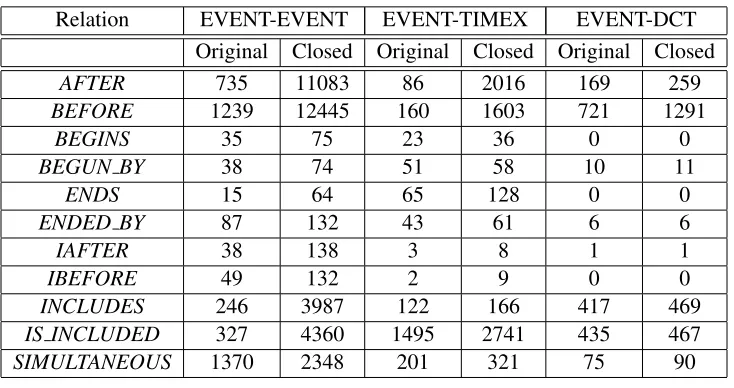
As a preparation step, fourteen relations are merged into eleven relations (TimeML relations). SIMULTANEOUS, IDENTITY, DURING, and DU-RUNG BY relations are identical in relative order between entities. Therfore, the relations are inte-grated into SIMULTANEOUS1. Then, closure algo-rithm is run on the documents to increase the num-ber of TLINKs. The distribution of relations of three types is given in Table 1.
A document with merged relations is divided into four documents with endpoint relations: start of an-chor and start of target, start of anan-chor and end of target, end of anchor and start of target, and end of anchor and end of target documents. The conversion table of a TimeML relation into four endpoint rela-tions is given in Table 2 and the distribution of three relations after the conversion is given in 3.
4 Relation identification with end points
In endpoint relation identification experiment, sup-port vector machine (SVM) and maximum entropy classifiers are built to classify three relations: be-fore, equal, and after. First, feature vectors are constructed. When four endpoint links are from a TLINK, their feature vectors are identical except tar-get endpoint relations.
1
Mani et al. (2006) said DURING was merged into IS INCLUSED. However, DURING, SIMULTANEOUS, and IDENTITY are converted into = of Allen’s relations in
Relation EVENT-EVENT EVENT-TIMEX EVENT-DCT Original Closed Original Closed Original Closed
AFTER 735 11083 86 2016 169 259
BEFORE 1239 12445 160 1603 721 1291
BEGINS 35 75 23 36 0 0
BEGUN BY 38 74 51 58 10 11
ENDS 15 64 65 128 0 0
ENDED BY 87 132 43 61 6 6
IAFTER 38 138 3 8 1 1
IBEFORE 49 132 2 9 0 0
INCLUDES 246 3987 122 166 417 469
IS INCLUDED 327 4360 1495 2741 435 467
[image:3.612.124.491.94.288.2]SIMULTANEOUS 1370 2348 201 321 75 90
Table 1: Distribution of TimeML relations
TimeML Relation Inverse Endpoint Relations
xBEFOREy yAFTERx x− < y−,x−< y+,
x+< y−,x+< y+ xSIMULTANEOUSy ySIMULTANEOUSx x− =y−,x−< y+,
x+> y−,x+=y+ xIBEFOREy yIAFTERx x− < y−,x−< y+,
x+=y−,x+< y+ xBEGINSy yBEGUN BYx x− =y−,x−< y+,
x+> y−,x+< y+ xENDSy yENDED BYx x− > y−,x−< y+,
x+> y−,x+=y+ xINCLUDESy yIS INCLUDEDx x− < y−,x−< y+,
x+> y−,x+> y+
Table 2: Relation conversion table
End pairs EVENT-EVENT EVENT-TIMEX EVENT-DCT
before equal after before equal after before equal after
start-start 1621 (39%) 1443 (35%) 1115 (27%) 327 (15%) 275 (12%) 1649 (73%) 1144 (62%) 85 (5%) 605 (33%)
start-end 3406 (82%) 38 (1%) 735 (18%) 2162 (96%) 3 86 (4%) 1664 (91%) 1 169 (9%)
end-start 1239 (30%) 49 (1%) 2891 (69%) 160 (7%) 2 2089 (93%) 721 (39%) 0 1113 (61%)
[image:3.612.72.553.613.676.2]end-end 1650 (39%) 1472 (35%) 1057 (25%) 1680 (75%) 309 (14%) 262 (12%) 1156 (63%) 81 (4%) 597 (33%)
10-fold cross validation is applied at document-level. In some previous studies, all temporal links were collected into a set and the set was split into training and test data without the distinction on sources. However, the approach could boost system performance as shown in Tatu and Srikanth (2008).
When TLINKs in a file are split in training and test data, links in training data can be composed of similar words in test data. In that case, the links in training can play a role of background knowledge. Therefore, document-level 10-fold cross validation is exploited.
4.1 Features
In constructing feature vectors of three TLINK types, features that were used in order to identify TimeML relations in previous studies are adopted. The features have been proved useful in identifying a TimeML relation in the studies. Moreover, the fea-tures still seem helpful for endpoint relation identifi-cation task. For example,pastandpresenttenses of two EVENTs could be a clue to make a prediction that present tensed EVENT is probably after past tensed EVENT.
Annotated information of EVENT and TIMEX in the temporal corpora is used in the feature vector construction. This proposed approach to use end-point conversion in relation identification task is the first attempt. Therefore, the annotated values are used as features in order to see the effect of this ap-proach. However, state-of-the-arts natural language processing programs such as Charniak parser and Porter Stemmer are sometimes used to extract ad-ditional features such as stems of event words, the existence of both entities in the same phrase, and etc.
The company hasreported declinesin op-erating profit inthe past three years
Features for EVENT TENSE, ASPECT,
MODAL, POS, and CLASS annotations are bor-rowed from temporal corpora as features. And, a stem of an EVENT word is added as a feature instead of a word itself in order to normalize it. reported is represented as <(TENSE:present), (ASPECT:perferce), (MODAL:none), (POS: verb), (CLASS: reporting), (STEM:report)>.
Features for TIMEXIn the extraction of TIMEX features, it tries to capture if specific words are in a time expression to normalize temporal expressions. The time point of an expression can be inferred through the specific words such asago, coming, cur-rent, earlierand etc. Additionally, the existence of plural words such asseconds, minutes, hours, days, months,andyearsis added as a feature. The specific words are:
• ago, coming, current, currently, earlier, early, every, following, future, last, later, latest, next, now, once, past, previously, recent, recently, soon, that, the, then, these, this, today, tomor-row, within, yesterday,andyet
the past three yearsare represented as<(AGO:0), (COMING:0), (CURRENT:0), (CURRENTLY:0), (EARLIER:0), (EARLY:0), (EVERY:0), (FOL-LOWING:0), (FUTURE:0), (LAST:1), (LATER:0), (LASTED:0), (NEXT:0), (NOW:0), (ONCE:0), (PAST:1), (PREVIOUSLY:0), (RECENT:0), (RE-CENTLY:0), (SOON:0), (THAT:0), (THE:1), (THEN:0), (THESE:0), (THIS:0), (TODAY:0), (TOMORRWO:0), (WITHIN:0), (YESTERDAY:0), (YET:0), (PLURAL:1)>.
• after, as, at, before, between, by, during, for, in, once, on, over, since, then, through, throughout, until, when,andwhile
EE and ET types have feature vectors that consist of features of both entities and relational features. ED type has only features of EVENT.
5 Restoration of original relations
Four endpoint relations of a TLINK are classified in the previous section. The combination of the clas-sified relations needs to be restored into a relation among the eleven merged TimeML relations. How-ever, due to the independence of four classifiers, it is not guaranteed that a TimeML relation can be gener-ated from four endpoint relations. When the restora-tion fails, the existence of errors in the four predic-tions is implied. In this step, two methods to restore a TimeML relation are investigated: Minimum Edit Distance (MED) and Highest Score (HS).
MED checks how many substitutions are needed to restore a TimeML relation. A TimeML relation with the minimum changes is defined as the restored relation. Let’s suppose four endpoint relations are given such as x− before y−, x− after y+, x+ be-forey−, and x+ before y+. Among other possible ways to get a TimeML relation,BEFOREcould be recovered with a change of before in x− after y+
intobefore. Therefore,BEFORE is chosen as a re-stored TimeML relation. When several candidates are available, a method is examined in selecting one. The method is to give weight on classifiers that show better performance. If two candidates are available by changing beforeof start-start or before of start-end in ET type, this method selects a candidate by changingbeforewhenbeforeof start-end shows bet-ter performance.
HS uses the sum of confidence scores from clas-sifiers. Each classifier of the four endpoint pairs generates confidence scores of three relations ( be-fore, equal, and after). Among 81 possible com-binations of four classifiers with three target rela-tions, the highest-scored one that can be restored into a TimeML relation is chosen as a prediction. When several candidates exist, the selection method of MED is also adopted.
6 Expectations and future plans
First, I will show how beneficial four endpoint systems are at identifying endpoint relations. F-measure will be used to show the performance of an endpoint relation classifier in identifying each end-point relation. And, accuracy is used to report over-all performance of the classifier. Second, I will show how effective the endpoint method is in identifying TLINK relations. I will build a base classifier with eleven TimeML relations and feature vectors that are identical with the endpoint systems. The perfor-mance difference in identifying TimeML relations between this proposed system and the base system will be presented to show whether this proposed ap-proach is successful.
Previous research such as Verhagen et al. (2007) using three reltions as target relations showed from 60% to 80% performance according to TLINK types. Moreover, some distributions of endpoint re-lations show over 90% such as before of end-start in ET and ED TLINKs, andafterof end-start in ET TLINK in Table 3. Therefore, we can expect each endpoint identification system will perform well in classifying endpoint relations.
The success of this new approach will depend on the restoration step. The excessively skewed dis-tributions can make similar predicted sequences of endpoint relations. It can weaken the advantage of this endpoint approach that every TimeML relation can be generated through combining endpoint rela-tions. For example, equal shows very small dis-tributions in start-end and end-start endpoint pairs. Therefore, it is probable that TimeML relations such asIAFTERandIBEFOREcannot be classified cor-rectly. It can be a challenge how to correctly classify endpoint relations with small distribution.
References
James Allen. 1983. Maintaining knowledge about tem-poral intervals. Communications of the Association for Computing Machinery, 26(1):832–843.
Branimir Boguraev and Rie Kubota Ando. 2005. TimeML-compliant text analysis for temporal reason-ing. In Proceedings of the 2005 International Joint Conference on Artificial Intelligence, pages 997–1003. Philip Bramsen, Pawan Deshpande, Yoong Keok Lee, and Regina Barzilay. 2006. Inducing temporal graphs. In Proceedings of the 2006 Conference on Empirical Methods on Natural Language Processing, pages 189– 198.
Nathanael Chambers and Dan Jurafsky. 2008. Jointly combining implicit constraints improves temporal or-dering. In EMNLP ’08: Proceedings of the Confer-ence on Empirical Methods in Natural Language Pro-cessing, pages 698–706, Morristown, NJ, USA. Asso-ciation for Computational Linguistics.
Nathanael Chambers, Shan Wang, and Dan Jurafsky. 2007. Classifying temporal relations between events. InProceedings of 45th Annual Meeting of the Associ-ation for ComputAssoci-ational Linguistics, pages 173–176. Inderjeet Mani, Marc Verhagen, Ben Wellner, Chong Min
Lee, and James Pustejovsky. 2006. Machine learning of temporal relations. InProceedings of the 21st In-ternational Conference on Computational Linguistics and 44th Annual Meeting of the Association for Com-putational Linguistics.
Inderjeet Mani, Ben Wellner, Marc Verhagen, and James Pustejovsky. 2007. Three approaches to learning tlinks in timeml. Technical Report CS-07-268, Bran-deis University, Waltham, MA, USA.
James Pustejovsky, Jose Castao, Robert Ingria, Roser Saur, Robert Gaizauskas, and Andrea Setzer. 2003a. TimeML: robust specification of event and temporal expressions in text. In IWCS-5 Fifth International Workshop on Computational Semantics.
James Pustejovsky, Patrick Hanks, Roser Saur, Andrew See, David Day, Lisa Ferro, Robert Gaizauskas, Mar-cia Lazo, Andrea Setzer, and Beth Sundheim. 2003b. The TimeBank corpus. InProceedings of Corpus Lin-guistics 2003, pages 647–656, Lancaster, UK. Marta Tatu and Munirathnam Srikanth. 2008.
Experi-ments with reasoning for temporal relations between events. InCOLING ’08: Proceedings of the 22nd In-ternational Conference on Computational Linguistics, pages 857–864, Morristown, NJ, USA. Association for Computational Linguistics.
Marc Verhagen, Inderjeet Mani, Roser Sauri, Robert Knippen, Seok Bae Jang, Jessica Littman, Anna Rumshisky, John Phillips, and James Pustejovsky. 2005. Automating temporal annotation with tarsqi. In
ACL ’05: Proceedings of the ACL 2005 on Interac-tive poster and demonstration sessions, pages 81–84, Morristown, NJ, USA. Association for Computational Linguistics.