Incremental Non-Projective Dependency Parsing
Joakim Nivre
V¨axj¨o University, School of Mathematics and Systems Engineering Uppsala University, Department of Linguistics and Philology
joakim.nivre@{msi.vxu.se,lingfil.uu.se}
Abstract
An open issue in data-driven dependency parsing is how to handle non-projective dependencies, which seem to be required by linguistically adequate representations, but which pose problems in parsing with respect to both accuracy and efficiency. Using data from five different languages, we evaluate an incremental deterministic parser that derives non-projective depen-dency structures inO(n2)time, supported
by SVM classifiers for predicting the next parser action. The experiments show that unrestricted non-projective parsing gives a significant improvement in accuracy, compared to a strictly projective baseline, with up to 35% error reduction, leading to state-of-the-art results for the given data sets. Moreover, by restricting the class of permissible structures to limited degrees of non-projectivity, the parsing time can be reduced by up to 50% without a significant decrease in accuracy.
1 Introduction
Data-driven dependency parsing has been shown to give accurate and efficient parsing for a wide range of languages, such as Japanese (Kudo and Mat-sumoto, 2002), English (Yamada and MatMat-sumoto, 2003), Swedish (Nivre et al., 2004), Chinese (Cheng et al., 2004), and Czech (McDonald et al., 2005).
Whereas most of the early approaches were limited to strictly projective dependency structures, where the projection of a syntactic head must be contin-uous, attention has recently shifted to the analysis ofnon-projectivestructures, which are required for linguistically adequate representations, especially in languages with free or flexible word order.
The most popular strategy for capturing non-projective structures in data-driven dependency parsing is to apply some kind of post-processing to the output of a strictly projective dependency parser, as inpseudo-projective parsing(Nivre and Nilsson, 2005),corrective modeling(Hall and Nov´ak, 2005), or approximate non-projective parsing (McDonald and Pereira, 2006). And it is rare to find parsers that derive non-projective structures directly, the no-table exception being the non-projective spanning tree parser proposed by McDonald et al. (2005).
There are essentially two arguments that have been advanced against using parsing algorithms that derive non-projective dependency structures di-rectly. The first is that the added expressivity com-promises efficiency, since the parsing problem for a grammar that allows arbitrary non-projective depen-dency structures has been shown to beN Pcomplete (Neuhaus and Br¨oker, 1997). On the other hand, most data-driven approaches do not rely on gram-mars, and with a suitable factorization of depen-dency structures, it is possible to achieve parsing of unrestricted non-projective structures inO(n2)time, as shown by McDonald et al. (2005).
The second argument against non-projective de-pendency parsing comes from the observation that, even in languages with free or flexible word order,
most dependency structures are either projective or very nearly projective. This can be seen by con-sidering data from treebanks, such as the Prague Dependency Treebank of Czech (B¨ohmov´a et al., 2003), the TIGER Treebank of German (Brants et al., 2002), or the Slovene Dependency Treebank (Dˇzeroski et al., 2006), where the overall proportion of non-projective dependencies is only about 2% even though the proportion of sentences that con-tain some non-projective dependency is as high as 25%. This means that an approach that starts by de-riving the best projective approximation of the cor-rect dependency structure is likely to achieve high accuracy, while an approach that instead attempts to search the complete space of non-projective de-pendency structures runs the risk of finding struc-tures that depart too much from the near-projective norm. Again, however, the results of McDonald et al. (2005) suggest that the latter risk is minimized if inductive learning is used to guide the search.
One way of improving efficiency, and potentially also accuracy, in non-projective dependency parsing is to restrict the search to a subclass of “mildly non-projective” structures. Nivre (2006) definesdegrees of non-projectivity in terms of the maximum number of intervening constituents in the projection of a syn-tactic head and shows that limited degrees of non-projectivity give a much better fit with the linguistic data than strict projectivity, but also enables more ef-ficient processing than unrestricted non-projectivity. However, the results presented by Nivre (2006) are all based on oracle parsing, which means that they only provide upper bounds on the accuracy that can be achieved.
In this paper, we investigate to what extent con-straints on non-projective structures can improve accuracy and efficiency in practical parsing, using treebank-induced classifiers to predict the actions of a deterministic incremental parser. The parsing al-gorithm used belongs to the family of alal-gorithms de-scribed by Covington (2001), and the classifiers are trained using support vector machines (SVM) (Vap-nik, 1995). The system is evaluated using treebank data from five languages: Danish, Dutch, German, Portuguese, and Slovene.
The paper is structured as follows. Section 2 defines syntactic representations as labeled depen-dency graphs and introduces the notion of degree
used to constrain the search. Section 3 describes the parsing algorithm, including modifications neces-sary to handle degrees of non-projectivity, and sec-tion 4 describes the data-driven predicsec-tion of parser actions, using history-based models and SVM clas-sifiers. Section 5 presents the experimental setup, section 6 discusses the experimental results, and sec-tion 7 contains our conclusions.
2 Dependency Graphs
A dependency graph is a labeled directed graph, the nodes of which are indices corresponding to the to-kens of a sentence. Formally:
Definition 1 Given a set R of dependency types (arc labels), a dependency graph for a sentence
x = (w1, . . . , wn) is a labeled directed graphG =
(V, E, L), where:
1. V ={0,1,2, . . . , n}
2. E⊆V ×V
3. L:E →R
The set V ofnodes (or vertices) is the set of non-negative integers up to and includingn. This means that every token index i of the sentence is a node (1≤i≤n) and that there is a special node0, which will always be a root of the dependency graph. The set E of arcs (or edges) is a set of ordered pairs (i, j), whereiandjare nodes. Since arcs are used to represent dependency relations, we will say thati
is theheadandj is thedependent of the arc(i, j). The function L assigns a dependency type (label)
r ∈ R to every arc e ∈ E. We use the notation
i→ jto mean that there is an arc connectingiand
j (i.e., (i, j) ∈ E); we use the notation i →r j if this arc is labeledr (i.e., ((i, j), r) ∈ L); and we use the notationi→∗ jandi↔∗jfor the reflexive
and transitive closure of the arc relation E and the corresponding undirected relation, respectively.
Definition 2 A dependency graphGiswell-formed if and only if:
1. The node 0 is a root, i.e., there is no nodeisuch thati→0(ROOT).
2. Gis weakly connected, i.e.,i ↔∗ j for every pair of nodesi,j(CONNECTEDNESS).
3. Every node has at most one head, i.e., ifi→j
then there is no node k such that k 6= iand
(“Only one of them concerns quality.”)
0 1
R Z (Out-of
?
AuxP
2 P nich them
?
Atr
3 VB
je is
?
Pred
4 T jen only
?
AuxZ
5 C jedna one-FEM-SG
?
Sb
6 R na to
?
AuxP
7 N4 kvalitu quality
?
Adv
8 Z:
. .)
?
[image:3.612.114.491.55.199.2]AuxZ
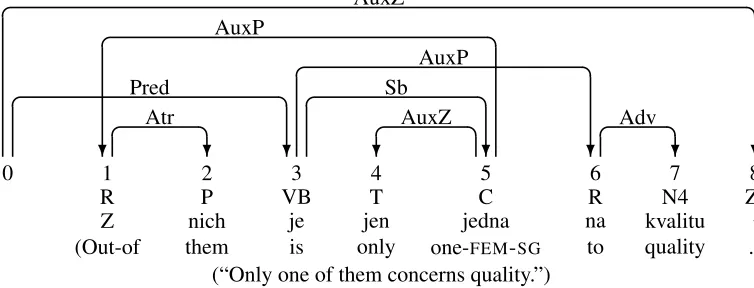
Figure 1: Dependency graph for Czech sentence from the Prague Dependency Treebank
The well-formedness conditions are independent in that none of them is entailed by any (combination) of the others, but they jointly entail that the graph is a tree rooted at the node 0. By way of example, figure 1 shows a Czech sentence from the Prague Dependency Treebank (B¨ohmov´a et al., 2003) with a well-formed dependency graph according to Defi-nitions 1 and 2.
The constraints imposed on dependency graphs in Definition 2 are assumed in almost all versions of dependency grammar, especially in computational systems, and are sometimes complemented by a fourth constraint:
4. The graph Gis projective, i.e., if i → j then
i→∗ k, for every nodeksuch thati < k < j
orj < k < i(PROJECTIVITY).
Most theoretical formulations of dependency gram-mar regard projectivity as the norm but recognize the need for non-projective representations to cap-ture non-local dependencies (Mel’ˇcuk, 1988; Hud-son, 1990). Finding a way of incorporating a suit-ably restricted notion of non-projectivity into prac-tical parsing systems is therefore an important step towards a more adequate syntactic analysis, as dis-cussed in the introduction of this paper.
In order to distinguish classes of dependency graphs that fall in between arbitrary non-projective and projective, Nivre (2006) introduces a notion of degree of non-projectivity, such that projective graphs have degree 0 while arbitrary non-projective graphs have unbounded degree.
Definition 3 LetG = (V, E, L)be a well-formed dependency graph, let G(i,j) be the subgraph ofG
defined by V(i,j) = {i, i+ 1, . . . , j−1, j}, and let
min(e) be the smallest andmax(e) the largest ele-ment of an arcein the linear order<:
1. Thedegree of an arc e ∈ E is the number of connected components (i.e., weakly connected subgraphs) inG(min(e)+1,max(e)−1)that are not
dominated by the head ofeinG(min(e),max(e)).
2. ThedegreeofGis the maximum degree of any arce∈E.
To exemplify the notion of degree, we note that the dependency graph in figure 1 has degree1. The only non-projective arc in the graph is(5,1)andG(2,4)
contains three connected components, each consist-ing of a sconsist-ingle root node (2, 3, 4). Since exactly one of these, 3, is not dominated by 5 inG(1,5), the arc (5,1)has degree 1.
Nivre (2006) presents an empirical study, based on data from the Prague Dependency Treebank of Czech (B¨ohmov´a et al., 2003) and the Danish De-pendency Treebank (Kromann, 2003), showing that more than 99.5% of all sentences occurring in the two treebanks have a dependency graph with a max-imum degree of 2; about 98% have a maxmax-imum de-gree of 1; but only 77% in the Czech data and 85% in the Danish data have degree 0 (which is equivalent to assuming PROJECTIVITY). This suggests that lim-ited degrees of non-projectivity may allow a parser to capture a larger class of naturally occurring syn-tactic structures, while still constraining the search to a proper subclass of all possible structures.1
1
3 Parsing Algorithm
Covington (2001) describes a parsing strategy for dependency representations that has been known since the 1960s but not presented in the literature. The left-to-right (or incremental) version of this strategy can be formulated in the following way:
PARSE(x= (w1, . . . , wn))
1 forj = 1up ton
2 fori=j−1down to0 3 LINK(i,j)
LINK(i,j) is a nondeterministic operation that adds the arci→j(with some label), adds the arcj → i
(with some label), or does nothing at all. In this way, the algorithm builds a graph by systematically trying to link every pair of nodes (i, j) (i < j). We assume that LINK(i,j) respects the ROOT and
SINGLE-HEADconstraints and that it does not in-troduce cycles into the graph, i.e., it adds an arc
i → j only if j 6= 0, there is nok 6= isuch that
k → j, and it is not the case that j →∗ i. Given
these constraints, the graphGgiven at termination can always be turned into a well-formed dependency graph by adding arcs from the root 0 to any root node in{1, . . . , n}.
Assuming that LINK(i, j) can be performed in some constant time c, the running time of the al-gorithm is Pn
i=1c(i−1) = c(n
2
2 −
n
2), which in
terms of asymptotic complexity isO(n2). Checking ROOTand SINGLE-HEADin constant time is easy, but in order to prevent cycles we need to be able to find, for any node k, the root of the connected component to whichkbelongs in the partially built graph. This problem can be solved efficiently us-ing standard techniques for disjoint sets, includus-ing path compression and union by rank, which guaran-tee that the necessary checks can be performed in average constant time (Cormen et al., 1990).
In the experiments reported in this paper, we mod-ify the basic algorithm by making the performance of LINK(i,j) conditional on the arcs(i, j)and(j, i) being permissible under different degree constraints:
PARSE(x= (w1, . . . , wn),d)
1 forj = 1up ton
2 fori=j−1down to0 3 ifPERMISSIBLE(i,j,d) 4 LINK(i,j)
The function PERMISSIBLE(i, j, d) returnstrue if
and only if i → j andj → i have a degree less than or equal todgiven the partially built graphG. Settingd= 0gives strictly projective parsing, while
d = ∞ corresponds to unrestricted non-projective parsing. With low values ofd, we will reduce the number of calls to LINK(i, j), which will reduce the overall parsing time provided that the time re-quired to compute PERMISSIBLE(i, j, d)is insignif-icant compared to the time needed for LINK(i, j). This is typically the case in data-driven systems, where LINK(i, j)requires a call to a trained classi-fier, while PERMISSIBLE(i, j, d) only needs access to the partially built graphG.2
4 History-Based Parsing
History-based parsing uses features of the parsing history to predict the next parser action (Black et al., 1992). In the current setup, this involves using fea-tures of the partially built dependency graphGand the inputx = (w1, . . . , wn) to predict the outcome
of the nondeterministic LINK(i, j)operation. Given that we use a deterministic parsing strategy, this re-duces to a pure classification problem.
Let Φ(i, j, G) = (φ1,. . . ,φm) be a feature
vec-tor representation of the parser hisvec-tory at the time of performing LINK(i, j). The task of the history-based classifier is then to map Φ(i, j, G) to one of the following actions:
1. Add the arci→r j(for somer∈R).
2. Add the arcj→r i(for somer∈R). 3. Do nothing.
Training data for the classifier can be generated by running the parser on a sample of treebank data, us-ing the gold standard dependency graph as an ora-cle to predict LINK(i, j)and constructing one
train-ing instance(Φ(i, j, G), a)for each performance of LINK(i, j)with outcomea.
The features in Φ(i, j, G) = (φ1, . . . , φm) can
be arbitrary features of the inputxand the partially built graphGbut will in the experiments below be restricted to linguistic attributes of input tokens, in-cluding their dependency types according toG.
2
Language Tok Sen T/S Lem CPoS PoS MSF Dep NPT NPS
Danish 94 5.2 18.2 no 10 24 47 52 1.0 15.6
Dutch 195 13.3 14.6 yes 13 302 81 26 5.4 36.4
German 700 39.2 17.8 no 52 52 0 46 2.3 27.8
Portuguese 207 9.1 22.8 yes 15 21 146 55 1.3 18.9
[image:5.612.112.500.61.144.2]Slovene 29 1.5 18.7 yes 11 28 51 25 1.9 22.2
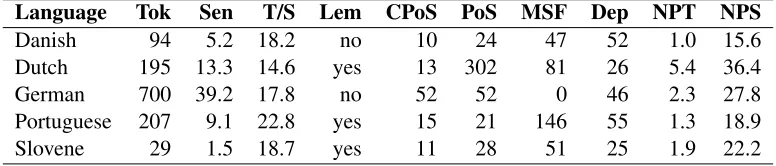
Table 1: Data sets; Tok = number of tokens (*1000); Sen = number of sentences (*1000); T/S = tokens per sentence (mean); Lem = lemmatization present; CPoS = number of coarse-grained part-of-speech tags; PoS = number of (fine-grained) part-of-speech tags; MSF = number of morphosyntactic features (split into atoms); Dep = number of dependency types; NPT = proportion of non-projective dependencies/tokens (%); NPS = proportion of non-projective dependency graphs/sentences (%)
The history-based classifier can be trained with any of the available supervised methods for func-tion approximafunc-tion, but in the experiments below we will rely on SVM, which has previously shown good performance for this kind of task (Kudo and Mat-sumoto, 2002; Yamada and MatMat-sumoto, 2003).
5 Experimental Setup
The purpose of the experiments is twofold. First, we want to investigate whether allowing non-projective structures to be derived incrementally can improve parsing accuracy compared to a strictly projective baseline. Secondly, we want to examine whether restricting the degree of non-projectivity can im-prove efficiency compared to an unrestricted non-projective baseline. In order to investigate both these issues, we have trained one non-projective parser for each language, allowing arbitrary non-projective structures as found in the treebanks during training, but applying different constraints during parsing:
1. Non-projective (d=∞) 2. Max degree 2 (d= 2) 3. Max degree 1 (d= 1)
These three versions of the non-projective parser are compared to a strictly projective parser (d = 0), which uses the same parsing algorithm but only con-siders projective arcs in both training and testing.3
The experiments are based on treebank data from five languages: the Danish Dependency Treebank
3
An alternative would have been to train all parsers on non-projective data, or restrict the training data for each parser according to its parsing restriction. Preliminary experiments showed that the setup used here gave the best performance for all parsers involved.
(Kromann, 2003), the Alpino Treebank of Dutch (van der Beek et al., 2002), the TIGER Treebank of German (Brants et al., 2002), the Floresta Sint´actica of Portuguese (Afonso et al., 2002), and the Slovene Dependency Treebank (Dˇzeroski et al., 2006).4 The data sets used are the training sets from the CoNLL-X Shared Task on multilingual dependency parsing (Buchholz and Marsi, 2006), with 20% of the data reserved for testing using a pseudo-random split. Ta-ble 1 gives an overview of the five data sets, showing the number of tokens and sentences, the presence of different kinds of linguistic annotation, and the amount of non-projectivity.
The features used in the history-based model for all languages include the following core set of 20 features, where i andj are the tokens about to be linked and thecontext stackis a stack of root nodes
kinG(i+1,j−1), added from right to left (i.e., with
the top node being closest toi):
1. Word form:i,j,j+1,h(i). 2. Lemma (if available):i.
3. Part-of-speech:i−1,i,j,j+1,j+2,k,k−1. 4. Coarse part-of-speech (if available):i,j,k. 5. Morphosyntactic features (if available):i,j. 6. Dependency type:i,j,l(i),l(j),r(i).
In the specification of features, we usekandk−1to refer to the two topmost tokens on the context stack, and we useh(α),l(α)andr(α)to refer to thehead,
4
Danish Dutch German Portuguese Slovene
Constraint AS ER AS ER AS ER AS ER AS ER
Non-projective 88.13 8.34 86.79 36.18 89.78 21.51 90.59 11.39 76.52 6.83 Max degree 2 88.08 7.95 86.15 33.09 89.74 21.20 90.58 11.30 76.48 6.67 Max degree 1 88.00 7.33 85.12 28.12 89.49 19.28 90.48 10.36 76.40 6.35
[image:6.612.90.524.61.143.2]Projective 87.05 – 79.30 – 86.98 – 89.38 – 74.80 –
Table 2: Parsing accuracy; AS = attachment score; ER = error reduction w.r.t. projective baseline (%)
theleftmost dependentand therightmost dependent of a tokenαin the partially built dependency graph.5 In addition to the core set of features, the model for each language has been augmented with a small number of additional features, which have proven useful in previous experiments with the same data set. The maximum number of features used is 28 (Danish); the minimum number is 23 (German).
The history-based classifiers have been trained using SVM learning, which combines a maximum margin strategy with the use of kernel functions to map the original feature space to a higher-dimensional space. More specifically, we use LIB-SVM (Chang and Lin, 2001) with a quadratic kernel
K(xi, xj) = (γxTi xj+r)2. We use the built-in
one-versus-one strategy for multi-class classification and convert symbolic features to numerical features us-ing the standard technique of binarization.
Parsing accuracy is measured by the unlabeled at-tachment score (AS), i.e., the proportion of words that are assigned the correct head (not counting punctuation). Although the parsers do derivelabeled dependency graphs, we concentrate on the graph structure here, since this is what is concerned in the distinction between projective and non-projective dependency graphs. Efficiency is evaluated by re-porting the parsing time (PT), i.e., the time required to parse the respective test sets. Since both training sets and test sets vary considerably in size between languages, we are primarily interested in the rela-tive differences for parsers applied to the same lan-guage. Experiments have been performed on a Sun-Blade 2000 with one 1.2GHz UltraSPARC-III pro-cessor and 2GB of memory.
5
The lack of symmetry in the feature set reflects the asym-metry in the partially built graphG, where, e.g., onlyican have dependents to the right at decision time. This explains why there are more features defined in terms of graph structure foriand more features defined in terms of string context forj.
6 Results and Discussion
Table 2 shows the parsing accuracy of the non-projective parser with different maximum degrees, both the raw attachment scores and the amount of error reduction with respect to the baseline parser. Our first observation is that the non-projective parser invariably achieves higher accuracy than the pro-jective baseline, with differences that are statisti-cally significant across the board (using McNemar’s test). The amount of error reduction varies be-tween languages and seems to depend primarily on the frequency of non-projective structures, which is not surprising. Thus, for Dutch and German, the two languages with the highest proportion of non-projective structures, the best error reduction is over 35% and over 20%, respectively. However, there seems to be a sparse data effect in that Slovene, which has the smallest training data set, has the smallest error reduction despite having more non-projective structures than Danish and Portuguese.
Our second observation is that the highest score is always obtained with an unbounded degree of non-projectivity during parsing. This seems to corrobo-rate the results obtained by McDonald et al. (2005) with a different parsing method, showing that the use of inductive learning to guide the search dur-ing parsdur-ing eliminates the potentially harmful ef-fect of increasing the size of the search space. Al-though the differences between different degrees of non-projectivity are not statistically significant for the current data sets,6 the remarkable consistency across languages suggests that they are nevertheless genuine. In either case, however, they must be con-sidered marginal, except possibly for Dutch, which leads to our third and final observation about
accu-6
Danish Dutch German Portuguese Slovene
Constraint PT TR PT TR PT TR PT TR PT TR
Non-projective 426 – 3791 – 24454 – 3708 – 204 –
[image:7.612.88.526.61.143.2]Max degree 2 395 7.29 2068 45.46 17903 26.79 3004 18.99 130 36.39 Max degree 1 346 18.72 1695 55.28 13079 46.52 2446 34.04 108 47.05 Projective 211 50.53 784 79.32 7362 69.90 1389 62.55 429 79.00
Table 3: Parsing time; PT = parsing time (s); TR = time reduction w.r.t. non-projective baseline (%)
System Danish Dutch German Portuguese Slovene
CoNLL-X McDonald et al. 84.79 79.19 87.34 86.82 73.44 CoNLL-X Nivre et al. 84.77 78.59 85.82 87.60 70.30 Incremental non-projective 84.85 77.91 85.90 87.12 70.86
Table 4: Related work (labeled attachment score)
racy, namely that restricting the maximum degree of non-projectivity to 2 or 1 has a very marginal effect on accuracy and is always significantly better than the projective baseline.
Turning next to efficiency, table 3 shows the pars-ing time for the different parsers across the five lan-guages. Our first observation here is that the pars-ing time can be reduced by restrictpars-ing the degree of non-projectivity during parsing, thus corroborat-ing the claim that the runncorroborat-ing time of the history-based classifier dominates the overall parsing time. As expected, the largest reduction is obtained with the strictly projective parser, but here we must also take into account that the training data set is smaller (because of the restriction to projective potential links), which improves the average running time of the history-based classifier in itself. Our second ob-servation is that the amount of reduction in parsing time seems to be roughly related to the amount of non-projectivity, with a reduction of about 50% at a max degree of 1 for the languages where more than 20% of all sentences are non-projective (Dutch, German, Slovene) but significantly smaller for Por-tuguese and especially for Danish. On the whole, however, the reduction in parsing time with limited degrees of non-projectivity is substantial, especially considering the very marginal drop in accuracy.
In order to compare the performance to the state of the art in dependency parsing, we have retrained the non-projective parser on the entire training data set for each language and evaluated it on the final test set from the CoNLL-X shared task (Buchholz
and Marsi, 2006). Thus, table 4 shows labeled at-tachment scores, the main evaluation metric used in the shared task, in comparison to the two highest scoring systems from the original evaluation (Mc-Donald et al., 2006; Nivre et al., 2006). The incre-mental non-projective parser has the best reported score for Danish and outperforms at least one of the other two systems for four languages out of five, although most of the differences are probably too small to be statistically significant. But whereas the spanning tree parser of McDonald et al. (2006) and the pseudo-projective parser of Nivre et al. (2006) achieve this performance only with special pre- or post-processing,7 the approach presented here de-rives a labeled non-projective graph in a single incre-mental process and hence at least has the advantage of simplicity. Moreover, it has better time complex-ity than the approximate second-order spanning tree parsing of McDonald et al. (2006), which has expo-nential complexity in the worst case (although this does not appear to be a problem in practice).
7 Conclusion
In this paper, we have investigated a data-driven ap-proach to dependency parsing that combines a deter-ministic incremental parsing algorithm with history-based SVM classifiers for predicting the next parser action. We have shown that, for languages with a
7
[image:7.612.115.495.176.231.2]non-negligible proportion of non-projective struc-tures, parsing accuracy can be improved signifi-cantly by allowing non-projective structures to be derived. We have also shown that the parsing time can be reduced substantially, with only a marginal loss in accuracy, by limiting the degree of non-projectivity allowed during parsing. A comparison with results from the CoNLL-X shared task shows that the parsing accuracy is comparable to that of the best available systems, which means that incremen-tal non-projective dependency parsing is a viable al-ternative to approaches based on post-processing of projective approximations.
Acknowledgments
The research presented in this paper was partially supported by a grant from the Swedish Research Council. I want to thank Johan Hall and Jens Nils-son for their contributions to MaltParser, which was used to perform the experiments. I am also grateful to three anonymous reviewers for finding important errors in the preliminary version and for suggesting several other improvements for the final version.
References
S. Afonso, E. Bick, R. Haber, and D. Santos. 2002. “Floresta sint´a(c)tica”: a treebank for Portuguese. InProc. of LREC, 1698–1703.
E. Black, F. Jelinek, J. D. Lafferty, D. M. Magerman, R. L. Mer-cer, and S. Roukos. 1992. Towards history-based grammars: Using richer models for probabilistic parsing. InProc. of the DARPA Speech and Natural Language Workshop, 31–37. A. B¨ohmov´a, J. Hajiˇc, E. Hajiˇcov´a, and B. Hladk´a. 2003.
The PDT: a 3-level annotation scenario. In A. Abeill´e, ed.,
Treebanks: Building and Using Parsed Corpora, chapter 7. Kluwer, Dordrecht.
S. Brants, S. Dipper, S. Hansen, W. Lezius, and G. Smith. 2002. The TIGER treebank. InProc. of TLT.
S. Buchholz and E. Marsi. 2006. CoNLL-X shared task on multilingual dependency parsing. InProc. of CoNLL, 149– 164.
C.-C. Chang and C.-J. Lin, 2001. LIBSVM: A Library for Support Vector Machines. Software available at http://www.csie.ntu.edu.tw/ cjlin/libsvm.
Y. Cheng, M. Asahara, and Y. Matsumoto. 2004. Determinis-tic dependency structure analyzer for Chinese. InProc. of IJCNLP, 500–508.
T. H. Cormen, C. E. Leiserson, and R. L. Rivest. 1990. Intro-duction to Algorithms. MIT Press.
M. A. Covington. 2001. A fundamental algorithm for depen-dency parsing. InProc. of the Annual ACM Southeast Con-ference, 95–102.
S. Dˇzeroski, T. Erjavec, N. Ledinek, P. Pajas, Z. ˇZabokrtsky, and A. ˇZele. 2006. Towards a Slovene dependency treebank. In
Proc. of LREC.
Keith Hall and Vaclav Nov´ak. 2005. Corrective modeling for non-projective dependency parsing. InProc. of IWPT, 42– 52
R. A. Hudson. 1990.English Word Grammar. Blackwell. M. T. Kromann. 2003. The Danish dependency treebank and
the underlying linguistic theory. InProc. of TLT.
T. Kudo and Y. Matsumoto. 2002. Japanese dependency analy-sis using cascaded chunking. InProc. of CoNLL, 63–69. M. Kuhlmann and J. Nivre. 2006. Mildly non-projective
de-pendency structures. In Proc. of COLING-ACL, Posters, 507–514.
R. McDonald and F-. Pereira. 2006. Online learning of approx-imate dependency parsing algorithms. InProc. of EACL, 81–88.
R. McDonald, F. Pereira, K. Ribarov, and J. Hajiˇc. 2005. Non-projective dependency parsing using spanning tree al-gorithms. InProc. of HLT-EMNLP, 523–530.
R. McDonald, K. Lerman, and F. Pereira. 2006. Multilingual dependency analysis with a two-stage discriminative parser. InProc. of CoNLL, 216–220.
I. Mel’ˇcuk. 1988. Dependency Syntax: Theory and Practice. State University of New York Press.
P. Neuhaus and N. Br¨oker. 1997. The complexity of recog-nition of linguistically adequate dependency grammars. In
Proc. of ACL-EACL, 337–343.
J. Nivre and J. Nilsson. 2005. Pseudo-projective dependency parsing. InProc. of ACL, 99–106.
J. Nivre, J. Hall, and J. Nilsson. 2004. Memory-based depen-dency parsing. InProc. of CoNLL, 49–56.
J. Nivre, J. Hall, J. Nilsson, G. Eryi˘git, and S. Marinov. 2006. Labeled pseudo-projective dependency parsing with support vector machines. InProc. of CoNLL, 221–225.
J. Nivre. 2006. Constraints on non-projective dependency graphs. InProc. of EACL, 73–80.
L. van der Beek, G. Bouma, R. Malouf, and G. van Noord. 2002. The Alpino dependency treebank. InComputational Linguistics in the Netherlands (CLIN).
V. N. Vapnik. 1995.The Nature of Statistical Learning Theory. Springer.