
Exploring the nature of nonconformities : the development of a procedure that classifies construction project nonconformities into risks and non risks
77
0
0
Full text
(2)
(3) Colophon Title:. Exploring the nature of nonconformities. Place and date. Schalkwijk, November 11, 2014. Research period. March 2014 – November 2014. Author. M.J.G. (Chiel) de Wit. Student number. s0165247. E-mail. [email protected]. University. University of Twente. Program. Civil Engineering and Management. Graduation committee Prof. Dr. Ir. J.I.M. (Joop) Halman University of Twente Construction Management & Engineering. Dr. S.H.S. (Saad) Al-Jibouri University of Twente Construction Management & Engineering. Ir. F.J. (Fokke) Huisman BAM Infratechniek Mobiliteit Departement: Process Management. Photo on cover page. Joop van Houdt/Rijkswaterstaat. Educational institution:. Principal institution:. University of Twente. BAM Infraconsult. Faculty of Engineering Technology. Department of RAMS/Risk/SE. Program of Civil Engineering and Management. H.J. Nederhorststraat 1. P.O. Box 217. 2801 SC Gouda. 7500 AE Enschede. www.bam.nl. www.utwente.nl/CTW.
(4)
(5) Preface In January 2014, I was invited at BAM for a first meeting to discuss a possible graduation project. All I knew was that it had something to do with risks. After the meeting, it was clear that the coming eight months would be dedicated to risks and nonconformities. During this eight months I was supported by many people, who I would like to thank by means of this preface. First of all I would like to thank Fokke Huisman, as my daily supervisor from BAM. He was literally always available for questions. His unlimited enthusiasm for risk management gave me the right motivation to work on the topic, and his network within the organisation made it possible that I could quickly reach the right people. Because of that I was even able to reach people who were not even working anymore within the organisation. During this research I got the possibility to critically look at the organisation. This was only possible because of the open attitude of anyone within the organisation. Hence, I would especially like to thank all BAM employees I interviewed, who gave many new insights in my thesis. I also would like to thank Joop Halman and Saad Al-Jibouri, who were my supervisors from the University of Twente. They were able to find and stipulate the limitations of my work and gave me insights how to tackle them. The feedback they provided me from was useful on all levels, from the full picture to the smallest detail. Further, I would like to thank my daily colleagues from the department of RAMS/RISK/SE of BAM Infraconsult and of the department of process management of BAM ITM. Due to their presence I perceived my graduation process as very pleasant. Finally I would like to thank my family and friends for the support during my graduation process. Especially my parents since they welcomed me back home to live at their place during my graduation period. Last but not least: Mimí, thanks for all your correcting works and for being a listening ear. Enjoy the reading, Chiel de Wit. i.
(6)
(7) Summary During construction projects, many nonconformities occur. A nonconformity is a noncompliance of a requirement. Often rework is necessary to correct the nonconformity and ensure that is complied with the requirements. Therefore, these nonconformities increase the costs of construction projects and thus construction contractors often strive to eliminate them. This research was conducted at one of these contractors: BAM Infra. Two problems were identified at contractor BAM. First, BAM developed a risk database in which risk data of finished construction projects is collected to be used as input for future projects. However, risk data of unidentified occurred risks is not included in this database and BAM does not know what unidentified risks occur. Second, BAM strives to eliminate their nonconformities, in order to eliminate nonconformities, insight in the nature of nonconformities is necessary and BAM does not have this insight. While combining both problems, classifying nonconformities into risks and non-risks can contribute to a solution of both problems. It can provide insight into the nature of nonconformities and the nonconformities that are classified as risk can be unidentified risks and included in the database. Therefore, in this research a procedure is developed that determines in a few simple steps whether a nonconformity is a risk or not. The main question of this research is hence: What procedure can be developed in order to classify nonconformities into risk and non-risk? This procedure can be used by many contractors to obtain insight in the nature of nonconformities. Moreover, it can be used by contractors to identify unidentified occurred risks. These risks can be included in a database to be used as input at future projects. In addition, this research contributes to the gap in literature by a new approach to classify nonconformities with a risk management perspective.. Method First, a theoretical procedure was developed using the results of a literature study. This procedure was empirically tested on samples of documented construction project nonconformities. The insights obtained during these tests were used to adjust the procedure, resulting in an empirically tested procedure. This procedure was tested on the nonconformities of four construction projects. Two types of tests were performed, reliability and validity tests. The reliability tests were performed to obtain insight in whether the procedure provides comparable results when performed by two persons of the same nonconformities. The unreliability is considered to be high if the percentage of disagreement is higher than 15%. The reliability tests were performed on a sample of 100 nonconformities of two projects. During the validity tests all documented nonconformities of three projects were analysed, the results were used to obtain the validity of the procedure and determine the results of the procedure. The validity shows whether the results of the procedure are the expected results. Moreover, these tests were used to obtain the results of the procedure.. The procedure The procedure consists of three main steps, which are divided into sub-steps. Figure 1 shows an overview of the procedure and appendix 1 shows the final procedure. The first step determines if a nonconformity is a risk or not and consists of four simple questions that need to be answered for each nonconformity. The second step selects the nonconformities that are risks and concludes if these risks were identified. The third and last step answers the question why the unidentified risks were not-identified in advance. This data can be used to improve the risk identification of future projects. The nonconformities that are non-risks can be. iii.
(8) managed by improving standard processes, while the nonconformities that are risks can be approached through risk management.. Step 1. Step 2. Step 3. Unidentified risk. Reasons for nonidentification. Risk. Risk management. Identified risk. Non-risk. Improving standard processes. Figure 1 Overview procedure. Testing the procedure The reliability results of the second project show an unreliability of the sub-steps of step one between 10% and 34%. When looking at the validity, the nonconformities that are risks are both identified and unidentified risks. The results of the three analysed projects show that the nonconformities that are not risks are on average 85% of the total impact. Eliminating these nonconformities that are no risks can lower the costs of projects by 1,2%. A total amount of 32 unidentified risks were identified out of 2116 nonconformities, of these risks the reasons for non-identification show no patterns.. Conclusions and recommendations It can be concluded that the reliability of the procedure is low, the unreliability is higher than 15% for some of the steps. The unreliability can be explained by the low quality of the data that was used as input. The documented information did not contain clear information of the nonconformities, leaving space for interpretation. If the procedure is implemented, it is recommended to perform the first step of the procedure during the project directly after nonconformity occurred. Additional information is then available, by the responsible person. In contrast, the validity is sufficient. The risks are in fact risks. However, it was not validated whether the non-risks are in fact non-risks. Further research can be performed to test this. The results provide insight into the nature of nonconformities and the nonconformities that are risks can be included in a risk database. Because relatively few unidentified risks were identified it is recommended to perform the procedure at more and different types of projects. For BAM it is recommended to focus on the improvement of standard processes, since the category with the highest impact are these risks. Thus, the developed procedure classifies nonconformities into risks and non-risks. It can be used to provide insight into the nature of nonconformities. It also identifies unidentified risks that can be included in a database. It provides a new approach of classifying nonconformities. In order to successfully implement the procedure within the organisation, it is recommended for BAM to improve the way nonconformities are documented. It was determined during the research that nonconformities were not always documented completely; this could have affected the results of the results. The improvements should therefore result in clear unambiguous descriptions of nonconformities.. iv.
(9) Table of Contents Terminology ..................................................................................................................................... vii 1.. Introduction ............................................................................................................................... 1. 2.. Research design ......................................................................................................................... 5 2.1. Problem definition .................................................................................................................... 5 2.2. Objective ................................................................................................................................... 5 2.3. Scope......................................................................................................................................... 5 2.4. Research questions ................................................................................................................... 6 2.5. Method ..................................................................................................................................... 6. 3.. Theoretical Background............................................................................................................ 11 3.1. Defining nonconformity .......................................................................................................... 11 3.2. Defining unidentified occurred risk ......................................................................................... 13 3.3. Conditions for a nonconformity to be a risk ........................................................................... 20 3.4. Conclusion of background study ............................................................................................. 22. 4.. Empirical procedure ................................................................................................................. 25 4.1. Results interviews ................................................................................................................... 25 4.2. Step one, classification of nonconformities into risks and non-risks ...................................... 26 4.3. Step two, select risks and determine unidentified risks .......................................................... 29 4.4. Step three, reasons for non-identification .............................................................................. 30 4.5. Conclusion of empirical procedure .......................................................................................... 32. 5.. Reliability of the procedure ...................................................................................................... 35 5.1. Results of project 1 ................................................................................................................. 35 5.2. Results of project 2 ................................................................................................................. 36 5.3. Cross case results .................................................................................................................... 38 5.4. Conclusion reliability ............................................................................................................... 39. 6.. Results and validity .................................................................................................................. 41 6.1. Results of project 1 ................................................................................................................. 41 6.2. Results of project 3 ................................................................................................................. 43 6.3. Results of project 4 ................................................................................................................. 45 6.4. Cross case results .................................................................................................................... 47 6.5. Validity discussion and conclusion .......................................................................................... 48 6.6. Discussion and conclusion of the results of the procedure ..................................................... 49. 7.. Discussion ................................................................................................................................ 53. 8.. Conclusion ................................................................................................................................ 55 8.1. Theoretical relevance.............................................................................................................. 55 8.2. Practical relevance .................................................................................................................. 55 8.3. Limitations .............................................................................................................................. 56. 9.. Recommendations ................................................................................................................... 57 9.1. Recommendations for further research .................................................................................. 57 9.2. Recommendations for the organisation ................................................................................. 57. References ....................................................................................................................................... 59 Appendices ...................................................................................................................................... 63. v.
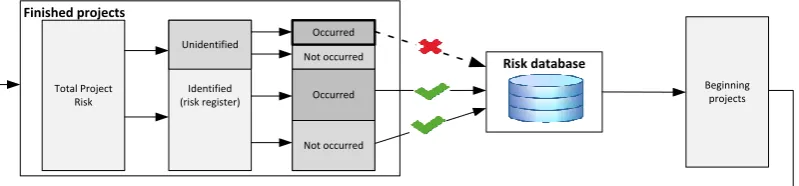
(10)
(11) Terminology The terms below are often used in this research:. Mitigation measure:. Risk mitigation seeks to reduce the probability and/or impact of a risk to below an acceptable threshold (PMI, 2000). Two types of mitigation measures can be distinguished, cause oriented and effect oriented mitigation measures. Cause oriented measures tend to influence the cause of a risk. Effect oriented measures tend to influence the effect of a risk (van Well-Stam, Lindenaar, van Kinderen, & van den Bunt, 2003).. Nonconformity:. A non-compliance of stated, obligatory or generally implied requirements (see §3.1.2).. Non-risk nonconformity:. A nonconformity that is not an occurred risk. It is the result of (wrong) execution of standard processes. It can be managed by improving standard processes.. Quality:. Conformance to specifications (see §3.1.1).. Requirement:. Need or expectation that is stated, generally implied or obligatory (ISO, 2005). A requirement can be defined of a product, process or service (Burati, Farrington, & Ledbetter, 1992).. Risk:. The likelihood for an effect on the project objectives, caused by limited knowledge (non-frequent) within a project. Project risks can have a noninfluenceable or influenceable cause (see §3.2.1).. Risk management:. The systematic process of identifying, analysing, and responding to project risk (PMI, 2000).. Risk nonconformity:. Nonconformity that is an occurred risk. Risk management can be performed to manage them.. Risk register:. Register that contains project specific risk information it contains the identified risks (Cárdenas, Al-Jibouri, Halman, van de Linde, & Kaalberg, 2014). Risk data of individual risks is collected in the risk register. Such as: cause description; effect description; quantification of the risk and probability of occurrence.. Uncertainty:. Variability, where the system/process under attention can react in multiple ways and/or Limited knowledge, which is a property of the analysts performing the study and/or of our state of knowledge (§3.2.1).. Limited knowledge (epistemic uncertainty):. A property of the analysts performing the study and/or of our state of knowledge. Uncertainty based on limited knowledge does not necessarily decrease when more information is acquired. More information can even increase uncertainty since new information can decrease understanding. It can invalidate understandings of systems or processes (Van Asselt & Rotmans, 2002).. Variability (aleatory uncertainty):. The system/process under attention can react in multiple ways. This is also referred to as ‘stochastic uncertainty’ (Helton, 1994, cited in Van Asselt and Rotmans (2002).. Unidentified risk:. A risk that has not been identified, and has not been documented in the project risk register. Those risks can be distinguished in two types, based on their underlying uncertainty: unidentifiable unidentified risks and identifiable unidentified risks (see §3.2.2).. vii.
(12)
(13) 1. Introduction The picture on the front page shows a construction project in its execution phase. During this execution phase often nonconformities occur. For instance, sheet pile leakage. After sheet piles are driven and the pit is excavated it can be discovered that the sheet pile is leaking. This situation, in which a product (sheet pile) is constructed and afterwards it appears that not is fulfilled to a requirement (no leakage), is called a nonconformity. After a nonconformity occurs often rework is necessary to ensure that the final product complies with its requirements. Many of these nonconformities occur during construction projects. In case of the example of the sheet pile, some measures can be taken to stop the leakage. These measures increase the costs of construction projects and therefore construction contractors often strive to eliminate them. BAM is one of the contractors that strive to eliminate nonconformities, this research is performed at BAM. It is a European contractor, which is active in the sectors construction and mechanical and technical services, infrastructure, real estate and public private partnerships. BAM Infra is the Dutch infrastructure contractor of BAM. BAM Infra consists of the infrastructure companies: BAM Civil, BAM Rail, BAM Roads, BAM Infra Technique, BAM Infra Asset Management and BAM Infraconsult. This research is conducted at the department of RAMS/Risk/SE of BAM Infraconsult, which is the engineering company of BAM Infra. The department RAMS/Risk/SE facilitates the risk management of large multidisciplinary projects starting with a turnover of approximately 10 million euro. Van Staveren (2014) states that good risk management results in less nonconformities of safety and quality. Therefore, BAM performs risk management. The risk managers, who facilitate the risk management within BAM Infra, ensure that the risk management process is performed correctly. Risk management is the systematic process of identifying, analysing and responding to risk and its incorporated uncertainties (PMI, 2000). As reported in their annual report of 2013, BAM strives to intensify their risk management practice. Therefore, BAM formulated strategic objectives in their annual report. Two of these objectives are an accurate and complete identification of key opportunities and threats at strategic, tactical and operational levels; and supporting a learning and sharing environment (BAM Group, 2014, p. 17). BAM Infraconsult developed a risk database in order to contribute to these two strategic objectives. In this database, risk data of completed construction projects is collected. Future construction projects can use this information as input for the identification, analysis and mitigation of risks. Figure 2 illustrates that the total project risk consists of identified risk and unidentified risk. Both identified and unidentified risks can occur. The identified risks are included in the database. However, unidentified occurred risks are not included in the database. The unidentified not occurred risks will remain unknown; there is no effect of these risks on the project objectives. However, the unidentified occurred risks can possibly be identified because of their impact on the project objectives. It is therefore important to include these risks in the database. In the current situation it is unknown what these risks are, they are not included to the database and not used as input for the risk management of future construction projects. Consequently, recurrence of the same unidentified occurred risks at future construction projects is possible. However, BAM does not know what these risks are. To prevent the afore mentioned nonconformities from occurring BAM also performs Quality Management. Quality management concerns the optimisation of the quality activities involved in producing a product, process, or service (Burati et al., 1992). An example of a quality management activity is the development and improvement of standard processes within the organisation. Moreover, quality management standard ISO 9001 requires nonconformities to be detected, corrected and prevented from recurrence during the execution phase of a. 1.
(14) 1. construction project. Within BAM the QA/QC manager is responsible for the quality management at construction projects. Unless BAM performs quality management, still nonconformities occur. Although some of these nonconformities have a positive effect on the project objectives (for instance if the client requests to not-conform to a requirement), most of the nonconformities have a negative impact on the project objectives. In order to eliminate these negative nonconformities, insight in the nature of the nonconformities is necessary. Within BAM there is little or no insight of the nature of these nonconformities. An analysis of the nonconformities to obtain their nature can provide BAM from useful information about how to eliminate them in the future.. Finished projects Occurred Unidentified Not occurred Total Project Risk. Identified (risk register). Risk database. Occurred. Beginning projects. Not occurred. Figure 2 BAM and the risk database without unidentified occurred risks.. In summary, BAM has two problems. First BAM does not know what the unidentified occurred risks (further called: unidentified risks) are. Second BAM has no insight in the nature of their nonconformities. While combining these problems, it can be questioned whether nonconformities can be classified into risks and non-risks. This can provide insight in the nature of nonconformities, namely risks and non-risks. If many of the nonconformities are occurred risks, it can indicate that the risk management process should be improved. If many of the nonconformities are non-risks, it can indicate that the execution of standard processes should be improved. It can also provide from unidentified risks, because the nonconformities that are classified as risks can also be unidentified risks. These unidentified risks can be included in the risk database and be used as input for future projects.. Preliminary research Within BAM Infra there is no insight in whether the nonconformities can be classified as risks or non-risks, and because of the large amount of documented nonconformities of one project (a nonconformity register can contain more than 500 nonconformities) it is not readily possible to make this analysis. Therefore, a preliminary research was performed using a sample of nonconformities. The results of this preliminary research (appendix 2) show that nonconformities can be classified into risks and non-risks. During the preliminary research the two risk managers of a construction project classified a sample of 200 nonconformities into risk and non-risk. The results show that some of the nonconformities are occurred risks (further called risks) and other nonconformities are no risks. Some of the nonconformities that are risks are unidentified risks. However, the disagreement between the risk managers who classified the nonconformities was high, there was a disagreement of 26% of the nonconformities. Next to this disagreement, it can also be discussed whether all nonconformities that were classified as risks are in fact risks. Therefore it is concluded that a procedure is necessary to classify nonconformities into risks and non-risks.. 1. 2. QA/QC stands for Quality Assurance and Quality Control.
(15) Thus, this research proposes a procedure that determines, in a few simple steps whether a nonconformity that has occurred is a risk or not. This procedure is developed based on the results of a literature study and empirical tests on construction project nonconformities. Risk 2 managers are the intended users of this procedure. The procedure has relied on information from three infrastructure projects and uses documented nonconformities as input. The input is obtained from nonconformity registers of construction projects. In these registers, information of nonconformities is documented. Of this information the procedure uses: cause, effect, correcting measures (to correct the nonconformity) and preventing measures (to eliminate the cause of the nonconformity).. Relevance: This research can be relevant for any contractor within the construction industry, because it strives to provide insight in the nature of nonconformities. With this insight a first step can be made into eliminating the nonconformities. The nonconformities that are unidentified risks can be included in a database to enable managing them at future projects. Documenting nonconformities in a nonconformity register is one of the requirements of standard ISO 9001 and contractors of large infrastructure projects are obliged to be ISO 9001 certified (Rijkswaterstaat, 2014). Therefore, large infrastructure contractors document their nonconformities in a comparable way. Dutch contractors Heijmans, Ballast Nedam, Volker Wessels and BAM all document cause, effect, and measures of nonconformities and many more infrastructure contractors are ISO 9001 certified. This research will use that information of nonconformities and therefore the procedure is widely applicable by these infrastructure contractors. The procedure is also theoretically relevant since little research has been carried out on this subject, and a procedure that classifies nonconformities into risks and non-risks has not been developed before. Much has been written about the causes and the costs of nonconformities (Abdul-Rahman, Thompson, & Whyte, 1996; Burati Jr, Farrington, & Ledbetter, 1992; Love & Li, 2000; Love, Manual, & Li, 1999). Nevertheless, little literature is found about the relationship between nonconformities and risk. For instance, Josephson and Hammarlund (1999) determine risk as one of the causes of nonconformities. In contrast with Josephson and Hammarlund (1999), Aven (2014) states that all nonconformities are consequences of some type of risk. This research does not consider all these types of risk as risk and contributes to the research of Aven (2014) by providing empirical data of classifying nonconformities.. 2. Risk managers are the intended users of the procedure because of their affinity with risks, they can be assisted by the QA/QC manager, who has affinity with nonconformities. 3.
(16)
(17) 2. Research design This chapter contains the research design which describes the problem, the objective and how this objective was achieved. It defines the deliverables of this research (Verschuren & Doorewaard, 2007). First the research problem is defined using the results of the preliminary research (§2.1). After that the objective of this research is determined (§2.2). It is followed by a description of the scope (§2.3). The main research question is described using the problem and objective. This main question is divided into several sub-questions (§2.4). Finally the method of this research is described (§2.5).. 2.1.. Problem definition. Two main problems were identified within BAM: During construction projects, occurred nonconformities are recorded in nonconformity registers. These nonconformities often lead to rework and increase the costs. In order to be able to eliminate the nonconformities insight in the nature of the nonconformities is necessary. However, within contractor BAM there is little or no insight in the nature of the nonconformities. The second problem concerns the risk database. This database, in which risk data of completed construction projects is included, does not include data of unidentified occurred risks. It is unknown for BAM what unidentified risks occur. Therefore, recurrence of these risks at future projects is possible. Combining these two problems results in the following problem definition: As a construction company, BAM does not know what unidentified risks occur during construction projects and there is little or no insight in the nature of the nonconformities that are documented during construction projects.. 2.2.. Objective. The objective of this research is divided into two parts: the objective of this research project and the objective within this research project. Objective of this research project: To provide insight in the nature of nonconformities. Objective within this research project: To develop a procedure that classifies nonconformities of construction projects into risk and non-risk.. 2.3.. Scope. This research is limited to investigating documented nonconformities. As a consequence, the nonconformities that are not documented are not included in this research. This research focuses on the risks concerning the project objectives(financial, time, quality). Within the construction industry, often three types of risk management are applied. Risk management that focuses on the reliability and availability of products; safety risk management where is focused on personnel safety; and the risk management that focuses on the project objectives. This research focuses on the risk management concerning the project objectives.. 5.
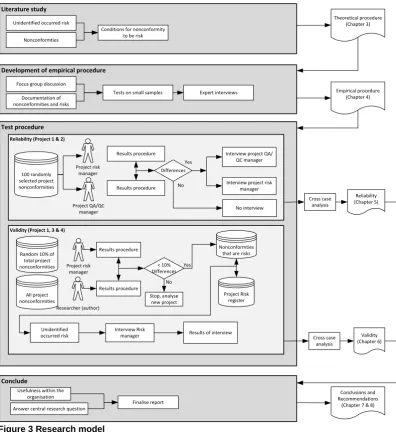
(18) 2.4.. Research questions. The central question of this research is: What procedure can be developed that classifies nonconformities into risk and non-risk? The following sub questions were derived from the central research question: 1.1. What are the theoretical conditions for a nonconformity to be considered as risk? 1.1.1. 1.1.2. 1.1.3.. 1.2. What empirically tested procedure can be developed that classifies nonconformities into risks and non-risks? 1.2.1. 1.2.2. 1.2.3.. 1.3.2.. Chapter 5 and 6. What is the reliability of the procedure, when performed by risk managers and QA/QC managers? What is the validity and what are the results of the procedure?. 1.4. How can this procedure be used within the organisation?. 2.5.. Chapter 4. How do risk managers classify nonconformities using a simplified version of this procedure? How does the theoretical procedure work in practice? How do experts judge the usability of a procedure that classifies nonconformities into risks and non-risks?. 1.3. Is this procedure valid and reliable? 1.3.1.. Chapter 3. What is a nonconformity? What is an unidentified occurred risk? When is a nonconformity a risk?. Chapter 7. Method. In this section, the research strategy and data collection of each research part are discussed. First the literature study is described, then the development of the empirical procedure is elucidated. After that, it is described how the procedure was tested. Finally it is described how the conclusions are drawn and the report is finalised. Figure 3 shows the research model, which incorporates all steps of the procedure.. 2.5.1.. Literature study. A literature study was performed in order to answer the first sub question. The literature that was analysed consisted of books and scientific literature. The literature was searched using scientific search engines; Scopus was used as the main search engine. Specific articles were searched using Sciencedirect and Google scholar. In addition, articles and master theses were extracted from the Blackboard site “platform risk management” from the University of Twente. The search terms that were used are described in appendix 3.. 2.5.2.. Development of empirical procedure. During the empirical research, a focus group study was performed and finally expert interviews were performed. Focus group Firstly, a focus group research was performed to answer research question 1.2.1. How do risk managers classify nonconformities using a simplified version of the procedure? During the focus group research it was determined whether the theoretical steps are all necessary for risk managers as intended users to classify nonconformities into risks and non-risks. First project nonconformity registers and risk registers were studied. Twenty-four nonconformities were selected from the nonconformity register of a multidisciplinary project. Three questions of each of these nonconformities were answered by ten risk managers.. 6.
(19) -. -. What is the impact (no impact, low, middle, high)? The higher the impact the higher the risk. Because the impact of nonconformities is not documented in the nonconformity register, this question was asked to determine whether risk managers are capable of estimating the impact. Is the nonconformity an occurred risk? Would you register it as risk in the risk register of your project?. If the results of each of the questions show a high disagreement between the risk managers, it indicates that a simplified version of the procedure does not provide the desired results. The answers of these questions were discussed during a focus group discussion with five risk managers. Tests on samples of nonconformities The theoretical procedure was tested on samples of nonconformities of a multidisciplinary project in order to answer research question 1.2.1: How does the theoretical procedure work in practice? These tests resulted in the draft procedure. Expert interviews The draft procedure was discussed during semi-structured interviews with eleven experts. During these interviews the research problem was discussed and all steps of the procedure were discussed. The interviews resulted in the answer to research question 1.2.2. How do experts judge the usability of the procedure? The experts that were interviewed were risk managers, QA/QC managers, project managers and directors. Appendix 4 shows a list of interviewed persons.. 2.5.3.. Test procedure. The procedure that was developed was first tested on reliability. After that the procedure was tested to obtain the results, these results were also used to conclude the validity of the procedure. Reliability The reliability of the draft procedure was tested. Reliability is the extent to which a measurement gives results that are consistent when the entity being measured has not changed (Leedy & Ormrod, 2010). The reliability was tested on two representative multidisciplinary infrastructure projects. The main project type of project one is roads, and of project two the main project type is civil works. The contract value of both projects is high: 120 million euro for project one and 207 million euro for project two. Because of their size and the focus of different disciplines can be concluded that these are representative large multidisciplinary projects for the organisation. To test the reliability, the risk manager and QA/QC manager of the project, performed the procedure for a randomly selected list of 100 nonconformities of the project under consideration. Then, the results of the risk manager and QA/QC manager were compared. Fewer differences indicate a higher reliability. The risk manager and QA/QC manager were interviewed separately to determine the reasons for the differences. After the reliability test on project one, the procedure was changed using the reasons for the differences between the QA/QC manager and risk manager of project one. The reliability is considered to be low if less than 85% of the nonconformities are classified equally. This because during the preliminary research both risk managers classified 74% of the nonconformities equally. 85% will therefore indicate an improvement of the reliability. Finally a cross case analysis was performed to determine the differences between the first and the second project.. 7.
(20) Validity test and test the results of the procedure After conducting the reliability test on project one a concept procedure was developed. This procedure was tested on validity. The validity is the extent to which the instrument measures what it is intended to measure (Leedy & Ormrod, 2010). The procedure was also tested to determine the results of the procedure. By performing the procedure on construction projects both results were gathered. The tests were performed on three representative multidisciplinary projects. Project one, project three and project four. The main project type of project one is roads. The main project type of project three is rail and the main project type of project four is civil works. The contract value of the three projects is high, 120 million euro for project one, 171 million euro for project three, and 141 million euro for project four. Because of their size and the focus on different disciplines, it is assumed that these are representative large multidisciplinary projects for the organisation. The procedure was performed for all documented nonconformities of these three projects. This study was performed by the author because the analysis is very time consuming. Ideally the procedure is performed by the future users, the risks managers, however this is expensive due to the time consumption. Therefore, the author performed the analysis of all nonconformities. The nonconformities that were unknown for the author, were discussed with the risk manager. To check the results of the author, the project risk manager performed the procedure on a random sample of 10% of the nonconformities. In case of no or little differences (<10%) between the results it was concluded that the results of the author are sufficient. The results of the procedure were identified and unidentified occurred risks. With these results the validity can be tested: it is an indication that the results are valid if identified occurred risks are the result of the procedure, because the procedure tends to classify nonconformities into risks. The project risk manager was interviewed concerning the unidentified risks. The results of each project were analysed to determine the nature of the nonconformities. Thus, which nonconformities are risks and which are non-risks. In addition a cross case analysis was performed after the results of the three projects were collected. This analysis was performed in order to map patterns between the three projects. The validity results of the three projects was used to determine the overall validity.. 2.5.4.. Conclude. After the validity tests were completed, the results were discussed and the central research question was answered. Finally, the report was finalised.. 8.
(21) Literature study Theoretical procedure (Chapter 3). Unidentified occurred risk Conditions for nonconformity to be risk. Nonconformties. Development of empirical procedure Focus group discussion Tests on small samples. Empirical procedure (Chapter 4). Expert interviews. Documentation of nonconformities and risks. Test procedure Reliability (Project 1 & 2) Results procedure Yes. Project risk manager. 100 randomly selected project nonconformities. Interview project QA/ QC manager. Differences Interview project risk manager. No. Results procedure Project QA/QC manager. No interview. Cross case analysis. Reliability (Chapter 5). Validity (Project 1, 3 & 4) Nonconformties that are risks. Results procedure. Random 10% of total project nonconformities. < 10% Differences. Project risk manager. Yes. No Results procedure All project nonconformities. Stop, analyse new project. Project Risk register. Researcher (author). Unidentified occurred risk. Interview Risk manager. Results of interview. Cross case analysis. Validity (Chapter 6). Conclude Usefulness within the organisation Finalise report Answer central research question. Conclusions and Recommendations (Chapter 7 & 8). Figure 3 Research model. 9.
(22)
(23) 3. Theoretical Background This chapter contains the results of the literature study that was conducted to determine the theoretical conditions for a nonconformity to be considered as risk. First nonconformity and risk are defined. After that is elaborated on reasons for non-identification that can be assigned to unidentified risks. Finally, the conditions for a nonconformity to be a risk are determined.. 3.1.. Defining nonconformity. In this section nonconformity is defined. Because documenting nonconformities is part of quality management, first the concept of quality is discussed, followed by an elucidation of the concept of quality management. Consequently, nonconformities are defined.. 3.1.1.. Quality management. This section elaborates on the concepts of quality and quality management. Quality: Multiple definitions of “quality” can be found in literature: -. “Fitness for use” (Juran, 1951) “Quality is resulting from the integrated effects of four attributes: serviceability, safety, durability and compatibility” (Bea, 2006) “Conformance to established requirements” (Crosby, 1979) (Burati et al., 1992). Two of the three definitions define quality in terms of fitness or conformance to “something”. Juran (1951) defines this “something” as use, Crosby (1979) and Burati et al. (1992) define it as requirements. It is possible that a product can be used, but does not fulfil all the requirements. For example, a bridge without a hand rail is fit for its primary use but it can be imagined that it does not fulfil all its requirements. The definition given by Bea (2006), can be used without measuring quality to established requirements. Products with high serviceability, safety, durability and compatibility have a high quality. This definition differs from the definition of Burati et al. (1992), who define quality as conformance to established requirements, while Bea (2006) defines quality as a more “stand alone” definition that can be used without measuring it against established requirements. The serviceability, safety durability and compatibility of a product can be seen as general functional requirements for each product. The definition of Bea (2006) is therefore more specific than the other definitions. Concerning these differences Reeves and Bednar (1994) point out that a universal definition of quality does not exist. Moreover, the different definitions of quality are inconsistent. ISO attempted to make a universal definition for quality: “a degree to which a set of inherent characteristics fulfils requirements”. A requirement is a need or expectation that is stated, generally implied or obligatory. In this definition, quality is measured compared to a set of characteristics (ISO, 2005). The better it complies with these characteristics, the higher the quality. Nevertheless as Reeves and Bednar (1994) point out, each quality definition has its own strengths and weaknesses. Next to that, the definition of quality can differ regarding the type of person using it. Managers need a different definition of quality than consumers. This is supported by Juran (1998). He stipulates that it is unlikely that the definition “fitness for use” can provide enough information for managers needing to take action concerning quality. Reeves and Bednar (1994) explicate four quality definitions that are the roots of all other definitions: 11.
(24) -. Quality is excellence Quality is value Quality is conformance to specifications Quality is meeting and/or exceeding customer’s expectations. The above given definitions can be used in different situations. This research focuses on infrastructure projects in the construction industry. Quality in case of this research, is often used as a managerial instrument. During the tender phase, contractors specify the quality they will reach in their solution. During the execution phase, the contractor has to prove to the client that the quality they promised is reached, and conforms to specifications. Therefore this research uses the following definition of quality: Quality is conformance to specifications.. Quality management: Burati et al. (1992) define quality management in the construction industry: “Quality management concerns the optimisation of the quality activities involved in producing a product, process, or service. As such, it includes prevention and appraisal activities.” Quality management is thus about production, and will take place during the execution phase. During this execution phase, projects, processes or services are “produced” at a certain quality. Quality management is about optimisation of the quality activities. The quality activities are performed to produce the project, process or service at the desired quality. The appraisal activities that are described in the definition of quality management imply that it is possible that projects, processes or services do not meet the quality required. The next section elaborates on those nonconformities.. 3.1.2.. Nonconformity. Terms such as: quality deviation, defect, non-conformance and nonconformity are all used to express the same meaning (Abdul-Rahman, 1995; Burati et al., 1992; Love & Edwards, 2005). In literature these words have been interchanged, creating ambiguity (Love & Edwards, 2005). In this research the term “nonconformity” is used. Multiple definitions of nonconformity can be found in literature: -. -. “Non-fulfilment of a requirement” ISO (2005). “A deviation that occurs with a severity sufficient to consider rejection of the product, process, or service. In some situations the product, process, or service may be accepted as is; in other situations it will require corrective actions”. o With a deviation being: “a departure from established requirements” (Burati et al., 1992). “not meeting quality” (Arditi & Gunaydin, 1997).. All definitions define nonconformity as non-compliance with requirements. Arditi and Gunaydin (1997) refer to not meeting quality, and define quality as conformance to specifications. As stated by Burati et al. (1992) a nonconformity has deviation with a severity sufficient to consider rejection of the product, process or service. If a product process or service does not fulfil its requirements, a logical next step is that it will be rejected until it fulfils its requirements. An example of a product nonconformity is: “after demoulding a concrete wall it is discovered that the coverage of reinforcement is less than required”. The product, the concrete wall, does not fulfil to its requirements. An example of a process requirement is for instance: “it is not. 12.
(25) detectable that the risk management process is performed as prescribed”. The process, the risk management process, does not comply to its requirements. An example of a service nonconformity is: “the road was not opened on time after night construction works”. There is not fulfilled to requirement for the service that the road has to be opened on time. A requirement as defined by ISO (2005) is a “need or expectation that is stated, generally implied or obligatory”. A requirement can thus be written down, obligatory (according to standards), or generally implied. Generally implied means that within the sector the requirement is custom or common practice that the need or expectation under consideration is implied. As a result a nonconformity can be defined for this research as: A non-compliance of stated, obligatory or generally implied requirements.. As defined by (ISO, 2005) a qualifier can be used for specific requirements, for example: product, process or customer. A nonconformity has a cause and effect. Studies have been performed about causes of nonconformities (Brunson, 1982) cited in Josephson and Hammarlund (1999). After a nonconformity has occurred, often rework is necessary to recover it (Ashford, 1992). Quality management standard ISO 9001, prescribes that nonconformities have to be detected, corrected by the contractor or accepted by the client, and prevented from recurring during a project. In accordance with the contractor, a nonconforming product can be accepted by the client for a lower price. Nonconformities have to be recorded in a nonconformity register (ISO, 2008).. 3.2.. Defining unidentified occurred risk. In this research, a procedure is developed that classifies nonconformities into risk and nonrisk, and assigns reasons for non-identification to nonconformities that are unidentified risks. It is therefore essential to know what an unidentified occurred risk is. For that reason first uncertainty and risk are defined. Afterwards, construction project risk is defined, followed by the definition of unidentified risk. Finally, reasons for non-identification are obtained; knowing why a risk has not been identified can provide information to improve the risk identification process of future projects.. 3.2.1.. Uncertainty and Risk. This section elaborates on uncertainty and risk. First, the definition of uncertainty will be elaborated. Using the concept of uncertainty, risk will be defined. Uncertainty Van Asselt and Rotmans (2002) state that it is difficult to define uncertainty. Based on their study they define a typology with several sources of uncertainty that can be used for integrated assessment practitioners (Figure 4). Two types of uncertainty are distinguished: -. -. Variability, where the system/process under attention can react in multiple ways. This is also referred to as ‘stochastic uncertainty’ (Helton, 1994, cited in Van Asselt and Rotmans (2002). Limited knowledge, which is a property of the analysts performing the study and/or of our state of knowledge. Uncertainty based on limited knowledge does not necessarily decrease when more information is acquired. More information can even increase. 13.
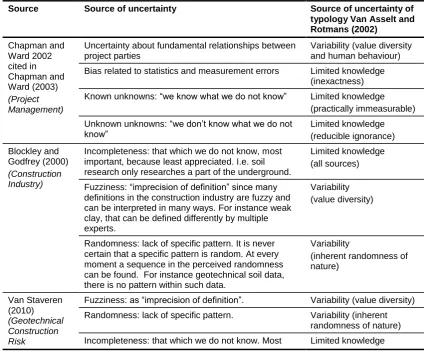
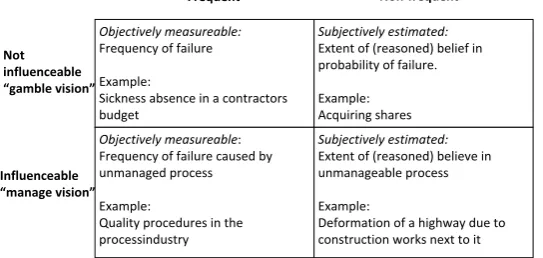
(26) uncertainty since new information can decrease understanding. It can invalidate understandings of systems or processes (Van Asselt & Rotmans, 2002). Five different sources of variability are distinguished: -. Inherent randomness of nature, natural processes which are not predictable. Value diversity, differences in the norms and values of people which cause different problem perceptions and definitions. Human behaviour, “non-rational” behaviour, or variations in standard behavioural patterns. Social, economic and cultural dynamics. “Non-linear chaotic and unpredictable nature of societal processes”. Technological surprises, new developments in technology, or unexpected external effects of technologies. (Van Asselt & Rotmans, 2002). Van Asselt and Rotmans (2002) point out that variability partly causes limited knowledge, but knowledge with regard to deterministic processes can also be incomplete and uncertain. Seven different sources of limited knowledge are described. This ranges from inexactness as lowest uncertainty to irreducible ignorance as highest uncertainty (Figure 4). -. Inexactness, every measurement is affected by measurement errors. “We roughly know.” Lack of observation/measurements, lacking data that could have been collected but haven’t been. “We could have known.” Practically immeasurable, lacking data that in principle can be measure, but not in practice (too expensive, too lengthy). “We know what we do not know.” Conflicting evidence, different data sets/observations are available, but allow room for competing interpretations. “We don’t know what we know.” Reducible ignorance, processes that we do not observe, nor theoretically imagine at this point in time, but may in future. “We don’t know what we do not know.” Indeterminacy, processes of which we understand the principles and laws, but which can never be fully predicted or determined. “We will never know.” Irreducible ignorance, there may be processes and interaction between processes that cannot be determined by human capacities and capabilities. “We cannot know” (Van Asselt & Rotmans, 2002, pp. 80-81).. The typology of Van Asselt and Rotmans (2002) is developed for integrated assessment practitioners, it can therefore be discussed whether this typology is applicable on construction projects. Hence the typology is compared with uncertainty sources used in construction literature and project management literature (Table 1). It can be concluded that, the sources of uncertainty described in the construction industry literature and project management literature can be applied to the typology of Van Asselt and Rotmans (2002). Now uncertainty in this research can be defined: As per the typology of Van Asselt and Rotmans (2002): Variability, where the system/process under attention can react in multiple ways and/or Limited knowledge, which is a property of the analysts performing the study and/or of our state of knowledge.. In conclusion, two types of uncertainty can be distinguished: variability and limited knowledge (Van Asselt & Rotmans, 2002). Uncertainty in project management and uncertainty in the construction industry can be applied to the typology of Van Asselt and Rotmans. Moreover,. 14.
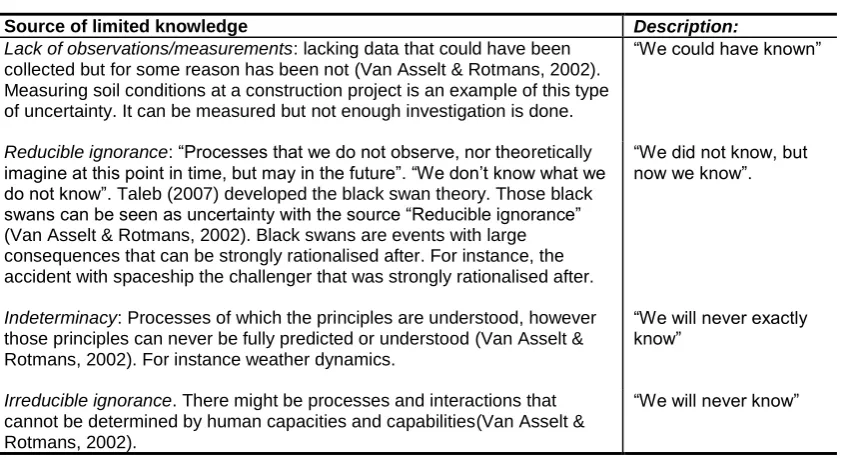
(27) uncertainty can be applied to risk management. As stated by Van Asselt and Vos (2006) uncertainty and risk are intermingled.. Figure 4 Types of uncertainty adopted from (Van Asselt & Rotmans, 2002). Table 1 Comparison of typology of Van Asselt and Rotmans (2002) with construction and project management uncertainty definitions Source. Source of uncertainty. Source of uncertainty of typology Van Asselt and Rotmans (2002). Chapman and Ward 2002 cited in Chapman and Ward (2003) (Project Management). Uncertainty about fundamental relationships between project parties. Variability (value diversity and human behaviour). Bias related to statistics and measurement errors. Limited knowledge (inexactness). Known unknowns: “we know what we do not know”. Limited knowledge (practically immeasurable). Unknown unknowns: “we don’t know what we do not know”. Limited knowledge (reducible ignorance). Incompleteness: that which we do not know, most important, because least appreciated. I.e. soil research only researches a part of the underground.. Limited knowledge (all sources). Fuzziness: “imprecision of definition” since many definitions in the construction industry are fuzzy and can be interpreted in many ways. For instance weak clay, that can be defined differently by multiple experts.. Variability (value diversity). Randomness: lack of specific pattern. It is never certain that a specific pattern is random. At every moment a sequence in the perceived randomness can be found. For instance geotechnical soil data, there is no pattern within such data.. Variability (inherent randomness of nature). Fuzziness: as “imprecision of definition”.. Variability (value diversity). Randomness: lack of specific pattern.. Variability (inherent randomness of nature). Incompleteness: that which we do not know. Most. Limited knowledge. Blockley and Godfrey (2000) (Construction Industry). Van Staveren (2010) (Geotechnical Construction Risk. 15.
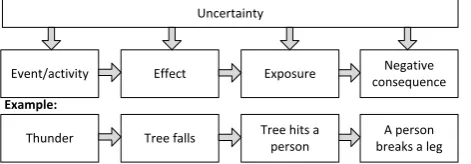
(28) Management). important, because least appreciated.. (all sources). Falseness: wrong information due to human error, it is natural to make mistakes however this can largely be prevented by applying quality management systems. Variability (behavioural variability). Risk Halman (1994) explains risk as a connected process-chain of cause, exposure, and negative effect (Figure 5). The example shows how the process-chain results in a negative effect.. Uncertainty. Event/activity. Effect. Exposure. Negative consequence. Tree falls. Tree hits a person. A person breaks a leg. Example: Thunder. Figure 5 Risk as a process-chain adopted from Halman (1994). However, not all sources state that risk has a negative effect. PMI (2000) states that a risk can have a positive or negative effect on the project objectives. As described in the introduction a nonconformity can have a positive or a negative effect on the project objectives. Therefore, within this research, a risk can have a positive or a negative effect. When only the impact is considered, a risk is higher when the effect (positive/negative) of the risk is higher. The impact of a risk in this research is purely financial. Contractors often specify five types of objectives: time, money, quality, surrounding and employee safety (van Well-Stam et al., 2003). A risk can affect one or more of these objectives. Time, money, quality, surrounding and employee safety are strongly related in practice, and occurrence of these risks results in a financial impact. Delays have a financial impact, because the resources are used longer on site. Quality risks often lead to rework that has a financial impact. Surrounding and employee safety risks in infrastructure projects are often related to financial penalties from the client because it can affect the reputation of the client. Therefore, the impact of a risk in this research is chosen as purely financial. The vectors between each element of the process-chain (Figure 5) are assigned with a likelihood. This likelihood is described by Van Staveren (2009) as a chance that can be defined, subjectively estimated or objectively measured. For example, there is a likelihood that thunder results in a tree to fall. Likelihood can also be indicated with classifiers such as likely and unlikely. Moreover, it can also be indicated in probabilities of occurrence. When only the likelihood is considered, a risk is higher when the likelihood is higher, however when the likelihood is 100%, it is no risk, because there is a certainty it is happening. Several sources, such as PMI (2000), state that the size of a risk can be calculated by multiplying the (calculated) probability with the (objectively calculated) effect of the risk. However, as stated by Vercilli, 1995 (cited in Van Asselt and Vos, 2006), “risk refers to the possible negative consequences of uncertainty”. This probability or likelihood can thus be objectively calculated but also subjectively estimated. There can therefore be an uncertainty about the likelihood. If the likelihood is subjectively estimated the exact likelihood is uncertain.. 16.
(29) This uncertainty, can also affect the effect of a risk (Halman et al., 2008). It can thus be uncertain what the effects of a risk are if it occurs, (Figure 5). Thus uncertainty can affect all elements of the “process-chain” and the likelihood of a risk. A risk therefore has a likelihood and an effect. Halman (1994) analysed the risk definitions that are described in literature. These risk definitions can be distinguished by frequent and non-frequent risk definitions and by influenceable and not-influenceable risk definitions ( Figure 6). This framework is explained in the next few paragraphs and then used to further define risk in this research. Frequent risks are objectively measurable. Historical data can be collected on these risks. Using this data, the effects and probability of occurrence can be predicted. Because of their frequency standard processes/plans can be developed on how to manage these risks (Halman, 1994). Frequent risks can be attributed to the type of uncertainty called variability. Variability indicates that the uncertainty can be calculated. Because of these risks cause and effect can be objectively measured and calculated using historical data. Non-frequent risks can be subjectively estimated, because no historical data is available for these risks. The probability of occurrence and the elements of the process chains can only be subjectively estimated. Of non-frequent, no standardised plans/processes can be developed in order to manage these risks (Halman, 1994). Non-frequent risks can be attributed to the type of uncertainty called limited knowledge. Because these risks are not frequent, there is a limited amount of knowledge of these risks; this can be about the probability of occurrence or the effects of the risks. This indicates the type of uncertainty called limited knowledge. Not influenceable risks indicate the gamble definition of risk. There is no influence possible on the cause of this risk. By doing an analysis information can be obtained about this risk, and it can possibly be avoided. But when the risk is taken, you can only wait to see whether the risk occurs or not. The measures that can be taken are measures to minimise the effect if it occurs (Halman, 1994). Frequent Objectively measureable: Frequency of failure Not influenceable “gamble vision” Example: Sickness absence in a contractors budget. Influenceable “manage vision”. Non-frequent Subjectively estimated: Extent of (reasoned) belief in probability of failure. Example: Acquiring shares. Objectively measureable: Frequency of failure caused by unmanaged process. Subjectively estimated: Extent of (reasoned) believe in unmanageable process. Example: Quality procedures in the processindustry. Example: Deformation of a highway due to construction works next to it. Figure 6 Risk categories adopted from Halman (1994). In contrast, of influenceable risks the cause can be influenced. Therefore these risks can be influenced/managed by the risk taker before they occur. The lower the influenceability the higher the risk. Of these risks measures can be taken to prevent the risk from occurring (Halman, 1994). Having the framework of Halman(1994) defined, risk can be further defined for this research. As outlined above, a risk in this research has a likelihood and an effect. In addition, a risk in this research is defined as non-frequent risk. Because for frequent risks historical data is 17.
(30) available to predict the effects and the probability of occurrence, and these risks can be managed in standard processes. Within the construction industry, these standard processes are often defined already and managed. Therefore these type of risks are not considered as risk in this research. A risk in this research is thus not-frequent, and is affected by epistemic uncertainty. A risk in this research has a limited or no influenceability. Two types of influenceability are distinguished because both can be useful for future projects. The influenceable risks can be managed before they occur, the non-influenceable risks can be avoided or measures can be taken to minimise the effect (Halman, 1994). To conclude, project risk can be defined for this research: The likelihood of an effect on the project objectives, caused by limited knowledge (non-frequent) within a project. Project risks can have a non-influenceable or influenceable cause.. 3.2.2.. Unidentified risk. The procedure distinguishes between identified and unidentified risks. Therefore this section elaborates on unidentified risk, which is a further specification of definition of risk defined in the previous section. As stated by Van Staveren (2009) identified and unidentified risk correspond with known and unknown uncertainty. Unidentified risks cannot be managed because they are not identified before they occur, after they occur they can be managed by managing the effects of the risk. Unidentified risks can be assigned to different sources of uncertainty. As described in the previous section, Van Asselt and Rotmans (2002) distinguish seven sources of uncertainty referring to limited knowledge. Four of these seven sources relate to unidentified risks and are explicated in Table 2.. Table 2 Sources of uncertainty related to unidentified occurred risk Source of limited knowledge Lack of observations/measurements: lacking data that could have been collected but for some reason has been not (Van Asselt & Rotmans, 2002). Measuring soil conditions at a construction project is an example of this type of uncertainty. It can be measured but not enough investigation is done.. Description: “We could have known”. Reducible ignorance: “Processes that we do not observe, nor theoretically imagine at this point in time, but may in the future”. “We don’t know what we do not know”. Taleb (2007) developed the black swan theory. Those black swans can be seen as uncertainty with the source “Reducible ignorance” (Van Asselt & Rotmans, 2002). Black swans are events with large consequences that can be strongly rationalised after. For instance, the accident with spaceship the challenger that was strongly rationalised after.. “We did not know, but now we know”.. Indeterminacy: Processes of which the principles are understood, however those principles can never be fully predicted or understood (Van Asselt & Rotmans, 2002). For instance weather dynamics.. “We will never exactly know”. Irreducible ignorance. There might be processes and interactions that cannot be determined by human capacities and capabilities(Van Asselt & Rotmans, 2002).. “We will never know”. Ramasesh and Browning (2014) define two types of unknown uncertainties, unknowable unknown unknowns (further called: unidentifiable unidentified risk) and knowable unknown. 18.
(31) unknowns (further called: identifiable unidentified risks). An unidentifiable unidentified risk is an unidentified risk that could not have been anticipated. An identifiable unidentified risk is an unidentified occurred risk that could have been anticipated. The above stated types of uncertainty can be assigned to those categories as follows: Identifiable unidentified risks: lack of observations/measurements. Unidentifiable unidentified risks: Reducible ignorance, Indeterminacy, Irreducible ignorance. Finally, unidentified risk can be defined as: Risks that have not been identified and can be distinguished into two types: identifiable and unidentifiable.. 3.2.3.. Reasons for non-identification. In this paragraph, reasons for non-identification are determined. Assigning these reasons to the nonconformities that are unidentified risks can give insight in the improvement possibilities of the risk identification of future projects. First it is explained which type of unidentified risks are focused on. After that, reasons for non-identification are determined from different risk identification methods. Risk identification determines which risks might affect the project and register their characteristics (Mojtahedi, Mousavi, & Makui, 2010). Risk identification is considered by many to be the most important element of the risk management process, as once a risk has been identified, it is possible to address it (Chapman, 2001). Unidentifiable unidentified risks cannot be managed (Ramasesh & Browning, 2014). “One can never know completely what one does not know” therefore risk identification will never be complete (Pidgeon, 1988). Thus, risk identification is always incomplete (Sjöberg, 1980). That is why in every project unidentifiable unidentified risks can occur. The reason why these risks were not identified, is that it was not possible to identify them (Ramasesh & Browning, 2014). For example the tsunami in the Indian Ocean in 2004 disrupted many construction projects but it is something that could not have been anticipated. Identifiable unidentified risks are possible to know. Based on extensive literature and empirical research, Ramasesh and Browning (2014) developed a framework that describes the driving factors in a project that increase the likelihood for the occurrence of identifiable unidentified risks. If one of these factors is present on a project it indicates a high likelihood for the occurrence of identifiable unidentified risks. The presence of one of these factors can thus be one of the reasons for non-identification. Therefore the four characteristics of the framework of Ramasesh and Browning (2014) are described in the next paragraphs: The first characteristic is complexity. Complexity of a system makes it difficult to understand and recognise all of the variables of this system. Two types of complexity are described: element complexity, (complexity of the project elements) and relationship complexity, (complexity of relationships among elements). An increased amount of complexity, increases the likelihood of experiencing identifiable unidentified risks (Ramasesh & Browning, 2014). The second characteristic is complicatedness. Complicatedness is how complexity is perceived by its observers. Increasing complicatedness increases the likelihood of experiencing identifiable unidentified risks (Ramasesh & Browning, 2014). Mindlessness as the third characteristic, is the opposite of awareness. Mindlessness is a failure to recognise key aspects of a situation. Increasing mindlessness increases the likelihood for identifiable unidentified risks (Ramasesh & Browning, 2014). As fourth characteristic, project pathologies are described. Project pathologies are abnormalities a project can suffer from. Project pathologies such as project subsystem 19.
(32) mismatches, fragmented expertise, stakeholders’ unclear expectations and dysfunctional culture, could increase the likelihood of identifiable unidentified risks occurring on a project (Ramasesh & Browning, 2014). The above explained framework of Ramasesh and Browning (2014), provides reasons why unidentified risks have occurred. However, more reasons for non-identification can be found. When a risk is not identified, it implies shortcomings in the risk-identification. Risk identification literature is studied to elaborate on these reasons. Halman (1994) provides different aspects that are important for good risk identification. He points out that due to group dynamics, risks given by minorities can be overlooked. This is supported by Chapman (2001), who states that people of the same rank have to participate during risk identification. A reason of non-identification can therefore be group dynamics. In his article about risk identification, Chapman (2001) demonstrates that several categories can be used to guide risk identification. Each set of categories tries to cover a whole project. Forgetting to stipulate one of the categories can be a reason of non-identification. Hanna, Thomas, and Swanson (2013) state that cooperating with multiple parties reduces the likelihood of overlooking risks. Accordingly Chapman (2001) states that the success of the risk identification depends on the in-depth knowledge of the team and the selection of representatives. It can thus be stated that a reason of non-identification can be a lack of mobilisation of knowledge. Finally, Chapman (2001) states that it is important that a facilitator (risk manager) has extensive knowledge of a project. This can be a reason of non-identification.. 3.3.. Conditions for a nonconformity to be a risk. Having defined the concepts of risk and nonconformity, in this section a theoretical procedure is developed that classifies nonconformities into risks and non-risks. First, is elaborated on current research about nonconformities as risks. Consequently, the theoretical procedure is elucidated. Van Staveren (2014) states that good geotechnical risk management results in less nonconformities of safety and quality. Nevertheless, it is not explained under what conditions a nonconformity is a risk. Further research that discusses nonconformities is performed by Cárdenas et al. (2014). They used Bayesian networks to develop construction risk models. Some of the risk factors, or risks that have been used as input for these risk models are possible nonconformities of a construction project. These possible nonconformities, are derived from expert knowledge, not from what actually happened during a construction project. When a nonconformity is a risk is not explained. While looking at previous research about nonconformities, much has been written about the causes and the cost of nonconformities (Abdul-Rahman et al., 1996; Burati Jr et al., 1992; Love & Li, 2000; Love et al., 1999). However, nonconformities have not often been related to risk. For instance, Josephson and Hammarlund (1999) determine risk as one of the causes of nonconformities. In contrast with Josephson and Hammarlund (1999), Aven (2014) states that all nonconformities are consequences of some type of risk. Two types of risk are defined. Risk due to variability and risk due to limited knowledge. Additionally, Aven (2014) distinguishes two types of nonconformities, nonconformities with a common cause and a special cause. From extensive literature research, Aven (2014) concludes that variability can cause common cause nonconformities (variability is not considered as risk in this research). Additionally, Aven (2014) concludes that, limited knowledge can cause common cause nonconformities and special cause nonconformities. Since limited knowledge is attributed to risk in this. 20.
(33) research, a nonconformity with a special cause is a risk as well. However, when a nonconformity with a common cause is a risk (attributed to limited knowledge) is not explained. Hence, the research of Aven (2014) cannot be used to classify nonconformities into risk and non-risk. Moreover, Aven (2014) does not support his research with empirical data. Apart from the afore mentioned, no sources have been found that explain conditions for a nonconformity to be a risk (appendix 3 shows the used search terms). This research aims to fill that gap. Because previous research did not conclude a method to classify nonconformities into risk and non-risk, the definition of risk is used to develop this method. Figure 7 shows the theoretical procedure. The risk definition consists of four parts, existence of likelihood, existence of effect, existence of a low frequency and a risk is influenceable or not.. Likelihood: a risk has a likelihood A nonconformity also has a likelihood before it occurs: there is a likelihood that a product or process does not comply with a requirement. Because both risk and nonconformity have a likelihood, it is excluded from the procedure. A risk can have a positive or a negative effect on the project objectives (PMI, 2000). This effect is the financial impact. Nonconformities that have no financial impact are thus no occurred risks. This is the first step of the procedure.. No impact. No risk No risk. Total project nonconformities. No Risk. Standard process. Frequent. Not influenceable. Impact Not frequent. Identified Unidentified Identified. Risk Management. Influenceable Unidentified. Figure 7 Procedure to classify nonconformities into risk and non-risk. A risk is defined as not-frequent. Therefore, for a nonconformity to be a risk, the nonconformity has to be not-frequent. A nonconformity is not-frequent if the probability of occurrence and the size its effects could have not been calculated before the nonconformity occurred, but can only be subjectively estimated. A risk is influenceable or not. This distinction is made because a not influenceable risk requires a different type of management than an influenceable risk. The non-frequent nonconformities with an impact are occurred risks. These risks can be identified and unidentified. The last theoretical step is to determine the reason for nonidentification of the unidentified occurred risks.. 21.
Figure
+7


Related documents
There are infinitely many principles of justice (conclusion). 24 “These, Socrates, said Parmenides, are a few, and only a few of the difficulties in which we are involved if
For the topologies studied, this suggests that in an idealized fractional bandwidth routed network the increase in network throughput achieved by improving the transceiver coding can
Augmented Reality * is to augment the real world with virtual information. It is the opposite of Virtual Reality that is to create a synthesised environment
Although again, skills show no effect for the probability of reporting good chances for the long-term unemployed, there are positive effects in the group of short-term
It was decided that with the presence of such significant red flag signs that she should undergo advanced imaging, in this case an MRI, that revealed an underlying malignancy, which
More frequent and longer long runs and even the occasional set of back-to-back long runs make your weekly mileage jump around a bit more than during training for a road
Breeders goat farm kerala, boer goats for sale usa, milk goats for sale in arkansas, how big can pygmy goats get, savanna goats for sale canada, boer goats canterbury, goats for sale
The association between RAI treatment failure and various clinical parameters includ- ing age, sex, height, weight, body mass index (BMI), thyroid gland volume, and isthmus length
