http://www.scirp.org/journal/acs ISSN Online: 2160-0422
ISSN Print: 2160-0414
DOI: 10.4236/acs.2018.81006 Jan. 17, 2018 84 Atmospheric and Climate Sciences
Mathematical Modeling of the Influence of the
Wind Field Structure in the Atmosphere on the
Cloud Formation Processes
Boris A. Ashabokov
1,2, Lyudmila M. Fedchenko
1, Alexander V. Shapovalov
1,
Khazhbara M. Kalov
1, Ruslan Kh. Kalov
1, Alla A. Tashilova
1, Vitaly A. Shapovalov
11High-Mountain Geophysical Institute, Nalchik, Russia
2Institute of Computer Science and Problems of Regional Management, Kabardino-Balkarian Research Center, Russian Academy of Sciences, Nalchik, Russia
Abstract
The state of the physics of convective clouds and cloud seeding is discussed briefly. It is noted that at the present time there is a transition from the stage of investigation of “elementary” processes in the clouds to the stage of study-ing the formation of macro- and microstructural characteristics of clouds as a whole, taking into account their system properties. The main directions of the development of cloud physics at the upcoming stage of its development are discussed. The paper points out that one of these areas is the determination of the structure-forming factors for the clouds and the study of their influence on their formation and evolution. It is noted that one of such factors is the in-teraction of clouds with their surrounding atmosphere, and the main method of studying its role in the processes of cloud formation is mathematical mod-eling. A three-dimensional nonstationary model of convective clouds is pre-sented with a detailed account of the processes of thermohydrodynamics and microphysics, which is used for research. The results of modeling the influ-ence of the wind field structure in the atmosphere on the formation and evo-lution of clouds are presented. It is shown that the dynamic characteristics of the atmosphere have a significant effect on the formation of macro- and mi-crostructural characteristics of convective clouds: the more complex the structure of the wind field in the atmosphere (i.e., the more intense the inte-raction of the atmosphere and the cloud), the less powerful the clouds are formed.
Keywords
Wind in the Atmosphere, Wind Field Structure, Interaction with Clouds, Modeling, System Properties of Clouds, Interaction of Clouds with the
How to cite this paper: Ashabokov, B.A., Fedchenko, L.M., Shapovalov, A.V., Kalov, K.M., Kalov, R.K., Tashilova, A.A. and Sha-povalov, V.A. (2018) Mathematical Modeling of the Influence of the Wind Field Structure in the Atmosphere on the Cloud Formation Processes. Atmospheric and Climate Sciences, 8, 84-96.
https://doi.org/10.4236/acs.2018.81006
Received: December 14, 2017 Accepted: January 14, 2018 Published: January 17, 2018
Copyright © 2018 by authors and Scientific Research Publishing Inc. This work is licensed under the Creative Commons Attribution International License (CC BY 4.0).
DOI: 10.4236/acs.2018.81006 85 Atmospheric and Climate Sciences
Atmosphere, Three-Dimensional Cloud Model
1. Introduction
The present period of time is a transition period for cloud physics and cloud seeding: a gradual transition from the stage of studying the “elementary” processes in the clouds to the stage of studying the formation and evolution of clouds as a whole, taking into account their system properties [1][2]. Obviously, such a transition is natural, because cloud physics is not limited to the study of individual processes in the clouds, and there are still many factors affecting the formation and evolution of clouds and requiring study. It should also be noted that the transition of cloud physics to the next stage of evolution will take a cer-tain period of time. This is due to the fact that, on the one hand, such “elemen-tary” processes, whose role in the formation and evolution of clouds are great, remained unexplored or insufficiently studied, and, on the other hand, it is ne-cessary to formulate research directions at the next stage of the evolution of cloud physics, the tasks of these directions, develop methodologies and methods for solving these problems. Taking into account that convective clouds belong to complex physical systems, one of the directions of research of a new stage of its evolution is the determination of the main structure-forming factors for clouds and the study of their influence on the formation of their macro- and micro-structural characteristics. Such factors, as noted in [1][2], are the interaction of clouds with their surrounding atmosphere and the interaction of processes in the clouds (the properties of hierarchy and emergence of systems) [3][4].
In this paper, we present some results of studies on the effect of the structure of the wind field in the atmosphere on the formation of macro- and microstruc-tural characteristics of convective clouds. It is one of the most important me-chanisms of interaction of clouds with their surrounding atmosphere.
Note that this problem has long been in the field of view of researchers. As an example, we can mention papers [5]-[11], which are devoted to the investigation of the possible influence on the processes of cloud formation of various mechan-isms of interaction of the atmosphere with clouds. The list of these works can be continued, but without dwelling on this, we note that the authors of these works did not distinguish the belonging of this problem to a new stage in the evolution of cloud physics. In addition, the possibilities of the methods that they used were significantly limited. Therefore, these studies should be carried out from a new perspective and using more effective methods and methodologies.
DOI: 10.4236/acs.2018.81006 86 Atmospheric and Climate Sciences
processes of cloud formation. In particular, on the basis of this model, the for-mation of the thermodynamic, microstructural and electrical characteristics of convective clouds was studied [14][15][16], and the formation of their micro-structural characteristics was studied in [17] [18]. Of the works devoted to the study of the role of the interaction of processes in the clouds on the formation of their microstructural characteristics, it can be noted [19]. It presents the results of modeling the influence of deformations in the clouds (formation of the inte-raction of processes in the clouds) on the formation of microstructural characte-ristics of hail clouds. We also note that a new method based on the use of the “digital atmosphere” is used to form the input data of the model (initial condi-tions) [20].
2. Research Method
The present work uses a three-dimensional model with detailed account of processes, including electrical ones, to study the effect of the wind field structure in the atmosphere on the formation of macro- and microstructural characteris-tics of convective clouds.
We present a system of equations describing processes in the clouds to get an idea of the model, and for a more detailed acquaintance with the model, we can recommend the papers [4][5][6].
The mathematical model of the convective cloud includes the equations of thermodynamics, microphysics and electrostatics:
(
)
u
u u lv
t π
∂ + ⋅∇ = −∇ + ∆ +′ ′
∂ V , (1)
(
)
v
v v lu
t π
∂ + ⋅∇ = −∇ + ∆ −′ ′
∂ V , (2)
(
)
0
0, 61 S
w
w w g s Q
t θ π θ ′ ∂ ′ ′ ′ + ⋅∇ = −∇ + ∆ + + −
∂ V , (3)
Continuity equation:
u w
w
x y z
ν σ
∂ ∂ ∂
+ + =
∂ ∂ ∂ , (4)
Equations of thermodynamics:
(
)
К К С С З Зp p p
L M L M
L M
t c T t c T t c T t
δ δ
δ
θ θ θ θ θ θ
δ δ δ
∂ ′
+ ⋅∇ = + + + ∆
∂ V , (5)
(
)
MК MCs
s s
t t t
δ δ
δ δ
∂ ′
+ ⋅∇ = − − + ∆
∂ V , (6)
Equations for the distribution functions of droplets, crystals, and frost-fragmentation by mass:
(
)
1 1 1 1
1
1 1 1 1 1
1 1
К KГ АК ДР З
f f f f
u v w V
t x y z
f f f f f
f I
t t t t t
∂ ∂ ∂ ∂ + + + − ∂ ∂ ∂ ∂ ∂ ∂ ∂ ∂ ∂ ′ = + + + + + ∆ + ∂ ∂ ∂ ∂ ∂
DOI: 10.4236/acs.2018.81006 87 Atmospheric and Climate Sciences
(
)
2 2 2 2
2
2 2 2
2 2 АВ
C AК З
f f f f
u v w V
t x y z
f f f
f I I
t t t
∂ ∂ ∂ ∂ + + + − ∂ ∂ ∂ ∂ ∂ ∂ ∂ ′ = + + + ∆ + + ∂ ∂ ∂
, (8)
(
)
3 3 3 3 3 3
2 3
З АК
f f f f f f
u v w V f
t x y z t t
∂ + ∂ + ∂ + − ∂ =∂ +∂ + ∆′
∂ ∂ ∂ ∂ ∂ ∂ , (9)
Poisson's equation for the potential of an electrostatic field:
2 2 2
e
2 2 2
0
U U U
x y z
ρ ε
∂ ∂ ∂
+ + = −
∂ ∂ ∂ . (10)
The initial conditions for Equations (1)-(12) have the following form:
( )
( ) ( )
( ) ( )
( )
( )
00( ) ( )
00( )
0, 0 , , 0 , , 0 ,
, 0 , , 0 ,
u u v v w w
s s
θ θ
= = =
= =
r r r r r r
r r r r (11)
(
)
(
)
(
)
( )
( )
1 , , 0 2 , , 0 3 , , 0 0, , 0 , 0 0.
f r m = f r m = f r m = ρ− r =ρ+ r = (12)
Border conditions:
( )
( ) ( )
( ) ( )
( )
( )
( ) ( )
( )
0 0 0
0 0 0, ; 0, ;
, , , , , ,
, , ,
x y z
x L y L z L
u t u v t v w t w
t s t s
θ
θ
= = == = =
= =
r r r r r r
r r r r
( )
,( )
,( )
, 0, ,( )
0( ) ( )
, , 0( )
z 0u r t =v r t =w r t = θ r t =θ r s r t =s r = (13)
(
)
(
)
(
)
1 , , 2 , , 3 , , 0 0, ; 0, ;
x y z
x L y L z L
f r m t = f r m t = f r m t = = = =
(
)
(
)
(
)
1 2 3
0
, , , , , ,
0
z
f m t f m t f m t
z z z =
∂ ∂ ∂
= = =
∂ ∂ ∂
r r r
(14)
( )
( )
( )
( )
0
0, 0,
, , ,
0 , 0 , 0 , , 0
x y z
z
x L y L z L
U t U t U t
U t
x = y = z = =
∂ ∂ ∂
= = = =
∂ ∂ ∂
r r r
r (15)
The system of equations is applied for the space-time domain:
0≤ ≤x Lx, 0≤ ≤y Ly, 0≤ ≤z Lz, 0≤ < ∞ >m ,t 0. (16)
The following notation is used:
(
)
u v w , K K Kx y z x x y y z z
∂ ∂ ∂ ′ ∂ ∂ ∂ ∂ ∂ ∂
⋅∇ ≡ + + ∆ = + +
∂ ∂ ∂ ∂ ∂ ∂ ∂ ∂ ∂
V ,
{
x y z, ,}
=
r -coordinate vector, V =
{
u v w, ,}
-velocity vector, u r( )
, v r( )
,( )
w r -velocity vector components; l-inertial force parameter; θ
( )
r -potentialtemperature;
( )
(
( )
1000)
R Cpp
c P z
π r = θ -dimensionless pressure; θ -average
potential temperature; R-gas constant; s r
( )
-specific air humidity; QS( )
r -thetotal ratio of the mixture of liquid and solid phases in the cloud; σ
( )
z -a para-meter that takes into account the change in air density with altitude; P z( )
и( )
T r -respectively, pressure and temperature; cp-heat capacity of air at con-stant pressure; LK,L LC, З-respectively, the specific heat of condensation,
subli-mation and freezing; π′
( ) ( ) ( )
r ,θ′ r ,s′ r -deviations of dimensionless pressure,DOI: 10.4236/acs.2018.81006 88 Atmospheric and Climate Sciences
ambient atmosphere π0
( ) ( ) ( )
r ,θ0 r ,s0 r ; KМ t
δ
δ , C
М t
δ
δ -changes in specific
humidity due to the diffusion of steam into droplets and crystals; МЗ
t
δ
δ -the
mass of the dropping water that freezes per unit time in a unit volume of air; K r
( )
-turbulent diffusion coefficient. V m V1
( ) ( )
, 2 m -steady rate of fall of liquid andsolid particles; 1
К f t ∂ ∂ , 1 КГ f t ∂ ∂ , 1 АК f t ∂ ∂ , 1 ДР f t ∂ ∂ , 1 З f t ∂ ∂
-changes in the
distribution function of droplets due to microphysical condensation processes, coagulation of droplets, accretion of droplets and crystals, crushing and freezing, respectively; 2
C f t ∂ ∂ , 2 АК f t ∂ ∂ , 2 З f t ∂ ∂
-changes in the distribution function of
crystals due to sublimation, accretion and freezing of droplets; 3
З f t ∂ ∂ , 3 АК f t ∂ ∂
-changes in the distribution function f3
(
r, ,m t)
due to the formationof fragments during spontaneous freezing of supercooled cloud droplets and their accretion with crystals; I1 and I2-sources of droplets and crystals; IАВ
-source of artificial crystals under cloud seeding; ε0-dielectric constant of
va-cuum.
The boundaries of the spatial domain are denoted by 0,Lx, 0,Ly и 0,Lz
The remaining notations are given in the works [4][5][6].
Powerful convective clouds observed in the North Caucasus on 02.09.2010 and 07.06.2012 and accompanied by the fall of hail were selected for the study. Calculations were made of the formation and evolution of clouds for various wind field structures in the atmosphere, which included the actual structure constructed from the aerological sounding data (the Mineralnye Vody Airport, North Caucasus, Russia) of the atmosphere on the days indicated, and the model wind structures constructed using the same data but modified as planned au-thors. The remaining parameters of the atmosphere remained unchanged during the calculations. In Figure 1, the real (left) and model (right) wind field structures in the atmosphere are given as an example (02.06.2010). The difference between the real and model field structures, as you can see, is that in the second case, at all levels, the wind velocity vector in the atmosphere is directed along the axis OX.
Comparative analysis of the characteristics of the model clouds (i.e. based on the calculation results) to study the effect of the wind field structure on the processes of cloud- and precipitation formation processes at the same time in-stants was carried out: the characteristics of the velocity fields of vertical air movements in the cloud and near cloudiness, radar reflectivity, as well as the maximum values of cloud parameters.
3. Results of Calculations
DOI: 10.4236/acs.2018.81006 89 Atmospheric and Climate Sciences
Figure 1. Real (left) and model (right) structure of the wind field in the atmosphere, used
[image:6.595.223.528.261.462.2]for calculations.
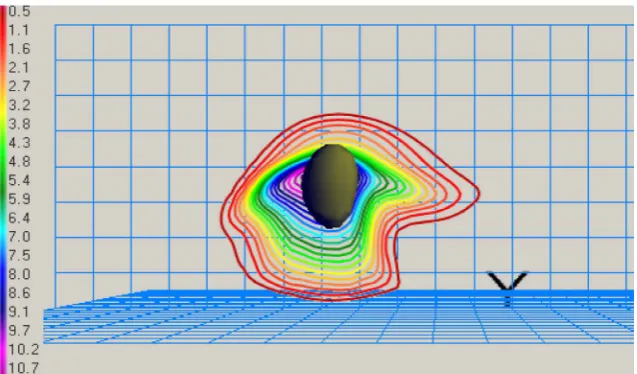
Figure 2. Isolines of upflow velocity in the vertical plane (20th min).
Figure 3. Isolines of different values of the upflow velocity in the vertical plane (30th
[image:6.595.227.526.493.692.2]DOI: 10.4236/acs.2018.81006 90 Atmospheric and Climate Sciences
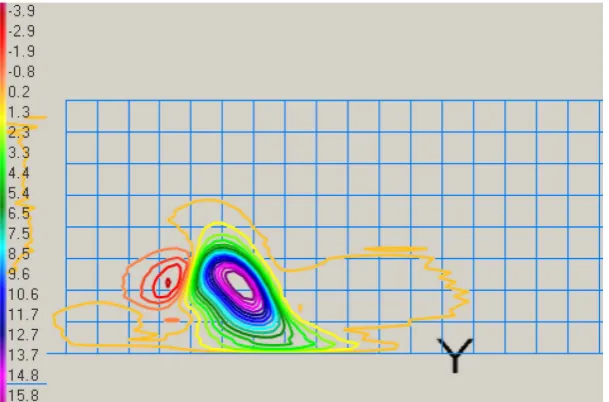
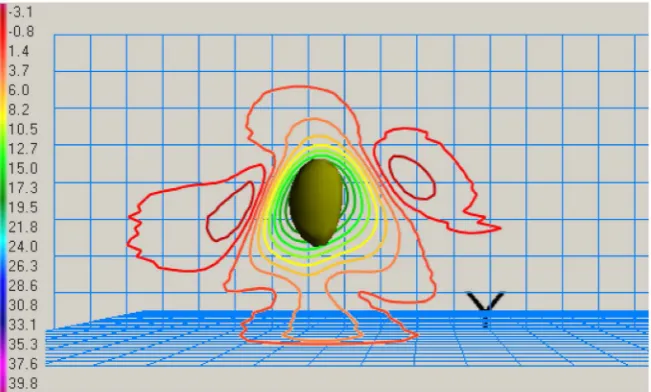
isolines of vertical velocities in the cloud and near cloud are shown in a vertical plane passing through the center of the cloud along the axis OX. The figures correspond to 20 and 30 min of the evolution of the cloud. It can be noted that the velocity field of the ascending and descending air currents has a rather com-plex structure, and, as can be seen in the figures, over time it changes noticeably and becomes more complex.
At the same time, the shape of the zone of upflows in the cloud and its incli-nation to the OX axis change more slowly with time. As for the vertical move-ments of air around the cloud, the figure shows that the structure of the velocity field of vertical air currents has undergone significant changes. Firstly, in the course of the evolution of the cloud, the area covered by the ascending and des-cending movements of the air expanded significantly, and secondly, the velocity field structure of these movements became noticeably more complex. As for the maximum values of the velocity of vertical airflows in the cloud, they remain relatively small—17.9 m/s for 20th min. and 12.8 m/s for 30th min of the cloud evolution, i.e. there is a slight decrease in the value of this parameter. Figure 4
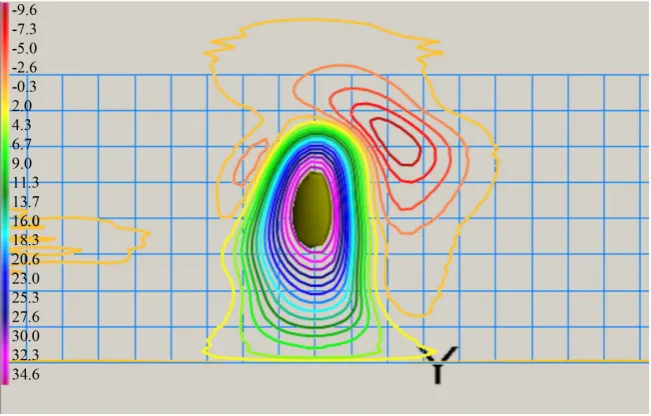
[image:7.595.212.538.490.686.2]and Figure 5 show the isolines of the rate of ascending and descending air movements in and around the cloud at the same time in the same vertical plane passing through the center of the cloud along the axis OX. But calculations were made for the model structure of the wind field in the atmosphere, i.e. for the case when the direction of the wind velocity vector at all levels coincides with the di-rection of the axis OX. In dark colors, the isosurfaces corresponding to the ve-locities of the ascending currents W = 35.0 and 34.1 m/s are identified in the figures. Comparison of Figure 4 and Figure 5 shows that the structures of the vertical air movement fields at the points in time under consideration differ markedly, and there is also a noticeable increase in the rate of descending air movements. As for the structure of the field of vertical air movements, one can
Figure 4. Isolines of different values of the upflow velocity and isosurface W = 35.0 m /s
DOI: 10.4236/acs.2018.81006 91 Atmospheric and Climate Sciences
Figure 5. Isolines of vertical stream velocity and isosurface W = 34.1 m/s in the vertical
plane (30th min).
notice a significant change in it: the descending air currents in the considered plane under the influence of wind in the atmosphere are localized for 30th min in the upper part of the cloud and on its leeward side.
Comparison of Figure 2 and Figure 3 with Figure 4 and Figure 5 shows that the velocity fields of vertical air movements around the cloud corresponding to different structures of the wind field in the atmosphere differ qualitatively: the structures of vertical air movements in the cloud and near-cloud space corres-ponding to the real structure of the wind in the atmosphere, are noticeably more complex. As for the maximum rate of ascending airflow in the cloud, attention is drawn to the fact that the values of this parameter at the points of time corres-ponding to the model structure of the wind field in the atmosphere are signifi-cantly higher than its values corresponding to the actual structure of the wind field in the atmosphere.
DOI: 10.4236/acs.2018.81006 92 Atmospheric and Climate Sciences
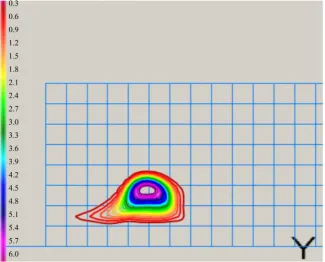
field in the atmosphere. In this case, the water content in the cloud is localized in the region of ascending currents, which agrees with the theory of formation of the liquid-drop fraction in the cloud, and the level of localization of the in-creased water content may change with time depending on the rate of ascending currents. The region of localization of glaciation is located at higher levels in comparison with the region of localization of droplets. It is important to note that these areas may overlap depending on the stage of the evolution of the cloud. As an example, Figure 6 and Figure 7 show isolines of water content at the 20th min of the cloud evolution, corresponding to the real and model struc-tures of the wind field in the atmosphere.
The figures show that the water-localization zones corresponding to different wind structures in the atmosphere differ qualitatively. Significantly, the values (including the maximum) of this parameter are also different. Comparison of the figures shows that in the case of the model structure of the wind field in the atmosphere, the size of the region of localization of water content in the cloud, as well as its values, is much larger than in the cloud evaluating in the atmos-phere with real wind field structure. In Figure 7, it can be seen that the isolines of water content reach the surface of the earth, i.e. in the case of the model structure of the wind field in the atmosphere, precipitation is observed in the cloud. This is explained by the fact that in connection with the more intense air-flow in the cloud in the case of the model structure of the wind field in the at-mosphere, the formation of precipitation particles also becomes more intense.
[image:9.595.211.537.445.707.2]W = 35.0 m/s against the background of the isolines of water content in the vertical plane (20th min).
DOI: 10.4236/acs.2018.81006 93 Atmospheric and Climate Sciences
Figure 7. The isosurface of the vertical component of the velocity. W = 35.0 m/s against
the background of the isolines of water content in the vertical plane (20th min).
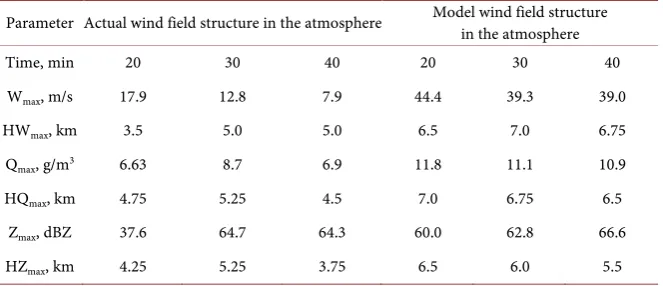
The obtained results were supplemented with the results of calculations of the maximum values of the cloud parameters at different instants corresponding to different wind field structures in the atmosphere. These parameter values also give useful information about the effect of the wind field structure in the at-mosphere on the formation and evolution of clouds. Table 1 gives the maximum values of the main cloud parameters obtained as a result of calculations. The following designations are used in the table: Wmax, Qmax and Zmax are the maxi-mum values of the rate of air upflows and water content in the cloud, and also the reflectivity, HWmax, HQmax and HZmax are the levels at which these characte-ristics are located. It can be seen from the table that the maximum values of the velocity of air up flows Wmax at all stages of the cloud evolution are much larger in the case of the model structure of the wind field in the atmosphere, i.e. in the case when the interaction of the cloud with the surrounding atmosphere is less intense. Accordingly, the heights in which these characteristics are located in the cloud are noticeably higher in this case than in the case of the actual structure of the wind field in the atmosphere. As it is known, the importance of water con-tent plays an important role in the formation and evolution of clouds. It can be seen from the table that the maximum values of this parameter at all times are much larger and located higher in the cloud evaluating in the case of the model structure of the wind field in the atmosphere. In the same way, the maximum glacier values behave in relation to the structure of the wind field in the atmos-phere.
DOI: 10.4236/acs.2018.81006 94 Atmospheric and Climate Sciences
Table 1. The maximum values of the cloud parameters corresponding to different variants of the wind distribution in the atmosphere.
Parameter Actual wind field structure in the atmosphere Model wind field structure in the atmosphere
Time, min 20 30 40 20 30 40
Wmax, m/s 17.9 12.8 7.9 44.4 39.3 39.0
HWmax, km 3.5 5.0 5.0 6.5 7.0 6.75
Qmax, g/m3 6.63 8.7 6.9 11.8 11.1 10.9
HQmax, km 4.75 5.25 4.5 7.0 6.75 6.5
Zmax, dBZ 37.6 64.7 64.3 60.0 62.8 66.6
HZmax, km 4.25 5.25 3.75 6.5 6.0 5.5
parameter is reached at the 30th min, and in the second case, an increase in this parameter is observed throughout the considered period of time. In addition, the maximum reflectance value is almost always greater in the case when the direc-tion of the wind does not change with altitude. This indicates that in the case of the model structure of the wind field in the atmosphere, the processes of preci-pitation formation are more intense.
4. Conclusions
A new round of research in cloud physics, connected with the study of the sys-tem properties of clouds, is beginning.
The next stage of the development of this scientific direction should be fo-cused on studying the influence of such structure-forming factors, the tion of processes in the clouds (emergent properties of clouds), and the interac-tion of clouds with the surrounding atmosphere (hierarchy property). Studies on these and other areas of the development of cloud physics and active effects on them are possible only on the basis of numerical modeling using full three-dimensional and specially constructed cloud models.
The results of numerical experiments have shown that the structure of the wind field in the atmosphere, which is one of the mechanisms of interaction of clouds with their surrounding atmosphere, has a significant influence on the formation and evolution of clouds. These results can be used in forecasting me-thods of hazardous weather phenomena accompanying convective processes in the atmosphere.
Conflict of Interest
The authors declare no conflict of interest.
References
DOI: 10.4236/acs.2018.81006 95 Atmospheric and Climate Sciences [2] Ashabokov, B.A., Fedchenko, L.M., Shapovalov, A.V. and Shapovalov, V.A. (2017) Physics of Clouds and Active Influences on Them. LLC Printing House, Nalchik, 240.
[3] Volkova, V.N. and Denisov, A.A. (2006) Theory of Systems. High School, Moscow, 511.
[4] Mesarovich, M., Mako, D. and Takahara, I.M. (1978) Theory of Hierarchical Mul-ti-Level Systems. Mir, Moscow, 311.
[5] Abshayev, M.T., Goral, G.G. and Malbakhova, N.M. (1987) Forecast of the Hail Process Type. Proceedings of the High-Mountain Geophysical Institute, No. 67, 72-79.
[6] Kovalchuk, A.N. (1969) On the Influence of the Wind Shear on the Fall of Hail.
Proceedings of the VGI, Leningrad, No. 14, 39-48.
[7] Malbakhova, N.M. (1990) Interrelation of the Structure of Hail Clouds with the Vertical Structure of the Wind in the Atmosphere. Proceedings of the High-Mountain Geophysical Institute, 80, 99-106.
[8] Newton, C.U. (1964) Hydrodynamic Interaction with the Surrounding Wind Field as One of the Factors of Development of Cumulus Clouds. Dynamics of Cumulus Clouds. Mir, Moscow, 187-201.
[9] Pastushkov, R.S. (1972) Numerical Simulation of the Interaction of Convective Clouds with Their Surrounding Atmosphere. Proceedings of the Central Aerologi-cal Observatory (CAO), No. 108, 93-97.
[10] Pastushkov, R.S. (1969) On the Development of Cumulus Clouds in an Atmosphere with Vertical Wind Shear. Meteorology and Hydrology, No. 4, 26-41.
[11] Fedchenko, L.M., Goral, G.G., Belentsova, V.A. and Malbakhova, N.M. (1991) Dangerous Convective Phenomena and Their Forecast in Conditions of Complex Relief. Gidrometeoizdat, Moscow, 425.
[12] Ashabokov, B.A. and Shapovalov, A.V. (2008) Convective Clouds: Numerical Mod-els and Simulation Results in Natural and Active Environments. Publishing house of Kabardino-Balkarian Scientific Center of Russian Academy of Sciences, Nalchik, 257.
[13] Ashabokov, B.A., Fedchenko, L.M., Kupovikh, G.V., Shapovalov, A.V., Skorbezh, N.N. and Shapovalov, V.A. (2012) Model of a Convective Cloud with Allowance for the Influence of Physical Processes on Its Characteristics. News of Higher Schools, North-Caucasian Region, Series: Natural Sciences, Rostov-Don, No. 6, 58-62. [14] Ashabokov, B.A., Shapovalov, A.V., Kuliev, D.D., Prodan, K.A. and Shapovalov,
V.A. (2014) Numerical Simulation of Thermodynamic, Microstructural, and Elec-tric Characteristics of Convective Clouds at the Growth and Mature Stages. Radio-physics and Quantum Electronics, 56, 811-817.
https://doi.org/10.1007/s11141-014-9483-z
[15] Ashabokov, B.A., Kuliev, D.D., Prodan, K.A., Shapovalov, A.V. and Shapovalov, V.A. (2012) Some Results of a Numerical Study of the Formation of Thermody-namic, Microstructural, and Electrical Characteristics of Convective Clouds. Re-ports of VII All-Russian Conference on Atmospheric Electricity, St. Petersburg, 4-28 September 2012, 31-33.
DOI: 10.4236/acs.2018.81006 96 Atmospheric and Climate Sciences [17] Ashabokov, B.A., Shapovalov, V.A., Ezaova, A.G. and Shapovalov, M.A. (2014) In-vestigation of the Formation of the Ice Phase in High-Power Convective Clouds Based on a Three-Dimensional Numerical Model. Natural and Technical Sciences, No. 5, 78-83.
[18] Shapovalov, A.V., Shapovalov, V.A, Ezaova, A.G. and Prodan, K.A. (2013) Model-ling of the Spectra of Particles in Convective Clouds with Mixed Phase Composition and Radiative Properties. News of Kabardino-Balkarian Scientific Center of Russian Academy of Sciences, Nalchik, No. 5, 63-72.
[19] Ashabokov, B.A., Fedchenko, L.M., Shapovalov, A.V. and Shoranov, R.A. (1994) Numerical Studies of the Formation and Growth of Hail with Natural Development of the Cloud and Active Influence. Meteorology and Hydrology, No. 1, 41-48. [20] Ashabokov, B.A., Kagermazov, A.K., Shapovalov, A.V. and Shapovalov, V.A. (2016)