Skotty
Student s1009281 Pauline Simons Industrial Design Bachelor assignment University of Twente Oude Drienerloweg 5 7522NB Enschede-Noord
Co-operation with Philips Innovation Services High Tech Campus 5 Eindhoven
Exam committee
Preface
T
his report contains the documentation of the nal bachelor assignment, part of the study Industrial Design at the Univer-sity of Twente. is assignment consists of performing a case in co-operation with a company to apply the knowledge and skills regarding to Industrial Design in a practice. During the training these knowledge can be widened, deepened or specialised. e student shows that she is able to work systematically and planned. She communicate adequately with mentors and she has enough re ective skills to operate in a professional eld. Secondary objectives are the introduction with the future eld and the off ering of clues for the master choice.
In this preface my appreciation goes out to Mike Schavemaker (Philips) and Maarten Bonnema (University of Twente). ey were my mentors during the whole internship and alerted me often of environmental aspects that may be important.
I also would like to thank a few employ-ees of Philips in particular; Leontien de Roode, Arthur van Es, Jeanine Kierkels, Wouter Henderickx and Sandro Prueser for their help on very diverse topics. Dr Ma and his medical car team, Manish Kumar Singh and Ramesh Kumar shared very interesting information about the current way of working in the healthcare sector in India and China. I would like to thank them.
Proem Summary Introduction
1. Purpose and scope Purpose Scope setting 2. Contextual analysis
Geographic areas Diagnostic technologies Current form factors Components Integration Materialization Conclusion 3. User analysis
Non-governmental organisations Interviews
Use cases Work ow Requirements Modular components 4. Concept creation
Architecture Function diagram Sketches
Concepts
Selection of concept Conclusion
T
he purpose of the bachelor assignment is to perform a project in co-operation with a business in a professional eld. is assignment is performed at the company Philips. e project that is worked on is the Skotty. e purpose of the Skotty is to develop a kit with a combination of diagnostics and communication equipment. e Skotty is easy to carry, easy to operate and includes a method to be able to set up a communication with someone at another location. is form factor has to be designed to persuade the client that this product has the potention of to be developed. e form factor prototype can be used in communication with the target group to nd their user requirements. e Skotty will be used by nurses and technicians in the remote areas of China and India. In these countries is a growing economic middle class but the healthcare providing falls behind. ere are good healthcare possibilities for the population in urban areas but the inhabitants of the rural regions are not able to use those.
e Skotty consists of existing Philips’ technologies, available in three con gurations:
- Basic diagnostics (weight scale, blood pressure meter and glucose meter) With these technologies the body mass index, hypertension/cardiovascular diseases and diabetes can be diagnosed. - Advanced diagnostics 1 (X-ray)
With these technology a scan of the chest and bones can be performed. Diseases like tuberculosis (TB) can be diagnosed with the X-ray scan.
- Advanced diagnostics 2 (Ultrasound) e ultrasound module is used for obstetrics, to perform an echo. (not researched in this assignment)
ese diagnostic technologies can be xed on a standard platform. In this platform a battery, a tablet and a LED camera light are present. e battery, powers and chargesthe other components. e tablet can connect to a 2G/3G/WiFi network. is opens the possibility to set up a connection with a doctor or specialist at another location.
If there is no coverage of 2G/3G/WiFi and the technician/nurse needs a second opinion, a satellite module can be added. With the aid of this module, there can be set up an encrypted connection via satellites.
e basic diagnostic con guration will be used by healthcare workers of non-governmental organisations or nurses in a community health center (CHC) in China. ey often have little medical knowledge. With the aid of the Skotty they can perform the measurements themselves and ask a second opinion of a doctor at another location.
e X-ray module can be used by technicians in mobile hospitals such as the medical car in China. is car is part of the provincial hospital and provides TB diagnoses and treatment in rural villages. ere is already X-ray equipment in the car but it has two problems: it takes one hour to develop the lm and there are few well-educated doctors who are able to interpret the lm. With the Skotty the technicians are able to share the images with a centralised specialist to diagnose the patients.
In these ways, the work of the doctors will be more effi cient because he can diagnose all the patients in the region from one location.
e form factor of the Skotty is like LEGO: there is a platform where the modules can be xed on. is form factor does not meet the size requirement yet, because of the use of existing technologies. e basic diagnostics can be placed in a backpack, to make it seem less expensive and to carry it easily. e X-ray module has two handles to carry it with two persons. It is too heavy for one person. e interface is not developed, it is important that this is easy to use, nurses does have just a little training.
I
n this report the bachelor assignment of Pauline Simons is discussed. e assignment is performed by Philips Electronics NV in Eindhoven. is company mainly develops products and markets for healthcare, lifestyle and lighting. rough innovation they try to improve the quality of consumer live. ey integrate the newest technologies and designs in human centered solutions. e topic of this report is the Skotty. is concept is focused on the combination of modular diagnostic equipment and communication devices in one compact product. e principles of this concept are easy to carry, easy to operate and it must consist of modular technologies. It must be possible to set up a communication with a specialist. With these features it is an useful appliance for medical caregivers in remote areas. is report will start with the purpose and scoping of this assignment and it ends with a design and recommendations to improve it.
e second chapter describes a contextual analysis to frame the target group, the current form factors, the materialization and the potential diagnostic possibilities in the portfolio of Philips, followed by an explanation of the applications of these technologies. Finally, there is the construction of the Skotty, an integration and a conclusion.
In the third part, the analysis is expanded with the users: the target users are non-governmental-organizations (NGOs). e vision and way of working of (mostly Dutch) NGOs are investigated and selected on the criteria that they provide healthcare in China/India/mobile hospitals. Another part of the target users are the local general practitioners (GPs), village doctors, nurses and technicians. Followed from interviews with a few NGOs, use cases and the work ow of diagnosing a patient in a community
health center (chc) and in a medical car are illustrated. e information learned from the interviews is composed to a list of requirements. As a synthesis for the next chapter, working with the modular components is explained.
In contrast with the previous chapters which were largely theoretical, in the fourth chapter more practical activities are used. Based on the information of earlier chapters, an architecture of the whole system and its subsystems is presented. A function schedule follows the architecture . e functions of the diff eren modules are charted and linked with each other. Furthermore, a number of drawings of possible products is made, with regard to the technological aspects. ese drawings are extended in three concepts. e best concept is selected by testing using the requirements from the previous section.
In the fth chapter the best concept will be further detailed. e platform and each module will be explained. Not only the form is visualised, also the implementing in the current work ow in India and China will be described.
In the evaluation chapter the concept will be tested: does it meet all the requirements? Each requirement is provided with an argumention whether it is met or not.
e report will nish with a conclusion and recommendations for the further development of the Skotty.
This
report is about a bachelor assignment at Philips Electronics NV in Eindhoven. In this chapter is described what the purpose of this assignment is. e framework about what this assignment means and what is disregarded is also explained.Purpose
Philips has the aim to improve the quality of people’s life by focusing on healthcare and welfare. By means of innovations on these areas, they would like to make the world healthier and more sustainable. eir purpose is to improve the life of three billion people in 2025.
e Skotty concept ts this purpose, so it is important to investigate the market and the (technological) possibilities of Philips. e purpose of this bachelor assignment is to develop a detailed concept of the Skotty with a clear view of how which modular technologies will be integrated. is will be done by analyzing the existing Philips’s technologies and their requirements. Another important part is analyzing the users, volunteers of non-governmental-organizations, but also doctors, nurses and technicians working in remote areas to hunt down the user requirements. In this assignment, one compact product will be developed with the technologies that are necessary. By means of drawings it will be visualized. Finally there will be made a prototype using rapid prototyping technologies. With the prototype and recommendations Philips can be recommended why the company must provide a budget and continue with developing the Skotty. Furthermore with the recommendations Philips can learn on which points the concept can be improved.
Scope setting
Skotty is a complex product because it has functions and requirements in diff erent areas of technology. e Skotty includes a diagnostic part, a communication part and a software part. e project will be too wide if all aspects have to be elaborated, so a selection has been made.
e purpose of the project is to design a compact form factor to show how the
module principle works. is means the technologies have to be chosen, the target users have to be found and asked for their opinion. e work ow of the target users has to be elucidated, so it is possible to see the gaps and the opportunities for the Skotty. en a compact, easy to carry form factor has to be developed which includes the components that were found as necessities. is form factor will be translated into a prototype.
e diagnostic technologies, the
communication module and the platform do not have to work in this prototype. e software that links the modules and the platform with each other and the
specialists/doctors will be developed by another department. It is interesting to have a little research about the material options, but the production method of that material in a production process is not part of this assignment. e interface on the tablet display is also no part of the assignment. ere are some recommendations about it.
ere is also a nancial aspect regarding to the Skotty. For the non-commercial companies the prices have to be as low as possible and maybe there is an opportunity for a service structure. For the commercial markets the product may be more expensive, so that the Skotty is not only a contribution to the goal of Philips but also a nancial advantage. is nancial and service aspect will not be a part of this assignment.
T
he target group of the Skotty can be divided into two categories: the commercial users and the non-commercial users. A few examples of a commercial usage are on an airplane, a ship and an oil rig. With commercial users non-governmental organizations (NGOs) are meant. e circumstances in which the non-governmental organizations do their work are mostly very critical, worse than that of the commercial users. e critical circumstances form the challenge for the Skotty and so the workers of the NGOs are taken into account in designing the Skotty. is chapter contains a research to select the geographic areas where the NGOs provide healthcare, the materials and the diagnostic technologies. e current medical suitcases are researched to learn where is the gap in this product sector. e components of the Skotty will be elucidated. At the end of this areas of analysis, there is a conclusion with the most important ndings.
Geographic areas
In short the Skotty is a rst aid box for the 21th century. In addition to the primary care kit, employees in rural areas can diagnose the ill people of the population. ere are a lot of rural areas over the world each with their own cultural characteristics. In the beginning it is tactical to implement the Skotty in a region with a growing middle class. is gives opportunities to get a better view of the healthcare situation at that moment. By taking advantage of this network it is easier to contact the local physicians or nurses. Also the poor people are reached better. A lot of African countries are less developed and it is diffi cult to contact the users. In this case the medical structure is unknown and therefore it is not clear how the Skotty can t in the work ow. China and India have a growing middle class ( gure 2.1) and are appropriate
countries to develop the Skotty for. e opportunities for expansion to other countries will be opened.
Both of India and China, the healthcare situation is described below.
Figure 2.1: middle class of India [1]
India
e healthcare in India [1] is one of the biggest sectors and it is still growing. is is because India is located in a vicious circle: because of the increase of the population the healthcare sector expands continuously and through the better healthcare providing there are less infant mortalities and the people live longer: the population grows.
A big part of the Indian population lives in rural areas, 25% even below the poverty limit and 300 million of children have malnutrition. e incomes in India are unfairly distributed: the average income was $620 in 2005, while more than 150 million people earned more than $1.000 a year. Businessmen earned even more: $20.000 a year! So India can be split up in two parts: 25% of the country can enjoy the healthcare on western level against 75% who is living from traditional medicine. Only 11% of the Indian population has insurance.
Diseases such as polio and tetanus are under control in the meantime, but earlier diseases as hepatitis and malaria became resistant to the medicines and emerge more frequently.
Figure 2.2: the prices of health treatment [1]
Figure 2.3: collage of the Indian Healthcare
Figure 2.4: the healthcare pyramid of India [2]
with modern devices and well educated medical personnel. e consequence is that much people from abroad visits India and uses these facilities, called medical tourism. Not only the modern devices are interesting, the western visitors are also curious about the alternative medication. Beside the enormous growth in the healthcare sector; the pharmaceutical market is also increasing. International companies show more and more interest in India.
Figure 2.3 shows a collage of the Indian
healthcare to get an impression.
[image:9.595.65.250.383.596.2]TB symptoms are referred to these centers by the lowest level doctor.
ere are also non-governmental organizations that work in India and provide healthcare on-site. Beside the Damien foundation, the SMILE foundation works on the improvement of healthcare. is organization has a special program called ‘‘SMILE on wheels’’. As the name already mentioned, it is about a mobile hospital in a van. e mobility of the van is very high so the poorly accessible people can also be reached. ese poorly accessible people prefer to come to the mobile hospital instead of the corporate hospital.
China [3]
Between 1978 and 2003, the gross domestic product (GDP) in China has increased from 378 till 9101 Renminbi (RMB is Chinese yuan; $60 - $1438). is is an enormous growth with many economical consequences for China. However, the healthcare is an important aspect that has been ignored during the economic growth and is now far behind the development of the country. e government admits the immense gap between the demand for health, the opportunities of the healthcare insurances and the off er of the healthcare. e aim for the next years is to close this gap.
Figure 2.5: distribution of healthcare beds and personnel in urban and rural areas in China. [3]
As shown in gure 2.5, in China it is quite obvious that the majority of the healthcare equipment and personnel is in urban hospitals, while 70% of the population lives in the rural areas: the devices that China has are not well divided.
Hospitals get a subsidy of 10% from the government. e rest they get for example
from the sales of medicines. e results of this are not only increasing prices of medication but also patients that are prescribed an overdose of medicines. is counteracts the improvement of the healthcare sector.
e education of the physicians fails regularly: mostly they have had medical education for only twenty months. Good doctors are less present in rural areas and it does not work to attract physicians to that regions.
A third problem is the use of diff erent data systems in each hospital so it is diffi cult to monitor the patients. e existing healthcare services and their facilities are represented in gure 2.6.
Figuur 2.6: Mechanisms of the diff erent healthcare services in China. [3]
rough the increase in the urbanization the diseases of the people change from infection diseases to non communicable diseases such as heart infarcts. ese patients bene t from acute assistance; if it takes long it can be too late.
[image:10.595.346.542.563.765.2]Figure 2.7 shows a collage of the Chinese healthcare to get an impression of the situation there.
Figure 2.7: Impression of the Chinese healthcare.
Figure 2.9: Work ow in the CHC
Figure 2.8 shows the hospital pyramid of China. e lowest level of healthcare providers consists of the CHS (community health system in urban areas) and the village clinics (rural areas). e inhabitants of China do not trust these doctors and therefore they mostly skip them and visit the CHC or district/county level hospital directly. is is because of the Chinese grades; the village doctors are often appointed by Mao Zedong. e knowledge of these doctors is minimal and the government nances these village doctors for only ten percent. As a result, the doctors gain the most of their income through the sale of medicines. Also it happens that if they do not know the disease, they provide (an overdoses of ) medicines to have an income.
e work ow for patients when they arrive at the Community Health Center
(CHC) is shown in gure 2.9. is is very ineffi cient for the patient. Especially during the peak times (in the morning) the visit takes much time. e equipment that is present in the CHC is basic diagnostics. ey are focused on chronic diseases and elderly so there are for example a blood pressure meter, an ECG (electrocardiogram) and a thermometer. If the patient has complaints that cannot be explained by this equipment, the CHC doctor refers him/ her to a higher level hospital.
ere are also non-governmental organi-zations working in China. Some organizations provide healthcare. One of them is the Damien Foundation which has its origin in Belgium. is organization focuses on the control and treatment of tuberculosis (TB). To perform this mission they support the medical car team: for example the provincial hospital in the region of Qinghai has one medical car available. is province has a surface of 721 000 km2 and 5 627 000 inhabitants. e medical car travels from the province hospital to the rural areas. e car stays for a few days at that location and acts as a TB clinic. e local population can be diagnosed and treated in the car.
Comparison
In both India and China there is a growing economical middle class. ere is good, well developed healthcare in both countries but it is not available for the whole population. e good healthcare centers/ hospitals are often located in the urban areas, while the biggest part of the population lives in rural areas.
e diseases that often appear in China are chronic diseases. is can be explained by the air pollution and smog in the big metropolises. In India the infection diseases occur more often. An explanation therefore can be found in the bad hygienic circumstances.
During the design of the Skotty, these diff erences can be taken into account. e Skotty must be hygienic, it has to be easy to clean. e complaints of the Indian patients are probably very diverse. For China it is important to know that the patients will visit the nurse more often with the same complaints, so the nurse’s experience about these complaints grows.
Current form factors
Suitcases are well-known phenomena in the medical world. In this paragraph a few suitcases which provide healthcare are described.
e primary care kit can be found in almost every household and public building. In this kit materials and equipment for
treatment such as bandages are included. It is shown in gure 2.10.
Figure 2.10: Standard primary care kits
A village doctor in China has a slightly more advanced suitcase. Devices for treatment still are in this case, but there is for example also an analog blood pressure meter. As shown in gure 2.11, this suitcase is very outdated, but the doctor is able to diagnose a lot of diseases because of the amount of diff erent tools.
Figure 2.11: Suitcase of a village doctor
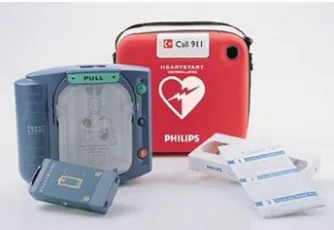
Philips itself has also developed a medical suitcase: the AED (automatische externe de brillator) ( gure 2.12). is de brillator is a good example for the Skotty. It is a small portable package especially and can be used by anyone. Even the inexperienced of the population must be able to use it correctly. An important diff erence is, compared to the primary care kit and the suitcase of the village doctor, that with this product only one disease can be treated: heart diseases.
diseases can be diagnosed. e nurse has to put the manchet around the upper arm of the patient. en this manchet has to be pumped full. After rising a certain pressure, the manchet can be blanked slowly and the blood pressure can be measured. e blood pressure meter has four rechargable batteries of 1.5 Volt. is is equal to 1500 measurements.
e module of the blood pressure meter consists of three components; the blood pressure meter itself (130x155x84mm, 355gram), the manchet (foldable, 140x50x50 mm, 135 gram) and a stethoscope (200x80 (diameter), 80 gram. In gure 2.14 the blood pressure meter, the manchet and the stethoscope are shown.
Figure 2.14: Blood pressure meter, manchet and stethoscope [5]
Glucose meter
e glucose meter allows the nurse to diagnose patients with diabetes. e nurse punctures with a needle in the patients nger tip. e blood drop that is caused by the prick will be collected on a test strip. is strip is inserted in the glucose meter. is glucose meter measures the amount of glucose in the blood of the patient. e components that are necessary to perform a glucose measurement are the glucose meter, the sampler, the needle, the test strips, the plasters, the needle container and a wire to connect the glucose meter with the tablet. e total dimensions are 120x90x25mm. ( gure 2.15) [5]
[image:13.595.70.237.50.165.2]Figure 2.15: Glucose meter [5] Figure 2.12: e Philips AED
Diagnostic technologies
In the portfolio of Philips Healthcare are just a few very interesting technologies. Most of the Philips technologies are not suitable because for example the size as in the case of MRI. A list of all the technologies can be found in appendix 1. ree technologies or combinations are selected as appropriate. ese can be divided in two categories, basic diagnostics (weight scale, blood pressure meter and glucose meter) and advanced diagnostics (X-ray and Ultrasound).
Basic diagnostics
e basic diagnostics that are in scope for the Skotty are a weight scale, blood pressure meter and glucose meter. ese technologies are meant for monitoring the patient. Diseases as diabetes or a low/high blood pressure can be detected with these diagnostic devices.
Weightscale
With the weight scale it is possible to diagnose patients that have overweight. It is a very simple tool. e nurse has to lay the weight scale on the ground and the patient stands on it. e weight scale has four rechargable batteries of 1.5 Volt. e weight of the person can also be read at the display of the weight scale. e dimensions of the weight scale are 230x180x20mm and it weights 1 kg. In gure 2.13 the weightscale is shown.
Figure 2.13: Weightscale [5]
Blood pressure meter
Advanced diagnostics X-Ray
e rst part of the advanced diagnostics is non-interventional X-Ray/digital radiography. In healthcare, digital X-ray is the name of a technology based on electromagnetic radiation. Compare it with visible light. Photons are sent by a machine through the body of the patient. A computer records the images of the scan. e white color represents the structures with a high density, because these will block most of the photons. It also represents metal and contrast liquids. e black parts are the structures containing air and the muscles, fat and uids appear gray[6].
With X-ray equipment a scan can be made of the whole body. It is not the meaning of the Skotty to make a full body scan so the designer chose in coorperation with Philips to make it a bit more speci c. ere are a lot of diseases that can be diagnosed by a chest or bone scan, so it is still widely applicable, such as tuberculosis. is disease often occurs in China. is kind of X-ray scans[7] will be performed by an X-ray technician who takes two views: the rst is posterior-anterior (through the chest, front to back) and the second is a lateral view (from the left to the right). e patient stands in front of the machine and has to hold his/her breath for a few seconds during the scan.
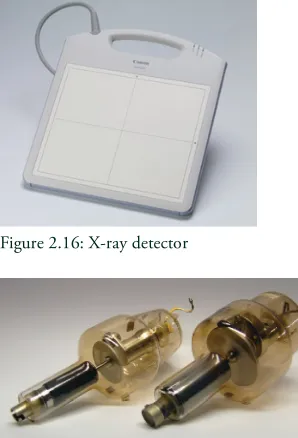
To perform an X-ray scan, there are seven components essential. e most known components are the tube and the detector, but also a grid, a collimator, a motorblock, an invertor and a generator are necessary. e dimensions of these components are listed below:
Detector: 230x180x10mm Grid: 440x460x10mm
Collimator: 180x159x235mm (5 kg) Motorblock + tube: 300x400x150mm (>35kg)
Invertor: 500x450x500mm Generator: 265x80x100mm (2kg)
[image:14.595.350.499.56.275.2]In gures 2.16 and 2.17 the detector and the tubes are shown.
Figure 2.16: X-ray detector
Figure 2.17: X-Ray tubes
An X-ray scan of the chest will be performed if you have any of these symptoms:
- a persistent cough; - chest injury; - chest pain;
- coughing up blood; - diffi culty breathing; - signs of tuberculosis; - signs of lung cancer; - other chest or lung diseases. With the X-ray technology diseases like the following can be diagnosed:
- collapsed lung;
- collection of uid around the lung;
- lung cancer/ tumor;
- malformation of the blood ves- sels;
- pneumonia;
- scarring of lung tissue; - tuberculosis.
Advanced diagnostics Ultrasound
In rural areas such as those in China and India there is a lot of infant mortality so this application of ultrasound is very interesting and will be focused on.
[image:15.595.301.570.322.497.2]During an ultrasound research, a special technician moves the device called transducer over a part of your body. To perform an ultrasound scan, there are two components essential: a transducer and a tablet to assimilate the information from the transducer and make this visible. e tablet of the platform can be used so the ultrasound module consists only of a transducer (185x75x55mm).
Figure 2.18: Ultrasound transducer
e transducer ( gure 2.18) emits sound waves. ese re ect on the tissues in your body. e transducer receives the waves that return. e images are made of these sound waves.
Obstetric ultrasound is a useful clinical test to:
- Determine the presence of a li- ving embryo/ fetus;
- Estimate the period of pregnancy; - Diagnose congenital malfunc
tions of the fetus;
- Evaluate the position of the fetus; - Evaluate the position of the pla-
centa;
- Determine the amount of preg- nancies;
- Determine the quantity of amni- otic around the fetus;
- Check the opening or shortening of the cervix;
- Judge the growth of the fetus; - Judge the well-being of the fetus. Components
In the previous section three diagnostic technologies are explained. e Skotty consists of these technologies but there are also other components. In this paragraph the construction of the Skotty will be
described. Platform
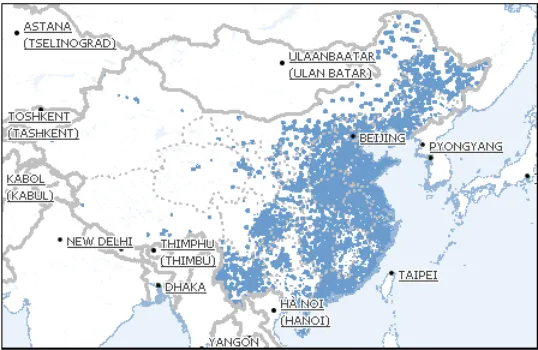
e Skotty will be built from a platform with diagnostic modules. e three diagnostic modules (basic and advanced diagnostics (2x)) are described in the previous section. e satellite module will be explained in the next subsection. e platform itself consists of a power supply, a LED camera pen and a tablet with a possibility to communicate via 2G/3G and WiFi. With the LED camera pen, the specialist in the hospital can have a look in the eyes of the patient. e focus areas for the Skotty are as mentioned earlier India and China. In gure 2.19 [9] the coverage areas of 2G and 3G in China are shown. Especially in the inland areas there is not much coverage.
Figure 2.19: the coverage areas of 2G/ 3G in China.
Satellite
To ll in the gap of the non covered areas, it is possible to add a satellite communication module to the Skotty. When there is no 2G/3G in the region and the nurse has to take a diagnose he/ she cannot interpret, he/she can communicate via the satellite with physicians/specialists worldwide. ere can be set up an encrypted connection, as used in the army. Telemedicine is also a possibility through the addition of this satellite module. Integration
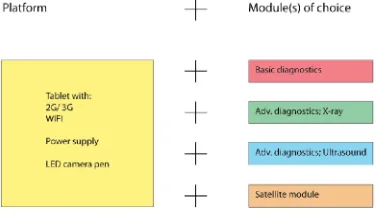
meter and glucose meter) and advanced diagnostics (dXr and Ultrasound). e platform itself consists of a power supply, a tablet and a device to communicate. Also applicable is the satellite module.
[image:16.595.117.305.157.264.2]In short, the structure of the Skotty can be described as shown in gure 2.20.
Figure 2.20: e structure of the Skotty
ere are two ways of communication. e local communication uses 2G or 3G and is integrated in the tablet. e world wide communication can be connected to by the satellite module and is applicable by both basic and advanced diagnostics, but most of the time it is not necessary by basic diagnostics and will not be taken because of its weight.
In theory it is possible to combine both basic and advanced diagnostics, for example if a weight scale and ultrasound are needed, but it is not the meaning of the Skotty. e power supply is not intended for those situations. In these cases a generator should be used.
e Skotty is meant for use in rural areas and the starting countries are China and India because of their growing middle class. e option for other countries remains open.
Materialization
e casing of the suitcase or backpack needs to meet a few important requirements. For example
- it has to protect the diagnostic and communicational devices inside the bag/ case against damage from falling
- it has to protect the diagnostic and communicational devices inside the bag/ case against all kind of weather.
- a dirty case in uences the appearance of the Skotty negatively so the material of the case has to be easy to clean.
- the material must be of good quality and must have a good price/ quality ratio. Good quality include that the material must have a durability of at least 10 years under normal circumstances and in all kind of weather.
With these requirements in mind, and with the help of Wim Poelman, there was searched for a suitable material. is results in the following materials:
Polypropylene pressed with long bers is material is used for bumpers of cars. It deforms a lot so it has a good cushioning. Side Impact Protection System (SIPS) is way of cushioning is well-known as it is often used in Volvo cars. In this case it can be made of cardboard with a plastic layer to protect it against water.
Expanded polystyrene (EPS)
is material is common named styrofoam. is material is interesting when we choose for a casing of two materials. e inside material then can be this EPS.
Expanded polypropylene (EPP) [10] is foam is widely known as ARPRO. Products made from ARPRO are durable, light weight and recyclable. It has excellent energy absorption and high strength properties. It is used for packages of Philips car lights. When these drop down, they are not damaged.
Nyrim [11]
Nyrim is a thermoplastic material, commonly used for its high shape stability over a wide temperature range (-40°- 140°C). It has an excellent impact strength and very high abrasion resistance. It may be too extreme for the Skotty.
Magnesium
is material has a very exclusive appearance and can be used for the casing together with for example Styrofoam. Ethylene vinyl acetate (EVA)[12]
weight, viscous, strong and cushioning. It is applicable with metal inserts. It will be squirted in a mold and after removing it from the mold, it is frothing a bit. e amount of frothing can be estimated reasonable well.
In conclusion, ethylene vinyl acetate seems a good opportunity. It has many positive characteristics, and thereby it can satisfy as a mono material, which is positive additional characteristic.
Conclusion
In this chapter the framework of Skotty is drafted:
- the users are healthcare providers in China and India
- the gap in the market is suitcase with tools to diagnose patients. Treatment tools are available, also in India and China.
- the diagnostic areas are patient monitoring, tuberculosis and obstetrics - the components and the structure of the Skotty are setted
- the potential materials are selected.
I
n this chapter, the NGO’s that are possible users for the Skotty are selected and explained. e NGO’s are interviewed about their way of working and their user requirements. To nd useful interview questions, use case scenarios are developed. ese use cases facilitate communication between the diff erent businesses in Philips/ NGO’s and me during for example the interviews e work ow of a patient aided by one of these organizations is illustrated and the requirements of these users are used for the list of requirements.
Another part of the analysis discusses the materials of the casing, the competitor research and the way of designing with modular components.
At the end of this chapter, the requirements will conclude the most important ndings. Non-governmental organizations [13] A non-governmental organization is an example of a non-pro t organization with the purpose of the improvement of human well-being. A NGO operates apart from the national government. In 2006 40.000 international NGOs were estimated. A list of NGOs that provide healthcare via sending physicians or erecting mobile clinics is composed. is list (appendix 2) contains the interesting NGOs for this project. e Skotty will contribute the volunteers of the NGOs a lot, so the NGOs are the target users. e NGOs not only work with employees, sometimes they also work with the local population. Interviews with diff erent educated medical workers decide on which level the Skotty can be used. Provisionally we call the user nurse. e medical knowledge of nurses is very varying. In this scenario, the nurse has little medical knowledge. e organizations that shared information during the development of Skotty are explained in the next subsections.
SMILE foundation[14]
In India, neglecting a simple preventive medical treatment can induce a more serious illness which can lead to death. e quality of the healthcare has to be increased until it meets the needs of the population and the awareness of the importance of good healthcare has to be improved. e smile foundation tries to improve these points via the smile on wheels-program. is is a unique mobile program that tackles problems about mobility, availability, accessibility of the primary care in rural areas.
AMREF Flying Doctors [15]
Flying doctors deploy all of her knowledge and expertise to catch the errors on medical facilities for example in the rural areas in Africa. Furthermore, they educate people about living healthy, but also about the medicines, safe drinking water and they distribute mosquito nets. ere are medical ights to hospitals in diffi cult accessible areas, where during the visits not only the sick people were helped but also the local caregivers were trained. is way, the local caregivers can continue their work when the ying doctors go home. Damien Foundation[16]
e Damien foundation combats lepra and TB in Asia, Africa and America. ey manage the healthcare on the long-term. ese diseases are dangerously contagious, so only cure is not enough.
India E-health[17]
E-health points provide families in rural areas with clean drinking water, medicines, understandable diagnostics and advanced telemedicine so that a doctor and modern healthcare can be applied in the village. Interviews
outcomes of the interviews are illustrated. e whole interview write-up can be found in appendix 3.
SMILE on wheels (India)
SMILE on wheels is a program provided by the SMILE Foundation. It contains a mobile hospital in a van that visits remote areas. e sequence of the visits is predetermined. e population prefers visiting the van compared to ‘normal’ hospitals because the distance and availability.
e van contains basic equipment but also X-ray. It is not focused on a special disease. e employees of the van are mainly interested in the communication part of the Skotty.
Tuberculose centers (India)
In a TB center a healthworker and a technician are working. e local village doctor refers patients with TB symptoms to these centers where the technician performs lab tests. Two times a week a doctor visits the center to have a consultation or examinations with the patients. He visits in the center during a half hour six patients. If the patient does not have TB symptoms, the doctor refers the patient back to the village doctor. If there are symptoms, the patient get treatment and if the doctor doubts, the patient is referred to a hospital to perform an X-Ray scan.
e doctor that visit these centers is not very enthousiastic about the X-Ray application, he prefers the lab test. e communication possibility is interesting in case of consultation, not in case of examination.
Medical car team (China)
In the province Qinghai in China the provincial hospital has a special medical car that visits the rural villages to provide TB diagnoses and treatment.
Five or six times each year this team makes a tour of twenty days along ten villages. e planning of this tour is based on the information from the village doctors. is village doctor has basic information about the patient as for example the blood pressure/glucose measure. Also information about the family and the disease history of the patient.
e technician in the car perfoms a lab
test of each patient. e doctor in the car interpret this test; if the test does not answer all the questions, the patient get an X-Ray scan. It takes one hour to develop the X-Ray scan to a lm. ere are just few doctors who are able to interpret this scan. e medical car team is very enthousiastic about the Skotty. Especially the X-ray application and the communication possibilities have many bene ts for the team.
Use cases
Based on the information of the interviews and the contextual analysis, four use cases are elaborated. On the following page ( gure 3.1) the situation of the basic diagnostics is illustrated in a use case. In appendix 4 the use cases of the other situations can be found. With these use case the idea of the Skotty can be explained easier and misconceptions can be avoided. e proceedings of the healthcare providers are one by one elaborated. e NGOs can probably recognize themselves in these scenarios and have a better understanding of how the product can be integrated in their work. With the scenarios feedback is provoked, to learn the real, detailed way of working.
Work ow
Based on the feedback and information extracted from the interviews there are two work ows to distinguish that have oppurtunities for the implementing of the Skotty. ese two work ows are shown in
< Figure 3.3: e work ow in a medical car
Requirements
With the information in the previous paragraphs and the interviews done with diff erent health care workers the requirements of the Skotty can be composed. ese requirements are listed by their origin. In appendix 5 each of the requirements is provided with a short explanation.
Environment
- e Skotty must provide primary care. - e product has to diagnose at least 50% of the frequently common complaints. - e usability of the product is very important. erefore, a nurse must be able to use the product after a short training.
- e product must be weatherproof. It will be used in diff erent areas of the world so it must resistant rain and temperature changes (-20 /+60 degrees Celsius[18] [19]).
- e product has to be resistant to ronmental factors such as sand and dust. - e Skotty may not look very expensive because of theft.
- e product price of the platform and the basic diagnostics may not exceed €500,00.
Patient
- e product must be hygienic. It is not allowed that the patient get an infection via for example blood residues of the vious patient.
- e appearance of the product must be friendly and intimate. e patient is not familiar with this product, so the product has to satisfy him/her.
- e product must be in the same style of design as other products in the Philips Healthcare line.
Technician/nurse
- e product must be safe and may not damage the nurse/patient.
- e language must be adjustable or sen by ordering.
- e interface must be consistent with the knowledge and experience of the nurse: most nurses cannot type.
- e interface must join the habits of the people living in remote areas.
- e product must be reliable. It has to work always and if the battery is low, it
has to give feedback about that. e data cannot be lost.
- e product must contain a second ion option.
- It must be possible to share patient data via the product with a person at another location. is person needs a computer/ tablet or smartphone.
- e Skotty must contain a tion module so a connection with a cialist can set up.
- e product must be easy to clean. It should be possible to clean the surfaces in one minute.
Use
- e product must be a compact kit. e dimensions of this kit with basic diagnostics must be less than 25x20x15 cm (based on the dimensions of the Philips AED).
- e product must be portable. is means that the weight of the product must be less than 5 kg.
- e product must be easy to carry. is means the user has at least one free hand. - e technologies must be modular. - e modules must be clicked on/off / changed in 10 seconds.
- e product must be accurate: the sion must be even high - or higher - as the individual products without Skotty. - e product must be ruggedized. If it is not operating and it drops down from the car/table/.. with a height of 1m, it must be undamaged. If it operates and it drops down from the car/table/.. with a height of 0,5m, it must be undamaged. Society
- Under normal circumstances, the uct must have a durability of at least ten years.
Modular components
module can order it at a central place. e modules must be easily to x on/ in the platform. erefore are a lot of ways to x the modules. ese ways are illustrated in appendix 6.
Later, during the concept development a few of these xation possibilities will be applied in the design to experiment which method or which combination of methods is the best.
I
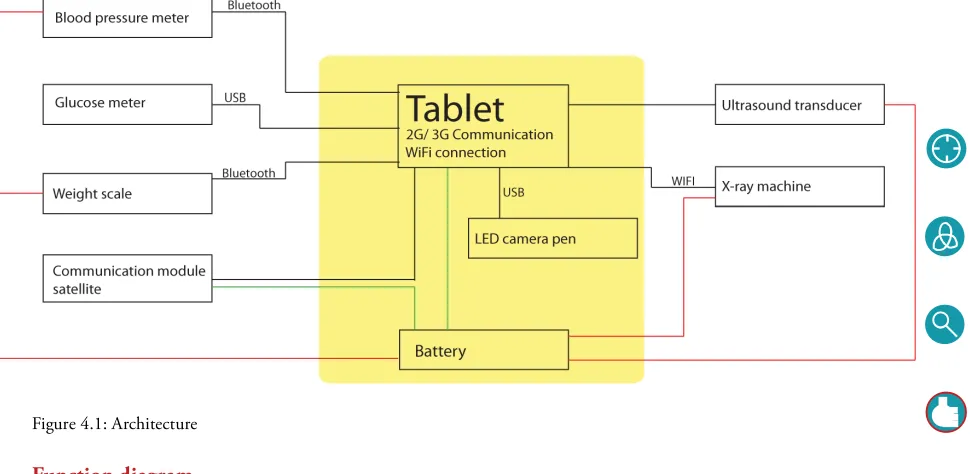
n this chapter the requirements of the Skotty will be transformed in a concept for the form-factor. Via an architecture, a function diagram and an amount of sketches, three concepts are created. ese concepts will be evaluated on the basis of the requirements found in the previous chapter. e best concept will be selected and elaborated in chapter ve. ArchitectureIn gure 4.1 is shown the architecture of the Skotty. In this diagram all the components of the Skotty and their relation with each other are displayed.
e black lines are communication interfaces, the green lines are constant connections with the power supply and the red lines are connections with the power supply to charge the component. e components with USB communication with the tablet are charged via that connection.
e components located in yellow square represent the platform.
[image:25.595.280.576.188.407.2]At this moment it is unknown how the satellite module and the ultrasound transducer are connected with the tablet.
Figure 4.1: Architecture
Function diagram
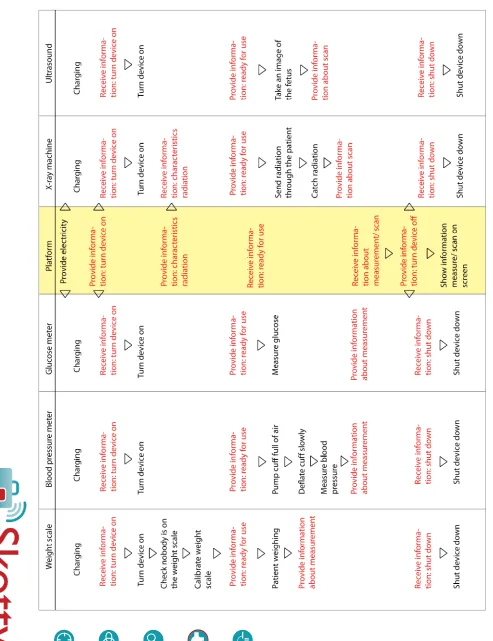
Each of the subsystems have its own functions. ese functions are at a number of moments related with functions of the platform. To get a clear view of this during the time, in gure 4.2 is shown the
function diagram of the Skotty. Sketches
In gures 4.3 en 4.4 a few sketches of the possible form factors with the modular components kept in mind are shown.
Figure 4.3: sketches
Figure 4.4: Sketches
[image:25.595.52.537.501.738.2]In this diagram are illustrated in red the information ows between the platform and the components. In black is displayed what the actions of the components are owing to the message of the platform.
Figure 4.4: Sketches
Concepts
From the sketches three concepts are developed. In this paragraph, the idea behind each of these concepts is described. e way of working in the eld and the advantages of each concept in the work ow are illustrated.
Concept 1
e rst concept is based on a briefcase. You can carry it vertically and very easily. While you use it, it has to lay horizontally on the ground or on a table. Large modules like the weight scale or the X-ray detector can be xed at the back side. e other modules can be layed in the foam in the case. is foam is exible so the size of the modules does not matter. Under the short ap, the power supply and an extra communication device (router) are located, in the large ap is inserted the display. e outside of the briefcase is made of cotton: this is easy to clean and makes the appearance of the product a bit less expensive. e building of this concept is illustrated in gures 4.5, 4.6 and 4.7.
[image:27.595.306.480.273.439.2]Figure 4.5: concept 1, during transport or in stock
Figure 4.6: Concept 1, when opening the ap and taking the modules you need.
Figure 4.7: Concept 1, showing the power supply and communication module. Normally, this ap in front is closed.
Note: the placement of the power supply in this concept appears not clever. When the suitcase is upright, it topples.
Concept 2
[image:27.595.75.219.615.695.2]against shocks.
is concept will be made of polypropylene, strengthened by pressed bers. Inside the suitcase there is Styrofoam.
Figure 4.8: Concept 2, because of its straigt form, the suitcase is easy to pile up.
Figure 4.9: Concept 2, most of the standard components are located in the upper ap.
Figure 4.10: Concept 2, the weight scale scan be placed between the two parts of the suitcase. e diagnostic modules can be placed in the lower ap.
Concept 3
Concept 3 is a concept which emphasized the modular principle. As shown in gures 4.11 and 4.12, the form factor contains of platform (red color) which is in all con gurations the same. On the platform
the modules can be xed via a simple click system. It is like LEGO. e nurse or technician determines the size of the case herself. If she takes just one module it is quite small, if she takes all the modules it will be bigger and heavier. It is not the purpose of the Skotty to take both basic and advanced diagnostics but if the nurse wants it, it is possible. In that case, a noti cation must be made to the power supply: this has not more power, so they can perform fewer diagnoses or they had to nd a generator to charge the power supply in the platform.
An addition by this concept is a bag of cloth where the case can be inserted in. rough this bag, the nurse can wear the case on her back. Another advantage of the bag is that it camou ages the modern, expensive product and protects it against theft.
e casings of the modules and the platform will be made of the material EVA as already described in the paragraph about materials.
Figure 4.11: Concept 3, the platform (red)with three diagnostic modules.
Figure 4.12 : Concept 3, the modules can be clicked on/ off easily.
[image:28.595.77.312.467.607.2] [image:28.595.359.532.564.697.2]Selection of concept
e requirements of page 23 are a bit shortened shown in gure 4.13. e author of this report has decided what are the scores of each concept (1=worst, 5=best) per requirement. Some requirements are for each concept the same or not yet developed and therefore these requirements do not have a score.
Environment Concept 1 Concept 2 Concept 3
Provide primary care. - -
-Diagnose at least 50% of the common complaints. - -
-A non-specialist must be able to use the product - -
- e product must be weatherproof. 3 4 5
e product has to be resistant to sand and dust. 4 5 3
It may not look very expensive because of theft. 5 3 5
e product price is maximal €500,00. 3 4 3
Patient
e product must be hygienic. 4 3 4
e appearance of the product must be friendly and intimate.
4 4 2
e product must t in the Philips Healthcare line. 2 4 4 Technician/ nurse
e product must be safe and may not damage the user.
- -
- e language must be adjustable. - -
- e interface must be consistent with the knowledge and experience of the user.
- -
- e interface must join the habits of the people living in remote areas.
- -
- e product must be reliable. - -
- e product must have a second opinion option. It must be possible to share patient data.
e Skotty must have a communication module. - -
- e product must be easy to clean. 4 5 5
Use
e product must be a compact form-factor, less than 25x20x15 cm
4 4 4 (can be 5,
depend on user) e product must be portable, the weight of the
product must be less than 5 kg.
5 5 4
e product must be easy to carry. 4 4 5
e technologies must be modular. 4 3 5
e modules must be clicked on/ off / changed in 10 seconds.
4 3 5
e product must be accurate. - -
- e product must be ruggedized. 3 5 5
Society
e product must have a durability of at least ten years
4 4 5
Total 57 60 64
Conclusion
As gure 4.13 shows, concept 3 meets the most requirements but the scores do not diff er much. Concept 3 loses relatively many points on the appearance of the Skotty, so there is a speci c point of interest to improve the concept.
5. Concept detailing
I
n the previous chapter concept 3, theconcept based on the LEGO principle, seems to have the most opportunities to develop more. In this chapter this concept will be further elaborated. is is done per component of the Skotty. It starts with the platform, followed by the basic and advanced diagnostics and ends with the satellite module.
Platform
e platform of the Skotty is in each con guration the same. e function of the platform is to display the results of the measurements or scans and to set up a connection with a doctor or specialist. In this paragraph the characteristics and appearance of the platform will be illustrated.
Components
e rst component of the platform is a tablet. On this tablet the results of the measurements and scans can be imaged and visualized for the technician. Furthermore, it is possible to communicate with the tablet via the local communication infrastructure (2G or 3G). It can also be connected to WiFi. On the tablet special software is installed to encrypt the information that is sent and received, to abuse prevention. e data of the patients is handled con dential.
Besides the tablet, there is also a power supply in the platform. is power supply provides electricity to the modules and the tablet. For some modules this is necessary to work, for others it is just for charging. is will be explained per module.
Another part of the platform is the digital pen camera with led light. With this pen the technician can make pictures of the patient, for example of the eyes. is camera is connected to the tablet via USB. Interfaces
All the modules can be connected with the platform to show the results. is can be done via diff erent ways:
Weight scale:
Bluetooth to communicate the results. Special plug for the electricity.
Blood pressure meter:
Bluetooth to communicate the results. Special plug for the electricity.
Glucose meter:
USB to communicate the results and charging.
X-ray:
e detector can communicate with the detector via WiFi. How the other X-ray components communicate is still unknown.
e X-ray machine has its own generator for electricity.
Ultrasound:
is is still unknown.
Special plug for the electricity.
e platform can also be connected by a local generator to charge the power supply. erefore is a special plug in the casing of the platform.
Formfactors
In this section concept 3 (chapter 4) will be further developed. A few more detailed opportunities for the design of the platform will be illustrated. An important note that must taken into account are the display: this must be visible and on the surface while operating, while transporting it must be protected.
e touch screen must be placed in the operating position under the right angle for the best visual quality. It must be supported at the back side, otherwise the screen ips.
Figure 5.1: Detailing concept A. One of the possible form factors for the Skotty platform.
Figure 5.2: Detailing concept B. One of the possible form factors for the Skotty platform
In chapter four is concept 3 chosen to be further developed. e exact form of this concept is not yet established. e LEGO principle is sure and with that aspect in thought, three opportunities for the platform-form factor are devised.
In gure 5.1 is shown concept A. In this concept the screen ips around a horizontal axis and can be moved to the position that is ne with the (sun) light. e standard position is against the bevelled edge, which supports the screen then. At the side is the LED camera light positioned. It is connected by a wire to the platform. Also at the side is a plug to connect a local generator to the Skotty for charging the power supply. Below the screen are USB ports for the connection with the diagnostic modules. e modules
Figure 5.3: Detailing concept C: One of the possible form factors for the Skotty platform.
can be clicked on this platform because of their wider outer edge.
In gure 5.2 is shown concept B. In this concept the screen ips round a vertical axis. A disadvantage is that the screen cannot be adjusted to a ne angle regarding to (sun)light.
e modules can be clicked on the platform with small hinges.
Figure 5.3 shows the third idea of the Skotty platform. In this concept the handle can be collapsed. en the screen ap in front can be ipped over the horizontal axis above at the platform. At the back side is a magnet, so if the whole system is tilted, it stands in a good angle to read the screen. e rest of the things are the same as by the concept A.
[image:32.595.61.311.42.452.2]as it consists of one part instead of a few accessories.
Final platform
[image:33.595.34.284.184.690.2] e nal form factor of the platform is illustrated in gure 5.4. e dark grey strip in the upper part of gure 5.4 shows the magnetic strip, which ensures that the platform does not topple.
Figure 5.4: e nal platform.
To avoid that the platform topple, the magnet has to be strong enough. e force of the magnet can be estimated by using the law of moments. At the front side the moment is 75mm x 39N, at the back side the arm is 10mm. erefore the force of
the magnet has to be at least 294N. In gure 5.5 the locations of the components in the platform are shown and in gure 5.6 the dimensions are applied. On the left side of the casing is an opening to insert the tablet and the power supply in the casing. ere is also a plug to connect the platform with a local generator. e Skotty is designed to use existing diagnostic technologies. e dimensions of these products are taken into account in the modules that are described in the next sessions.
e power supply in the platform is not chosen already and it is not clear which power supply have to be chosen. e size of the battery depends on the duration of the use and the power that is necessary per measurement/ scan. At this moment the maximum space for the power supply is 220x130x20mm.
Figure 5.5: e locations of the components in the plaform.
[image:34.595.67.533.409.811.2]Basic diagnostics
e rst con guration of the Skotty consists of a platform with the basic diagnostic modules. e modules that are used are existing technologies of Philips Healthcare as illustrated in chapter 2, processed in a new casing. In this section the characteristics and appearance of the basic diagnostics will be illustrated. Components
is module consists of three parts: the weight scale, the blood pressure meter and the glucose meter.
Weigth scale
e dimensions of the weight scale module are 240x190x30mm. e weightscale as illustrated in chapter 2 ts in this module. In gures 5.7, 5.8 and 5.9 the weight scale module is visualised.
Figure 5.7: e back side of the weight scale module
Figure 5.8: e front side of the weight scale module.
Figure 5.9 e weight scale in the module.
Blood pressure meter
e module of the blood pressure meter has to store three components; the blood pressure meter (130x155x84mm, 355gram), the manchet (foldable, 140x50x50 mm, 135 gram) and a stethoscope (200x80 (diameter), 80 gram) ( gures 5.10, 5.11 and 5.12).
e information about the measurements can be sent to the tablet via WiFi.
Figure 5.10: e back side of the blood pressure meter module.
Figure 5.11: e front side of the blood pressure meter module.
Figure 5.12: e components in the blood pressure meter module.
Glucose meter
e work ow was very ineffi cient. In gure 5.17 the new use case is shown. e work ow in the CHC improves when the Skotty is implemented. e new work ow is shown in gure 5.18.
Figure 5. 17: the new use case
Figure 5.13: e back side of the glucose meter module.
Figure 5.14: e front side of the glucose meter module.
Figure 5.15: e components in the glucose meter module.
In gure 5.16 the platform with all the basic diagnostic components is shown. With this basic diagnostic module, the work ow in the CHC changes.
[image:36.595.161.292.321.453.2]Advanced diagnostics-X-ray
Another con guration of the Skotty consists of a platform with equipment to perform an X-ray scan. e components that are used are existing technologies of Philips Healthcare, processed in large box with the dimensions 690x520x510mm. In this paragraph the characteristics and appearance of the X-ray module will be illustrated.
e components that are necessary to perform an X-ray scan are very large and heavy; cannot just be clicked on the platform. erefore there is a casing developed for all these components together. ese casing has two handles and must be lifted by two persons. In gure 5.19 and 5.20 is this casing illustrated. In gure 5.21 is indicated which component where can be placed.
[image:38.595.340.571.70.256.2]Figure 5.19: e X-ray module in non-operating position. e red line suggests a zipper.
[image:38.595.115.310.353.508.2]Figure 5.20: e inside of the X-ray module.
Figure 5.21: e components of the X-ray module are indicated.
[image:38.595.355.546.355.508.2] e platform can be clicked at the upside of the X-ray module as shown in gure 5.22.
Figure 5.22: e platform and X-ray module.
With this X-ray module, the work ow in for example the Medical car of the Damien Foundation changes. e X-ray machine now can produce images and these can be interpreted by an X-ray doctor externally. is is much more effi cient. As shown in
gure 5.23, this work ow is improved. In gure 5.24 the improved work ow is visually illustrated.
[image:38.595.59.323.547.735.2]Advanced diagnostics-Ultrasound
e third con guration of the Skotty consists of a platform with equipment to perform an echo with ultrasound.
[image:40.595.389.531.92.655.2] e ultrasound module consists only a transducer (185x75x55mm). is is shown in gure 5.25.
Figure 5.25: e ultrasound module
Satellite communication
Beside the diagnostic modules the Skotty also have a communication module. is module consists of a satellite beacon to set up a connection with a specialist on the other side of the world.
Components
e beacon is the only component in this module. e diameter of the beacon is 80mm and the height is 222mm.
e casing of this module is shown in gure 5.26.
Figure 5.26: the satellite module.
[image:40.595.106.258.188.305.2]Integration
As shown in gure 5.16, the platform with the basic diagnostics is very thick. is does not wear very comfortable. To improve this comfortability and to prevent an expensive look, in gure 5.25 is shown a bag in which the whole bag can be tted.
Figure 5.25: e backpack for the Skotty with the basic diagnostic module.
[image:41.595.48.283.165.405.2]
![Figure 2.8: e Chinese healthcare system [4]](https://thumb-us.123doks.com/thumbv2/123dok_us/9920493.493876/10.595.346.542.563.765/figure-e-chinese-healthcare-system.webp)