http://www.scirp.org/journal/ajor ISSN Online: 2160-8849
ISSN Print: 2160-8830
DOI: 10.4236/ajor.2018.81005 Jan. 30, 2018 50 American Journal of Operations Research
Shedding Light on Non Binding Constraints in
Linear Programming: An Industrial Application
Alireza Tehrani Nejad Moghaddam
1*, Thibault Monier
21Energy Economist, 22 Rue d’arcueil, Paris, France
2Energy Economist, 10 Rue Mathis, Paris, France
Abstract
In Linear Programming (LP) applications, unexpected non binding con-straints are among the “why” questions that can cause a great deal of debate. That is, those constraints that are expected to have been active based on price signals, market drivers or manager’s experiences. In such situations, users have to solve many auxiliary LP problems in order to grasp the underlying technical reasons. This practice, however, is cumbersome and time-consuming in large scale industrial models. This paper suggests a simple solution-assisted methodology, based on known concepts in LP, to detect a sub set of active constraints that have the most preventing impact on any non binding con-straint at the optimal solution. The approach is based on the marginal rate of substitutions that are available in the final simplex tableau. A numerical ex-ample followed by a real-type case study is provided for illustration.
Keywords
Linear Programming, Solution Interpretation, Non Binding Constraint, Decision Support
1. Introduction
Linear programming (LP) has found practical applications in all facets of busi-ness due to the computational efficiency of the simplex method and the
availa-bility of cheap and high-speed digital computers (for instance, see [1]). The oil
refining industry is an illustrative example of such applications since 1952 [2]. The rapid evolution of the easy-to-use software made model building and LP solving accessible to everyone. For instance, engineers are capable to construct refinery models by drawing graphically the process models, connecting them into sophisticated external simulators (for non linear computations), designing
How to cite this paper: Tehrani Nejad, A. and Monier, T. (2018) Shedding Light on Non Binding Constraints in Linear Pro-gramming: An Industrial Application. Amer-ican Journal of Operations Research, 8, 50-61.
https://doi.org/10.4236/ajor.2018.81005
Received: January 2, 2018 Accepted: January 27, 2018 Published: January 30, 2018
Copyright © 2018 by authors and Scientific Research Publishing Inc. This work is licensed under the Creative Commons Attribution International License (CC BY 4.0).
DOI: 10.4236/ajor.2018.81005 51 American Journal of Operations Research
intermediate tanks, blending final products and monitoring the storage capaci-ties. User interfaces are also configured to easily adapt the problem at hand into a multi-objective, multi-period or multi-location model. The commercial soft-ware imports the required input data from external sources, generates thousand of material and quality balance equations, points out data inconsistencies, de-bugs mathematical formulations, removes redundancies, linearizes the problem during the recursion passes (if necessary) and solves the problem in a fraction of time. Modern visualization technologies are also provided to report the solution in comprehensive manners.
Consequently, the seize and complexity of production planning models have increased to represent more accurately real operations. Today, we can optimize far more complex problems that we can understand. Powerful report generators provide numerical results without explaining “why the solution is what it is”. However, in strategic decision making and production planning, managers are
interested in whys not numbers [3]. Managers need to interrogate the model’s
output in terms of arbitrage and orientations before becoming confident in its utilization for decision making. The answer to these questions, which emerge from a deep understanding of the solution, is seldom evident from the output reports. Depending on users’ experience, ability and patience, analyzing the so-lution and preparing support for decision making can take up to several days. Surprisingly, this practical need continues to be neglected by the commercial op-timization software whose evolutions, driven primarily by computing speed and algorithms enhancement, have resulted in a new generation of LP users with a much less OR background.
The need to support the meaning of an optimal solution for non expert users is not new. During 1980 and 1990, Greenberg promoted and developed the project of Intelligent Mathematical Programming Systems (IMPS), initially mo-tivated by the US Department of Energy and sponsored by a consortium of
in-dustries [4][5][6][7][8]. The analysis module of IMPS, called ANALYZE,
in-cludes a collection of algorithms and rule-based heuristics to find causal sub-structures supporting analysis such as infeasibility diagnosis, suggestive reason-ing about redundancy and dual values interpretation associated with bindreason-ing constraints.
DOI: 10.4236/ajor.2018.81005 52 American Journal of Operations Research
condition constraints such as the catalytic limitation which reacts inversely with the poly-aromatics content of the feed. Due to reliability issues related to up-stream logistics, the poly-aromatics content of the feed has been substantially increased. In this specific circumstance, the key production unit has reached its catalytic limitation before its hydraulic capacity constrain. This path-tracing analysis, that reveals the root cause of the non binding hydraulic constraint, re-quires advanced knowledge of the industrial process, the LP model scheme and its sensitivity to various input parameters. To the best of our knowledge, this kind of “why” questions related to non binding constraints have not been tackled in the literature.
The dual variables, which identify the bottlenecks of the model from the ob-jective function viewpoint, are not a proper tool for non binding constraint analysis. In Sections 4 and 5, we illustrate some cases where dual variables pro-vide counter intuitive indications. Moreover, the traditional sensitivity analysis on the right hand side parameters cannot neither explain why a given constraint is non binding. In the absence of any theoretical framework, users usually force the suspicious non binding constraints to operate at full capacity. Then, they in-vestigate by comparing the output results. Most often, much more auxiliary LP runs are required before grasping meaning and consistency of the solution beha-vior. This practice, however, is cumbersome and time-consuming when the problem is of anything else than trivial size and complexity and the expert re-sources are not available.
This practical-oriented paper is aimed to answer to the clear statement of the insights we wish to obtain from the model about why a given constraint is not active at the optimal solution. We suggest a solution-assisted procedure that can be considered as a kind of local sensitivity analysis carried out in a deterministic framework. The procedure tracks the marginal rate of technical substitutions (partial derivatives) between the slack variable of the given non binding con-straint and all the binding concon-straints in the final simplex tableau. Under the assumption of proportional perturbation, these marginal coefficients are trans-formed into elasticity measures capable to shed lights on directions which pre-vent a given non binding constraint from further saturation. These elasticities are comparable to the sensitivity measures of Samuelson’s comparative statics
which play an important role to support decision makers [9]. Under the non
DOI: 10.4236/ajor.2018.81005 53 American Journal of Operations Research
industry. Finally, Section 7 concludes.
2. Definitions and Notations
Let us suppose the following profit maximization LP problem,
{
T}
max c x Ax| ≤b x, ≥0 (1)
where, A is a given m n× linear technology matrix with full row rank. The
m-vector b represents the resource availabilities, called the right-hand-side (RHS)
terms, and the n-vector c represents the constant output market prices, called
the objective function coefficients. The n-vector x represents the non negative decision variables. The dual problem associated with model (1) can be formu-lated as follows,
{
T T}
min b y A y d| − =c y, ≥0,d≥0 (2)
where, the m-vector y corresponds to the shadow input prices and the n-vector d
represents the opportunity (or reduced) cost associated with the primal variables. The dual constraint indicates that an equilibrium solution is achieved only when
the difference between marginal revenue c and marginal cost T
A y is
nonnega-tive for all the decision variables characterizing the production plan. If x is prim-al feasible,
(
y d,)
is dual feasible and T0
x d= , then they are primal-dual
op-timal solutions. Throughout this paper, we assume that the primal and dual problems are not degenerate so that the optimal variables are unique.
We partition the A technology matrix into a basic B and non basic component
N
A . The other vectors are also partitioned accordingly, c=
[
c cB, N]
and[
B, N]
x= x x , where the basic variables xB>0 and the non basic variables
0
N
x = . We denote IB and IN the sets of basic and non basic index
respec-tively. Rewriting the constraint equation of model (1), and pre-multiplying both sides by the inverse of the (non singular) basis matrix,
(
)
1 1
.
B N N
x =B b− − B A− x (3)
Relation (3) provides a simultaneous system of equations showing how all of
the basic variables xB are affected by marginal changes in the value of nonbasic
variables xN. In relation (3), the expression
(
)
1 N
B A− corresponds to the
ma-trix of marginal rate of technical substitution MRTS(xB,xN) between the non
ba-sic variables and all the baba-sic variables involved in the production plan [10].
DOI: 10.4236/ajor.2018.81005 54 American Journal of Operations Research
instructions exist for Cplex and Xpress solvers. For other practical applications of the MRTS, please see Tehrani Nejad, 2007; Tehrani Nejad and Michelot, 2009;
Tehrani Nejad and Saint Antonin, 2014 [11][12][13].
3. Method
At the optimal solution, let us suppose that the i-th constraint is non binding.
Following relation (3), its positive slack variable xsi can be stated as below,
(
)
*
, ,
N
si si i si sk sk
k I
x x M x x x
∈
= −
∑
(4)where *
si
x is the optimal level of the basic slack variable and xsk,k∈IN refer to
non basic slack variables. In relation (4), the MRTS row-vector Mi
(
xsi,xsk)
,corresponds to the optimal adjustment of the basic slack variable
x
si inre-sponse to marginal impulse in the RHS of the k-th binding constraint, bk. In
other words, Mi
(
xsi,xsk)
is the rate at which xsi varies per unit increase in bkat the optimal solution. These marginal rates reveal some sort of importance measure that can be used to rank the influence of the active constraints on the
saturation level of the ith non binding constraint. For notational convenience, let
(
,)
ik i si sk
M =M x x . Since the marginal coefficients Mik belong to the basis
in-verse 1
B− , they are free of sign. Depending on the optimal solution, negative or
positive Mik refer respectively to those active constraints whose relaxation
would increase or decrease the utilization rate of the i-th non binding constraint.
For the purpose of this paper, active constraints with negative Mik are of
inter-est.
That is evident that the Mik extracted from the final simplex tableau are not
directly comparable for two reasons. First, the LP constraints are usually ex-pressed in different units of measurement (ton, %, ˚C,...). Second, depending on
the constraint structure, some Mik might need adjustment. To circumvent this
limitation, we propose the following procedure that can be readily automated through post processors.
1) Extract the row-vector Mik associated with the i-th non binding
constraint from the final simplex tableau.
2) If the k-th active constraint is originally of type
∑
q xj j∑
xi≤α
, then theassociated Mik must be multiplied by
∑
xi (see [14]).3) The sign of the Mik associated with an active greater-than-or-equal
con-straint must be reversed in order to be in line with a relaxation perturbation. 4) To render homogeneous the units of measurement and to scale the
varia-tions according to the size of the input constraints, each Mik must be converted
into a cross elasticity indicator Eik at the point of measure:
, ,
k
ik ik N
si
b
E M k I
x
= ⋅ ∈ (5)
DOI: 10.4236/ajor.2018.81005 55 American Journal of Operations Research
elasticity Eik measures the responsiveness of the slack variable of the i-th non
binding constraint with respect to the marginal relaxation of the active con-straints individually. This local and individual sensitivity measurement, called critically importance measure in reliability analysis [9], can efficiently assist the user in a more in depth analysis of the LP solution.
5) Rank the Eik from the most negative values.
The most negative cross elasticity points out the active constraint that has the
most preventive impact on the saturation level of the i-th non binding constraint.
Then, the user has to evaluate the precision and the justification of the identified constraint. In practice, some of these active constraints can be relaxed after technical discussion with production engineers. Some others, however, remain truly the bottlenecks of the plant and have to be communicated to the managers for investment projects.
4. Non Linear Models
Industrial optimization models also include non linear constraints. These mod-els can be summarized as follows,
( )
( )
{
T}
max c x g x| ≤b h x, =0,x≥0 (6)
In relation (6), the constraints are segregated into linear g x
( )
and nonlinear h x
( )
functions. The industrial practice consists in linearizing the nonlinear functions using the first order Taylor expansion around a base point 0
x .
That is,
( )
( )
( )(
)
{
T 0 0 0}
max c x g x| ≤b h x, + ∇g x x−x =0,x≥0 (7)
This approximation is valid only in the neighborhood of the original point.
The base point x0 and the derivatives
( )
0g x
∇ must be reevaluated through
recursion steps until the convergence criteria are reached. The LP problem (7) can be solved using the Simplex method where the relation (4) applies to its the non binding constraints.
5. Numerical Illustration
Let us suppose a stylized problem of producing gasoline xG, diesel xD and
fuel oil xF whose market prices are respectively $100, $150 and $55 per ton.
The producer can purchase five different grades of crude oil x x x x x1, 2, 3, 4, 5
whose market prices are respectively $90, $70, $80, $96, $75. We assume that the availability of crude oils x x2, 3 and x5 is limited to 75 tons and the
produc-tion capacity of diesel is limited to 150 tons. Due to corrosion issues, the sum of
crude x1 and x4 should remain lower than 30% of the total crude mix.
Processing each ton of crude generates respectively 0.3, 0.5, 0.3, 0.2 and 0.4 tons
of CO2. The regional authorities require that the total CO2 emissions should not
DOI: 10.4236/ajor.2018.81005 56 American Journal of Operations Research
(
)
(
)
1 2 3 4 5
1 2 3 4 5
1 2 3 4 5
1 2 3 4 5
max 100 150 55 90 70 80 96 75
. .
0.40 0.40 0.45 0.16 0.35 0 Gasoline production 0.40 0.25 0.25 0.55 0.30 0 Diesel production 0.20 0.35 0.30 0.29 0.35
G D F
G D F
x x x x x x x x
s t
x x x x x x
x x x x x x
x x x x x x
+ + − − − − − + + + + − = + + + + − = + + + + − =
(
)
(
)
(
)
(
)
1 2 3 4 5 2
1 2 3 4 5
2 3 5
0 Fuel oil production 0.03 0.05 0.03 0.02 0.04 11.5 CO emissions 0.70 0.30 0.30 0.70 0.30 0 Corrosion limitation
75, 75, 75, D 150 Crude availability
x x x x x
x x x x x
x x x x
+ + + + ≤ − − + − ≤ ≤ ≤ ≤ ≤
At the optimum, the total profit amounts to $7174.8. This level of perfor-mance is obtained by processing the five crude oils at 57.1, 75, 75, 39.3 and 75 tons respectively. The output products are consequently equal to 119.1, 104.5 and 97.8 tones for gasoline, diesel and fuel oil respectively. The crude oils 2, 3 and 5 are processed at their maximum availability leading to a positive
opportu-nity cost of $19.7, $17.1 and $19.8 respectively. Finally, the CO2 emissions and
corrosion blending constraints are both binding at optimum. The information
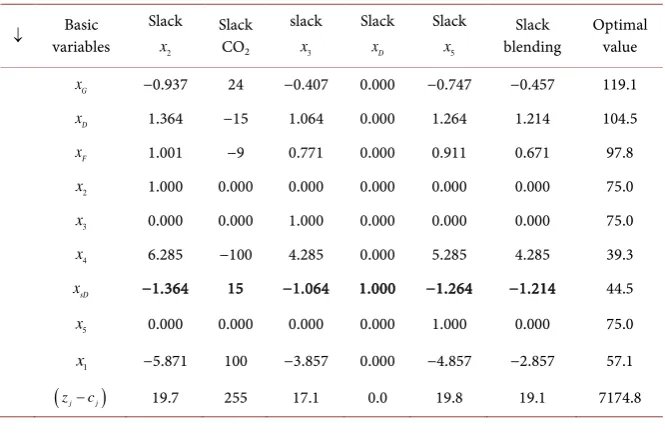
are summarized in Table 1 which contains a part of the final Simplex tableau.
The column to the immediate left indicates the basic activities as they appear
in the column of the basic index IB. Their optimal values are read in the most
right column. The first row corresponds to the slack variables associated with the binding constraints. The coefficients inside the tableau represent the MRTS be-tween the basic variables and non basic slack variables. The last row represents the dual optimal variables and the optimal value of the objective function.
Despite the higher relative price of diesel, its production capacity constraint is not fully utilized. This unexpected result, however, needs to be explained before recommending the production plan to refinery’s operators. The MRTS coeffi-cients that link the basic slack variable xsD to the binding constraints, i.e., the
[image:7.595.207.540.514.735.2]bold row in Table 1, can provide valuable insights to this question. Following
Table 1. Part of the final simplex tableau.
↓ Basic variables Slack 2 x Slack CO2 slack 3 x Slack D x Slack 5 x Slack
blending Optimal value
G
x −0.937 24 −0.407 0.000 −0.747 −0.457 119.1
D
x 1.364 −15 1.064 0.000 1.264 1.214 104.5
F
x 1.001 −9 0.771 0.000 0.911 0.671 97.8
2
x 1.000 0.000 0.000 0.000 0.000 0.000 75.0
3
x 0.000 0.000 1.000 0.000 0.000 0.000 75.0
4
x 6.285 −100 4.285 0.000 5.285 4.285 39.3
sD
x −1.364 15 −1.064 1.000 −1.264 −1.214 44.5
5
x 0.000 0.000 0.000 0.000 1.000 0.000 75.0
1
x −5.871 100 −3.857 0.000 −4.857 −2.857 57.1
DOI: 10.4236/ajor.2018.81005 57 American Journal of Operations Research
the suggested procedure in Section 3, we convert the extracted MRTS into an elasticity measure at the optimal solution. The blending constraint needs some
extra adjustment,
(
)
(
5)
(
)
1
1.214 i 0.3 45.5 2.57
E= −
∑
x = − . In words, at theop-timal solution, 1% increase in the crude blending limitation would increase the
saturation level of the diesel production by 2.57%. Table 2 ranks the computed
elasticities from the most negative values.
Several interesting remarks are in order. First, the corrosion issue is the most preventive constraint for diesel production. Without this insight, the user should have relaxed all the binding constraints one by one in order to identify the most
responsive one. Second, contrary to its largest marginal value, the CO2
con-straint has a negative impact on diesel production: increasing the CO2 pollution
rights would alter the optimal crude processing by replacing crude 4 with crude
1 which has a higher CO2 content and a lower diesel yield. This optimal
substitu-tion, which is a consequence of the Rybczynski theorem in economics [10], leads
to increase the gasoline product (+24 tons) to the detriment of diesel (−15 tons). This counter intuitive example confirms the limitation of marginal values for non binding constraint analysis. Third, according to diesel production equation, crude oils 2 and 3 have the same average yield in terms of diesel output (%25). However, the computed elasticities reveal that crude oil 2 has a higher marginal yield and is, therefore, a more suitable candidate to increase the diesel output.
6. Case Study
In the previous section, we provided a very simple numerical example to detail the procedure. In this section, we apply the suggested methodology to a real-type refinery LP model which contains near to 5000 linear constraints and more than 7000 continuous variables. In this LP model, the constraints are categorized into material and quality balance constraints, product specification constraints, crude availability constraints and process units capacity constraints. The linear objec-tive function consists in maximizing the net profit of the oil refining operations
(for more details, see Tehrani Nejad and Saint Antonin [15]). Cplex is the used
solver.
6.1. Model Overview
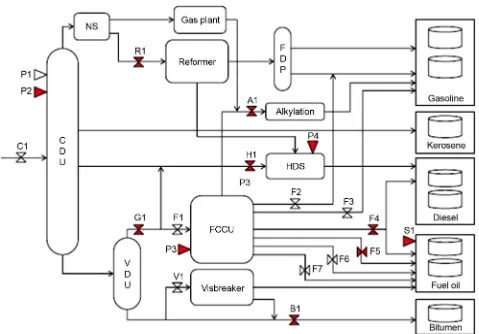
The general scheme of the model is given in Figure 1. In non technical words,
the crude distillation unit (CDU) separates crude oils into various fractions ac-cording to their boiling points. Light fractions are used to make gasoline and naphtha whilst middle fractions are used to produce kerosene and diesel. The heaviest fractions are sent to vacuum distillation unit (VDU) to produce vacuum distillate and vacuum residue. The major part of vacuum residue is fed to a
Table 2. Sensitivity importance measures.
Blending Crude 2 Crude 5 Crude 3 CO2 emissions
DOI: 10.4236/ajor.2018.81005 58 American Journal of Operations Research
Figure 1. Oil refinery scheme.
visbreaker, to reduce the viscosity of the fuel oil products. The vacuum distillate is converted by a fluid catalytic cracker unit (FCCU) to a gasoline blending component and light cycle oil for blending into the diesel pool. Here, the FCCU is combined with an Alkylation unit to produce high value gasoline components called alkylate. The sulfur specifications for gasoline, middle and heavy oil products require the use of a hydro-desulfurization unit (HDS). On the other side, a reforming unit converts low-octane naphthas into high-octane gasoline blending components. Most often, reformer’s output is separated into light and heavy components by a fractionation unit called FDP. The oil product categories considered are propane, butane, naphtha, gasoline, jet fuel, diesel, heating oils, heavy fuel oils and different bitumen grades.
6.2. Results and Discussion
Based on market indicators, the manager expects the crude distillation unit (CDU) to be fully utilized. However, the optimal solution recommends an
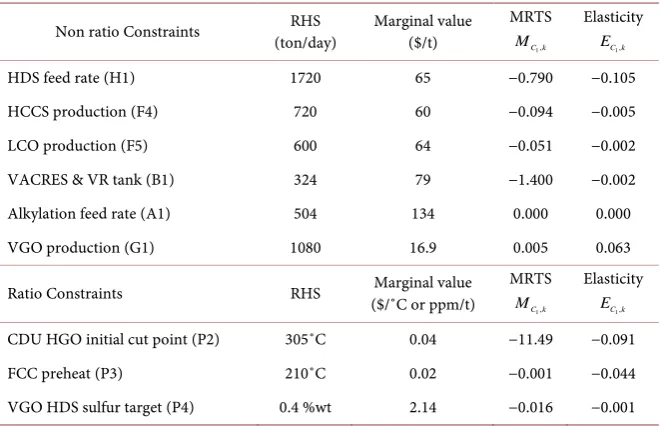
aver-age utilization rate of 91.5%. Table 3 summaries the main active constraints at
the optimal solution. These active constraints are illustrated by bold arrows in
DOI: 10.4236/ajor.2018.81005 59 American Journal of Operations Research
Table 3. Marginal values, MRTS and elasticities measures.
Non ratio Constraints (ton/day) RHS Marginal value ($/t) MRTS
1,
C k
M
Elasticity
1,
C k
E
HDS feed rate (H1) 1720 65 −0.790 −0.105
HCCS production (F4) 720 60 −0.094 −0.005
LCO production (F5) 600 64 −0.051 −0.002
VACRES & VR tank (B1) 324 79 −1.400 −0.002
Alkylation feed rate (A1) 504 134 0.000 0.000
VGO production (G1) 1080 16.9 0.005 0.063
Ratio Constraints RHS ($/˚C or ppm/t) Marginal value MRTS
1,
C k
M
Elasticity
1,
C k
E
CDU HGO initial cut point (P2) 305˚C 0.04 −11.49 −0.091
FCC preheat (P3) 210˚C 0.02 −0.001 −0.044
VGO HDS sulfur target (P4) 0.4 %wt 2.14 −0.016 −0.001
elastisities Eik between the mentioned active constraints and the slack variable
of the CDU capacity constraint. The results are reported in the two last columns of Table 3.
Several remarks are in order. First, the HDS feed rate constraint is directly identified to be the most preventing constraint with respect to the CDU throughput. We verified this result by increasing individually the RHS of the
ac-tive constraints reported in Table 3. By relaxing only the HDS capacity up to
60%, the utilization rate of the crude unit increases steeply from 91.5% to 96.6%, and then flattens. Second, given the high marginal values of the gasoline-related
units, i.e., Alkylation and the FCC effluents (HCCS and LCO), the LP practioner
would have been most plausibly disoriented by first inspecting those constraints. Third, although the Alkylation unit has the highest marginal value, its cross elas-ticity with respect to crude distillation unit is zero. That simply implies having more Alkylation would significantly increase the overall net margin of the refi-nery without impacting the crude intake amount. Forth, the relative high mar-ginal value of the HDS capacity constraint confirms that the low utilization rate of the crude unit, suggested by the optimal solution, is not simply due to low price effects.
7. Conclusion
DOI: 10.4236/ajor.2018.81005 60 American Journal of Operations Research
The distinguished feature of this approach is that it requires no more informa-tion than what is provided by the final simplex tableau. A numerical example as well as a real-type oil refining case study was provided to illustrate the procedure. The simplicity of this method, we believe, constitutes its elegance.
Acknowledgments
Without involving them in any possible error, the first author would like to ex-press his gratitude to Quirino Paris, Harvey Greenberg and Nastaran Manou-chehri for their valuable comments on this paper.
References
[1] Bixby, R. (2012) Documenta Mathematica. Extra Volume ISMP, 107-121.
[2] Charnes, A., Cooper, W.W. and Mellon, B. (1952) Blending Aviation Gasoline—A Study in Programming Interdependent Activities in an Integrated Oil Company.
Econometrica, 20, 135-139. https://doi.org/10.2307/1907844
[3] Geoffrion, A. (1976) The Purpose of Mathematical Modeling Is Insight, Not Num-bers. Interfaces, 7, 81-92. https://doi.org/10.1287/inte.7.1.81
[4] Greenberg, H.J. (1987) ANALYZE: A Computer-Assisted Analysis System for Li-near Programming Model. Operational Research Letters, 76, 249-255.
https://doi.org/10.1016/0167-6377(87)90057-5
[5] Greenberg, H.J. (1991) Intelligent Analysis Support for Linear Programs. Comput-ers Chemical Engineering, 16, 659-673.
https://doi.org/10.1016/0098-1354(92)80015-2
[6] Greenberg, H.J. (1991) A Primer for ANALYZE: A Computer-Assisted Analysis System for Mathematical Programming Models and Solutions. Operations Research Society of America, Baltimore, MD.
[7] Greenberg, H.J. (1993) How to Analyze the Results of Linear Programs, Part 2: Price Interpretation Interfaces. 23, 97-114. https://doi.org/10.1287/inte.23.5.97
[8] Greenberg, H.J. (1996) A Bibliography for the Development of an Intelligent Ma-thematical Programming System. Annals of Operations Research, 65, 55-90.
https://doi.org/10.1007/BF02187327
[9] Borgonovoa, E. and Plischke, E. (2016) Sensitivity Analysis: A Review of Recent Advances. European Journal of Operational Research, 248, 869-887.
https://doi.org/10.1016/j.ejor.2015.06.032
[10] Paris, Q. (2013) An Economic Interpretation of Linear Programming. Revised Edi-tion, Palgrave Mcmillan.
[11] Tehrani Nejad, M.A. (2007) Allocation of CO2 Emissions in Petroleum Refineries to Petroleum Joint Products: A Linear Programming Model for Practical Application.
Energy Economics, 29, 974-977. https://doi.org/10.1016/j.eneco.2006.11.005
[12] Tehrani Nejad, M.A. and Michelot, Ch. (2009) A Contribution to the Linear Pro-gramming Approach in Joint Cost Allocation: Methodology and Application. Eu-ropean Journal of Operational Research, 197, 999-1011.
https://doi.org/10.1016/j.ejor.2007.12.043
DOI: 10.4236/ajor.2018.81005 61 American Journal of Operations Research [14] Rosenthal, R.E. (2015) GAMS, a User’s Guide. GAMS Development Corporation,
Washington DC.