http://www.scirp.org/journal/jsea ISSN Online: 1945-3124
ISSN Print: 1945-3116
DOI: 10.4236/jsea.2018.111003 Jan. 30, 2018 28 Journal of Software Engineering and Applications
On the Dependability of Highly Heterogeneous
and Open Distributed Systems
Naftaly H. Minsky
Department of Computer Science, Rutgers University, New Brunswick, NJ, USA
Abstract
This paper introduces an architecture of distributed systems that facilitates the implementation of a substantial range of dependable system properties, i.e., properties that span an entire system, or a set of components dispersed throughout it. This architecture, called GDS, for governed distributed system, governs the system by controlling the flow of messages between its actors, in-dependently of the internals of the interacting actors. This governance is done via an enforced collection of interaction laws organized into a modular and conflict free hierarchical ensemble. This ensemble of laws is sensitive to the history of interaction; and it is enforced in a decentralized manner, and is thus scalable. The dependable system properties that can be implemented under GDS can have the following beneficial consequences, among others: a) the ability to establish regularities over the system, rendering it more coherent, and easier to reason about; b) the ability to provide a degree of trust among the disparate actor of the system; and c) the ability to ensure compliance with interaction protocols that are essential for distributed computing. Consequently, the GDS architecture can have a significant impact on the following important system qualities: security, fault tolerance, auditability, and manageability.
Keywords
Open Distributed Systems, Governance, Dependability, System Properties, Middleware, LGI, Fault Tolerance, Security
1. Introduction
Heterogeneous distributed systems suffer from considerable difficulties in estab-lishing system properties in a dependable manner. By a “system property”, we mean a property that spans an entire system S, or a set of actors1 dispersed 1We use the term “actor” for an autonomous process of computation, that may be driven by a
soft-ware component, by a physical device, or by a person operating via some computation interface. How to cite this paper: Minsky, N.H.
(2018) On the Dependability of Highly Heterogeneous and Open Distributed Sys-tems. Journal of Software Engineering and Applications, 11, 28-68.
https://doi.org/10.4236/jsea.2018.111003
Received: November 29, 2017 Accepted: January 27, 2018 Published: January 30, 2018
Copyright © 2018 by author and ScientificResearch Publishing Inc. This work is licensed under the CreativeCommons Attribution International
License (CC BY 4.0).
DOI: 10.4236/jsea.2018.111003 29 Journal of Software Engineering and Applications
throughout it. Such a property may, for example, be: a) that certain types of messages sent by any actor of S are logged for audit purposes; b) that if any actor
x of S gets a message “stop” from a system operator, x would stop communicat-ing with all other actors of S, except for operators; and c) that all members of a group of actors dispersed throughout S comply with a given interaction proto-col—see detail of this example below.
And we consider a system property P of a system S to be dependable if it satis-fies the following, broadly stated, conditions: 1) it is reasonably easy to verify that P is satisfied by S; and 2) P is stable with respect to changes of the code of
S—that is, it is not likely to be violated by most changes of the code of various system components, or by the unpredictable behavior of other kind of actors, like people. The dependability of system properties are essential for important qualities of a system, such as fault tolerance, security, auditability, and managea-bility—which are key aspects of the dependability of a system as a whole [1].
The difficulties in establishing dependable system properties is particularly se-rious in highly heterogeneous systems whose components may be written in dif-ferent languages, may run on difdif-ferent platforms, and may be designed, con-structed, and even maintained under different administrative domains. Such a distributed system is often said to be open2[2][3]—because of a lack of effective
constraints on the organization of the system as a whole, and on the internals of its disparate components. Many of the most critical societal systems and infra-structures are at least partially open. These include grids, federated organizations of various kinds, supply chains, and various systems-of-systems. Other systems tend to become progressively open, as they grow in size and evolve. Moreover, some systems are designed to be open, with the hope that this would make them more flexible. The concept of service oriented architecture [4] (SOA) is a prom-inent example of this trend, which is being adopted by a wide range of complex distributed systems. The following example illustrates the difficulty in establish-ing dependable system properties of heterogeneous and open systems.
Consider, for example, a system S that contains a distributed database, con-sisting of a small number of database servers, which are being used by a large and heterogeneous set of clients. And suppose that each client can maintain locks over items on several database servers at a time. It is well known that a ne-cessary condition for ensuring serializability—an important criterion of correct-ness of concurrent transactions—is that every client observes the two-phase locking (2PL) protocol [5], defined as follows:
The (2PL) protocol: Once a client releases one of its locks, it does not acquire other locks until all its locks are released.
Now, suppose that one does not use a central lock manager for enforcing this protocol, because it would be a single point of failure and a potential bottleneck. The problem is, how can such a protocol be implemented dependently.
On the Conventional Approaches for Establishing Dependable System
DOI: 10.4236/jsea.2018.111003 30 Journal of Software Engineering and Applications
Properties in a Heterogeneous Distributed System: The seemingly natural approach for establishing system properties—such as the 2PL protocol—is code based. For example, to ensure that every potential client of a distributed database observes the 2PL protocol, each of them is to be programmed to comply with it. But doing so everywhere in an open system, is laborious, error prone, and hard to verify—virtually impossible to verify in an open system. And even if this pro-tocol is established correctly in this manner, it would not be dependable because it can be violated by an inadvertent or malicious change in any component. Of course, one can try to avoid this difficulty by providing all potential clients with a stub designed to interact with the databases according to the 2PL protocol. But how can one be sure that all clients use this stub, and that none of them modifies it to gain some advantage? Moreover, the use of such a stub is problematic when clients are programmed in different languages.
It has been suggested (see [4] for example) that one can rely on strong man-agement and good software engineering practices to address these kinds of problems. But while such, mostly human, disciplines are clearly necessary, they cannot cope reliably with the complexities of a large open system—due to lack of global knowledge of, and control over, the code of its component parts. We need a more rigorous and more reliable solution for the problem of dependability of highly heterogeneous distributed system.
Our Approach: The approach of this paper to the problem in question is based on the following observation: If a system property of an open system is based on the code of many of its actors it cannot be dependable without the knowledge of, and the control over, all this code. But since such knowledge and control of many actors of an open system is not generally available, we adopt here a level of abstraction that ignores the internals of the actors—focusing on the observable, messaging-based, interaction between them. And we provide means for controlling the interaction between the actors of a system by specify-ing a law about how messages should flow between its actors, and between them and the outside world; and by enforcing this law via a suitable middleware.
We call such an enforced policy the fabric of the system, generally denoted byF, as it can be made to establish important aspects of the underlying structure
of the system so governed3. A system governed by such a fabric is called a go-verned distributed system, or GDS. As we shall see, the existence of a fabric enables the dependable implementation of many useful system properties. Moreover, although the fabric itself is oblivious of the behavior of all the actors of a given system, it is able to establish dependable system properties that are contingent on the knowledge of one or few actors (cf. Section 4.3.1).
It should be pointed out that controlling the flow of messages in order to go-vern a distributed system is far from a new. It is what conventional access con-trol (AC) mechanisms does, and it is behind the concept of “policy based sys-tems”, and of other types of system architectures—as discussed briefly in Section
3We employ here one of the dictionary (the American Heritage) definitions of the term “fabric” as
DOI: 10.4236/jsea.2018.111003 31 Journal of Software Engineering and Applications
6. But these attempts at the governance of a distributed system, do not satisfy the design principles of GDS stated in Section 2—which are necessary for the effec-tive implementation of dependable system properties.
The Structure of this Paper: The rest of this paper is organized as follows: Section 2 spells out our design principles of the GDS architecture; Section 3 is an outline of a middleware that facilitates the fulfillment of these principles, and which serves as a basis for GDS—this middleware, called LGI, has been pub-lished widely, and is outlined here to make this paper reasonably self-contained; Section 4 introduces the concept of GDS, and discusses its key properties, in-cluding the means provided by GDS for establishing system properties dependa-bly. This section also provides an example of a GDS, which is an outline of an implemented case study of it; Section 5 discusses the potential impact of GDS on various aspects of distributed systems—focusing on the fault tolerance at the ap-plication level of distributed systems, and on their security; Section 6 discusses related work; Section 7 lists several open problems, raised by the GDS architec-ture, that need to be addressed for this architecture to attain its full potential; Section 8 concludes this paper.
Finally, it should be pointed out that this paper provides only a proof of con-cept for GDS, as its practical effectiveness is yet to be validated by its use for real complex application—which requires industrial participation.
2. The Design Principles of GDS
We outline here some of the key properties we require a GDS to satisfy; they pertain to the nature of the fabric of a GDS, and to the middleware used for en-forcing it. Each of these requirements is followed by its rationale.
R1: The governance of a GDS should be sensitive to the history of inte-raction—i.e., it should be stateful—and it should enable a degree of proac-tive control. Statefulness is required, in particular, for establishing interaction protocols, such as our example 2PL protocol. Proactive control is required for ensuring a degree of liveness.
R2: The enforcement policies by the fabric of a GDS should be decentra-lized and strict: Enforcement should be decentralized for the following reasons: a) for scalability, which cannot be achieved with a centralized—even if repli-cated—reference monitors, under highly stateful control (as shown in [6]); and b) for preventing the enforcement mechanism itself from becoming a single point of failure, and a central target for attacks.
DOI: 10.4236/jsea.2018.111003 32 Journal of Software Engineering and Applications
R3: The fabric of a GDS should be modular: Modularity of the fabric is re-quired because a complex distributed system, such as one that supports a fede-rated enterprise or a grid, cannot be governed effectively via a singleton mono-lithic policy. Rather, its governance is likely to require a whole ensemble of semi-independent policies, which we call laws. For example, consider a system that is partitioned into several semi-independent divisions, belonging to differ-ent administrative domains. Such a system, as a whole, needs to be governed by a global law. But each of its divisions is likely to be governed by its own law, while conforming to the global law of the system at large. Moreover, a set of ac-tors dispersed throughout such a system, possibly crosscutting through several of its divisions, may have to interact with each other subject to some coordina-tion law. There may be many such crosscutting laws in the fabric of a system, and all of them must conform to its global law. Furthermore, the various laws that collectively govern a given system may be defined by different stakeholders, with little or no coordination which each other—and these stakeholders may themselves belong to different administrative domains.
By modularity of the fabric F that consists of such a collection of laws we mean, in particular, that F should be free from inconsistencies between the laws it consist of. This would facilitate the incremental construction of the fabric by different stakeholder, and would make the fabric simpler, and easier to reason about.
R4: The evolution of the fabric of a GDS should be controllable: This is required because a haphazard change of the fabric might have a damaging effect on the system it governs. So, we need the ability to regulate who can change the fabric, in which manner, and under which circumstances.
3. On the Middleware Used by the GDS Architecture
The GDS architecture requires a suitable middleware for formulating the policies of the fabric and for enforcing them. We have chosen for this purpose a mid-dleware called law governed interaction (LGI), mostly because it satisfies re-quirements R1 and R2 above, and it helps in satisfying rere-quirements R3 and R4. We outline here the structure of this middleware and some of its key properties, to make this paper reasonably self contained. This section can be skipped by a reader who is familiar with LGI.
com-DOI: 10.4236/jsea.2018.111003 33 Journal of Software Engineering and Applications
plex systems is described in Section 4.
The rest of this section is organized as follows: Section 3.1 describe the gist of the LGI middleware; Section 3.2 describes the concept of LGI laws, which is re-lated to, but very different from, the concept of policy under AC; Section 3.3 in-troduce an example of an LGI law; Section 3.4 discusses the expressive power of LGI; Section 3.5, outlines the concept of conformance hierarchy of laws, which facilitates the modular organization of the fabric of a GDS, as stipulated by re-quirement R3 in Section 2; and Section 3.6 discusses the trustworthiness of LGI, and its performance.
3.1. The Gist of LGI
As pointed out above, we are dealing here with systems that are simple enough to be governed by a single monolithic law. Such a law is denoted by , and the system governed by it is called an -community, or simply a community. Now, although the purpose of LGI is to govern the exchange of messages between the disparate member of a given -community according to its law , it does not do so directly. Rather, LGI controls the interactive activities of each actor c of an
-community C, subject to law . This control, over any given actor c, is strictly
local, in that it is independent of the coincidental activities and state of any other actor.
This localization of control—which, as argued in sway does not reduce the expressive power of LGI—is what enables its enforcement to be decentralized. Broadly speaking, law enforcement is done as follows: For an actor c to belong to an -community C it must interact with other members of C via a private con-troller, denoted by Tc
, which is trusted—for reasons to be discussed later—to
mediate the interactive activities of c, subject to law . Tc
runs on a generic
controller designed to interpret and enforce any well formed law loaded into it.
c
Tcan maintain a state (sometime called control state) that represents some
function, determined by law , of the history of the interaction of c with the rest of the system. The formation of this state is regulated by law , and the ruling of the law for an interactive event that occurs at Tc
can take its local state into
account. (Note that there is no limit on the size of the state of a controller, which is not a finite state machine.)
The pair c T, c
is called an -agent, or simply and agent, which is said to
DOI: 10.4236/jsea.2018.111003 34 Journal of Software Engineering and Applications
Figure 1.Interaction between a pair of LGI-agents, mediated by a pair of controllersunder possibly different laws.
A key property of LGI-based communication is that a pair of -agents can rec-ognize each other as such. And since laws are strictly enforced under LGI, it fol-lows that the members of an -community can trust each other to observe the same law. (Note that this property will be generalized under GDS, which enables agents operating under different laws to interoperate, as we show in Section 4.3.6.)
3.2. On the nature of LGI’s Laws
The function of a law under LGI is to decide what should be done in response to the occurrence of certain events at any -agent x. This decision is called the
ruling of the law for the event e that triggered it. More specifically, a law that governs an agent x is defined in terms of the three elements E, Sx, and O outlined
below (see [10]).
1) The set E of regulated events: This is the set of events that may occur at any agent x, and whose disposition is subject to the law under which x operates. E
contains the following three types of events, among others: a) the arrived event, which represents the arrival, at the controller of x, of a message intended for its actor; b) the sent event, which represents the arrival, at the controller of x, of a message sent to anybody by its actor; and c) the adopted event, which signals the moment of creation of the agent in question, by its actor adopting a controller with a given law.
2) The control-state Sx of agent x: The control-state (or simply “state”) Sx of an
agent x, is maintained by its controller. This state is initially empty, but it can change dynamically in response to the various events that occur at x, subject to the law under which this agent operates.
3) The set O of control operations: These are the operations that can be in-cluded in the rulings of the law at any agent x.
We are now in a position to give a more formal definition of the concept of law, as follows:
*
:E S× x →Sx×O
In other words, for any given (e, Sx) pair, the law mandates a new state (which
may imply an arbitrary state change), as well as a (possibly empty) sequence of control operations that are to be carried out atomically in response to the occur-rence of event e in the presence of state Sx.
DOI: 10.4236/jsea.2018.111003 35 Journal of Software Engineering and Applications
state of a given agent. On one hand, the ruling of the law may depend on the current state of the agent, on the other hand the evolution of the state is regu-lated by the law—although it is driven by the various event that occur at that agent. 2) Besides changing the state of the operating agent, the law can cause some messages sent by its actor to be changed, rerouted, or blocked; and it can initiate messages proactively. Moreover, the law can respond to various exceptions that may occur at a given agent.
3) Note that this abstract definition of the concept of law does not specify a language for writing laws (which we call a law-language). This is for several rea-sons. First, despite the pragmatic importance of choosing an appropriate law-language, this choice has no impact on the semantics of LGI, as long as the chosen language is sufficiently powerful to specify all possible mappings of the form defined above. Second, specifying in this paper the details of law-language would complicate it, without shading much light on the subject matter. In fact, the implemented LGI mechanism employs three different law-languages, which are based on: a) the logic-programming language Prolog; b) Java; and c) Java-Script—and another, safer, law-language is under consideration.
3.3. An Example of an LGI Law
The purpose of this section is to provide a taste of the nature of LGI laws. We do this by introducing in details a simple law that establishes a somewhat contrived coordination protocol, which illustrates some key characteristics of LGI. This protocol, which we call ping-pong protocol, may be viewed as representing po-lite conversation, as will become apparent below. For another example the read-er is refread-erred to [11], which introduces the 2PL law that implements the 2PL
protocol described in Section 1.
The ping-pong protocol is defined as follows: Consider a group G of actors that interact with each other subject to this protocol. Members of this group can exchange two kinds of messages: ping messages, used for posing questions, or requests; and pong messages, used as a reply to previously received ping mes-sages. Such exchange is subject to the following constraint: once a member x of
G sends a ping message to another member y ofG, x would not be able to send other pings to y until it gets a reply from y in the form of a pong messages. And y can send only one pong message to x for every ping it gets from it. (The sense in which such exchange may be considered polite is fairly self evident.)
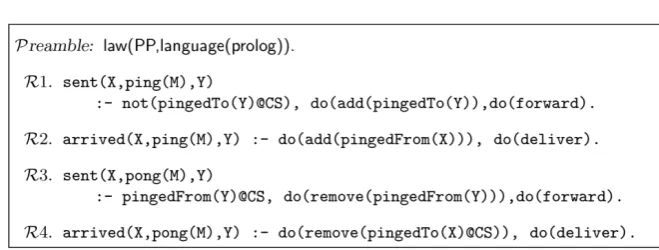
Figure 2 displays a law PP that establishes this protocol over the group G of
actors that chose to operate under it. This law is written in the Prolog-based law-language, which can be understood, roughly, as a set of event-condition-action (ECA) rules. Since some readers may not be familiar with Prolog, and with this law-language, we provide the following explanation for this law.
DOI: 10.4236/jsea.2018.111003 36 Journal of Software Engineering and Applications
Figure 2.The ping-pong law PP.
intended to mean that x pinged y, and did not yet get a pong as a reply to it; and (b) the term pinged form (y) is intended to mean that x got a ping from y, and did not yet reply to it by a pong. We can now explain the effect of each of the four rules of law PP, as follows.
By Rule R1 of this law, any agent x in G can send a ping to any y in G, pro-vided that x does not have a term pinged to (y) in its CS. And the sending of a ping to y would add the term v pinged to (y) to the CS x. When this ping arrives at its destination y it would, by Rule R2, add the term pinged form (x) to the CS of y, and the ping itself would be delivered to the actor ofy.
Now, by Rule R3, any agent x can send a pong to any y, provided that it does have a term pinged form (y) in its CS. If this is the case, then this term would be removed from its CS, and the pong would be forwarded. When this pong arrives at its destination y it would, by Rule R4, remove the term pinged to (x) to the CS of y, allowing y to send to x another ping, and the pong would be delivered to the actor of y.
It should also be pointed out that an actor communication subject to law PP
can communicate only with actors that also communicate under the same law. This is implicit in the structure of the law displayed in Figure 2, which is appar-ent for anybody familiar with this law-language.
3.4. On the Expressive Power of the Local LGI Laws, and on Their
Global Sway
One may suspect that the decentralization of control under LGI, and its strictly local laws, involves a reduction of its expressive power. But this is not the case, in the following sense: Consider a centralized control mechanism (CCM) that me-diated all the interaction between a given group of actors inG, thus having a global view of the interaction between all the actors of the system. Suppose also that CCM is stateful, in the sense that it can maintain an arbitrary function of the entire history of the interaction between all the members of G. It turns out that any policy that can be established by CCM can also be established under a local LGI law. This has been shown in [12] (Section 4), simply by simulating any given CCM-based policy, via a local LGI law.
DOI: 10.4236/jsea.2018.111003 37 Journal of Software Engineering and Applications
for the implementation of global aggregate properties which are sometimes re-quired in a given system.
On the Global Sway of Local LGI laws: We distinguish between two kinds of global system properties, which we call regularities, and aggregate properties. We define them below, and show how they can be established over a distributed community.
1) By the term regularity we mean here compliance with a fixed principle4.
Formally, a regularity of a given -community C can be expressed as a univer-sally quantified formula of the form ∀ ∈x CP x
( )
, where P(x) is a local propertyof agent x of C—that is, P(x) is defined over the local state of x, along with an event that occurred at it at a given moment in time. Such regularities are the di-rect consequences of LGI, due to the fact that all members of an L-community comply with the same law . An example of such regularity is the compliance with the Ping-Pong protocol by all members of the PP-community.
2) By aggregate property we mean a property that depends on the state and behavior of all members of the community in question, or on a substantial part of its membership. As an example, consider an -community C whose members should be able to issue purchase orders for any amount of money, provided that the following aggregate property Q is satisfied: The total amount of money thus paid by members of this community does not exceed the limit U. Obviously, this property cannot be established directly by local constraints on the purchases of each member of C. But this aggregate property can be established indirectly by a strictly local LGI law, as follows.
Instead, of allowing every member of community C to issue a purchase order, our law would provide the power to do so to one actor—call it BO (for budget office)—which is to do so on behalf of the other actors of C upon their request. This can be done in the following way. Let law of C have two different modes of operations, depending upon the operating agent, as follows. First, when re-sides in a controller associated with any member c of C except BO, operates as follows: whenever c sends a purchase order to some vendorv, the law causes this message to be rerouted to BO. Second, if resides in a controller associated with
BO, it operates as follows: it forwards any purchase order it gets to its intended destination, but only if the total amount of money spent resulting from this purchase would not exceed U. (Basically, this is the way that most enterprises operate.)
Note that law described above is strictly local. It is true that implementing our aggregate property require some centralization in BO, and some overhead. But this is involved just with purchase orders. And as long as such orders con-stitute a small fraction of the total volume of interactions among members of C, such partial centralization is not likely to degrade substantially the efficiency and the scalability of the community in question. There are, of course, other proper-ties that require aggregation—such as the maintenance of unique naming, which
DOI: 10.4236/jsea.2018.111003 38 Journal of Software Engineering and Applications
we have implemented in [13]. But our experience with LGI suggests that the im-plementation of most useful aggregate properties have only a marginal effect on the efficiently and scalability of a community.
3.5. The Organization of Laws into a Conformance Hierarchy
LGI enables the organization of a set of laws that collectively governs a single system, into a coherent ensemble called a conformance hierarchy. We denote here such a hierarchy of laws by the symbol F, because it is used in this paper to represent the fabric of a GDS (cf. Section 1). F is a tree of laws rooted by a law called R, in which every law, except of R itself, conforms transitively to itssu-perior law, in a sense to be described below. Moreover the conformance relation between laws in F is inherent in the manner in which F is constructed, requiring no extra validation. For a formal definition of such hierarchy of laws, and a detailed example of its use, see [6]; here we provide just an informal introduction of this concept.
The Nature of Conformance of LGI-Laws: Several access control mechan-isms [9][14] defined conformance between policies basically as follows: policy
P′ conforms to policy P if and only if P′ is more restrictive than P, or equal to
it. But this would not do for LGI-laws, for several reasons, the most important of which is the following. The ruling of an LGI-law is not confined to a decision whether to approve or reject an action by an actor; it can also require some other actions to be carried out in response to an event, such as changing the sender’s state in a specified manner. And it is generally not meaningful to ask if one such action is more or less restrictive than another. So, instead of using a uniform de-finition of conformance, based on restrictiveness, LGI lets each law define what it means for its subordinates to conform to it. This is done, broadly, as follows.
A law that belongs to a conformance hierarchy F has two parts, called the
ground part and the meta part. The ground part of a law imposes constraints on the interactive behavior of the actors operating directly under this law—it has the structure defined Section 3.2. The meta part of circumscribes the extent to which laws subordinate to it are allowed to deviate from its ground part. In par-ticular, this allows a law, anywhere in this hierarchy, to make any of its provi-sions irreversible by any of its subordinate laws, by not permitting any deviation from it.
One application of such conformance is setting out defaults. For example, the root law R may prohibit all interaction between actors, while enabling
subordi-nate laws to permit such interaction, perhaps under certain conditions. Alterna-tively, law R may permit all interaction, while enabling subordinate laws to
prohibit selected interactions.
This very flexible concept of conformance is somewhat analogous to the manner in which the federal law of the US circumscribes the freedom of state laws to deviate from it.
DOI: 10.4236/jsea.2018.111003 39 Journal of Software Engineering and Applications
below. First one creates the root law R of F. Second, given a law already in F,
one defines a law ′, subordinate to , by means of a law-like text called delta, denoted by ∆
(
, ′)
, which specifies the intended differences between ′and . Now, law ′ is derived from law and ∆
(
, ′)
, essentially bydy-namic consultation during the interpretation of ′, as described broadly below. Consider the special case involving the root law R, and its subordinate law s
derived from R by the delta ∆
(
R, s′)
. And consider an agent x operatingunder law s. Now, when an event e occurs at an agentx, it is first submitted to
law R for evaluation. Law R may consult the delta ∆
(
R, s′)
of s beforede-ciding on its ruling—although it may also render its own ruling, not involving the delta. If consulted, the delta will do its own evaluation of this event, and will return its advice about the ruling in question to law R. R, in turn, would
rend-er its final ruling about how to respond to evente, taking the advice of the delta into account—but not necessarily accepting it, because this advice might contra-dict the meta part of R. In this way, the dynamically derived law s naturally conforms to its superior law R, requiring no further verification.
A notable property of this organization of laws is that interacting agents op-erating under laws in a common hierarchy can identify the position of each oth-er’s laws within this hierarchy. This can be done because every law carries the sequence of hashes of all the laws in the path from itself to the root R.
3.6. On the Implementation of Controllers, and on Their
Performance
We mention here briefly two different ways for controllers to be implemented. One way is to have a trustworthy organization, called controller service (CoS), whose business it is to rent the use of genuine controllers to its customers. Such controllers would authenticity themselves by digital certificate signed by a certi-fication authority of the CoS. The CoS would maintain a collection of servers each of which will host a number (usually in the hundreds) of independent con-trollers. Such a CoS could provide its controllers to arbitrary clients, or be dedi-cated to a single organization, as will be the case in this paper (cf. Section 4.1).
There are other ways for implementing trusted controllers. For example actors operating via their smart phones may have their private controllers built into their phones. We have done that, experimentally, in [15], and one can make such controller quite secure using a TPM-like technology, which on Android, may be TrustZone [16]. Also, if one has a secure co-processor [17] attached to one’s host, one can implement a controller on it.
DOI: 10.4236/jsea.2018.111003 40 Journal of Software Engineering and Applications
4. The Concept of Governed Distributed System (GDS)
We start in Section 4.1 with a definition of the concept of GDS. Then we proceed as follows: Section 4.2 illustrates this concept via an outlines of an implemented example; and Section 4.3 introduces the main key aspects of GDS.5
4.1. The Definition of GDS
We define a GDS, denoted here byS, as a four-tuple
, , , ,
Ac F Ag T
where Ac is a set of actors that belong to S—in a sense to be clarified later; F, called the fabric of S, is a conformance hierarchy of LGI-laws that collectively governs the flow of messages in S, while being oblivious of the internals of the communicating actors; Ag is a set of LGI-agents formed by actors in Ac operat-ing under laws in F; and T is a controller-service (CoS) which is assumed to be maintained by the organization that manages S, and can be viewed as the trusted computing base (TCB) [18] of S. In other words, T provides the set of LGI-controllers that enforce the laws in F. We elaborate on these elements of GDS, and on its overall architecture, in the following numbered paragraphs. We then discuss the process of the construction of a GDS.
1) The set Ac of actors: This set consists of all the actors that communicate subject to laws of the fabric F of S. We make here several comments about Ac. First, although most of the actors in Ac are likely to be software components, some of them may be people operating via their smart-phones, or such; and some may be physical devices, like sensors and actuators. GDS treats all such actors uniformly.
Second, a given member c of Ac may not belong exclusively to S, because we generally cannot rule out the possibility that c may also operate as part of anoth-er system, which may or may not be a GDS. This is because we adopt a level of abstraction that ignores the internals of actors, which can be communicating in arbitrary manner. From the viewpoint of a given system S, such communication by its actors is called rogue communication, and the consequences of such communication to the concept of GDS are discussed in Section 4.3.8. (Note: The term “rogue” means here unprincipled, and not bad or dishonest; indeed, as we shall see later, rogue communication is sometimes beneficial.)
And third, this architecture is silent on the membership of Ac, except that Ac
is assumed to contain one distinguished actor with a specified role. It is called the fabric server (or, F-server for short), and its role is to maintain the fabric F of this system. For more about the F-server see paragraph 3 below.
2) The fabric F: We make here two comments about F: First, due to the con-formance nature of the hierarchical law ensemble F, its root law R has
DOI: 10.4236/jsea.2018.111003 41 Journal of Software Engineering and Applications
fined as irreversible. Other provisions of R may be modified by subordinate
laws, subject to constraints imposed by R on deviations from it. In a sense,
then, law R governs, directly or indirectly, the entire fabric F, and thus, the
en-tire system S.
Second, although the laws in the fabric of a GDS are oblivious of the internals of the actors operating under them, the designers of these laws may not be so oblivious. A law designer may have some knowledge about the functionality of certain actors, or make various assumptions about them, and thus design his law accordingly. For example, the root law of our Acme example Section 4.2 is based on some assumptions about a specific certification authority, and about the types of certificates it signs.
3) The Reason and Consequences of Having the Entire Fabric F Main-tained in a Single F-Server: The main reason, besides convenience, for main-taining all the laws of the fabric F of a given GDS S in the F-server of S—which is itself an actor of S—is for enabling effective control over the evolution of F, as discussed in Section 4.3.3. But the central maintenance of F seems to raise the following concerns: a) will this centralization reduce the scalability of GDS? b) will the F-server be a single point of failure of a GDS? and c) will it make a GDS more vulnerable to attacks? Fortunately, the answer to all these questions is neg-ative, as we argue below.
First, the centralization of V has a negligible effect on the scalability of a GDS, because the F-server does not participate in the dynamic control over commu-nications—this is done by the controllers, operating subject to their local laws, acquired from the F-server. The F-server is just a library of the laws in F, from which individual actors acquire the laws under which they are to operate—and this constitute a relatively infrequent access to the F-server.
Second, the fabric is likely to be modified relatively infrequently, which enables the F-service to be easily replicated, and thus not be a single point of failure. And third, the replicated F-service provides a good defense against at-tacks. Because if we have at least three replicas, then an attack on one of them can be discovered by frequent comparison of the one-way hashes of the various replicas, replacing the compromised replica with a correct one.
4) The set Ag of F-agents: Let us first clarify some notations: An F-agent x is an actor c that communicates subject to some law in F. More formally, an
F-agents is a pair (cf. Section 3.1) c T, c
—namely, an actor c paired with the
controller it adopted, under some lawin F. And the messages sent by F-agents are called F-messages. But if we want to be more specific about the law under which an agent operate we call it an -agent and its messages we call -messages.
Note that a single actor can animate several different F-agents, via different controllers, operating subject to the same or different laws. This may be the case, for example, when a single server provides several different services, possibly subject to different laws. Therefore, it is the F-agents that are the loci of control by the fabric of GDS, not the actors themselves, whose internals are not visible to
DOI: 10.4236/jsea.2018.111003 42 Journal of Software Engineering and Applications
requiring actors to authenticate themselves in some way.
5) On the overall structure of a GDS: It is clear that a GDS-based system S
generally consists of several, perhaps many, communities each operating under one of the laws of its fabricF. Different such communities may overlap, in the sense that a single actor can animate agents operating under different laws—as we have seen in (4) above—and thus belonging to different communities. Also, as we shall see in Section 4.3.6, agents belonging to different communities may be able to interoperate, if they are allowed to do so by the fabric.
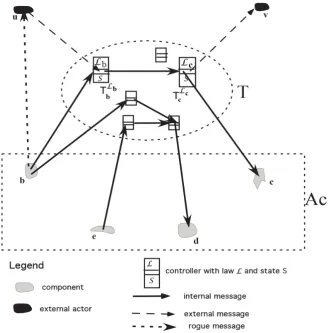
A schematic depiction of a GDS is portrayed by Figure 3. The actors in Ac are depicted within the dotted rectangle by irregular shaded figures, representing their presumed heterogeneity, and the fact that the fabric F is oblivious to their internals. The controllers belonging to T are depicted by rectangles, inside the dotted oval that represents the CoS that maintains them; and note that these controllers will be operating subject to various laws in F. Finally, the dark irre-gular shapes on top of this figure depict actors, anywhere over the Internet, that do not operate under laws in F, and thus do not belong to the system in ques-tion; but F-agents may interact with them, if this is permitted by their laws.
The Construction of a GDS
We describe here the construction of a brand new GDS, which is quite straightforward. We do not address in this paper the more complex issue of the complete conversion of a legacy system into a GDS. However, an incremental conversion can be carried out by means of the grafting of some aspects of GDS into an otherwise conventional system—which is discussed here as well.
The Construction of a GDS from Scratch: The construction of a new system
Sas a GDS can be carried out in two consecutive steps: 1) the design and con-struction of the foundation of S; and 2) the incremental construction of the rest of it. The foundation of S consists of two distinct parts: a) the root law R of the
fabric F of S; and b) a set of actors, which are required for the definition of R.
One of these is the F-server, which maintains the fabric of the system; and there may be other actors that may have to be included in the foundation.
Once the foundation of S is in place, the rest of it can be constructed incre-mentally, via steps of two kinds: a) adding a law to F, subordinate to an existing law in it; and b) having an actor adopt one of the existing laws in F, thus forming a new F-agent—we do not discuss here the programming of the actors them-selves. These two types of steps can be carried out by different stakeholders in various orders, and perhaps concurrently. And recall that although each actor selects the law in F—or several such laws—to operate under, a law may impose constraints on the type of actors that may operate under it. In particular, law R
of Acme—our example-system—requires an actor that attempt to adopt it to authenticate itself via a certificate signed by AcmeCA.
DOI: 10.4236/jsea.2018.111003 43 Journal of Software Engineering and Applications
Figure 3. A schematic depiction of a GDS.
may be virtually compelled to operate under a certain law in F if it needs some services provided only under this law. For instance, if the databases of our 2PL example in intro are written to accept only queries and updates sent under law
2PL, than anybody who wants to access this database would have to adopt this law.
Grafting Some Aspects of GDS into an Otherwise Conventional Distri-buted System: One may not want to subject an entire distriDistri-buted system to GDS-type of governance; but just to incorporate some aspects of it into an oth-erwise conventional system. In particular, to ensure that the members of a group
G of actors comply with a given protocol defined by a law , when involved in a certain activity, one can have the members of G adopt this law, and operate sub-ject to it when participating in this activity. This would create, what we have called in Section 3 -community. For instance, the database servers and their clients of the example in Section 1 would adopt law 2PL. There may be many
such governed communities in a given system, whose laws form a kind of frag-mented fabric, which may be organized into several conformance hierarchies that does not govern the entire system.
DOI: 10.4236/jsea.2018.111003 44 Journal of Software Engineering and Applications
simplified outline of a case study we have implemented. This case study simu-lated a federated enterprise called Acme consisting of two semi-independent di-visions D1 and D2, maintained under different administrative domains—along with a federation division D0, maintained by the management of the federation at large. D0 includes, in particular, the distinguished F-server, and a certification authority called AcmeCA.
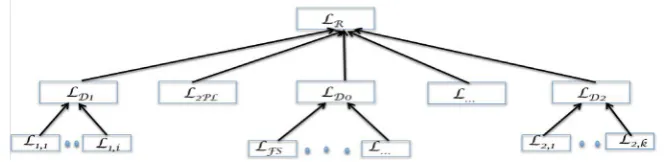
The fabric Fof Acme is a three level conformance hierarchy of laws, depicted in Figure 4. The first level of this hierarchy—introduced in Section 4.2.1—consists of the root law R. The second level contains the laws of the three
divisions of the system, introduced in Section 4.2.2; as well as some crosscutting laws that govern groups of actors whose members may belong to several divi-sions. The placement in F of such crosscutting laws is discussed inin Section 4.3.7. The third level, introduced inin Section 4.2.3, is a collection of laws under which various individual actor may operate.
All these laws are described here informally, and they reflect only part of the laws used in our case study. Note that all but the root law are represented by their deltas6, which specify the differences between the law in question and its
superior law. To see how such laws are actually written see [6] where a fairly so-phisticated hierarchical ensemble of laws is introduced in detail. Here are some comments about our informal description of F.
We employ the following convention about the meta part of any given law
in the hierarchy: a) if has a rule that addresses a certain aspect of interactive activity of an actor subject to it—such as the sending of a certain type of mes-sages—then this rule is irreversible, i.e., it cannot be deviated from by subordi-nate laws of , unless such deviation is explicitly permitted by the meta part of
(such permissions are denoted by bracketed texts in bold italics); and b) if is silent about certain aspect of interaction, then subordinate laws have the free-dom of legislation about it. (This does not reflect the entire richness of the con-cept of conformance, but it will do for this example.)
4.2.1. The Root Law
As has already been pointed out, the root law R is the global law of the system,
in the sense that all its provisions are shared by all the laws in F—modulo mod-ification by subordinate laws, if such are permitted by R. The main role of R is
to establish broad system regularities and defaults. The following is the set of rules that thus govern Acme, which should be viewed as a small sample of rules that can be established by such a law. We elaborate on these rules, and motivate them, in the discussion that follows them.
1) Authentication of actors: To adopt an LGI-controller under this law, thus forming an F-agent, an actor c needs to authenticate itself via a certificate signed by AcmeCA, which we assume to identify the following aspects of c: its unique
name, with respect to the Acme system; its role in the system; and the division to
DOI: 10.4236/jsea.2018.111003 45 Journal of Software Engineering and Applications
Figure 4.A basic hierarchical law-ensemble for the acme system.
which it belongs. This authenticated attributes of actors is stored in the state of their adopted controllers. [Subordinate laws may add conditions to this rule,and may require additional operations to be carried out upon adoption,
but they cannot weaken this rule.]
2) Sender identification: Every message sent is to be concatenated with the previously authenticated unique name, role, and division of its sender, with re-spect to the Acme system.
3) Constraints over the interaction between F-agents: The following two provisions are made by this rule: a) all inter-division interactions are prohibited, [unless permitted by the corresponding subordinate division laws]; and b) all intra-division interactions are permitted, [unless prohibited by the subor-dinate division law in question];
4) Establishing an Audit trail of inter-division interactions: Every in-ter-division message would be logged in a specified logging service, upon its ar-rival.
5) Providing system operators with the power to control the system: An
F-agent that receives a message stop (pattern) sent by an operator—i.e., by an agent, probably a person, that has a role of an operator—would lose the ability to send or receive F-messages of the specified pattern; and if the pattern is “all”, then it would lose the power to send and receive all F-messages.
Discussion: The following is an elaboration on these rules, which provides some clarification and motivation for them.
R-auth provides Acme with a degree of control over which actors can operate as F-agents. This provision is irreversible, governing all F-agents, although it can be tightened by subordinate laws, as it is by law D1, below. Also, note that
maintaining the certified attributes of each actor in the state of its controller fa-cilitates the enforcement of other rules of this law, such as Rules 2 and 3.
Rule 2 provides the receiver of a message with an official identifier of its send-er. The identifier in question is more informative and more trustworthy than identifying the sender by its IP address. This is because an IP address can be spoofed; and even if not spoofed, it does not carry much meaning to the receiver. Note that keeping this identifier in the state of every F-agent can be useful in many ways. In particular it is used here for enforcing the constraints of Rule 3.
disad-DOI: 10.4236/jsea.2018.111003 46 Journal of Software Engineering and Applications
vantages of centralization.
Rule 3 establishes two different types of access control provisions: Provision a) prohibits all inter-division interaction, as a default, allowing subordinate divi-sion laws to permit any such interactions, as described in Section 4.2.2. (Note the unconventional nature of this type of conformance, where the subordinate divi-sion laws can be more permissive than their superior law.) Providivi-sion b) is ana-logous to a), with the opposite effect.
Rule 4 ensures dependable logging of all inter-division messages. Note that this rule can be stated here despite the fact that Rule 3 of the same law prohibits all inter-division messages—but if such an interaction would be permitted by the subordinate division laws, it would be subject to this rule. This is just an example of the ability of the fabric to establish dependable monitoring, and facilitate the audit, of message flow.
Rule 5 enables system operators to prohibit any given F-agent from sending messages that fit a specified pattern. Such prohibition with the patter “all” would effectively remove the F-agent in question from a system by stopping all its communication. This is just an example of how one can endow some F-agents with a real power to control from a far what other F-agents can do.
4.2.2. Division Laws
A division law, say law D1 of division D1, is to be derived from the root law R
via a delta ∆
(
R, D1)
. One can reasonably assume that the writer of this deltahas some idea of the intended structure of this division, and on the intended role and function of certain of its F-agents. This delta can, then, be used to impose this structure. For example, the delta of law D1 makes the following three
types of provisions.
1) Constraint on the Composition of D1: Given that Rule 1 of law R permits its subordinate laws to add conditions on their adoption, this delta requires that actors adopting law D1 would be authenticated as belonging to division D1.
2) Imposing Constraints over Intra-Division Interaction: Recall that all in-tra-division interactions have been permitted by R, as a default, allowing subor-dinates laws to impose arbitrary prohibitions on such interactions. So, this delta can impose any desired prohibition on the interactions between F-agents be-longing to D1.
3) Enabling Selected Inter-Division Interactions: Recall that inter-division in-teractions are prohibited by law R, as a default, allowing subordinates laws to permit them. Note, however, that for an interaction between two divisions, say
D1 and D2, to be enabled, it must be permitted by both D1 and D2—this is
due to the local nature of our laws. For example, to permit a message from an
F-agent x1 in D1 to an F-agent x2 in D2, law D1 needs to permit x1 to send a
message to x2, and D2 needs to permit x2 to receive this message. Of course,
DOI: 10.4236/jsea.2018.111003 47 Journal of Software Engineering and Applications
certain types of messages to be exchanged between a certain sets of pairs of
F-agents belonging to the two divisions.
4.2.3. Laws of Individual Agents
An actor c belonging to a certain division, may operate directly under the law of that division. But there are sometimes reasons for c to operate under its own law
c—subordinate to its division. Some such reasons are discussed below.
Suppose that an actor c is a web server, and that it makes certain promises to its clients about the services it provides. But such promises are not very credible if they are just stated—on the website of c say—unless c is highly reputed. This is particularly true in an open system, where the code of the service is not known to its clients, and where this code can be changed without the client’s knowledge. This inherent lack of trust is a serious and well known difficulty with services over the Internet. However, promises that can be formulated in terms of message exchange can be rendered trustworthy and dependable by formulating them as a law, and then providing one’s services via a controller that enforces this law. The clients of such a service can trust these law-based promises due to the existence of L-trust (cf. Section 4.3.5), which has the following consequences: a) the prom-ise can be verified by studying the law—which is likely to be much smaller and simpler than the server’s code; and b) the law cannot be changed without the client’s knowledge.
There are many examples of important promises that can be rendered trust-worthy in this way, including such things as money back guarantees, the so called service level agreements (SLAs), confidentiality, etc. And, as pointed out before, a single actor may form different F-agents operating under laws that make different types of such promises. Below we elaborate on one type of such promises.
Server’s Promise Made during a Conversation: The interaction between a server and its clients may involve a sequence of messages exchanged, according to some predefined protocol—such interaction is known as conversation [20]. During such a conversation, the server may make various promises to the client. For such promises to be dependable, they need to be enforced. For example, suppose that our server is a travel agent that provides for the following kind of conversation: A client x may request to reserve the right to buy a certain ticket at a particular price p, within a grace period t. If the server agrees, it should sell that ticket to x, if x pays for it within period t—which means, in particular, that the server should not sell that ticket to anybody else within this time period. (Note that an LGI law that enforces such a promise, in a different context, has been described in [21].)
4.3. Key Aspects of GDS
DOI: 10.4236/jsea.2018.111003 48 Journal of Software Engineering and Applications
evolution of the fabrics of a GDS; 4) perspective on the strict enforcement of the laws; 5) law-based trust: a behavioral-trust modality induced by GDS; 6) flexible interoperability; 7) the handling of crosscutting laws; 8) rogue communication, and its limited effect on a GDS.
4.3.1. The Means Provided by GDS for Establishing System Properties Dependably
The means provided by the GDS architecture for implementing dependable sys-tem properties is to establish them via the fabric of the syssys-tem. We call such a property fabric-based, or an F-property; and we distinguish between perfect F-properties and contingent ones, as stated below. After making this distinction we discuss the sense in which such system properties can be considered de-pendable.
Perfect and Contingent F-properties: A perfect F-property is one that is es-tablished entirely by the fabric, making no assumptions about the behavior of any of the actor in Ac. The root law of our Acme case study (cf. Section 4.2.1) establishes several such properties. One of them, due to Rule 4, establishes the logging of all inter-division messages. Another example of a perfect F-property is the compliance with the 2PL protocol by all the clients of the databases that op-erate under law 2PL.
A contingent F-property is one established by F, under the assumption that one, or relatively few, actors satisfy a specified condition. One example of a con-tingent F-property—established by Rule 2 in law R of Acme—is the
identifica-tion of the sender of any message, via its correct name with respect to Acme. This property is satisfied only under the assumption that the certification au-thority AcmeCA provides all members of Ac with their correct names in the
certificates it signs for them. Another example of a contingent F-property is that the process of database-use by the 2PL-community is serializable. For this
prop-erty to be satisfied it is not sufficient for the clients of the database to operate according to the 2PL protocol—which is a perfect F-property, as pointed out above—one also needs to ensure that the few individual databases in question satisfy the following conditions: a) that they serve only clients that operate sub-ject to law 2PL; and b) that they deal correctly with requests to lock and unlock
database items.
On the Dependability of F-Properties: We have defined in intro the depen-dability of a system property in terms of the ease of its verification, and in terms of its stability. A perfect F-property satisfies this definition in the following manner7:
1) Ease of verification: It is generally easier to verify a system property P if it is a perfect F-property, than if it is implemented by the code of all or many system actors. This is because F is likely to be orders of magnitude smaller than the code of all system actors; and because of the lack of central knowledge of the code of all actors.
DOI: 10.4236/jsea.2018.111003 49 Journal of Software Engineering and Applications
2) Stability: Since F is oblivious of the code of the system, it follows that a per-fect F-property P is invariant under changes of this code. Moreover, although an
F-property can be changed by changing F itself, the evolution of F can be regu-lated (cf. Section 4.3.3). So one would be able to depend on P not to change ha-phazardly during the evolutionary lifetime of the system. Moreover we expect the evolution of F to be relatively slow.
These modes of dependability, justified above for perfect F-properties, can be viewed as being approximately satisfied for contingent F-properties—and the less one assumes about the code of actors, the better approximation it is. Hence-forth we will refer, somewhat loosely, to F-properties as dependable, whether they are perfect or contingent.
4.3.2. Freedom from Inconsistencies between the Laws of a Fabric A system governed by a collection of laws, or policies, may suffer from inconsis-tencies, particularly if these laws are formulated by different stakeholders. In-deed, many access control mechanisms are plagued by the policy inconsistency problem [9][22]. The conventional remedy to this problem is to apply various
conflict resolution techniques for resolving such inconsistencies. But as has been shown in [23], these techniques are generally cumbersome, not very effective, and often lead to unexpected and undesirable results.
Fortunately, the fabric of a GDS is inherently free of inconsistencies. Indeed, a given law in a hierarchy F cannot be inconsistent with its superior laws, be-cause it is forced by its construction, to conform to them. And two different laws in F that do not reside on the same path from the root law, govern the interactive activities of different agents; so they cannot, by definition, be inconsistent. This inherent freedom from inconsistencies facilitates the construction and evolution of the fabric of a GDS, and simplifies the reasoning about it.
Of course, consistency does not mean correctness. A fabric, and any of its laws, can be wrong in a sense that it does not do what its writer, or writers, in-tended. Dealing with the correctness problem—by reasoning about the fabric, or by testing it—is beyond the scope of this paper. But, the fabric is expected to be orders of magnitude smaller than the system it governs, so that informal rea-soning about it may be sufficient.
4.3.3. Regulating the Evolution of the Fabrics of a GDS
DOI: 10.4236/jsea.2018.111003 50 Journal of Software Engineering and Applications
This type of regulation can be done in the following way. As stated in Section 4.1, the fabric F of a given GDS is maintained in the F-server, which is itself an actor of the system in question, and thus must operate subject to some law in
F—let this law be called FS. Now, since changes of F must be carried out by
means of messages sent to the F-server, and since these messages are governed by F—directly by its own law FS—it follows that F can regulate its own
evolu-tion.
This self regulatory nature of the fabric is an essential property of the GDS architecture. And it does not contradict the fundamental unpredictability of the long term evolution of software systems. Because the law that regulate the evolu-tion of the fabric can be designed so that it can itself be changed, presumably by authorized stakeholders.
4.3.4. Perspective on the Strict Enforcement of Laws
Laws are strictly enforced by the LGI middleware, rather than having violations of a law reported, with the expectation that a proper sanction for them would be applied at some time in the future—as it is done, in particular by most mul-ti-agent systems, such as OMNI [24]. This is because strict enforcement is essen-tial for dependability. For example, if a message is considered harmful to its re-cipient it should be blocked, rather than reported for future disposition—after the harm was done. As another example, if the 2PL is not enforced strictly, then
the serializability property may be violated, and database clients may well enter into a deadlock.
However, such report & sanction approach to law enforcement is sometime necessary. In particular, because it is not always possible to determine locally the legality or illegality of a single message, or the harm that a single message can cause. For this, one may need to take into account past and future messages sent by possibly several agents. This situation requires suspicious messages to be re-ported, analyzed in the context of other information, and possibly responded to via a relatively suitable sanction—even if this is done long after the offending event happened. This is generally how most social laws are being enforced.
Fortunately such report & sanction approach to law enforcement can be easily facilitated under GDS, with its strict enforcement of laws. This can be done simply by writing lax laws, but enforcing them strictly. For example, instead of blocking a potentially harmful message, or changing it in any way, a law can be written to let this message pass, but to log it in some logging service. The strict enforcement of such a lax provision would ensure that the logging is done, but the disposition of such a log cannot be determined by the fabric alone.
DOI: 10.4236/jsea.2018.111003 51 Journal of Software Engineering and Applications
actors themselves, but between the F-agents animated by such actors. This mode of trust—called law-based trust, or L-trust for short—is defined as follows:
Definition 1 (L-trust) The members of a pair of communicating F-agents can justifiably trust the observable—i.e., interactive—behavior of their interlocutor to comply with the laws under which it operates, even if the actors that animate these agents have no trust in each other.
Moreover, each of these agents can identify the law under which its interlocu-tor operates, as well as the position of this law in the hierarchical structure of the fabric.
This trust rests on the following properties of GDS: a) as part of their hand-shake, the controllers of the interacting agents exchange the certificates signed by the trusted CoS, which authenticate them as bona fide LGI controllers; b) the controllers also exchange the sequence of one-way hashes that identify the laws under which they operate, and the position of this law in the hierarchical struc-ture of F; c) the law enforcement by controllers is strict.
Note that this mode of trust is fundamental to the GDS architecture as it faci-litates some of its basic features—such as flexible interoperability, as discussed below.
4.3.6. Flexible Interoperability
As pointed out in Section 4.1 (cf, paragraph 6), a GDS generally consists of sev-eral communities operating under different laws, and some members of different communities may need to interoperate, i.e., communicate with each other, de-spite their different laws. We first discuss here how such interoperation is car-ried out, comparing it to the manner in which interoperation is done under access control. We will then comment about interoperation between the
F-agents of a given GDS, and actors outside of this system.
Interoperation between F-Agents Operating Under Different Laws: To put interoperation in context, we start by reviewing how it is handled under conven-tional access control (AC). This issue has been addressed frequently in the AC literature [25]; generally using the composition approach, which can be de-scribed as follows: Consider two parties operating under policies P1 and P2, re-spectively. To enable them to interoperate without violating their respective pol-icies, one composes these policies into a single policy P12, which is consistent with both P1 and P2. The composition P12 is then to be fed into an appropriate reference monitor, which would mediate the interaction between the two parties. Unfortunately, composition of policies has several serious drawbacks (cf, [25]): a) manual composition is laborious, and error prone; b) automatic composition is computationally hard, and c) composition is often impossible because P1 and
P2 may actually be inconsistent. Moreover, as we have shown in [6], composi-tion-based interoperation makes it very hard to establish multi-policy systems, and it renders changes of their policies extremely inflexible.
DOI: 10.4236/jsea.2018.111003 52 Journal of Software Engineering and Applications F-agents x1 and x2, operating under laws 1 and 2, respectively. Due to the
lo-cality of LGI-laws, and the resulting dual mediation for every pairwise interac-tion via two different controllers (as shown in Figure 1), there is no need to compose 1 and 2 into a single law in order to enable x1 and x2 to interoperate.
Rather, each of this law may permit a degree of interoperation with the other. They may, for example, allow the exchange of only certain types of messages, under specified circumstances. Of course, each of these laws may need to know the nature of the law that its interlocutor operates under. This is enabled by L-trust. For example, consider two organizations, say CIA and FBI, each operat-ing under its own law. But each of these laws can specify the type of interopera-tion it permits with the other.
Moreover, since the two interacting laws belong to the same conformance hierarchy F, it follows that they both conform to their lowest common ancestor law in F; and, of course, all the laws in F conform to the root law R. If this
commonality between 1 and 2 is sufficient for them to interoperate then they
can do it seamlessly.
Interoperation between an F-Agent of a Given GDS, and its Outside: The law under which an F-agent x operates can permit it to communicate with any actor z over the Internet; although may impose some condition on such communication. In particular, may require z to authenticate itself in a certain manner. Note that Figure 3 depicts interaction between an F-agent b and an ac-tor u that does not belong to the GDS in question.
4.3.7. The Handling of Crosscutting Laws
The hierarchical structure of the fabric of a GDS has many advantages, but it seems to rule out crosscutting laws, which are very important in many complex applications. To explain what we mean by “crosscutting laws”, and the problem they pose, consider a group G of actors that constitute a proper subset of the ac-tors of Acme, and is dispersed throughout this system. For example, suppose that some members of G belong to division D1 of Acme, while other belong to division D2. Now suppose that members of G need to interact with each other subject to some law C—we use C here for “crosscutting.” A concrete example of
a crosscutting law is 2PL, i.e., the law that established the 2PL protocol.
The problem is that there seems to be no place for defining this law as part of the hierarchical fabric F of Acme. It cannot be incorporated into the root law R
of F, because C is not supposed to govern the entire system. It cannot be
de-fined as subordinate to either law D1 or law D2 because group G crosscuts
through both of them.
Fortunately, there is a simple resolution of this problem, which utilizes the ability of any actor to operate, simultaneously, under several different laws—provided that these laws agree to be adopted by the actor in question. In particular, law C can be defined as subordinate directly to the root law R, just
as we have placed law 2PL in Figure 4. And if a member of group G wished to