http://www.scirp.org/journal/ajps ISSN Online: 2158-2750
ISSN Print: 2158-2742
DOI: 10.4236/ajps.2018.93033 Feb. 26, 2018 435 American Journal of Plant Sciences
Weed Interference in the Morphophysiological
and Nutritional Characteristics of Erva-Mate
(
Ilex
paraguariensis
)
Felipe Adelio De David
1, Leandro Galon
1, Gismael Francisco Perin
1, Germani Concenço
2,
Alfredo Castamann
1, Cesar Tiago Forte
1, Paula Rochelly De David
1, Altemir José Mossi
1,
André Andres
2, Ivana Santos Moisinho
21Federal University of the Southern Border, Campus Erechim, Erechim/RS/BR, Brazil 2Embrapa Temperate Agriculture [Embrapa Clima Temperado], Pelotas-RS, Brazil
Abstract
The erva-mate (Ilex paraguariensis) represents an alternative crop for agri-cultural exploitation in South Brazilian farms with potential to export the harvested product. However, there is scarce information about the interfe-rence caused by weeds on this crop. The objective of this work was to evaluate the interference of weed species on the morphophysiological and nutritional characteristics of erva-mate. The experiment was installed in greenhouse at the Federal University of Fronteira Sul (UFFS), Campus Erechim/RS, Brazil, in randomized blocks design, arranged in a 4 × 6 factorial scheme, with four replications. In factor A, weed species (Urochloaplantaginea—Alexandergrass, Bidens pilosa—Hairy beggarticks, Ipomoea indivisa—Morning glory and Conyzabonariensis—Hairy fleabane) were allocated, and in B the populations of these species competing with the erva-mate (0, 1, 2, 3, 4 and 5 plants per pot) were considered. The variables evaluated in erva-mate were sub-stomatal CO2 concentration, photosynthetic rate, CO2 consumed, stomatal conduc-tance, transpiration rate, water use efficiency, height, stem diameter, leaf area and shoot dry mass. Concentrations of nitrogen (N), phosphorus (P), calcium (Ca) and magnesium (Mg) were also evaluated. Overall, all weed species and densities among the tested ones harmed the development of erva-mate plants, which was considered as low competitive with weeds.
Keywords
Urochloaplantaginea, Bidenspilosa, Ipomoeaindivisa, Conyzabonariensis How to cite this paper: De David, F.A.,
Galon, L., Perin, G.F., Concenço, G., Cas-tamann, A., Forte, C.T., De David, P.R., Mossi, A.J., Andres, A. and Moisinho, I.S. (2018) Weed Interference in the Morpho-physiological and Nutritional Characteristics of Erva-Mate (Ilex paraguariensis). Ameri-can Journal of Plant Sciences, 9, 435-445.
https://doi.org/10.4236/ajps.2018.93033
Received: January 2, 2018 Accepted: February 23, 2018 Published: February 26, 2018
Copyright © 2018 by authors and Scientific Research Publishing Inc. This work is licensed under the Creative Commons Attribution-NonCommercial International License (CC BY-NC 4.0).
http://creativecommons.org/licenses/by-nc/4.0/
DOI: 10.4236/ajps.2018.93033 436 American Journal of Plant Sciences
1. Introduction
Erva-mate (Ilex paraguariensis St. Hil.) is an arboreal species found in South America. It has 80% of its natural occurrence in Brazil [1], playing an important economic, social and even cultural role, mainly for smallholders.
Despite the importance of this herb for the economy, its average productivity of about 7.65 t·ha−1 (510 @ ha−1) is far below what could be effectively produced [2], an appropriate management system is applied.
Productivity losses caused by weeds in erva-mate are associated with competi-tion [3], allelopathy, and indirectly to a reduction in product quality [4]. As na-turally occurring species, weeds have genetic variability that guarantees them a high competitive ability [5], whether annual or perennial.
Martins [6] and Medeiros [7] verified that weeds significantly competed for nutrients with olive cultivars and eucalyptus clones. For the erva-mate, however, there are only a few studies about weed interference and their effects on the morphophysiological characteristics and nutrient accumulation by this crop.
Therefore, the hypothesis of this work is that weeds cause negative effects in morphophysiological characteristics and nutrient accumulation in erva-mate. To test the hypothesis, we aimed to evaluate weed interference on the morphophy-siological characteristics and nutritional status of erva-mate.
2. Material and Methods
Experimental data most directly related to management practices recommenda-tions are preferably obtained in additive experiments [8], where a single crop plant is maintained in a constant plant arrangement, while the weed is planted around in variable density [9].
The study was established in greenhouse, at the Federal University of Frontei-ra Sul (UFFS), Campus Erechim, from May to December 2015, in randomized blocks design, arranged in a 4 × 6 scheme, with four replications. In factor A, the weed species were allocated (Urochloaplantaginea—alexandergrass, Bidens pi-losa—hairy beggarticks, Ipomoea indivisa—morning glory and Conyza bona-riensis—hairy fleabane) and in B the populations of these species (0, 1, 2, 3, 4, 5 plants per pot) were allocated.
The erva-mate native genotype seedlings were selected from the same planting pot, with uniform size of 0.2 m. The experimental unit consisted of a pot con-taining eight liters of Red aluminoferric Latosol (Hapludox), to where an er-va-mate seedling was transplanted. The soil had the following chemical charac-teristics: pH(water) 5.2 (SMP index); 2% organic matter content; 6.4 mg·dm−3 of P; and Ca, Mg and CTC(pH 7,0) of 12; 3.8 and 21.8 cmolc·dm−3, respectively.
Transplanting was carried out in the first half of May 2015, and soil fertiliza-tion was accomplished according to the technical recommendafertiliza-tions for the er-va-mate [10], 15 days after transplanting (DATp), based on soil analysis. Seedl-ings were protected with 50% shading screen in the first 30 DATp.
DOI: 10.4236/ajps.2018.93033 437 American Journal of Plant Sciences the erva-mate. This methodology aimed to approach field conditions, where the erva-mate is transplanted to weed-free areas, where weeds start to compete with the crop only about 90 days after crop planting. Irrigation was performed on demand to keep plots moist and avoid water stress.
At 160 DATp, when weeds entered the reproductive stage, the following va-riables were evaluated for erva-mate: sub-stomatal CO2 concentration (Ci— μmol·mol−1), photosynthetic rate (A—μmol·m−2·s−1), CO
2 consumed (ΔC— μmol·mol−1), stomatal conductance (Gs—mol·m−1·s−1), transpiration rate (E— mol H2O m−2·s−1) and water use efficiency (EUA—mol CO2 mol H2O−1). These variables were determined in the middle third of the first fully expanded leaf of erva-mate. To evaluate the physiological variables, it was used an infrared gas analyzer (IRGA), ADC LCA Pro-SD (Analytical Development Co. Ltd, Hoddes-don, UK), being two blocks evaluated per day, between eight and ten o’clock in the morning, in order to maintain homogeneous environmental conditions during the analysis of each block.
At 180 DATp, the plant height (cm) of erva-mate was assessed with graduate ruler from the soil to the plant apical meristem. Stem diameter (mm) was deter-mined with digital caliper 5 cm above soil surface. Leaf area (cm2·plant−1) was determined with portable leaf area meter model CI-203, BioScience Industries.
At 190 DATp, erva-mate plants were cut to soil level, packed in kraft paper bags and set for drying into forced air circulation oven at 65˚C ± 5˚C for four days, to determine its dry mass (g·plant−1). Afterwards, only the mate leaves were ground and passed through a process of digestion with H2O2, H2SO4 for deter-mination of nitrogen (N), phosphorus (P), calcium (Ca) and magnesium (Mg), according to procedures described by Tedesco [11].
The data were submitted to analysis of variance by the F-test, and when sig-nificant, data was explored either by regression analysis of by Tukey’s test. All tests were performed at 5% probability (p < 0.05), and results in tables and graphs were presented according to the respective significances in the ANOVA analysis.
3. Results and Discussion
PhysiologicalparametersThe population of Alexan dergrass and morning glory competing with erva-mate provided significant increase in Ci of this crop compared to the control (Figure 1(a)). The Ci increase in erva-mate when competing with weeds is related to depletion in environmental resources. The increase in Ci can indicate an attempt of the plant to reduce stress generated by the competition, since this is a physio-logical variable influenced by environmental conditions like water and light availability, among others [12], which partly command the stomatal open-ing/closure mechanism.
DOI: 10.4236/ajps.2018.93033 438 American Journal of Plant Sciences
[image:4.595.69.529.61.674.2]
Figure 1. Sub-stomatic CO2 concentration (Ci—µmol·mol−1) (a), photosynthetic rate (A—µmol·m−2·s−1) (b), CO2 consumed
(ΔC—µmol·mol−1) (c), stomatal conductance of water vapors (Gs—mol·m−1·s−1) (d), transpiration rate (E—mol H
2O·m−2·s−1) (e),
water use efficiency (EUA—mol CO2 mol H2O−1) (f), of mate in function of species and weed populations. UFFS-Erechim, 2016.
DOI: 10.4236/ajps.2018.93033 439 American Journal of Plant Sciences With three plants of hairy beggarticks per plot, a decrease of 54.6% in A of er-va-mate was reported. When competing with morning glory, there was a linear reduction in A of the crop as the weed density increased, reaching about 61% reduction when plant proportion was 1:5 (1 crop plant, 5 morning glory plants)
(Figure 1(b)). For the other weeds, there was effect of the competition in the
rate of A in erva-mate, but there was no effect of weed density on this parameter; in other words, the presence of the weeds affected the rate of A, but not its den-sity of occurrence (Figure 1(b)).
Concenço [13] highlighted that A (Figure 1(b)) is related to CO2 consumed
(Figure 1(c)) and increase in plant biomass. As the weed population increased,
the level of competition also increased with reduction in the consumed CO2 (ΔC) by erva-mate (Figure 1(c)), resulting also in lower A (Figure 1(b)). Similar results were observed by Matos [12], who reported reduction of A in coffee trees when under competition with Mucuna aterrima and Urochloa decumbens in densities of 28 and 84 plants·m−2, respectively.
The ΔC of erva-mate plants decreased drastically when this crop was infested with alexandergrass, hairy beggarticks or morning glory, with respective de-creases in ΔC of about 80%, 49% and 59%, but there was no impact of hairy fleabane (Figure 1(c)).
For stomatal conductance (Gs) of erva-mate, a decrease of approximately 21% was observed when comparing the maximum infestation level of morning glory with the control free from infestation (Figure 1(d)); the reduction in Gs was li-near to the increase in number of plants of this weed. The other weed species did not affect the erva-mate in a way that could be described by a regression. The water is only lost by transpiration while the stomata are open. Stomatal opening and closing depends on factors such as solar radiation, CO2 level in the meso-phyll, relative humidity, water potential, wind and growth substances of each species [12].
Similar results were found by [14], who reported decrease in Gs of coffee trees, when competing with M. aterrima or U. plantaginea. In this way, the re-duction in photosynthetic rate of erva-mate (Figure 1(b)) caused by the coexis-tence with morning glory also affected directly the Gs.
Analyzing the transpiration rate (E) of erva-mate (Figure 1(e)), it was verified adjustment to the linear model for morning glory, similarly to what was ob-served for Gs (Figure 1(d)), where the decrease in E was of about 25% in the largest morning glory population (Figure 1(e)). Galon [12] observed a gradual reduction of E for glyphosate resistant and susceptible biotypes of C. bonarien-sis, similarly to what was observed in the present study.
DOI: 10.4236/ajps.2018.93033 440 American Journal of Plant Sciences The WUE reduction of erva-mate as function of its competition with weeds is related directly to a decrease in the CO2 consumed (Figure 1(c)), transpiration
(Figure 1(e)), stomatal conductance (Figure 1(d)) and photosynthetic rates
(Figure 1(b)). The results corroborate with those found by Ferreira [15] when
verifying that soybean in competition with Bidenspilosa and Urochloabrizantha affected considerably the crop WUE.
When analyzing the physiological data of erva-mate as a whole in function of the competition, it is observed that hairy fleabane and hairy beggarticks were the less competitive weed species, as they caused the smaller decreases in erva-mate physiological parameters (Figure 1).
Alexandergrass was more aggressive when competing with the erva-mate, be-cause there was a significant decrease in most physiological parameters of the crop when under competition with this weed. From the population of four plants per pot onwards, it was noticed that morning-glory also started to inter-fere in erva-mate physiological traits (Figure 1).
Biometricalvariables
Regarding plant height, there was no model adjustment to the data (data not shown). Plant height of erva-mate may have been affected not only by weed spe-cies and/or population density, but also by the natural variability in genetic traits inherent to the erva-mate native genotypes.
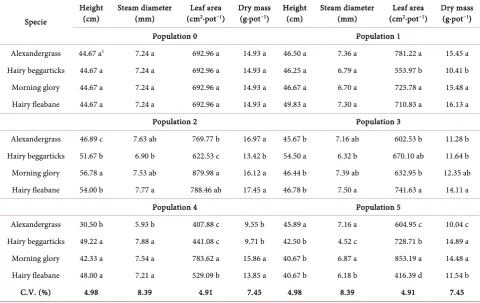
In plant densities of 4:1 alexandergrass/erva-mate plant proportion, there was a big decrease in erva-mate height. The other weed species caused also reduction in crop height (Table 1). In the largest population tested, hairy beggarticks, morning glory and hairy fleabane significantly affected the erva-mate height as function of the interspecific competition (Table 1).
Similar results were observed by Martins [16] who verified that seven plants·m−2 of Amaranthus retroflexus, U. brizantha, B. pilosa or C. echinatus, interfered differentially in seedling height of two olive cultivars (Arbequina and Ascolano) compared to the weed free control. Arbequina competing with B. pi-losa and A. retroflexus presented lower seedling height, attributed to genetic dif-ferences between cultivars in terms of competitive ability [12].
The stem diameter of erva-mate in competition with hairy fleabane, was not affected up to three plants of the competitor. There was reduction of 2.8 and 17.4% in stem diameter when the erva-mate competed with four and five hairy fleabane plants, respectively (Table 1). This behavior is directly associated with the reduction in the physiological characteristics of erva-mate, as consequence of the competition. Toledo [17] also verified reduction in diameter of eucalyptus in competition with U. decumbens.
Regarding the erva-mate leaf area, the competition of two hairy fleabane plants with the crop caused increase of approximately 12% compared to the control plot with further reduction in this variable in higher competition densi-ties, reaching about 41% reduction with five plants, compared to the control
DOI: 10.4236/ajps.2018.93033 441 American Journal of Plant Sciences
Table 1. Height, steam diameter, leaf area and dry mass of the native mate genotype in competition with alexandergrass, hairy beggarticks, morning glory and hairy fleabane. UFFS-Erechim, 2016.
Specie
Height
(cm) Steam diameter (mm) (cmLeaf area 2·pot−1) Dry mass (g·pot−1) Height (cm) Steam diameter (mm) (cmLeaf area 2·pot−1) Dry mass (g·pot−1)
Population 0 Population 1
Alexandergrass 44.67 a1 7.24 a 692.96 a 14.93 a 46.50 a 7.36 a 781.22 a 15.45 a Hairy beggarticks 44.67 a 7.24 a 692.96 a 14.93 a 46.25 a 6.79 a 553.97 b 10.41 b Morning glory 44.67 a 7.24 a 692.96 a 14.93 a 46.67 a 6.70 a 725.78 a 15.48 a Hairy fleabane 44.67 a 7.24 a 692.96 a 14.93 a 49.83 a 7.30 a 710.83 a 16.13 a
Population 2 Population 3
Alexandergrass 46.89 c 7.63 ab 769.77 b 16.97 a 45.67 b 7.16 ab 602.53 b 11.28 b Hairy beggarticks 51.67 b 6.90 b 622.53 c 13.42 b 54.50 a 6.32 b 670.10 ab 11.64 b Morning glory 56.78 a 7.53 ab 879.98 a 16.12 a 46.44 b 7.39 ab 632.95 b 12.35 ab Hairy fleabane 54.00 b 7.77 a 788.46 ab 17.45 a 46.78 b 7.50 a 741.63 a 14.11 a
Population 4 Population 5
Alexandergrass 30.50 b 5.93 b 407.88 c 9.55 b 45.89 a 7.16 a 604.95 c 10.04 c Hairy beggarticks 49.22 a 7.88 a 441.08 c 9.71 b 42.50 b 4.52 c 728.71 b 14.89 a Morning glory 42.33 a 7.54 a 783.62 a 15.86 a 40.67 b 6.87 a 853.19 a 14.48 a Hairy fleabane 48.00 a 7.21 a 529.09 b 13.85 a 40.67 b 6.18 b 416.39 d 11.54 b
C.V. (%) 4.98 8.39 4.91 7.45 4.98 8.39 4.91 7.45
1Means followed by the same lowercase letter in the column within each population do not differ by Tukey test (p ≤ 0.05). ANOVA: For all variables, tfactors
A and B were significant (p < 0.05). Comparison within factor B is not presented.
natural mechanism that plants use to try to escape competition in its initial stag-es, before it becomes severe; the plant tries to increase its interception of light energy and overcome shading [18]. With increase in the population of hairy beggarticks, there was a proportional reduction in leaf area, except for popula-tion 5, where it tended to stabilize. Costa [19] found a reduction of 42% in euca-lyptus leaf area after 60 days of competition with Commelinabenghalensis.
When analyzing the erva-mate stem diameter, leaf area and dry mass in com-petition with the studied weeds, in general, there was a considerable reduction in dry mass 4:1 crop:hairy beggarticks proportion, and with three or more alexan-dergrass plants competing with the crop. Hairy fleabane affected the crop only at the 5:1 proportion, and the morning-glory was the least aggressive weed (Table 1).
DOI: 10.4236/ajps.2018.93033 442 American Journal of Plant Sciences fleabane, which has numerous offspring [12], similarly to hairy beggarticks, has a higher competitive aggressiveness when its population increases.
Nutrientcontent
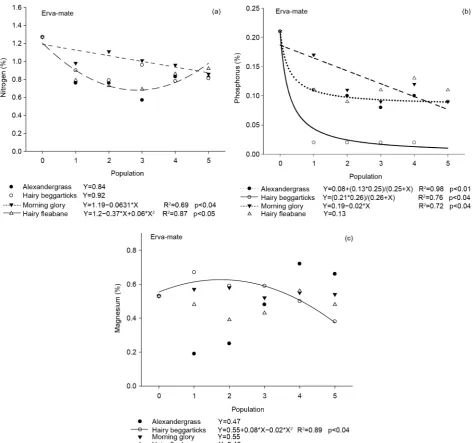
[image:8.595.62.536.245.688.2]Regarding the nitrogen content (N) in erva-mate plants, morning-glory pro-vided a linear decrease of 5.3%; 10.6%; 15.9%; 21.2% and 26.5% in leaf N con-tent, respectively in the populations of 1, 2, 3, 4 and 5 plants, compared to the control treatment (Figure 2(a)); that is, as the weed population increased, there was a proportional decrease in N accumulation in leaves. Martins [12] found that in olive cultivars, there were smaller N accumulations in leaves under com-petition with B. pilosa, Cechinatus, A. retroflexus and U. brizantha, compared to the control plot.
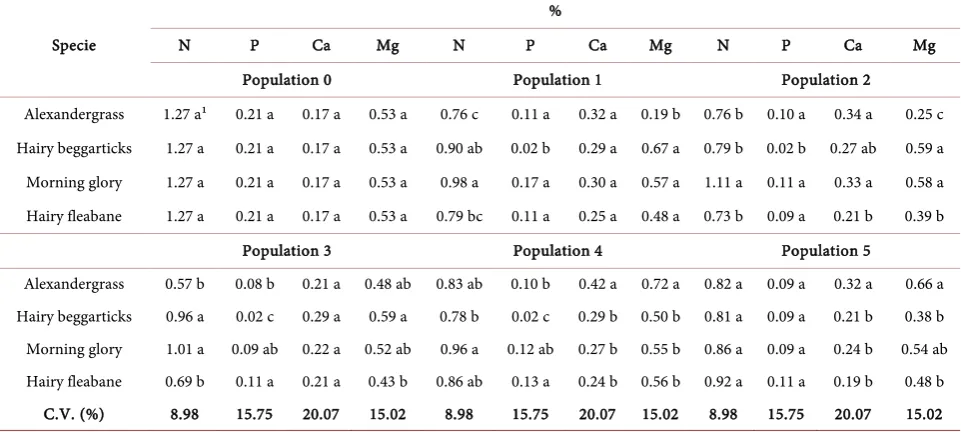
DOI: 10.4236/ajps.2018.93033 443 American Journal of Plant Sciences Comparing the N content within each plant population, it was possible to ve-rify that morning glory was less competitive than the other species for N, as the erva-mate absorbed more N under competition with this weed compared to the other ones (Table 2). ANOVA: For all variables, the interaction A × B is signifi-cant (p < 0.05).
For phosphorus (P) content, overall, alexandergrass and hairy beggarticks caused reduction of approximately 57% and 92% in P content compared to the control (Figure 2(b)). Comparing weed species within each population, it was observed in general that hairy beggarticks was the most competitive one by the nutrient, and hairy fleabane and morning glory were the least competitive ones by P (Table 2). The reduction in P content in erva-mate as function of the weed populations can be explained by the fact that P has low mobility in soil. Weeds develop faster compared to erva-mate, and their roots are more aggressively dis-tributed in soil, providing greater absorption of less mobile elements as P.
For Mg content in erva-mate, it was generally observed that the hairy beggar-ticks, morning glory and hairy fleabane were more competitive by Ca and Mg in the larger populations (Table 2), as the erva-mate content for these nutrients was reduced under competition with these weeds. These results corroborate with those found by [21], who verified that coffee leaves collected from plants free of competition had P concentration 19.5% higher than leaves coming from plants under competition; in the same study, Mg contents were reduced as the weed population increased.
[image:9.595.58.539.494.710.2]In general, the competition between the erva-mate and the weeds early in the crop development may compromise the entire crop cycle. It was verified that weeds caused reduction on erva-mate metabolism.
Table 2. Nitrogen (N), phosphorus (P), calcium (Ca) and magnesium (Mg) contents in foliar tissues in native mate genotype in competition with alexandergrass, hairy beggarticks, morning glory and hairy fleabane UFFS-Erechim, 2016.
Specie
%
N P Ca Mg N P Ca Mg N P Ca Mg
Population 0 Population 1 Population 2
Alexandergrass 1.27 a¹ 0.21 a 0.17 a 0.53 a 0.76 c 0.11 a 0.32 a 0.19 b 0.76 b 0.10 a 0.34 a 0.25 c Hairy beggarticks 1.27 a 0.21 a 0.17 a 0.53 a 0.90 ab 0.02 b 0.29 a 0.67 a 0.79 b 0.02 b 0.27 ab 0.59 a Morning glory 1.27 a 0.21 a 0.17 a 0.53 a 0.98 a 0.17 a 0.30 a 0.57 a 1.11 a 0.11 a 0.33 a 0.58 a Hairy fleabane 1.27 a 0.21 a 0.17 a 0.53 a 0.79 bc 0.11 a 0.25 a 0.48 a 0.73 b 0.09 a 0.21 b 0.39 b
Population 3 Population 4 Population 5
Alexandergrass 0.57 b 0.08 b 0.21 a 0.48 ab 0.83 ab 0.10 b 0.42 a 0.72 a 0.82 a 0.09 a 0.32 a 0.66 a Hairy beggarticks 0.96 a 0.02 c 0.29 a 0.59 a 0.78 b 0.02 c 0.29 b 0.50 b 0.81 a 0.09 a 0.21 b 0.38 b Morning glory 1.01 a 0.09 ab 0.22 a 0.52 ab 0.96 a 0.12 ab 0.27 b 0.55 b 0.86 a 0.09 a 0.24 b 0.54 ab Hairy fleabane 0.69 b 0.11 a 0.21 a 0.43 b 0.86 ab 0.13 a 0.24 b 0.56 b 0.92 a 0.11 a 0.19 b 0.48 b
C.V. (%) 8.98 15.75 20.07 15.02 8.98 15.75 20.07 15.02 8.98 15.75 20.07 15.02
DOI: 10.4236/ajps.2018.93033 444 American Journal of Plant Sciences
4. Conclusions
Morning glory and alexandergrass were the weed species which most consis-tently affected the physiology of the primary metabolism of erva-mate plants.
Overall, all weed species and densities among the tested ones harmed the de-velopment of erva-mate plants, which was considered as low competitive with weeds. Thus, under field conditions, erva-mate plants should have a ring around it where all weeds need to be controlled. The minimum ringing size allowed for weed elimination should be studied in future works.
References
[1] Cardozo Jr., E.L., Donaduzzi, C.M., Ferrarese-Filho, O., Friedrich, J.C., Gonela, A. and Sturion, J.A. (2010) Qualitative Genetic Analysis of Methylxanthines and Phe-nolic Compounds in Mate Progênies. Pesquisa Agropecuária Brasileira, 45, 171-177.
https://doi.org/10.1590/S0100-204X2010000200008
[2] Secretaria de Estado da Agricultura e do Abastecimento—SEAB (2014) Produtos Florestais—Erva-mate. Curitiba, 9 p.
[3] Galon, L., Ferreira, E.A., Concenço, G., Silva, A.A., Silva, D.V., Silva, A.F., Aspiazú, I. and Vargas, L. (2013) Características fisiológicas de biótipos de Conyza bonarien-sis re-bonarien-sistentes ao glyphosate cultivados sob competição. Planta Daninha, 31, 859-866. https://doi.org/10.1590/S0100-83582013000400012
[4] Vargas, L. and Roman, E.S. (2005) Seletividade e eficiência de herbicidas em cereais de inverno. Revista Brasileira de Herbicidas, 4, 1-10.
https://doi.org/10.7824/rbh.v4i3.32
[5] Carvalho, F.P., Santos, J.B., Cury, J.P., Valadão Silva, D., Braga, R.R. and Byrro, E.C.M. (2011) Alocação de matéria seca e capacidade competitiva de cultivares de milho com plantas daninhas. Planta Daninha, 29, 373-382.
https://doi.org/10.1590/S0100-83582011000200015
[6] Martins, L.M., Cruz, M.C.M., Oliveira, A.F., Fagundes, M.C.P. and Santos, J.B. (2015) Crescimento inicial de mudas de oliveira em competição com plantas da-ninhas. Revista Agrarian, 8, 124-132.
[7] Medeiros, W.N., Melo, C.A.D., Tiburcio, R.A.S., Silva, G.S., Machado, A.F.L., Tuf-fi-Santos, L.D. and Ferreira, F.A. (2016) Crescimento inicial e concentração de nu-trientes em clones de Eucalyptus urophylla x Eucalyptus grandis sob interferência de plantas daninhas. Ciência Florestal, 26, 147-157.
[8] Poole, M. and Gill, G.S. (1987) Competition between Crops and Weeds in Southern Australia. Plant Protection Quarterly, 2, 86-96.
[9] Radosevich, S.R., Holt, J.S. and ghersa, C.M. (2007) Ecology of Weeds and Invasive Plants: Relationship to Agriculture and Natural Resource Management. Wi-ley-Interscience, New Jersey, Estados Unidos da América, 400 p.
[10] Rede Oficial de Laboratórios de Análise de Solo e de Tecido Vegetal—ROLAS. (2004) Manual de adubação e calagem para os estados do Rio Grande do Sul e Santa Cata-rina. Porto Alegre, 400 p.
[11] Tedesco, M.J., Gianello, C., Bissani, C.A., Bohnen, H. and Volkweiss, S.J. (1995) Análises de solo, plantas e outros materiais. 2nd Edition, Porto Alegre, 174 p. [12] Matos, C.C., Fialho, C.M.T., Ferreira, E.A., Silva, D.V., Silva, A.A., Santos, J.B.
DOI: 10.4236/ajps.2018.93033 445 American Journal of Plant Sciences
[13] Concenço, G., Ferreira, E.A., Silva, A.A., Ferreira, F.A., Galon, L., Reis, M.R., d’An-tonino, L., Vargas, L. and Silva, L.V.B.D. (2008) Eficiência fotossintética de biótipos de azevém em condição de competição. Planta Daninha, 26, 595-600.
https://doi.org/10.1590/S0100-83582008000300015
[14] Matos, C.C., Fialho, C.M.T., Ferreira, E.A., Silva, D.V., Silva, A.A., Santos, J.B., França, A.C. and Galon, L. (2013) Características fisiológicas do cafeeiro em com-petição com plantas daninhas. Bioscience Journal, 29, 1111-1119.
[15] Ferreira, E.A., Matos, C.C., Barbosa, E.A., Melo, C.A.D., Silva, D.V. and Santos, J.B. (2015) Aspectos fisiológicos da soja transgênica submetida à competição com plan-tas daninhas. Revista de Ciência Agrárias, 58, 115-121.
https://doi.org/10.4322/rca.1745
[16] Martins, L.M., Cruz, M.C.M., Oliveira, A.F., Santos, J.B. and Fagundes, M.C.P. (2015) Crescimento vegetativo e teores de nutrientes em mudas de oliveira em competição com plantas daninhas. Comunicata Scientiae, 6, 430-436.
https://doi.org/10.14295/cs.v6i4.849
[17] Toledo, R.E.B., Victória Filho, R., Pitelli, R.A., Alves, P.L.C.A. and Lopes, M.A.F. (2000) Efeito de períodos de controle de plantas daninhas sobre o desenvolvimento inicial de plantas de eucalipto. Planta Daninha, 18, 395-404.
https://doi.org/10.1590/S0100-83582000000300002
[18] Silva, A.A., Ferreira, F.A., Ferreira, L.R. and Santos, J.B. (2007) Competição entre plantas daninhas e culturas. In: Silva, A.A. and Silva J.F., Eds., Tópicos em manejo de plantas daninhas, Viçosa, UFV, 1-40.
[19] Costa, A.G.F., Alves, P.L.C.A. and Pavani, M.C.M.D. (2004) Períodos de inter-ferência de trapoeraba (Commelina benghalensis Hort.) no crescimento inicial de eucalipto (Euca-lyptus grandis W. Hill ex Maiden). Revista Árvore, 28, 471-478.
https://doi.org/10.1590/S0100-67622004000400001
[20] Manabe, P.M.S., Matos, C.C., Ferreira, E.A., Silva, A.A., Sediyama, T., Manabe, A., Silva, A.F., Rocha, P.R.R. and Galon, L. (2014) Características fisiológicas de fei-joeiro em competição com plantas daninhas. Bioscience Journal, 30, 1721-1728. [21] Fialho, C.M.T., Silva, A.A., Faria, A.T., Torres, L.G., Rocha, P.R.R. and Santos, J.B.
(2012) Teor foliar de nutrientes em plantas daninhas e de café cultivadas em com-petição. Planta Daninha, 30, 65-73.