1
Transferring process engineering knowledge across borders
PUBLIC VERSION
2 Author: Hirata, G. (Genki)
Title: Transferring process engineering knowledge across borders
Date: July 2013
Master assignment Industrial Engineering and Management
Sensata Technologies Holland; Almelo; Netherlands
Supervisors:
• Ir. W. Bandsma; Assistant professor, Business Administration (BA) department; University of Twente
• Dr. S.J. de Boer; Associate professor in International Management, Business Administration (BA) department; University of Twente
• Dr. H.J.M. Ruel, Senior Lecturer/Senior researcher International Management, Business Administration (BA) department; University of Twente
• O. van Straaten; Group leader Process Management Team (PMT); Sensata Technologies Holland
• Dr. ir. S.J.A. Löwik; Assistant professor, Business Administration (BA) department; University of Twente
3
Preface
This research is conducted according to my master program Industrial Engineering and Management at University of Twente. In February 2010, Sensata Technologies was approached who gave the opportunity to perform research on how to transfer knowledge across borders. Sensata was investigating how they could shift the responsibility for some tasks to their oversea subsidiaries. However, there was not yet a clear plan formulated indicating which steps needed to be taken in order to achieve the transfer. The recommendations of this research on how the knowledge transfer should be executed were applied into practice.
I would like to thank the following people at Sensata Technologies who gave me the freedom and opportunity to conduct this research, and supported me during my internship:
Olaf van Straaten Bas Splinter Henk Braamhaar Gerd Priet Dennis Giessen Erik Egmond Joop Hesselink
During the research, the illness of my supervisor Sirp de Boer was discovered, which had the consequence that he could not supervise this research anymore. Very unfortunately, he passed away due to his illness: I remember mr. de Boer as a very passionate and helpful person who helped me frequently whenever I was stuck in my research. I would like to thank him again for his ongoing support he gave to me. The role was succeed by one of his colleagues mr. Huub Ruel. He supported me as a second supervisor from spring 2011 onwards. In spring 2012, he decided to leave the University of Twente. Due to this, a new supervisor was found in the name of mr. Sandor Löwik.
I would like to make use of this opportunity to thank my supervisors for the ongoing support and advice they gave me throughout my research.
4
Table of contents
Chapter 1 Research structure 8
1.1 Introduction 8
1.2 Project background 9
1.3 Research scope 10
1.4 Research design 11
1.5 Research questions 12
1.6 Conclusions 13
Chapter 2 Theory on knowledge transfer & national cultures 15
2.1 Introduction to knowledge transfer 15
2.2 Measuring effective knowledge transfer 17
2.3 Stages in knowledge transfer 19
2.4 Factors influencing knowledge transfer 20
2.5 Constructing the research framework 29
2.6 Conclusions 31
Chapter 3 Measuring influencing factors in the knowledge transfer 33
3.1 Data on process engineering knowledge 33
3.2 Data on prior knowledge and motivation of the recipient 35
3.3 Data on tacitness of knowledge to be transferred 37
3.4 Validity of the collected data 38
3.4 Conclusions 39
Chapter 4 New Product Development projects 40
4.1 B-list New Product Development projects 40
4.2 B-list New Product Development team 42
4.3 Process engineering knowledge to be transferred 43
4.4 Prior skills required for conducting process engineering tasks 45
4.5 Transfer case Mexico 45
4.6 Conclusions 46
Chapter 5 Research findings after applying the research framework 48
5.1 Prior knowledge of the recipient 48
5.2 Tacitness of the knowledge to be transferred 52
5.3 Motivation of the source and the recipient 54
5.4 Differences in cultural dimensions 55
5.5 Interventions 60
5
Chapter 6 Implementation of recommended interventions 65
6.1 Interventions in the implementation stage of the knowledge transfer 65 6.2 Interventions in the ramp-up stage of the knowledge transfer 67
6.3 Conclusions 68
Chapter 7 Conclusions & recommendations 70
7.1 Conclusions 70
7.2 Recommendations 73
References 75
Appendix A Scores on Hofstede’s five cultural dimensions 79
Appendix B Global New Product Development checklist 80
Appendix C-1 Process engineering tasks (Concept/Development/Pilot phase) 81 Appendix C-2 Process engineering tasks (Pre-launch/Production phase) 82
Appendix D Interviewees 83
Appendix E Interview questions (3 process engineers) 83
Appendix F Interview questions (Transfer case Mexico) 84
Appendix G-1 Transfer plan Mexico (based on GNPD checklist) 85 Appendix G-2 Transfer plan Mexico (based on process engineer experience) 86
Appendix H Assessment template prior knowledge 87
Appendix I Assessment template prior skills 88
6
Chapter 2 Theory on knowledge transfer & national cultures
In this chapter, the general knowledge retrieved from the literature on knowledge transfer and national cultures are presented. In the previous chapter, it was explained that the transfer case of Sensata is characterized by the fact that the transfer occurres transcontinental from Europe to Asia, intra-firm (between subsidiaries of the same company) and that New Product Development knowledge was transferred. Literature which described similar transfers as the transfer case of Sensata were expected to be useful for this research and were therefore reviewed by the researcher. The following research questions were answered in this chapter:
• What are factors influencing the transnational transfer of process engineering knowledge used in New Product Development projects
• What kind of interventions are required in order to achieve an effective transnational transfer of process engineering knowledge used in New Product Development projects
A number of authors studied factors that influence the knowledge transfer process (a.o. Szulanski, 1996; Cohen and Levinthal, 1990; Cummings and Teng, 2003; Minbaeva et al, 2003). Particularly the study of Cummings and Teng (2003) has a good fit with the transfer at Sensata, because they studied transfers concerning: “knowledge transfer”, “New Product Development knowledge”, “transnational transfer” and “intra-firm transfer”. The key factors influencing the transfer as described by Cummings and Teng (2003) were used as basis for the research framework developed for the transfer case of Sensata. Another study which was used extensively during this research was the influencing factors and transfer stages as proposed by Szulanski (1996; 2000). Szulanski (1996) studied transfers concerning “knowledge transfer” and “intra-firm transfer”. He elaborated on the different stages during this transfer process, and that some factors are mostly influencing the transfer process during a particular stage (Szulanski 2000). This was interesting for this research to identify which factors were mostly influencing the transfer at Sensata in different stages of the knowledge transfer process. The findings of Cummings and Teng (2003) and Szulanski (1996; 2000) complement each other in the sense that Szulanski (1996; 2000) presented the concept of transfer stages which was not discussed by Cummings and Teng (2003). Therefore, the choice is made to integrate the findings from both studies into one research framework to be applied at the transfer case of Sensata.
In the next section, a brief introduction is given to the knowledge transfer process. After that, concepts from the literature are presented how knowledge transfer can be measured. Thereafter, the factors influencing effective knowledge transfer are presented based on the findings retrieved from Cummings and Teng (2003), Szulanski (1996; 2000) and other researchers. At the end of this chapter, the general knowledge retrieved from the literature is integrated into one research framework and a brief summary is given of this chapter.
2.1 Introduction to knowledge transfer
7 the organization and which is perceived superior to internal alternative practices and known alternatives outside the company. Transfer of best practice can also be seen as replication of organizational routines. The transfer at Sensata studied in this research did not consider specifically the transfer of best practices. However, the concept given by Szulanski of replicating organizational routines is not only applicable for transfer of best practices, but knowledge transfer in general: in a later study, Szulanski (2000) defines knowledge transfer as a process in which an organization recreates and maintains a complex, causally ambiguous set of routines in a new setting (Szulanski, 2000). “Causally ambiguous” means that the precise reason why an organizational routine becomes a success or a failure is not always clear. Szulanski (1996) mentions additionally the source-recipient concept in the knowledge transfer process: the source is defined as the organization where the knowledge resides originally while the recipient is defined as the organization receiving the knowledge from the source organization, where the knowledge needs to be re-created in a new setting. In order to put more emphasize on the aspect that knowledge is transferred from the source organization to the recipient organization, and that the knowledge is re-created at the recipient organization, the following definition for knowledge transfer is used in this research.
• Knowledge transfer is a process in which the source organization sends knowledge to the recipient organization so that the knowledge can be re-created and maintained in a new setting.
In section 2.3, the different stages in the knowledge transfer process is described and section 2.4 presents the factors influencing the knowledge transfer process.
The knowledge transfer process is influenced by factors occurring in different stages of the transfer process which influence the outcome (success/failure) of the transfer (Szulanski, 1996). Past studies have shown that transferring knowledge is far from easy (Gupta and Govindarajan, 1991a; Kerwin and Woodruff, 1992). It can be difficult to know exactly what needs to be transferred prior to engaging in a knowledge transfer process (Sowell, 1980). It is challenging for multinational companies to achieve an effective knowledge transfer across borders, because its participants are often separated by time, space, culture and language (Schlegelmilch and Chini, 2003) which may limit their ability to access, share and absorb knowledge effectively (Duan et al., 2010). Even in case of intra-firm transfers where the transfer occurs between organizational units of the same company in one country, the transfer can still be difficult (Cerny, 1996; Hansen, 2002) if the knowledge to be transferred is not codified (not verbalized in written words) (Szulanski, 1996; Hansen, 1999). It may cost considerable time and effort to explain the knowledge and to understand one another (Uzzi, 1997; Hansen, 1999).
8 Development is tacit (Goffin and Koners, 2011). Explicit knowledge can be readily explained and documented, whereas tacit knowledge is difficult to express in words (Goffin and Koners, 2011). Simonin (1999) defines tacit knowledge as a specific expertise that a particular company acquires over the years, which cannot be transferred only by blue prints or written instructions. He mentions that the more tacit the knowledge is, the more difficult the transfer process is (Simonin, 1999). Based on the findings that New Product Development involves a lot of tacit knowledge (Goffin and Koners, 2011) and that tacit knowledge is difficult to transfer (Simonin, 1999), the transfer of knowledge on New Product Development activities is expected to be particularly challenging.
So knowledge transfer is often not easy, particularly in case New Product Development knowledge needs to be transferred across borders. The next section continues to describe how the success or failure of effective knowledge transfer can be measured.
2.2 Measuring effective knowledge transfer
The literature showed different views on when a transfer is regarded as successful. One approach to assess effective knowledge transfer was derived from the literature on New Product Development projects. In the previous chapter it was mentioned that Sensata desired that the Make site engineers should be able to perform the tasks in the New Product Development projects at least as good as the Business center would be able to do. So the shift of responsibilities from the Business center process engineers to the Make site engineers should not have any negative impact on the quality of the New Product Development projects. Success criteria for New Product Development projects are defined by Soderquist (2006). He mentioned that a successful New Product Development project is one that is ready on time, at the budgeted cost, conform specifications with regard to technical performance agreed with the customer. So according to Soderquist (2006), if these criteria are met, the quality of the New Product development project is good. Following the concept described by Soderquist (2006), if the quality of Sensata’s New Product Development projects after the knowledge transfer remains at least the same as before the transfer, then the transfer of knowledge could be considered as a success. Therefore, it was important that the quality of the New Product Development projects would be monitored.
• Effective knowledge transfer can be measured by monitoring the quality of B-list New Product development projects
Sensata is actually already monitoring the quality of their New Product Development projects. Because the process engineering tasks themselves do not change (only the people responsible change) there are no reasons to argue that the way of monitoring the New Product Development projects should change. Therefore, existing way of monitoring the quality of the projects can be used in order to measure effective knowledge transfer, which is discussed more in detail in chapter 3.
9 (Nelson, 1993). People from the source organization where the knowledge is originally located, would be the most capable persons to measure the knowledge level of the recipient. The source should act as a mentor to the recipient and ask questions to the recipient (mentee) to elicit the mentee’s degree of comprehension of a particular knowledge and provide feedback to the answers given by the recipient (Swap, 2001). The mentee can then reflect on the answers he gave and the feedback received from the mentor (Swap, 2001). This way, both the mentor (source) as well as the mentee (recipient) can measure to what extent the knowledge has been effectively transferred. Mentoring relationships can not only measure effective knowledge transfer, but it can also contribute to the effective transfer of knowledge itself (Bryant, 2005). This is discussed at a later section in this chapter as it is one of the interventions to be applied in order to actually transfer knowledge.
• Effective knowledge transfer can be measured by establishing mentoring relationships between the source and the recipient organization
The mentor in the case of Sensata should be the Business center process engineer (source) and the mentee should be the Make site process engineer (recipient).
One remark to the measuring methods discussed in this section is that the source should not be narrow minded with regard to how the transferred knowledge is used at the recipient. Williamson (2007) stated that the recipient could decide to adapt the transferred knowledge to fit the local context (adaptation). In case the transferred knowledge is context-dependent, meaning the knowledge has a rich connection with the environment, adaptation of the knowledge to fit the new environment is more likely to happen (Willamson, 2007). So depending on the context-dependent nature of the knowledge to be transferred, the source and recipient should decide whether or not to adapt the knowledge. As adapting the knowledge is not necessarily wrong but even important in certain situations, this should be taken into account when measuring effective knowledge transfer. Because people from different departments work together in New Product Development projects and because the New Product Development team interacts with external parties such as suppliers and customer to develop the new product, it is expected that the knowledge used in these projects are highly context dependent, therefore requiring an adaptation of the transferred knowledge at the recipient’s site.
10
2.3 Stages in knowledge transfer
[image:10.612.65.540.205.286.2]Szulanski (1996) described the different stages during the knowledge transfer process, what kind of organizational events take place in each stage and which factors are mostly influencing in a particular stage of the knowledge transfer process. Szulanski (1996; 2000) defined four subsequent stages in the knowledge transfer process:
Figure 3: Stages in knowledge transfer
The initiation stage comprises of all events happening, that lead to the decision to transfer (Szulanski, 1996). The source and the recipient organization discuss with each other whether there is a need to transfer knowledge from one to another (Szulanski, 1996). At the same time, both parties discuss whether it is feasible to carry out the transfer they have in mind. This initiation process often requires months of information collection and evaluation (Szulanski, 1996). Once the decision has been taken to continue with the knowledge transfer, the implementation stage starts (Szulanski, 1996).
During the implementation stage, knowledge is actually transferred between the source and recipient (Szulanski, 1996), which requires considerable contact between the two organizations. The source prepares documentation material describing the knowledge to be transferred and sends this to the recipient. The source organization may need to send their people abroad to the recipient to facilitate the successful absorption of the documentation material (Szulanski, 1996). Vice versa, the recipient organization may need to send their people to the source organization to receive training. It is likely that initially the productivity of the recipient is low, since people need to get used to the new knowledge. Once the recipient organization starts using the transferred knowledge, the ramp-up stage starts (Szulanski, 1996).
11 In the integration stage, use of the new knowledge gradually becomes routinized: the knowledge loses its novelty and becomes part of the taken for granted situation of the knowledge receiving organization (Szulanski, 1996).
This section presented the four subsequent stags of the knowledge transfer process and explained what kind of events take place in each stage. The next section describes how certain factors influence effective knowledge transfer and in which stage(s) these factors are influencing effective knowledge transfer. Chapter 5 describes when each stage is started in the transfer case of Sensata.
2.4 Factors influencing knowledge transfer
At the beginning of this chapter, it was mentioned that different authors studied factors that influence the knowledge transfer process (a.o. Szulanski, 1996; Cohen and Levinthal, 1990; Cummings and Teng, 2003; Minbaeva et al, 2003). The factors found in the literature are categorized into four broad contextual domains (Cummings and Teng 2003):
1. Source context 2. Relational context 3. Recipient context 4. Activity context
In general, factors that affect the opportunity to transfer are more likely to influence effective knowledge transfer in the initiation stage, while factors that affect the execution of the transfer are likely to influence effective knowledge transfer in subsequent implementation, ramp-up and integration stages. In the remainder of this section, the influencing factors categorized under each contextual domain are described.
2.4.1. Source context
12 One approach for measuring the tacitness of knowledge can be derived from the study of Ambrosini and Bowman (2001) who studied the different degrees of tacitness of knowledge. They mention that the lowest degree of tacitness is explicit knowledge which can be easily expressed in words (Ambrosini and Bowman, 2001). Then there is tacit knowledge that is currently not expressed in words, but could be verbalized by asking the source “how do you do that?” (Ambrosini and Bowman, 2001). However, some tacit knowledge can only be partially expressed in words. Some tacit knowledge could be even too deeply embedded in the mind of the source that it is nearly impossible to verbalize this knowledge through the normal use of words (Ambrosini and Bowman, 2001). Therefore, it is not a realistic endeavor for companies to transfer this “most tacit knowledge” (Amdrosini and Bowman, 2001). However, the transfer of explicit knowledge, tacit knowledge that can be articulated and tacit knowledge that can be partially articulated can be achieved by the interventions presented in section 2.4.4. Figure 4 gives a presentation of the different degrees of tacitness of knowledge retrieved from the study of Ambrosini and Bowman (2001):
Figure 4: Degree of tacitness (based on Ambrosini and Bowman, 2001)
13 has adapted the transferred knowledge, that the adapted knowledge does not achieve satisfactory results anymore because the recipient changed some elements of the transferred knowledge that should not have been changed. One reason for this could be that the recipient did not understand fully how the transferred knowledge works due to its tacit nature. Therefore, tacitness of the knowledge to be transferred is also expected to be influencing in the integration stage of the knowledge transfer. The following is stated:
• The tacitness of the knowledge to be transferred influences effective knowledge transfer during the implementation, ramp-up and integration stage of the knowledge transfer • Effective knowledge transfer decreases (increases) as the tacitness of the knowledge to be
transferred increases (decreases)
Szulanski (1996) mentions that motivation of the source organization influence effective knowledge transfer. Motivation of the source is defined as to what extent the source devotes time and resources to the knowledge transfer and their willingness to share their knowledge (Szulanski, 1996). By having a motivated source, it is more likely to achieve an effective transfer (Szulanski, 1996). In the initiation stage, the source needs to explain the recipient what knowledge exactly is in scope to be transferred (Szulanski, 2000). This can be difficult in case the knowledge to be transferred is tacit (Szulanski, 2000). Additionally, the source may need to document the knowledge to be transferred (Szulanski, 1996). In the implementation stage, the source needs to actually transfer the knowledge to the recipient (Szulanski, 1996). Because New Product Development knowledge is tacit, it is difficult to transfer (Goffin and Koners, 2011). Therefore, when the recipient starts using the transferred knowledge in the ramp-up stage, the recipient may need aid from the source. At the end of the ramp-up stage, the recipient achieves satisfactory results with the transferred knowledge. Therefore, in the subsequent integration stage, it is likely that the source does not have to put much effort in the transfer anymore relative to the previous stages. For these reasons, it is argued that the motivation of the source is influencing effective knowledge transfer in the initiation, implementation and the ramp-up stage. Therefore, the following is stated:
• The motivation of the source influences effective knowledge transfer during the initiation, implementation and the ramp-up stage
• Effective knowledge transfer decreases (increases) as the motivation of the source decreases (increases)
2.4.2 Relational context
14 the knowledge sender and the receiver (Marsden, 1990): a laborious and distant relationship can cause difficulties to transfer knowledge successfully (Szulanski, 1996). Both Cummings and Teng (2003) and Szulanski (1996) mention that the closer and more intimate the relationship between source and recipient, the greater the likelihood to achieve an effective knowledge transfer. However, both studies do not elaborate into detail on the different characteristics of cultures and also do not lay emphasis on the difference between Western and Asian cultures which is interesting for this research. Hofstede is one of the most notable researchers on the field of cultural differences between Western and Asian countries. Because the study of Hofstede provides further insight on cultural differences between Western and Asian countries, the choice is made to include Hofstede’s study in this research.
Hofstede applied five dimensions to classify national cultural differences:
1) Individualism vs. Collectivism 2) Large vs. Small power distance 3) Long term vs. Short term orientation 4) Uncertainty avoidance
5) Masculinity and Femininity
The five cultural dimensions defined by Hofstede are used in this research to classify the Dutch (Business center) and the Malaysian (Make site) culture.
Hofstede (2007) defined the core element of culture to be values which are about what is good and what is bad: among societies, culture can be very different, but within a society, culture remains considerably stable over time (Hofstede, 2007). Attachment A presents the scores of fifty countries on the five cultural dimensions of Hofstede. Hofstede (2007) has found clear differences between Asian and Western countries on the dimensions “Individualism vs. Collectivism”, “Large vs. Small power distance” and “Long term vs. Short term orientation”. Hofstede (2007) mentioned that on the dimensions of “Uncertainty avoidance” and “Masculinity versus Femininity”, Asian countries differ as much among themselves as Western countries.
According to Hofstede (2007), the most evident difference between Asian countries and Western European countries relates to the cultural difference on Individualism versus Collectivism. Individualism stands for a society in which everyone is expected to look after him or herself and his or her family. Collectivism stands for a society in which people are integrated in groups which take care and protect you your entire life, in exchange of your loyalty to your group you belong to. Western countries scored above average in this dimension, while Asian countries all scored below average.
Power distance is the extent to which members of an organization with less power, expect and accept that power is not distributed equally. Asian cultures score relatively high on Power distance.
15 obligations are characteristic for Short Term Orientation (Hofstede, 1988; 2004). This dimension was first called Confusion dynamism as presented in attachment A, but was later renamed to the current name.
Uncertainty avoidance relates to what extent people of a society feel unconformable with situations which are novel, unknown, surprising or different than usual (Hofstede, 2004). Cultures avoiding uncertainty tries to minimize the possibility of such situations by strict laws and rules (Hofstede, 2004).
Masculinity versus Femininity refers to the extent that masculine values like assertiveness, performance, and competition, prevails over feminine values like quality of life, maintaining warm relationships and solidarity (Hofstede, 1989).
Lucas (2006) mention that transfers occurring between similar cultures are likely to be more effective because the cultural similarity eases the knowledge transfer. The researcher argues that this is not necessarily always the case, because if cultures of both the source and the recipient organization score high on the “Uncertainty avoidance” dimension, both parties do not feel comfortable with “changes” and therefore might be resistant to the knowledge transfer. However, because the similarity in cultures makes it in general easier for the source and the recipient organization to understand each other, it is argued that generally speaking, the less cultural differences, the more effective the transfer is expected to be. Later in chapter 5, the Dutch, Malaysian and Mexican cultures are compared with each other and it is discussed what kind of influence the differences and/or similarities have on effective knowledge transfer.
The source and the recipient organization start interacting with each other in the initiation stage in order to identify the need to transfer knowledge and whether it is feasible to carry out the transfer (Szulanski, 1996). Therefore, cultural differences are expected to be influencing effective knowledge transfer in the initiation stage. In the implementation stage, the contact between the source and recipient is expected to increase, because the knowledge is actually transferred from the source to the recipient (Szulanski, 1996). Additionally, the source is expected to support the recipient in the ramp-up stage with additional advice or guidance, particularly in case the knowledge to be transferred is tacit (Szulanski, 1996). Because a lot of interaction is expected between the source and recipient in the implementation and ramp-up stage, cultural differences influence effective knowledge transfer in these stages. In the integration stage, the recipient achieves satisfactory results with the transferred knowledge and the knowledge becomes routinized at the recipient (Szulanski, 1996). The recipient might adapt the transferred knowledge so that it fits to the local setting for example due to cultural differences between the source and the recipient. Therefore, cultural differences also influence effective knowledge transfer in the integration stage. Now the importance of cultural differences in all stages of the knowledge transfer has been discussed, the following is stated:
16 • Effective knowledge transfer decreases (increases) as differences on the five cultural
dimensions between source and recipient increase (decrease)
2.4.3. Recipient context
According to Cummings and Teng (2003), it is important that the recipient perceive the importance of the transfer, because if the recipient perceives the knowledge transfer as a high priority, they will have greater motivation to support the transfer. Research showed that the motivation of the recipient is an important factor in order to achieve effective knowledge transfer (Baughn et al., 1997; Hamel, 1991, Szulanski, 1996; Cohen and Levinthal, 1990; Kim, 1998; Inkpen and Dinur, 1998; Park and Ghauri, 2010). In the initiation stage, the source and recipient identify the need to transfer knowledge and whether it is feasible to carry out the transfer (Szulanski, 1996), however, knowledge is not yet actually transferred to the recipient. Therefore, it is argued that not much effort is required from the recipient yet to acquire the new knowledge. So motivation of the recipient is expected to have little influence on effective knowledge transfer in the initiation stage. However in the subsequent stages of implementation, ramp-up and integration stage, the recipient actually start acquiring the knowledge, ramping up towards a satisfactory level and the knowledge eventually become part of the taken for granted situation at the recipient. Because considerable effort is required from the recipient in these stages, motivation of the recipient is expected to have influence effective knowledge transfer in the implementation, ramp-up and integration stage. Therefore, the following is stated:
• Motivation of the recipient influences effective knowledge transfer during the implementation, ramp-up and integration stage
• Effective knowledge transfer decreases (increases) as motivation of the recipient decreases (increases)
Another factor from the recipient context which influences effective knowledge is prior knowledge of the recipient. Several studies consider prior knowledge of the recipient as a key factor in the knowledge transfer process (Cohen and Levinthal, 1990; Kim, 1998; Zahra and George, 2002; Szulanski, 1996). Prior knowledge is defined as the knowledge and skills the recipient already possesses, which is related to the knowledge to be transferred (Cohen and Levinthal 1990; Kim, 1998). Prior knowledge increases the ability of the recipient to make sense of, to assimilate and to use the new knowledge (Cohen and Levinthal, 1990): so prior knowledge is expected to be influencing effective knowledge transfer from the moment that the recipient starts acquiring the knowledge, which happens in the implementation, ramp-up and integration stage. Therefore, the prior knowledge of the recipient is expected to influence effective knowledge transfer in these three stages. The following can be stated:
• Prior knowledge of the recipient influences effective knowledge transfer during the implementation, ramp-up and integration stage
17
2.4.4 Activity context
Research has shown that successful knowledge transfer requires many activities (Cummings and Teng, 2003). Transfer activities are defined as every means useful for transferring knowledge effectively from the source to the recipient (Albino et al., 1998). So transfer activities are actually the interventions in order to achieve the desire outcome (in this research, effective knowledge transfer) according to the design science approach. Therefore, rather than using “transfer activities”, the choice is made to use “interventions” in the remaining of this research to describe all the actions that should be carried out in order to achieve effective knowledge transfer. As discussed in section 2.4.1., it is not a realistic endeavour to transfer the “most tacit knowledge” which is deeply embedded in the mind of people. However, the transfer of explicit knowledge, tacit knowledge that can be articulated and tacit knowledge that can be partially articulated is possible by applying the interventions discussed in this section.
Documentation of the knowledge to be transferred can be carried out by collecting available manuals or work instructions already existing at the site of the source organization. Explicit knowledge has the lowest degree of tacitness (Ambrosini and Bowman, 2001) and therefore the easiest to transfer in written documents. Then there is tacit knowledge that can be made explicit by asking the right question to the individual possessing the tacit knowledge (Ambrosini and Bowman, 2001). The transfer of this kind of tacit knowledge can be made less difficult by converting tacit knowledge to explicit knowledge, which is defined as codification of tacit knowledge (Teece, 1976). Tacit knowledge that can be partially codified can also be put into documentation, though the contents will be still lacking some knowledge that could not be codified. Therefore the use of “documentation” for this type of knowledge would not be as effective as the use of “documentation” for explicit knowledge and tacit knowledge that can be articulated. Although Dinur et al (2009) do not mention documentation as a method to transfer tacit knowledge, following the concept of Ambrosini and Bowman (2001), documentation is certainly a valid approach to transfer tacit knowledge that can be fully or partially articulated. The source organization should be responsible for codifying tacit knowledge (Simonin, 1999), putting the information together with existing documentation material and sending the documentation material to the recipient organization (Cummings and Teng, 2003). However, the prepared documentation material still needs to be explained and made understandable for the recipient organization through teaching.
18 relationship with a person in a face-to-face setting (O’Dell and Grayson, 1998) and Lane and Lubatkin (1998) states that especially for learning complex tacit knowledge, face to face interactions are required where the source and the recipient actually meet each other. So teaching methods should allow as much as possible face-to-face interaction between the source and the recipient.
The following teaching methods which can be applied in knowledge transfers were retrieved from the study of Zhao and Anand (2009):
1. Classroom lecturing 2. One-on-one mentorship
3. Transfer of people from the source to the recipient or vice versa
Classroom lecturing is a setting in which the source gives lectures to the recipient. The most effective way to transfer knowledge by this method is that the source and the recipient actually meet each other in a “classroom” rather than having lecturing by webcams or videoconference. During these lectures, the documentation material prepared by the source can be presented in power point presentations and explained to the recipient so that the recipient can understand how the documentation material should be used. Similar to documentation, classroom lecturing is particularly suited for transferring explicit knowledge and tacit knowledge that can be articulated, because this knowledge can be expressed in words during the lectures. Tacit knowledge that can be partially articulated can also be transferred by classroom lectures, though some knowledge would still be missing. Similar to the use of “documentation”, the use of “class room lectures” for this type of knowledge would not be as effective as the use of “class room lectures” for explicit knowledge and tacit knowledge that can be articulated.
19 articulated is limited, it is argued that these types of knowledge can be transferred effectively by means of mentorships. Tacit knowledge that can be partially articulated can also be transferred by mentorships. However, some part of this type of knowledge cannot be articulated and therefore, cannot be transferred effectively by mentorships.
Transfer of people from the source to the recipient or vice versa is the most effective way for transferring knowledge (O’Dell and Grayson; 1998). Research has shown that tacit knowledge embedded in individuals, can be transferred by transferring these individuals (Allen, 1977; Berry and Broadbent, 1984, 1987; Starbuck, 1992). Wang et al. (2001) argue that a successful knowledge transfer is determined by the ability of expatriates (people from the source visiting the recipient for a long period) to share their experiences and communicate their knowledge through face to face interaction to the recipient organization. Though Dinur et al (2009) mention that short term and long term visits contribute to effective knowledge transfer, the literature does not prescribe how long one should visit the other site, probably because this depends highly on the specific transfer situation. However, it is argued that the more tacit the knowledge to be transferred, the more difficult it is to transfer that knowledge quickly and easily (Perrin and Rolland, 2007), and the longer it takes until the recipient has learned the tacit knowledge. So tacit knowledge that can only be partially articulated can be transferred effectively by means of the recipient having one long ongoing learning period or multiple short learning periods in which he or she can have close face-to-face interaction with the source. Transfer of people for a long period is also suited for transferring explicit knowledge and tacit knowledge that can be fully articulated, though it may not be the efficient way to transfer because the transfer can also be achieved by less resource intensive activities such as preparing documentation and explaining the documentation is classroom lectures. However, transfer of people for a short period is definitely important for explicit knowledge and tacit knowledge that can be fully articulated, in order that the source and the recipient actually meet each other in order to strengthen their relationship prior to initiating the knowledge transfer. Therefore, it is argued that for transferring explicit knowledge and tacit knowledge that can be fully articulated, it is recommended that the source should visit the site of the recipient or vice versa at least for a short period, and if it happens for a long period, it will also definitely help effective knowledge transfer.
The interventions “documentation” and the various methods of teaching, “classroom lecturing”, “one-on-one mentorship”, “transfer of people for a long period”, “transfer of people for multiple short periods”, “transfer of people for a short period” can be used to actually transfer knowledge from the source to the recipient. Because the actual transfer of knowledge occurs in the implementation stage, these interventions are expected to influence effective knowledge transfer in this stage. Subsequently, interventions are also needed in the ramp-up stage in order that the knowledge level of the recipient ramps up to a satisfactory level. At the end of the ramp-up stage, the recipient has reached a satisfactory knowledge level. Therefore, in the subsequent integration stage, no interventions as described earlier are expected to be necessary. For the reasons mentioned, interventions are particularly influencing effective knowledge transfer in the implementation and the ramp-up stage. The following can be stated:
20 • Classroom lecturing is effective for transferring explicit knowledge and tacit knowledge
that can be articulated
• One-on-one mentorship is effective for transferring explicit knowledge and tacit knowledge that can be articulated
• Transfer of people for a short period is effective for transferring explicit knowledge and tacit knowledge that can be articulated
• Transfer of people for a long period or transfer of people for multiple short periods is the most effective way of transferring knowledge and effective for transferring explicit knowledge, tacit knowledge that can be articulated and tacit knowledge that can be partially articulated
The findings of this section are all combined into one research framework which is presented in the next section.
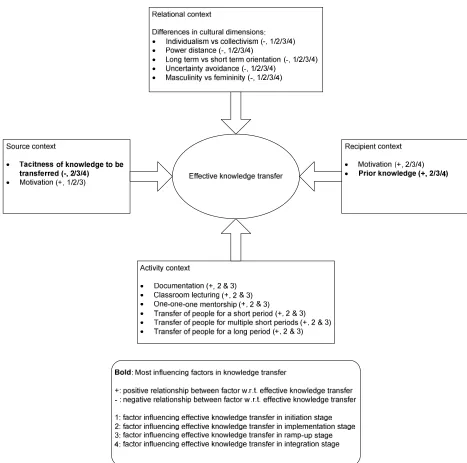
2.5 Constructing the research framework
In the previous section, the factors influencing the knowledge transfer during different stages have been presented. The factors tacitness of knowledge to be transferred and the prior knowledge of the recipient organization influence effective knowledge transfer most (Szulanski, 2000). Szulanski (2000) did not mention how much these factors are exactly more influencing effective knowledge transfer relative to other factors. Therefore, no quantitative measures are incorporated in this research framework indicating the relative importance of each factor to the knowledge transfer. However, a similar transfer from Business center Holland to Make site Mexico occurred in 2008 when Make site Mexico became responsible for process engineering tasks in B-list New Product Development tasks. Though it was expected that there were differences between Make site Mexico and Malaysia (e.g. cultural differences), it was likely that the factors that were important in transfer case Mexico would be also important for the transfer case Malaysia. The findings from transfer case Mexico are described in chapter 4.
21
Figure 5: Research framework
22 applying merely documentation, classroom lecturing and/or one-on-one mentorships, which was taken into consideration when applying this research framework to the transfer case of Sensata.
In order to apply the interventions, time and resources need to be spent by the source and/or the recipient organization. Documentation material should be prepared in the initiation stage by the source organization and therefore, the motivation of the source is expected to be a pre-condition that documentation contributes to effective knowledge transfer. In classroom lecturing in the implementation stage, both the source and the recipient need to actively participate in the lectures, in order that these lectures would lead to effective knowledge transfer. Therefore, the motivation of the source and recipient are expected to be pre-conditions that classroom lecturing contributes to effective knowledge transfer. This line of reasoning applies also to one-on-one mentoring and transfer of people from the source to the recipient or vice versa in the implementation stage and subsequent ramp-up and integration stage, because without the source and recipient being motivated, these interventions will not lead to an effective knowledge transfer. So motivation of the source and recipient are important pre-conditions that the interventions would lead to effective knowledge transfer and therefore needed to be taken into consideration when applying this research framework to the transfer case of Sensata. It is likely that the motivation of the source is particularly important in the initiation and the implementation stage, while the motivation of the recipient is particularly important in the implementation stage and subsequent ramp-up and integration stage.
2.6 Conclusions
This chapter described the factors influencing effective knowledge transfer and the interventions to be applied in order to achieve effective knowledge transfer. In the previous chapter, it was mentioned that the design science approach was applied in this research. Following this approach, a systematic review of existing literature on knowledge transfer and national cultures is performed.
Effective knowledge transfer can be measured by monitoring the quality of the New Product Development projects before and after the Make site process engineers start using the transferred knowledge. If the quality of the project remains the same, it is one indication that the Make site process engineers have the knowledge to perform the process engineering tasks just as good as the Business center process engineer. Another approach to measure effective knowledge transfer was to establish mentoring relationships between the source and the recipient. The mentor and the mentee can monitor the knowledge transfer progress through the close contact they have with each other.
23 partially articulated. Transferring “the most tacit knowledge” which is deeply embedded in the mind of people is argued to be not a realistic endeavour. Particularly in order to transfer tacit knowledge, face to face interactions are required where the source and the recipient actually meet each other, so they can easier build a relationship together (O’Dell and Grayson, 1998; Lane and Lubatkin; 1998). Documentation, classroom lecturing and one-on-one mentorship are effective for transferring explicit knowledge and tacit knowledge that can be articulated. Transfer of people is effective for transferring explicit knowledge, tacit knowledge that can be fully articulated and tacit knowledge that can be partially articulated, and is considered to be the most effective way of transferring knowledge (O’Dell and Grayson, 1998; Wang et al. 2001; Moreland et al, 1996). It is expected that the more tacit the knowledge to be transferred, the more difficult it is to transfer that quickly and easily (Perrin and Rolland, 2007), requiring a longer teaching/learning period and therefore a longer period that one needs to stay at the other location.
24
References
Aken, J.E., Romme, G., 2009, Reinventing the future: adding design science to the repertoire of organization and management studies. Organization Management Journal (2009) 6, p5-12 Albino, V., Garavelli, A.C., Schiuma, G., 1998, Knowledge transfer and inter-firm
relationships in industrial districts: the role of the leader firm. Technovation 19 (1999) p53– 63
Allen, T.J., 1977, Managing the Flow of Technology: Technology Transfer and the Dissemination of Technological Information Within the R&D Organization. MIT Press, Cambridge, MA.
Ambrosini, V., Bowman, C., 2001, Tacit knowledge: Some suggestions for operationalization, Journal of management studies, 38:6, p0022-2380
Argote, L., Ingram, P., 2000, Knowledge transfer: a basis for competitive advantage in firms, Organizational Behavior and Human Decision Processes 82 (1), p150–169.
Arrow, K. J. (1974), The Limits of Organization. Norton, New York.
Bhagat, R.S., Kedia, B.L., Harveston, P.D., Triandis, H.C. (2002), ‘Cultural variations in the cross-border transfer of organizational knowledge: an integrative framework, The Academy of Management Review, 27 (2), p204-221.
Baughn, C., Denekamp, J., Stevens, J., Osborn, R., 1997, Protecting intellectual capital in international alliances, Journal of World Business 32 (2), p103–117.
Berry, D.C., Broadbent, D.E., 1984, On the relationship between task performance and associated verbalized knowledge. The Quarterly Journal of Experimental Psychology 36A, p209–231.
Berry, D.C., Broadbent, D.E., 1987, The combination of explicit and implicit learning processes in task control, Psychological Research 49, p7–15.
Bloom B.D., Crabtree B.F., 2006, The qualitative research interview, Medical Education, 40, p314–321.
Bresman, H., Birkinshaw, J.M., Nobel, R., 1999, Knowledge transfer in international acquisitions, Journal of International Business Studies 30 (3), p439–462.
Brown, J. D. (2000). Using surveys in language programs. Cambridge: Cambridge University Press.
Cerny, K., 1996, Making local knowledge global, Harvard Business Review 74 (3), p22–38 Chang, L., 1994, A psychometric evaluation of 4-poing and 6-point Likert-type scales in
relation to reliability and validity, Applied Psychological Measurement, 18, p205–215. Chen, J., Sun, P. Y.T., McQueen R. J., 2010, The impact of national cultures on structured
knowledge transfer, Journal of knowledge management, 14 (2), p228-242
Cohen, W., Levinthal, D.A., 1990, Absorptive capacity: A new perspective on learning and innovation, Administrative science quarterly, 35, p128-152
Cohen L, Manion L, Morrison K., 2000, Research Methods in Education, 5th edition, London, Routledge Falmer.
25 Cook, S.D.N., Brown, J.S., 1999, Bridging epistemologies: The generative dance between
organizational knowledge and organizational knowing. Organization Science 10 (4) p381-400
Cummings, J.L., Teng, B.S., 2003, Transferring R&D knowledge: the key factors affecting knowledge transfer success, Journal of engineering and technology management, 20, p39-68. De Vaus, D., 2009, Research Design in Social research, Los Angeles, Sage.
Dinur, A., Hamilton III., R.D., Inkpen, A.C., 2009, Critical context and international intra-firm best-practice transfers, Journal of International management, 15, p432-446
Dixon, N.M., 1994, The Organizational Learning Cycle: How We Can Learn Collectively. McGraw-Hill, New York
Dougherty, D., Hardy, C., 1996, Sustained product innovation in large, mature
organizations: overcoming innovation-to-organization problems, Academy of Management Journal 39, p1120–1153.
Duan, Y., Nie, W., Coakes, E., 2010, Identifying key factors affecting transnational knowledge transfer, Information & Management, 47 (7/8), p356–363
Dunn, Kevin, I. Hay, 2005, Interviewing, Qualitative research methods in human geography Goffin, K., Koners, U., 2011, Tacit Knowledge, Lessons Learnt, and New Product
Development. Journal of product innovation management, 28, p300-318
Gonzalez, R., Gasco, J., Llopis, J. (2006), Information systems offshore outsourcing: a descriptive analysis, Industrial Management & Data Systems, 106 (9), p1233-1248. Grant, R.M., 1996, Towards a knowledge-based theory of the firm, Strategic Management
Journal 17 (Winter), p109–122.
Gupta, A.K., Govindarajan, V., 1991a, Knowledge flows and the structure of control within multinational corporations, Academy of Management Review, 16 (4), p768–792
Hamel, G., 1991, Competition for competence and inter-partner learning within international strategic alliances, Strategic Management Journal 12, p83–103.
Hansen, M.T., 2002, Knowledge networks: explaining effective knowledge sharing in multiunit companies, Organization Science, 13, p232–248.
Hofstede, G., 1984, Cultural Dimensions In Management And Planning, Asia Pacific journal of management 1 (2), p81-99.
Hofstede, G., Bond, M.H., 1988, The Confucius Connection: From Cultural Roots To Economic Growth, Organizational dynamics, 16, p4-21
Hofstede, G., McCrae, R., 2004, Personality and Culture Revisited: Linking Traits and Dimensions of Culture, Cross-Cultural Research, 38 (1), p52-88.
Hofstede, G., 2007, Asian management in the 21st century, Asia Pacific Journal Management, 24, p411–420
Huang, C.M., Chang, H.C., Henderson, S., 2008, Knowledge transfer barriers between research and development and marketing groups within Taiwanese small- and medium-sized enterprise high-technology new product development teams, Human Factors and
Ergonomics in Manufacturing & Service Industries, 18 (6), p621–657
Jimes, C., L. Lucardi., 2003, Reconsidering the tacit-explicit distinction: A move toward functional (tacit) knowledge management. Electronic Journal of Knowledge Management 1 (1), p23–32.
26 Kazanjian, R.K., Drazin, R., Glynn, M.A., 2000, Creativity and technological learning: the
roles of organization architecture and crisis in large-scale projects, Journal of Engineering and Technology Management 17 (3–4), p273–298.
Kerwin, K., Woodruff, D., 1992, Can olds hitch its wagon to Saturn’s star? Business Week, 74.
Kim, L., 1998, Crisis Construction and Organizational Learning: Capability Building in Catching-up at Hyundai Motor, Organization science, 9(4), p506-521
Lane P.J., Lubatkin M., 1998, Relative Absorptive Capacity and Interorganizational Learning, Strategic Management Journal, 19 (5), p461-477.
Leonard, D., S. Sensiper., 1998, The role of tacit knowledge in group innovation. California Management Review 40 (3), p112–32.
Li Q., 2013, A novel Likert scale based on fuzzy sets theory, Expert Systems with Applications, 40, p1609–1618.
Longhurst, R., 2003, Semi-structured interviews and focus groups, Key methods in geography, p117-132.
Lucas, L.M., 2006, The role of culture on knowledge transfer: the case of the multinational corporation, The Learning Organization, 13, p257-275.
Minbaeva et al., 2003, MNC Knowledge Transfer, Subsidiary Absorptive Capacity, and HRM
Nelson, R., 1993, National Innovation Systems: A Comparative Analysis. Oxford University Press, New York.
Nonaka, I., 1994, A dynamic theory of organizational knowledge creation, Organizational Science, 5(1), p14-37.
Nonaka, I., Takeuchi, H., 1995, The Knowledge Creating Company, Oxford University Press, New York, NY
Park, B.I., Ghauri, P.N. Key factors affecting acquisition of technological capabilities from foreign acquiring firms by small and medium sized local firms, Journal of World Business (2010).
Purser, R.E., Pasmore, W.A., Tenkasi, R.V., 1992, The influence of deliberations on learning in new product development teams, Journal of Engineering and Technology Management, 9 (1), p1–28.
Schlegelmilch, B.B., Chini, T.C., Knowledge transfer between marketing functions in multinational companies: a conceptual model, International Business Review, 12 (2), 2003, p215–232.
Simonin, B., 1999, Ambiguity and the process of knowledge transfer in strategic alliances, Strategic Management Journal, 20, p595-623
Soderquist, K.E., Organising Knowledge Management and Dissemination in New Product Development Lessons from 12 Global Corporations, Long Range Planning 39, p497-523 Sowell, T., 1980, Knowledge and Decisions, Basic Books, New York.
Spender, J.C., 1996, Making knowledge the basis of a dynamic theory of the firm, Strategic Management Journal, 17 (special issue), p45–62.
27 Stasser, G., Stewart, D.D., Wittenbaum, G.M. 1995. Expert roles and information exchange
during discussion: the importance of knowing who knows what, Journal of Experimental Social Psychology 31, p244–265.
Szulanski, G., 1996, Exploring Internal Stickiness: Impediments to the Transfer of Best Practice Within the Firm, Strategic management journal, 17, p27-43.
Szulanski, G., 2000, The Process of Knowledge Transfer: A Diachronic Analysis of Stickiness, Organizational behavior and human decision processes, 82, p9-27.
Teece, D. J., 1976, The Multinational Corporation and the Resource Cost of International Technology Transfer, Ballinger, Cambridge, MA.
Uzzi, B., 1996, Sources and consequences of embeddedness for the economic performance of organizations, American Sociological Review 61, p674–698.
Wang, Z., Leung, K., Smith, P.B., 2001, Job attitudes and organizational justice in joint venture hotels in China: the role of expatriate managers, International Journal of Human Resource Management, 12 (6), p926-945