http://wrap.warwick.ac.uk
Original citation:
Yau, Jane Yin-Kim and Joy, Mike. (2008) A self-regulated learning approach : a mobile
context-aware and adaptive learning schedule (mCALS) tool. International Journal of
Interactive Mobile Technologies (iJIM), Volume 2 (Number 3). pp. 52-57. ISSN
1865-7923
Permanent WRAP url:
http://wrap.warwick.ac.uk/47642
Copyright and reuse:
The Warwick Research Archive Portal (WRAP) makes this work of researchers of the
University of Warwick available open access under the following conditions.
This article is made available under the Creative Commons Attribution 3.0 (CC BY 3.0)
license and may be reused according to the conditions of the license. For more details
see:
http://creativecommons.org/licenses/by/3.0/
A note on versions:
The version presented in WRAP is the published version, or, version of record, and may
be cited as it appears here.
A Self-Regulated Learning Approach: A Mobile
Context-aware and Adaptive Learning Schedule
(mCALS) Tool
J.Y-K. Yau and M. Joy
Department of Computer Science, University of Warwick, Coventry, UK
Abstract—Self-regulated students are able to create and maximize opportunities they have for studying or learning. We combine this learning approach with our Mobile Context-aware and Adaptive Learning Schedule (mCALS) tool which will create and enhance opportunities for students to study or learn in different locations. The learning schedule is used for two purposes, a) to help students organize their work and facilitate time management, and b) for capturing the users’ activities which can be retrieved and translated as learning contexts later by our tool. These contexts are then used as a basis for selecting appropriate learning materials for the students. Using a learning schedule to capture and retrieve contexts is a novel approach in the context-awareness mobile learning field. In this paper, we present the conceptual model and preliminary architecture of our mCALS tool, as well as our research questions and methodology for evaluating it. The learning materials we intend to use for our tool will be Java for novice programmers. We decided that this would be appropriate because large amounts of time and motivation are necessary to learn an object-oriented programming language such as Java, and we are currently seeking ways to facilitate this for novice programmers.
Index Terms—Context-aware, Learning Schedule, Mobile Learning, Learning Java programming, Learning Objects, Self-Regulated Learning
I. INTRODUCTION
A self-regulated student can be characterized by his/her “active participation in learning from the meta-cognitive, motivational, and behavioral point of view”, and the characteristics of such a student coincide with those attributes of performance and higher-capacity students [1]. Montalvo and Torres [1] noted that a self-regulated student is able to
a) use cognitive strategies to organize, transform, elaborate and recover information;
b) direct their mental processes toward the achievement of personal goals through plan and control;
c) show positive emotions towards tasks and a high sense of academic self-efficacy, and have the ability
to control these to adapt to the requirements of the task and of the specific learning situation;
d) plan and control the time and effort on tasks, and create and structure preferable learning environments such as identifying a suitable place for study and obtaining help from teachers and students when they experience difficulties;
e) use strategies to maintain their concentration, effort and motivation and avoid external and internal distractions, whilst performing tasks.
Initial investigation for the requirements of a mobile learning organizer established that there was a demand by users for institutional support of mobile learning, especially for timetabling information and providing course content [2]. Learning organizers have been used in other mobile learning systems [2, 6], however this has not been for the purpose of capturing and retrieving users’ contexts at a later stage. Several mobile learning projects are underway in Europe and one definition of mobile learning which has become prevalent from these projects is that mobile learning is not only about learning using handheld computer devices, but about learning across contexts [3]. It is especially important to capture these contexts (in one way or another) as previous assumptions which apply to stationary learning applications no longer apply to applications which function on mobile devices [4].
Prekop and Burnet [5] divide contexts into Internal
and External dimensions.
• The Internal dimensions include human factors such
as users (emotional/physical state, personal events, beliefs, previous experiences), social environment
(work context, business processes, communication), and activities (goals, tasks).
• The External dimensions include the physical environment (light, sound, movement, touch, acceleration, temperature, air pressure, proximity to other objects, time), infrastructure and location, and
students (who are willing to learn) to learn in various locations. Self-regulated learners require both will and
skill for achievement of learning/studying [1]. Our mCALS tool aims to provide the skill part for students by determining which learning materials (in terms of learning objects) would be appropriate for them at that location with those contextual attributes which can affect their ability to learn/study, and we believe that by taking these attributes into consideration, students’ learning/studying process can be enhanced.
Our research for this model is motivated by the current lack of pedagogic knowledge in how different contexts in mobile environments and the implications that they can bring towards students’ learning/studying; and whether by bringing in contexts and making the mobile learning system context-aware can increase the learning effectiveness of such mobile learning systems.
Our paper is structured as follows -- in section 2, a literature review is presented, and the resulting outstanding problems and issues discussed. In section 3, the conceptual model and the preliminary architecture of our mCALS tool is illustrated and discussed, and our research questions and methodology for evaluation are then examined. Finally in section 4, we present our conclusions and suggestions for future work.
II. LITERATUREREVIEW
A number of context-aware mobile learning tools have been proposed by different authors. A location-aware learning reminder/organizer was developed by Ryu and Parsons [6] to help students find their way round the university campus -- for example, to go to a particular location for a lecture, -- and also contextual help is provided when they walk past certain buildings such as the library – books of the students which have become available are notified to the student. A mobile location-aware handheld event planner was designed and evaluated by Fithian et al. [7], which allows the user to view which colleagues are located near him/her, if he/she decided to have a spontaneous meeting. Normal events can also be scheduled and notifications sent to participants.
A system prototype has been developed by Bomsdorf [8] allowing learning materials to be selected depending on a given situation – this takes into account learner profiles such as their location, time available for learning, concentration level and frequency of disruptions. Similarly, a situation-aware framework/mechanism has been developed by Bouzeghoub et al. [9] which takes into account time, place, user knowledge, user activity, user environment and device capacity for adaptation to user. A Java Learning Object Ontology has been developed by Lee et al. [10] as an adaptive learning tool to facilitate different learning strategies/paths for students, which can be chosen dynamically.
Existing problems/issues relating to context-awareness (whether within the mobile learning paradigm or not) include the following.
• How to capture users’ contexts without the users having to provide them and interfering with what they are doing, so that it becomes implicit [11]?
• How to make the mobile devices aware of the environment that they are situated in, for example, the level of noise, lighting, temperature, without attaching a number of sensors to the devices? Wearable/pervasive computing can provide a solution for detecting attributes within the users’ environment such as temperature, light; however the wearable computing might cause inconvenience or discomfort to the users [11].
• How to detect people’s emotions and intentions? Currently this is still a very difficult task and some sensors might be able to generate these, however these may not be entirely accurate [12].
• How to maintain users’ privacy and personal integrity with the use of location-aware technology knowing their location [13]?
III. OURMOBILECONTEXT-AWAREAND ADAPTIVELEARNINGSCHEDULE(MCALS)TOOL
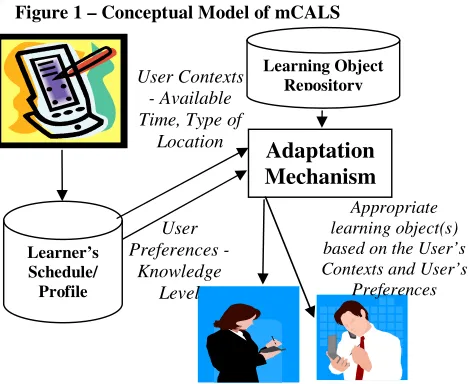
Figure 1 depicts the conceptual model of our Mobile Context-aware and Adaptive Learning Schedule (mCALS) tool, consisting of three components - Learner’s Schedule/Profile, Adaptation Mechanism, and Learning Object Repository.
[image:3.612.320.555.535.727.2]The goal of the system is to select appropriate learning objects for students based on their current user contexts and user preferences. The user context attributes include their location (we use the elements concentration level and frequency of interruption), and the user preferences attributes include their knowledge level for that topic – in our case Java -- and their available time. The user contexts are captured via a learner schedule (otherwise known as a learning organizer), which is a novel way of capturing contexts in such a context-aware mobile learning system. We believe that this learning schedule approach can be a successful time management technique and an effective self-regulated learning approach for motivated students.
Figure 1 – Conceptual Model of mCALS
Adaptation
Mechanism
Learner’s Schedule/ Profile
Learning Object Repository
User Contexts - Available Time, Type of
Location
User Preferences
-Knowledge Level
Appropriate learning object(s) based on the User’s Contexts and User’s
A. Our Preliminary Architecture of mCALS
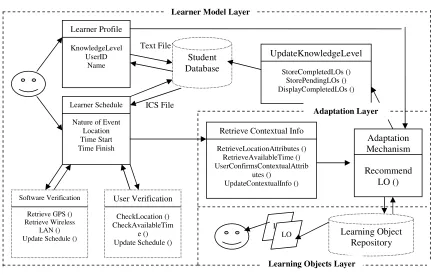
Our system architecture of our tool, illustrated in Figure 2, is logically divided into three layers – Learner Model layer, Adaptation layer and Learning Objects layer. (Note that this is an expanded version originally illustrated in [14]).
Learner Model Layer
There are three system components within this layer –
• Learner Profile,
• Learner Schedule,
• UpdateKnowledgeLevel.
Two methods are in place to check that the Learner Schedule is up-to-date, namely Software Verification and User Verification. The Student Database stores details about the learner profile, and their schedule, and the student’s updated knowledge level of Java. For the learner profile, their knowledge level of Java – novice, intermediate or advanced (in the form of a string); this will be updated when they have successfully attempted some learning materials. A unique user ID will be created for each student, and the students’ personal details, although not essential, can also be entered here (such as name, age, gender) if required.
For the learner schedule, students are required to enter their scheduled events; the primary attributes being the nature of the event (such as lecture), location, time starts and ends (in the form of a string). A graphical-based calendar will be displayed here for ease of entry.
These events a re stored into the learner schedule and for the purpose of retrieving the event details with ease, the calendar will be transformed into an ICS text file.
Before the Learner Schedule information is retrieved and accessed by the Retrieve Contextual Info component, two verification methods – software and user verification – are in place to check whether the learner’s schedule is still accurate.
For the software verification, we expect that GPS will detect the appropriate outdoor locations and WirelessLAN will detect the indoor locations. Therefore two methods – RetrieveGPS() and RetrieveWirelessLAN()
will be in place to retrieve this information, feed it to our schedule and update where necessary. Using this information, the learner’s actual location can be identified and this can be used to confirm whether the learner is keeping to his/her schedule.
The user verification will prompt the user to check a) his/her location and b) his/her available time, and this information will be used to update the schedule, if necessary.
Knowledge Level: {Novice, Intermediate, Advanced}
Nature of Event: {lecture, exam, lunch, meeting…}
Location: {campus, home, restaurant..} Time Start
Time Finish
Learner Schedule Figure 2.1 - Input for the Learner Profile and
Learner Schedule Components
Learner Profile ICS File
Text File
Retrieve Contextual Info
RetrieveLocationAttributes () RetrieveAvailableTime () UserConfirmsContextualAttrib
utes () UpdateContextualInfo () Learner Schedule
Nature of Event Location Time Start Time Finish
Adaptation Mechanism
Recommend LO ()
Software Verification
Retrieve GPS () Retrieve Wireless
LAN () Update Schedule ()
User Verification
CheckLocation () CheckAvailableTim
e () Update Schedule ()
UpdateKnowledgeLevel
StoreCompletedLOs () StorePendingLOs () DisplayCompletedLOs ()
Learner Profile
KnowledgeLevel UserID
Name
Learning Object Repository Student
[image:4.612.92.523.79.353.2]Database
Figure 2 - System Architecture of the Mobile Context-aware and Adaptive Learning Schedule tool
Adaptation Layer
LO LO
Learner Model Layer
[image:4.612.336.516.412.517.2]Adaptation Layer
Pre-adaptation – Retrieve Contextual Information
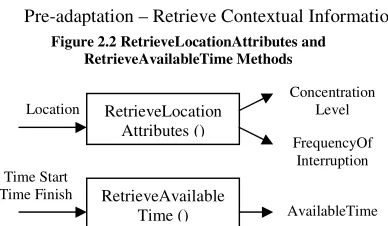
We use the location attribute to calculate two default values for the level of concentration and frequency of interruption typical for that type of location. The values of these attributes in relation to the location have been obtained by a study performed by Cui and Bull [15] where they found that different students perceived the same level of concentration and frequency of interruption in the same location, although the noise levels may have been different. These will be used as default levels for the students’ concentration level and frequency of interruption which will be used as grounds for adaptation of the recommended learning objects (amongst other factors). Using the Time Start and Time Finish attributes, we obtain the available time that the student has at a particular point in time. See Figure 2.2.
Figure 2.3 shows the input and output of the Retrieve Contextual Info component, the function of which is to first retrieve the contextual information from the learner schedule, and then transfer this into actual approximate values which can be used by the Adaptation Mechanism. The attributes taken from the learner schedule include Location, Time Start and Time Finish.
A method UserConfirmsContextualAttributes() will also be implemented to give the user the option to view and confirm the values of these attributes, or change these values, if necessary. These attributes include Concentration level, Frequency of Interruption and Available Time. The method UpdateContextualInfo() will be used to update this contextual information, as necessary. Figure 2.2 shows the input and output of the
RetrievedLocationAttributes() and
RetreiveAvailableTime() methods.
The parameters fed into the mechanism include knowledge level, concentration level, frequency of interruption, and available time. Specific adaptation rules are defined within the adaptation mechanism which will then take the parameters into consideration and select the appropriate learning objects for the learner. The Learning Object Repository contains learning objects for Java, in the form of text for factual information and examples and multiple choice questions such as exercises and tests. Graf and Kinshuk [16] noted that active learners prefer testing and experimenting and the use of exercises and tests would be ideal for them; whereas for reflective learners, they prefer to read materials and therefore content containing objects and examples would be appropriate for them.
Learning Objects Layer
The learning objects which have been recommended to the students will be stored along with the following information –
• Whether the student has completed it.
• In the case of a test or exercise, whether the student answered it correctly.
This information will be transferred to the student database and when the student has attempted an appropriate amount of material (and accurately), their knowledge level will be increased.
B. Our Research Questions
Our research questions are divided into five sections – Learning Schedule, Learning Environment/Space, Contextual Attributes, Our Adaptation Mechanism and Usability of our tool. We defined Learning Schedule as a set of activities related to both learning and non-learning events which have been planned by the user to be performed.
Learning Schedule
We want to examine whether students use a learning schedule for time management. One group we will target for our experiment will be first year computer scientists because we are currently seeking ways to facilitate novices to learn Java programming. We want to find out whether students find that using a learning schedule is an effective way of managing their time.
• How likely is it that these students observe/follow their learning schedule?
• If students have not previously used a learning
schedule, do they think that they can benefit from using such one for managing their time?
• If they do not use one, is that because they foresee that they cannot observe/follow their learning schedule?
[image:5.612.83.277.88.201.2]• Are there any particular personal characteristics/learning styles relating to the student Figure 2.3 – Input and Output of the Retrieve
Contextual Info Component
Learner Schedule
Retrieve Contextual
Info
Location Time Start Time Finish
Adaptation
Mechanism Concentration Level: {low,
medium, high} Frequency of Interruption: {low,
medium, high} Time Available
Learner Profile
Knowledge Level
AvailableTime Concentration
Level
Time Start Time Finish
Location RetrieveLocation
Attributes ()
RetrieveAvailable Time ()
Figure 2.2 RetrieveLocationAttributes and RetrieveAvailableTime Methods
[image:5.612.75.285.465.602.2]which affect whether they use a learning schedule for time management, and their ability to observe and follow it? (Characteristics such as conscientiousness, motivation)
• Are students willing to provide their daily learning-related and non-learning-related activities which are accurate and up-to-date and which they will conform to?
Learning Environment/Space
• Which places do first year computer science/programming students learn/study/do programming in?
• Are there specific places which they will go to
perform certain learning activities, such as programming must be in computer lab?
• For each of these places, how well can they learn/study/do programming in?
• Are there restrictions in any of these places which hinder their ability to perform a certain learning task, or with the mobile devices that they are using?
• Which factors in each of these places affect their
concentration level for learning/studying/doing programming and to what degree?
• How well can students learn/study/do programming if the place that they are in is prone to frequent interruptions?
• How do interruptions affect the students in performing certain tasks?
Contextual Attributes (Knowledge Level, Location - Concentration Level and Frequency of Interruption, Available Time)
• Is it motivating for computer science students to
learn/study if they are using learning materials which are adapted and are appropriate for their knowledge level?
• Do they think that the location that they are
learning/studying/doing programming in can affect how well they learn/study/do programming?
• What are the factors within the location which can affect their ability to study (such as noise level, movement) and how do these affect learning/studying?
• If students are learning in a place prone to
interruptions, would it be helpful for them if the learning materials selected for them had greater granularity so that they can frequently stop as necessary?
Adaptation Mechanism
• Would students find it more convenient and more helpful to their learning when learning materials selected for them are appropriate for them in the given contextual situation that they are in?
• Will they be able to carry out the activities selected
for them?
• Do they think it would be more helpful towards their learning/studying/doing programming if their
concentration level (to approximation) and/or the
frequency of interruption in the location that they are situated in and/or the available time that they have for studying during that period of studying time is taken into consideration?
• Are students able to study/learn/do programming more effectively (or with more ease of use) when these contextual features are taken into consideration?
Usability of our tool
• Would students use such a device for learning in
various places?
• Would students find it convenient and time-saving that the learning materials selected for them are appropriate for them in the given contextual situation that they are in?
• Do they like having activities selected for them? Would students prefer to input the location and time available manually themselves at the point of using it, rather than keeping a learning schedule for the system to retrieve the contexts later when necessary?
• Would the students mind the tool knowing where they are?
C. Our Methodology for evaluating mCALS
Our evaluation methods are divided into two phases – an interview research activity and a system prototype evaluation. We have currently completed phase 1 of our research activity and are analyzing the interview data. 40 students participated in our semi-structured interview and each interview took approximately 20 minutes to complete and four areas were explored – a) studying in different environments, b) personal information management, c) learning characteristics, and d) learning preferences. Phase 2 of our research activity will be underway once we have completed our interview data analysis and obtained a deep understanding of what students required i.e. forming the user requirements of our context-aware mobile learning system tool. A system prototype will then be implemented and evaluated via the means of simulation tests for checking the technical workings of the system including that that adaptation mechanism is able to accurately retrieve the up-to-date context and select appropriate materials for learners based on their current contexts. We will also ask a number of students to evaluate our tool in order to obtain learner-centered feedback via questionnaires or interviews.
D. Preliminary Interview Data Analysis
computer lab, or their bedroom etc. There were many differences between the students’ preferred learning environments, for example, one student found that he/she was able to concentrate very well in the library because of the quietness, but another found it extremely distracting with lots of people around. Factors which the students noted could distract them from concentration included noise (whether constant or irregular), temperature, number of people around, and their proximity to them.
In terms of personal information management, most of our participants used a diary for managing their studies and noted that it was effective for time-management especially since it reminds them not to forget important meetings and deadlines. It allows them to schedule their workload, assign time for specific modules to maximize effectiveness and efficiency of their studies and some of the participants highlighted the fact that they were still able to fit in their social and leisure activities. Our findings show that participants who used a diary regularly were fairly likely to keep their scheduled events unless something unexpected or more urgent came up. On the other hand, it was also noted by a few of our participants that they used their diaries as a reminder tool to make them aware or remind them of possible events/tasks that they can attend/perform if they had sufficient time such that not everything in the diary would be strictly adhered to.
IV. CONCLUSIONS/FUTUREWORK
In this paper, we have described our Mobile Context-aware and Adaptive Learning Schedule tool as a system which could aid self-regulated learners whilst they are learning in mobile learning environments. Their learning opportunities at different locations could be created or enhanced by our tool. The originality of our research includes the capturing of different learning contexts which are created in different environments and the use of our learning schedule for storing and retrieving this information. We plan to expand the scope of our research not limited to self-regulated learners. Thereafter, we hope to generalize these requirements for a generic context-aware mobile learning system.
ACKNOWLEDGMENT
This journal paper also appears in the proceedings of the International Conference on Interactive Mobile and Computer Aided Learning, April 2008.
REFERENCES
[1] Montalvo, F. and Torres, M. (2004) ‘Self-Regulated Learning: Current and Future Directions’. Electronic Journal Research in Educational Psychology, 2 (1), 1-34.
[2] Corlett, D. Sharples, M., Bull, S. and Chan, T. (2005) ‘Evaluation of a Mobile Learning Organiser for University
Students’. Journal of Computer Assisted Learning, Vol. 21, No. 3, pp. 162-170(9).
[3] Sharples, M. (2006) Big Issues in Mobile Learning, Kaleidoscope Network of Excellence Report.
[4] Lavoie, M. (2006) I, Mlearning: Identifying design recommendations for a context-aware mobile learning system, IADIS International Conference on Mobile Learning , pp. 265-269.
[5] Prekop, P. and Burnett, M. (2003) ‘Activities, context
and ubiquitous computing’. Computer Communications,
Vol. 26, Num. 11, pp. 1168-1176.
[6] Ryu, H. and Parsons, D. (2008) ‘A learner-centred design of a location-aware learning reminder’, Int. J. Mobile
Learning and Organization, to appear.
[7] Fithian, R., Iachello, G., Moghazy, J., Pousman, Z. and Stasko, J. (2003) The design and evaluation of a mobile location-aware handheld event planner, International Conference on Human Computer Interaction with mobile devices and services, pp. 145-160.
[8] Bomsdorf, B. (2005) Adaptation of Learning Spaces: Supporting Ubiquitous Learning in Higher Distance Education, Dagstuhl Seminar Proceedings 05181 Mobile Computing and Ambient Intelligence: The Challenge of Multimedia.
[9] Bouzeghoub, A., Do, K. and Lecocq, C. (2007) Contextual Adaptation of Learning Resources, IADIS International Conference Mobile Learning, pp. 41-48. [10] Lee, M., Ye, D. and Wang, T. (2005) Java Learning Object Ontology, International Conference on Advanced Learning Technologies, pp. 538-542.
[11] Schmidt, A. (2002) Ubiquitous Computing –
Computing in Context. PhD thesis.
[12] Schmidt, A. (2000) ‘Implicit Human Computer Interaction Through Context’. Personal Technologies, Vol 4(2), June 2000.
[13] Synnes, K., Nord, J. and Parnes, P. (2003) Location Privacy in the Alipes Platform, International Conference on System Sciences, pp. 10-19.
[14] Yau, J. and Joy, M. (2007) Architecture of a Context-aware and Adaptive Learning Schedule for Learning Java,
International Conference on Advanced Learning
Technologies, pp. 252-256.
[15] Cui, Y. and Bull, S. (2005) ‘Context and learner
modeling for the mobile foreign language learner’. Science
Direct, System 33, pp. 353-367.
[16] Graf, S. and Kinshuk (2006) An Approach for detecting
learning styles in learning management systems,
International Conference on Advanced Learning
Technologies, pp. 161-163.
AUTHORS
J. Y-K Yau is with the University of Warwick (e-mail: j.y-k.yau@ warwick.ac.uk).
M. Joy is with the University of Warwick (e-mail: [email protected]).