University of Warwick institutional repository: http://go.warwick.ac.uk/wrap
A Thesis Submitted for the Degree of PhD at the University of Warwick
http://go.warwick.ac.uk/wrap/3602
This thesis is made available online and is protected by original copyright. Please scroll down to view the document itself.
Modelling Recursion
by
Mojtaba Ammari-Allahyari
A thesis submitted for the degree of Doctor of
Philosophy in Mathematics Education
University of Warwick, Institute of Education
In memory of my Grandfather,
Declaration
I declare that this thesis was carried on in accordance with the regulations of
the University of Warwick. This research is my own work and it has not been
submitted for any other degree.
This thesis has not been presented to any other University for examination
either in the United Kingdom or overseas.
Acknowledgment
First and foremost I would like to acknowledge the debt I owe to Professor Dave Pratt who, as both friend and supervisor, gave me the encouragement and direction to construct a thesis. The outcome owes much to his inspiration. Thanks also to Dr Peter Johnston-Wilder and the members and my colleagues at Warwick Institute of Education. I am grateful for your help and concern.
I am grateful for the bursary that enabled me to embark on this PhD. It was awarded by the National office of “World Mathematical Year 2000”, which was assigned by the International Mathematical Union (IMU) and supported by UNESCO in Iran and MSRT (Ministry of Science, Research, & Technology of Iran).
Thanks to all the students who worked with me.
Thanks also to my dear friends for their support during my journey towards this PhD, in particular Miss Katia Merine and Mr Reza Shahrjerdi.
Special thanks to my mother, father, and my sister without whose continual support and assurance I would not have been able to finish this journey.
Finally, a short acknowledgement in Persian, my mother tongue:
صًاد یدبا ّ یلزا ٍدًرّآ دْجّ َب ّ گرسب عدبه ،یتسُ قلاخ ماٌب َب َتسباّ تایضایر یًاِج لاس یله داتس زا نٌکیه رکشت رتفد
ْکسًْی ،مْلع ترازّ ّ ىاریا رد
یرّاٌف ّ تاقیقحت رْکٌک یراسگرب اب َک ىاریا
ٍرّد ماسعا یارتکد
آ َب ىاریا رد یضایر شزْه
وک ىاریا رد صًاد يیا تفرشیپ دًدْوً ک
Table of Contents
Declaration ...
Acknowledgment ... 1
Table of Contents ... 2
Table of Figures ... 5
Table of Tables ... 11
Table of Programs ... 12
Table of Flowcharts... 13
Abstract 14
1. Introduction ... 18
1.1. Overview ... 18
1.2. My story toward recursion ... 18
1.3. Pedagogical account... 21
1.4. Epistemological issues ... 22
1.5. Research Themes ... 25
1.6. Structure of the Thesis ... 26
2. Review of the Literature ... 29
2.1. Overview ... 29
PART ONE ... 29
2.2. Recursion and its Essential Components ... 29
2.2.1. Essential Components of Recursion ... 36
2.2.2. Tail and Embedded Recursion ... 39
PART TWO ... 41
2.3. Students‟ Difficulties with Understanding Recursion ... 41
2.3.1. Declarative vs. Imperative programming ... 43
2.3.2. Inherent complexity of Recursion ... 44
2.3.3. Need for a comprehensive definition for Recursion ... 45
2.3.4. Everyday analogies and Recursion ... 48
2.3.5. Fractals ... 50
2.3.6. Recursion vs. Iteration ... 52
2.3.7. Flow of Control ... 57
2.3.8. Functional abstraction ... 61
PART THREE ... 65
2.4. A Brief Introduction to Mental Models ... 66
2.4.1. Main Characteristics and Definition of Mental Models ... 67
2.5. Mental Models of Recursion ... 78
2.6. Computer-based Approach to Recursion ... 85
2.6.1. Pedagogical Aspects of Computer-based Tools ... 88
2.7. Summary ... 93
3. Aim of Research ... 91
3.1. Overview ... 91
3.2. Theoretical stance ... 94
3.3. Main Theme ... 96
3.4. Specific Aims ... 97
3.5. My Approach ... 98
4. Methodology ... 100
4.2. History of Design-Based-Research (DBR) in a Nutshell ... 100
4.3. DBR and Traditional Methods ... 104
4.4. DBR in This Study ... 106
4.4.1. Developmental Dimension (Tool design ) ... 109
4.4.2. Usage Dimension (Tool use) ... 109
4.5. Qualitative Research Methodology... 110
4.5.1. Semi-structured Interview ... 113
4.5.2. Participant Observation ... 115
4.6. Research Setting... 117
4.6.1. Participants ... 117
4.6.2. Implementation ... 118
4.7. Methods for Data Collection ... 121
4.8. Methods for Data Analysis ... 124
4.9. Summary ... 126
5. The Evolution of the Computer-Based Domain ... 127
5.1. Overview ... 127
5.2. The Development of the Domains of Abstraction in a Nutshell ... 129
5.3. Iteration One – Treemenders ... 131
5.3.1. My Approach - Treemenders ... 133
5.3.2. Pen & paper task – Iteration One ... 136
5.3.3. Tool design – Treemenders ... 144
5.3.4. Tool use – Treemenders ... 147
5.3.5. Discussion – Treemenders ... 158
5.3.6. Issues & conjecture(s) for the next Iteration ... 163
5.4. Iteration Two – Spirals and Blank box ... 167
5.4.1. Overview ... 167
5.4.2. My Approach – Spirals ... 173
5.4.3. Pen & paper task – Iteration Two ... 176
5.4.4. Tool Design – The Blank-Box and the AVDA environment in Spirals ... 177
5.4.5. Tool Use – Spirals ... 193
5.4.6. Discussion – the Blank-box, Spiral and the AVDA environment .. 211
5.4.7. Issues & conjecture(s) for the next Iteration ... 217
6. Iteration Three – Tool design of the Treebuilder... 221
6.1. Overview ... 221
6.2. My Approach – Treebuilder ... 222
6.3. Tool design – Treebuilder and the AVDA environment ... 232
6.3.1. The main page of the Treebuilder domain of abstraction ... 235
6.3.2. Making a forest – Treebuilder domain of abstraction ... 236
6.3.3. Blue strategy – Treebuilder domain of abstraction ... 238
6.3.4. Red strategy – Treebuilder domain of abstraction ... 243
6.3.5. Your tree – Treebuilder domain of abstraction ... 246
6.4. Functioning features of the tool design ... 249
6.4.1. Functioning aspects in the Spirals domain ... 250
6.4.2. Functioning aspects in the Treebuilder domain ... 250
6.5. Summary ... 251
7. Iteratin Three – Tool Use of the Treebuilder ... 253
7.1. PART ONE – Spirals Domain ... 254
7.1.2. George & Peter‟s account on the Spiral domain – Iteration Three ... 266
7.1.3. Discussion of George & Peter‟s account on the Spirals – Iteration Three ... 274
7.1.4. Richard and Philip‟s account on the Spirals domain – Iteration Three ... 278
7.1.5. Discussion of Richard and Philip‟s account on the Spirals – Iteration Three ... 281
7.2. PART TWO – Students‟ Accounts on the Treebuilder domain ... 284
7.2.1. Simon‟s account on the Treebuilder domain ... 284
7.2.2. Richard and Philip‟s account on the Treebuilder domain ... 300
7.2.3. George & Peter‟s account on the Treebuilder domain ... 313
7.3. Findings and Results of the Third Iteration ... 327
7.4. Summary ... 331
8. Discussion and Conclusion ... 332
8.1. Overview ... 332
8.2. Summary of major findings of the research ... 332
8.2.1. Students‟ Knowledge of Recursion (Thinking-in-change) ... 333
8.2.2. Design constructs ... 336
8.3. Discussion ... 337
8.3.1. Students‟ thinking-in-change in AVDA ... 338
8.3.2. Recursion: A difficult concept ... 338
8.3.3. Delegatory Control Passing (DCP) ... 341
8.3.4. Terminating Confusion (TC) ... 342
8.3.5. Recursion vs. Iteration (RI) ... 343
8.3.6. Confluence of Tail and Embedded Recursion ... 343
8.3.7. Functional abstraction ... 344
8.3.8. Mental Model Evolution (MME) ... 344
8.3.9. Mental Compiling Process (MCP) ... 347
8.3.10. Elements of Mental Model of Recursion ... 348
8.4. Limitations of the study ... 354
8.5. Implications... 355
8.6. Final reflections ... 358
Reference... 361
Table of Figures
Figure 1- A beautiful image of the Mandelbrot set on the front cover of Chaos
and Fractals ... 19
Figure 2- Divide and Conquer strategy for going on holiday ... 30
Figure 3- Divide and Conquer strategy for factorial function... 31
Figure 4- D&C strategy for determinant of a matrix of order „n‟ ... 31
Figure 5- The process of approaching and touching base case in computational view ... 37
Figure 6- Visual aspect of meeting base case 0! = 1 ... 38
Figure 7- Final value for 4! after reaching the base case ... 38
Figure 8- The outcome of the above procedure in Logo programming environment... 40
Figure 9- A binary tree, the output of the above procedure in Logo environment ... 41
Figure 10- Koch curve fractal ... 51
Figure 11- Rasmussen‟s taxonomy of the purpose of mental models (Rasmussen 1979) ... 69
Figure 12- Kim‟s model of the relationship between knowledge acquisition and mental models ... 71
Figure 13-Modelling of a mental model ... 76
Figure 14- The interaction between major components of design for abstraction ... 107
Figure 15- The process of conceptualization of a concept by researcher and phenomenalization of it by students ... 107
Figure 16- The Camtasia recorder version that I have employed in this research ... 113
Figure 17- The participation classification of Gold (1969) ... 115
Figure 18- Three iterations of this research in the DBR framework... 128
Figure 19- The cycle of design-test-modify and emerging issues-design... 128
Figure 20- The images of the trees ((a) on the left, (b) on the right side of the page) in iteration one ... 134
Figure 21- Image of the Koch curve in iteration one ... 135
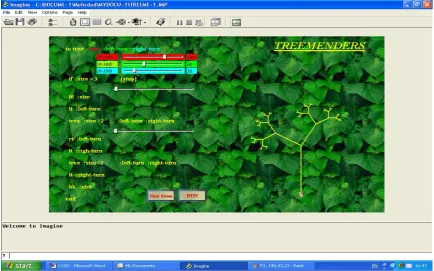
Figure 22-The main interface of the Treemenders ... 135
Figure 23- Feng‟s experiment with angles (both 60 degrees) ... 150
Figure 24- Infinite loop by taking the length of the size of new stems equal to the length of the main trunk (lines 92-94 Sarah and Jin) ... 154
Figure 25-The main interface of Spirals (AVDA approach) ... 170
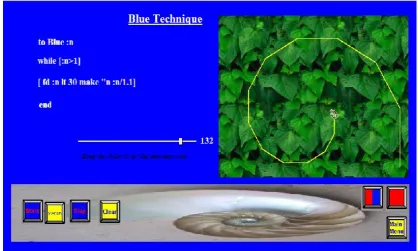
Figure 26- The blue technique (iterative procedure) ... 170
Figure 27-The red technique (recursive procedure) ... 171
Figure 28-The comparison module (AVDA approach) ... 171
Figure 29- The blank-box module ... 172
Figure 30- Joshua tree in the pre-questionnaire task ... 176
Figure 31-The spiral shape patterns in the pre-questionnaire task ... 177
Figure 32-The interface of the blank-box module... 181
Figure 33-Control box in the blank-box module ... 182
Figure 35- The order of execution of the modules in the Spirals domain by the
students ... 185
Figure 36-The blue technique (iterative)... 186
Figure 37-The red technique (recursive)... 188
Figure 38- The comparison page and AVDA innovation in the Spirals domain ... 189
Figure 39-The colour-codes in the iterative technique in the AVDA environment... 190
Figure 40-Animation and the colour codes in the tail recursive procedure in the AVDA environment ... 191
Figure 41-The box for showing the length of the last segment which was being drawn by the turtle ... 192
Figure 42-The images of the pre-questionnaire task ... 194
Figure 43-The main interface of the Treebuilder domain ... 221
Figure 44-The main interface of the making a forest module ... 223
Figure 45-The main interface of the your tree module ... 224
Figure 46-The main interface of the red strategy module... 224
Figure 47-The main interface of the blue strategy module ... 225
Figure 48-The modules of the Treebuilder domain of abstraction ... 232
Figure 49- The main page of the Treebuilder domain of abstraction ... 235
Figure 50- The interface of the making a forest module ... 236
Figure 51- The interface of the blue strategy module ... 238
Figure 52- The embedded recursive procedure in the blue strategy ... 238
Figure 53- The shadow turtles alongside the main turtle, (a) when the main turtle started to draw new red branches to the left (red colour), (b) when the main turtle started to draw new branches to the right (yellow colour), (c) the main interface of the blue strategy when the turtle was trying to draw some yellow branches. The background colour of the box of the size is yellow ... 240
Figure 54- The interface of the red strategy module... 243
Figure 55- Running the procedure with 110 as an initial value, and the procedure is waiting for the student to press the continue button to run the first recursive call ... 244
Figure 56- A new copy of the original procedure is generated and the turtle has drawn the new stems after the continue button has been pressed twice ... 245
Figure 57- The AVDA approach to generating the new copies of the original procedure and the way that the turtle draws the branches ... 246
Figure 58- The interface of the your tree module ... 246
Figure 59- The commands of the incomplete procedure which were given to the students ... 247
Figure 60- The order of the modules in the third iteration ... 253
Figure 61- Simon was struggling to describe the recursive call ... 258
Figure 62- Simon was pointing to those commands that the recursive call was calling ... 258
Figure 63-Simon was pointing to those commands that while „n‟ was greater than one, were being executed by the procedure ... 259
Figure 65- The interface of the blue technique in the comparison module, when
Simon was running it in the step mode ... 261
Figure 66- Simon was pointing to the colour codes of the commands of the blue technique, which were being executed by the procedure in the comparison module ... 261
Figure 67- The colour codes and animation of the commands of the red technique in the AVDA environment of the comparison module ... 262
Figure 68- Simon‟s evolution of the mental models of the concept of tail recursion after working in the AVDA environment ... 264
Figure 69- The stopping condition in the red technique ... 269
Figure 70- The recursive call in the red procedure ... 270
Figure 71- The second red within the red procedure (two reds)... 270
Figure 72- When the procedure reached its stopping condition and began to end the instantiations ... 271
Figure 73- The end command that George mentioned in line 103 ... 272
Figure 74- The commands that George said are being done while „n‟ is greater than 1 ... 272
Figure 75- The commands that were being done after each time calling the red procedure ... 273
Figure 76- George and Peter‟s evolution of the tail recursion mental model after working with the red and blue techniques ... 277
Figure 77- The final output of the blue technique (a) and the red technique (b) with n = 100 ... 279
Figure 78- Richard was pointing to the recursive call as re-definer of the value of „n‟ ... 280
Figure 79- Richard and Philip‟s evolution of tail recursion mental model after working with the red and blue techniques (before their experience with the AVDA innovation) ... 282
Figure 80- Richard and Philip‟s evolution of the tail recursion mental model after working with the red and blue techniques (after their experience with the AVDA innovation) ... 283
Figure 81- The main interface of the making a forest module ... 284
Figure 82-Simon was pointing to the first branching point ... 286
Figure 83- The written commands for the embedded recursive procedure to generate a binary tree in the blue strategy and the colour codes (red and yellow) for the recursive calls ... 288
Figure 84- The interface of the red strategy after running it in the step mode290 Figure 85- The commands above the first recursive call that Simon was pointing to are shown in the red box in this picture ... 291
Figure 86- Simon‟s evolution of embedded recursion mental model after working with the first three modules of the Treebuilder domain ... 294
Figure 87- The main interface of the your tree module ... 294
Figure 88- Simon was pointing to the second vertical stem in the ternary tree ... 295
Figure 89- Simon‟s first attempt to complete the incomplete embedded procedure by putting two lines in the first empty box ... 295
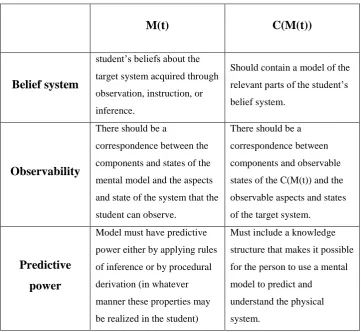
Figure 118- The image of the tree that George made by making both angles to the left and right equal to 50 ... 316 Figure 119- George is pointing to the little stems on the right side of the tree ... 317 Figure 120- (a) angles to the right and left were chosen 18, (b) shows the final output of the tree ... 317 Figure 121- Peter was pointing to the size of the stems until they got less than 5 and stop ... 318 Figure 122- George was pointing to the commands after the first recursive call (the red line) after it got to its stopping condition, and he appreciated that the procedure was resuming those suspended commands ... 319 Figure 123- George was pointing to the first branching point as the turtle was about to start drawing the yellow branches to the left ... 320 Figure 124- George was pointing to the last stem which was drawn by the turtle with the yellow colour to the left ... 320 Figure 125- George was pointing to the first red branches to the left and stated that they look like a spiral ... 321 Figure 126- George was pointing to the little yellow branches to the right on the top of the red branches ... 321 Figure 127- George was pointing to the movements of the turtle in the red strategy with the initial value of n = 9 ... 322 Figure 128- The copies of the procedure which were being generated in the AVDA environment in the red strategy ... 322 Figure 129- The spiral shape branches that George pointed in the red strategy ... 323 Figure 130- Turtle was drawing the little stems at the end of the branch to the left and George pointed to it as a detailed part of the stem ... 323 Figure 131- When the procedure was doing the second recursive call it is shown that the first recursive call is also called and it helped George to point to it in the above image ... 325 Figure 132- As George mentioned, the procedure was calling the second recursive call and he pointed to it in this image ... 325 Figure 133- The position in which George predicted that the new stems would be drawn by the turtle ... 326 Figure 134- George was pointing to the branching point where he thought the next branch would be drawn ... 326 Figure 135- The branch was drawn by the turtle from the branching point that George predicted ... 326 Figure 136- George was pointing to the little stems at one of the end points and explained that the same thing is going to be done by the turtle at the other ending point ... 327 Figure 137-The pattern for the evolution of the students‟ mental models of recursive procedures in the third iteration before using AVDA ... 330 Figure 138-The pattern for the evolution of the students‟ mental model of recursive procedures in the third iteration after using AVDA ... 331 Figure 139- The developing path of evolution of students‟ mental models of recursion ... 334 Figure 140- Integrated model of recursion from a functional abstraction
Table of Tables
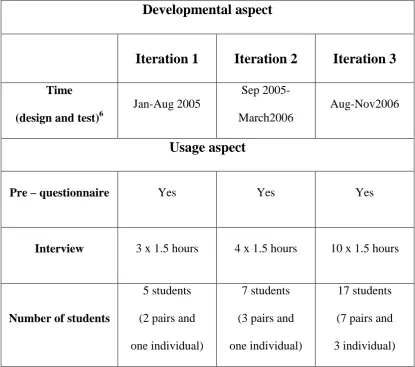
Table 1- Separation of tool design and recursion from functional abstraction view ... 64 Table 2-Functional issues to distinguish the student‟s mental model and its conceptualisation by the researcher ... 77 Table 3- An outline of the developmental and usage of the three iterations... 120 Table 4- The major issues were considered in development of tools in three iterations ... 130 Table 5-Some interesting result from Sarah and Jin‟s experiment with
Table of Programs
Program 1- A tail recursive Logo procedure to make a spiral ... 39 Program 2- An embedded recursive procedure in Logo programming language ... 40 Program 3- An iterative Logo program to calculate factorial of a natural
number „n‟ ... .53 Program 4- A recursive Logo program to calculate factorial of a natural
Table of Flowcharts
Abstract
The purpose of my research is to examine and explore the ways that
undergraduate students understand the concept of recursion. In order to do
this, I have designed computer-based software, which provides students with a
virtual and interactive environment where they can explore the concept of
recursion, and demonstrate and develop their knowledge of recursion through
active engagement. I have designed this computer-based software environment
with the aim of investigating how students think about recursion. My approach is to design digital tools to facilitate students‟ understanding of recursion and to
expose that thinking.
My research investigates students‟ understanding of the hidden layers and
inherent complexity of recursion, including how they apply it within relevant
contexts. The software design embedded the idea of functional abstraction
around two basic principles of: „functioning‟ and „functionality‟. The
functionality principle focuses on what recursion achieve, and the functioning
dimension concerns how recursion is operationalised. I wanted to answer the
following crucial question: How does the recursive thinking of university
students evolve through using carefully designed digital tools?
In the process of exploring this main question, other questions emerged:
1. Do students understand the difference between recursion and iteration?
2. How is tail and embedded recursion understood by the students?
influence students‟ understanding of tail and embedded recursion?
4. Why is it important to have a clear understanding of the control passing
mechanisms in order to understand recursion?
5. What is the role of functional abstraction in both, the design of
computer-based tools and the students‟ understanding of recursion?
6. How are students‟ mental models of recursion shaped by their
engagement with computer-based tools?
From a functional abstraction point of view almost all previous research into
the concept of recursion has focused on the functionality dimension. Typically,
it has focused on procedures for the calculation of the factorial of a natural
number, and students were tested to see if they are able to work out the values
of the a function recursively (Wiedenbeck, 1988; Anazi and Uesato, 1982) or if
they are able to recognize a recursive structure (Sooriamurthi, 2001; Kurland
and Pea, 1985). Also, I invented the Animative Visualisation in the Domain of
Abstraction (AVDA) which combines the functioning and functionality
principles regarding the concept of recursion. In the AVDA environment,
students are given the opportunity to explore the hidden layers and the
complicated behaviour of the control passing mechanisms of the concept of
recursion.
In addition, most of the textbooks in mathematics and computer sciences
usually fail to explain how to use recursion to solve a problem. Although it is
problems, students are able to draw on to facilitate solving iterative problems
(Pirolli et al, 1988).
My approach is inspired by how recursion can be found in everyday life and in
real world phenomena, such as fractal-shaped objects like trees and spirals.
This research strictly adheres to a Design Based Research methodology (DBR),
which is founded on the principle of the cycle of designing, testing (observing
the students‟ experiments with the design), analysing, and modifying (Barab
and Squire, 2004; Cobb and diSessa, 2003). My study was implemented
throughout three iterations. The results showed that in the AVDA (Animative
Visualisation in the Domain of Abstraction) environment students‟ thinking
about the concept of recursion changed significantly. In the AVDA
environment they were able to see and experience the complicated control
passing mechanism of the tail and embedded recursion, referred to a delegatory
control passing. This complicated control passing mechanism is a kind of
generalization of flow in the iterative procedures, which is discussed later in
the thesis.
My results show that, to model a spiral, students prefer to use iterative
techniques, rather than tail recursion. The AVDA environment helped students
to appreciate the delegatory control passing for tail recursive procedures.
However, they still demonstrated difficulties in understanding embedded
recursive procedures in modelling binary and ternary trees, particularly
Based on the results of my research, I have devised a model of the evolution of
students‟ mental model of recursion which I have called – the quasi-pyramid
model. This model was derived from applying functional abstraction including
both functionality and functioning principles. Pedagogic implications are
discussed. For example, the teaching of recursion might adopt „animative‟
visualization, which is of vitally important for students‟ understanding of latent
layers of recursion.
1.
Introduction
1.1.
Overview
This chapter begins with an itinerary perspective, which explains the history of
how I became interested in undertaking research into the concept of recursion.
It then shows the way that the initial ideas of this research program were
shaped, and offers an action plan. This chapter also looks back upon my
previous experiences as a mathematics student – during the time that I was
completing my B.Sc. and M.Sc. in mathematics – as well as my many years of
teaching mathematical courses at university level. The primitive ideas available
during those years were mainly environs of how we can use graphical
presentation and related electronic gadgets to develop our learning skills as
students. In other words, to what extent and to what degree would we be able
to use, computers and digital gadgets to facilitate thinking about and
understanding of mathematical concepts?
My own personal statements here will be followed by a more pedagogical and
epistemological point of view relating to the concept of recursion.
1.2.
My story toward recursion
Everything started by seeing a picture...
My journey into the world of recursion was triggered by a book called Chaos
finished my M.Sc. in Pure Mathematics. There was a fascinating image on the
front cover of the book that attracted me to delve further into it.
Figure 1- A beautiful image of the Mandelbrot set on the front cover of Chaos and Fractals
Later, I was to realise that the image is called the Mandelbrot set after
Mandelbrot, who first introduced them in 1974. Whilst skimming quickly over
the content I noticed that a very serious and strong type of mathematics was
introduced in a simple and tangible style. When I was studying mathematics
during my first degree, and then later during my M.Sc., I always believed that
using computers and digital tools would help me to have a lucid intuition about
the concepts which were being studied. For instance, as a student on a calculus
course I noticed that those calculus books which contained graphical images to
illustrate the limits, integrals, derivatives, etc. played a significant role in the
This realisation persuaded me to consider applying computer and digital tools
and using fractals to facilitate the teaching and learning of mathematical
concepts.
There were two reasons behind this idea, the first being that computers can act
as a facilitator for constructing new knowledge by providing tangible
presentation in an interactive environment. The second was based on using
fractals as convincing and persuading objects for students to work with
mathematical concepts before knowing them. Moreover, my teaching
experiments with university level students convinced me that using computers
and digital tools could play a significant role in increasing the students‟ ability
to learn mathematical concepts. For example, when they were studying
calculus, some mathematical software packages like MAPLE were very helpful
to give them an appropriate intuition of the functions when they wanted to
calculate limits, integrals or derivatives.
When I encountered these fascinating and wonderful fractal images, it became
apparent to me that only an elementary knowledge about mathematics was
needed to be able to work with them. I believed that they might attract students
because of their amazing beauty and could have the potential to persuade
students to work with mathematical objects. However, this raised an important
question, how can we use these potentials in the world of mathematics.
In considering the solution to the above question I noticed that fractals
recursively. So, if you want students to use fractals as a facilitator to learning
other mathematical concepts, perhaps you need to make sure that they have no
problem understanding them at the first stage. Therefore, my focus of attention
switched to the concept of recursion and investigating how students understand
this concept. At first glance, it seems that the concept of recursion has no
problematic part, but I soon realised that the complicated mechanism of the
concept is not recognised easily by students. The next section concentrates on
the pedagogical issues related to the concept of recursion.
1.3.
Pedagogical account
The concept of recursion is one of the subjects, which is fundamentally
difficult in mathematics and related disciplines. The reasons for this difficulty
can be seen from two perspectives. The first is the lack of analogies in
everyday experiments and intuitions of the concept of recursion. The second is
rooted in its inherent complicated mechanism of recursion. The gap between
formal mathematical concepts and everyday life analogies is of great
importance from a pedagogical perspective. It is particularly visible for the
concept of recursion as a consequence of the aforementioned problems with the
concept of recursion. Finding links and bridges between formal explanations of
recursion and informal analogies in everyday life seems to be a difficult task.
It is also hard to find a definition of the concept of recursion which is
acceptable for most researchers and authors in text books. In addition,
examples, rather than explaining its main components, also make it a difficult
concept for the students to learn.
If we argue that the difficulty of the concept of recursion is due to its inherently
complicated mechanism, which underpins the challenges of mathematical
pedagogy, the next important issue is which specific meanings we would like
students to acquire. Perhaps these difficulties will be significantly reduced if
we can find an appropriate way to uncover the roots of these difficulties. This
might be considered as a starting point in employing the digital tools and
computers to reveal the hidden layers of complexity of the concept of
recursion. The next section of this introduction will describe the
epistemological issues of the concept of recursion.
1.4.
Epistemological issues
From an epistemological point of view, the concept of recursion lies in the
intersection of different disciplines. Basically, it is widely used in mathematics
and computer sciences. The concept of recursion is considered as an
interdisciplinary concept. The first danger for interdisciplinary concepts is the
challenge for a comprehensive definition. Lack of any commonly accepted
definition of recursion for each of the disciplines is one of the biggest
epistemological challenges for interdisciplinary concepts like recursion. In
particular, the lack of a clear and comprehensive definition of the concept of
recursion, which distinguishes the characteristics of mathematical and
computer sciences, is a major difficulty in introducing this concept in both
In both mathematical and computer science disciplines, recursion is usually
defined in a stereotypical way. Most mathematical text books define recursion
by introducing a recursive sequence or function. Similarly, the computer
sciences mainly define it by presenting the classical example of a factorial of a
natural number. A lack of a clear definition in both disciplines is noticeable.
The nature of recursion, and its components in mathematical topics, is also
different from computer sciences. Therefore, it seems that each of these
disciplines declares its own epistemology for the concept of recursion. On the
one hand, mathematics (a conceptual view) regards recursion as a function1
which is applied within its own definition. This application has an end point if
and only if the function has a limit. On the other hand, computer sciences (a
procedural view) consider recursion as a procedure which starts with an initial
program and uses itself as its sub-procedure. And the calling process will be
terminated when the procedure meets its stopping condition. The starting and
terminating processes in mathematics and computer sciences are different and
they need distinct epistemological perspectives for the concept of recursion.
Yet, at the higher and more advanced level of mathematics, we find more exact
formal and symbolic definitions of recursion for one and more independent
variable functions2. In both procedural and conceptual views, recursion is
defined by introducing two main components, base case(s) and recursive
call(s). There is a subtle difference between these components in the
mathematical and computer science disciplines. The base case in mathematics
1 The term function in this sentence is used as a mathematical concept.
2 Bloch (2003) is a good reference for more information about higher level mathematics and
is mainly considered as the starting point or initial value. However, in
computer sciences, it is actually the stopping condition, and without having it
the recursive procedure will never stop and the result would be an infinite loop.
For instance, the Fibonacci sequence is a recursive function, starting with two
initial values (base cases):
a1 = 1, a2 = 1
The recursive part of the Fibonacci sequence is:
an = a(n-1) + a(n-2) for any n 3.
Most of the text books in both mathematics and computer sciences define and
introduce the concept of recursion by the providing examples of recursive
functions or procedures rather than a certain and clear definition of the concept
and its components.
The main focus in this thesis is the procedural view of the concept of recursion
and the reason is again rooted in my interest in employing fractals in
mathematics education. From this perspective recursion is considered to have
two main parts, the base case and the recursive call. The base case in this
approach operates as the stopping of the procedure and the procedure will be
terminated when all the recursive calls as well as the original procedure meet
the base case.
1.5.
Research Themes
This study addresses the themes presented in this chapter. Focus is placed on
the design of an environment in which students can articulate their own
knowledge of the concept of recursion by active engagement with computer–
based tools. In this context, computer-based tools are defined as, using
computers and designing dynamic environments or situations to provide
students with an interactive window1 with which to build their own new
knowledge based on their previous quasi-shaped knowledge. By quasi-shaped
knowledge I refer to the previously gained or understood and accepted
information about the concept which is being learnt, which obviously might not
be true. The design process of computer–based tools and digital gadgets in this
study is based principally on Papert‟s idea of computer-based tools and their
potential for presenting mathematical concepts, that is, recursion in the case of
this study.
My interest in fractals and using them in mathematics education led me to use
fractal-shaped objects such as trees and spirals for this research. These objects
were also chosen for two more reasons. Firstly, they can only be defined
recursively. Secondly, they can be used to bridge formal and informal
mathematics. My experiences in teaching mathematical courses at university
level revealed a huge gap between the formal mathematical concepts and the
informal mathematics that students were using in their everyday lives. Nunez et
1
al, (1993) term this “street mathematics versus school mathematics”. Thus I
decided to use trees and spirals as everyday examples of recursion to
phenomenalize the concept of recursion and bridge the gap between formal and
informal mathematics. The term phenomenalize is adopted from Pratt (1998) and by that I mean the explanation of the students‟ understanding of the
contextualisation of a concept within a computer-based environment. Research
supporting this view will be presented in the next chapter when I review the
literature related to the concept of recursion.
The main conjecture that is examined in this PhD research program is that
students can become aware of the hidden layers and the inherent complexities
of the concept of recursion through active engagement with interactive
computer–based tools. In other words, how does the recursive thinking of
university students evolve through the use of carefully designed digital tools?
And what is the role of computer-based tools in this thinking evolution?
Therefore, the general approach of the study will be to design the computer–
based tools as a window to find out how students think about recursive
procedures and their indispensable components. Having set out the above
issues concerning students‟ perceptions of the concept of recursion, I also
intend to investigate how their perceptions are shaped and formed by the tools
that were designed and provided for them.
1.6.
Structure of the Thesis
This section explains the structure of the thesis. Chapter One provides a brief
recursion in further detail. It identifies some important gaps in the knowledge
of the concept of recursion. It also presents the aims of the research which will
emerge from a detailed review of the literature. Chapter Three outlines the
approach to and the aims of the study. The method and methodological issues
are discussed in Chapter Four. Chapter Five mainly investigates the design of
computer-based tools for studying students‟ thinking when they articulate
meanings about the concept of recursion through active engagement with
computer-based tools for the first and second iterations. It also reports on the
data of early phases of the study in iteration one (the Treemenders). This
section will be followed by the emergent issues from the data for the first
iteration and conjecture which will be reported to the second iteration‟s domain
(the Spirals). In defining the term domain I reference what is called the
domain of abstraction which is used for interactive computer-based tools.
Similarly, the second iteration will also be discussed from both design and the students‟ thinking in this chapter. This will be followed by the emergent issues
and the conjectures, which will be reported in the final stage.
The final phase of the research will be presented in Chapters Six and Seven.
Chapter Six focuses largely on the tool design of the third iteration – the
Treebuilder. The main design features of the modules and tasks of the
Treebuilder are also discussed. Chapter Seven examines a number of student
accounts of the final phase of the computer-based tool. It reveals how they
construct and evolve their own mental models of the concept of recursion.
Chapter Seven is divided into two major parts. Part One is basically a
accounts of its three tasks. The second part of Chapter Seven is predominantly
about the students‟ accounts of the four modules of the Treebuilder.
Finally, Chapter Eight summarises the findings of Chapter Seven and develops
these into new theoretical perspectives. It also discusses the wider implications
of this research, and finishes by presenting some pedagogical implications and
future steps.
2.
Review of the Literature
2.1.
Overview
This chapter reviews the literature in the domain of the concept of recursion.
The literature review is divided into three parts. In the first part, I review the
research that has been undertaken into the essential components of recursion.
The second part addresses the difficulties students have in understanding and
applying the concept of recursion. Finally, the third part, examines the
cognitive science approach on how students understand recursion and its
crucial components. My investigations into the research that has been carried
out regarding the idea of mental models of recursion are also included.
PART ONE
2.2.
Recursion and its Essential Components
Recursion is an interdisciplinary concept between mathematics and computer
sciences. It is not only a mathematical concept but also a programming
technique. It can also be considered as a problem-solving strategy both in
programming and mathematical modelling (Sooriamurthi, 2001; McCracken,
1987). As a problem-solving strategy, recursion falls into the category of the
Divide and Conquer (D&C) problem solving strategy. This strategy is a top
down approach or top down strategy of problem-solving, which means that to
solve a problem it needs to be broken down into a number of smaller
solutions of all the simpler sub-problems. For instance, to plan to go on
holiday, first we need to tackle a number of small sub-problems in order to
achieve the main goal, e.g. choosing the place to go, type of transport (personal
car, public transport, air, coach, etc.), booking hotels, and the cost, etc.
The following diagram shows how an original problem is connected to its
sub-problems. It is clear that some of the sub-problems of „going on holiday‟ are
different to the original problem itself. Which means the nature and structure of
booking a room is different from choosing a place to go or estimating the cost
of holiday.
Going on holiday
Choosing the place Financial issues
…
Choosing transport Booking hotel
Figure 2- Divide and Conquer strategy for going on holiday
However, in recursion the sub-problems have the same nature and structure of
the original problem on a smaller scale. This makes recursion a special case of
D&C problem solving strategy. In the case of recursion, the sub-problems of
The following two examples show this special form D&C strategy in the case
of recursion. The first example is to find „n!‟ for a natural number „n‟. To solve
this problem we need to find „(n – 1)!‟ and to do that, we need to find „(n – 2)!‟
and so forth.
n! = n (n – 1)! (n – 1)! = (n – 1) (n – 2)!
. . . 3! = 3 2! 2! = 2 1! 1! = 1
Figure 3- Divide and Conquer strategy for factorial function
It is clear that all the sub-problems have the same structural nature of the
original problem, but with smaller natural numbers. The second example is
computing the determinant of an „n n‟ matrix. The D&C process is shown
below:
Computing the determinant of a given matrix of order „n n‟
Computing the determinant of „n‟ sub-matrices of order „(n – 1) (n – 1)‟
Computing the determinant of „n . (n – 1)‟ sub-matrices of order „(n – 2) (n – 2)‟
. . .
Computing „n.(n – 1).(n – 2). … . 4.3‟ sub-matrices of order „2 2‟
A number of researchers in mathematics and computer science have tried to
provide a satisfactory and convincing definition of the concept of recursion
(Gersting, J. L., 2007; Harvey, 1997; Wiedenbeck, 1988; Kessler and
Anderson, 1986). Unfortunately, we do not have a comprehensive and perfect
definition for recursion yet. The interdisciplinary nature of the concept of
recursion makes it more difficult to attain a transparent definition of this
concept in both mathematics and computer science. From a mathematical point
of view, recursion can be considered as an inductive process with no stopping
condition. In contrast, from a computer science perspective, recursion is a
computational technique, which needs to be stopped at some stage to avoid
infinite loops. This highlights the major difference between the structure of
recursion in mathematics and computer science.
Some researchers like Harvey (1997) and Kahney (1985) defined recursion
from a computational perspective. Harvey (1997) defined it as a process or
function which is able to recall itself, or use itself as its sub-process. The
struggle of researchers and authors can be easily seen. Kahney (1985) defines it
as follows:
“A process that is capable of triggering new instantiations and
back from terminated ones.” (p. 235)
Whereas some other researchers for example, Gersting (2007) tried to provide
“A definition in which the item being defined appears as part of
the definition is called an inductive definition or a recursive
definition1.” (p. 129)
She was aware of the fact that this definition is not a satisfactory definition and
hence adds:
“At first this seems like nonsense – how can we define
something in terms of itself?” (p. 129)
This statement shows that Gersting (along with many other researchers)
struggles to formulate an articulate definition. Her efforts to make the
definition as clear as possible cause more shortcomings regarding the definition
in those two mathematical and computational aspects. Gersting (2007)
continues:
“This works because there are two parts to a recursive
definition:
1. A basis, where some simple cases of the item being defined are
explicitly given
2. An inductive or recursive step, where new cases of the item
being defined are given in terms of previous cases
Part 1 gives us a place to start by providing some simple,
concrete cases; part 2 allows us to construct new cases from
these simple ones and then to construct still other cases from
these new ones, and so forth.” (ibid, p. 129)
In the latter part of the definition Gersting (2007) stated that „the base‟ in
recursion provides us a starting point. It indicates her tendency towards a
mathematical approach rather than a computational one. In a mathematical
approach there is no concern of moving towards infinity. However, in a
computational programming approach having a stopping condition is a must, to
avoid infinite loops.
Most mathematical text books define recursion in a stereotypical way.
Predominantly they use some stereotype examples like factorial of a natural
number or the Fibonacci sequence to define recursion. These examples are
explained in the following. Factorial function:
1! = 1 the base case
n! = n (n – 1)! the recursive call
Fibonacci sequence:
1
2 1 a
a
) 2 ( ) 1 (
n n
n a a
a for n3.
1, 1, 2, 3, 5, 8, 13, 21, ..., an (a(n1)a(n2)), …
There is no transparent explanation of the crucial components of recursion and
for recursion. The differences are almost overlooked by many authors and
researchers.
Tung et al, (2001) described this stereotypical approach to recursion by
distinguishing between understanding of the semantics of recursion and
applying it. They suggested that using examples and applying the concept
facilitate understanding of the semantics of it.
“Recursion seems to be an exception. Most learners are
required to write recursive programs before fully understanding
their behaviours. Due to the stereotypical nature of many
recursive programming problems, instructors usually use
example of recursive programming problems augmented with
„canned‟ problem-solving strategies to teach students” (p.
286).
Separation of „applying recursion‟ and „understanding recursion‟ is
what is called functional abstraction. Functional abstraction is about the
difference between „what‟ and „how‟ it will be done. This is discussed
in the second part of this chapter. This separation seems to have been
neglected in the literature that is available and will be focused on later
in this thesis.
The next section of the first part addresses the literature on the main
2.2.1.Essential Components of Recursion
Each recursive process or function whether in mathematics or computer
science (computational aspect) has two main components, base case(s) and
recursive call(s). Some recursive processes might have more than one base case
and recursive call. It has been mentioned above that base case has different
interpretation in mathematics and computer science. This makes this
component of recursion an important element of the definition of recursion in
both mathematics and computer science disciplines. Theoretically, it is called
the simplest form of the problem.
Broadly speaking, the base case is another dilemma in defining recursion in
mathematical and computational perspectives. As has already been mentioned
above, the base case is the first and simplest step in the process, which reduces
the problem to a manageable form that can be directly solved. In this style, the
base case can be considered as a trivial form of the problem. The problematic
issue is that the base case is not necessarily a starting point from a
computational view. For instance, in the Fibonacci sequence above, the base
cases are the starting point and they are the first two terms of the sequence. The
Fibonacci sequence is not a convergent sequence – which means that it does
not have any limit; this is quite natural from a mathematical point of view.
However, from a computational perspective, we need to consider a stopping
condition to avoid an infinite loop. Ginat and Shifroni (1999) argue that
“Recursion is an essential and unique tool for computational
into sub-problems of the same kind. Although such
decompositions logically sound, it is not easily comprehended.
The problem solver has to carefully specify decomposition to
sub-problems and composition of the sub-problem solutions.”
(p. 127)
They also add that
“[…] the key emphasis in enhancing recursion formulation
should be at the abstract level of problem decomposition. That
is, divide – and – conquer at „the problem level‟ irrespective of
the machine implementation.” (p. 128)
From a computational point of view, after each time calling of the recursive
call the new sub-problem should approach nearer to the base case – which is
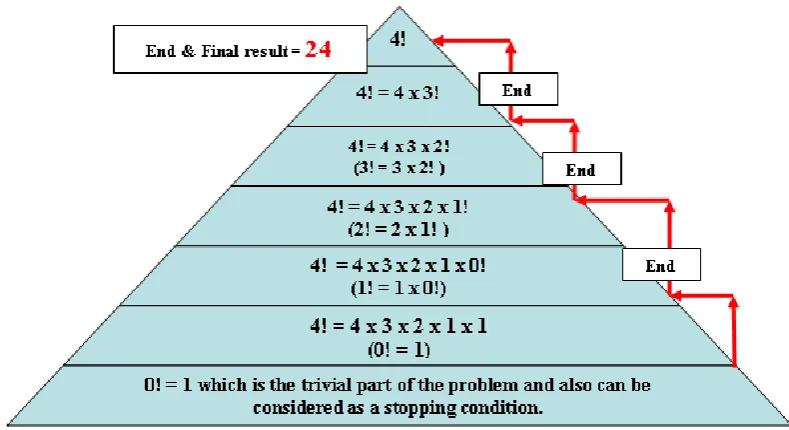
going to operate as a stopping condition. For instance, to calculate 4! one needs
to track the following steps:
4! = 4 3! 3! = 3 2!
2! = 2 1! 1! = 1 0!
0! = 1 the base case is touched so 1! = 1 1 = 1
2! = 2 1! = 2 1 = 2 3! = 3 2! = 3 2 = 6
And finally 4! = 4 3! = 4 6 = 24
Figure 6- Visual aspect of meeting base case 0! = 1
[image:42.595.122.517.390.605.2]2.2.2.Tail and Embedded Recursion
As mentioned above, the recursive call(s) is one of the indispensable
components of recursive procedures. There are two sorts of recursive processes
regarding the location of the recursive call(s) in recursive procedures. They are
called tail and embedded recursive processes. In tail recursion, the recursive call appears in the last line of the procedure, before the „end‟, whereas in
embedded recursion, the recursive call(s) can be located at any other line of the
procedure. The following two Logo programs described these two types of
recursive procedures by making spiral and binary trees. The first program is a
tail recursive procedure to create a spiral.
To Spiral :size
If :size < 5 [STOP ]
Forward :size Right turn 60
Spiral :size / 2
End
Program 1- A tail recursive Logo procedure to make a spiral Base case
Figure 8- The outcome of the above procedure in Logo programming environment
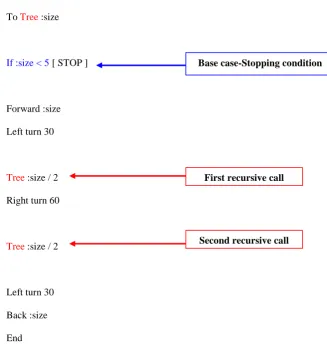
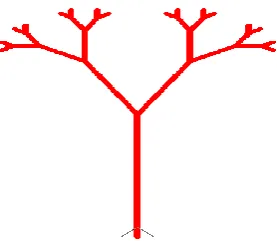
The next program is an embedded recursive procedure with two recursive calls
to make a binary tree.
To Tree :size
If :size < 5 [ STOP ]
Forward :size Left turn 30
Tree :size / 2 Right turn 60
Tree :size / 2
Left turn 30 Back :size End
Program 2- An embedded recursive procedure in Logo programming language First recursive call
Figure 9- A binary tree, the output of the above procedure in Logo environment
Thus far, I have introduced the concept of recursion and its essential
components. In addition, some of the important shortcomings of the definition
of the concept of recursion as well as the interpretation of the base case in two
mathematical and computational perspectives have been described. In the next
part of this chapter I review the literature with regard to students‟ difficulties in
understanding the concept of recursion. This review for the most part
concentrates on the computational perspective of the concept of recursion. The
predominant reason behind this tendency, anchored in designing and using
computer-based tools for the concept of recursion, is the central theme of this
thesis.
PART TWO
2.3.
Students‟ Difficulties with Understanding Recursion
It is widely acknowledged that recursion is one of the most difficult concepts
for students. Many students find recursion difficult to understand and to apply
2001; Wanda, 2001; Segal, 1995; Harvey, 1993; Wiedenbeck, 1988; Kurland
and Pea, 1985; Anazi and Uesato, 1983). Levy and Lapidot (2002) summarise
this view:
“It is generally accepted that recursion is one of the most
complicated and difficult-to-learn concepts for novice
programmers” (p. 89)
Henderson and Romero (1989) also argue that
“[…] we have found that recursion is a very difficult concept for
student to learn.” (p. 27)
Students‟ difficulties with this concept are due to several reasons, which are
categorised as follows:
Declarative vs. Imperative thinking;
Inherent complexity of the concept;
Need for a comprehensive definition and its components;
Lack of everyday analogies;
Recursion vs. Iteration;
Flow of control;
Functional abstraction.
There are a number of articles concerning the concept of recursion and its
structure – base case, recursive call, flow of control, etc. – which will be
Pratt, 2001; Segal, 1995; Wiedenbeck, 1988; Kurland and Pea, 1985; Anazi
and Uesato, 1983). However, there are only few articles concerning the
definition of the concept of recursion (Harvey, 1997).
2.3.1.Declarative vs. Imperative programming
In the computer sciences, Declarative is used as opposed to Imperative (also
referred to as procedural) programming. Imperative programming is a sequence
of instructions for the computer to be executed one by one. In contrast,
declarative programming describes what something is like, rather than how it is
going to be created. In other words, in imperative programming, a program
specifies an algorithm to reach a goal in an explicit way. In contrast, in
declarative programming a program specifies the goal or state that needs to be
achieved and leaves the implementation of the appropriate algorithm to the
support software. The complex mechanism of recursion is more like
declarative routine than procedural style. For instance, a spreadsheet is
declarative while Logo procedural programs are imperative. Sooriamurthi
(2001) argues that:
“It is important to emphasize that a recursive routine is to be
understood in one declarative reading of the routine. If one
starts to manually unravel the recursion then one is doing too
He also argues that the problems with understanding the concept of recursion is
rooted in “[…] insufficient exposure to declarative thinking in programming
context” (p. 25).
2.3.2.Inherent complexity of Recursion
Broadly speaking, due to its complex and uncommon structure, recursion is a
difficult concept to apprehend. Velazquez (2000) states that the
“[…] difficulty in learning recursion does not come from the
recursion concept itself, but from its interaction with other
mechanisms of imperative programming.” (p 310)
Sooriamurthi (2001), meanwhile, argues that the difference between
declarative and imperative strategies is one of the reasons for the complicated
nature of the concept of recursion particularly for programming as a new way
of thinking. He also adds that:
“In the world of mathematics, students are normally concerned
about the declarative “what part” and not so much (if not at
all) on an imperative “how part.” (Sooriamurthi, 2001)
This point, again, raises the necessity of distinguishing between mathematical
2.3.3.Need for a comprehensive definition for Recursion
Although many researchers and educators have researched around this concept
on a very wide range of issues, there is still no all-inclusive definition of
recursion. Leron and Zazkis (1985) distinguished between mathematical and
computational aspects of the concepts of recursion. He states that from the
mathematical view recursion is very close to mathematical induction and from
the computational view he considered recursion as a programming technique.
Ginat and Shifroni (1999), meanwhile, explain that:
“Recursion is an essential and unique tool for computational
problem solving. It encapsulates decomposition of a problem
into sub – problems of the same kind. Although such
decomposition is logically sound, it is not easily
comprehended.” (p. 127)
Wiedenbeck (1988) has further argued that a lack of lucid separation between
mathematical and programming forms of recursion confused students.
With regard to the appreciation of the essential components of recursion, the
base case is one of the most difficult parts of any recursive process or function.
Recognition of the base case is one of the most problematic aspects of
recursion (Haberman and Averbuch, 2002; Sooriamurthi, 2001; Kurland and
Pea, 1985).
The base case can be considered as a stopping condition and also as a trivial
the problem in the Divide and Conquer problem–solving strategy. Haberman
and Averbuch (2002) distinguish between how the base case informs
mathematical and computational points of views as follows:
“There are two aspects of base cases. The first is based on a
declarative, abstract approach that treats base cases as the
smallest instances (in terms of problem size) of the problem for
which we know the answer immediately, without any efforts. It
may be the smallest concrete entity, a boundary value, or a
degenerated case. It also presents the “smallest” possible input
of the problem. The second aspect is based on the procedural
approach, and refers to the base case as a stopping condition.
In this sense, it represents the end of decomposing the problem
to smaller similar problems. In order to get a comprehensive
view of the role of base cases in recursion formulation, one
should adopt both the declarative and the procedural
approaches.” (p. 84)
Distinguishing between these two aspects of the base case, Haberman and
Averbuch (2002) ascertained the difficulty of this component of the concept of
recursion. However, this matter needs to be further investigated. The base case,
even as a stopping condition, can be considered in declarative routine. It is not
necessary to see the base case as a stopping condition in procedural
programming. Our example of the factorial of a natural number shows that in a
base case in that declarative approach represents the end of decomposing the
problem into smaller and similar problems which can be considered as a
stopping condition. In this case, in each step of decomposition, one should
ensure that each recursive call of the problem approaches the base case. As
soon as the condition 0!1 is reached, the process stops all the previous
instantiations (Figures 6 and 8).
This process of approaching the base case after each time the recursive call is
called shows the subtle inter-relationships between the base case and the
recursive call within recursive procedures. These hidden internal mechanisms
make the concept of recursion hard to understand. The students‟ difficulty with
the other indispensable component of the concept of recursion, recursive
call(s), is anchored in their mental model of the recursion or mixing recursion
with iteration. Ginat and Shifroni (1999) describe this phenomenon as follows:
“The difficulties revealed in our study demonstrate that students
adhere to the iterative pattern of “forward accumulation”, due
to their confidence with the iteration construct, but lack of trust
and full understanding of the recursion mechanism.” (p. 130)
They pointed to the students‟ confidence with the iteration construct and their
lack of trust with recursion‟s mechanism. However, in their research there is
insufficient evidence regarding this natural tendency of the students. Anderson
et al, (1988) argue that the duality feature of the recursive call(s) is another
“Another source of difficulty (especially in LISP) is the duality
of meaning in recursive procedure call. On the one hand the
call produces some resultant data; on the other hand it specifies
that an operation be carried out repeatedly. […] It can be data
or complex operation, depending on your view.” (pp. 162-63)
They also add that:
“Because students often perseverate on one view of recursion,
they are often blinded to solutions that could be easily attained
from the other view.” (ibid, p. 163)
It seems that one of the reasons for students‟ confidence with iterative
processes compared to recursive ones is their intuitions and everyday life
experiments, which are described in the next section.
2.3.4.Everyday analogies and Recursion
Finding everyday life analogies for the concept of recursion is a very difficult
task. There are some researchers who have taken into account the role of lack
of everyday analogies in learning and applying recursion (Levy and Lapidot,
2002; Wiedenbeck, 1988; Pirolli and Anderson, 1985; Kurland and Pea, 1985).
Wiedenbeck (1988) argues that students can run and perform iteration easily
because in their everyday life they have seen and experienced plenty of