Effects of a pun versus an explicit message on
behavioural change
Hilde Dorman
Hilde Dorman
University of Twente
Communication Studies
WATCH OUT!!
Effects of a poster on behavioural change
Master thesis
March 2015
University of Twente
Faculty of behavioural sciences
Communication Studies
Corporate Communication
Hilde Dorman
s1127217
PREFACE
“I’d made it this far and refused to give up, because all my life I had always finished the race. To persevere is important for everybody. Don’t give up, don’t give in, there is always an answer to everything”. This is a quotation by Louis Zamperini used in the film ‘Unbroken” and the song ‘Miracles’ by Coldplay. It comes very close to the feelings I have now that I am finishing this master thesis. Despite the fact that the process was not always easy, it is brought to a successful conclusion.
The past four and a half year I have had a lot of fun studying Communication and I am happy I made the choice to start with it after my nursing education. The fact that I am a nurse myself, has contributed to the fact that I am very interested in everything that has to do with the combination communication and health care. So, I did not have to think twice when I got the chance to do a follow-up study to the Femke Berendsen’s study that was about the prevention of wearing jewellery in nursing homes. I find it very interesting to investigate how behaviour can be changed into more desirable behaviour and thus the quality of health care can be improved. Now that I have finished communication studies, I also hope to contribute to a better and qualitatively stronger health care in future.
The completion of this thesis could not have been succeeded without the help of several persons whom I would like to thank. First, I would like to thank Joyce Karreman for all the time and effort she has put in my research. Thanks to her knowledge and advice I always found a way to get back on track. Second, I owe many thanks to Bert Pol. With his specialized knowledge and critical feedback, he helped me to look further and find side-ways I would never have seen without his directions. I would also like to thank Jordy Gosselt for his feedback and instructions at the end of the writing of this master thesis in order to reach the finish-line as well as possible.
Furthermore, I owe many thanks to Andrea Eikelenboom. She helped me to find the nursing homes and brought me into contact with the contact persons Tomas Klop of ‘Het Herstelhotel’ and Sanne Geurts of nursing home Madeleine. Of course I also want to thank Tomas and Sanne for their effort, help and hospitality. They made sure that I was not lost in the corridors of their organization, and was able to obtain as many respondents as possible. To all those respondents I am greatly indebted as well. Without them, the research could not have been completed at all.
Last but not least, I wish to express many thanks to my family, friends and Stefan. They offered me all the time and space I needed to complete this thesis. They listened when I just did not see the right way and always supported me not to give up.
Enschede, March 2015
Hilde Dorman
ABSTRACT
During the last few years, the prevention of health care associated infections has received a growing amount of attention. The number of deaths due to preventable harm in healthcare organisations is estimated at 1700 per year, and the outbreak of infections is seen as one of the most important causes of preventable harms (Arets, 2012). Health care workers often violate the most basic guideline, not wearing jewellery during work. In the past, several campaigns promoting better hand hygiene were launched, but substantial lasting effects had not been reached. Therefore, this study investigates whether campaigns that make use of posters can be effective and which factors are of influence on behavioural change.
In this study I set out to analyse which kind of posters are cognitively processed and whether that may lead to planned or automatic behavioural change. This is done by comparing the effects of a poster with an explicit message and a poster with a pun. The research question is: “In which way is an activating message on a poster processed, and to what extent does the design of the poster influence planned or automatic behaviour change?” To answer the research question, three methods were used: an observational study, a survey and semi-structured interviews. The study was conducted in two nursing homes in the vicinity of Nijmegen; ‘Het Herstelhotel’ and nursing home ‘Madeleine’. In ‘Het Herstelhotel’ the poster with the explicit message was revealed and the poster with the pun was hung up in Madeleine. Both posters showed the same picture. In total, 65 respondents participated. Their behaviour according to the wearing of jewellery was observed before the poster was hung and three weeks after the placement of the poster. During the second observation they were asked to fill in the questionnaire. 25 of them have participated in the interview study.
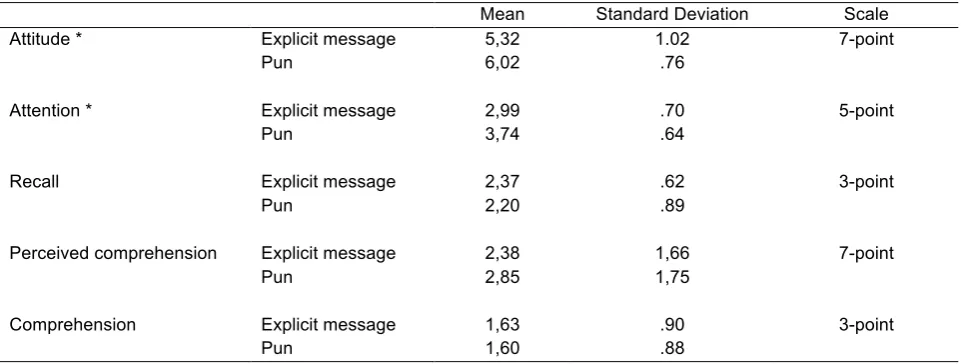
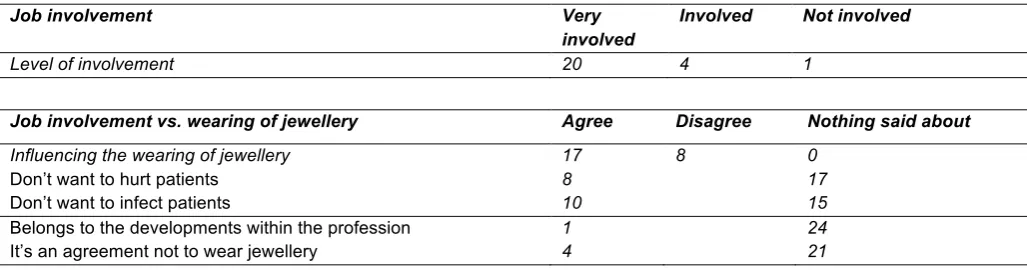
The results of this study showed that the poster with the pun led to a more positive attitude and higher attention than the poster with the explicit message, but there was no difference between both posters regarding recall, and perceived comprehension. In contrast to the study of Berendsen (2012), this present study revealed that there was no difference between both posters regarding behavioural change. During the second observation, significantly less jewellery was worn in both conditions. Moreover, the interviews showed that respondents themselves were of the opinion that the poster had no effect on their behaviour, but they reported that the social environment and more or less their involvement with the job had influenced them. Based on these results it could be concluded that both posters were observed, but the design was not deeply processed. Both posters may have served as a prompt, which triggered the unconscious process and led to automatic behavioural change. The respondents may (unconsciously) know that the wearing of jewellery is forbidden and were again reminded when they saw the poster. Thereby, they want to conform to the social norm, and therefore wear no jewellery anymore.
SAMENVATTING
De afgelopen jaren is er steeds meer aandacht besteed aan de preventie van ziekenhuisinfecties. Het aantal mensen dat overlijdt aan een te voorkomen complicatie wordt geschat op 1700 per jaar. Eén van de belangrijkste oorzaken hiervan is verspreiding van ziekenhuisinfecties (Arets, 2012). Het niet dragen van sieraden wordt gezien als één van de meest basale richtlijnen om dergelijke uitbraken te voorkomen, maar toch wordt deze regel regelmatig overtreden door medewerkers van zorginstellingen. In het verleden werden er al verschillende campagnes gelanceerd om het personeel bewuster te maken van goede handhygiëne, maar deze hebben niet tot het gewenste resultaat geleid. In deze studie wordt onderzocht of campagnes die gebruik maken van posters effectief kunnen zijn en welke factoren daarbij van invloed kunnen zijn op gedragsverandering.
In dit onderzoek wordt geanalyseerd of en wat voor soort poster cognitief verwerkt wordt en in hoeverre dit zou kunnen leiden tot een geplande of automatische gedragsverandering. Dit is gedaan door het effect dat een poster met een expliciete boodschap heeft op gedrag te vergelijken met het effect op gedrag dat een poster met een woordspeling heeft. De onderzoeksvraag hierbij luidt: “Op welke manier wordt een activerende boodschap op een poster verwerkt en in hoeverre beïnvloedt het design van de poster geplande of automatische gedragsverandering?” Om deze onderzoeksvraag te kunnen beantwoorden, werden drie methoden gebruikt: een observatiestudie, een enquêtestudie en een interviewstudie. Het onderzoek werd uitgevoerd in twee verpleeghuizen in de regio Nijmegen. Dit waren ‘Het Herstelhotel’ en ‘verpleeghuis Madeleine’. De poster met de expliciete boodschap werd opgehangen in ‘Het Herstelhotel’ en de poster met de woordspeling heeft in verpleeghuis ‘Madeleine’ gehangen. Op beide posters was dezelfde afbeelding afgebeeld. In totaal hebben 65 respondenten deelgenomen aan het onderzoek. Hun gedrag ten aanzien van het dragen van sieraden tijdens hun werk werd geobserveerd voordat de posters werden opgehangen en dit werd herhaald toen de posters drie weken gehangen hadden. Tijdens de tweede observatie werd aan de geobserveerde respondenten gevraagd om de enquête in te vullen. Tevens werd aan 25 van hen gevraagd om deel te nemen aan de interviewstudie.
niet is toegestaan, maar werden hier opnieuw aan herinnerd toen zij de poster zagen. Ook kan het feit dat zij zich willen conformeren aan de sociale norm een reden zijn van het feit dat ze geen sieraden meer dragen.
Over het geheel genomen kan geconcludeerd worden dat dit onderzoek tot meer kennis heeft geleid over het effect van posters op het proces van gedragsverandering. Managers van verschillende organisaties zouden deze kennis kunnen gebruiken om gewenst gedrag binnen hun organisatie na te streven. Hiervoor hoeven zij geen dure posters te ontwerpen, omdat het design van een poster niet van invloed is op gedrag. Een aanbeveling voor toekomstig onderzoek is om na te gaan in hoeverre het onbewuste (automatische) verwerkingsproces leidt tot permanente gedragsverandering.
TABLE OF CONTENTS
1. Introduction 8
1.1 The danger of bad infection prevention 8
1.2 Relevance of the research 9
1.3 Context of the research 10
2. Literature review 12
2.1 The problem of wearing jewellery in healthcare institutions 12 2.2 Studies about the prevention of health care associated infections 12
2.3 Attitude and behavioural change 13
2.4 Planned versus automatic behaviour 14 2.5 Creativity in persuasive (governmental) communication 16
2.6 Influencing planned behaviour 16
2.7 Applicability of the hypothesis 20
2.8 Influencing automatic behaviour 20
3. Methods 24
3.1 The research design 24
3.2 Procedure of the research 25
3.3 The research population 26
3.4 The measuring instrument 28
4. Results 31
4.1 Results of the survey 31
4.2 Results of the observational study 32
4.3 Results of the interview study 34
5. Conclusion 38
6. Discussion 41
6.1 Theoretical implications 41
6.2 Limitations 43
6.3 Recommendations for future research 44
6.4 Practical recommendations 44
References 45
1. INTRODUCTION
1.1 The danger of bad infection prevention
“It is safer to take part in the traffic than to stay in a hospital”. This may be a shocking quotation, but if you realize that the number of deaths due to preventable harm in healthcare institutions is estimated at 1700 per year, this quotation will come very close to the truth. Health care associated injuries can be a result of health care providers not following the professional standards, shortcomings of the health care system and/ or the patients’ behaviour (Huis, 2013).
According to Huis (2013), one of the most essential contributions towards patient safety is the reduction of hospital-acquired infections. The outbreak of infections is one of the most important causes of preventable harms (Arets, 2012). At any time, over 1.4 million people worldwide develop infectious complications associated with health care. This leads to a considerable burden of disease and mortality (Erasmus, Daha, Brug, Richardus, Berhendt, Vos & Van Beeck, 2010). Adequate hand hygiene among hospital personnel could probably prevent 15% to 30% of the health care associated infections (Huis, 2013).
Over the past two decades, improving patient safety has received growing attention. The substantial reduction of hospital-acquired infections is seen as one of the first goals of the World Health Organisation’s World Alliance for Patient Safety. To reach this goal, improvement in compliance with hand hygiene guidelines is needed (Erasmus et al. (2010). Over the past several decades, various campaigns promoting hand hygiene have been launched, but substantial effects of those campaigns are hardly achieved.
The Healthcare Inspectorate stated that, in particular, the elderly care takes insufficient account of contagion risks (Inspectie voor de Gezondheidszorg, 2013). Too little attention is paid to infection prevention in the studied elderly institutions. This is alarming, because the elderly have an increased risk of contracting infectious diseases (Sweers, 2013). According to a study of the Healthcare Inspectorate, general precautions especially are not executed. Examples of such requirements are washing hands, the proper use of gloves and not wearing jewellery.
In nursing homes healthcare-associated infections are a serious problem and associated with excessive comorbidity and mortality. Many of the Dutch nursing homes do not adhere to the guidelines of infection prevention (Inspectie voor de Gezondheidszorg, 2014). The most basic guidelines, such as not wearing jewellery, are often violated by the health care workers. It should be stated, however, that during the last few years some small improvements have occurred. However, the Healthcare Inspectorate conducted research into infection prevention and concluded that healthcare institutions are still not well prepared for an increase of resistant bacteria.
increasingly difficult to fight. Many infections become resistant to antibiotics. Because of the increase of resistance, a good hygiene policy becomes more and more important (Haenen et al., 2013).
Central to personal hygiene is hand hygiene. This means; a proper washing of the hands and not wearing jewellery (Landelijk centrum hygiëne en veiligheid, 2009). Microorganisms on the hands of the health care workers contribute to the incidence of infections in patients, because hands are the most convenient transport mechanisms for micro-organisms (Huis, 2013). Furthermore, this researcher argued that for good hand hygiene it is essential not to wear jewellery. The wearing of rings, bracelets and watches during the work can be dangerous, because it is impossible to clean the skin in the location of the piece of jewellery sufficiently, allowing bacteria to settle down and spread (Huis, 2013).
Because of the importance of good hygiene, nurses in healthcare institutions in the Netherlands have to be aware of the negative consequences of wearing jewellery. Thereby, they should change their behaviour to no wearing of jewellery during work time. In nursing homes, a clear social norm about not wearing jewellery during work time has to be developed. This may lead to less preventable harms in the health care institutions (Sweers, 2013).
1.2 Relevance of the research
As stated above, the various campaigns promoting hand hygiene have not led to the desired effect. In the past, it was often believed that creativity in (persuasive) communication is necessary for a communication message to be effective (Smith, MacKenzie, Yang, Buchholz & Darley, 2007). However, there is very little research conducted to investigate the effects of creativity and how it relates to effectiveness. This study attempts to provide new knowledge in the field of public communication and attitude/behaviour change by studying the importance of creativity in messages. It is expected that creativity is important when messages are consciously processed, but less so when they are automatically processed. According to Bargh (1984) automatic processes do not demand much attention and become active without the necessity of active control by the individual.
In her master thesis Berendsen (2012) studied whether a poster with a pun or an explicit expression, in combination with an (in)congruent image, can influence the memory, the attitude, comprehension and behaviour of recipients in natural conditions. The conclusion of this study was that a poster with a pun and an incongruent image increases the recall of the poster. However, a poster with an explicit message and a congruent picture increased perceived comprehension, recall of the recall of the poster and recall of the message and finally leads to more behavioural change.
Thus, the goal of this research is to investigate whether activating messages in a natural environment are processed consciously or unconsciously, whether that finally may lead to planned or automatic behaviour change, and to what extent the design of the poster matters. Based on this goal, the following research question can be formulated: “In which way is an activating message on a poster processed, and to what extent does the design of the poster influence planned or automatic behaviour change?”
1.3 Context of the research
Most studies into the effects of creative messages were conducted in commercial communication studies (Berendsen, 2012). This research, however, will focus on public communication in a natural environment. A main difference between commercial advertising and public communication is the complexity of the message and the kind of message that is communicated. Commercial advertising is aimed at the creation of strong brands and the stimulation of purchases. These are relatively simple messages (Pol, 2011). The aim of public communication is to keep citizens from harmful behaviour and to stimulate desired behaviour (Rijksvoorlichtingsdienst, 2010). These are more complicated messages.
The context of the proposed research is two different healthcare institutions in the vicinity of Nijmegen. The selected institutions are primarily focused on elderly care. Good hand hygiene is particularly of importance in these institutions because of the intensive (physical) contact between the health care employee and the residents. Furthermore the residents of these nursing homes are very susceptible to infections.
Within both healthcare organisations, much attention is already paid to the importance of good hand hygiene and not wearing jewellery. However, according to one of the team managers, jewellery is still worn. In this study we will measure what is more effective; a poster with a pun or a poster with an explicit message or that factors such as social environment and job involvement are of greater influence.
1.3.1 ZZG Herstelhotel
1.3.2 Pantein; Nursing home ‘Madeleine’
2. LITERATURE REVIEW
2.1 The problem of wearing jewellery in healthcare institutions
Approximately 5 to 10% of hospitalized patients in the Western world acquire healthcare associated infections (Longtin, Sax, Allegranzi, Schneider & Pittet, 2011). Furthermore, the European Centre for Disease Prevention and Control (ECDC, 2007) states that the number of patients acquiring those kinds of infections in the European Union every year can be estimated at 3000.000 with approximately 50.000 deaths occurring as a consequence. In de United States of America, this figure is around 99.000 per year. So, it could be stated that those kinds of infections are a global problem (Ward, 2010).
Health care associated infections have been given significant media attention due to their tremendous costs, both monetarily losses and loss of lives (White, 2013). Critical in the prevention of these infections is hand hygiene. However, Longtin et al. (2011) stated that compliance among health care workers is most often below 40%. According to White (2013) jewellery, including rings, watches and piercings have been postulated as contributing to the spread of infections, because they increase the bacterial load of the skin (Longtin et al., 2011). Jewellery is thought to carry microorganisms on their surfaces or harbour them on the skin underneath.
Thus, it can be stated that jewellery use by health care workers has been linked to the rise of health care acquired infections. A number of specific guidelines and recommendations have been published restricting the use of jewellery in the health care environment. For example, in 2009 the World Health Organisation published guidelines focusing on hand hygiene in health care that make specific recommendations with regard to the use of jewellery (White, 2013). With regard to wristwatches, for example, White (2013) states that they are believed to harbour large amounts of microorganisms, especially given the difficulty in cleaning them properly.
2.2 Studies about the prevention of health care associated infections
To prevent health care associated infections, it is important that health care workers get good education about infection prevention. According to Gould and Drey (2013) this education has to be at an early stage in student nurses’ preclinical experience to protect patients and reduce risks of occupational exposure to infection. However, earlier research showed that qualified staff are poor role models for student nurses (Ward, 2010; Geller, Bakken, Currie, Schnall & Larson, 2010). Gould and Drey (2013) stated that ward managers could improve practice by establishing clear rules about nail enhancements and wearing jewellery.
means were significantly less important. Furthermore, several other reasons for noncompliance were reported in literature. For example, Chan, Molassiotis, Eunice, et al. (2002) named lack of leadership as an important issue. Harris, Samore, Nafziger, DiRosario, Roghmann and Carmeli (2002) argued that the lack of a positive role model is an important factor that leads to noncompliance and also risk perception (Naing, Nordin & Musa, 2001) is seen as a reason of this kind of undesirable behaviour.
2.3 Attitude and behaviour change
To prevent healthcare workers wearing jewellery during work time, nurses have to be aware of the fact that it is not allowed to wear jewellery during work time, that the wearing of jewellery is not the acceptable norm of health care institutions and that they have to comply with the existing standards. To achieve this, health care workers have to change their attitude or, in the most desired case, their behaviour.
An attitude can be defined as a psychological tendency that is expressed by evaluating a particular entity with some degree of favour or disfavour (Gass & Seiter, 2014). A second feature of attitudes is that they represent favourable or unfavourable evaluations of things. A third aspect of attitudes is that they are always directed toward an attitude object; people hold attitudes among things or toward things. The conceptualizations of attitude differ in the extent to which they describe attitudes as being constructed or stored in memory (Bohner & Dickel, 2011). Furthermore, an important feature of attitudes is their persistence. Some attitudes are very easy- and others are very hard to change. When an attitude changes, it is more likely that the behaviour will change a well (Petty & Cacioppo, 1986) For this purpose, it is important that healthcare workers know the reasons why they should not wear jewellery.
However, to achieve an attitude or behaviour change, it is not enough to know why the wearing of jewellery is prohibited. According to Cacioppo and Petty (1986) it is essential that people are involved in the subject, that they are able to change their attitude and that there are some favourable cues that motivates to change. Moreover, Kelman (1958) argues that there are three different processes of influence that may lead to an attitude change: compliance, identification and internalization. Compliance can occur when an individual accepts influence because he or she hopes to achieve a favourable reaction from another person or group. Identification occurs when an individual accepts influence because he or she wants to establish or maintain a satisfying self-defining relationship to another person or group. Internalization occurs when an individual accepts influence because the content of the induced behaviour – the ideas and actions of which it is composed- is intrinsically rewarding.
In the past, studies about attitude change especially focused on message based persuasion and social influence. Message based persuasion research examined attitudes at the individual level. An example of this is exposure to communication stimuli, like posters and advertisements. This could be seen as planned behavioural change; behaviour that is preceded by consideration. (Pol & Swankhuisen, 2013).
individual is involved in a message, or to the context in which the message is displayed is a crucial factor regarding the effectiveness of the message (Petty, Cacioppo & Schurmann, 1983; Pol et al., 2013). For example, when an individual is highly involved in his/her profession, this may affect the degree in which the individual attaches importance to the message.
2.4 Planned versus automatic behaviour
According to Pol et al. (2013) an estimated 95% of our behaviour is automatic behaviour. Automatic behaviour can be defined as behaviour we do not consciously think about. Planned behaviour is behaviour we consciously think about. In this section the differences between both sorts of behaviour will be discussed.
2.4.1 Planned behaviour
A well-known theory about planned behaviour is the theory of planned behaviour of Ajzen (1991). This theory is an extension of the theory of reasoned action. The theory of reasoned action is a rational model of the persuasion process and is based on one’s beliefs about an outcome and the evaluation of that outcome. Furthermore, this theory states that intentions are also guided by the subjective norm (Fishbein, 1979). As in the original theory of reasoned action, a central factor in the theory of planned behaviour is the individual’s intention to perform a given behaviour. Intentions are assumed to capture the motivational factors that influence behaviour. However, the motivation to process information thoroughly can differ per person (Pol et al., 2013). Information is processed deeply when it is seen as personally important.
As a general rule, it can be stated that the stronger the intention to engage in specific behaviour, the more likely should be its performance. However, in the theory of planned behaviour a third element is added; perceived behavioural control (Gass & Seiter, 2014). Ajzen (1991) states that where the theory of reasoned action is under a person’s control, the theory of planned behaviour acknowledges that behaviour is not always volitional. There are several factors that may impinge on a person’s perceived behavioural control. These are internal factors (lack of knowledge and/or skills) and external factors (e.g. limited resources, extenuating circumstances.) (Gass & Seiter, 2014). The theory of planned behaviour is the most extensively studied social cognition theory, and is relevant to both intention and behaviour change. (Hardeman, Johnston, Johnston, Bonetti, Wareham & Kinmonth, 2002). Only in the case of planned behaviour, actions can be seen as the consequences of our intentions. But, it is estimated that only 5% of our behaviour is planned (Pol et al., 2013).
2.4.2 Automatic behaviour
The recent insights about automatic behaviour give a different interpretation to what in the Elaboration Likelihood Model is called the peripheral route. The recent insights go deeper and describe behaviour we do not consciously think about at all. The ideas about influencing automatic behaviour give much more effective tools about practical influencing than the Elaboration Likelihood Model does (Pol et al., 2013). In recent social-scientific literature some interventions are discussed to influence automatic behaviour. Those can be divided into two categories: interventions to break existing automatic behaviour and interventions aimed at priming and social influence. According to Dijksterhuis, Spears, Postmes et al. (1998) priming traits and stereotypes can lead to corresponding behaviour in the receiver. Such priming can result in behavioural assimilation. Activated traits produce assimilation because they function as an interpretation frame and cause perceptual input to be interpreted in line with this trait construct.
Furthermore, automatic behaviour can be influenced by means of prompting. The major goal for using prompts is to provide a means to externalise mental activities that are usually covert (Scardamalia & Bereiter, 1985; Lin & Lehman, 1999). Prompts may help to comprehend and recall information. The most important effect of prompting is that it focuses people’s attention on their own thoughts and on understanding the activities they are engaged in. According to Lin and Lehman (1999) engaging people may increase the probability that relevant information will be accessed when needed.
The present study is aimed at prompting and social influence. Social influence may ensure compliance with the rules. The poster may serve as a prompt and makes the health care worker again aware of the social norms. Here a prompt is seen as a symbol or message that serves to suggest or remind (Cambridge Dictionary). The difference between a prompt and a prime, however, is that people are not aware of a prime. They observe a stimulus, but have no idea that this influenced their behaviour. People are aware of a prompt, a reminder of something they unconsciously knew already (Pol et al., 2013). In case of priming, people are able to see the stimulus, but we are not aware of the impact this stimulus has on our behaviour.
2.5 Creativity in persuasive (governmental) communication
In the past, several campaigns have been launched to prevent the wearing of jewellery, but they have not led to the desired effect (Erasmus et al. (2010). It was often believed that creativity in (persuasive) communication is necessary for a communication message to be effective so that it leads to behavioural change. Marketing researchers agree that creativity is one of the essential elements for advertising success (Smith, MacKenzie, Yang, Buchholz & Darley, 2007). Heath and Feldwick (2007) argue that the ‘creative’ content builds favourability and not the rational message.
A message can be seen as creative when it is divergent and relevant. According to Smith et al. (2007) divergence can be defined as the extent to which an message contains brand of execution elements that are different, novel, unusual, original and unique. Relevance refers to the extent to which the message contains elements that are meaningful, appropriate or valuable to the audience (Yang & Smith, 2009; Berendsen, 2012).
Creative messages are presumed to evoke a favourable response from the target audience (Ang, Leong, Lee & Lou, 2012). However, especially in governmental communication, the extent of personal relevance is seen as a very important factor regarding the effectiveness of messages. In many cases, the government is of the opinion that the social involvement is high, that everyone is involved in the message. However, in most cases this level of involvement is low. This is often the case in health education programs, for example (Pol et al., 2013). If someone is highly involved in the message, the person will be more inclined to pay attention to the message. In that case, the use of creative elements will not be effective because the person wants to pay attention to the message and not be distracted by other elements.
Very little research has been conducted to define message creativity or how it relates to the effectiveness of messages (Smith & Yang, 2004; Gass & Seiter, 2014). One of the most important factors for creative messages to be successful is novelty. Novel advertisements are original, out of the ordinary and not expected. However, Ang, Lee and Leong (2007) propose that to be effective, novel messages need to be both meaningful and connect their audience as well. Novelty, coupled with meaningfulness and connectedness, enhances consumer ad response. Messages containing those elements will be evaluated as being more creative and are better recalled and liked than novel messages which lack those elements (Ang, Leong, Lee & Lou, 2012). The question is, however, to what extent those creative elements are of effect regarding behavioural change. Is it that as important as it is expected to be?
2.6 Influencing planned behaviour
2.6.1 Pun versus explicit message
A wordplay, or pun, is a witticism that relies for its effect on playing with different levels of language. This can be phonological, morphological, lexical, syntactic and textual. According to Van Mulken, Enschot- van Dijk and Hoeken (2003) puns refer to the “usually humorous use of a word in such a way as to suggest two or more of its meanings or the meaning of another word similar in sound”. Therefore, puns are a form of figurative speech, a trope in which the message has at least two different meanings. Punning is probably the most obvious of all forms of humour (Partington, 2009). Of all the various forms of humour, plays on words and puns have received the bulk of attention in linguistic studies. Puns are frequently used in advertisements as a rhetorical device to promote a certain product or action by creating humour, attracting the receiver’s preferences (Laviosa, 2005).
An explicit message can be defined as a message that is fully and clearly expressed, leaving nothing implied (Cambridge Dictionary). According to Kintsch & Van Dijk, (1978) this can be described as a text that only uses those propositions that are necessary to establish formal coherence. This means that only words are interpolated that makes it possible to interpret the text. Toncar and Munch (2001) argue that an explicit message leads to logical inferences derived directly from the message. Those writers state that an explicit message is processed less deeply than wordplay is. Therefore, the pun is seen as independent variable in this research.
2.6.2 Attitude, attention, recall, comprehension, and behaviour; dependent variables
Literature shows that posters with a pun increase the attitude, attention and recall towards the poster (Toncar et al., 2001; McQuarrie & Mick, 1999; McGuire, 2000). But they are more difficult to understand, and it is less likely that they lead to behavioural change than a poster with an explicit message (Van Mulken et al., 2003; Berendsen, 2012). Those factors are seen as the dependent variables and will be discussed below.
Attitude towards the poster
Attitude change means that a person’s evaluation is modified from one value to another (Petty & Wegener, 2010). But how is it possible that some attitudes are very durable and others change overtime? The Elaboration Likelihood Model of Petty and Cacioppo (1986) provide a useful answer to this question. This model proposes two basic routes of processing a message. These are the central route and the peripheral route. Central processing involves cognitive elaboration. This means that the receiver is cognitive involved in the message. Peripheral processing involves focusing on cues that are not directly related to the substance of a message. Whether a person emphasizes the central or the peripheral route hinges on two factors: people’s motivation and ability to process information. Attitudes formed via central processing are more resistant to change than attitudes formed via peripheral processing. Actively thinking seems to ‘plant’ the attitude more firmly (Gass & Seiter, 2014; Petty & Cacioppo, 1986).
the ad with the product that is being advertised, which in turn may lead to a more positive attitude towards the product than when an explicit message is used (Toncar et al. (2001). Therefore, advertisers try to create positive attitudes by using creative elements. Several scholars indicate that rhetorical figures in messages (such as puns), in contrast to explicit messages, should increase a positive attitude among receivers (Huhmann & Albinsson, 2012; McQuarrie & Mick, 2003; Huhmann, Mothersbaugh & Franke, 2002 and Berendsen 2012). Thus, it is expected that a poster with a pun will lead to a more positive attitude than a poster with an explicit message.
Hypothesis 1: A poster with a pun leads to a more positive attitude towards the poster than a poster with an explicit message.
Attention
Attention can be goal-driven (or active) when it is controlled by the observer’s deliberate strategies and intentions or attention can be stimulus-driven (or passive) when it is controlled by some salient attribute of the image that is not necessarily relevant to observer’s perceptual goals Yantis (1998). Not all consumers are involved in all messages (Greenwald and Leavitt, 1984). However, it is important to recognize that any given act of attention typically involves some combination of two attentional modes.
In this study, the focus is on the attention of the health workers to the specific poster. Those people are not necessarily involved in the message. In other words, they have not chosen to come in contact with the message on the poster. Thus, in this case the paid attention will especially be stimulus-driven. Moreover, the posters used in this study can be seen as an activating message. Therefore, the visual elements as well as the textual elements are important components (McQuarrie & Mick, 1999). Visual elements are superior in capturing attention, independent of its size. Textual elements best captures attention in direct proportion to its surface size (Pieters & Wedel, 2004). Furthermore, pictures have the ability to influence the receiver, because they elicit affective responses (Miniard, Lord & Unnava, 1991; Berendsen, 2012).
In this study the focus is on the textual elements. McQuarrie and Mick (1996) made a distinction between tropes and schemes. A figure in the schematic mode occurs when a text contains excessive order or regularity, while a figure in the tropic mode occurs when a text contains a deficiency of order or irregularities. According to McGuire (2000) rhetorical tropes are eye-catching, making the messages more interesting than a text with an explicit message, and thus enhancing more attention to, and effective encoding of, the arguments. Puns could be classified as tropes, because the irregularity of a pun requires a semantic interpretation. Several studies showed that posters with a pun attract more attention than posters with an explicit message, due to their irregular shape (Huhmann et al., 2002; Laviosa, 2005) Therefore, it is expected that a poster with a pun will attract more attention than a poster with an explicit message.
Recall
According to McQuarrie and Mick (1996) and Toncar and Munch (2001) tropes “invite elaboration by the reader”. The level or depth of comprehension of advertising language influences both attitude and memory for advertised information. Because tropes entail a deviation from expected meaning, they place additional processing demands on viewers. Viewers must first process the literal language used in the message and then make the “leap” to understand the deviation. Therefore, compared with explicit language, tropes should have significant effects on the cognitive processing and memory for print advertising, like posters. Viewers of a trope must assign a meaning that is different from its literal meaning and that resolves inconsistency inherent a trope structure. This necessitates deeper processing (Toncar & Munch, 2001).
Although figures of speech are used widely in print ads, the effects of these message structures on cognitive processing and memory have not been investigated systematically. However, several studies have shown that advertisements with rhetoric figures are better remembered than advertisements with explicit messages. Rhetorical figures stimulate cognitive processing, because they rely on the nonliteral meaning of words (McQuarrie & Mick, 2006; Toncar & Munch, 2003). Based on the literature, it could be expected that if tropes are processed more deeply than explicit claims, this should have implications for memory. The deeper level associations that result from processing tropes should enhance the recall of these claims.
Hypothesis 3: A poster with a pun will be better recalled than a poster with an explicit message.
However, in the case of unconscious processing, it is expected that it does not matter whether the poster contains a pun or an explicit message. The information is not deeply processed, so the details are not stored in memory. The poster serves primarily as a prompt. A crucial factor for an effective prompt is that the target group has the right associations with it (Pol et al. 2013). So the respondents have to know what the poster means, but not necessarily which details the poster contained.
Perceived comprehension
Perceived comprehension can be defined as a ‘communicator’s assessment of his or her success or failure when attempting to understand something’ (Myers & Bryant, 2000). Previous research overwhelmingly suggests that feelings of ease people experience while processing information lead them to infer that their comprehension is high, while feelings of difficulty lead them to infer that their comprehension is low (Miele & Molden, 2010). Therefore, for a poster to be effective, it is essential the receiver completely understands the message and it is essential that the message is not extremely difficult. The level to which an advertisement is understood, depends to a large extent on how an advertisement is developed and the use of creative elements. According to Gardner and Luchtenberg (2000) comprehension can be achieved both by first looking at the image and then reading the text, and the other way around. Furthermore they state that in most ads, the text anchors the image. This could be an explicit message as well as a pun.
it flatters the audience’s intellectual capabilities by showing them that they possess the relevant knowledge to solve the problem. However, the disability to solve the problem may also have the opposite effect. Therefore, it is very important that the receiver understands the intention of the pun. However, a disadvantage of a pun is that the message may cause uncertainty and conflict with respect to the intended meaning (Mothersbaugh, Huhmann & Franke, 2002). For interpreting a pun, Van Mulken, Enschot-Van Dijk and Hoeken (2003) suggest that the receiver has to process more than one meaning in the message and this generally involves more processing effort than interpreting an explicit message. However, the supplementary interpretation of wordplay does not necessarily supply extra information (Van Mulken et al. 2003). On this basis, it can be expected that a poster with a pun is more difficult to understand and perceive to understand than a poster with an explicit message.
Hypothesis 4: A poster with a pun is more difficult to perceive to comprehend and to comprehend than a poster with an explicit message
Behaviour
In literature, there is very little known about the effects of a pun on the behaviour of the recipient. In this research, a congruent image will be combined with a pun or an explicit message. This could be seen as the prompt. Because it is expected that a pun distracts attention from the message (McQuire, 2000) it is believed that is less likely that a poster with a pun leads to the desired behavioural change than a poster with an explicit message (Berendsen, 2012).
Hypothesis 5: It is less likely that a poster with a pun leads to the desired behavioural change, than a poster with an explicit message will do.
However, Pol et al. (2013) argue that posters can be seen as a prompt and will be unconsciously processed. Persons may be aware of the prompt but not aware of the effect it has on their behaviour. How automatic behaviour could be influenced will be discussed in paragraph 2.8.
2.7 Applicability of the hypothesis
The hypotheses described above are only applicable when there is planned behaviour. This could be the case when there is a difference regarding behavioural change between the poster with the wordplay and the poster with the explicit message. Attitude, attention, recall and comprehension could be of influence on behavioural change then. In case of automatic behaviour, however, it is expected that the opposite effect will occur. When there is automatic behaviour, attitude, attention, recall and comprehension will play no role as influencer. In that case, the design of the poster has no direct influence on behavioural change. How automatic behaviour could be influenced, will be discussed in the following section.
2.8 Influencing automatic behaviour
unintentional or automatic in nature. Attitudes are discovered to become activated automatically on the mere presence of the attitude object, without conscious awareness or intention (Bargh, Chen & Burrows, 1996).
Traditionally, the study of attitude change has focused on message based persuasion and social influence. Message based persuasion research examined attitudes at the individual level. An example of this is exposure to (persuasive) communication stimuli, like posters, advertisements etcetera. Nowadays, social influence is seen as a more important factor of attitude change. Attitudes are now seen as social phenomena that are embedded in social interaction (Wood, 2000). Moreover, the effectiveness of advertising messages is widely believed to be moderated by audience involvement (Greenwald & Leavitt, 1984). Several studies have indicated that involvement is an important moderator of the amount and type of information processing elicited by (persuasive) communication (Petty et al., 1983; Petty & Cacioppo, 1986; Greenwald & Leavitt, 1984). However, in the case of automatic behaviour, attitudes play no role as an influencer. When automatic behaviour needs to be changed, no attention needs to be paid to underlying attitudes. Attitudes follow the behaviour or are quite separate from them. So, in the case of automatic behaviour, they are no predictors of behaviour (Pol, et al., 2013). As stated above (p12), in this study social environment and job involvement can be seen as influencers of automatic behaviour. Both will be discussed below.
2.8.1 Influence of the social environment
Bargh et al. (1996) propose that social behaviour is often triggered automatically on the mere presence of relevant situational features. These writers argue that if an individual consistently behaves the same way in response to a situation, that behavioural response should become automatically associated with those situational features.
The strength of the social norm is deeply ingrained in social norms that have become an integral part of our behaviour. According to Pol et al. (2013) the social network theory offers good opportunities in order to change stuck behaviour. The core of this theory is that members of a target group are heavily involved by the implementation of the communication message. The success of this method is due to dialogue and discussion between the group members. Arguments of people in your own group are seen as more impressive than outsiders’ arguments. However, a precondition for the success of the social network theory is social cohesion (Pol et al., 2013).
Moreover, according to Bargh et al. (1996), there is a strong historical precedent for postulating an automatic link between the representations used to perceived behaviour and those who engage in that behaviour themselves. Those writers argue that imitation, for example, consists of performing an action that corresponds in its structure to the perceived action of another person. When we see others behave in a particular way, we tend to behave in the same way. Learning about others, such as their group membership and reputation is crucial for social interaction (Frith & Frith, 2012).
Dijksterhuis and Bargh (2001) argue that the tendency to imitate is the consequence of the way we, or our brains, are shaped. Social perception has a direct effect on social behaviour. So, perceptual representations automatically activate corresponding behaviour. Because imitations are the consequence of ‘mere’ perception, there are no additional mechanisms needed to engage in imitation. No motivation is required, nor a conscious decision. We just do it. Furthermore, Dijksterhuis and Bargh (2001) argue that imitation is safe as a basic, default behavioural tendency. This capacity is present in early childhood (Piaget, 1946). Human beings have a fundamental ‘need to belong’ (Baumeister & Leary, 1995). They do not want to be the outsider and they need to be accepted and be liked. Imitation may lead to greater cohesion and the greater liking. It makes social interactions easier without many conflicts. So, a system that allows for automatic imitation will help to fulfil an enormously important social need.
Dijksterhuis et al. (2000) state that our social environment also directs our actions through cognitive constructs such as personality traits and social stereotypes. The perception of an individual usually leads to the activation of traits or stereotypes and the activation of these constructs affects our behaviour. So, behaviour is partly socially constructed but not everybody is affected in the same way. Hereby, the critical determinant is associative strength. This means that an attribute that is not present in one’s cognitive repertoire does not elicit behavioural effects.
In this study, the focus will be on the conformity to the social norm. According to Cialdini and Goldstein (2004) conformity refers to the act of changing ones behaviour to match the responses of others. Individuals often look to social norms to gain an accurate comprehension of and effectively respond to social situations. Social norms have been found to influence a range of behaviours. The impact of the social norms on subtle behaviour shaping and more overt compliance-gaining will be determined by the extent to which each of the norms is focal and the degree to which the different types of norms are in alignment. Given that relevant norms must be salient in order to elicit the proper norm congruent behaviour, individuals attempting to persuade others to engage in a particular behaviour face the dual challenge of making the norm salient not only immediately following message reception, but in the future as well.
“Is the behaviour of the health care worker influenced by colleagues who are behaving according to the organisational norms?”
2.8.2 Influence of (job) involvement
According to Kanungo (1981) there is a difference between job involvement and work involvement. Involvement in a specific job is not the same as involvement with work in general. The former is seen as a belief descriptive of the present job and tends to be a function of how much the job can satisfy the person’s present needs. Involvement with work in general is a normative belief about the value of work in one’s life. It is seen as a function of one’s past cultural conditioning or socialization. In this research the influence of the specific job in the health care worker’s life will be questioned and how this relates to his/her thoughts about wearing jewellery. Therefore, in this study the concept ‘job involvement’ will be used. Job involvement is the internalization of values about the goodness of work or the importance of work in the worth of the person, and perhaps it thus measures the ease in which the person can be further socialized by the organisation (Lodahl et al., 1965). According to Lodahl et al. (1965) there is a high relevance of social norms and values to the understanding of industrial motivation. The work may be judged by the organisation; it sets the norms for what is good work.
Moreover, the work, or the way in which work is executed, may become a routine. This automaticity in behaviour is called routinization. Features of routinization include unintentionality, uncontrollability, lack of awareness, and efficiency (Bargh, 1994). Research on habits and automaticity gives important insights into the role of routinization in behaviour regulation. Through frequent and consistent co-activation, representations of environmental features become associated with goals and behaviour. As a result, environmental features can automatically trigger behaviour without a conscious decision to execute the behaviour (Ohly, Sonnentag & Pluntke, 2006). Routines may be attractive for involved employees, due to their past success, relative ease and certainty. However, associative thinking, based on habits and following routines, may make it more difficult to search for improvements.
According to the Elaboration Likelihood Model of Petty and Cacioppo (1986) ‘high involvement’ attitudes in response to an advertisement would be affected via the central route and ‘low involvement’ attitudes would be affected via the peripheral route. High involvement messages have greater personal relevance and consequences or elicit more personal connections than low involvement messages. Personal relevance is thought to increase a person’s motivation for engaging in consideration of the issue-relevant information presented (Petty et al., 1983). Therefore, one could speak of central processing when the target group is motivated and able to process the message. However, there are all sorts of reasons why a message is not centrally processed, even though the receiver is strongly motivated and able to process the message. This may be the case when a person has lack of time, when he/she finds the arguments not convincing or the message is unconsciously processed (Pol et al., 2013). Based on the described literature above, the following question could be asked:
3. METHODS
3.1 The research design
In this study three methods will be used to answer the research question. These are an observational study, a survey and semi-structured interviews. By using the three methods it will be possible to obtain a more complete picture of the actual effect of both posters.
3.1.1 Observational study
The observations are the basis of this study. According to Aldmann (1974) the observation method plays a curious and unique role in the behavioural sciences. It is seen as the necessary link between laboratory research and ‘real world’ behaviour.
In this study it is observed to what extent nurses wear jewellery before and after the intervention. The study took place over time with two periods of observations; before and after the posters were presented. To be exact, this was a trend survey, because it keeps up with changes in the population by drawing a new sample at each measurement. (Dooley, 2009) This is necessary, because it is hardly possible to observe the same nurses during the two observation periods. To record the results of the observations, a self-developed scoring form was used to directly observe hand hygiene compliance (not wearing jewellery). This scoring form is attached in the appendix.
The first period of observations was done during an unobtrusive presence in the wards. The second observations where done during the second visit when the respondents where asked to fill in the questionnaire.
3.1.2 The questionnaire
Questionnaires are used to measure the effects of the two different posters on the dependent variables attitude, attention, recall, comprehension and self-reported behaviour. A questionnaire is a generally accepted method within the social sciences, because this method is relatively simple and reliable (Ten Klooster, Visser & De Jong, 2008). Questionnaires usually consist of many items and the most common method for creating a scale is the use of Likert-type questions. A Likert item consists of a statement, followed by a number of possible levels of agreement. These scales range from a group of categories—least to most—asking people to indicate how much they agree or disagree, approve or disapprove, or believe to be true or false (Allen & Seaman, 2007). Adding up Likert item scores assumes equal weighting of each question (Dooley, 2009). According to Wakita, Ueshima and Noguchi (2012) the answering options vary more when more options are used. The questionnaire was handed out and filled out during the second observations.
3.1.3 The semi-structured interview
respondents to give their opinions as clearly as possible. During the interview, the researcher can ask for clarification to obtain as much information as necessary.
According to Downs and Adrians (2004) face-to-face communication may lead to more detailed information. The interviews in this study were done in a semi-structured way. This means that no use was made of fixed questions. However, there were some questions attached that could help in case the conversation faltered. The main disadvantages of using interviews as a research method is that it is very time consuming, the collected data are hard to code, interpret and analyse because the opinion of the researcher may reflected in the interview.
The interviews were analysed by means of a codebook. This codebook consisted of the several topics used in the interviews. In order to ensure the reliability of the coding, an independent researcher was asked to code the interviews as well. This second coder was asked to code the quotes of a part of the respondents. Based on this, the reliability coefficient Kohens Kappa could be calculated. This was done by coding the quotes of seven respondents for each topic. The calculations are processed in the Graph Pad software program. The Kohens Kappa of the construct ‘opinions regarding the wearing of jewellery’ was 0,95. This was 0,80 for the construct ‘social environment’ and the Kappa of the construct ‘job involvement’ was 0,78. This means that there was a high degree of similarity between both coders. The inter-rater reliability was of sufficient quality to achieve reliable outcomes.
3.2 Procedure of the research
To investigate whether behavioural change occurs after the intervention, it was important to determine how many health care workers were wearing jewellery before the posters were exposed. Therefore, a 0-measurement was performed. During this measurement two different nursing homes were visited, both in the vicinity of Nijmegen; ‘Het Herstelhotel’ in Groesbeek and nursing home ‘Madeleine’ in Boxmeer. In each nursing home it was observed if and what kind of hand jewellery was worn. The results were noted down on the observation form. The researcher was present in the nursing home until every present health care worker was observed. This took about 4 hours in ‘Het Herstelhotel’ and 2 hours in Madeleine.
During the observations a cover story was used to prevent test-effects. The employees were told that the researcher was doing research about communication in health care. However, before the research started, the researcher had contact with a contact person of the different locations. This person was fully informed of the study and helped the researcher to gather as many as results as possible. All the results of the observations were processed anonymously. The contact person also has placed the posters at the several departments of both nursing homes. This was done a f days after the first observations, so the employees could not directly link the posters with the researcher. The posters were placed in the staff offices, the cleaning cupboard and the staff toilets. It was not allowed to place posters in public areas.
were told again that the study was about health communication. Completing the survey took place in a quiet room (if possible). During the completion of the survey, the respondents were again observed for wearing hand jewellery. In cases in which respondents had not seen the poster, they only had to fill in the general data.
After completing the survey, respondents were randomly asked if they would participate in the interview. The interviews were conducted on the basis of three topics: their opinion about the wearing of jewellery, the influence of their colleagues with regard to their behaviour and job involvement. The interviews were all recorded. Respondents were asked not to talk in substance about the research. The contact persons of the nursing homes were asked to inform the employees about the actual purpose of the study afterwards.
3.3 The research population
To measure the effects of the posters, it is essential to select a representative research population (Verschuren & Doorewaard, 2007). For this research, a potential behaviour change with regard to wearing jewellery was measured among healthcare workers in several nursing homes. Those respondents were chosen, because former research had shown that infections within those institutions occur regularly. This, among other things, may be due to bad infection prevention and wearing jewellery during work time. Moreover, according to the Healthcare inspectorate, most basic guidelines to prevent infections are violated by those healthcare employees.
The research population consisted of all employees who were physically present at the department and in direct contact with the residents. These are mainly nurses, but the study population also includes physiotherapists, physicians, housekeeping are part of the study population. A total of 79 respondents participated in this study. The respondents during the first observations were not necessarily the same as the respondents during the second observations. 54 participants of ‘the nursing home where the poster with the explicit message was hung took part in this research and 25 participants of the nursing home where the pun was hung. In total 65 of the respondents who were exposed to a poster took part in the survey. A number of 45 employees were exposed to the poster with the explicit message (69,2%) and 20 respondents who where exposed to the poster with the pun (30,8%) have completed the questionnaire. Of those respondents 15 health care workers who where exposed to the poster with the explicit message where interviewed and there where 11 health care workers who where exposed to the poster with the pun. Two participants who where exposed to the poster with the explicit message had not noticed the poster and therefore could not fill in the questionnaire. Of those respondents only the demographics were analysed.
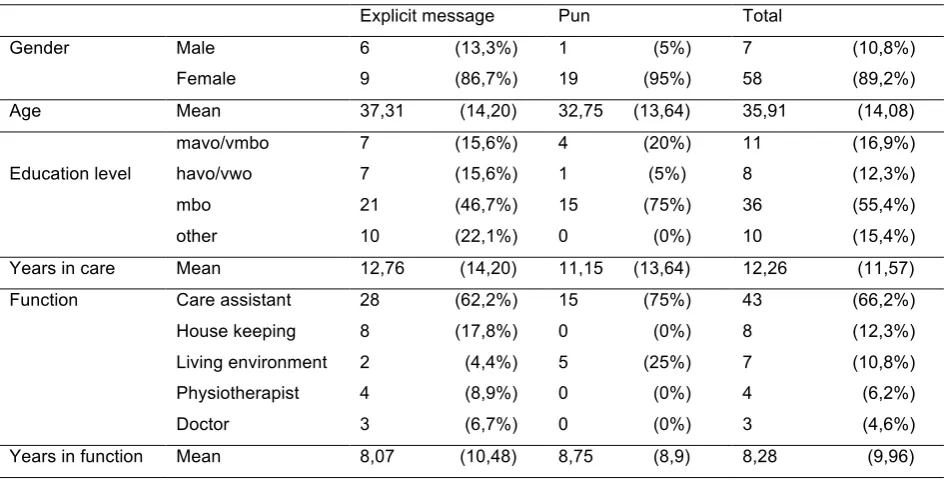
significant differences between the average ages of both groups (t(df63) = 1,21, p = .23) Based on age, this means that the respondents are evenly distributed over both groups.
Furthermore, table 3.1.2 shows that the majority of the respondents have completed vocational training (55,4%). This was 46,7% in the nursing home where the poster with the explicit message was hung and in ‘the nursing home where the poster with the pun was exposed it was 75%. Here, the independent sample T-test shows (t (df63)= .90, p = .37). Thus, regarding the educational level, the respondents are evenly distributed over both groups as well.
[image:27.595.66.539.389.630.2]The health care workers have worked an average of 12,26 years in the healthcare sector (SD = 11,57). This was 12,76 (SD = 14,20) for the respondents who were exposed to the poster with the explicit message and 11,15 (SD = 13,64) for the respondents who were exposed to the pun. The number of working years ranged from a few days to 40 years. Of all the respondents, the function of Care Assistant is present the most (66,2%). This was 62,2% in the nursing home with the poster with the explicit message and 75% in the nursing home with the pun. The respondents had been in their function on average 8,28 years in their function (SD = 9,96). An independent sample T-test shows no significant differences between the two groups regarding the average number of years in care (t(df63) = 0,51, p = .61) and regarding the average number of years in function (t(df63) = -0,25, p = 0,80). Based on these data it can be stated that de respondents are evenly divided over both conditions.
Table 3.2.1. Demographics of the respondents per condition
Explicit message Pun Total
Gender Male
Female
6 (13,3%) 1 (5%) 7 (10,8%) 9 (86,7%) 19 (95%) 58 (89,2%) Age Mean 37,31 (14,20) 32,75 (13,64) 35,91 (14,08)
Education level
mavo/vmbo havo/vwo mbo other
7 (15,6%) 4 (20%) 11 (16,9%) 7 (15,6%) 1 (5%) 8 (12,3%) 21 (46,7%) 15 (75%) 36 (55,4%) 10 (22,1%) 0 (0%) 10 (15,4%) Years in care Mean 12,76 (14,20) 11,15 (13,64) 12,26 (11,57) Function Care assistant
House keeping Living environment Physiotherapist Doctor
28 (62,2%) 15 (75%) 43 (66,2%) 8 (17,8%) 0 (0%) 8 (12,3%) 2 (4,4%) 5 (25%) 7 (10,8%) 4 (8,9%) 0 (0%) 4 (6,2%) 3 (6,7%) 0 (0%) 3 (4,6%) Years in function Mean 8,07 (10,48) 8,75 (8,9) 8,28 (9,96)
3.4 The measurement instrument 3.4.1 Stimuli
research the two posters had the same size and layout. This means they had the same picture, colours and font. The posters used were selected on the basis of the study of Berendsen (2012). The pre-test of that study concluded that the pun ‘versier hem buiten werktijd’ and the explicit message ‘draag geen sieraden tijdens werk’ were best understood. The image with the ‘X’ was seen as the most appropriate fit for the message. Both posters are depicted in Figure 3.1.
Figure 3.1: The used posters for the research
3.4.2 Measurement of planned behaviour Attitude
Attitudes can’t be observed directly, because they are inside people’s heads. Therefore, social scientists have developed explicit and implicit methods of measuring attitudes. Explicit measurements can be made when people know their attitude. An example of an explicit measure is a self-report scale. Implicit measurements can be done when people are not aware of their attitude. They assume that unconscious attitudes can be accessed. This may be done by implicit association tests (Gass & Seiter, 2014). This study measured conscious attitudes by using the Likert Scale.
To measure the attitude of the respondents, the attitude regarding the poster was measured. To do this, nine items on a 7-point Likert scale were used (McQuarrie & Mick, 2006; Burton & Lichtenstein, 1988; Mackert, Lazard, Champlin, Liang, Mabry, Stroever & Watkins, 2014). Examples of items are: (1) foolish (7) nice and (1) useful (7) not useful etc. The items formed a reliable scale (α =
.90).
Attention
Attention to the poster is very important in order to achieve an effect. Seven items on a 5-point Likertscale measure the extent to which the respondents pay attention to the poster (1 = totally disagree, 5 = totally agree) (Based on Chaffee & Schleuder, 1986). All the items formed a reliable scale (α = .82).