University of Warwick institutional repository: http://go.warwick.ac.uk/wrap
A Thesis Submitted for the Degree of PhD at the University of Warwick
http://go.warwick.ac.uk/wrap/61068
This thesis is made available online and is protected by original copyright. Please scroll down to view the document itself.
Object Code Verification
by
Matthew Wahab
Thesis
Submitted to the University of Warwick for the degree of
Doctor of Philosophy
Department of Computer Science
Abstract
Object code is a program of a processor language and can be directly executed on a machine. Program verification constructs a formal proof that a program correctly implements its speci-fication. Verifying object code therefore ensures that the program which is to be executed on a machine is correct. However, the nature of processor languages makes it difficult to specify and reason about object code programs in a formal system of logic. Furthermore, a proof of the correctness of an object code program will often be too large to construct manually because of the size of object code programs. The presence of pointers and computed jumps in object code programs constrains the use of automated tools to simplify object code verification.
This thesis develops an abstract language which is expressive enough to describe any se-quential object code program. The abstract language supports the definition of program logics in which to specify and verify object code programs. This allows the object code programs of any processor language to be verified in a single system of logic. The abstract language is expressive enough that a single command is enough to describe the behaviour of any processor instruction. An object code program can therefore be translated to the abstract language by replacing each instruction with the equivalent command of the abstract language. This ensures that the use of the abstract language does not increase the difficulty of verifying an object code program.
The verification of an object code program can be simplified by constructing an abstraction of the program and showing that the abstraction correctly implements the program specification. Methods for abstracting programs of the abstract language are developed which consider only the text of a program. These methods are based on describing a finite sequence of commands as a single, equivalent, command of the abstract language. This is used to define transformations which abstract a program by replacing groups of program commands with a single command. The abstraction of a program formed in this way can be verified in the same system of logic as the original program. Because the transformations consider only the program text, they are suitable for efficient mechanisation in an automated proof tool. By reducing the number of commands which must be considered, these methods can reduce the manual work needed to verify a program.
The use of an abstract language allows object code programs to be specified and verified in a system of logic while the use of abstraction to simplify programs makes verification practical. As examples, object code programs for two different processors are modelled, abstracted and verified in terms of the abstract language. Features of processor languages and of object code programs which affect verification and abstraction are also summarised.
Acknowledgements
I am grateful to Professor Mathai Joseph for suggesting the topic of this thesis and for his support and encouragement during the course of the work. Professor Joseph’s guidance in the principles and issues surrounding program verification was invaluable and the thesis has bene-fited by his comments on the contents and the text. I am also grateful to Dr. Sara Kalvala for discussions on the contents of the thesis and on the use of automated theorem provers, which help clarify many of the issues involved. Dr Kalvala also read through drafts of the thesis which was greatly improved by her comments.
Declaration
This thesis is the result of work carried out in accordance with the regulations of the Univer-sity of Warwick. This thesis is the result of my own work and no part of it has previously been submitted for any qualification at any university.
Copyright cMatthew Wahab,1998
Contents
1 Introduction 1
1.1 Object Code Verification . . . 3
1.2 Outline of the Thesis . . . 5
2 Verification and Abstraction 10 2.1 Program Verification . . . 11
2.1.1 Program Logics . . . 12
2.1.2 Proof Methods for Program Verification . . . 13
2.2 Processor Languages . . . 16
2.2.1 Object Code Programs . . . 17
2.2.2 Processor Instructions . . . 18
2.2.3 Features of Processor Languages . . . 21
2.3 Modelling Object Code . . . 21
2.3.1 Instructions and Data Operations . . . 22
2.3.2 Program Execution . . . 23
2.3.3 Verification and the LanguageL . . . 25
2.4 Program Refinement and Abstraction . . . 25
2.4.1 Refinement Calculus . . . 26
2.4.2 Compilation . . . 26
2.4.3 Abstraction . . . 27
2.4.4 Abstraction by Program Manipulation . . . 28
2.4.5 Abstraction and the LanguageL . . . 30
2.5 Automated Tools . . . 30
2.5.1 Processor Simulation . . . 31
CONTENTS iv
2.6 Conclusion . . . 32
3 Commands 34 3.1 Expressions ofL . . . 35
3.1.1 Basic Model . . . 37
3.1.2 Syntax of the Expressions . . . 42
3.1.3 Semantics of the Expressions . . . 43
3.1.4 Equivalence Between Expressions . . . 47
3.1.5 Substitution . . . 48
3.1.6 Assignment Lists . . . 51
3.1.7 State Update . . . 54
3.1.8 Substitution Expressions . . . 54
3.2 Commands ofL . . . 59
3.2.1 Syntax of the Commands . . . 59
3.2.2 Correct Assignment Lists . . . 62
3.2.3 Semantics of the Commands . . . 64
3.3 Abstraction of Commands . . . 67
3.3.1 Sequential Composition . . . 68
3.3.2 Properties of Composition . . . 70
3.3.3 Applying Sequential Composition . . . 72
3.4 Proof Rules for Commands . . . 74
3.4.1 Example . . . 76
3.5 Conclusion . . . 79
4 Programs 82 4.1 Programs ofL . . . 83
4.1.1 Semantics of Programs . . . 85
4.1.2 Transition Relation: leads-to . . . 88
4.1.3 Refinement of Programs . . . 89
4.1.4 Simple Program Abstraction . . . 92
4.2 Program Transformation . . . 92
CONTENTS v
4.2.2 Regions of a Program . . . 99
4.2.3 Semantics of Regions . . . 105
4.2.4 Transition Relation: Traces . . . 108
4.3 Program Abstraction . . . 112
4.3.1 Abstracting from Regions . . . 112
4.3.2 Path Transformation of a Region . . . 113
4.3.3 General Transformation of a Region . . . 116
4.4 Proof Rules for Programs . . . 121
4.4.1 Verifying Programs . . . 123
4.5 Conclusion . . . 126
5 Examples: Processor Languages 129 5.1 General Data Model . . . 130
5.1.1 Data Operations . . . 131
5.1.2 Memory Operations . . . 133
5.1.3 Example: Division of Natural Numbers . . . 134
5.2 The Motorola 68000 Architecture . . . 141
5.2.1 Instructions . . . 141
5.2.2 Operations . . . 143
5.2.3 Example: Summation . . . 146
5.2.4 Example: Division . . . 153
5.3 The PowerPC Architecture . . . 157
5.3.1 Registers . . . 157
5.3.2 Instructions . . . 158
5.3.3 Example: String Length . . . 161
5.3.4 Example: Division . . . 166
5.4 Other Features of Processor Languages . . . 170
5.4.1 Multiple Data Move Instructions . . . 170
5.4.2 Organisation of Registers . . . 172
5.4.3 Delayed Instructions . . . 173
CONTENTS vi
6 Examples: Proof Methods for Object Code 178
6.1 Features of Object Code Programs . . . 179
6.1.1 Processor Architecture . . . 179
6.1.2 Loops in Programs . . . 180
6.1.3 Sub-Routines . . . 182
6.1.4 Summary . . . 183
6.2 Verification by Data Refinement . . . 184
6.2.1 Data Refinement . . . 184
6.2.2 Application of Data Refinement . . . 186
6.2.3 Example: Division . . . 187
6.2.4 Related Work . . . 190
6.3 Structured Proofs . . . 191
6.3.1 Weakest Precondition of Regions . . . 191
6.3.2 Properties of the Weakest Precondition . . . 193
6.3.3 Example: String Copy . . . 195
6.3.4 Verifying Regions of a Program . . . 198
6.4 Conclusion . . . 199
7 Verification of the Theory 201 7.1 The PVS System . . . 202
7.1.1 The PVS Specification Language . . . 202
7.2 Development of the Theory . . . 203
7.2.1 Mechanical and Mathematical Proofs . . . 204
7.3 Verifying the Theory in PVS . . . 205
7.3.1 Specification of the Theory in PVS . . . 205
7.4 Implementing the Theory . . . 208
7.5 Conclusion . . . 209
8 Conclusion 211 8.1 Contribution of the Thesis . . . 212
8.2 Application . . . 215
CONTENTS vii
8.4 Verifying Safety Properties . . . 217
8.5 Extending the Work . . . 217
8.6 Summary of Results . . . 219
A Functions 227 A.1 Bit-Vector Functions . . . 227
A.1.1 Bit-Vector Operations . . . 228
A.1.2 Arithmetic Operations . . . 228
A.1.3 Shift and Rotate Operations . . . 230
A.1.4 Memory Access . . . 232
B Processor Language Features 233 B.1 Motorola 68000: Condition Codes . . . 233
B.1.1 Condition Code Calculation . . . 235
B.1.2 Addressing Modes of the M68000 . . . 236
C Proofs: Commands 240 C.1 Expressions . . . 240
C.1.1 Lemma (3.1) . . . 240
C.2 Substitution . . . 241
C.2.1 Lemma (3.2) . . . 241
C.2.2 Theorem (3.1) . . . 242
C.2.3 Correct Assignment Lists . . . 246
C.2.4 Theorem (3.2) . . . 248
C.3 Composition . . . 249
C.3.1 Composition and Assignment . . . 249
C.3.2 Theorem (3.3) . . . 252
C.3.3 Theorem (3.4) . . . 252
C.3.4 Theorem (3.5) . . . 252
C.3.5 Theorem (3.6) . . . 253
C.3.6 Theorem (3.7) . . . 253
C.3.7 Theorem (3.8) . . . 254
CONTENTS viii
D Proofs: Programs 256
D.1 Program Syntax and Semantics . . . 256
D.1.1 Rules of Construction for Programs . . . 256
D.1.2 Theorem (4.1): Program Induction . . . 257
D.1.3 Lemma (D.2) and Lemma (4.1) . . . 258
D.2 Additional Induction Schemes . . . 258
D.3 Transition Relations . . . 259
D.3.1 Theorem 4.2 . . . 259
D.3.2 Traces . . . 259
D.3.3 Lemma (4.3) . . . 261
D.4 Refinement . . . 263
D.4.1 Theorem (4.5) . . . 263
D.5 Control Flow Properties . . . 264
D.5.1 Theorem (4.6) . . . 264
D.5.2 Theorem (4.8) . . . 265
D.6 Paths . . . 266
D.7 Loops and mtrace . . . 268
D.8 Regions . . . 270
D.8.1 Corollary (4.5) . . . 271
D.9 Composition Over a Set . . . 271
D.10 Path Transformation . . . 275
D.10.1 Theorem (4.13) . . . 280
D.10.2 Theorem (4.14) . . . 281
D.11 General Transformation . . . 285
D.11.1 Loops . . . 287
D.11.2 Theorem (4.16) . . . 288
D.11.3 Theorem (4.17) . . . 289
D.11.4 Theorem (4.18) . . . 294
D.11.5 Theorem (4.19) . . . 296
D.11.6 Theorem (4.20) . . . 300
CONTENTS ix
E.1 Theorem (6.3) . . . 301
E.2 Theorem (6.4) . . . 302
List of Figures
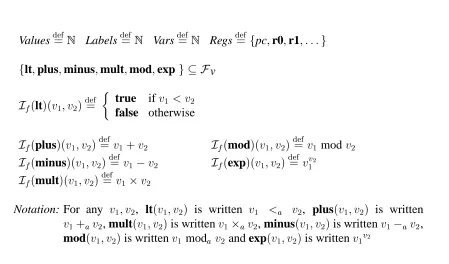
3.1 Basic Model for Data Operations . . . 41
3.2 Example of Expressions Modelling Data Operations . . . 46
3.3 Rules for the Substitution Operator . . . 58
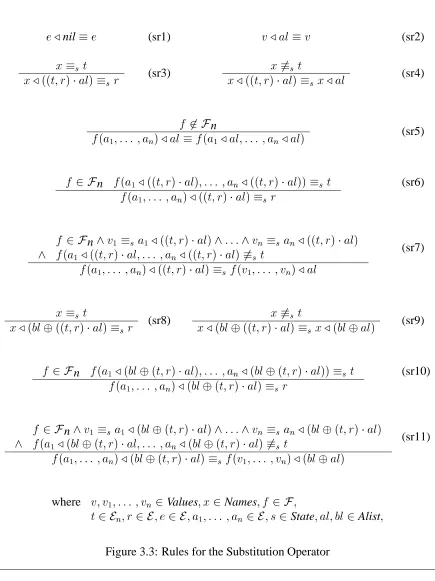
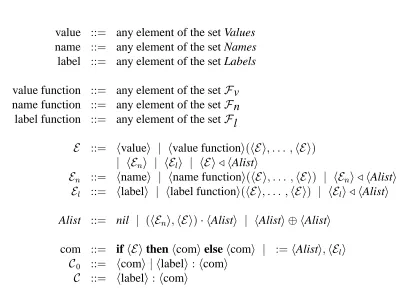
3.4 Summary of Syntax for Expressions and Commands ofL . . . 61
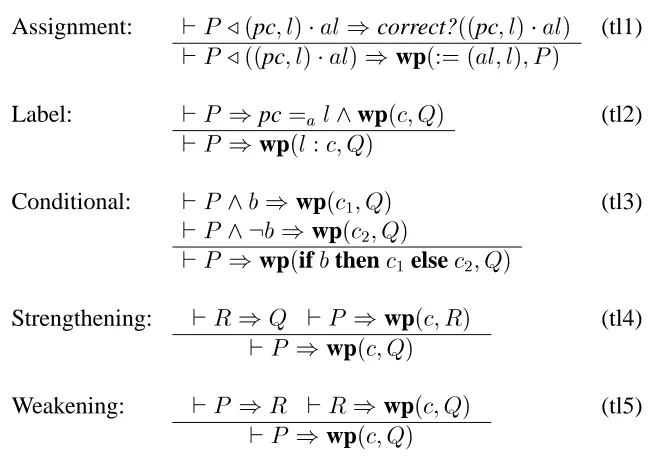
3.5 Proof Rules for Commands ofL . . . 77
4.1 Reducible Loops . . . 94
4.2 An Irreducible Loop . . . 94
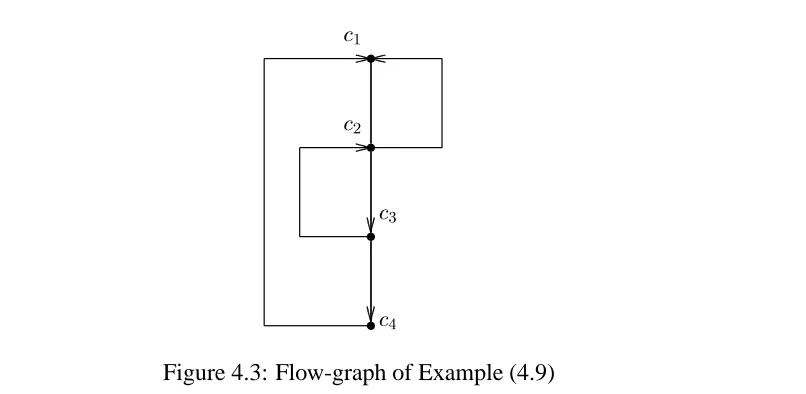
4.3 Flow-graph of Example (4.9) . . . 98
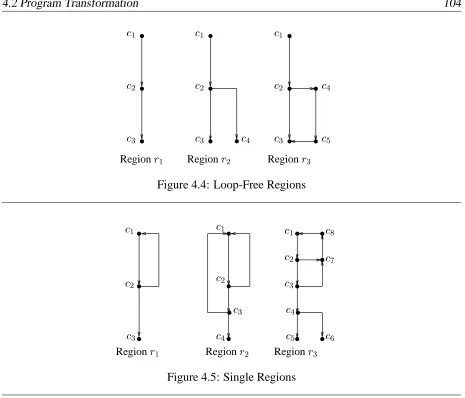
4.4 Loop-Free Regions . . . 104
4.5 Single Regions . . . 104
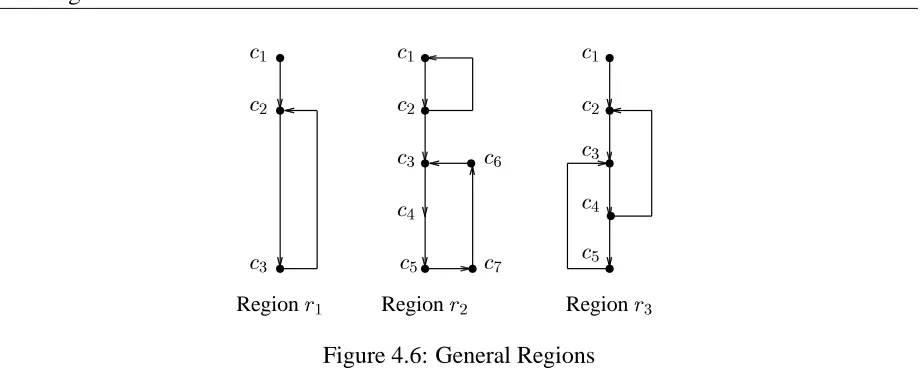
4.6 General Regions . . . 105
4.7 Proof Rules for the Programs . . . 122
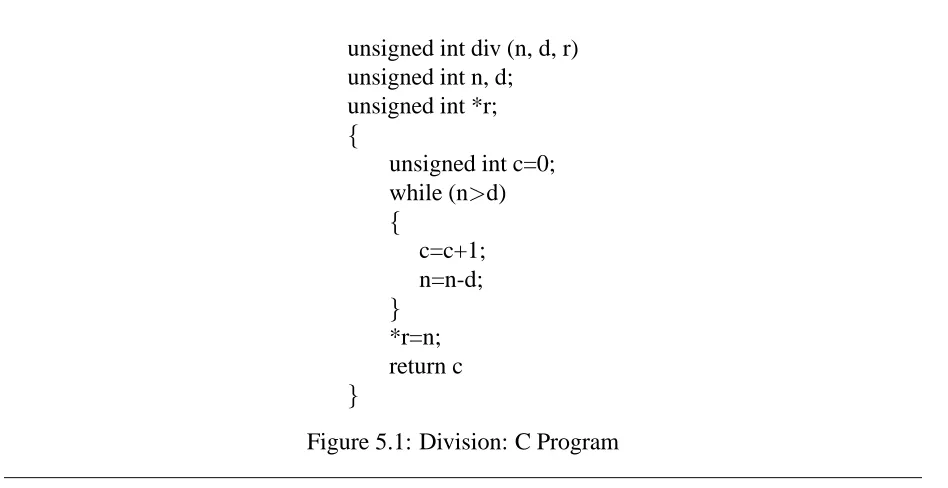
5.1 Division: C Program . . . 134
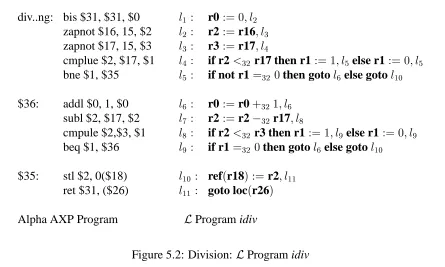
5.2 Division:LProgram idiv . . . 135
5.3 Commands of Abstraction idiv2 . . . 138
5.4 Addressing Modes . . . 142
5.5 Summation: C Program . . . 146
5.6 Summation: M68000 Program . . . 147
5.7 Summation:LProgram sum . . . 148
5.8 Commands of Abstraction sum1 . . . 150
5.9 Division: M68000 . . . 153
5.10 Commands of Abstraction m68div2 . . . 155
5.11 Strlength: C Program . . . 160
LIST OF FIGURES xi
5.12 Strlength: Optimised PowerPC Program . . . 162
5.13 Strlength:LProgram len . . . 163
5.14 Commands of Abstraction len2 . . . 164
5.15 Division: PowerPC . . . 167
5.16 Commands of Abstraction ppcdiv2 . . . 168
6.1 Proof Rules for the Regions . . . 194
6.2 String Copy . . . 195
Glossary of Symbols and Keywords
Expressions
Values Basic values . . . 37
Labels Basic labels . . . 37
Vars Basic variables . . . 37
Regs Register identifiers . . . 37
Names Set of all variable names . . . 37
name Name constructor . . . 37
pc Program counter ofL . . . 37
B Interpretation of values as Booleans . . . 37
true, false Boolean values ofL. . . 37
State The type of states . . . 38
undef Undefined elements . . . 38
F Function identifiers . . . 39
If Interpretation of function identifiers . . . 39
arity Arity of a function identifier . . . 39
Fv Value functions . . . 39
F l Label functions . . . 39
Fn Name functions . . . 39
equal Equality operator ofL. . . 39
E Value expressions . . . 42
El Label expressions . . . 42
En Name expressions . . . 42
Eb Boolean expressions ofL. . . 42
Ie Interpretation of an expression as a value . . . 43
Il Interpretation of a label expression as a label . . . 43
In Interpretation of a name expression as a name . . . 43
Ib Interpretation of an expression as a Boolean . . . 43
(I;s) Equivalence in state
s
under interpretationI. . . 47s Equivalence in state
s
under assumed interpretation . . . 47Glossary of Symbols and Keywords xiii
I
Strong equivalence under interpretationI . . . 47
Strong equivalence under assumed interpretation . . . 47
Alist Assignment lists . . . 51
nil Empty assignment list . . . 51
cons((
x;e
);al
) Assignment list constructor . . . 51(
x;e
)al
Abbreviation of cons((x;e
);al
). . . 51combine(
al;bl
) Combination of assignment lists . . . 51al
bl
Abbreviation of combine(al;bl
). . . 51combine? Recogniser for combined assignment lists . . . 51
simple? Recogniser for simple assignment lists . . . 52
Slist Simple assignment lists . . . 52
initial Prefix of an assignment list . . . 52
x
2sal
Membership of assignment list in states
. . . 53find Expression associated with name in an assignment list . . . 53
occs?, Assoc Names and values in assignment list . . . 62
correct? Correct assignment lists . . . 62
update(
s;al
) Update states
with assignment listal
. . . 54subst Substitution expression . . . 54
e / al
Substitution ofal
in value, label or name expressione
. . . 54, 55bl / al
Substitution ofal
in assignment listbl
. . . 56Commands C 0 Set of all commands . . . 59
if then else Conditional command . . . 59
:=(
al;l
) Assignment command . . . 59l
:c
Labelled command . . . 59label(
c
) Label of commandc
. . . 59regular? Regular commands . . . 60
C Commands of the languageL. . . 60
Ic(
c
)(s;t
) Interpretation of commandc
in statess;t
. . . 64goto, abort Derived commands . . . 65
enabled Selection of command in a state . . . 66
halt? Failure of command . . . 66
; Sequential composition . . . 68
of labelled and conditional commands . . . 69
of assignment commands . . . 69
Glossary of Symbols and Keywords xiv
P Programs ofL. . . 83
at Access a command of a program . . . 83
p
+c
Addition of commandc
to programp
. . . 84p
1 ]p
s Combination of programsp
1andp
2. . . 84Behaviour The type of program behaviours . . . 86
Ip(
p
)() Interpretation of programp
in behaviour. . . 86halt? Failure of a program in a state . . . 87
final? Final states of a program . . . 87
s
;ct
For commandc
, abbreviation ofIc(c
)(s;t
). . . 88s
;pt
States
leads to statet
through programp
. . . 88c
1 7 !c
2 Commandc
1 directly reaches commandc
2 . . . 95c
1 p 7 !c
2 Commandc
1 reaches commandc
2 throughp
. . . 97path?(
p;c
1c
2 ) There is a path fromc
1toc
2 throughp
. . . 266loopfree?(
p
) Programp
contains no loops . . . 103trace Trace through a program . . . 109
tset Trace set of a program . . . 109
mtrace Maximal trace through a program . . . 110
rmtrace Restricted maximal trace through a program . . . 110
p
1 vp
2 Refinement between programsp
1andp
2 . . . 90p
1 I;alp
2 Programp
2 data refines programp
1. . . 185Regions region? Defining predicate for regions . . . 99
R Set of all regions . . . 99
region Region constructor . . . 100
unit Unit region constructor . . . 100
unit? Unit region recogniser . . . 100
label(
r
) Label of regionr
. . . 101body(
r
) Body of regionr
. . . 101head(
r
) Head of regionr
. . . 101c
2r
Membership of a region . . . 101r
1r
2,r
1r
2 Subset relations between regions . . . 101r
1< r
2r
1 is a maximal sub-region ofr
2. . . 192s
;rt
States
leads to statet
through regionr
. . . 101c
1 r 7 !c
2 Commandc
1 reachesc
2 through regionr
. . . 101rest(
r
) Sub-regions of regionr
. . . 102loopfree?(
r
) Regionr
contains no loops . . . 103Glossary of Symbols and Keywords xv
enabled(
r
)(s
) Regionr
is enabled in states
. . . 105final?(
r
)(s
) States
is final for regionr
. . . 105halt?(
r
)(s
) Regionr
fails in states
. . . 105Ir(
r
)(s;t
) Interpretation of regionr
in statess;t
. . . 106r
1 vr
2 Refinement between regionsr
1;r
2. . . 107c
;A
Generalised composition of commandc
with setA
. . . 113T
1 Path transformation of regions . . . 114lphead? Commands beginning a loop . . . 116
lpheads Set of commands beginning a loop . . . 116
cuts Cut-points of a region . . . 116
lpbody Body of a loop . . . 117
loops Sub-regions beginning with a cut-point . . . 117
gtbody Abstractions of paths in a region . . . 118
T
2 General transformation of regions . . . 118Assertion Language A Set of all assertions . . . 74
:,^,_,) In general logical operators, also defined forA. . . 74
8(
v
:F
(v
)) Universal quantification inA. . . 74P / al
Substitution in assertion ofA . . . 74W
A
Generalised disjunction over set of assertionsA
. . . 192`
P
Validity of assertionP
. . . 74wp(
c;Q
) Weakest precondition of commandc
. . . 75[
P
]p
[Q
] Specification of programp
. . . 122wp 0 (
r;Q
) Weakest precondition of a path in regionr
. . . 192wp1 (
r;Q
) Weakest liberal precondition of regionr
. . . 192wp(
r;Q
) Weakest precondition of regionr
. . . 192Expressions in Examples Values, Vars, Labels Values, variables and labels in examples . . . 41
Regs Set of register identifiers, in general . . . 41
for Motorola 68000 processor . . . 141
for PowerPC processor . . . 157
ref General name function . . . 40
also generic memory access . . . 133
loc General label function . . . 40
not, and, or Negation, conjunction and disjunction of expressions inEb . . . 45
=a Synonym for equality ofL. . . 39
Glossary of Symbols and Keywords xvi
x
y, moda Exponentiation and modulus . . . 41Byte, Word, Long Size of byte, word and long-word bit-vectors . . . 130
mkBit Bit constructor . . . 131
bit(
i
)(a
) Biti
of bit-vectora
. . . 131Byte Byte constructor . . . 131
Word, mkWord Word constructors . . . 131
Long, mkLong Long-word constructors . . . 131
mkQuad Quad-word constructor . . . 46
B(
i
)(a
) Bytei
of bit-vectora
. . . 131W(
i
)(a
) Wordi
of bit-vectora
. . . 131ext Sign extension of bit-vectors . . . 132
cond(
b;e
1;e
2 ) Conditional expression with testb
. . . 171Mem Memory access for Alpha AXP . . . 46
Inst Label access for Alpha AXP . . . 46
readl Read long-word . . . 133
writel Write long-word . . . 133
mkSR Constructs value of M68000 status register . . . 143
calcSR Calculates value of M68000 status register . . . 145
calcCRF Calculates value of PowerPC condition register . . . 162
+sz, sz,sz Arithmetic on bit-vectors of size sz . . . 132
=sz,
<
sz,>
sz Comparison relations between bit-vectors of size sz . . . 132+32, 32, 32 Addition, subtraction and multiplication of long-words . . . 132
= 32,
>
32 Equality and greater-than between long-words . . . 132+64, 64, 64 Addition, subtraction and multiplication of quad-words . . . 46
Chapter 1
Introduction
Programs are developed to produce a behaviour from a computer which will meet some re-quirement. A specification is a formal description of the properties required of the computer’s behaviour. A program satisfies its specification, and is correct, if every behaviour which it pro-duces has the properties described by the specification. The correctness problem is to show that a program satisfies its specification. This is often solved by testing the program on a sample of the data it is expected to process. Testing shows that the program is correct for the test cases and increases confidence in the program. It cannot show that a program satisfies its specification since it is always possible that the test data excludes those cases which cause errors.
Verification is a stronger method for establishing the correctness of program which constructs
a mathematical proof that the program satisfies its specification. In verification, both the program and its specification are described in the terms of a logic. The rules of the logic are applied to show that the actions performed by the program produce a behaviour with the properties de-scribed by the specification. The logical description of the program is derived from the program text together with the semantics of the programming language. Since it is a description of the program requirements, the program specification must be produced manually and must be in a form which is suitable for verification. To verify a program therefore requires the program text, a semantics for the language and a method for translating the semantics to the terms of the logic.
Programs are typically written in high-level languages. These languages are often described informally and do not have a formally defined semantics. Informal descriptions can contain inconsistencies or errors and may be incomplete. To verify a high-level program, assumptions must therefore be made about the intended semantics of the high-level language. Because there can be no guarantee that these assumptions are correct, there is no guarantee that verifying the program will prove its correctness. Furthermore, a program of a high-level language cannot be directly executed on a computer but must be translated to an executable form, called object code, by a compiler. If a high-level program is to be verified then it is also necessary to verify the compiler since an error during the translation will lead to the execution of incorrect object code.
Object code is a program of a processor language and the semantics of these languages are suitable for use in a proof of correctness. Since object code can be executed on a machine,
Introduction 2
verifying the object code also ensures that the executed program is correct. However, the nature of processor languages means that it is difficult to describe, in the terms of a logic, the actions performed by object code. The size of object code programs also makes acute a general problem in program verification. Because the effect of each command in a program must be considered during program verification, the size of a correctness proof is proportional to the number of commands in the program. A processor language contains a large number of highly specialised commands (called instructions) which carry out relatively simple actions. These result in object code programs which are much larger than the equivalent high-level programs. Verifying even a simple program can require a large amount of work and the proof needed to verify a typical object code program is too large to be carried out manually.
Automated proof tools can assist in program verification by carrying out the basic inference and simplification steps which occur in any proof. Such tools apply the rules of the logic to the text of logical formulas. This allows quick and efficient reasoning about the properties estab-lished by an individual program command. However, an automated tool is less able to assist when considering the properties established by a group of commands. This requires inferences be drawn from the properties of the individual commands about the interaction between the commands in the group. Theorem proving techniques have been used to construct proof tools for verifying object code programs. However, these tools often require manual intervention to direct the course of the proof and this is made difficult by the methods used to reason about programs. The machine resources needed to use these tools also impose severe limits on the size of the program which can be verified.
Proof tools developed for object code verification are also limited to the programs of a single processor. A proof tool will have a model of a processor language, which is used to derive the properties of the language needed to verify a program. This model and its properties will be specialised to a single processor, because the instructions of each processor are unique to that processor language. To verify the object code of a different processor, it would be necessary to repeat the work carried out to construct the model and derive its properties. Because a processor can have several hundred instructions, this will be a time-consuming task effectively restricting the proof tool to the object code of a single processor only.
1.1 Object Code Verification 3
1.1
Object Code Verification
This thesis describes a method for the verification of object code programs which allows the proof of correctness to be simplified by manipulating the text of a program. By only considering the text of a program, the method supports the use of automated proof tools during program verification. The method is independent of any processor language and provides a means for applying the same tools and techniques to different processor languages.
The object code programs which will be considered are sequential programs which do not modify themselves. The verification of a program is assumed to be carried out in program logics, logical systems such as those of Hoare (1969) and Dijkstra (1976), in which proof rules are applied to the text of a program. The specification of a program is assumed to describe its
liveness properties, which state that execution of the program will eventually establish some
property (Manna & Pnueli, 1991). It is also assumed that automated tools are available to assist in verifying a program. However, the method described in this thesis is independent of any particular proof tool. Where assumptions are made about the abilities of an automated tool, they can be satisfied by techniques which are well enough established to be considered standard.
To increase confidence in the correctness of the methods for object code verification devel-oped in this thesis, the theory described in this thesis has been verified using the PVS theorem prover (Owre et al., 1993). Note, however, that the PVS theorem prover has not been used to implement a proof tool for program verification. The techniques needed to verify the theory are markedly different from those required to efficiently verify a program and the work with PVS cannot easily be used for program verification. The work with PVS is only intended to verify the theory which would be implemented by a proof tool for program verification.
Approach
The approach to object code verification followed in this thesis is to develop an abstract language, denotedL, in which to describe the object code of arbitrary processors. The languageLsupports the definition of proof rules for program logics in which to verify programs of L. An object code program is verified by translating the object code to a program of L then showing that theLprogram is correct. The languageL is expressive enough that a processor instruction can be described by a single L command. The translation from object code to a program of L is therefore a simple replacement of each instruction of the object code program with its equivalent command of L. The language Lis independent of any processor language, allowing tools and techniques to be developed for the verification of object code independently of the processor language in which the object code is written.
The abstract languageLprovides the means for verifying object code programs but verifying object code as a program of L does not, in itself, simplify the proof of correctness. Because there is a command in the L program for every instruction of the object code, the number of commands which must be considered during the proof will not be reduced. The approach used to simplify the verification of a program
p
is based on constructing an abstractionp
01.1 Object Code Verification 4
program. The abstraction
p
0is a program ofLwhich is correct only if the original program
p
is correct. The abstraction will, normally, be constructed to be simpler to verify than the programp
, with a single command of the abstractionp
0describing the behaviour of a group of commands in program
p
. Because the abstraction is a program ofL, the program logics and proof methods of proof applied to verify programs are equally applicable to the abstractions of programs. This allows the verification of a program to be carried out in a uniform environment, regardless of whether the program is the original or an abstraction of the original.The abstractions of a program are constructed by applying transformations to the text of the program. Because only the program text is used to abstract from a program, the program transfor-mations are suitable for efficient mechanisation. To use program transfortransfor-mations in verification they must be shown to be correct: the transformations must preserve the correctness of the pro-gram. The transformations described in this thesis will be shown to be correct, the correctness of a program is preserved by the transformation constructing its abstraction. In particular, the ab-straction of an incorrect program will also be incorrect. It will therefore be impossible to verify an incorrect program by abstracting from the program. This ensures that it is safe to apply the transformations during program verification.
The use of the abstract languageLto describe object code programs and the use of program transformations to simplify the proof of correctness will allow an object code program to verified through the following steps:
1. The object code program is translated into the languageL, to obtain a program
p
. 2. The program specification is described in terms of a program logic for the languageL. 3. An abstractionp
0of program
p
is constructed from the program text, possibly with the use of an automated proof tool.4. The rules of the program logic are applied to show that the abstraction
p
0establishes one or more properties required by the specification.
5. Steps 3 and 4 are repeated as necessary until it is shown that all properties required by the specification are established by the program.
With the exception of steps 1 and 3, this is the usual approach to program verification. The methods needed to carry out steps 1 and 3 are the principal contribution of this thesis. Step 1 exploits the ability to describe and verify an object code program of any processor as a program of L. This allows a set of tools and techniques developed for verifying programs of L to be applied to the object code of a wide range of processors. Step 3 allows the verification of theL program to be simplified by using automated tools to abstract from the program. This approach to verifying a program is independent of the proof method used to prove properties of the program. Although the method of intermittent assertions (Manna, 1974; Burstall, 1974) will be used here, other proof methods can also be applied.
1.2 Outline of the Thesis 5
intended to support the definition of proof rules and do not require the use of a particular program logic or method of proof. This provides flexibility in the choice of logics and methods used to verify a program. Furthermore, a program logic defined for the abstract language L will be a generic logic for reasoning about the object code of different processors. The use of an abstract language to model object code allows the use of abstraction to simplify the task of verifying program. The languageLwill therefore make the verification of object code both possible and practical. Any difficulty which occurs during a proof will be because the program is difficult to verify and not because it is an object code program.
1.2
Outline of the Thesis
After a section describing the mathematical Notation used, the thesis begins with the back-ground of program verification and abstraction in Chapter 2. This describes the techniques used to reason about programs, including the standard program logics and proof methods. Processor languages will be described with a summary of the problems which make object code difficult to verify and the solutions which have been considered. The basis for reasoning about the rela-tionship between a program and its abstraction will be summarised as will the approach used to show that a program transformation correctly constructs an abstraction. Alternative methods for verifying object code will also be considered as will alternatives to object code verification.
Commands of the language L are used to model the instructions of a processor language. The commands and expressions of the languageLare described in Chapter 3. The syntax and the semantics of both the expressions and the commands are described in detail. The syntax of expressions and commands is used to define a transformation which abstracts from commands of
Land which results in a command ofL. This transformation forms the basis for transformations which abstract from programs. Its correctness is justified from the semantics of the expressions and commands. The chapter ends with an example of proof rules for reasoning about the com-mands ofL.
Programs of L are used to describe object code in a form suitable for verification. The programs of L and methods for their abstraction are the subject of Chapter 4. The semantics of the programs are used to justify methods of reasoning about program execution. These, in turn, allow comparisons to be made between programs and their abstractions. Two methods for constructing an abstraction are described: the first is based on the abstraction of manually chosen commands of a program. The second method is intended for use in an automated tool and assumes the commands are chosen mechanically. Both methods define transformations on a program which are shown to preserve the correctness of the program. The chapter ends with an example of a program logic which is used to verify a simple program ofL.
1.2 Outline of the Thesis 6
of the languageL. If this is possible then the ability to manipulate and verify object code of the processors follows. The Motorola 68000 and PowerPC do not present any great difficulty and simple programs for each processor are modelled in the language L and shown to be correct. However, processor languages can have features which make the abstraction of object programs difficult. Some of these features and their effect on the methods used to model and verify object code are described.
The use of an abstract language permits proof methods, defined for the abstract language, to be applied to the object code of different processors. The abstract languageLalso allows the use of standard methods for reasoning about programs to be applied to object code programs. Pro-gram verification has been extensively studied and there are many such techniques. Chapter 6 describes two proof methods which can be applied to programs of L. The first is an example of a method which can make transferring a proof of correctness between the object code of dif-ferent processors simpler. The second is an example of the definition of a proof method for the languageLwhich can be applied to arbitrary object code programs.
The theory described in Chapter 3 and Chapter 4 has been verified using the PVS theorem prover (Owre et al., 1993). The theory underlying the proof methods described in Chapter 6 has also been verified with PVS. The theory defined for verification by the theorem prover closely follows that described in Chapters 3, 4 and 6. The major differences are in the additional defini-tions and lemmas required to prove the theory in PVS and in the definidefini-tions of the expressions ofL. Chapter 7 describes the role played by the PVS theorem prover in the development of the theory. The differences between the theory defined in Chapters 3, 4 and 6 and the theory as it is defined in the PVS specification language will also be described. The proofs for Chapter 3 and Chapter 4 are given in Appendix C and Appendix D respectively; the proofs for Chapter 6 are given in Appendix E. The theory described in this thesis is intended to allow the implementa-tion of a proof tool for program verificaimplementa-tion. The techniques and methods needed for such an implementation will be briefly discussed.
Notation 7
Notation
Types: The basic types are the booleans, the integers and the non-negative integers. The type of
boolean values is denoted boolean and the integers are denotedZ. The non-negative integers are called the natural numbers, or simply the naturals, and denotedN. The type of functions from
T
toS
is writtenT
!S
and !associates to the right. Functions from a typeT
to the booleans are called predicates onT
. The cross-product of typesT
andS
is writtenT
S
. That a variable or constantx
has typeT
will be denoted(x
:T
). Where the type of a variable is obvious from the context it will sometimes be omitted.Types are defined and the definition of a type
T
may be parameterised with a typeS
: the application ofT
toS
is writtenT
(S
)and is a type. WhereS
can be an arbitrary type it may be omitted:T
is written forT
(S
)whenS
may be any type. In general, types will only be given in the mathematical definitions and formulas and may be omitted from the text.Functions: Functions are generally named in lower-case and predicates are generally named
with a question mark. For example, eg names a function and eg? names a predicate. Func-tions may be defined recursively and such a definition is either by primitive recursion or can be transformed to primitive recursion (Kleene, 1952).
Operators are functions whose first argument is a cross product of types. The operator may
be identified symbolically and its type may be given with underline characters indicating the placement of arguments. For example, the type of the addition operator on the integers is written
+ :(ZZ)!Z.
Logical operators: The boolean values true and false are written true and false respectively.
The conjunction, disjunction, implication and logical equivalence operators are written^,_,) and,respectively. The universal and existential quantifiers are8and9respectively. Equality is written=and a defining equality is written
def = . The presentation of a formula having the form
A
1^
:::
^A
n )C
may be given asA
1
A
nC
Free variables in the formula are universally quantified.
Basic operators: The operator
applied to a variablex
of typeT
and expressione
of typeS
is writtenx
:e
and forms a function of typeT
!S
. Nested lambda expressions are abbreviated,x
1;x
2;:::x
n:
e
Textual substitution replaces variables
x
1;::: ;x
n with expressionse
1;::: ;e
n in expressionf
(where the variables occur free) and is writtenf
[e
1
;::: ;e
n=x
1;::: ;x
n ].The arithmetic operators addition, subtraction, multiplication, division and remainder ap-plied to integers
x
andy
are writtenx
+y
,x y
,x
y
,x
y
andx
mody
respectively. The remainder, mod, satisfies((x
y
)y
)+(x
mody
)=x
.A sequence of a type
T
is a total function from the naturals toT
, seq(T
) defNotation 8
The suffix of a sequence
beginning at then
th element, written n, is the sequence defined ndef=
(m
:N) :(n
+m
).Sets: In a set
a
having type Set(T
), every member ofa
has typeT
anda
is said to be a setof type
T
. Sets may be defined by comprehension, written fx
:T
jf
g wherex
is a variable of typeT
, andf
is a boolean formula in whichx
may occur. The empty set is writtenfg anda
is a singleton set if there is an elementx
such thata
= fx
g.The membership operator is written 2, the union, intersection, subset and proper subset operators are written[, \, and respectively. The difference between setsa
andb
of typeT
is writtena b
and defineda b
def=f
x
:T
jx
2a
^:x
2b
g. The power-set of a seta
of typeT
is writtenPa
, has typeSet(Set(
T
))and definitionPa
def= f
b
:Set(T
)jb
a
g.The image of a function
f
with type(S
!T
)on a seta
with type Set(S
)is a set with typeSet(
T
)and definition:f
(a
) def= f
x
:T
j9(y
:S
):y
2a
^x
=f
(y
)gSets and types are equivalent: a set
a
of typeT
is the subtype ofT
containing only those elements ofT
which are also ina
. A typeT
is the set containing all elements of typeT
. Sets and predicates are also equivalent: the seta
of typeSet
(T
)is the predicate (x
:T
) :x
2a
. The predicatep
on typeT
is the setfx
:T
jp
(x
)g.The Hilbert epsilon operator is written
and its application to a seta
is writtena
. Whena
has type Set(T
), the result ofa
has typeT
. Whena
is not empty, the resulta
is a arbitrary member ofa
,(a
)2a
. Whena
is empty anda
has the type Set(T
), the result ofa
is an arbitrary constant of typeT
.Finite Sets: The finite sets of type
T
have type FiniteSet(T
). The empty set is finite and ifa
is finite then so isfx
g[a
. Any subset of a finite set is also finite as is the power-set of a finite set. If setsa
andb
are finite sets of typeT
andS
respectively, the cross-product ofa
andb
, definedf(x;y
): (T
S
)jx
2a
^y
2b
g, is also finite (Levy, 1979). For finite seta
,ja
jis the cardinality ofa
satisfyingjfgj=0andja
[fx
gj=1+ja
jforx
62a
.Two induction schemes are assumed on finite sets. Letbe a predicate on finite sets (with type FiniteSet(
T
)!boolean for someT
).(Finite induction)
(fg) 8
b
:(b
))(8x
:x
62b
)(b
[fx
g)) 8a
:(a
)(Strong finite induction)
8
b
:(8c
:c
b
)(c
)))(b
) 8a
:(a
)Notation 9
Inductive definitions: The presentation of the theory makes use of inductive definitions of
predicates and types. The basis of the inductive definitions is described by Paulson (1994b, 1995b) and by Camilleri & Melham (1992). The inductive definition of a predicate has the usual form. For example, the transitive closure of a relation
R
, writtenR
+, is defined by induction. If
R
is a predicate on type(X
Y
)thenR
+
is defined as the base and inductive cases.
(Base case)
R
(x;y
)R
+(
x;y
)(Inductive case)
R
+(
x;y
)R
+(
y;z
)R
+(
x;z
) The reflexive transitive closure of a relationR
is writtenR
and defined
R
(x;y
)def
=
x
=y
_R
+(
x;y
).Inductively Defined Types: The inductive definition of types is for the purposes of the
presentation and is intended to be equivalent to a definition in Backus-Naur form.
The inductive definition of a type is on a set of constructor functions and a basis set. The constructors are not defined but are assumed to be such that the definition is free (see Loeckx & Sieber, 1987). In particular, it is assumed that induction and recursion on the structure of elements is possible. For example, the type of lists is written list(
T
), for some typeT
. The definition is from the basis setB
=fnilgand constructor function cons of type(T
list(T
))!list(
T
). The type list(T
)is defined inductively.nil2list(
T
)x
2T y
2list(T
)cons(
x;y
)2list(T
)For an inductively defined type
T
, a partial orderis assumed between the elements of the type. Ifx;y
have typeT
thenx
y
states thatx
forms part of the structure ofy
andx
is said to be a sub-term ofy
. For example, the relationon the lists, list(T
), can be defined by recursion.x
nil def=
x
=nilx
cons(y;l
)def
=
x
=cons(y;l
)_x
l
Graphs: A graph is a pair (
V;R
) whereV
is a set of typeT
andR
is a relation, of type (V
V
)!boolean. Forx;y
2V
,x
reachesy
through the graph iff the transitive closure ofR
is true forx
andy
,R
+(
x;y
). A path through the graph fromx
toy
is a sequencev
1
;v
2;::: ;v
n such thatR
(x;v
1
;
),
R
(v
n;y
)and, for 1j < n
,R
(v
j;v
j +1) are true and
v
i =v
j iffi
=j
, where1i;j
n
andv
i;v
j 2V
fx;y
g. If the sequence is empty,n
= 0, then the path is made up ofx
andy
,R
(x;y
). There is a path fromx
toy
iffx
reachesy
. There is a cycle in a graph, called a loop in the setV
, iff there is ax
2V
such thatR
Chapter 2
Verification and Abstraction
The method for object code verification described in this thesis is based on the use of the abstract languageL. This has two functions: the first, as a description language in which the programs of different processors can be modelled and verified. The second, as a standard form in which to transform and abstract programs. For both purposes, only the syntax of the language is used. For verification, the syntax of the abstract languageL must therefore support both the descrip-tion of object code and the definidescrip-tion of program logics in which to verify L programs. For abstraction, the syntax ofLmust support the manipulation of the commands and programs ofL. The semantics of the languageL are used to justify the rules of program logics and the correct-ness of program transformations. This ensures that the methods used to verify and abstract from programs are sound and therefore it is not possible to verify an incorrect program.
The requirements of the abstract languageLare those of the methods used to model, verify and abstract programs. The particular areas of interest are:
The principles underlying program verification: modelling and specifying program be-haviour and the proof methods for program verification.
Processor languages: the execution and data models of processors and the features which complicate the verification of object code programs.
Abstraction of programs: methods for constructing abstractions of programs and the justi-fication for verifying a program by verifying its abstraction.
The use of automated tools in program verification.
A number of methods for showing the correctness of object code programs have been proposed. These include the use of theorem provers to simulate processors and methods for producing correct object code from verified high-level programs. A common factor is the attempt to sim-plify the verification of the program which is to be executed on the machine. Although these methods have a number of drawbacks, some of the underlying techniques are useful for program verification in general and these techniques will also be reviewed.
2.1 Program Verification 11
2.1
Program Verification
Program verification has been extensively studied; its methods are described by Apt (1981), Cousot (1990) and Francez (1992) among others. A mathematical treatment is given by Loeckx & Sieber (1987). The difficulty of verifying a program is determined by the proof methods for verification. These describe how a program is verified and also suggest how the task of verifying programs can be simplified. To verify that a program is correct, the result of executing the program must be shown to establish the properties required by the program specification. This section will summarise the methods used to specify and to verify programs, beginning with the relationship between programs and specifications. The requirements of program logics and the methods for proving correctness will then be described.
Programs and Specifications
A program is made up of commands which evaluate expressions and assign the resulting values to variables. The program is verified by reasoning about the properties of the program variables during the program execution. A program state is an assignment of values to variables and a sequence of states describes the behaviour of the program when it is executed. Each command
begins in a state and produces (or ends) in a state by assigning values to variables. No
(exe-cutable) command can assign more than one value to a variable. Each program begins in an
initial state and if the program terminates then it does so in a final state.
Execution of a program begins with the selection of a command. This is the first command of the program and, when executed, it produces either a final or an intermediate state. If the state is intermediate then the program execution continues, repeatedly selecting and executing commands until a final state is produced. A command can be executed any number of times; there is a loop in the program if one or more commands are repeatedly executed. The semantics of the programming language determine how commands of a program are selected as well as the relationship between the states in which a command begins and ends. The behaviour of a program is described by the initial state and the sequence of states produced during its execution.
2.1 Program Verification 12
2.1.1
Program Logics
Verification is carried out in a program logic in which axioms and proof rules are used to show that commands and programs satisfy a specification. The axioms and proof rules of the program logic specify the semantics of the programming language. A program logic also provides a means for specifying commands and programs as formulas of the logic. A program is verified by using the proof rules to show that the logical formula specifying the program is true. Approaches to defining proof rules for programs vary but the underlying principles are similar to those used for commands. The description here will therefore concentrate on proof rules for commands.
The method used to specify commands and programs determines whether a program logic is used to establish partial correctness or total correctness. Hoare (1969) describes a logic, based on the work of Floyd (1967), for verifying partial correctness. In this, a command
c
is specified by a formula of the formfP
gc
fQ
g. This asserts that ifc
, beginning in a state satisfying preconditionP
, terminates then it produces a state satisfying postconditionQ
. Manna (1974) developed a variant of Hoare’s logic in which total correctness can be verified. Dijkstra (1976) describes a second program logic, the wp calculus, also for verifying total correctness. This extends a stan-dard logical system with a predicate transformer, wp. Applied to a commandc
and postconditionQ
, this calculates the weakest precondition, wp(c;Q
), which must be satisfied for commandc
to terminate and establishQ
. A specification based in the wp calculus has the formP
)wp(c;Q
), whereP
is the precondition andQ
the postcondition for commandc
.Proof Rules of a Program Logic
The axioms and proof rules of a program logic are determined by the semantics of the program-ming language and by the methods used to prove a program correct. The proof rules are defined on the syntax of the programming language; their correctness is justified from the semantics of the language. The semantics of individual commands are, in general, specified as axioms of the logic. Compound commands, formed by combining two or more commands, are specified in terms of proof rules. These describe how the behaviour of the component commands establishes the specification of the compound command.
For most commands of a programming language, the definition of proof rules requires only the standard logical operators (conjunction, negation, etc). For example, consider the conditional command if
b
thenc
1elsec
2, whereb
is a test, commandc
1 the true branch (executed if the test succeeds) and commandc
2the false branch. The conditional command is specified with arbitrary pre- and postconditionsP
andQ
by the proof rule:P
^b
)wp(c
1;Q
)
P
^:b
)wp(c
2;Q
)
P
)wp(ifb
thenc
1else
c
2;Q
)This rule allows the specification of the conditional command, to be established by deriving specifications for the commands
c
1andc
2 (Dijkstra, 1976).Proof rules for commands can also require specialised operators. In particular, assignment
2.1 Program Verification 13
language. Assignment commands are used to make changes to a machine state. The most gen-eral form, a simultaneous assignment command, is written
x
1;::: ;x
n:=
e
1
;::: ;e
n wherex
1;::: ;x
n are variables ande
1;::: ;e
n are expressions. This simultaneously assigns to each variablex
i the result of evaluating expressione
i. The assignment is specified, by its affect on an arbitrary preconditionP
, as the assignment axiom (Dijkstra, 1976):P
[e
1
;::: ;e
n=x
1;::: ;x
n])wp(
x
1
;::: ;x
n :=e
1
;::: ;e
n;P
)This axiom uses textual substitution to model the changes made to precondition
P
by the assign-ment to the variables. An implicit requireassign-ment of the axiom is that the assignassign-ment is executable. An assignment commands is unexecutable if a variable is assigned two distinct values: no state can associate two values with a single variable. To ensure that all assignments are executable, simple languages often exclude as syntactically incorrect assignments in which the same variable occurs twice on the left-hand side:i
6=j
)x
i 6=x
j.In languages which contain pointers or arrays, both the assignment axiom and the syntactic restriction on assignment commands are invalid (Francez, 1992). Pointers are expressions which identify a variable and which can depend on the values of variables; an array can be considered a form of pointer. Pointers give rise to the aliasing problem: it is not possible to determine syntactically whether a pointer identifies a given variable. Consequently, it is not possible to use syntactic comparisons between variables to determine whether an assignment command is executable. Neither is it possible to use textual substitution to define proof rules for assignment commands, since this is also based on syntactic comparisons. Instead, proof rules for assignment commands in the presence of pointers must use specialised substitution operators (Cartwright & Oppen, 1981; Manna & Waldinger, 1981). Unexecutable commands are avoided by restricting assignment commands to a single variable or (equivalently) by interpreting a multiple assignment as a sequence of single assignments (Gries, 1981; Cartwright & Oppen, 1981).
The specification of programs and proof rules for programs depend on the type of program-ming language being considered. A programprogram-ming language is either a structured or a flow-graph
language (Loeckx & Sieber, 1987). A program of a structured language is a compound command
and can be specified as a command (e.g. using Hoare formulas or the wp function). There are a number of approaches to specifying flow-graph programs (Loeckx & Sieber, 1987; Francez, 1992). Common to all is a method for associating pre- and postconditions with the program be-ing specified. All proof rules for programs allow the specification of a program to be established from specifications of the commands (similarly to rules for compound commands). The proof rules for programs also determine the proof methods which can be used to verify a program.
2.1.2
Proof Methods for Program Verification
2.1 Program Verification 14
so in a state which satisfies
Q
. The method of intermittent assertions verifies the total correctness of a program (Manna, 1974; Burstall, 1974): the program is said to establish postconditionQ
from preconditionP
if execution of a program in a state satisfyingP
eventually terminates and does so in a state satisfyingQ
. The method of intermittent assertions is equivalent to the method of inductive assertions together with a proof that the program terminates (Cousot & Cousot, 1987).In both proof methods, the program to be verified is broken down into sequences of com-mands each of which is shown to satisfy an intermediate specification. These intermediate spec-ifications are then used to establish the program specification. The proof methods describe how the sequences of commands and their intermediate specifications must be chosen. The proof methods also describe how the intermediate specifications are established from the sequences of commands; the approach used suggests a method for simplifying program verification.
Proving Correctness
The method of inductive assertions and the method of intermittent assertions are both applied in the same way. Assume program
p
is to establish postconditionQ
from preconditionP
. Also assume that the program terminates in a state in which a final command is selected. As the first step, a set of points are chosen such that the first command of the program is a cut-point, the final command is a cut-point and at least one command in every loop is a cut-point. Each cut-point cuti is associated with an assertionA
i. If cuti is the first command thenA
i is the precondition of the programP
. If it is the final command, thenA
i is the postcondition of the programQ
. All other assertions are intermediate assertions, chosen so that if the program establishes the intermediate assertions then the program specification will be established as a logical consequence. The cut-points at the loops are needed to allow the properties of loops in the program to be established by induction on the program variables (Floyd, 1967).Associating the cut-points with the intermediate assertions breaks down the proof that the program
p
establishesQ
from preconditionP
to the smaller proofs of each of the statements:From precondition
P
, programp
establishes assertionA
i. From assertionA
i, programp
establishes assertionA
j.. .
From assertion
A
k, programp
establishes the postconditionQ
The assertions
A
i form intermediate specifications to be satisfied by the sequences of commands between each cut-point in the program. For each cut-point cuti, the sequence of commandscuti
;c
1;::: ;c
n is formed up to, but not including, the next cut-point: commandc
n is followed by a cut-point cutj. The cut-points do not need to be distinct, if cuti is cutj then the commands are part of a loop in the program. The intermediate assertions,A
i andA
j, associated with the cut-points are the pre- and postcondition forming the specification to be satisfied by the sequence.associ-2.1 Program Verification 15
ating a second set of assertions,
B
1;::: ;B
n, with each command in the sequence. Each pair of assertionsB
i;B
i+1is a pre- and postcondition for commandc
i. The precondition for cuti is the assertionA
i and the postcondition forc
n is the assertionA
j. As before, assertionsB
1;::: ;B
n are chosen so that if each command satisfies its specification then the sequence of commands also satisfies its specification. The sequence is then verified by a proof of each of the formulas:A
i )wp(cuti;B
1)
B
1)wp(
c
1;B
2) ..
.
B
n)wp(c
n;A
j)If the sequence of commands is part of a loop (which may have been broken down into more than one sequence) then the proof will be by induction on the value of one or more variables. To show that the loop satisfies a specification, each sequence of commands in the loop must be shown to establish a property under each of the assumptions required for the induction scheme. The properties of each command in the sequence may therefore be the subject of more than one proof attempt.
Applying the Proof Methods
To verify a program using either the method of inductive assertions or the method of intermittent assertions requires a semantics for the programming language. This is needed to determine the effect of executing commands in the program as well as the method used to form sequences of commands in a program. For example, if a command
c
must be shown to satisfy the specificationB
i )wp(c;B
i+1
), then the effect of executing
c
in a state satisfyingB
i must be to produce a state satisfyingB
i. This can only be established from a specification of the command’s semantics.A large part of the work needed to verify a program is due to the method used to reason about the sequences of commands between program cut-points. Breaking down the sequences into individual commands means that the work needed to verify the program is proportional to the number of program commands. However, neither the proof method of Floyd (1967) nor that of Burstall (1974) requires that every command in the program be considered. It is only necessary to show that the program establishes the assertions at the program cut-points. If only these assertions are considered then the work needed is proportional to the number of cut-points. The number of cut-points will usually be less, and at worst no more, than the total number of program commands. It follows that transforming a program so that only the assertions at the program cut-points need to be considered can reduce the work needed to verify the program.
The languageLhas two purposes: the first, to provide a method for describing arbitrary ob-ject code programs in a form which allows the use of the proof methods of Floyd (1967) and Burstall (1974). The second, to support the transformation of a program so that only the asser-tions at the program cut-points need to be considered during verification. For this, the language
2.2 Processor Languages 16
Rather than consider each command in the sequence, the specification of the sequence can then be established by reasoning about the single command
c
. This reduces the number of commands which must be considered to the number of sequences between program cut-points. The work required to verify a program is then proportional to the number of cut-points in the program.For example, assume a sequence of commands, cuti
;c
1;::: ;c
n, beginning with cut-pointcuti must be shown to establish postcondition
A
i+1 from preconditionA
i. This is achieved by showing that each commandc
i satisfies the intermediate specification,B
j )wp(c
i;B
j+1 ). This requires
n
+1 different proofs, one for each individual command, to show that the sequence satisfies its specification. By constructing a commandc
which describes the behaviour of the sequence, it is only necessary to prove thatA
i )wp(c;A
i+1
). The proofs for the
n
+1individual commands are reduced to a proof for a single command.To reduce the work which must be carried out manually, the transformation of a program must be mechanised: an object code program contains too many commands to make manual transformation practical. Since programs ofL are used to model object code, the requirements of the languageLare determined by the features of processor languages and by the methods used to abstractLprograms.
2.2
Processor Languages
A processor language provides the means for controlling the behaviour of a machine. The lan-guage of a processor is defined by the processor architecture, the specification which must be satisfied by a hardware implementation of the processor (Hayes, 1988). A processor can be con-sidered an interpreter for the processor language: the action performed by an instruction is the result of the processor interpreting the instruction. The actions which can be carried out by an instruction are therefore determined by the actions which can be carried out by processor. This allows processor languages to be considered as a group, rather than individually. Any instruction (or feature) which occurs in the language of one processor could occur in any other processor. More generally, a processor language can (in principle) include any instruction whose semantics can be described as a function transforming the state of the machine.