Lecture - 11 on
Data Structures
Threaded Trees
• Binary trees have a lot of wasted space: the leaf nodes each have 2 null pointers
• We can use these pointers to help us in inorder traversals
• We have the pointers reference the next node in an inorder traversal; called threads
• We need to know if a pointer is an actual link or a thread, so we keep a boolean for each pointer
Threaded Tree Example
8 7
5 3
11
13 1
6
9
Threaded Tree Traversal
• We start at the leftmost node in the tree, print it, and follow its right thread
• If we follow a thread to the right, we output the node and continue to its right
• If we follow a link to the right, we go to the leftmost node, print it, and continue
Threaded Tree Traversal
8 7
5 3
11
13 1
6
9
Start at leftmost node, print it
Output
1
Threaded Tree Traversal
8 7
5 3
11
13 1
6
9
Follow thread to right, print node
Output
1
3
Threaded Tree Traversal
8 7
5 3
11
13 1
6
9
Follow link to right, go to leftmost node and print
Output
1
3
5
Threaded Tree Traversal
8 7
5 3
11
13 1
6
9
Follow thread to right, print node
Output
1
3
5
6
Threaded Tree Traversal
8 7
5 3
11
13 1
6
9
Follow link to right, go to leftmost node and print
Output
1
3
5
6
7
Threaded Tree Traversal
8 7
5 3
11
13 1
6
9
Follow thread to right, print node
Output
1
3
5
6
7
8
Threaded Tree Traversal
8 7
5 3
11
13 1
6
9
Follow link to right, go to leftmost node and print
Output
1
3
5
6
7
8
9
Threaded Tree Traversal
8 7
5 3
11
13 1
6
9
Follow thread to right, print node
Output
1
3
5
6
7
8
9
11
Threaded Tree Traversal
8 7
5 3
11
13 1
6
9
Follow link to right, go to leftmost node and print
Output
1
3
5
6
7
8
9
11
13
Threaded Tree Modification
• We’re still wasting pointers, since half of our leafs’ pointers are still null
• We can add threads to the previous node in an inorder traversal as well, which we can use to traverse the tree backwards or even to do postorder traversals
Threaded Tree Modification
8 7
5 3
11
13 1
6
9
Binary Search Trees
(Con..)
(Con..)
Binary Search Tree (Con..) (Con..)
A Binary Search Tree is a binary tree with the following Basic properties:
• All items in the left subtree are less than the root.
• All items in the right subtree are greater or equal to the root.
• Each subtree is itself a binary search tree.
(Con..)
(Con..)
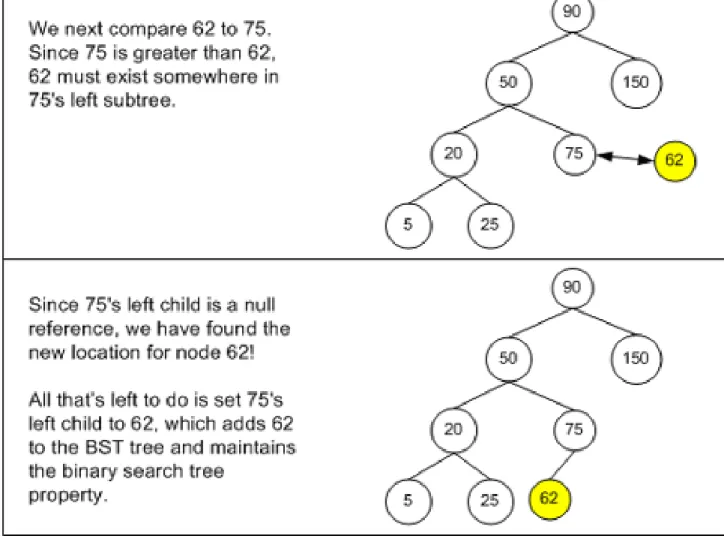
Figure 1. Inserting a new node into a BST
A BST after nodes with values of 20, 50, 90, 150, 175, and 200 have been added
Inserting a new key in a BST
How to insert a new key?
The same procedure used for search also applies: Determine the location by searching. Search will fail. Insert new key where the search failed.
Example:
10 8
5
3 4
2
9
Insert 4?
Building a BST
Build a BST from a sequence of nodes read one a time
Example: Inserting C A B L M (in this order!)
1) Insert C
C
2) Insert A
C
A
Building a BST
3) Insert B C A
B
4) Insert L
5) Insert M
C A
B L C M
A L
Building a BST
Is there a unique BST for letters A B C L M ?
NO! Different input sequences result in different trees
C A
B L
M A
B
C
L
Inserting: A B C L M Inserting: C A B L M
Sorting with a BST
Given a BST can you output its keys in sorted order?
Visit keys with Inorder:
- visit left - print root - visit right
How can you find the minimum?
How can you find the maximum?
C A
B L
M Example:
A B C L M
Inorder visit prints:
Preorder Traversal
23 18 12 20 44 35 52
Postorder Traversal
12 20 18 35 52 44 23
Inorder Traversal
12 18 20 23 35 44 52
Inorder traversal of a binary search tree produces a
Right-Node-Left Traversal
52 44 35 23 20 18 12
Right-node-left traversal of a binary search tree produces a
Deleting from a BST
To delete node with key x first you need to search for it.
Once found, apply one of the following three cases
CASE A: x is a leaf
x
delete x BST property maintained q
r
q r
p p
Deleting from a BST cont.
Case B: x is interior with only one subtree
L
x q
r
delete x L
q r
BST property maintained
Deleting from a BST cont.
Case C: x is interior with two subtrees
W
x q
r
delete x
Z t s
r
W q
r
delete x s Z
r
t
Deleting from a BST cont.
Case C cont: … or you can also do it like this
W q r
r t
q < x < r
Q is smaller than the smaller element in Z
R is larger than the largest
element in W
Binary Search Trees
1 5
8 16
18 23
30 33
38 44
47 54
58 64
67 70
74 77
81 85
88 91
99 101
105 110
116 118
122 126
130 133
2 12 21 32 40 49 59 69 75 83 90 100 107 117 125 131
6 24 45 66 80 93 111 128
17 57 87 120
35
71
102
Example 1:
Find 47
< 71
> 35
< 57
> 45
<49
63-item list
Example 2:
Find 112
> 71
> 102
< 120
>111
<117
<116 Not found
Insertions and Deletions in Binary Search Trees
1 5
8 16
18 23
30 33
38 44
47 54
58 64
67 70
74 77
81 85
88 91
99 101
105 110
116 118
122 126
130 133
2 12 21 32 40 49 59 69 75 83 90 100 107 117 125 131
6 24 45 66 80 93 111 128
17 57 87 120
35
71
102
Example 1:
Insert 48
< 71
> 35
< 57
> 45
<49
Example 2:
Delete 116
> 71
> 102
< 120
>111
<117
> 47
48 Deleted