warwick.ac.uk/lib-publications
A Thesis Submitted for the Degree of PhD at the University of Warwick
Permanent WRAP URL:
http://wrap.warwick.ac.uk/110798
Copyright and reuse:
This thesis is made available online and is protected by original copyright.
Please scroll down to view the document itself.
Please refer to the repository record for this item for information to help you to cite it.
Our policy information is available from the repository home page.
MARKETS W ITH PREPAYMENTS
by
PAUL ROSSOLYMOS
Thesis submitted for the degree of PhD
UNIVERSITY OF WARWICK DEPARTMENT OF ECONOMICS
COVENTRY CV4 7AL, UK
Summary
The purpose of this thesis is to examine the behaviour of consumers and producers in markets where the consumers of a product have to prepay for their purchases and then wait for a period of time before the goods are delivered to them.
Chapter 2 examines the role o f prepayments as a means to support efficient exchange. We develop a framework to discuss contractual arrangements between a buyer, who places an order for a product, and a seller, who makes an investment in specific assets in response to the buyer’s order. We find that contracts stipulating a non-refundable prepayment which is to be paid when the order is placed can support efficient exchange as long as the prepayment is set equal to the amount of the investment in specific assets.
In chapter 3 we develop a model of a market where some customers of a firm with monopoly power must pay an advance deposit for the right to purchase a new durable good sooner than others. We will show that this behaviour can be explained by a model in which a monopolist, having already spent money o n R & D but being uncertain of the profitability of his product due to cost uncertainty, charges the non-refundable prepayment in order to be able to recover the R & D cost in the case where the product turns out to be unprofitable and, therefore, is not produced. Some high-valuation customers will be prepared to bear the risk of losing the prepayment (in the case where the product is not produced) as long as they are given priority over others in the delivery of the product.
Chapter 4 examines the role of prepayments as an integral part of the pricing strategy of an incumbent firm who is privately informed as to the level of cost and is concerned with deterring entry in a market of a new product. We show that there exist separating equilibria in which the low-cost incumbent’s pricing policy is successful in deterring entry. This pricing policy involves the signing (by the incumbent and the buyers) of a number of contracts one period before production starts. These contracts require consumers who have signed them to prepay for their purchases of the product before production starts and take delivery after the end of the production period.
Chapter 5 extends the model of chapter 4 to allow for heterogeneous consumers and the possibility for the incumbent to choose between two patterns for serving consumers who are willing to prepay. Both serving patterns give rise to a unique separating equilibrium in which prepayments prevent entry. In addition, rationing of those consumers who are willing to prepay may emerge in equilibrium and this depends on the serving pattern that is adopted by the incumbent.
Table of Contents
Summary ¡¡j
List of Figures xi
List of Tables xiv
Acknowledgements xv
PART 1 - INTRODUCTION TO THE ANALYSIS
Chapter I - Introduction 2
PART 2 - ANALYSIS OF PREPAYMENTS
Chapter 2 - Contractual Exchange or Vertical Integration? The Role of Prepayments in
Supporting Efficient Contractual Exchange
1. Introduction • 14
1.1. Contractual Exchange: Some Introductory Remarks 16 1.2. Contractual Exchange When the Seller Values the Prepayment
Less than the Buyer 17
2. Reputation Effects and Contract-Handling Agents: Why the Seller
May Value the Prepayment Less than the Buyer 19
3. The Model 21
4. Market Exchange m 22
5. Vertical Integration 24
6. Contracting Scheme p 24
7. Contracting Scheme p When the Supplier Values the Prepayment
Less than the Buyer 29
7.1. Contracting Scheme p i 31 7.2. Contracting Scheme p 2 35 7.3. Contracting Scheme p 3 37 7.4. Contracting Scheme p 4 40 8. Prepayments as Opposed to Hostages: Some Critical Remarks on
Williamson’s Hostages as a Means to Support Exchange 43
9. Concluding Remarks 46
Appendix 47
Notes 50
Chapter 3 - An Optimal Sales Strategy for a Monopolist of a New
Durable Good: Contracts and Prepayments
1. Introduction 60
2. Previous Relevant Research 62 3. The Period-2 Price and the Coase Conjecture 66 4. Consumers’ Behaviour and the Expected Profit-Maximizing
Sales Strategy 67
a Period-0 Contract {p0P iP 2 ) 72 4.1.2. Effects of Changes in p0 and y on the Value of the
Marginal Consumer 74
4.2. Determination of the Expected Profit-Maximizing Pricing
Policy Given the Equation for the Marginal Consumer T 75 5. Welfare Implications of the Expected Profit-Maximizing Pricing
Policy 82
5.1. Expected Welfare When the Monopolist’s Pricing Policy
Involves Prepayments 83
5.1.1. Case 1: c(T )< c ^ p , * 83 5.1.2.Case 2: 0 £ c„ Z c (T ) 84 5.1.3. Case 3: p ‘ <c KZ 1 85 5.2. Expected Welfare in a First-Best Environment, EW™ 86 5.3. Expected Profits and Welfare in the No-Prepayments
Monopolistic Setting 87
5.3.4. Expected Profits and Expected Welfare 93 5.4. Expected Welfare Comparisons 94 6. The Prepayment as a Facilitating Device to Secure a Line of
Credit 96
7. Conclusion 97
Notes 98
Chapter 4 - Prepayments and Contracts as Signals of Cost
1. Introduction 105
2. ¡Description of the Model 107 3. Review of Relevant Research 109
4. The Model 110
5. Sequential Separating Equilibria 113 5.1. Sequential Rationality for the Low-Cost Incumbent 113 5.2. Sequential Rationality for the High-Cost Incumbent 114 5.3. Sequential Separating Equilibria 115 6. Undominated Sequential Separating Equilibria 117
7. Pooling Equilibria 121
8. Concluding Remarks 122
Appendix 124
Notes 127
Chapter 5 - Prepayments and Contracts as Signals of Cost in a
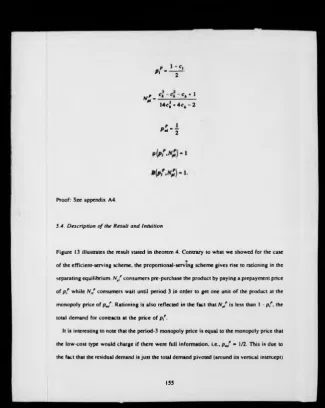
1. Introduction and Summary of the Model 133 2. Review of Previous Research 135 3. Main Elements o f the Model 137 4. The Efficient-Serving Scheme 138 4.1. Description o f the Efficient-Serving Scheme 138 4.2. Sequential Separating Equilibria 140 4.2.1. Sequential Rationality for the Low-Cost Type 140 4.2.2. Sequential Rationality for the High-Cost Type 142 4.3. Undominated Sequential Separating Equilibria 145 4.4. Description of the Result and Intuition 146 5. The Proportional-Serving Scheme 149 5.1. Description o f the Proportional-Serving Scheme 149 5.2. Sequential Separating Equilibria 150 5.2.1. Sequential Ratione'ity for the Low-Cost Incumbent 150 5.2.2. Sequential Rationality for the High-Cost Incumbent 152 5.4. Description of the Result and Intuition * 155 6. Equilibrium Effects of Changes in ck 156 6.1. Effects on the Size of Equilibrium Prepayments. p,E and p f 156 6.2. Effects on Equilibrium Profits Under Both Serving Schemes 157
7. Conclusion 159
Appendix 161
Notes 174
1. Introduction 193 2. Description of the Model 196
2.1. The Incumbent’s Ability to Reduce the Size of the Market
in the Post-Entry Game 197 2.2. The Incumbent’s Incentives to Reduce the Size of the Market
in the Post-Entry Game 198 2.3. The Size of the Post-Entry Market and the Probability of
Entry 198
2.4. Efficiency and Ex Ante Welfare 198
3. The Model 199
3.1. Basic Elements of the Model 199 3.2. Decision Sequence and Information Structure 201 3.3. The Size of the Market in the Post-Entry Game and the
Probability of Entry 202
3.4. Equilibrium Outcomes 204 3.4.1. Case 1: Only Buyer 1 Prepays or n »= 1 205 3.4.2. Case 2: Both Buyers Prepay or n = 0 208 3.4.3. Case 3: No Buyer Prepays or n = 2 210 4. Expected Profits Versus Expected Consumers Surplus 212 5. n - 1 Versus n = 0: Relative Profitability of Prepayments 213 6. Welfare Effects of Prepayments 214
7. Conclusion 215
Appendix 218
List of Figures
Chapter 2
Figure 1 - Cost Distinctions 54 Figure 2 - Demand Distribution and Costs of Supply 55 Figure 3 - The Relationship Between the Equilibrium Contract- p J
Payment and Total Costs, and Between the Equilibrium C ontract-pi Prepayment and the Specific-Asset Investment,
Given a Value for a 56
Figure 4 - The Equilibrium Contract- p i Full Payment as a Function of v,
k and a 57
Figure 5 - The Equilibrium Contract- p i Prepayment as a Function of v,
k and a 58
Chapter 3
Figure 1 - The Marginal Consumer T Given the Period-0 Contract
I 99
Figure 2 - Effects of Changes in p 0 and y on the Marginal Consumer 100 Figure 3 - The Expected Profit-Maximizing Solution 101 Figure 4 - Effects of Changes in y on T and p0‘ 102 Figure 5 - Cost Realization and the Consumers’ Decision in the
No-Prepayments Monopolistic Regime 103 Figure 6 - The Period-1 Kinked Demand Curve When the Monopolist
Chapter 4
Figure 1 - Sequential Rationality for the Low-Cost Type 129 Figure 2 - Sequential Rationality for the High-Cost Type 130 Figure 3 - Sequential Separating Equilibria 131 Figure 4 - Undominated Sequential Separating Equilibria 132
Chapter 5
Figure 1 - The Efficient-Serving Scheme 177 Figure 2 - Sequential Rationality for the Low-Cost Type Under
the Efficient-Serving Scheme 178 Figure 3 - Sequential Rationality for the Low-Cost Type Under
the Efficient-Serving Scheme in the Case Where
c ,€ [0.5,1] 179
Figure 4 - Sequential Rationality for the High-Cost Type Under
the Efficient-Serving Scheme 180 Figure S - Sequential Separating Equilibria Under'the
Efficient-Serving Scheme 181
Figure 6 - Sequential Separating Equilibria Under the
Efficient-Serving Scheme When c* is Much Bigger than c, 182 Figure 7 - The Unique Undominated Sequential Separating Equilibrium
Under the Efficient-Serving Scheme 183 Figure 8 - Optimality of the Unique Undominated Sequential Separating
Figure 10 - Sequential Rationality for the Low-Cost Type Under the
Proportional-Serving Scheme 186 Figure 11 - Sequential Rationality for the High-Cost Type Under
the Proportional-Serving Scheme 187 Figure 12 - Sequential Separating Equilibria Under the
Proportional-Serving Scheme 188
Figure 13 - The Unique Undominated Sequential Separating Equilibrium
Under the Proportional-Serving Scheme 189 Figure 14 - Equilibrium Effects of Changes in c* on p f - p,E 190 Figure 15 - The Variation in Equilibrium Profits Under the
Proportional-Serving Scheme Minus Equilibrium Profits
Under the Efficient-Serving Scheme 191 Figure 16 - Decomposition of the Difference Between the Equilibrium
Profits Under the Two Serving Schemes in Profits from Prepayments and Profits from Sales to the Residual
Demand . 192
Chapter 6
[image:14.367.18.338.31.427.2]Acknowledgements
I wish to thank above all my supervisors Norman Ireland and Morten Hviid. This work could not have been completed without their help and advice. I am especially grateful to Norman Ireland for the privilege o f sharing in his insights into formulating the models that appear in the chapters of this thesis.
I also gratefully acknowledge financial support from the Commission of the European Communities under grant B/SPES/915036.
1 INTRODUCTION
The purpose of this thesis is to offer an economic rationale for a widespread phenomenon: potential buyers of some products have to prepay for their purchases and wait for a period of time before the goods are dispatched to them. Although prepayments form an integral part of the pricing policy of a considerable number of firms, their presence has not been explained by a systematic theory in the economics literature. This thesis is an attempt to provide such a theory. Our aim is to investigate the circumstances that induce producers to use prepayments in a profitable way as well as to explore the implications of the use of prepayments for social welfare.
In real-life examples of business practices, the presence of prepayments can be indicated by the use of different names. Down payments, up-front payments, or (advance) deposits are some of them. Furthermore, prepayments can be either part of the total payment for one unit of the product or they can constitute the total payment themselves. In the former case, it is natural to adopt the position that prepayments form a premium over and above the unit price of the product while in the latter, one would expect that they take the form of advance-purchase discounts.
Nevertheless, the presence of prepayments may not necessarily be the outcome of the characteristics of the production side of the market only. It can also be dictated by the attitudes of consumers towards the attributes of the goods under question. To illustrate this point, we quote the following example from the The Independent newspaper (31/10/92):
...so eager were consumers to get their hands on the new 730i or 735i...that they were prepared to pay a premium. (Emphasis added).
In this example, some consumers are willing to pay a premium (over and above the unit price of the product) now in order to buy an advantageous place in the queue for the delivery of the forthcoming product. In effect, the situation involves a Veblen good so that early consumers obtain prestige but later ones do not.
Besides the durable-goods industry, prepayments can also be found in the services industry. Thomas (1991) reports on how to pick a private investigator:
...There should be a contractual written fee agreement with the investigator, and most reputable investigators will request a retainer fee and prepayment covering up to half the anticipated cost of the assignment in advance. (Emphasis added).
uncertainty, the investigator’s good reputation for accomplishing his tasks can be a force that induces his clients to prepay. Hence, the investigator can still recover (part of) his set-up costs in the case where his client’s case is not solved.
Another example is offered by Seal (1991):
Marriott Hotels, Resorts and Suites is offering 21-day and 14-day advance-purchase room rates at 192 hotels from June 21 through September 2. The payments are nonrefundable and deeply discounted...During its 1990 holiday test run, Marriott’s nonrefundable advance- purchase program raised volume at 178 participating hotels by 10%, compared with the same period in 1989.
The obvious explanation for Marriott’s strategy is that this strategy aims at attracting as many customers as possible during the highly competitive summer-time. A less obvious explanation is that this strategy reveals some information about Marriott’s operational efficiency. If this is true so that customers are convinced that Marriott’s strategy cannot be imitated by other hotels, then there will be a queue of customers waiting to book the limited number of rooms that are offered at the special discount rate. When no more such rooms are available, customers will have to pay the normal higher rate. Tim explanation is consistent with the fact that the advance-purchase payments are non-refundable. When customers are convinced that no other hotel will imitate Marriott’s strategy in the period that will elapse between the booking of the room and checking in, they will be willing to pay a non-refundable prepayment.
The above examples of business practices provide us with the motivation to construct a theory that can explain the reasons that induce firms to use prepayments as part of their pricing policies. This theory is described in detail in the next five chapters of the thesis.
exchange between a buyer who places an order for a product and a supplier who makes an investment in specific assets in response to the buyer’s order. We will start by examining the
market exchange between the buyer and the seller under conditions of uncertainty and asset
specificity. Asset specificity refers to durable investments that are undertaken in support of particular transactions. The product in question is assumed to be produced by a special- purpose technology which requires such an investment. The opportunity cost of investments in transaction-specific durable assets is much lower in best alternative uses should the original transaction be prematurely terminated [Williamson (1985, p. 95)]. The presence of asset specificity would not cause any problems if uncertainty in the demand side of the exchange were assumed away. We assume, however, that demand is stochastic so that, although the buyer has already placed an order and the supplier has made the specific-asset investment, the buyer can either take or refuse delivery depending on his value of the product which is realized after the investment in specific assets has been made. If the realized value of the product is such that the buyer prefers to cancel the order and defect from the agreement under the specific-asset technology, the producer will be holding unproductive assets which cannot be economically shifted to other uses. The prospect o f this loss will prompt the producer to make efficiency-distorting price adjustments.
when he places the order. We will show that the prepayment will support an efficient outcome as long as it is set equal to the amount of investment in specific assets. The buyer will confirm the order and exchange will take place whenever the realized value of the product is greater than or equal to marginal cost of production. Under these circumstances, contractual exchange is preferable to vertical integration, taking into account the fact that internal organization of transactions is characterized by incentive and bureaucratic disabilities.
Nevertheless, prepayments will not support an efficient outcome if the seller values the prepayment less than the buyer. This will be the case where although the buyer pays a prepayment which is equal to the investment in specific assets (this will be referred to as the full value of the prepayment), the seller values the received prepayment at an amount which is smaller than that investment. The nature of the inefficiency will depend on (1) whether the full value of the prepayment is reduced by an amount proportional to that value or by a constant amount and (2) whether the full value of the prepayment is reduced under all possible demand realizations or under those realizations that induce the buyer to cancel the order. In this environment, internal organization of the transaction through vertical integration becomes a more appropriate mode of economic organization.
In chapter 3 we develop a model of a market where some customers of a firm with monopoly power must pay a prepayment for the right to buy a new durable good sooner than others. We consider a firm that has developed a new product which is going to be produced and launched into the market only if the unit production cost is revealed to be sufficiently low. This feature is modelled by assuming that the unit production cost is a random variable whose value becomes common knowledge after the monopolist has spent money on R & D and determined the expected profit-maximizing pricing policy. The fact that the monopolist has already spent a non-recoverable amount on R & D makes him worry about the outcome of his investment In other words, if the value of the unit production cost turns out to be too high for production to be profitable, the monopolist will not be able to cover his sunk cost simply because production will not take place. It is reasonable to argue, therefore, that the monopolist would like to “insure” his assets against this possibility.
The monopolist can achieve this aim if there is a distribution of consumer types indexed by their valuation of the good with each consumer type experiencing a reduction in his utility by purchasing and consuming the good later than others. Then, the higher the type of a consumer (the higher his product valuation), the morê this type’s utility will be reduced by purchasing and consuming the good later than others. Plausible stories may include the following [Ireland and Stoneman (1985)]:
Assuming that the monopolist cannot identify consumers by their valuation, the monopolist will try to exploit the consumers’ time preference by charging consumer types with a sufficiently high valuation for the product a non-refundable prepayment payable before the unit production cost becomes common knowledge and, at the same time promising them to the first to get the good if it is produced, in which case, they will also pay a unit price (payable upon delivery). For these types, the expected benefits from getting the good sooner than others outweigh the risk of losing the prepayment and not getting the good in the case where the unit cost turns out to be too high for production to be profitable. On the other hand, those consumer types for whom the expected benefits from early delivery do not outweigh the risk of losing the prepayment will choose not to pay the prepayment and, consequently, they will be able to buy the good (if it is produced) only after those who have prepaid are served.
An important implication of the above model (which will be discussed in more detail in the conclusion of the thesis where we will consider possible extensions of the model) is that the prepayment constitutes a mechanism by which the producer can shift the risk involved in the activity o f innovation to the consumer. This is important in the face of arguments that have been made concerning the bias of the market against risky R & D.
privately informed as to the level of cost. Thus, the entrant will consider entering the market only in the event that his cost is lower than the incumbent’s cost
Our interest will be focused on the game between the incumbent and the consumers rather than the entrant. The entrant will make his entry decision only after this game has reached an end and he will do so “passively”. By this we mean that if consumers decide to purchase from the incumbent then the entrant will not enter since there will be no market left. If. on the other hand, consumers do not purchase from the incumbent then the entrant will enter to serve the entire market. The incumbent, therefore, wants to convince consumers to purchase the product from him so that he can eliminate the threat of entry.
Given the presence of cost uncertainty, consumers will not buy from the incumbent unless they know that his cost of production is lower than that of the entrant. Suppose then that, before production starts and before the entrant makes his entry decision, the incumbent is prepared to sign a number of forward contracts requiring buyers who sign to prepurchase one unit of the product by prepaying. The number of contracts to be signed is chosen by the incumbent and it can be less than the total number of consumers. Furthermore, contracts are signed on a first-come-first-served basis. Any consumers who do not have the chance to prepay will buy the product later by paying the monopoly price (which will be equal to the consumers' reservation price in the case of identical consumers).
remaining consumers will make their purchases of the product after it is produced by paying a monopoly price. The fact that some consumers prepay is taken by the entrant to mean that the incumbent’s type is a low-cost one. Then the existence of some consumers who do not have the chance to prepay but, instead, wait until the end of the production period in order to purchase the product does not prompt the entrant to enter. Nevertheless, the entrant could still enter since, by entering, he would, at worst, be as well off as by staying out. To rule out a situation like the above, where the entrant enters even though he knows that he enters against a more efficient producer, we will assume that there is a very small fixed cost of entry.
Chapter 5 extends the previous model by assuming that consumers are heterogeneous and indexed by their reservation price. It is further assumed that the incumbent has two choices as to the pattern of serving consumers who are willing to prepay: the efficient-serving scheme and the proportional-serving scheme. Under the former, only consumers with the highest reservation prices are allowed to prepay while in the case of the latter, all consumers have the same probability of prepaying. Depending on the type of the serving scheme that is chosen by the incumbent, rationing of consumers in the equilibrium can be optimal from the point of view of the low-cost incumbent: only a part of the demand for advance-purchase contracts involving prepayments is satisfied by the low-cost incumbent in the separating equilibrium. If rationing actually takes place in the separating equilibrium, rationed consumers will be able to purchase the product from the low-cost incumbent after production has taken place by paying a monopoly price which will be higher than the prepayment.
serving patterns to choose from will give rise to a unique separating equilibrium outcome as opposed to chapter 4 where there is a multiplicity problem even after the elimination of dominated strategies.
In chapter 6, it is the entrant’s cost (rather than the incumbent’s) which is the unknown parameter. We will show that an incumbent seller with a known unit cost can reduce the probability of entry into his market of an entrant who faces a sufficiently large fixed cost of entry and whose variable unit cost is unknown by signing contracts requiring buyers to pay for the product before it is delivered to them. This model assumes that there are a single incumbent, a single potential entrant and two buyers. The incumbent and the buyers do not know the entrant’s cost which may turn out to be either higher or lower than the incumbent’ unit cost. In order to forestall a situation where the entrant’s cost will turn out to be lower than the incumbent’s (with the possible consequence of provoking entry), the incumbent will try to “appropriate” either one or both buyers before the time of entry decision thus reducing the probability of entry since the presence of fixed costs of entry implies that the entrant’s average cost is decreasing in the number of customers served. If the incumbent is successful in convincing the buyers to purchase the product from»him then it might be the case that the incumbent’s pricing policy will facilitate the entry prevention of a more efficient producer.
the incentive to prepay (hoping that the other buyer will not prepay) since if he does not prepay and wait for the entrant’s decision then the entrant may enter in which case the product will be sold to both buyers. Second, given each buyer’s incentive to prepay because of the above reason, each buyer goes through the following reasoning:
If I do not prepay and the other buyer prepays then the probability of entry will be reduced in which case I may have to either pay a higher price in order to get the product from the incumbent in a later period or do without the product if the incumbent’s monopoly price in that period is greater than my reservation price.
It will be shown that, depending on the values of the parameters of the model, one of the following possibilities can emerge as a subgame-perfect equilibrium:
(1) A single buyer prepays (2) Both buyers prepay (3) Neither buyer prepays
If a single buyer prepays, the probability of entry is reduced while if both prepay, entry is completely eliminated.
2 CONTRACTUAL EXCHANGE OR VERTICAL INTEGRATION? THE ROLE O F PREPAYMENTS IN SUPPORTING EFFICIENT CONTRACTUAL EXCHANGE
1. Introduction
This chapter’s theme is the analysis of an example of a market exchange between a buyer and a seller under conditions of uncertainty and asset specificity. As this type of exchange will yield an inefficient1 outcome, two alternatives will be examined: contractual exchange and
vertical integration. Contractual exchange will play an important role since contracts
stipulating prepayments will support efficient exchange in some situations.
The product in question is produced by a special-purpose technology which requires an investment in transaction-specific durable assets. Asset specificity refers to durable investments that are undertaken in support of particular transactions. The opportunity cost of such investments is much lower in best alternative uses (or by alternative users) should the original transaction be prematurely terminated [Williamson (1985, p. 95)]. Furthermore, the specific identity of the parties to a transaction matters in these circumstances, which is to say that continuity of the relationship is valued [Williamson (1985, p. 55)].
2 CONTRACTUAL EXCHANGE OR VERTICAL INTEGRATION? THE ROLE OF PREPAYMENTS IN SUPPORTING EFFICIENT CONTRACTUAL EXCHANGE
1. Introduction
This chapter’s theme is the analysis of an example of a market exchange between a buyer and a seller under conditions of uncertainty and asset specificity. As this type of exchange will yield an inefficient1 outcome, two alternatives will be examined: contractual exchange and
vertical integration. Contractual exchange will play an important role since contracts
stipulating prepayments will support efficient exchange in some situations.
The product in question is produced by a special-purpose technology which requires an investment in transaction-specific durable assets. Asset specificity refers to durable investments that are undertaken in support of particular transactions. The opportunity cost of such investments is much lower in best alternative uses (or by alternative users) should the original transaction be prematurely terminated [Williamson (1985, p. 95)]. Furthermore, the specific identity of the parties to a transaction matters in these circumstances, which is to say that continuity of the relationship is valued [Williamson (1985, p. 55)].
terminology of Klein. Crawford and Alchian (1978. p. 298), a stream of quasi-rents is created which can be appropriated through opportunistic behaviour by either party.
The second attribute of the model is the presence of uncertainty in the demand side of the exchange. There are two periods in the model. The buyer places an order in period 1 and the producer makes the specific-asset investment. Production occurs in period 2. The buyer, however, can either take delivery, paying the unit price of the product, or refuse it. This behaviour hinges on the assumption that demand is stochastic. The gross value of the good will be assumed to be uniformly distributed over the interval [0,1 ] and the two parties to the exchange learn this value in the beginning of period 2. If the realized value of the product is such that the buyer prefers to cancel the order and defect from the agreement under the specific-asset technology, the producer will be holding unproductive assets which cannot be economically shifted to other uses. The prospect of this loss will prompt the producer to make efficiency-distorting price adjustments.
The influence of the previously mentioned kind of uncertainty on economic organization is conditional. The existence of uncertainty is a matter of little consequence for non-specific transactions. Since the seller can easily redeploy his assets through new trading relations, continuity of a particular relationship has little value. Similarly, the presence of asset specificity in an environment without uncertainty does not cause any problems since the supplier will not commit any specific assets unless the gross value of the good is greater than or equal to the marginal cost of its production.
effectiveness of both modes of organization in dealing with the inefficiencies caused by the lack of safeguards in the market exchange between the buyer and the seller.
Since internal organization of this exchange through vertical integration yields the efficient outcome, vertical integration is going to be the benchmark with which different contracting alternatives will be compared. These contracting schemes will share the characteristic of explicitly introducing safeguards against the buyer’s potential opportunistic behaviour.
The particular safeguard that we are interested in examining is prepayments: the buyer is charged an up-front payment when he places the order. Then we want to assess the role of contracts stipulating prepayments in supporting efficient exchange.
/. / . Contractual Exchange: Some Introductory Remarks
The contracts that wc are concerned with are complete in that they specify each party’s obligations in every conceivable eventuality. The benefits of writing such contracts derive from the fact that they lay down each party’s obligations completely and unambiguously in
advance. %
There are costs associated with writing complete contracts, however. The following seem to be important [Hart and Holmstrom (1987)]: (1) the cost of deciding and reaching an agreement about how to deal with all possible events; and (2) the cost of writing the contract in a sufficiently clear and unambiguous way so that the terms of the contract can be enforced. Less important seems to be the cost to each party of waiting for the various eventualities to occur - i.e., the realization of the value of the good in the beginning of period 2 - as long as the length of the periods is not too long.
self-enforcing [Hart and Holmstrdm (1987)] and of the bilateral-governance type [Williamson (1985)]. Both concepts refer to those contracts that are not enforced by outsiders or third parties, such as the courts. Although the courts may be there as a last resort, these agreements are enforced on a day-to-day basis by custom, good faith, reputation, and so on. In our case, it is the completeness of contracts that precludes the need to resort to third-party assistance.
The consideration of such contracts as an alternative to the market exchange in question is motivated by the fact that this market exchange will give rise to an inefficiency: the product will be exchanged at a price that exceeds marginal cost. In other words, there are going to be some realizations of the value of the good above marginal cost for which efficient exchange will not take place since the unit price of the product will exceed those values.
As a remedy to this inefficiency, we will consider contract p below as well as some variants of it:
( p ) The buyer places an order in period 1 and pays a prepayment which is part of the
full payment. The producer makes the specific-asset investment in period 1 and receives the prepayment which is non-refundablC. If the buyer confirms the order in period 2, the producer also receives the remaining part of the full payment.
The introduction of the prepayment as a safeguard device will support an efficient outcome. The buyer will confirm the order and exchange will take place whenever the realized value of the product is greater than or equal to the marginal cost of production. This will be true as long as the prepayment is set equal to the amount of the investment in specific assets.
Contracting scheme p illustrates the importance of a complete contract when there are relationship-specific investments. There are situations, however, where it is difficult to postulate contracts that induce efficient relationship-specific investments and this difficulty may become an important factor in explaining vertical integration.
Our type of contracts will give rise to inefficiencies in situations where the seller values the prepayment less than the buyer: even though the buyer pays a prepayment which is equal to the investment in specific assets (this will be referred to as the full value of the prepayment), the value of this prepayment to the seller is less than the amount of the investment. Failure to assure the seller that a prepayment which he values at a full amount will be transferred to him will prompt the seller to safeguard his specific-asset investment through efficiency-distorting price adjustments.
We will consider four variations of contract p depending on (1) whether the full value of the prepayment is reduced by an amount proportional to that value or by a constant amount and (2) whether the full value of the prepayment is reduced under all possible demand realizations or under those realizations that induce the buyer to cancel the order.
It is going to be true that the efficiency properties of*contract p will carry over to the case where the seller values the prepayment less than the buyer only when the prepayment is reduced by a constant amount and regardless of whether the buyer confirms the order or not. The remaining three contracts will give rise to inefficient outcomes. Depending on the contract considered, it may be the case that either inefficient exchange takes place or efficient exchange does not take place.
Before proceeding with the formal analysis, in section 2 we will present some theoretical anc. empirical evidence that is consistent with the type of contracts considered in point (2) above. Section 3 describes the main ingredients of the model while the market exchange in question is analyzed in section 4. In section 5 we describe the internal organization (through vertical integration) of the market exchange. Contracting scheme fp is examined in section 6 and its variants (when the seller values the prepayment less than the buyer) in section 7. Section 8 compares our findings with those of Williamson (1983) and section 9 presents some concluding remarks.
2. Reputation Effects and Contract-Handling Agents: Why the Seller May Value the Prepayment Less than the Buyer
Two of the four variations of contract p that will be considered whenever the seller values the prepayment less than the buyer refer to cases where either the full value of the prepayment to the seller is reduced only when the order is cancelled or regardless of whether or not the order is cancelled. *
On the other hand, the reduced prepayment valuation which occurs under all possible demand realizations can be thought of as reflecting the cost of third-party consultation on how to formulate and write the contract in question.
Reputations have been considered in the economics and legal literature to be private devices or non-legal sanctions which provide incentives that assure contractual performance in the absence of third-party enforcer [f.ex., Klein and Leffler (1981, p. 616), Cherny (1990, p. 393) and Williamson (1991, p. 290, 291)].2 Furthermore, in order for a reputation to have an effect, both sides involved in a transaction must ex ante have some idea of the meaning of appropriate fulfilment of the contract. Potential future trading partners must be able to observe either fulfilment or lack of it [Kreps, in Alt and Shepsle eds. (1990, p. 93)].
The issue of reputation-activated contract enforceability is not relevant to our context since the confirmation of an order depends mainly on a random event. Rather, order cancellation or non-enforceability bring into existence reputation effects. Nevertheless, if the seller is at all likely to be discredited as not being a decent and reliable trader, we must make the assumption that outsiders to the contract (e.g., other firms in the industry) do not have and cannot obtain perfect information as to the precise reason of the cancellation of the order.
3. The Model4
3.1. Technologies and Costs
Let us assume that the product in question is produced be a special-purpose technology (T)
which requires an investment in transaction-specific durable assets. Asset specificity implies that there is going to be a non-salvageable value in any advance commitments that the producer makes. This value will be denoted by k. Furthermore, the value that can be realized by redeploying the salvageable part of the investment will be given by v. Alternatively, the redeployable unit operating costs of T are v.5
3.2. Demand and the Contracting Process
There are two periods. Orders are placed in the first, and production, if any, occurs in the second. Demand is stochastic in that the gross value of the good to the buyer (r) is assumed to be uniformly distributed over the interval [0,1]. The quantity demanded at every price will be assumed to be a constant, which it will be convenient to set equal to unity. The product value and cost relations are shown in figure 2.
The actual value of r is realized in the beginning of period 2. That is, after the buyer has placed the order and the seller has committed the investment in specific assets. Depending on the realized value and the price of the product, the buyer can either take delivery or refuse it. In the latter case, the seller will be left with unproductive assets.
(m) The buyer places an order in period 1 and the producer makes the specific-asset investment. If the buyer confirms the order, the producer receives a per unit payment of pm in the second period but nothing otherwise.6
The next section analyzes the consequences of organizing the transaction in question within the market. We will assume that there is competition in the supply side of the market and a single buyer. This is an ex ante consideration since the condition of asset specificity implies that a bilateral monopoly is created after a transaction has been initiated between the buyer and a particular seller.
4. M arket Exchange m
When the transaction is organized in the market, the buyer will confirm the order whenever the realized value of the good is greater than or equal to p but not otherwise. The buyer’s expected benefits then are equal to
1
p
- • i ( i - r t - (i)
The supplier’s expected profits are equal to
v i
E ns = - J k d r + j ( p - v - k)dr • - k p + ( l -p )(p - v - k )
-(1 - p ) ( p - v ) - k .
Since the production side of the industry is competitively organized, producers will be willing to supply if
(1 - P ) ( P -v) - 0
and hence
(
2)
For any pm in (0,1) we have that p” > v. The product thus will be exchanged at a price that exceeds marginal cost. In other words, for any realized value of the good in [v\p*'), exchange does not take place although such exchange would be efficient according to the marginal-cost supply criterion.
The obtained result is due to the lack of any device that could safeguard the seller's specific-asset investment against the possibility of the buyer reneging on his order. This prompts the seller to raise the unit price of the product in order to cover both variable and fixed costs. Indeed, it can be seen from (2) that p” > v + k.
breaks even in expected terms. The disadvantage, therefore, accrues entirely to the buyer who derives a lower expected benefit in equilibrium [as can be seen from (1)].
In an effort to restore efficiency in our two-party transaction, we will consider two alternative governance structures in the next two sections: vertical integration and contracting scheme p for the case where the seller values the prepayment in the same amount as the buyer.
5. Vertical Integration
The integrated firm will decide to produce only if the realized value of the product is greater than or equal to the marginal cost, v. Hence, the probability of production under T is 1 - v. The average net benefits during production periods are (1 - v)/2. In computing expected net benefits, the amount of the investment in specific assets. k, must be taken into account. Thus, expected net benefits for technology T are
»r
2
Contracting scheme p which is analyzed below will replicate the vertical integration conditions, being thus in accordance with the marginal-cost supply criterion and generating an expected net benefit for the buyer equal to bT.
Let us restate contract fp\
(p ) The buyer places an order in period 1 and pays a prepayment equal to p ,p. The producer makes the specific-asset investment in period 1 and receives the prepayment which is non-refundable and is part of the full payment for one unit of the product, pp . If the buyer confirms the order in the beginning of period 2, the producer also receives the remaining part of the full payment, p*3 - p, p .
Let p - Pi be denoted by p2. p2 is received in the second period and only if the buyer confirms the order. The buyer will confirm the order under contract fp whenever the realized value of the good is greater than or equal to p 2. Then, the buyer's expected net benefits are
Given that p = p, + p 2 and, both p, and p2 take values in (0,1), the equality in (3) implies that
uB» € (0,0.5).
As has been explained in section 4 for the case of market exchange, the existence of a competitively organized production market and a single buyer implies that u„'‘ should be
Ena - - f p xdr * f [ r - p x ~p2)dr
o h
positive.
Given that the seller receives p, and bears the cost of the investment in specific assets (k)
regardless of whether the buyer confirms the order or not while he receives an additional p:
and incurs the marginal cost v when the buyer confirms the order, his expected profits are equal to the following:
1
E”s - P , - * * / ( / » , -v)<fr
ft
• p - p 2 - k * ( l - Pj)(p2 -V) <•»>
^ ( l *ft2) P i- * * ( * - P i ) ( P i- y )
(5)
using (3) and the definition of p2. (5) implies that the seller also incurs the cost of guaranteeing to the buyer a net benefit of uB.
One way to solve the model is to set the expression in (4) equal to zero since, by assumption, competition prevails among suppliers of the product. This procedure would not be helpful, however, since it would only yield a set of (pj>2) pairs but not a unique solution and thus not a unique contracting scheme of type jp. One could argue that the multiplicity of equilibrium solution pairs does not create any problems as long as the vertical-integration solution belongs to that set. Then we could just pick that solution from the set of (pp2) pairs on the grounds that it is the desirable one.
support to the argument that contracting scheme fp is an efficiency-promoting governance structure.
In order to be able to obtain a unique solution and. hence, a unique contractual scheme (which supports efficient exchange) in an optimal way so that we do not have to just choose from among a set of equilibrium solutions, we will interpret the assumption of the competitively organized production side of the industry in a more constructive way.
To this end, we argue that it is the full payment (p) that should be consistent with zero expected profits. The supplier should not be prevented from optimally choosing either component (p, or p,) of the full payment as long as this full payment yields zero equilibrium expected profits.
We will follow this alternative solution procedure starting with the maximization of expected profits [as they are given by (5)] with respect to p2:
max Ens. Pi
The first-order condition for a maximum yields ,
- P j * » - o
from which we have that
E *s(piv,k)
« ~ -jv 2 ♦ v2 - (v ♦ *) ♦ ^+p -
^(1 ♦ v2)mP v - k . (7)
Now we set this expression equal to zero since we have assumed that the supply side of the market is competitively organized:
p ' * V * t <8>
Since p 2p = p p - Pi*3, we have that p,*3 = k. Furthermore, from (3), the equilibrium expected net benefits of the buyer are
1L j f - * 2
which is identical to the net benefit calculation, />r,«for technology T under the vertical integration reference structure.
consideration.
Our result is in agreement with intuition. Since the producer’s investment in specific assets is completely safeguarded against the possibility of order cancellation and the producer operates in a competitively organized industry, we would expect that the full payment (p*)
should be enough to cover variable and fixed costs.
The following proposition summarizes the main result of this section.
Proposition I. For any v, k and such that v e (0,1), k e (0,1), uBw e (0,0.5) and EKs(p:v,k) t 0, there exists a unique contract o f type fp which, accompanied by the
stipulation that p ,v = k, replicates the efficient-supply condition o f vertical integration.
Taking into consideration that contract fp is comprehensive and easy to write as well as that internal organization is characterized by incentive and bureaucratic disabilities, contract
p should be the most preferable mode of organization of the two-party transaction in question.
7. Contracting Scheme tp When the Supplier Values th e Prepayment Less than the Buyer
In order to assess whether or not prepayments can support efficient exchange in situations like the above, we should adapt contract p to the needs of the analysis of this section. Hence, contract p will be subject to either of the following four variations depending on (i) whether the full value of the prepayment is reduced by an amount proportional to that value or by a constant amount, and (ii) whether the full value of the prepayment is reduced under all possible demand realizations or under those realizations that imply cancellation of the order:
( p i ) The full payment for one unit of the product is p*3'. The buyer places an order in period 1 and prepays p,*3' . The producer makes the specific-asset investment in period 1 and receives p,*31 if the buyer confirms the order. He values the received prepayment in amount op,*3', 0 < a < 1, if the buyer cancels the order. If the buyer confirms the order, the seller also receives an additional period-2 payment equal to p ,131
such that p,"31 + p2pl = p*31.
(p 2 ) The full payment for one unit of the product is p*32. The buyer places an order in period 1 and prepays p,*32. The producer makes, the specific-asset investment in period 1 and receives p ,p2 if the buyer confirms the order. He values the received prepayment in amount p,*32 - 1132, tp2 e {Op,132), if the order is cancelled. If the buyer confirms the order, the seller receives an additional period-2 payment equal to p2p2
such that pi*32 + Pi*32 = p*32.
of whether or not the buyer confirms the order. If the order is confirmed, the seller is also paid p 2pi in period 2, where p ,v>i + p2pi = p pi.
( p 4 ) The full payment for one unit of the product is p p4. The buyer places an order in period 1 and prepays p p4. The producer makes the specific-asset investment in period 1 and values the received prepayment in amount p ,p4 - tp4, tp4 e (0, p p4),
regardless of whether or not the buyer confirms the order. If the order is confirmed, the seller is also paid p2p4 in period 2, where p ,p4 + p2p4 = p p4.
Contracts p i and p 2 imply that the seller values the prepayment less than the buyer whenever the buyer cancels the order. These contracts, therefore, reflect the adverse reputation effects coming from the cancellation of orders. In contrast, contracts p 3 and p 4 reflect third- party payments since the seller values the prepayment less than the buyer regardless of whether or not the order is cancelled.
7.1. Contracting Scheme fpl
Pi
1E " i - / ( « P i - * )* ■ ♦ ¡(P, ' P i ' » - * ) *
0 P i
» ¿ ( a .
1
(
1
- 2a)pi . ! [ ( . -
1)(1
-
2
«,) »
2
v]p, . j
(
9
)
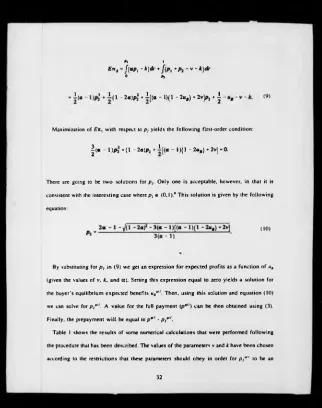
Maximization of Ens with respect to p2 yields the following first-order condition:
There are going to be two solutions for p2. Only one is acceptable, however, in that it is consistent with the interesting case where p2 e (0,1).8 This solution is given by the following equation:
By substituting for p 2 in (9) we get an expression for expected profits as a function of uB
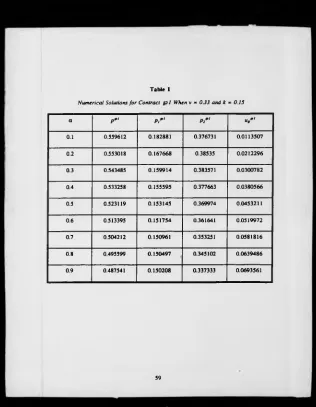
(given the values of v, k, and a). Setting this expression equal to zero yields a solution for the buyer’s equilibrium expected benefits uBp/. Then, using this solution and equation (10) we can solve for p f ' . A value for the full payment ip*’1) can be then obtained using (3). Finally, the prepayment will be equal to p **' - p2pl.
Table 1 shows the results of some numerical calculations that were performed following the procedure that has been described. The values of the parameters v and k have been chosen according to the restrictions that these parameters should obey in order for p2*‘ to be an
!<« -!)*?♦ (! -
2
«)p
2
+ l [(« - l) ( l - 2
ub) *
2
v] =
0
.
3 ( « - l )
[image:49.368.19.341.31.439.2]For the values of a that have been considered, our results are characterized by the following:
p f ‘ * * - 0 .1 5 p f 1 > v - 0.33 p»1» » * * - 0.4».
Furthermore, as a increases, the values of p ,v l, p f ' and p*1' converge from above to k, v and v + k, respectively. These are the values that were obtained under contract p .
The resulted numbers are in agreement with intuition. The lower the value of a (or, in reputation terms, the higher the foregone opportunities for future trading are valued by the seller), the higher the full payment and its components are and the lower the equilibrium expected utility of the buyer is. In other words, if future potential trading partners believe (with a positive probability) that the order has been cancelled because of misconduct from the part of the seller, the seller will make up for the loss of foregone future trading by adjusting upwards the prepayment and the full payment that are stipulated in the contracts with his present trading partners.
These price adjustments result in an inefficiency: p2pl > v. The buyer will not confirm an order for any realized value of the good in For these values, therefore, efficient exchange does not take place.
exchange, we evaluate the first-order condition (FOC) at p2 = v:
- f (« - 1 Iv1 ♦ (1 - 2 « )v ♦ ! [ ( « - 1)(1 - 2«,) * 2v]
For any v e [1/3,1], it is true that the FOC evaluated at p2 = v is positive. This implies that
p S “ > v. Then, since the buyer confirms the order whenever the realized value of the good is greater than or equal to p f and since p2pl > v, it may be the case that efficient exchange will not take place. In other words, for any realized value in [v^*®'), the buyer will cancel his order although exchange between the parties would be efficient according to the marginal- cost supply criterion.
If v e (0,1/3) then there are values of uB in (0,0.5) for which the FOC evaluated at p2 = v is less than or equal to zero. If v actually takes such a value and the buyer’s equilibrium expected utility is less than or equal to (3/2)(v - l)(v - 1/3) then we will have that p2p‘ <, v. In other words, if the average cost of production can be kept to low levels and the buyer does not require too high an expected utility in equilibrium then the seller reduces p2 in order to increase the probability of order confirmation. p2 may be reduced too much, however, in that the buyer will confirm an order even under demand realizations in which exchange between the two parties is not efficient.
The previous discussion is summarized in proposition 2.
Ens(uB;a,v,k) 2 0. Then, there exists a unique contract o f type p i where (i) i f v e 11/3,11 then p,"3' > v; and
(ii) if v e (0,113) and 3(v - l)(v - 113) - 2u„ <, =, or > 0 then p2pl <, =, or > v, respectively.
It is therefore possible that contract p 1 can support efficient exchange although it seems that for most values of marginal cost, contract p 1 may result to an inefficient outcome in that efficient exchange may not take place.
7.2. Contracting Scheme p 2
Recall that, under this contract, the supplier receives p ,t>i in period 1 and p2vi in period 2 if the buyer confirms the order while if the buyer cancels the order, the supplier receives a prepayment which is valued by him in amount p f 2 - tv>2.
The seller’s expected profits are thus given by9
Pt i *
0 ft
. - I f t 1 . ( M )
Maximizing Eits with respect to p2 gives the following first-order condition:
which implies a value for p 2 equal to
p W - v - r « . 0 2 )
Substituting for p2p2 into (11) and using (3), we get
tn ,(p .v .k S ‘ )
- - | ( v - <•“ (* .( » - -(v * *) ♦ | - i [ l * (» - ***)*] - p - ( v » * ) .The assumption of competition in the supply side of the market implies that
Ens(p;v,k)= 0
which gives
p ^ - v k . <l3)
Given (12) and (13), the prepayment p ,p2 is equal'to
p?2 =p p2 -P 2 2 - * + ' p2- (,4)
Although the full payment remains unchanged, the prepayment is raised by the constant rp: above the amount of investment in specific assets. In this way the seller eliminates the risk of getting a prepayment reduced by tp2 if the buyer cancels the order.
Since the full payment remains unchanged and the prepayment increases by tp2. the period- 2 payment (p2p2) must be reduced by tp2 relative to its contract-p value. Thus, contract p 2 may give rise to an inefficiency which is different from the one that contract p 1 gives rise to. Specifically, for any realized value of the good in [p2p2,v), the buyer confirms the order and exchange takes place although the value of the good is lower than the marginal cost of production.
The following proposition summarizes the results for contract p 2 .
Proposition 3. For any v, k. uBp2 and tp2 such that v e(O.I), k 6 (OJ). uBpi e (0.05). tpl
e (Op,*2) and Ens(p;v.k,tp2) 2 0, there exists a unique contract o f type p 2 which postulates
that
p f 1 - * - » « p f - v - t * 2 . p**2 = v + k.
7.3. Contracting Scheme p i
To analyze the implications of this contract, we follow the same procedure as with the previous contracts. Thus, the seller’s expected profits are11
*2 1
£ *J ’ / ( “Pi - * ) * » / ( “Pi *P i - * - *)<*•
• ft
"(■J " l )* i " (« - 1 -* )P i * - « “» -(»**)■ <l5)
Maximizing with respect to p2 gives the following first-order condition:
2
( f " *)*•' <0
*1
■v>’ °which implies a value for p2 equal to
p s = v ^ l - q ) (I6)
n 2 - a
Substituting for p2pi into (15) and using (3), we get Ens(p:vjc,a). By setting this function equal to zero, we obtain a solution for p which is equal to the following:'*
(i7)
a
(2
- a)2
«p f - P w - p ?
_ v » ( l - « ) ( ( « - l ) f v » ( l -<■)] (
18
)2 - a \ o( 2 - a ) / o '
As can be seen from (16), contract p 3 gives rise to the same sort of inefficiency as contract p i : p2f>i > v, i.e., for any realized value to the buyer in [vjj2pS), the order will be cancelled and exchange between the parties will not take place although such exchange would be efficient.
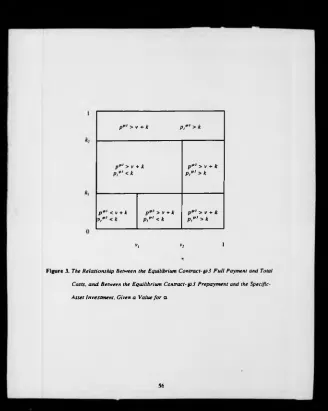
Although p2pi > v for any a € (0,1), v e (0,1) and k € (0,1), the relation between the equilibrium full payment (pp<) and total unit costs (v + k) as well as that between the equilibrium prepayment (p,pi) and the amount of investment in specific assets (k) depends on the values of v, k and a.
First, we explore the relation between the equilibrium full payment and total unit costs [using (17)J and that between the equilibrium prepayment and the investment in specific- assets [using (18)), given a value for a in (0,1). Figure 3 summarizes the results of these comparisons.15
We can see that if k is sufficiently high (i.e., k £ k2) then we have that p pi > v + k and p ,p) > k regardless of the value of v. An analogous result applies when v > v2: we have that p p< > v + k and p ,p3 > k regardless of the value of k. Thus, if the marginal cost of production and the amount of investment in specific assets are sufficiently high, the seller hedges against the prospective loss of (1 - a)p, by increasing both the full payment and the prepayment above their respective values of v + k and k.
smaller than the specific-asset investment. This effect reduces the full payment which, however, remains at a level above that of total costs. This is due to the fact that p ,pi > v.
Finally, if k and v become sufficiently small (k < k, and v < v,), the prepayment falls further down below k driving the full payment to a level below total costs.14
To sum up. the larger the amount of investment in specific assets and the larger the marginal cost, the more likely it is that the prepayment will be greater than the specific-asset investment. In other words, whenever the supplier commits specific assets with a large non- salvageable value and production involves a high marginal cost, the seller will safeguard his investment by charging a large prepayment.
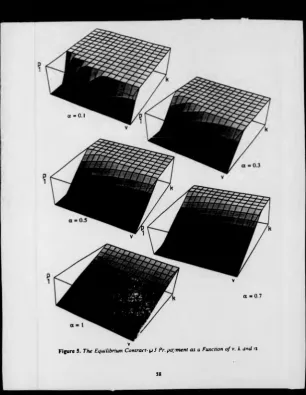
The previous remarks are also illustrated in figures 4 and 5. Each diagram in figure 4 describes how the equilibrium full payment (that is, the full payment that yields zero equilibrium expected profits) changes when v and k change, holding a constant. Figure 5 describes similar changes for the equilibrium prepayment.
When a = 1 then we have shown that p t3j = v + k and p ,pi = k. This case is depicted in the last diagram of every figure.
We can see that when k and v are sufficiently large, it then becomes true that p** > v +
k and p ,pi > k. All regions in figure 3 can be identified in figures 4 and 5.
Furthermore, figures 4 and 5 show how the full payment and the prepayment vary with a, holding v and k constant. As a increases, so that the amount by which the value of the prepayment to the seller is reduced decreases, both the full payment and the prepayment increase and converge to v + k and k, respectively, whenever they lie below these levels. They decrease towards v + k and k in cases where they lie above these levels.
E n ,{ p ; v .k .t* ) - - | v1 . v2 - (» * * ) ♦ ± ♦ p - ±(1 * v3) - t*4
- p - ( v * . i n
The assumption of competition in the supply side of the market implies that
p tA =v + k + tfA. (21)
The prepayment is therefore equal to
PtP4« P p4-/>24 - * * ' P4- (22>
Contracting scheme p 4 always supports the efficient outcome: the buyer will confirm the order and exchange will take place whenever the realized value of the good is greater than or equal to v. This is to be contrasted with contract fp l which may result to inefficient exchange taking place. The difference in the outcomes obtained under the two contracts hinges on the fact that under contract p 4 the transaction costs, t*34, are incurred in all demand states, regardless of whether or not the order is confirmed. Thus, raising the amount of prepayment by t*34 [equation (22)) provides the supplier with a perfect hedge against the prospect of incurring transaction costs. There is no reason therefore why efficiency should be affected: changing p2 does not alter the effects of t*4 on expected profits.