WORKING PAPERS SERIES
WP99-19
Improved Testing for the Efficiency
of Asset Pricing Theories in Linear
Factor Models
Table 1 Comparison of New Test Statistics and F-Statistics
A. Number of Observations T=60, Number of Factors K=1
Number of Test Statistics Percentile of Test Statistics
Assets (N) 0.5% 1.0% 2.5% 5.0% 10.0%
N=10 New Test Statistics 2.719 2.508 2.186 1.931 1.674
F(10,49) N=10, T-N-K=49 2.985 2.728 2.341 2.033 1.737
N=20 New Test Statistics 2.109 1.987 1.802 1.660 1.487
F(20,39) N=20, T-N-K=39 2.573 2.393 2.092 1.860 1.614
N=30 New Test Statistics 1.868 1.787 1.643 1.528 1.408
F(30,29) N=30, T-N-K=29 2.614 2.424 2.109 1.869 1.620
N=40 New Test Statistics 1.733 1.651 1.542 1.448 1.342
F(40,19) N=40, T-N-K=19 3.044 2.764 2.346 2.033 1.729
N=50 New Test Statistics 1.674 1.607 1.497 1.414 1.321
F(50,9) N=50, T-N-K=9 5.261 4.424 3.453 2.766 2.201
N=60 New Test Statistics 1.623 1.549 1.455 1.375 1.297
N=70 New Test Statistics 1.591 1.529 1.427 1.361 1.275
N=80 New Test Statistics 1.531 1.479 1.387 1.321 1.246
N=90 New Test Statistics 1.488 1.440 1.374 1.307 1.243
N=100 New Test Statistics 1.477 1.422 1.356 1.300 1.234
N=110 New Test Statistics 1.458 1.407 1.339 1.282 1.225
N=200 New Test Statistics 1.342 1.305 1.257 1.218 1.174
N=500 New Test Statistics 1.218 1.203 1.173 1.150 1.123
N=1000 New Test Statistics 1.167 1.150 1.132 1.115 1.097
N=+infinite New Test Statistics 1.036 1.036 1.036 1.036 1.036 Notes: For the new test statistics, see equation (12). The new statistics are the average value of N different
F(1, T-K-1) distributions. The statistics reported in the table are the results of simulations with 10,000 replications. Detail simulation procedures are explained in section 3.1.
B. Number of Observations T=60, Number of Factors K=3
Number of Test Statistics Percentile of Test Statistics
Assets (N) 0.5% 1.0% 2.5% 5.0% 10.0%
N=10 New Test Statistics 2.701 2.444 2.155 1.919 1.681
F(10,45) N=10, T-N-K=45 3.007 2.746 2.350 2.040 1.743
N=20 New Test Statistics 2.131 1.973 1.783 1.649 1.484
F(20,35) N=20, T-N-K=35 2.608 2.423 2.113 1.870 1.624
N=30 New Test Statistics 1.893 1.796 1.657 1.534 1.404
F(30,25) N=30, T-N-K=25 2.681 2.484 2.152 1.900 1.642
N=40 New Test Statistics 1.755 1.670 1.553 1.452 1.351
F(40,15) N=40, T-N-K=15 3.275 2.946 2.465 2.119 1.782
N=50 New Test Statistics 1.657 1.611 1.496 1.408 1.316
F(50,5) N=50, T-N-K=5 7.042 5.776 4.280 3.284 2.508
N=60 New Test Statistics 1.610 1.552 1.460 1.386 1.293
N=70 New Test Statistics 1.578 1.512 1.425 1.352 1.269
N=80 New Test Statistics 1.536 1.481 1.397 1.332 1.264
N=90 New Test Statistics 1.496 1.450 1.376 1.315 1.249
N=100 New Test Statistics 1.483 1.428 1.350 1.293 1.237
N=110 New Test Statistics 1.449 1.400 1.341 1.286 1.225
N=200 New Test Statistics 1.327 1.300 1.255 1.217 1.175
N=500 New Test Statistics 1.219 1.200 1.172 1.150 1.124
N=1000 New Test Statistics 1.162 1.151 1.133 1.117 1.100
N=+infinite New Test Statistics 1.037 1.037 1.037 1.037 1.037 Notes: For the new test statistics, see equation (12). The new statistics are the average value of N different
F(1, T-K-1) distributions. The statistics reported in the table are the results of simulations with 10,000 replications. Detail simulation procedures are explained in section 3.1.
C. Number of Observations T=60, Number of Factors K=5
Number of Test Statistics Percentile of Test Statistics
Assets (N) 0.5% 1.0% 2.5% 5.0% 10.0%
N=10 New Test Statistics 2.770 2.539 2.170 1.924 1.674
F(10,45) N=10, T-N-K=45 3.032 2.773 2.368 2.053 1.750
N=20 New Test Statistics 2.053 1.929 1.780 1.645 1.485
F(20,35) N=20, T-N-K=35 2.649 2.461 2.139 1.890 1.636
N=30 New Test Statistics 1.916 1.805 1.649 1.532 1.402
F(30,25) N=30, T-N-K=25 2.747 2.547 2.201 1.932 1.664
N=40 New Test Statistics 1.766 1.666 1.560 1.464 1.353
F(40,15) N=40, T-N-K=15 3.543 3.161 2.610 2.222 1.847
N=50 New Test Statistics 1.662 1.602 1.494 1.417 1.314
F(50,5) N=50, T-N-K=5 11.896 9.265 6.272 4.420 3.135
N=60 New Test Statistics 1.590 1.541 1.460 1.387 1.299
N=70 New Test Statistics 1.561 1.503 1.422 1.350 1.274
N=80 New Test Statistics 1.509 1.460 1.386 1.329 1.255
N=90 New Test Statistics 1.493 1.436 1.367 1.307 1.237
N=100 New Test Statistics 1.473 1.423 1.354 1.303 1.240
N=110 New Test Statistics 1.430 1.393 1.344 1.287 1.226
N=200 New Test Statistics 1.336 1.295 1.254 1.222 1.179
N=500 New Test Statistics 1.220 1.204 1.176 1.154 1.128
N=1000 New Test Statistics 1.162 1.152 1.134 1.116 1.099
N=+infinite New Test Statistics 1.038 1.038 1.038 1.038 1.038 Notes: For the new test statistics, see equation (12). The new statistics are the average value of N different
F(1, T-K-1) distributions. The statistics reported in the table are the results of simulations with 10,000 replications. Detail simulation procedures are explained in section 3.1.
D. Number of Observations T=120, Number of Factors K=1
Number of Test Statistics Percentile of Test Statistics
Assets (N) 0.5% 1.0% 2.5% 5.0% 10.0%
N=10 New Test Statistics 2.638 2.422 2.123 1.886 1.642
F(10,109) N=10, T-N-K=109 2.682 2.499 2.184 1.934 1.663
N=20 New Test Statistics 2.105 1.942 1.748 1.600 1.452
F(20,99) N=20, T-N-K=99 2.201 2.070 1.858 1.682 1.496
N=30 New Test Statistics 1.825 1.728 1.581 1.481 1.358
F(30,89) N=30, T-N-K=89 2.015 1.906 1.722 1.575 1.421
N=40 New Test Statistics 1.681 1.614 1.511 1.419 1.319
F(40,79) N=40, T-N-K=79 1.959 1.853 1.671 1.538 1.397
N=50 New Test Statistics 1.641 1.571 1.461 1.386 1.287
F(50,69) N=50, T-N-K=69 1.950 1.839 1.656 1.527 1.388
N=60 New Test Statistics 1.587 1.509 1.412 1.349 1.263
F(60,59) N=60, T-N-K=59 1.963 1.843 1.673 1.540 1.397
N=70 New Test Statistics 1.512 1.471 1.392 1.320 1.241
F(70,49) N=70, T-N-K=49 2.024 1.893 1.709 1.571 1.424
N=80 New Test Statistics 1.489 1.439 1.366 1.300 1.233
F(80,39) N=80, T-N-K=39 2.141 1.985 1.777 1.621 1.459
N=90 New Test Statistics 1.461 1.416 1.340 1.280 1.217
F(90,29) N=90, T-N-K=29 2.389 2.176 1.914 1.730 1.526
N=100 New Test Statistics 1.425 1.387 1.322 1.268 1.207
F(100,19) N=100, T-N-K=19 2.998 2.644 2.226 1.957 1.685
N=110 New Test Statistics 1.400 1.366 1.306 1.252 1.196
F(110,9) N=110, T-N-K=9 5.666 4.531 3.418 2.797 2.207
N=200 New Test Statistics 1.294 1.270 1.230 1.192 1.151
N=500 New Test Statistics 1.192 1.177 1.150 1.128 1.104
N=1000 New Test Statistics 1.137 1.125 1.107 1.093 1.074
N=+infinite New Test Statistics 1.017 1.017 1.017 1.017 1.017 Notes: For the new test statistics, see equation (12). The new statistics are the average value of N different
F(1, T-K-1) distributions. The statistics reported in the table are the results of simulations with 10,000 replications. Detail simulation procedures are explained in section 3.1.
E. Number of Observations T=120, Number of Factors K=3
Number of Test Statistics Percentile of Test Statistics
Assets (N) 0.5% 1.0% 2.5% 5.0% 10.0%
N=10 New Test Statistics 2.528 2.342 2.083 1.860 1.634
F(10,107) N=10, T-N-K=107 2.686 2.502 2.187 1.933 1.663
N=20 New Test Statistics 2.067 1.934 1.743 1.611 1.449
F(20,97) N=20, T-N-K=97 2.209 2.078 1.861 1.684 1.496
N=30 New Test Statistics 1.876 1.750 1.595 1.496 1.378
F(30,87) N=30, T-N-K=87 2.021 1.911 1.728 1.579 1.425
N=40 New Test Statistics 1.696 1.617 1.511 1.418 1.319
F(40,77) N=40, T-N-K=77 1.964 1.857 1.676 1.544 1.401
N=50 New Test Statistics 1.628 1.564 1.466 1.384 1.297
F(50,67) N=50, T-N-K=67 1.965 1.849 1.667 1.532 1.393
N=60 New Test Statistics 1.568 1.516 1.422 1.343 1.261
F(60,57) N=60, T-N-K=57 1.982 1.857 1.683 1.547 1.404
N=70 New Test Statistics 1.526 1.470 1.386 1.322 1.245
F(70,47) N=70, T-N-K=47 2.048 1.913 1.722 1.584 1.434
N=80 New Test Statistics 1.487 1.432 1.357 1.299 1.230
F(80,37) N=80, T-N-K=37 2.192 2.021 1.803 1.641 1.473
N=90 New Test Statistics 1.463 1.412 1.339 1.283 1.216
F(90,27) N=90, T-N-K=27 2.468 2.231 1.957 1.762 1.550
N=100 New Test Statistics 1.439 1.395 1.327 1.271 1.207
F(100,17) N=100, T-N-K=17 3.244 2.815 2.335 2.038 1.739
N=110 New Test Statistics 1.411 1.361 1.303 1.253 1.200
F(110,7) N=110, T-N-K=7 8.013 5.976 4.224 3.322 2.510
N=200 New Test Statistics 1.297 1.267 1.229 1.193 1.153
N=500 New Test Statistics 1.191 1.177 1.151 1.126 1.101
N=1000 New Test Statistics 1.140 1.129 1.110 1.094 1.077
N=+infinite New Test Statistics 1.018 1.018 1.018 1.018 1.018 Notes: For the new test statistics, see equation (12). The new statistics are the average value of N different
F(1, T-K-1) distributions. The statistics reported in the table are the results of simulations with 10,000 replications. Detail simulation procedures are explained in section 3.1.
F. Number of Observations T=120, Number of Factors K=5
Number of Test Statistics Percentile of Test Statistics
Assets (N) 0.5% 1.0% 2.5% 5.0% 10.0%
N=10 New Test Statistics 2.609 2.363 2.126 1.890 1.636
F(10,105) N=10, T-N-K=105 2.690 2.506 2.189 1.934 1.665
N=20 New Test Statistics 2.067 1.932 1.749 1.612 1.452
F(20,95) N=20, T-N-K=95 2.214 2.085 1.866 1.690 1.499
N=30 New Test Statistics 1.855 1.754 1.608 1.501 1.378
F(30,85) N=30, T-N-K=85 2.017 1.912 1.730 1.580 1.429
N=40 New Test Statistics 1.704 1.608 1.507 1.416 1.319
F(40,75) N=40, T-N-K=75 1.970 1.853 1.675 1.545 1.401
N=50 New Test Statistics 1.647 1.559 1.463 1.381 1.289
F(50,65) N=50, T-N-K=65 1.973 1.854 1.672 1.539 1.399
N=60 New Test Statistics 1.586 1.519 1.430 1.353 1.267
F(60,55) N=60, T-N-K=55 2.002 1.871 1.693 1.554 1.408
N=70 New Test Statistics 1.527 1.460 1.383 1.316 1.247
F(70,45) N=70, T-N-K=45 2.080 1.934 1.738 1.596 1.441
N=80 New Test Statistics 1.486 1.434 1.362 1.298 1.231
F(80,35) N=80, T-N-K=35 2.222 2.052 1.829 1.663 1.488
N=90 New Test Statistics 1.453 1.417 1.343 1.287 1.219
F(90,25) N=90, T-N-K=25 2.557 2.308 2.003 1.797 1.574
N=100 New Test Statistics 1.437 1.380 1.321 1.272 1.212
F(100,15) N=100, T-N-K=15 3.453 3.022 2.471 2.135 1.802
N=110 New Test Statistics 1.411 1.363 1.300 1.253 1.199
F(110,5) N=110, T-N-K=5 14.562 9.701 6.138 4.491 3.158
N=200 New Test Statistics 1.313 1.282 1.231 1.195 1.156
N=500 New Test Statistics 1.186 1.170 1.147 1.126 1.100
N=1000 New Test Statistics 1.141 1.127 1.110 1.096 1.078
N=+infinite New Test Statistics 1.018 1.018 1.018 1.018 1.018 Notes: For the new test statistics, see equation (12). The new statistics are the average value of N different
F(1, T-K-1) distributions. The statistics reported in the table are the results of simulations with 10,000 replications. Detail simulation procedures are explained in section 3.1.
G. Number of Observations T=600, Number of Factors K=3
Number of Test Statistics Percentile of Test Statistics
Assets (N) 0.5% 1.0% 2.5% 5.0% 10.0%
N=10 New Test Statistics 2.590 2.369 2.070 1.835 1.604
F(10,587) N=10, T-N-K=587 2.556 2.366 2.061 1.837 1.600
N=20 New Test Statistics 1.976 1.873 1.705 1.563 1.420
F(20,577) N=20, T-N-K=577 2.071 1.930 1.738 1.599 1.442
N=30 New Test Statistics 1.805 1.714 1.572 1.466 1.348
F(30,567) N=30, T-N-K=567 1.825 1.718 1.579 1.468 1.348
N=40 New Test Statistics 1.661 1.599 1.497 1.401 1.299
F(40,557) N=40, T-N-K=557 1.719 1.622 1.518 1.422 1.318
N=50 New Test Statistics 1.609 1.538 1.440 1.361 1.276
F(50,547) N=50, T-N-K=547 1.629 1.564 1.469 1.387 1.286
N=60 New Test Statistics 1.546 1.484 1.394 1.318 1.239
F(60,537) N=60, T-N-K=537 1.603 1.515 1.418 1.341 1.262
N=70 New Test Statistics 1.510 1.440 1.363 1.296 1.225
F(70,527) N=70, T-N-K=527 1.546 1.483 1.387 1.318 1.236
N=80 New Test Statistics 1.459 1.410 1.342 1.281 1.213
F(80,517) N=80, T-N-K=517 1.494 1.445 1.369 1.303 1.226
N=90 New Test Statistics 1.437 1.391 1.318 1.263 1.202
F(90,507) N=90, T-N-K=507 1.493 1.427 1.344 1.288 1.219
N=100 New Test Statistics 1.395 1.359 1.301 1.250 1.189
F(100,497) N=100, T-N-K=497 1.470 1.418 1.339 1.282 1.211
N=110 New Test Statistics 1.393 1.351 1.290 1.238 1.184
F(110,487) N=110, T-N-K=487 1.448 1.405 1.329 1.263 1.197
N=200 New Test Statistics 1.283 1.256 1.215 1.175 1.135
F(200,397) N=200, T-N-K=397 1.371 1.322 1.268 1.216 1.167
N=500 New Test Statistics 1.174 1.158 1.131 1.109 1.085
F(500,97) N=500, T-N-K=97 1.541 1.483 1.388 1.316 1.238
N=1000 New Test Statistics 1.123 1.110 1.094 1.079 1.062
N=+infinite New Test Statistics 1.003 1.003 1.003 1.003 1.003 Notes: For the new test statistics, see equation (12). The new statistics are the average value of N different
F(1, T-K-1) distributions. The statistics reported in the table are the results of simulations with 10,000 replications. Detail simulation procedures are explained in section 3.1.
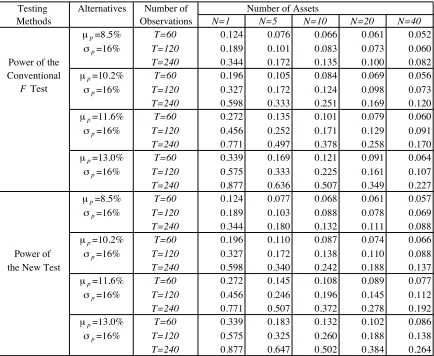
Table 2 Power of the Conventional F
Test and the New Test of the CAPM
for the Hypothesis H
0: a=0, H
1: a=
m
.
Testing Alternatives Number of Number of Assets
Methods Observations N=1 N=5 N=10 N=20 N=40
µp=8.5% T=60 0.124 0.076 0.066 0.061 0.052
!p=16% T=120 0.189 0.101 0.083 0.073 0.060
Power of the T=240 0.344 0.172 0.135 0.100 0.082
Conventional µp=10.2% T=60 0.196 0.105 0.084 0.069 0.056
F Test !p=16% T=120 0.327 0.172 0.124 0.098 0.073
T=240 0.598 0.333 0.251 0.169 0.120 µp=11.6% T=60 0.272 0.135 0.101 0.079 0.060
!p=16% T=120 0.456 0.252 0.171 0.129 0.091
T=240 0.771 0.497 0.378 0.258 0.170 µp=13.0% T=60 0.339 0.169 0.121 0.091 0.064
!p=16% T=120 0.575 0.333 0.225 0.161 0.107
T=240 0.877 0.636 0.507 0.349 0.227 µp=8.5% T=60 0.124 0.077 0.068 0.061 0.057
!p=16% T=120 0.189 0.103 0.088 0.078 0.069
T=240 0.344 0.180 0.132 0.111 0.088 µp=10.2% T=60 0.196 0.110 0.087 0.074 0.066
Power of !p=16% T=120 0.327 0.172 0.138 0.110 0.088
the New Test T=240 0.598 0.340 0.242 0.188 0.137
µp=11.6% T=60 0.272 0.145 0.108 0.089 0.077
!p=16% T=120 0.456 0.246 0.196 0.145 0.112
T=240 0.771 0.507 0.372 0.278 0.192 µp=13.0% T=60 0.339 0.183 0.132 0.102 0.086
!p=16% T=120 0.575 0.325 0.260 0.188 0.138
T=240 0.877 0.647 0.502 0.384 0.264 Notes: The table reports simulation results on the case of the null hypothesis H0:aj=0, j=1,…,N
against H1:aj=µ, j=1,…,N. The non-central variables of the F test and the new test are represented
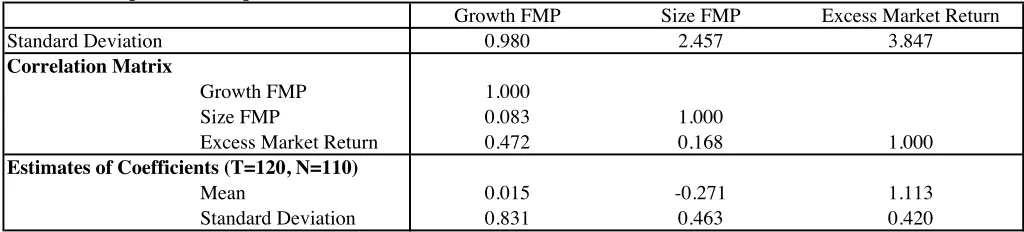
Table 3 Properties of Factors and Their Regression Coefficients
A. Entire Sample Period (April 1989 - March 1999)
Growth FMP Size FMP Excess Market Return
Standard Deviation 0.980 2.457 3.847
Correlation Matrix
Growth FMP 1.000
Size FMP 0.083 1.000
Excess Market Return 0.472 0.168 1.000
Estimates of Coefficients (T=120, N=110)
Mean 0.015 -0.271 1.113
Standard Deviation 0.831 0.463 0.420
B. Second Half Sample Period (April 1994 - March 1999)
Growth FMP Size FMP Excess Market Return
Standard Deviation 1.139 2.493 3.979
Correlation Matrix
Growth FMP 1.000
Size FMP 0.075 1.000
Excess Market Return 0.550 0.102 1.000
Estimates of Coefficients (T=60, N=50)
Mean -0.109 -0.246 0.980
Standard Deviation 1.062 0.487 0.477
Notes: All factor returns are monthly log-returns and have the expected value of zero.
The entire sample preiod (Panel A) is used for T=120, and the second half sample period (Panel B)
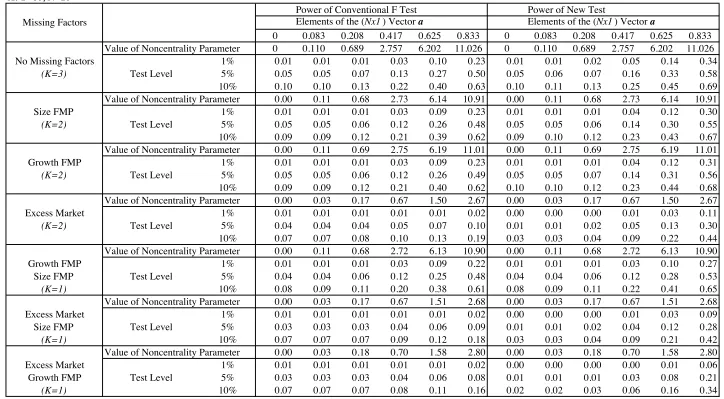
Table 4 Power of the Conventional F
Test and the New Test of Linear Factor Model for the Null Hypothesis H
0 M: a=0
against the Alternative Hypothesis H
1M
: a=
m
in the Presence of Missing Factors
A. T=60, N=10
Power of Conventional F Test Power of New Test
Missing Factors Elements of the (Nx1) Vector a Elements of the (Nx1) Vector a
0 0.083 0.208 0.417 0.625 0.833 0 0.083 0.208 0.417 0.625 0.833 Value of Noncentrality Parameter 0 0.110 0.689 2.757 6.202 11.026 0 0.110 0.689 2.757 6.202 11.026
No Missing Factors 1% 0.01 0.01 0.01 0.03 0.10 0.23 0.01 0.01 0.02 0.05 0.14 0.34
(K=3) Test Level 5% 0.05 0.05 0.07 0.13 0.27 0.50 0.05 0.06 0.07 0.16 0.33 0.58
10% 0.10 0.10 0.13 0.22 0.40 0.63 0.10 0.11 0.13 0.25 0.45 0.69 Value of Noncentrality Parameter 0.00 0.11 0.68 2.73 6.14 10.91 0.00 0.11 0.68 2.73 6.14 10.91
Size FMP 1% 0.01 0.01 0.01 0.03 0.09 0.23 0.01 0.01 0.01 0.04 0.12 0.30
(K=2) Test Level 5% 0.05 0.05 0.06 0.12 0.26 0.48 0.05 0.05 0.06 0.14 0.30 0.55
10% 0.09 0.09 0.12 0.21 0.39 0.62 0.09 0.10 0.12 0.23 0.43 0.67 Value of Noncentrality Parameter 0.00 0.11 0.69 2.75 6.19 11.01 0.00 0.11 0.69 2.75 6.19 11.01
Growth FMP 1% 0.01 0.01 0.01 0.03 0.09 0.23 0.01 0.01 0.01 0.04 0.12 0.31
(K=2) Test Level 5% 0.05 0.05 0.06 0.12 0.26 0.49 0.05 0.05 0.07 0.14 0.31 0.56
10% 0.09 0.09 0.12 0.21 0.40 0.62 0.10 0.10 0.12 0.23 0.44 0.68 Value of Noncentrality Parameter 0.00 0.03 0.17 0.67 1.50 2.67 0.00 0.03 0.17 0.67 1.50 2.67
Excess Market 1% 0.01 0.01 0.01 0.01 0.01 0.02 0.00 0.00 0.00 0.01 0.03 0.11
(K=2) Test Level 5% 0.04 0.04 0.04 0.05 0.07 0.10 0.01 0.01 0.02 0.05 0.13 0.30
10% 0.07 0.07 0.08 0.10 0.13 0.19 0.03 0.03 0.04 0.09 0.22 0.44 Value of Noncentrality Parameter 0.00 0.11 0.68 2.72 6.13 10.90 0.00 0.11 0.68 2.72 6.13 10.90
Growth FMP 1% 0.01 0.01 0.01 0.03 0.09 0.22 0.01 0.01 0.01 0.03 0.10 0.27
Size FMP Test Level 5% 0.04 0.04 0.06 0.12 0.25 0.48 0.04 0.04 0.06 0.12 0.28 0.53
(K=1) 10% 0.08 0.09 0.11 0.20 0.38 0.61 0.08 0.09 0.11 0.22 0.41 0.65
Value of Noncentrality Parameter 0.00 0.03 0.17 0.67 1.51 2.68 0.00 0.03 0.17 0.67 1.51 2.68
Excess Market 1% 0.01 0.01 0.01 0.01 0.01 0.02 0.00 0.00 0.00 0.01 0.03 0.09
Size FMP Test Level 5% 0.03 0.03 0.03 0.04 0.06 0.09 0.01 0.01 0.02 0.04 0.12 0.28
(K=1) 10% 0.07 0.07 0.07 0.09 0.12 0.18 0.03 0.03 0.04 0.09 0.21 0.42
Value of Noncentrality Parameter 0.00 0.03 0.18 0.70 1.58 2.80 0.00 0.03 0.18 0.70 1.58 2.80
Excess Market 1% 0.01 0.01 0.01 0.01 0.01 0.02 0.00 0.00 0.00 0.00 0.01 0.06
Growth FMP Test Level 5% 0.03 0.03 0.03 0.04 0.06 0.08 0.01 0.01 0.01 0.03 0.08 0.21
(K=1) 10% 0.07 0.07 0.07 0.08 0.11 0.16 0.02 0.02 0.03 0.06 0.16 0.34
Notes: Randomly selected N excess equity returns included in S&P500 are estimated with three factors in the linear regression model; excess market return, size and growth FMP returns. Then the coefficients and the variance of disturbance terms are used to generate N excess equity returns, which are used to test the power of the F test and our new test in the presence of missing factors. See section 3.2 for a detailed explanation on the simulation proceddure. The numbers in 'Elements of
the (Nx1) Vector a' are monthly returns equivalent to 0%, 1%, 2.5%, 5%, 7.5%, and 10% in annual term. T=60 represents 60 monthly returns from April 1994 to March 1999.
B. T=60, N=50
Power of Conventional F Test Power of New Test
Missing Factors Elements of the (Nx1) Vector a Elements of the (Nx1) Vector a
0 0.083 0.208 0.417 0.625 0.833 0 0.083 0.208 0.417 0.625 0.833 Value of Noncentrality Parameter 0 0.570 3.564 14.255 32.073 57.019 0 0.570 3.564 14.255 32.073 57.019
No Missing Factors 1% 0.01 0.01 0.01 0.02 0.04 0.08 0.01 0.01 0.02 0.15 0.59 0.95
(K=3) Test Level 5% 0.05 0.06 0.06 0.10 0.17 0.29 0.05 0.06 0.11 0.37 0.82 0.99
10% 0.10 0.10 0.12 0.17 0.29 0.45 0.11 0.12 0.18 0.50 0.89 1.00 Value of Noncentrality Parameter 0.00 0.55 3.46 13.84 31.15 55.37 0.00 0.55 3.46 13.84 31.15 55.37
Size FMP 1% 0.01 0.01 0.01 0.02 0.04 0.09 0.01 0.01 0.02 0.13 0.56 0.94
(K=2) Test Level 5% 0.05 0.05 0.06 0.10 0.18 0.31 0.04 0.04 0.08 0.31 0.78 0.98
10% 0.10 0.10 0.12 0.18 0.30 0.47 0.08 0.09 0.14 0.45 0.86 0.99 Value of Noncentrality Parameter 0.00 0.57 3.56 14.23 32.02 56.93 0.00 0.57 3.56 14.23 32.02 56.93
Growth FMP 1% 0.01 0.01 0.01 0.02 0.05 0.10 0.01 0.01 0.02 0.14 0.57 0.95
(K=2) Test Level 5% 0.05 0.05 0.06 0.10 0.19 0.32 0.04 0.05 0.09 0.32 0.79 0.99
10% 0.10 0.10 0.12 0.18 0.31 0.48 0.09 0.09 0.15 0.46 0.87 0.99 Value of Noncentrality Parameter 0.00 0.12 0.73 2.91 6.54 11.63 0.00 0.12 0.73 2.91 6.54 11.63
Excess Market 1% 0.01 0.01 0.01 0.01 0.02 0.02 0.00 0.00 0.00 0.01 0.16 0.68
(K=2) Test Level 5% 0.05 0.05 0.05 0.05 0.07 0.09 0.00 0.00 0.01 0.06 0.38 0.87
10% 0.09 0.09 0.10 0.11 0.13 0.16 0.01 0.01 0.02 0.11 0.52 0.93 Value of Noncentrality Parameter 0.00 0.55 3.45 13.81 31.08 55.25 0.00 0.55 3.45 13.81 31.08 55.25
Growth FMP 1% 0.01 0.01 0.01 0.02 0.05 0.11 0.00 0.01 0.01 0.10 0.50 0.93
Size FMP Test Level 5% 0.05 0.05 0.06 0.10 0.19 0.34 0.03 0.04 0.06 0.27 0.74 0.98
(K=1) 10% 0.09 0.10 0.12 0.18 0.31 0.51 0.06 0.07 0.12 0.40 0.84 0.99
Value of Noncentrality Parameter 0.00 0.12 0.73 2.91 6.55 11.65 0.00 0.12 0.73 2.91 6.55 11.65
Excess Market 1% 0.01 0.01 0.01 0.01 0.02 0.02 0.00 0.00 0.00 0.01 0.13 0.63
Size FMP Test Level 5% 0.05 0.05 0.05 0.06 0.07 0.09 0.00 0.00 0.00 0.05 0.34 0.85
(K=1) 10% 0.09 0.09 0.10 0.11 0.13 0.17 0.00 0.01 0.01 0.09 0.48 0.91
Value of Noncentrality Parameter 0.00 0.10 0.61 2.45 5.52 9.81 0.00 0.10 0.61 2.45 5.52 9.81
Excess Market 1% 0.01 0.01 0.01 0.01 0.01 0.02 0.00 0.00 0.00 0.00 0.06 0.46
Growth FMP Test Level 5% 0.04 0.04 0.05 0.05 0.06 0.08 0.00 0.00 0.00 0.02 0.21 0.73
(K=1) 10% 0.09 0.09 0.09 0.10 0.12 0.15 0.00 0.00 0.00 0.05 0.33 0.83
Notes: Randomly selected N excess equity returns included in S&P500 are estimated with three factors in the linear regression model; excess market return, size and growth FMP returns. Then the coefficients and the variance of disturbance terms are used to generate
N excess equity returns, which are used to test the power of the F test and our new test in the presence of missing factors.
See section 3.2 for a detailed explanation on the simulation proceddure. The numbers in 'Elements of the (Nx1) Vector a' are monthly returns equivalent to 0%, 1%, 2.5%, 5%, 7.5%, and 10% in annual term. T=60 represents 60 monthly returns from April 1994 to March 1999.
C. T=120, N=10
Power of Conventional F Test Power of New Test
Missing Factors Elements of the (Nx1) Vector a Elements of the (Nx1) Vector a
0 0.083 0.208 0.417 0.625 0.833 0 0.083 0.208 0.417 0.625 0.833 Value of Noncentrality Parameter 0 0.205 1.281 5.123 11.526 20.490 0 0.205 1.281 5.123 11.526 20.490
No Missing Factors 1% 0.01 0.01 0.02 0.09 0.31 0.67 0.01 0.01 0.03 0.12 0.39 0.75
(K=3) Test Level 5% 0.05 0.05 0.08 0.24 0.56 0.86 0.05 0.06 0.10 0.28 0.61 0.90
10% 0.10 0.11 0.16 0.37 0.69 0.92 0.10 0.11 0.17 0.39 0.72 0.94 Value of Noncentrality Parameter 0.00 0.20 1.28 5.12 11.51 20.46 0.00 0.20 1.28 5.12 11.51 20.46
Size FMP 1% 0.01 0.01 0.02 0.09 0.31 0.66 0.01 0.01 0.02 0.10 0.35 0.72
(K=2) Test Level 5% 0.04 0.05 0.08 0.23 0.55 0.85 0.04 0.05 0.08 0.25 0.58 0.88
10% 0.09 0.10 0.15 0.36 0.68 0.92 0.09 0.10 0.15 0.37 0.71 0.94 Value of Noncentrality Parameter 0.00 0.20 1.28 5.12 11.52 20.48 0.00 0.20 1.28 5.12 11.52 20.48
Growth FMP 1% 0.01 0.01 0.02 0.09 0.31 0.66 0.01 0.01 0.02 0.10 0.35 0.72
(K=2) Test Level 5% 0.04 0.05 0.08 0.24 0.55 0.85 0.04 0.05 0.08 0.25 0.58 0.88
10% 0.09 0.10 0.15 0.36 0.69 0.92 0.09 0.10 0.15 0.37 0.71 0.94 Value of Noncentrality Parameter 0.00 0.05 0.30 1.18 2.66 4.74 0.00 0.05 0.30 1.18 2.66 4.74
Excess Market 1% 0.01 0.01 0.01 0.01 0.02 0.05 0.00 0.00 0.00 0.02 0.12 0.40
(K=2) Test Level 5% 0.03 0.03 0.04 0.05 0.10 0.20 0.01 0.01 0.02 0.08 0.30 0.66
10% 0.07 0.07 0.08 0.11 0.19 0.33 0.03 0.03 0.05 0.16 0.44 0.79 Value of Noncentrality Parameter 0.00 0.20 1.28 5.12 11.51 20.46 0.00 0.20 1.28 5.12 11.51 20.46
Growth FMP 1% 0.01 0.01 0.02 0.08 0.30 0.66 0.01 0.01 0.02 0.09 0.32 0.69
Size FMP Test Level 5% 0.04 0.05 0.08 0.23 0.55 0.85 0.04 0.05 0.08 0.24 0.57 0.87
(K=1) 10% 0.09 0.10 0.14 0.36 0.68 0.92 0.09 0.10 0.14 0.36 0.70 0.93
Value of Noncentrality Parameter 0.00 0.05 0.30 1.18 2.66 4.72 0.00 0.05 0.30 1.18 2.66 4.72
Excess Market 1% 0.01 0.01 0.01 0.01 0.02 0.05 0.00 0.00 0.00 0.02 0.10 0.37
Size FMP Test Level 5% 0.03 0.03 0.03 0.05 0.09 0.19 0.01 0.01 0.02 0.08 0.30 0.65
(K=1) 10% 0.07 0.07 0.07 0.11 0.18 0.32 0.02 0.03 0.04 0.15 0.43 0.78
Value of Noncentrality Parameter 0.00 0.05 0.31 1.26 2.83 5.02 0.00 0.05 0.31 1.26 2.83 5.02
Excess Market 1% 0.01 0.01 0.01 0.01 0.02 0.04 0.00 0.00 0.00 0.01 0.07 0.31
Growth FMP Test Level 5% 0.03 0.03 0.03 0.05 0.09 0.17 0.01 0.01 0.01 0.06 0.24 0.59
(K=1) 10% 0.07 0.07 0.07 0.10 0.17 0.29 0.02 0.02 0.03 0.12 0.37 0.73
Notes: Randomly selected N excess equity returns included in S&P500 are estimated with three factors in the linear regression model; excess market return, size and growth FMP returns. Then the coefficients and the variance of disturbance terms are used to generate
N excess equity returns, which are used to test the power of the F test and our new test in the presence of missing factors.
See section 3.2 for a detailed explanation on the simulation proceddure. The numbers in 'Elements of the (Nx1) Vector a' are monthly returns equivalent to 0%, 1%, 2.5%, 5%, 7.5%, and 10% in annual term. T=120 represents 120 monthly returns from April 1989 to March 1999.
D. T=120, N=110
Power of Conventional F Test Power of New Test
Missing Factors Elements of the (Nx1) Vector a Elements of the (Nx1) Vector a
0 0.083 0.208 0.417 0.625 0.833 0 0.083 0.208 0.417 0.625 0.833 Value of Noncentrality Parameter 0 2.303 14.395 57.578 129.551 230.314 0 2.303 14.395 57.578 129.551 230.314
No Missing Factors 1% 0.01 0.01 0.01 0.03 0.08 0.18 0.01 0.02 0.10 0.83 1.00 1.00
(K=3) Test Level 5% 0.05 0.05 0.07 0.14 0.29 0.52 0.05 0.07 0.25 0.94 1.00 1.00
10% 0.10 0.11 0.13 0.25 0.46 0.71 0.10 0.13 0.37 0.97 1.00 1.00 Value of Noncentrality Parameter 0.00 2.17 13.53 54.14 121.81 216.55 0.00 2.17 13.53 54.14 121.81 216.55
Size FMP 1% 0.01 0.01 0.01 0.03 0.09 0.21 0.01 0.01 0.06 0.78 1.00 1.00
(K=2) Test Level 5% 0.05 0.05 0.06 0.14 0.31 0.55 0.03 0.05 0.20 0.92 1.00 1.00
10% 0.09 0.10 0.13 0.25 0.48 0.73 0.08 0.10 0.32 0.96 1.00 1.00 Value of Noncentrality Parameter 0.00 2.30 14.38 57.52 129.41 230.07 0.00 2.30 14.38 57.52 129.41 230.07
Growth FMP 1% 0.01 0.01 0.01 0.03 0.10 0.23 0.01 0.01 0.08 0.80 1.00 1.00
(K=2) Test Level 5% 0.05 0.05 0.07 0.15 0.33 0.58 0.04 0.06 0.23 0.93 1.00 1.00
10% 0.09 0.10 0.13 0.27 0.50 0.76 0.09 0.12 0.35 0.97 1.00 1.00 Value of Noncentrality Parameter 0.00 0.30 1.90 7.61 17.13 30.45 0.00 0.30 1.90 7.61 17.13 30.45
Excess Market 1% 0.01 0.01 0.01 0.01 0.02 0.02 0.00 0.00 0.00 0.13 0.96 1.00
(K=2) Test Level 5% 0.05 0.05 0.05 0.06 0.07 0.10 0.00 0.00 0.00 0.33 0.99 1.00
10% 0.09 0.10 0.10 0.12 0.14 0.18 0.00 0.00 0.01 0.48 1.00 1.00 Value of Noncentrality Parameter 0.00 2.16 13.49 53.94 121.37 215.77 0.00 2.16 13.49 53.94 121.37 215.77
Growth FMP 1% 0.01 0.01 0.01 0.03 0.10 0.25 0.01 0.01 0.06 0.77 1.00 1.00
Size FMP Test Level 5% 0.04 0.05 0.07 0.15 0.34 0.60 0.03 0.05 0.19 0.91 1.00 1.00
(K=1) 10% 0.09 0.10 0.13 0.27 0.52 0.78 0.07 0.09 0.30 0.96 1.00 1.00
Value of Noncentrality Parameter 0.00 0.28 1.76 7.06 15.88 28.22 0.00 0.28 1.76 7.06 15.88 28.22
Excess Market 1% 0.01 0.01 0.01 0.01 0.01 0.02 0.00 0.00 0.00 0.11 0.95 1.00
Size FMP Test Level 5% 0.04 0.04 0.05 0.06 0.07 0.09 0.00 0.00 0.00 0.30 0.99 1.00
(K=1) 10% 0.09 0.09 0.10 0.11 0.14 0.18 0.00 0.00 0.01 0.44 1.00 1.00
Value of Noncentrality Parameter 0.00 0.31 1.93 7.73 17.40 30.93 0.00 0.31 1.93 7.73 17.40 30.93
Excess Market 1% 0.01 0.01 0.01 0.01 0.02 0.02 0.00 0.00 0.00 0.06 0.89 1.00
Growth FMP Test Level 5% 0.04 0.05 0.05 0.06 0.07 0.10 0.00 0.00 0.00 0.19 0.98 1.00
(K=1) 10% 0.09 0.09 0.09 0.11 0.14 0.18 0.00 0.00 0.00 0.30 0.99 1.00
Notes: Randomly selected N excess equity returns included in S&P500 are estimated with three factors in the linear regression model; excess market return, size and growth FMP returns. Then the coefficients and the variance of disturbance terms are used to generate
N excess equity returns, which are used to test the power of the F test and our new test in the presence of missing factors.
See section 3.2 for a detailed explanation on the simulation proceddure. The numbers in 'Elements of the (Nx1) Vector a' are monthly returns equivalent to 0%, 1%, 2.5%, 5%, 7.5%, and 10% in annual term. T=120 represents 120 monthly returns from April 1989 to March 1999.
E. T=60, N=110
Power of New Test
Missing Factors Elements of the (Nx1) Vector a
0 0.083 0.208 0.417 0.625 0.833
Value of Noncentrality Parameter 0 1.195 7.469 29.876 67.221 119.503
No Missing Factors 1% 0.01 0.01 0.04 0.32 0.90 1.00
(K=3) Test Level 5% 0.05 0.06 0.13 0.56 0.97 1.00
10% 0.10 0.12 0.22 0.69 0.99 1.00
Value of Noncentrality Parameter 0.00 1.10 6.88 27.53 61.93 110.10
Size FMP 1% 0.01 0.01 0.03 0.27 0.88 1.00
(K=2) Test Level 5% 0.04 0.05 0.10 0.50 0.96 1.00
10% 0.08 0.09 0.17 0.64 0.98 1.00
Value of Noncentrality Parameter 0.00 1.18 7.37 29.49 66.34 117.94
Growth FMP 1% 0.01 0.01 0.03 0.29 0.89 1.00
(K=2) Test Level 5% 0.04 0.05 0.11 0.53 0.97 1.00
10% 0.09 0.10 0.19 0.66 0.99 1.00
Value of Noncentrality Parameter 0.00 0.24 1.50 6.00 13.50 24.00
Excess Market 1% 0.00 0.00 0.00 0.01 0.32 0.94
(K=2) Test Level 5% 0.00 0.00 0.00 0.05 0.56 0.99
10% 0.00 0.00 0.00 0.11 0.70 1.00
Value of Noncentrality Parameter 0.00 1.09 6.82 27.29 61.40 109.16
Growth FMP 1% 0.00 0.00 0.02 0.20 0.83 1.00
Size FMP Test Level 5% 0.03 0.03 0.08 0.45 0.95 1.00
(K=1) 10% 0.06 0.07 0.14 0.58 0.98 1.00
Value of Noncentrality Parameter 0.00 0.24 1.50 5.99 13.47 23.94
Excess Market 1% 0.00 0.00 0.00 0.01 0.23 0.91
Size FMP Test Level 5% 0.00 0.00 0.00 0.04 0.50 0.98
(K=1) 10% 0.00 0.00 0.00 0.08 0.64 0.99
Value of Noncentrality Parameter 0.00 0.22 1.39 5.56 12.50 22.23
Excess Market 1% 0.00 0.00 0.00 0.00 0.09 0.75
Growth FMP Test Level 5% 0.00 0.00 0.00 0.01 0.27 0.92
(K=1) 10% 0.00 0.00 0.00 0.02 0.41 0.96
Notes: Randomly selected N excess equity returns included in S&P500 are estimated with three factors in the linear regression model; excess market return, size and growth FMP returns. Then the coefficients and the variance of disturbance terms are used to generate
N excess equity returns, which are used to test the power of the new test in the presence of missing factors.
See section 3.2 for a detailed explanation on the simulation proceddure. The numbers in 'Elements of the (Nx1) Vector a' are monthly returns equivalent to 0%, 1%, 2.5%, 5%, 7.5%, and 10% in annual term. T=60 represents 60 monthly returns from April 1994 to March 1999. Note that the conventional F test is not available in this case. K is the number of factors used for the power test.
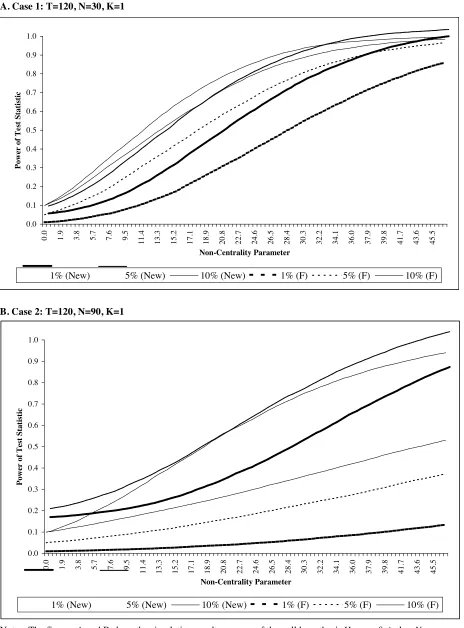
Figure 1 Power of the New and F
(N, T-N-K
) Test Statistics for the Null Hypothesis
H
0: a
j=0
for all j
against the Alternative Hypothesis H
1: a
1=
m
and a
j=0 for j
>1:
A. Case 1: T=120, N=30, K=1
B. Case 2: T=120, N=90, K=1
Notes: The figures A and B show the simulation results on case of the null hypothesis H0:aj=0, j=1,...,N
against the alternative hypothesis H1:aj=µ, for j=1, and aj=0, for j=2,...,N. Simulation procedures
are explained in section 3.2. The non-central variables for the alternative hypothesis are generated with equations (24) and (25) for the conventional F test and the new test, respectively.
0.0 0.1 0.2 0.3 0.4 0.5 0.6 0.7 0.8 0.9 1.0
0.0 1.9 3.8 5.7 7.6 9.5 11.4 13.3 15.2 17.1 18.9 20.8 22.7 24.6 26.5 28.4 30.3 32.2 34.1 36.0 37.9 39.8 41.7 43.6 45.5
Non-Centrality Parameter P o w er o f T es t S ta ti st ic
1% (New) 5% (New) 10% (New) 1% (F) 5% (F) 10% (F) 0.0 0.1 0.2 0.3 0.4 0.5 0.6 0.7 0.8 0.9 1.0
0.0 1.9 3.8 5.7 7.6 9.5 11.4 13.3 15.2 17.1 18.9 20.8 22.7 24.6 26.5 28.4 30.3 32.2 34.1 36.0 37.9 39.8 41.7 43.6 45.5
Non-Centrality Parameter P o w er o f T es t S ta ti st ic
!
!"#$%&'()*)+#,(,+#%+,(
(
List of other working papers:
1999
1. Yin-Wong Cheung, Menzie Chinn and Ian Marsh, How do UK-Based Foreign Exchange Dealers Think Their Market Operates?, WP99-21
2. Soosung Hwang, John Knight and Stephen Satchell, Forecasting Volatility using LINEX Loss Functions, WP99-20
3. Soosung Hwang and Steve Satchell, Improved Testing for the Efficiency of Asset Pricing Theories in Linear Factor Models, WP99-19
4. Soosung Hwang and Stephen Satchell, The Disappearance of Style in the US Equity Market, WP99-18
5. Soosung Hwang and Stephen Satchell, Modelling Emerging Market Risk Premia Using Higher Moments, WP99-17
6. Soosung Hwang and Stephen Satchell, Market Risk and the Concept of Fundamental Volatility: Measuring Volatility Across Asset and Derivative Markets and Testing for the Impact of Derivatives Markets on Financial Markets, WP99-16
7. Soosung Hwang, The Effects of Systematic Sampling and Temporal Aggregation on Discrete Time Long Memory Processes and their Finite Sample Properties, WP99-15
8. Ronald MacDonald and Ian Marsh, Currency Spillovers and Tri-Polarity: a Simultaneous Model of the US Dollar, German Mark and Japanese Yen, WP99-14
9. Robert Hillman, Forecasting Inflation with a Non-linear Output Gap Model, WP99-13
10.Robert Hillman and Mark Salmon , From Market Micro-structure to Macro Fundamentals: is there Predictability in the Dollar-Deutsche Mark Exchange Rate?, WP99-12
11.Renzo Avesani, Giampiero Gallo and Mark Salmon, On the Evolution of Credibility and Flexible Exchange Rate Target Zones, WP99-11
12.Paul Marriott and Mark Salmon, An Introduction to Differential Geometry in Econometrics, WP99-10
13.Mark Dixon, Anthony Ledford and Paul Marriott, Finite Sample Inference for Extreme Value Distributions, WP99-09
14.Ian Marsh and David Power, A Panel-Based Investigation into the Relationship Between Stock Prices and Dividends, WP99-08
15.Ian Marsh, An Analysis of the Performance of European Foreign Exchange Forecasters, WP99-07
16.Frank Critchley, Paul Marriott and Mark Salmon, An Elementary Account of Amari's Expected Geometry, WP99-06
17.Demos Tambakis and Anne-Sophie Van Royen, Bootstrap Predictability of Daily Exchange Rates in ARMA Models, WP99-05
18.Christopher Neely and Paul Weller, Technical Analysis and Central Bank Intervention, WP99-04
19.Christopher Neely and Paul Weller, Predictability in International Asset Returns: A Re-examination, WP99-03
20.Christopher Neely and Paul Weller, Intraday Technical Trading in the Foreign Exchange Market, WP99-02
21.Anthony Hall, Soosung Hwang and Stephen Satchell, Using Bayesian Variable Selection Methods to Choose Style Factors in Global Stock Return Models, WP99-01
1998
1. Soosung Hwang and Stephen Satchell, Implied Volatility Forecasting: A Compaison of Different Procedures Including Fractionally Integrated Models with Applications to UK Equity Options, WP98-05
4. Adam Kurpiel and Thierry Roncalli , Option Hedging with Stochastic Volatility, WP98-02