Original citation:
Young, Mark S., Birrell, Stewart A. and Stanton, Neville A.. (2011) Safe driving in a green world : a review of driver performance benchmarks and technologies to support ‘smart’ driving. Applied Ergonomics, Vol.42 (No.4). pp. 533-539.
Permanent WRAP url:
http://wrap.warwick.ac.uk/53202
Copyright and reuse:
The Warwick Research Archive Portal (WRAP) makes this work of researchers of the University of Warwick available open access under the following conditions. Copyright © and all moral rights to the version of the paper presented here belong to the individual author(s) and/or other copyright owners. To the extent reasonable and practicable the material made available in WRAP has been checked for eligibility before being made available.
Copies of full items can be used for personal research or study, educational, or not-for-profit purposes without prior permission or charge. Provided that the authors, title and full bibliographic details are credited, a hyperlink and/or URL is given for the original metadata page and the content is not changed in any way.
Publisher statement:
“NOTICE: this is the author’s version of a work that was accepted for publication in Applied Ergonomics.Changes resulting from the publishing process, such as peer review, editing, corrections, structural formatting, and other quality control mechanisms may not be reflected in this document. Changes may have been made to this work since it was submitted for publication. A definitive version was subsequently published in (see Original citation above).
http://dx.doi.org/10.1016/j.apergo.2010.08.012 A note on versions:
The version presented here may differ from the published version or, version of record, if you wish to cite this item you are advised to consult the publisher’s version. Please see the ‘permanent WRAP url’ above for details on accessing the published version and note that access may require a subscription.
Safe driving in a green world: a review of driver performance benchmarks and technologies
*Mark S. Young1, Stewart A. Birrell1and Neville A. Stanton2
1
Ergonomics Research Group, School of Engineering and Design, Brunel University,
Uxbridge, Middlesex UB8 3PH
2
Transportation Research Group, University of Southampton, Highfield, Southampton SO17
1BJ
* - author for correspondence
Tel: +44 (0)1895 266527
Fax: +44 (0)1895 269763
email: [email protected]
Safe driving in a green world: a review of driver performance benchmarks and
ABSTRACT
Road transport is a significant source of both safety and environmental concerns.
With climate change and fuel prices increasingly prominent on social and political
agendas, many drivers are turning their thoughts to
fuel-environmentally friendly) driving practices. Many vehicle manufacturers are
satisfying this demand by offering green driving feedback or advice tools. However,
there is a legitimate concern regarding the effects of such devices on road safety
both from the point of view of change in driving styles, as well as potential distraction
caused by the in-vehicle feedback. In this paper, we appraise the benchmarks for safe
and green driving, concluding that whilst they largely overlap, there are some specific
circumstances in which the goals are in conflict. We go on to review current and
emerging in-vehicle information systems which purport to affect safe and/or green
driving, and discuss some fundamental ergonomics principles for the design of such
devices. The results of the review are being used in the Foot-LITE project, aimed at
that is safe and green driving.
Keywords: safety, environment, driving, IVIS, interface design
öÓ¿²«-½®·°¬
λº»®»²½»-1. INTRODUCTION
Driving is a highly complex task, comprising over 1600 separate tasks over five
behavioural levels (Walker et al., 2001). Drivers simultaneously control the vehicle,
adjust speed and trajectory, deal with hazards, evaluate progress towards their goal,
and make strategic decisions such as navigation. Groeger (2000) suggests that driver
behaviour is very much goal-directed, and drivers may have multiple goals (safety,
speed, economy etc.), which at any one point in time might be in conflict. Drivers
appraise these conflicts and plan their driving accordingly.
With climate change becoming increasingly prominent on social and political
agendas, many drivers have a new goal in mind , or environmentally
friendly, driving. Whereas to date the key focus of ergonomics research in
transportation and other applied domains has quite properly been to enhance
vehicle safety and performance efficiency, it now behoves the ergonomics community
to contribute to the development of systems which encourage green driving
behaviour. Road transport is a significant source of both safety and environmental
concerns, accounting for 2.1% of global mortality (Peden and Sminkey, 2004) and
nearly 20% of total greenhouse gas emissions (EEA, 2007). Clearly, then, this is an
area where ergonomics can have a meaningful impact.
- 1 is a multidisciplinary consortium project aimed at developing a system
which will encourage drivers to drive in a safer and greener manner through on-board
interface, which delivers real-time feedback on driving style, and a post-drive
component for longer-term advice and information. The in-vehicle module is
connected to the on-board diagnostic system and uses additional monitoring sensors
to provide feedback on elements such as speed, acceleration, gear use, lane position
and headway. Journey data are then downloadable to the off-line, web-based system
for more detailed analysis and links to driver coaching modules. Foot-LITE is above
all an advisory system, providing information and feedback without intervention, on
ts of safe and green driving, with the aim
of modifying such behaviour to improve both aspects encouraging what has come to
. In order to achieve this goal, the first objective is to
ascertain the driver behaviours pertaining to both safe and green driving, to determine
whether there are any conflicts between these goals, and to establish the information
requirements for the driver. In other words, before we can develop a specification for
the Foot-LITE system, we need to defi
In this paper, written at the outset of the Foot-LITE project, we aim to establish such
benchmarks for smart driving, laying the basis for further development and
specification work for the Foot-LITE system or, indeed, any such system. We first
review the components of safe and green driving independently, before examining
where the two goals overlap and where they compete. We then close with a
s information requirements for smart driving, including a
summary of the positive and negative aspects of in-vehicle information systems
(IVIS), such as satellite navigation, congestion assistants, intelligent speed adaptation,
recent formation of the special interest group within the UK Institute for Ergonomics
and Human Factors), we hope this paper serves as a useful reference in a domain of
key relevance to environmental and ergonomics issues.
2. SAFE DRIVING
Throughout the literature, excessive driving speed consistently emerges as the single
biggest predictor of both crash risk and crash severity (Haworth and Symmons, 2001;
Taylor et al., 2002; af Wahlberg, 2006; Aarts and van Schagen, 2006). Exceeding the
speed limit or driving too fast for the conditions were identified as contributory
factors in 15% of all accidents on UK roads in 2005 (Robinson and Campbell, 2006).
Conversely, similar research indicates that for every 1 mph reduction in speed, a 5%
drop in accidents is observed (Taylor et al., 2000). It has further been suggested that
accident frequency (whether fatal, serious or minor) increases with driving speed to
the power of approximately 2.5 (Taylor et al., 2002). In other words, a 10% increase
in mean speed would result in a 26% increase in the frequency of all injury accidents.
This increases to 30% when considering just KSI (killed or serious injury) accidents
(Taylor et al, 2002). When considering the severity of an accident in crash statistics,
speed factors contributed to 26% of fatal accidents which in turn accounted for 28%
of all road fatalities (Robinson and Campbell, 2006).
It is worth noting that absolute speed is not necessarily the problem the emphasis is
on excessive speed, or inappropriate speed for the road and/or conditions. Indeed,
many roads traditionally associated with higher speeds (such as motorways) are
Nonetheless, it is well established that speeding (i.e., breaking the speed limit) is
dangerous, particularly in urban environments (Haworth and Symmons, 2001; Aarts
and van Schagen, 2006) where the number of vulnerable road users is greater.
Haworth and
fatal injuries at an impact speed of 50km/h is approximately ten times higher than at
Likewise, the tipping point between a survivable and
fatal collision for a pedestrian occurs between 50 and 60km/h.
Various parameters of speed (i.e., average speed, speed distribution, speed profile,
cruising speed, standard deviation, and free speed) are commonly used when
considering accident frequency or prediction. Related measures such as
acceleration/deceleration behaviour (af Wahlberg, 2006) and driver headway
(Brackstone and McDonald, 2007) have also been used. These will become pertinent
as we go on to discuss and contrast safe driving techniques with the components of
green driving.
Whilst speed has been identified as a major factor for unsafe driving, it is by no
means the sole contributor; others may include aggressive driving behaviours or risky
driving manoeuvres. In a review of published literature on aggressive driving, Tasca
(2000, p.2) proposed a formal definition of aggressive driving:
is aggressive if it is deliberate, likely to increase the risk of collision and is motivated
by impati Similarly, a
report published by the National Highway Traffic Safety Administration (NHTSA)
Tasca (2000)
further outlined some specific driving behaviours that meet the proposed definition,
including tailgating, weaving in and out of traffic, failure to yield the right of way to
Whilst definitions for aggressive driving have been established, the actual effect that
it has on accident statistics is more difficult to establish. A research update completed
for the American Automobile Association Foundation for Traffic Safety on aggressive
driving (AAA, 2009) suggested that 56% of fatal accidents between 2003 and 2007
involved one or more actions typically associated with aggressive driving, with
excessive speed being the number one factor. The report does recognise that these
statistics may overstate the actual effect, as ideally an estimate of the prevalence of
aggressive driving would include only instances in which such actions were
performed intentionally. A more accurate measure may be when an accident was
coded as having two or more of these potentially aggressive actions, as the report
suggests that ...
as opposed to accidentally, when a driver was coded as having committed multiple
potentially- . 8). When taking these
accidents into consideration they account for 8.4% of crashes. Interestingly, in 2004
the US database of fatal vehicle crashes (
System, or FARS) added a new code The
identification of a fatal accident using this code is very rare, accounting for only 0.2%
Although it may be argued that there are many other facets to safe driving, in this
review we have focused on those most prominent in the literature (and it is notable
that speed emerges conspicuously throughout, even as a consequence of aggressive
driving), as well as those which have most relevance for green driving behaviours. As
we shall see in the next section, speed and aggressive driving have effects on
eco-driving as much as they do on safe eco-driving.
3. GREEN DRIVING
Surprisingly, in our review we found relatively more scientific literature on the effects
of driving style on fuel economy and emissions than on how driving style affects
safety outcomes. Whilst there are several facets to the concept of green driving, for
the private driver the key controllable factors are fuel consumption and emissions.
Studies suggest that simply asking drivers to drive economically can reduce fuel
consumption by 10-15% (van der Voort et al., 2001; Waters and Laker, 1980). When
drivers are asked to drive more efficiently, they generally interpret this as to drive
slower. Indeed, Anable and Bristow (2007) estimated that enforcing the 70mph speed
limit on dual carriageways and motorways in the UK could save around one
mega-tonne of carbon per year. Reducing the speed limit to 60mph would almost double
the saving to 1.88 mega-tonnes. Generally, though, it is thought that fuel efficiency is
at its maximum between 60 and 80km/h, as this optimises the trade-off between
overcoming rolling road resistance and increasing wind resistance (Andre and
Clearly, then, simply reducing speed is not the only nor is it the optimal strategy
for eco-driving, especially considering the implications for journey time. In fact,
there are several factors other than speed which can influence both fuel consumption
and emissions; data from a study by Ericsson (2001) suggests the focus should be on
avoiding heavy acceleration, large power demands and high engine speeds. Similarly,
Johansson et al. (2003) found certain characteristics of driving behaviour that were
significantly correlated with good fuel economy, such as avoiding unnecessary stops,
maintaining low deceleration levels, minimising the use of 1st and 2nd gears,
increasing the use of 5th gear, and block changing gears where possible. Exploiting
abilities can use up to 60% more fuel than
mild or normal acceleration levels (El-Shawarby et al., 2005). More specifically,
Waters and Laker (1980) demonstrated that the optimal acceleration rate was 0.07g,
with fuel consumption increasing by 20% as acceleration increased up to 1.8g.
A report published by the Commission for Integrated Transport in the UK (CfIT,
2007) cited other evidence in favour of adopting an economical driving style for cars,
vans, buses and rail. The report contains results from a year-long study conducted in
the Netherlands, which showed that car drivers whose self-reported driving behaviour
displayed eco-driving techniques consumed 7% less fuel over the course of the study.
Some drivers associate green driving with avoiding unnecessary stops and reducing
deceleration rates. When Evans (1979) asked drivers to minimise fuel consumption,
two distinct responses were seen reducing speed and accelerations, and minimising
stops (which often result in increased acceleration). Fuel consumption savings were
minimising
subgroup but only 1.5% for the stops subgroups. Combining these observations with
the other studies reviewed here leads to the following consensus for what constitutes
green driving:
Plan ahead to avoid stopping
Use moderate engine speeds and a uniform throttle for steady speeds
Change gear up as soon as possible using positive (but not heavy) acceleration
Avoid sharp braking
Use engine braking for smooth deceleration
4. SAFE VS. GREEN DRIVING
Thus far, we have seen that there are some broad overlaps between driver behaviours
for safe and green driving, but also some specific differences. Speed, for instance, is
a significant factor in safe driving, but less important (though still relevant) for fuel
economy and emissions. Conversely, acceleration is perhaps more related to green
driving, although it is still a factor in safe driving (af Wahlberg, 2006). Nevertheless,
in each of these cases the relationship is a positive one changing the behaviour to
-versa. On the
other hand, some techniques that improve green driving may have detrimental effects
on safety. For instance, maintaining a constant speed through the avoidance of
braking may compromise headway; travelling in the highest possible gear may
adversely affect vehicle control. At the ext
following large vehicles in order to reduce drag) can be positively dangerous.
vehicle, the environment, and the driver, which could affect safety and/or fuel
economy. Notwithstanding these particular conflicts between safe and green
objectives, when it comes to driving style, on the whole a safe driver is a green driver,
with anticipation, smoothness, and sensible speed being the defining characteristics.
These characteristics of smart driving are already exemplified in some post-licensure
driver training programmes, such as that offered by
Police
Foundation, 2007; see also IAM, 2007), the IAM approach is to deal with hazards
A rigorously controlled study over eight weeks (Stanton et al., 2007) found that IAM
coaching resulted in improvements in driver skills, knowledge and attitudes. Other
research cited by Stanton et al. (2007) suggests that IAM coaching also reduces
frequency of traffic offences, as well as frequency and severity of accidents.
Moreover, direct opinion from the IAM for the Foot-LITE project is that the System
of car control designed to improve safety
-driving. Thus although the IAM programme has long
been associated with safe driving, more recently it has been promoted as a route to
eco-driving as well.
Further evidence for the overlap between safe and green driving emerges from
research into eco-driving programmes, which typically advocate a smoother driving
style and embody the principles listed at the end of the previous section. Haworth and
Symmons (2001) cited data showing a decrease of around 35% in accidents rates
consumption (11%) and emissions (23-50%). In another case study of the
effectiveness of economical driver training for van fleets, Hedges and Moss (1996)
showed that accident rates dropped by 40% after driving training. Moreover,
eco-driving training resulted in a 52% decrease in accident costs payable by the company
and an increase in fuel efficiency of over 50%.
Whilst driver training and coaching programmes can clearly result in benefits for
safety and the environment, it has been suggested that the positive effects of training
can wane over time, as drivers forget or do not feel motivated to maintain aspects of
the driving style (af Wahlberg, 2007; Johansson et al., 2003). Continuous advice and
real-time feedback can, on the other hand, enhance and maintain the benefits (Waters
and Laker, 1980). For instance, Isler and Starkey (2010) researched the use of a
sudden braking warning system which, in addition to the brake lights, flashed the
hazard warning lights above a threshold g-force for deceleration. This system
benefitted following vehicles, resulting in not only faster reaction times to the braking
event, but also a smoother deceleration thus offers theoretical improvements in fuel
consumption. Moreover, there is evidence that such advice could influence both
current behaviour as well as potentially inducing longer term behavioural adaptations
(van der Voort et al., 2001; Waters and Laker, 1980).
An in-car system such as Foot-LITE could provide just such support through real-time
driver feedback based on advanced or eco-driving techniques to improve both safety
and efficiency. Indeed, the role of future technologies in road safety has been
acknowledged by the eSafety Working Group (2002) as well as other more recent
Haworth and Symmons (2001) cautioned that fuel consumption feedback devices may
be detrimental to safety if they cause a distraction to the driver. It is important to bear
s before thinking about how to design such a device.
5. IN-VEHICLE INFORMATION SYSTEMS
Driving is widely accepted as being a predominantly visual task (Kramer and Rohr,
1982; Spence and Ho, 2009), yet it is necessary to share this resource between the
forward view of the road and other visual distractors. Whilst it has been suggested
that drivers might have up to 50% spare attentional capacity when driving (Hughes
and Cole, 1986), visual competition in driving is already high, and is a crucial factor
in driving performance (e.g., Antin, 1993). With the proliferation of IVIS and similar
nomadic devices, many authors have expressed their concerns about the potential
distraction or overload which such devices may cause (Donmez et al., 2007; Harbluk
et al., 2007; Horberry et al., 2006). Performance problems may be especially
pronounced if workload is already high (e.g., in urban driving; Liu and Lee, 2006) or
if the driver has a lower capacity to respond (e.g., in the elderly; May et al., 2005;
Sixsmith and Sixsmith, 1993). Research completed for the 100-car naturalistic
driving study by the National Traffic Highway Safety Administration (NHTSA) in the
US (Klauer et al, 2006) concluded that 78% of all crashes involved some degree of
driver inattention. More specifically, drivers distracted by a secondary task
contributed to over 22% of all crashes and near-crashes, with over a third of these
secondary tasks involving interaction with a wireless device such as a cell phone
Typical amongst IVIS devices are satellite navigation systems, but other emerging
systems include congestion assistants, intelligent speed adaptation, as well as a
number of prototype IVIS devices which purport to affect safety and/or fuel economy.
5.1. Satellite navigation systems
Satellite navigation systems are already very popular with motorists, and have
implications for safe and green driving. Many functions of modern satellite
navigation systems take considerably longer to complete and require more glances
compared to conventional controls and displays (such as headlights and windscreen
wipers, or visually checking the speed and fuel gauge). A series of related studies
(Antin, 1993; Dingus et al., 1989; Wierwille et al., 1991) attempted to assess the
visual attentional demand of moving-map displays relative to other in-car tasks.
General conclusions were that navigation tasks and displays place higher demands on
attention than do conventional (as measured by total glance duration, single glance
times, and number of fixations). However, it was also found that drivers adapt to
changes in driving demand by altering their scan patterns, suggesting that there may
be enough spare capacity to operate a navigation display (Antin, 1993). Dingus et al.
(1989) suggested some design improvements to reduce the demand of navigation
displays (and hence their impact on the driving task). These were primarily aimed at
improving the availability of information on the displays, to be more compatible with
rategy.
Of primary concern for distraction is when the driver interacts actively with the
navigation system (such as entering destination information) rather than when they
study comparing the task of destination entry to two other common in-vehicle tasks
entering a mobile phone number, and tuning the radio. Their findings suggested that,
compared to the other tasks, destination entry results in longer completion times,
greater eyes-off-road times, longer and more frequent glances to the device and a
greater number of lane excursions. Using a voice only system (with no visual
display) ameliorated the impact, but not to the level of the two comparison tasks
(Tijerina et al., 1998). A later study by Nowakowski et al. (2000) supported these
findings. Nevertheless, other research suggests that despite the long task times for
destination entry (around 30-40 seconds), the associated glance durations and
eyes-off-road times for the task are still within guidelines for safe operation (Chiang et al.,
2004).
Many satellite navigation products can optimise a route for shortest distance or fastest
time, as well as by other preferences. Ericsson et al. (2006) investigated the ability of
these systems to optimise route planning for lowest fuel consumption, using data from
a pre-existing database. The analysis suggested that 46% of trips were not maximally
fuel efficient, and that using a fuel optimised navigation system could have reduced
fuel consumption by 8.6%, corresponding to a 4% reduction across all journeys.
Moreover, the most fuel efficient route also saved on average 8.5% in journey time.
Enhancing the navigation system to include real-time congestion monitoring led to a
further 7.6% reduction in fuel consumption, though naturally this had the most
potential in congested areas. The authors suggested existing navigation systems can
offer a fuel saving potential, since 82% of the most fuel efficient routes were the same
5.2. Congestion assistants
Given the consequences of traffic jams for fuel consumption, two studies have
investigated the impacts of a congestion assistant (CA) on driving behaviour,
acceptance and workload in a driving simulator (Brookhuis et al., 2009; van Driel et
al., 2007). The CA consisted of three functions: congestion warning and information,
an active gas pedal (counterforce is applied to the pedal when approaching the jam if
the system judges speed to be and
task is taken over by the system when in the jam). Whilst the congestion warning had
no impact on driving behaviour, the active gas pedal reduced mean speed across the
trial, and the stop and go function reduced acceleration levels as well as headway
when in congested traffic. The authors concluded that these systems improved safety
(by reducing speed on approach to a traffic jam), enhanced traffic efficiency (due to
reduced headway times), and reduced emissions (through lower accelerations).
Whilst workload was observed to be reduced during the congestion period, there was
potential for workload increases to be observed on the approach to congestion. As a
negative consequence of using the system, time headway for manual driving was
shorter after the jam than before possibly a result of acclimatisation to shorter
headways with the CA system. Furthermore, whilst driver acceptance of the stop and
go system was good, the active gas pedal was the least accepted function by drivers in
this study, a finding in common with research suggesting that systems which restrict
5.3. Intelligent Speed Adaptation
Intelligent Speed Adaptation (ISA) is another system which faces similar issues of
safety case for ISA has been well documented (e.g., Carsten and Tate, 2005; although
see Young et al., 2007, for a view of some safety concerns with ISA), and ISA may
have environmental benefits too, by encouraging a smoother traffic flow. Servin et al.
(2006) used simulation modelling to demonstrate that ISA could reduce fuel use by up
to 70% and emissions by up to 93%, although the effects would be restricted to highly
congested conditions. In these conditions, the system also reduced travel time by
15%. These data are optimistic, though, as the savings were calculated against a 0%
penetration rate (i.e., no cars fitted with ISA) compared to 100% penetration (every
car fitted with ISA). Nevertheless, with high congestion it was shown that a
penetration rate of only 20% would deliver a 40% saving in fuel consumption and
would reduce emissions by 30-80% in ISA-fitted cars.
5.4. Other green driving systems
More specific prototype green driving tools have also been investigated. Widodo et
al. (2000) estimated fuel consumption and emissions using a green driving style
(reducing speed on approach to red traffic lights) either with or without in-vehicle
advice about the state of the traffic lights ahead. In the study, fuel use and emissions
decreased by between 8 and 30%. When traffic volume was high, using the in-vehicle
advice was more efficient than applying the driving style alone; the reverse was true
under low traffic volumes. Similarly, van der Voort et al. (2001) used a driving
simulator to evaluate different levels of green driving feedback against normal
driving. Drivers either used an existing system (which gave average miles per gallon
and LEDs for an indication of fuel economy) or were given enhanced advice about
optimal gear shift behaviour. The enhanced advice reduced fuel consumption by 16%
environment. As with other green driving techniques, there was no significant
difference in trip time between any of the trials mainly by avoiding unnecessary
stops.
In sum, various types of IVIS device that can contribute towards smart driving have
been available for some time now, and more are emerging. Several systems (e.g.,
satnav, congestion assistants, ISA) can have ancillary benefits for both safe and green
driving, while specific devices for green driving assistance are emerging. The
evidence suggests that these tools are most effective in urban environments, and that
unlike training programmes the benefits are maintained over time. Whilst such
devices may offer tangible benefits, the increased competition for limited attentional
resources within vehicles may ultimately affect performance (Schlegel, 1993); thus
devices should be designed according to robust ergonomics principles to ensure
positive benefits are gained while negative impacts on workload or distraction are
avoided. Indeed, codes of practice for the design and development of such systems
are beginning to emerge (e.g., Amditis et al., 2010; Cotter et al., 2006). More
specifically, work conducted by van Driel et al. (2002) presents some lessons learned
in this area based on user needs and evaluations of a green driving advice tool similar
to the Foot-LITE concept. It was suggested that future devices should support drivers
by giving directed advice including positive feedback to improve fuel economy or
driving style.
This paper aimed to set the benchmarks for what constitutes both safe
and green) driving, as a basis for determining the driver information requirements
for a smart driving IVIS tool such as Foot-LITE. We reviewed the ergonomics and
related driving performance literature to establish these benchmarks and the viability
of the Foot-LITE system. It was clear that driving style can measurably impact upon
safety and environmental friendliness, and for the most part the behaviours affecting
these two objectives (such as speed and aggression) are correlated. Furthermore,
there was evidence that although driver training can improve driving behaviour, the
effects are outlived by ongoing feedback, such as that provided by an IVIS advisor.
Various types of existing IVIS device were reviewed which can have ancillary
benefits for both safe and green driving, while there is a burgeoning market for
specific green driver assistance products. The evidence suggests that as with
training programmes these tools are most effective in urban environments, and that
unlike training programmes the benefits are maintained over time. Thus there is a
good basis for the Foot-LITE system to effectively contribute to both safe and green
driving.
Notwithstanding these positive conclusions, we also found that in specific instances,
the behaviours for safe and green driving can be in conflict. A system such as
Foot-LITE will need to manage these conflicts, and we steadfastly believe that the rational
conclusion in these instances is always to prioritise safety. Bearing this trade-off in
mind, we can revisit the green driving factors presented in section 3 of this paper to
propose a combined list of benchmarks for smart driving:
Use smooth but positive acceleration to reach high gears sooner, and use
engine braking for smooth deceleration
Use moderate engine speeds and a uniform throttle for steady speeds
Obey speed limits
The Institute for Advanced Motorists IAM, 2007) is highly
compatible with such smart driving, and the Foot-LITE project has adopted the IAM
model as the basis for its driver feedback product. Whilst there is good evidence that
IAM coaching improves driver skills (Stanton et al., 2007), as well as supposition that
it can also benefit eco-driving, so far there is no objective data on the specific effects
of IAM driving on fuel use and/or emissions. Establishing these data and validating
the assumption is one of the research goals of the Foot-LITE project.
Having established, at a high level, the information requirements of the driver, we
also considered the requirements for information presentation. Any IVIS interface
m
performance, and a safety-oriented system such as Foot-LITE must embody best
practice ergonomics principles to minimise issues of distraction or overload from the
information display. However, whereas there is ample research into the human
factors implications of safety-related IVIS devices, in most cases the evidence
regarding green driving IVIS tools is restricted to their effects on fuel economy and/or
emissions. There appears to be little addressing any distraction or safety effects of
using a green driving interface. Notably, many of the benefits of such tools are most
conditions of high driver workload and so less spare capacity is likely to be available
(Harms, 1991; Zeitlin, 1995), increasing the potential for distraction.
A system such as Foot-LITE could, therefore, improve both safety and efficiency, as
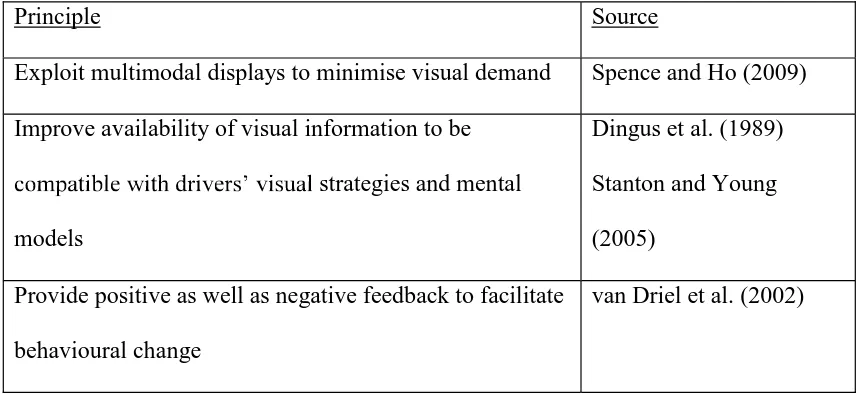
long as it is designed according to robust ergonomics principles (summarised in table
1). Lessons can and should be learned from analogous systems, and ergonomic
design guidance for such systems has recently become available (e.g., Amditis et al.,
2010; Cotter et al., 2006; van Driel et al., 2002). Both attention and mental workload
must be considered as key human factors; many authors agree that a key goal of
design is to maximise the match between task demands and human capacity (e.g.,
Bainbridge, 1991; Gopher and Kimchi, 1989; Lovesey, 1995; Neerincx and Griffioen,
1996). One way of achieving this, particularly in the visually intensive environment
of driving, would be to exploit multimodal displays (cf. Spence and Ho, 2009).
Where visual information is unavoidable, the interface should be designed to reduce
visual demand by improving the availability of information, to be compatible with the
short glance strategies used by drivers (cf. Dingus et al., 1989). Finally, in order to
facilitate behavioural change for a hypothetical IVIS smart driving advisor (such as
Foot-LITE), the feedback provided should be positive as well as negative (van Driel
et al., 2002).
INSERT TABLE 1 ABOUT HERE
Following the outcome of this review, more research is clearly needed in several areas
related to smart driving, and over the course of the Foot-LITE project these areas will
to be validated in contributing not only towards safe driving, but also eco-driving.
More specifically, any proposed smart driving interface must be able to demonstrate
an increase in desired behaviours while avoiding an increase in negative effects such
as distraction. The possibility of an adaptive interface, which regulates the level of
information (again prioritising safety-related information) according to task demands,
will also be investigated. Driving according to smart principles may in itself be
demanding, and consequently increase driver workload; this possibility needs to be
factored into any evaluation in the same way as other performance implications (such
as journey time) have previously been addressed.
From here, the next steps in the Foot-LITE project are: to elaborate on the information
requirements using a Cognitive Work Analysis (CWA) process, to develop a set of
candidate interface designs which meet the information presentation requirements
stated above (including multimodal displays), and to test the effects of these interfaces
on driver performance and workload. Although research has so far investigated safe
and green IVIS devices separately, nobody has yet brought them together in a single
integrated smart driving information system. Based on the review in this paper, the
Foot-LITE project can progress to development of the system, ensuring that green
driving does not come at the expense of safe driving. Indeed, whilst the growing
interest in green ergonomics more generally is laudable, we would suggest that this
should be an abiding principle across domains.
ACKNOWLEDGEMENTS
Technology Strategy Board under the Future Intelligent Transport Systems initiative.
The Foot-LITE consortium is comprised of: MIRA, TRW, Auto-txt, Hampshire
County Council, the Institute of Advanced Motorists, Ricardo, TfL, Zettlex, HW
Communications, the University of Southampton, the University of Newcastle, and
REFERENCES
Aarts, L. and van Schagen, I. (2006). Driving speed and the risk of road crashes: A
review. Accident Analysis and Prevention, 38, 215-224.
af Wahlberg, A. (2006). Speed choice verses acceleration behaviour as traffic accident
predictor. Journal of Safety Research, 37, 43-51.
af Wahlberg, A. (2007). Long-term effects of training in economical driving: Fuel
consumption, accidents, driver acceleration behaviour and technical feedback.
International Journal of Industrial Ergonomics, 37, 333-343.
AAA (2009). Aggressive driving: Research update. Report prepared for American
Automobile Association: Foundation for Traffic Safety, April 2009. Available at
http://www.aaafoundation.org/pdf/AggressiveDrivingResearchUpdate2009.pdf
(accessed 12 July 2010).
Amditis, A., Pagle, K., Joshi, S. and Bekiaris, E. (2010). Driver-Vehicle-Environment
monitoring for on-board driver support systems: Lessons learned from design and
implementation. Applied Ergonomics, 41(2), 225-235.
Anable, J. and Bristow, A. (2007). Transport and climate change: Supporting
document to the CfIT report. Report prepared for the Climate Change Working Group
http://cfit.independent.gov.uk/docs/2007/climatechange/pdf/2007climatechange-support.pdf (accessed 30 October 2009).
Andre, M. and Hammarstrom, U. (2000). Driving speeds in Europe for pollutant
emissions estimation. Transportation Research Part D, 5(5), 321-335.
Antin, J. F. (1993). Informational aspects of car design: navigation. In B. Peacock and
W. Karwowski (Eds.), Automotive ergonomics. (pp. 321-337). London: Taylor and
Francis.
Bainbridge, L. (1991). The "cognitive" in cognitive ergonomics. Le Travail Humain,
54(4), 337-343.
Brackstone, M. and McDonald, M. (2007). Driver headway: How close is too close on
a motorway. Ergonomics, 50(8), 1183-1195.
Brookhuis, K. A., van Driel, C. J. G., Hof, T., van Arem, B. and Hoedemaeker, M.
(2009). Driving with a congestion assistant; mental workload and acceptance. Applied
Ergonomics, 40(6), 1019-1025.
Carsten, O. M. J. and Tate, F. N. (2005). Intelligent speed adaptation: accident
Chiang, D. P., Brooks, A. M. and Weir, D. H. (2004). On the highway measures of
driver glance behaviour with an example automobile navigation system. Applied
Ergonomics, 35(3), 215-223.
CfIT (2007). Transport and Climate Change. Report prepared for Commission for
Integrated Transport, London UK. Available at
http://cfit.independent.gov.uk/pubs/2007/climatechange/pdf/2007climatechange.pdf
(accessed 12 September 2007).
COM (2006). European Road Safety Action Programme Mid-Term Review. Brussels,
Belgium, Commission of the European Communities (pp. 1-10).
Cotter, S., Hopkin, J. and Wood, K. (2006). A code of practice for developing
advanced driver assistance systems: Final report on work in the RESPONSE 3
project. Wokingham: TRL (Report No PPR175; pp. 1-59).
Dingus, T. A., Antin, J. F., Hulse, M. C., and Wierwille, W. W. (1989). Attentional
demand of an automobile moving-map navigation system. Transportation
Research-A, 23, 301-315.
Donmez, B., Boyle, L. and Lee, J. (2007). Safety implications of providing real-time
feedback to distracted drivers. Accident Analysis and Prevention, 39, 581-590.
EEA (2007). Transport and environment: On the way to a new common transport
El-Shawarby, I., Ahn, K. and Rakha, H. (2005). Comparative field evaluation of
vehicle cruise speed and acceleration level impacts on hot stabilized emissions.
Transportation Research Part D, 10, 13-30.
Ericsson, E. (2001). Independent driving pattern factors and their influence on
fuel-use and exhaust emission factor. Transportation Research Part D, 6, 325-345.
Ericsson, E., Larsson, H. and Brundell-Freij, K. (2006). Optimizing route choice for
lowest fuel consumption - Potential effects of a new driver support tool.
Transportation Research Part C, 14, 369-383.
Evans, L. (1979). Driver behaviour effects on fuel consumption in urban driving.
Human Factors, 21(4), 389-398.
eSafety Working Group (2002). Final report of the eSafety Working Group on road
safety (pp. 1-54).
Gopher, D., and Kimchi, R. (1989). Engineering psychology. Annual Review of
Psychology, 40, 431-455.
Groeger, J. A. (2000). Understanding driving: Applying cognitive psychology to a
Harbluk, J., Noy, Y., Trbovich, P. and Eizenman, M. (2007). An on-road assessment
of cognitive distraction: Impacts on drivers' visual behaviour and braking
performance. Accident Analysis and Prevention, 39, 372-379.
Harms, L. (1991). Variation in drivers' cognitive load. Effects of driving through
village areas and rural junctions. Ergonomics, 34(2), 151-160.
Haworth, N. and Symmons, M. (2001). The relationship between fuel economy and
safety outcomes. Victoria, Australia: Monash University Accident Research Centre
(Report No 188; pp. 1-67).
Hedges, P. and Moss, D. (1996). Costing the effectiveness of training: Case study 1
-improving Parcelforce driver performance. Industrial and Commercial Training,
28(3), 14-18.
Horberry, T., J., Anderson, J., Regan, M., Triggs, T. and Brown, J. (2006). Driver
distraction: The effects of concurrent in-vehicle tasks, road environment complexity
and age on driving performance. Accident Analysis and Prevention, 38, 185-191.
Hughes, P. K., and Cole, B. L. (1986). What attracts attention when driving?
Ergonomics, 29(3), 377-391.
IAM (Institute of Advanced Motorists) (Ed., 2007). How to be a better driver:
Isler, R. and Starkey, N. (2010). Evaluation of a sudden brake warning system: effect
on the response time of the following driver. Applied Ergonomics, 41, 569-576.
Johansson, H., Gustafsson, P., Henke, M. and Rosengren, M. (2003). Impact of
EcoDriving on emissions. International Scientific Symposium on Transport and Air
Pollution, Avignon, France.
Klauer, S., Dingus, D., Neale, T., Sudweeks, J. and Ramset, D. (2006). The impact of
driver inattention on near-crash/crash risk: An analysis using the 100-car naturalistic
study data. Washington, DC: National Highway Traffic Safety Administration
(NHTSA), Report No: DOT HS 810 594.
Kramer, U., and Rohr, G. (1982). A model of driver behaviour. Ergonomics, 25,
891-907.
Lai, F., Hjälmdahl, M., Chorlton, K. and Wiklund, M. (2010). The long-term effect of
intelligent speed adaptation on driver behaviour. Applied Ergonomics, 41(2),
179-186.
Liu, B.-S. and Lee, Y.-H. (2006). In-vehicle workload assessment: Effects of traffic
situations and cellular telephone use. Journal of Safety Research, 37, 99-105.
Lovesey, E. (1995). Information flow between cockpit and aircrew. Ergonomics,
May, A., Ross, T. and Osman, Z. (2005). The design of next generation in-vehicle
navigation systems for the older driver. Interacting with Computers, 17, 643-659.
NHTSA (2004). Aggressive driving enforcement: Strategies for implementing best
practices. Report prepared for National Highway Traffic Safety Administration.
Available at www.nhtsa.gov/people/injury/enforce/aggressdrivers/aggenforce/
(accessed 12 July 2010).
Neerincx, M. A., and Griffioen, E. (1996). Cognitive task analysis: harmonizing tasks
to human capacities. Ergonomics, 39, 543-561.
Nowakowski, C., Utsui, Y. and Green, P. (2000). Navigation system evaluation: The
effects of workload and input devices on destination entry time and driving
performance and their implications to the SAE recommended practice. The University
of Michigan Transport Research Institute, MI, USA, (Report No UMTRI-2000-20).
PACTS (2007). Beyond 2010 a holistic approach to road safety in Great Britain.
London: Parliamentary Advisory Council for Transport Safety.
Peden, M. and Sminkey, L. (2004). World Health Organization dedicates World
Health Day to road safety. Injury Prevention, 10, 67.
Police Foundation (2007). Roadcraft . London: The
Robinson, D. and Campbell, R. (2006). Contributory factors to road accidents.
London: Department for Transport (pp. 1-16).
Schlegel, R. E. (1993). Driver mental workload. In B. Peacock and W. Karwowski
(Eds.), Automotive ergonomics. (pp. 359-382). London: Taylor and Francis.
Servin, O., Boriboonsomsin, K. and Barth, M. (2006). An energy and emissions
impact evaluation of Intelligent Speed Adaptation. IEEE Intelligent Transportation
Systems Conference, Toronto, Canada.
Sixsmith, J. and Sixsmith, A. (1993). Older people, driving and new technology.
Applied Ergonomics, 24(1), 40-43.
Spence, C. and Ho, C. (2009). Crossmodal information processing in driving. In C.
Castro (Ed.), Human Factors of Visual and Cognitive Performance in Driving (pp.
187-200). Boca Raton, FL: CRC Press.
Stanton, N. A., Walker, G. H., Young, M. S., Kazi, T. A. and Salmon, P. (2007).
Changing drivers minds: The evaluation of an advanced driver coaching system.
Ergonomics, 50(8), 1209-1234.
Stanton, N. A. and Young, M. S. (2005). Driver behaviour with adaptive cruise
Tasca, L. (2000). A review of the literature on aggressive driving research. 1stGlobal
Web Conference on Aggressive Driving Issues. Available at
http://www.aggressive.drivers.com/papers/tasca/tasca.pdf (accessed 12 July 2010).
Taylor, M.C., Lynam, D.A. and Baruya, A. (2000).
the frequency of road accidents. Wokingham: TRL (Report No 421).
Taylor, M., Baruya, A. and Kennedy, J. (2002). The relationship between speed and
accidents on rural single-carriageway roads. Wokingham: TRL (Report No 511).
Tijerina, L., Parmer, E. and Goodman, M. (1998). Driver workload assessment of
route guidance system destination entry while driving: A test track study. 5thITS
World Congress, Seoul, Korea, 12-16 October.
van der Laan, J.D., Heino, A. and De Waard, D. (1997). A simple procedure for the
assessment of acceptance of advanced transport telematics. Transportation Research
Part C, 5, 1-10.
van der Voort, M., Dougherty, van Maarseveen, M. (2001). A prototype fuel
efficiency support tool. Transportation Research Part C, 9, 279-296.
van Driel, C., Hoedemaeker, M. and van Arem, B. (2007). Impacts of a Congestion
Assistant on driving behaviour and acceptance using a driving simulator.
van Driel, C., Tillema, F. and van der Voort, M. (2002). Directives for
new-generation fuel economy devices. Enschede, The Netherlands: Centre for Transport
Studies of the University of Twente (Report No 2002R-004 / VVR003; pp. 1-31).
Walker, G.H., Stanton, N.A., and Young, M.S. (2001). Hierarchical task analysis of
driving: a new research tool. In M. A. Hanson (Ed.), Contemporary Ergonomics 2001
Proceedings of the Annual Conference of the Ergonomics Society, Cirencester,
April 2001 (pp. 435-440). London: Taylor and Francis.
Waters, M. and Laker, I. (1980). Research on fuel conservation for cars. Crowthorne:
Transport and Road Research Laboratory (Report No 921).
Widodo, A., Hasegawa, T. and Tsugawa, S. (2000). Vehicle fuel consumption and
emission estimation in environmental-adaptive driving with or without inter-vehicle
communications. IEEE Intelligent Vehicles Symposium, Dearborn, MI, USA.
Wierwille, W. W., Hulse, M. C., Fischer, T. J., and Dingus, T. A. (1991). Visual
adaptation of the driver to high-demand driving situations while navigating with an
in-car navigation system. In A. G. Gale (Ed.), Vision in vehicles. (pp. 79-87).
North-Holland: Elsevier Science.
Young, M. S., Stanton, N. A. and Harris, D. (2007). Driving automation: learning
from aviation about design philosophies. International Journal of Vehicle Design,
Zeitlin, L. R. (1995). Estimates of driver mental workload: A long-term field trial of
Table 1: Summary of design principles for a hypothetical smart driving advisor
Principle Source
Exploit multimodal displays to minimise visual demand Spence and Ho (2009)
Improve availability of visual information to be
strategies and mental
models
Dingus et al. (1989)
Stanton and Young
(2005)
Provide positive as well as negative feedback to facilitate
behavioural change
van Driel et al. (2002)