http://wrap.warwick.ac.uk/
Original citation:Cullen, Mairi Ann and Cullen, Stephen Michael (2015) Evaluation of the ‘finished at school programme’ for ambitious about autism, 2013-2015 : final report. Coventry, UK: University of Warwick. Centre for Educational Development, Appraisal and Research.
Permanent WRAP url:
http://wrap.warwick.ac.uk/70009
Copyright and reuse:
The Warwick Research Archive Portal (WRAP) makes this work by researchers of the University of Warwick available open access under the following conditions. Copyright © and all moral rights to the version of the paper presented here belong to the individual author(s) and/or other copyright owners. To the extent reasonable and practicable the material made available in WRAP has been checked for eligibility before being made available.
Copies of full items can be used for personal research or study, educational, or not-for-profit purposes without prior permission or charge. Provided that the authors, title and full bibliographic details are credited, a hyperlink and/or URL is given for the original metadata page and the content is not changed in any way.
A note on versions:
1
Centre for Educational Development, Appraisal and Research
Evaluation of the ‘Finished at School Programme’ for
Ambitious about Autism, 2013-2015:
Final Report
Mairi Ann Cullen Stephen Cullen
Centre for Educational Development, Appraisal and Research University of Warwick
April 2015
2 CONTENTS
Acknowledgments
EXECUTIVE SUMMARY
1 INTRODUCTION 14
2 DEVELOPMENT OF STAFF SKILLS 21
3 IMPROVED PERSON-CENTRED TRANSITION PLANNING 35
4 IMPACT OF IMPROVED PLANNING ON YOUNG PEOPLE’S
TRANSITIONS 58
5 STRONGER ASSESSMENT PROCESSES 77
6 IMPROVED CURRICULUM PATHWAYS 83
7 IMPROVED ACCESS TO COLLEGE LIFE 91
8 CONCLUSIONS 101
3
Acknowledgments
The authors would like to thank all the young people, parents, and hub
representatives who gave time to be interviewed for this evaluation. Without their generous support, the evaluation could not have taken place.
We also thank Ambitious about Autism for commissioning the evaluation, and the staff there, especially Yola Jacobsen and Ian Adam Bellamy, for their support of the evaluation and helpful feedback throughout.
We gratefully acknowledge that the consent and assent processes and bespoke information sheets were informed by discussions with Sally Rees, based on her PhD research on transition key working in Wales which involved young people with autism.
In CEDAR, the University of Warwick, we thank Professors Geoff Lindsay and Richard Hastings for their support during the planning phase and throughout the project. We also thank our colleagues, Diana Smith, Shauna Yardley and Alison Baker for administrative support, transcription and data entry.
4
EXECUTIVE SUMMARY
Introduction
Ambitious about Autism (www.ambitiousaboutautism.org.uk) is the national charity for children and young people with autism. It provides services, raises awareness and understanding, and campaigns for change. Its vision is, ‘to make the ordinary possible for children and young people with autism’ and its mission is, ‘to help them to learn, thrive and achieve’.
Ambitious about Autism, with its partners, nasen and the Association of
Colleges, was commissioned by the Department for Education (DfE) to run the
‘Finished at School programme’ from April 2013 until March 2015. The programme
plan involved four colleges, each working with three partner secondary schools, supporting around 110 young people with autism to make a successful transition to post-school education. The aim of the programme was to prepare the general further education sector for the new responsibilities enshrined in the Children and Families Act, 2014. The programme also built on Ambitious about Autism’s campaign, ‘Finished at School’, for more and better post-school educational options for young
people with autism. The context of the campaign was that fewer than one in four young people with autism continued their education beyond school1.
This summary relates to the final report of the programme. A previous, interim report was published in 2014.
Key findings
The Finished at School programme successfully established four college-led hubs, each working in partnership with local secondary schools and other relevant agencies to improve the transition from school to college of over 110 young people with autism, including complex autism.
All 45 young people in the project who left school in summer 2014 made successful transitions to continued education. Thirty-four of these were to general further education colleges.
1
5
The three-day core training2 on personal centred approached to transition planning for young people with autism was viewed very positively. For college and school-based participants, it was effective in inspiring improvements to the transition to post-school education of young people with autism.
Substantial evidence of positive impact was found in relation to the five key areas of project work:
o Development of staff skills
o Improved person-centred planning o Strengthened assessment processes o Development of new curriculum pathways o Improved access to college life.
There was also clear evidence of strategic impact in two areas that bode well for sustainability of the work:
o In each of the four areas of the country, improved and extended local
partnerships were created in and through the project hubs, linking in to pre-existing strategic planning forums and partnership boards.
o In all four colleges, support for learners with autism was written in to
key strategic plans.
Detailed findings
Hub developments
The four colleges were successful in engaging a mix of mainstream (4) and special schools (8) to participate in the project3. It proved hardest to involve mainstream schools in the project. Reasons for this were mainly related to being unable to commit the time required to deliver the project4. Each hub developed links with key local strategic forums, such as the local Autism Board, enabling links to be made with a wide range of representatives, including from Health, Social Care and local
employers.
Prior to the Finished at School programme, some schools and some colleges involved in the four hubs had already incorporated autism-specific aspects to the
2
Designed and delivered by Helen Sanderson Associates with National Development Team for Inclusion.
3
During Year 2, two schools had to withdraw from project activity (but not from proactive transition planning) due to long-term staff illness.
4
Cullen, Cullen, Lindsay & Hastings (2014), Evaluation of the ‘Finished at School
6
transition of young people with autism to the further education sector. Others relied on general special educational needs processes. For two schools, one a special school and the other an enhanced resource provision for autism, transition to post-school was a new process as their respective first cohorts of students made this transition in September 2014.
By early March 2014, the target of identifying 110 young people with complex autism to participate in the project had been surpassed. ‘Complex’ autism was defined
operationally as autism plus other special educational needs or disabilities, or autism that was viewed as complex by relevant professionals. Each young person included in the project had to be due to make the transition to post-school education in
September 2014 (Cohort 1), September 2015 (Cohort 2) or September 2016 (Cohort 3). The majority of the young people had a statement of special educational needs.
Views of the training
Views of the core three-day training in, ‘Person-centred approaches to transition for young people with autism’, designed and delivered by Helen Sanderson Associates
with National Development Team for Inclusion were very positive. The majority of delegates had some involvement in transition planning for at least one young person with autism (78%) but had not received such training before (71%). At the end of the third day of training, delegates were very positive about the value of the training and about how it had been delivered. At that time, the majority of participants:
Understood the value of one-page profiles (88%5);
Valued the opportunity to be on training with partnership colleagues (83%);
Could see how they could use what they had learned (80%);
Had learned new tools to use in their practice (79%);
Thought that the person-centred reviews would fit well with their school or college processes (74%);
Felt confident they knew how to write person-centred outcomes (55%).
The training had been effective in inspiring almost all (92%) to reflect on at least one positive change they planned to make to improve the transition process for learners with autism. Most of these plans centred on adopting a person-centred approach, increasing learner voice and using one-page profiles.
5 The percentage given in brackets combines the percentage ‘strongly agreeing’/’agreeing’ or
7
Views of the training expressed during both Year 1 and Year 2 telephone interviews with the college and school leads were also positive overall. By Year 2, it was clear from these interviews, and from the 16 responses6 to the follow-up questionnaire, that the training had led to positive developments in the practice of person-centred planning with young people with autism and their parents. In many places, these practices had been generalised to a wider group of young people with special educational needs.
Impact
The Finished at School programme stimulated positive changes in person-centred practices that enhanced the transition to further education in September 2014 of the first cohort of project young people. These encompassed all five areas where the programme aimed to make a positive difference. Further changes in practice were also in place, or planned, to benefit the second, and later, cohorts of young people with autism moving on from school. All the interviewees said they had benefitted from being involved in the Finished at School programme. It was highly valued as an opportunity to test out the person-centred approach and processes set out in the new SEND Code of Practice 0-25. The opportunity to focus specifically on the transition of young people with autism, as opposed to transition in general, was also viewed as very beneficial as previously that had not happened to the same extent.
Development of staff skills
Joint training of school and college representatives led to a more cohesive approach to transition planning and practice in the hub areas, as new learning was implemented together.
Staff skills were enhanced around how to make annual reviews and transition planning centre on an understanding of each young person and of each young person’s aspirations for adult life.
Learning from the core training delivered as part of the project was shared with other colleagues in schools and colleges.
The relationships developed in the hubs enabled mutual learning across school and college representatives and increased supportive contact between the four colleges and the between each hub’s school partners.
6
8
The project focus on autism stimulated a desire for further training on autism such as the Autism Education Trust’s post-16 training which was delivered in
three of the lead colleges.
Enhanced strategic planning for transition
Relationships developed through the hubs enabled the college leads to join key strategic planning forums, such as the local Autism Board, and to be involved in the development of the Local Offer.
The hub relationships also stimulated local hub schools to work more closely together, for example, to enhance the curriculum offer across Sixth Forms.
Improved person-centred planning for transition
One-page profiles were created by the young people with autism which were found to be very useful by the receiving college staff.
Hub schools put in to practice person-centred annual review meetings which transformed the experience for the young people and their parents.
Greater emphasis was placed on providing the Cohort 1 young people with autism and their parents with opportunities to gain information about the range of post-school destinations available, and to have the opportunity to visit and to attend taster sessions in order to support young people’s choices.
Once a choice had been made, there were enhanced opportunities to
become familiar with that new environment through visits, link courses, ‘in-fill’
sessions and the creation of person-specific information packs including photos of key college staff and draft timetables for the new academic year.
Impact on the young people making the transition in 2014 (Cohort 1)
All 45 young people in Cohort 1 made a positive transition; 30 of them to the hub colleges.
The young people’s views of their one-page profiles depended on the quality of the process by which they had been created, that is, the more a young person was involved in creating his or her profile, the more it was valued.
All the young people interviewed were very positive about the activities that had supported their ability to make an active choice of post-school
destination.
The young people were also very positive about the activities that had
9 Strengthened assessment processes
The Finished at School programme enhanced the amount and quality of information collected by colleges about the young people with autism enrolling as students.
This enhanced information enabled the colleges to prepare better, and to understand more about each young person’s autism, meaning that
assessments included sensory needs and social communication needs, as well as curriculum progression.
New curriculum pathways
All four colleges undertook curriculum development work with new courses being offered and new bespoke programmes of study created to better match the ‘spiky profiles’ of individual learners with autism.
Strong links between the hub schools and colleges enabled enhanced curriculum progression pathways to be created.
There was a much stronger focus on preparing the young people for adulthood which began in school and intensified in college.
Planning for the next transition began early on in the lead colleges.
Improved access to college life
In all four colleges, young people with autism were included in college life – they were supported to access college facilities to the level each learner desired and also to have access to quieter alternatives to noisy, busy college facilities, such as canteens.
On some college campuses, new facilities were developed specifically for learners with autism, such as the creation of quiet areas and of sensory rooms. Attention was also paid to how best to adapt routes in to classes and to key facilities, such as libraries, to reduce the sensory impact.
Conclusions
It is clear from the evaluation data collected that the Finished at School programme was a success. The training on person-centred planning and reviews was welcomed by the four hubs and was effective in increasing knowledge about person-centred approaches and in inspiring positive changes in practice, including a greater
10
work was valued for creating both new and enhanced relationships locally, and as an arena for sharing good practice and ideas. The programme increased understanding of the practical implications of the Children and Families Act 2014 and the new SEND Code of Practice 0-25. The opportunity, created by the programme, to focus on improving transition for young people with autism had a positive impact on day-to-day practice in the schools and colleges and also generalised to improve transition for young people with other special educational needs. Regarding Cohort 1, it was clear that young people who would not otherwise have done so, moved on from school to a general further education college. All 45 Cohort 1 learners moved on to positive post-school destinations. This was a major achievement, underpinned by improved person-centred planning.
For those Cohort 1 learners who moved on to the hub colleges, there was evidence that these colleges had improved assessment processes. College staff gathered more and better information earlier about the young people with autism who planned to move to the college. This enabled staff to plan ahead and to provide appropriately for these learners’ needs. There was also evidence of positive developments in the
curriculum pathways available for young people with autism, and of a greater focus on preparing for adulthood. Aspects that had previously been perceived as barriers to college for young people with autism were systematically addressed: for example, where possible, autism-friendly adaptations were made to the physical environment to reduce sensory overload and triggers for anxiety.
In short, the Finished at School programme has demonstrated that, with locally coordinated person-centred transition planning, reasonable adjustments, and
11
Recommendations
Based on the data collected for the evaluation of the Finished at School programme, we make the following recommendations.
Recommendations to Ambitious about Autism and its partners
Ambitious about Autism and its partners, nasen and the Association of Colleges, should seek to continue the work promoting positive, person-centred, outcome-focused transition planning for young people with autism.
The work should expand to encompass, not only the transition pathways from school to college or training for work, but also from college or training to a fulfilling adult life.
Ambitious about Autism should continue to promote its College Inclusion Charter, appropriately updated to take account of the Children and Families Act 2014.
Ambitious about Autism and its partners should encourage relevant staff in all secondary schools and general further education colleges to access training in person-centred approaches and training in understanding the implications of autism for learners and for educational providers.
Recommendations to Local Authorities (including commissioners) and partners
Local authorities should support the creation of ‘Finished at School’-style partnership hubs to enable a strategic focus on successful transition to further education or training for local young people with autism.
Local authorities, working with relevant partners including parents and young people, should ensure that the Local Offer includes local post-school
provision to support the aspirations of all local young people with autism, across the full autism spectrum, so that young people with autism are not forced to move out of area in order to access appropriate post-school education.
Recommendations to general Further Education colleges
In relation to young people with autism, the general further education sector should, as part of the duty to, ‘use their best endeavours to secure the special educational provision that the young person needs’7, learn from the good
7
Paragraph 7.3 of the Special educational needs and disability code of practice: 0-25 years
12
practice approaches to transition from school to college, as exemplified in the Finished at School programme8.
Through the development of individual EHC plans every further education college should work with its feeder local authorities to support strategic planning for successful post-school transitions for young people with autism. This practice should support the transition for all young people with autism including those who do not have EHC plans.
Further education colleges should work with Local Authorities to ensure that specific information about courses and facilities for potential and existing learners with autism is part of the Local Offer.
Each further education college should, as far as possible, enable young people with autism to have opportunities (such as clear information, taster sessions, link courses) to find out about the range of courses offered at college. Colleges should recognise that the young people may need support from parents or school and/or college staff to take up these opportunities. College staff should be aware of, and act upon, the requirement to have a bespoke transition plan in place for each young person with autism wishing to attend a college.
Further Education colleges should develop outcomes-focused personalised study programmes based on the aspirations in individual’s Education, Health
and Care plan.
As far as possible, each college should plan alongside feeder local authorities and schools to ensure that a college representative is invited to attend, and attends, annual reviews from Year 9 onwards for any learner with complex autism who is likely to transition to the college.
To support the requirements of the Equality Act 2010, and the Children and Families Act 2014, every general further education college should make ‘best endeavours’9
to include in its Quality and Improvement Plan and Equality and Diversity policies a commitment to staff training on autism awareness and to embedding effective practice supporting learners with autism. All staff in general further education colleges should have access to at least awareness-raising training on autism from a credible provider.
8 For details of such approaches, see O’Brien, A. (2015).
Supporting Young People with Autism to Move from School to College. Learning from Ambitious about Autism’s Finished at School Programme. London: Ambitious about Autism.
9
Paragraph 7.3 of the Special educational needs and disability code of practice: 0-25 years
13
Recommendations to senior leaders in secondary schools
All secondary schools should adopt as far as possible the good practice in transition planning recommended in the SEND Code of Practice 0-25 years and highlighted by the Finished at School programme.
All secondary schools should ensure that, from Year 9 onwards, young people with autism and their parents are supported to be involved in person-centred planning for transition to further education or training after the end of schooling.
All secondary schools should allocate time to the special educational needs coordinator (SENCO) or another appropriate staff member to work with the local authority and relevant partners, including local further education colleges, to support strategic and operational planning for successful post-school transitions for young people with autism, including passing on
information to colleges about the young people’s educational achievements,
areas for development and autism-specific support needs.
All staff in secondary schools should have access to at least awareness-raising training on autism from a credible provider, such as the Autism Education Trust, and time to embed new or enhanced learning into practice.
All relevant staff in secondary schools should have access to training in person-centred ways of working with young people, including those with autism, and time allocated to embed new or enhanced learning into practice.
14
1
INTRODUCTION
1.1
Ambitious about Autism
Ambitious about Autism (www.ambitiousaboutautism.org.uk) is the national charity for children and young people with autism. It provides services, raises awareness and understanding, and campaigns for change. Its vision is, ‘to make the ordinary possible for children and young people with autism’ and its mission is, ‘to help them to learn, thrive and achieve’.
1.2
The Finished at School programme
Ambitious about Autism, with its partners, nasen and the Association of
Colleges, was commissioned by the Department for Education (DfE) to run the
‘Finished at School programme’ from April 2013 until March 2015. The programme
plan involved four college hubs, each working with three partner secondary schools, supporting around 110 young people with autism to make a successful transition to post-school education.
The aim of the programme was to prepare the general further education sector for the new responsibilities enshrined in the Children and Families Act, 2014. The key relevant changes in this Act, as identified by Ambitious about Autism on their website, are:
Statements of special educational needs (SEN) are replaced with a coordinated assessment process and an Education, Health and Care plan (EHC plan).
Young people in education or training with an Education, Health and Care plan (or a statement of SEN) have statutory rights to appropriate support up to the age of 25, including the right to an annual review.
Parents or young people with a statement of SEN or an EHC plan have the right to a Personal Budget for their support.
Health services and local authorities are required jointly to commission and plan services for children, young people and families with a statement of SEN or an EHC plan (the Local Offer).
15
autism. The context of the campaign was that fewer than one in four young people with autism continue their education beyond school10.
The four colleges were selected by Ambitious about Autism through a competitive tendering process. In order to be eligible to apply the colleges had to have
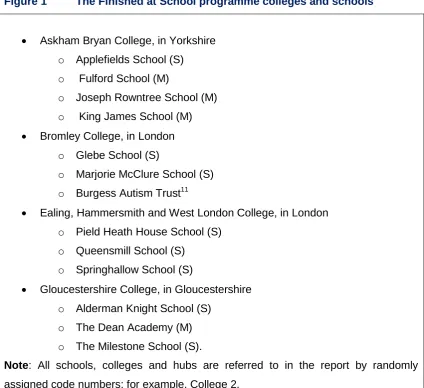
[image:16.595.86.511.267.655.2]established a core partnership consisting of special (S) and mainstream (M) secondary schools (see Figure 1) and a local authority transition lead. All partners were required to sign a statement declaring their willingness to participate in the programme.
Figure 1 The Finished at School programme colleges and schools
Askham Bryan College, in Yorkshire o Applefields School (S) o Fulford School (M)
o Joseph Rowntree School (M) o King James School (M)
Bromley College, in London o Glebe School (S)
o Marjorie McClure School (S) o Burgess Autism Trust11
Ealing, Hammersmith and West London College, in London o Pield Heath House School (S)
o Queensmill School (S) o Springhallow School (S)
Gloucestershire College, in Gloucestershire o Alderman Knight School (S)
o The Dean Academy (M) o The Milestone School (S).
Note: All schools, colleges and hubs are referred to in the report by randomly assigned code numbers; for example, College 2.
10
Ambitious about Autism, 2011. Finished at School. Where next for young people with autism? The Pears National Centre for Autism Education, London. Ambitious about Autism, 2012. Finished at School. Creating inclusive colleges for learners with autism. Showcasing good practice. The Pears National Centre for Autism Education, London.
11
16
Each college led a hub including its partner schools. Each hub also had a local steering group involving other important partners in the transition process, such as local authority transition officers. The five project aims for the hubs were that they would work to:
Develop staff skills.
Improve person-centred transition planning. Strengthen assessment processes.
Design improved curriculum pathways.
Ensure learners with autism are able to access all aspects of college life.
The hub work aimed to support the overall project aim by developing a model of transition support that would enable more young people with autism, including those with complex autism, to continue their education beyond school.
Of the young people identified to take part in the project, the expectation was that all would be on the autism spectrum, with the majority of them having a statement of SEN that included a diagnosis of autism. In addition, the autism would be ‘complex’,
either because it was associated with other learning difficulties or was, in itself, deemed complex by relevant professionals12. Each young person included in the project had to be due to make the transition to post-school education in September 2014 (Cohort 1), September 2015 (Cohort 2) or September 2016 (Cohort 3).
1.3
The evaluation
The evaluation, commissioned by Ambitious about Autism, was focused on the project’s progress and impact. Progress was the subject of the Interim Report13 in
March 2014. This Final Report focuses on impact. The evaluation also sought to capture key learning from the project in order to support further developments. The evaluation findings have informed a separate publication sharing learning from the project.14
12
E-mail from Ambitious about Autism to the college hub leads, 27 October 2013. 13
Cullen, M.A., Cullen, S.M., Hastings, R, Lindsay, G. 2014. Evaluation of the ‘Finished at
School’ Programme for Ambitious about Autism, 2013-2015: Interim Report. Coventry: University of Warwick.
14 O’Brien, A. (2015).
17
The evaluation used combined methods (that is, qualitative and quantitative approaches) to gathering evidence of progress and impact. The data collected covered three phases:
i) Initial perspectives (November 2013 to March 2014)
Telephone interview with lead trainer from Helen Sanderson Associates.15
Telephone interviews with college hub and school leads.
Questionnaire survey of training participants attending Day 3 of the core training on person-centred transition planning.
ii) Embedding processes (October to December 2014)
Visits to sample of partner schools.
Telephone interviews with local authority transition officers.
Telephone interviews with partner school leads.
Visits to each of the 4 hub colleges.
iii) Achieved impact (January to February 2015)
Follow-up survey of training participants.
Questionnaire survey of parents of all the project young people.
1.3.1 The data collected
The evaluation data on which the Interim Report was based were:
From training participants:
o Fifty-three questionnaires returned after Day 3 of the training.
From the college hubs:
o Four interviews, one with each hub’s college lead.
From the schools:
o Six (of a possible 13) school lead interviews.
Additional data collected to inform this Final Report are:
From training participants:
o Sixteen (of 27) questionnaires returned one year after the training.
15
18
From the college hubs:
o Four interviews, one with each hub’s college lead. o Eight interviews with other key staff in the hub colleges.
o Observations and field notes from a visit to each hub college (four
visits).
o Interviews with 12 young people (three young women and nine young
men).16
From the schools:
o Interviews with 11 (of 13) school leads.17
o Interviews with one other staff member and two local authority (LA)
transition officers linked to project schools.
o Interviews with four pupils (one female and three males).
From parents:
o Interviews with five parents (four mothers and one father). o Postal questionnaire returned by nine (of 112) parents.18
From the hub LAs:
o Interviews with three LA transition officers.19
All interviews were semi-structured and recorded where permission to do so was granted. (Two of the young people exercised their right to choose not to be recorded.) Most of the interviews with professionals were conducted by telephone and lasted between 40 and 75 minutes. The rest were conducted face-to-face during visits to the schools and colleges. One parent was interviewed by telephone; the others face-to-face.
The structure of the interviews with young people was informed by the ‘4 + 1 questions’ tool developed by Helen Sanderson Associates20. Consent and assent
processes and bespoke information sheets were informed by the principles underpinning the Mental Capacity Act. Young people (and parents) were also
16
Two other Cohort 1 young men were observed in a lesson but were not interviewed. 17
The remaining two schools each sent an e-mail to explain the circumstances that prevented participation.
18
The exceptionally low response was, we think, due to logistical issues in getting the
questionnaires to the parents. (For example, the postage stamp, checked as correct in a Post Office in Coventry, was deemed insufficient in at least one area – we know this because one responding parent reported having had to pay to receive the envelope.)
19
These were in addition to the two interviews with transition officers linked to project schools. The transition officer from the 4th LA was willing to participate but we were repeatedly unable to find a mutually convenient time to do the interview.
20
19
provided in advance with a one-page profile about the researcher. The design and structure of this was informed by examples of young people’s one-page profiles
published by Helen Sanderson Associates21. The idea to create one was based on the example of some Hub 3 college staff creating one-page profiles. All the young people were interviewed face-to-face. The young people chose whether to be
interviewed one-to-one, in a pair or in a small group. They also chose whether or not to have a trusted member of staff present with them during the interview.
Some interviews of each type were transcribed in full; for others, detailed notes were taken during the interviews, supplemented by listening again to the recordings. All the interviews were analysed thematically by collating answers to each question by interviewee type and then grouping together any similar views, as well as paying attention to unique views.
1.4
The structure of the report
The rest of this report is structured around the impact of the project in relation to the five key aims of the work of the hubs. Chapter 2 describes the impact of the project on the development of staff skills. Chapter 3, the longest in the report, focuses on improvements arising from the project in person-centred planning for transition. In Chapter 4, the impact this had on the project young people is reported. In Chapter 5, we present the findings about the impact of the project on assessment processes. In Chapter 6, we report on the developments in the curriculum offer made because of the Finished at School programme. Chapter 7 describes the changes that were made in the college environments, because of the project, to increase the access learners with autism had to all aspects of college life. We give our Conclusions in Chapter 8, followed by our recommendations in Chapter 9.
1.4.1 Presentation of the data
In presenting numerical data, because the number of questionnaire respondents is below 100, responses are given as numbers as well as percentages. All percentages have been rounded to the nearest integer and so may not sum to exactly 100%. To preserve confidentiality, all interviewees have been given a unique random code, as have the four hubs, four colleges and each school. These were used in the analysis process and are used where possible in the text but identification even with a random
21
20
21
2
DEVELOPMENT OF STAFF SKILLS
This chapter reports on the impact of the project on the development of staff skills around supporting young people with autism to move from school to college and to thrive within a general further education college environment. The focus is first on the ‘Person-centred approaches to transition’training delivered to each hub as part of the
project. Then the focus shifts to other ways in which staff skills were developed as a result of the project.
2.1 The ‘Person-centred approaches to transition’ training
2.1.1 The Helen Sanderson Associates training
As part of the Finished at School Programme, Ambitious about Autism commissioned Helen Sanderson Associates22, along with a consultant from the National
Development Team for Inclusion, to deliver four days of training to each of the four college-led hubs. The first three days of training focused on ‘Person-centred approaches to transition for young people with autism’. Specifically, the days
covered:
The use of a person-centred approach to working with young people.
A person-centred approach to planning ahead for young people.
The development of one-page profiles of each young person with autism.
The use of person-centred review meetings.
This was preceded by a training needs analysis day designed to help each hub decide the focus of their fourth day of training and to alert Helen Sanderson Associates of any hub-specific adaptations required for the three day training package on person-centred approaches. The fourth ‘day’ of training was in fact split
in to two separate opportunities: a fourth day of training facilitated by Helen
Sanderson Associates consolidating the work covered in the first three days training and helping participants action plan for taking this forward in practice; and a day with a consultant, Peter Vickers, to complement the person-centred training.
Views about the three days of core training were reported in the Interim Report. Here we add perspectives from one year later, including views about the fourth day of training. We first report findings from questionnaires to the training participants and
22
22
then views expressed during the interviews with school, college and local authority transitions officers in Year 2.
2.1.1.1 Views of the training from the questionnaires
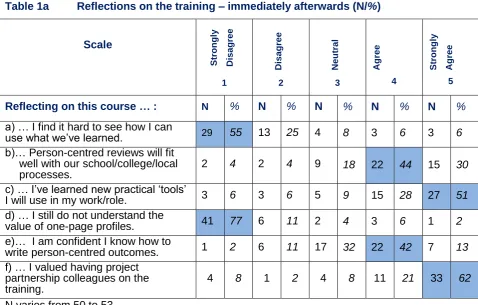
[image:23.595.85.564.262.567.2]Questionnaires about the training were completed at the end of Day 3 of the core training. Responses were received from all four hubs, 53 in total (Tables 1a and 2a), equating to all delegates who attended Day 3. Of these 53, 27 provided contact details to enable us to send them a follow-up questionnaire one year later. Of these 27, 16 completed the follow-up questionnaire (Tables 1b and 2b)23.
Table 1a Reflections on the training – immediately afterwards (N/%)
Scale Strong ly Dis a gre e Dis a gre e Neu tral Agree Strong ly Agree
1 2 3 4 5
Reflecting on this course … : N % N % N % N % N %
a) … I find it hard to see how I can
use what we’ve learned. 29 55 13 25 4 8 3 6 3 6
b)… Person-centred reviews will fit well with our school/college/local processes.
2 4 2 4 9 18 22 44 15 30
c) … I’ve learned new practical ‘tools’
I will use in my work/role. 3 6 3 6 5 9 15 28 27 51
d) … I still do not understand the
value of one-page profiles. 41 77 6 11 2 4 3 6 1 2
e)… I am confident I know how to
write person-centred outcomes. 1 2 6 11 17 32 22 42 7 13 f) … I valued having project
partnership colleagues on the training.
4 8 1 2 4 8 11 21 33 62
N varies from 50 to 53.
Tables 1a shows that the training was well received at the time, with a majority (55% to 88%) reporting positive views of its practical value.
23 Of the 11 non-responses, three were returned as ‘e-mail not delivered’ and one person had
23
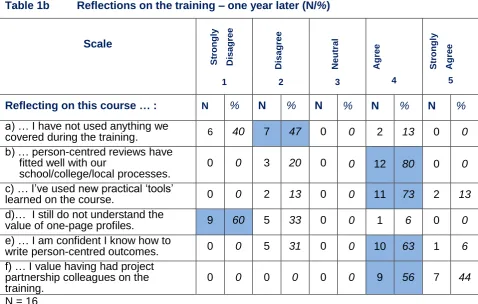
Table 1b Reflections on the training – one year later (N/%)
Scale
Strong
ly
Dis
a
gre
e
Dis
a
gre
e
Neu
tral
Agree Strong
ly
Agree
1 2 3 4 5
Reflecting on this course … : N % N % N % N % N %
a) … I have not used anything we
covered during the training. 6 40 7 47 0 0 2 13 0 0
b) … person-centred reviews have fitted well with our
school/college/local processes.
0 0 3 20 0 0 12 80 0 0
c) … I’ve used new practical ‘tools’
learned on the course. 0 0 2 13 0 0 11 73 2 13
d)… I still do not understand the
value of one-page profiles. 9 60 5 33 0 0 1 6 0 0
e) … I am confident I know how to
write person-centred outcomes. 0 0 5 31 0 0 10 63 1 6 f) … I value having had project
partnership colleagues on the training.
0 0 0 0 0 0 9 56 7 44
N = 16
For almost all of those who completed the follow-up questionnaire, the training had a positive impact on practice (Table 1b). For example, 13 of 16 said they had used aspects of the training, including new ‘tools’ learned about on the course. All
24
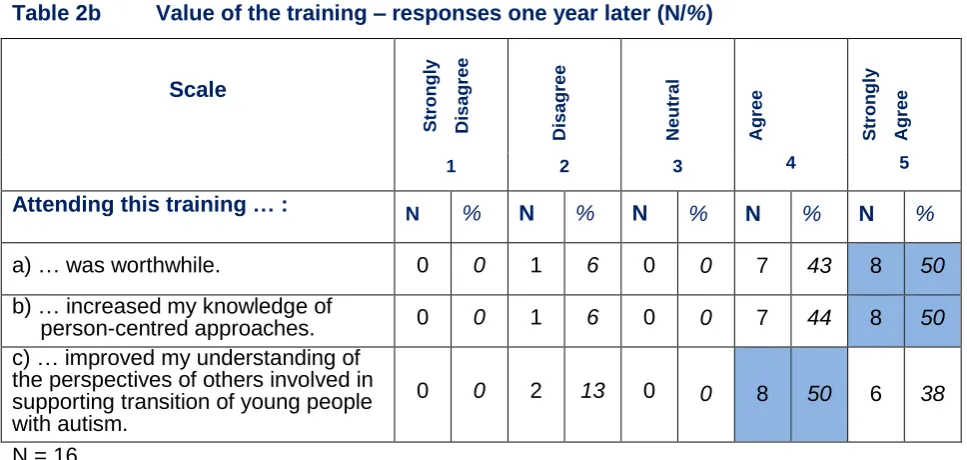
Tables 2a and 2b show that the positive views of the training at the end of Day 3, in terms of its worth, increased knowledge and improved understanding, were
[image:25.595.80.568.176.617.2]maintained one year later.
Table 2a Value of the training – responses immediately after (N/%)
Scale Strong ly Dis a gre e Dis a gre e Neu tral Agree Strong ly Agree
1 2 3 4 5
Attending this training … : N % N % N % N % N %
a) … was worthwhile. 0 0 1 2 3 6 11 21 38 72
b) ]… increased my knowledge of
person-centred approaches. 0 0 1 2 1 2 14 26 37 70 c) … improved my understanding of
the perspectives of others involved in supporting transition of young people with autism.
0 0 1 2 7 13 21 40 24 45
N = 53
Table 2b Value of the training – responses one year later (N/%)
Scale Strong ly Dis a gre e Dis a gre e Neu tral Agree Strong ly Agree
1 2 3 4 5
Attending this training … : N % N % N % N % N %
a) … was worthwhile. 0 0 1 6 0 0 7 43 8 50
b) … increased my knowledge of
person-centred approaches. 0 0 1 6 0 0 7 44 8 50
c) … improved my understanding of the perspectives of others involved in supporting transition of young people with autism.
0 0 2 13 0 0 8 50 6 38
N = 16
All but one24 of the 16 people who completed the follow-up questionnaire one year later responded to the open question asking them to write about at least one
positive change made, because of the training, to better support young people
24
[image:25.595.84.568.426.656.2]25
with autism. The changes described illustrated the positive impact of staff skill
development but also related to three more of the five main aims of the hubs:
Improved person-centred transition planning (see Chapter 3).
Improved design of curriculum pathways (see Chapter 6).
Improved access to college life (see Chapter 7).
The changes described are therefore reported in the relevant later chapters.
All but one of the 16 people who completed the follow-up questionnaire one year later also responded to the open question asking them to write about what it was from the training that had ‘proved to be of lasting value/use to them’. Figure 2
gives illustrative comments, reflecting the themes mentioned by college and school participants. Two comments were ‘atypical’ but illustrated well the wider impact of
staff skill development. The first is from a member of school staff; the second from
a member of college staff:
‘[Because of the training], being able to be part of the LA’s pilot project re the
development of the EHC [Education, Health and Care] proforma. Being able to share my thoughts and opinions with the LA and the senior leadership team in my school. Working with my local sector college. Piloting PowerPoint [presentations by young people in their review meetings] and getting positive feedback from all professionals and families invited to EHC transfer
meetings.’
(A school delegate who attended the training)
‘The whole training package was very worthwhile. Being part of the project
has seen us being invited to join local partnership boards and to join the Secondary Schools’ SENCO Forum so our partnership working has also increased as a direct result.’
26
Figure 2 Illustrative comments about the lasting value of the training
Illustrative college views
‘Ensuring that students [can make] informed decisions and are able to
make choices about both their present programme and their future. I have
seen the value of asking students their opinions, no matter what the level of communication or cognitive ability. [The training] has made me reflect on my own work and made it even more conscious to me that there is a need to provide students with the opportunity to make choices and comment on their activities in college [in order] to make their programme person-centred and relevant to their hopes and dreams for now and the future. This, in turn, helps students to take more responsibility and to be a part of the
decision-making process, rather than being passive.’
‘A new way of looking at what the young person wants as opposed to everything being needs-led. A very positive experience.’
‘The one-page profile, the approach to parents and carers, and the input
of learners in their reviews.
Illustrative school views
‘I found all the training extremely useful. The one-page profiles are
proving to be invaluable. They will be used for all SEN students across our mainstream school. The training also made me realise how impersonal and daunting our old review meetings were, both for students and parents. The changes we made will have a lasting impact.’
‘Seeing those person-centred wishes beginning to realise themselves. Used well, they can make a real difference to individuals.’
‘Person-centred reviews and how they can contribute to the EHC plans.’
27
In open comments on the post-training questionnaire, one college staff member, in commenting on the lasting value of the training, also raised two important issues: that the ‘best practice’ demonstrated on the training was not necessarily current
practice and that not all young people with autism would want to be involved in their review meeting:
‘Having attended some EHCP [Education, Health and Care plan] transfer
reviews, I can see how these are not person-centred at the moment, partly due to the rushed timeframe for them being completed. […] I also recognise that, for some young people, they just do not want to be involved.’
(A college staff member)
These issues are returned to later in the report.
2.1.1.2 Views expressed in Year 2 interviews
Across the interviews with school, college and local authority interviewees, three themes emerged as interviewees reflected back on the training.
One theme was the benefits of the training having been delivered jointly to school, college and other delegates. For example, one local authority transitions officer valued the impact on parents and young people of school staff going ‘off the site’ to
train alongside college staff:
‘I went along to one training session all about person centred planning. That
was a good thing because, if schools get off the site and go to college and meet people from the college, they see actually that they’re not so frightened
of the big, bad world outside of school. Again that filters down to the parents and to the children. So that’s been a good thing, all the joint training that’s been going on. […] It was good to see all the school and college staff and people all sitting together and talking. You just can’t do enough of that really, just getting people together and talking about common issues.’
(LA transitions officer 2)
28
their colleges. The profiles were valued as having helped the colleges learn about how best to support the young people to meet their aspirations for adult life.
A second theme was how valuable it was to learn, through the training, more about the reforms encapsulated in the Children and Families Act 2014 and the new
SEND Code of Practice: 0-25 years. It was reported as having, ‘helped people to understand’ the reforms and the new Code of Practice. It also led to school and
college project leads taking on a strategic role within their institution in terms of informing colleagues about the reforms and shaping thinking about how the new Code of Practice could be put in to practice. For example, as a result of attending the three core days of training, the College 1 lead was appointed by the college to act as the college’s representative at local authority meetings about the SEND reforms and
the local implementation of the new Education, Health and Care plans. She was then required to share this learning with senior managers and with staff. As a result of this, the local authority offered the college a link person to support them through the process of transferring a learner from a Learning Difficulties Assessment to an Education, Health and Care plan. As another example: because of the training, College 4 linked up with its local SEND Pathfinder25 practitioners and gained their support in implementing the reforms. In that college’s ‘home’ LA, too, because of the training, the authority paid for all of it transitions officers to receive one day’s training
on person-centred planning to support them in leading local Transfer Reviews in a person-centred way.
The third theme was about the fourth day of training. The focus of this day varied from hub to hub, as did views of its usefulness. The most positive comments came from Hub 3 where the focus had been on non-accredited activities within study programmes26. (see Chapter 6 on Curriculum Pathways). In Hub 2, where the fourth day focused on ‘a recap in the context of the Local Offer’, one interviewee reported
that this was not as useful as the core training on person-centred reviews.
2.1.2 Sharing learning from the training
From interviews with the project’s school and college leads, it became clear that the
external training received had prompted at least some school leads and all college
25 From October 2011 to March 2013, 31 local authorities acted as ‘Pathfinder’ areas for the
proposed SEND reforms. 26
29
leads to share the main learning from the training to other school and college staff.
School examples included:
A school lead who modelled person-centred reviews to other staff who went on to use the approach in their classes (School 12/ Hub 4).
Staff who attended the training reported as feeling, ‘more confident about transition planning and holding person-centred reviews. This approach is being shared within the school.’ (School 8/Hub 1).
Staff using person-centred conversations ‘all the time’, leading to the creation of Personal Profiles and ‘feeling more comfortable’ about facilitating
person-centred reviews. (School 9/Hub 2).
Staff using the learning from the training to support the transition of other young people in the school and cascading the learning from the training to enable two teaching assistants to work with young people on creating one-page profiles. (School 7/Hub 2).
College examples of sharing key learning from the training with colleagues included:
The Person-centred Planning Toolkit27 circulated to tutors and the adoption by the college of person-centred reviews, based on the training received though the Finished at School project (College 2).
Delivery of a 45 minute cascade to departmental tutors on one-page profiles, highlighting also the tools and supportive resources available on the Helen Sanderson Associates website (College 4).
This sharing of the learning did not preclude or replace the need for colleagues to access appropriate training in their own right. (see section 2.2).
A minority of comments raised issues related to the training. One school lead raised an important issue about the constraint the local context could have on implementation of the learning from the training. Because, in this person’s view, the
local authority did not take on board a person-centred approach for the Transfer Reviews being conducted locally, the newly learned and trialled person-centred
27 ‘Person-centred thinking tools’ available from the Helen Sanderson Associates website:
http://www.helensandersonassociates.co.uk/person-centred-practice/person-centred-thinking-tools/
30
approach to reviews, ‘had to be abandoned’ (School 5/Hub 1). Another person was
critical of the training as having not been sufficiently adapted from generic person-centred approaches to autism-specific person-centred approaches (School 7/Hub 2). These were minority views: the majority were very positive about the usefulness of the training.
2.1.3 Changed practice because of the training
There were examples from all four hubs of the training having led to person-centred approaches being integrated in to both school and college practice. For
example, an LA transitions officer in Hub 2 reported that, because of the training, College 2 had integrated person-centred planning into its core curriculum (further details in Chapters 5 and 6). The College 1 lead reported that she was working with senior managers to plan how to make person-centred reviews happen across the college. At time of interview in early 2015, the plan was for course managers to use one-to-one sessions with the learners to develop this approach.
Schools, too, reported adopting person-centred approaches. In some cases, this was corroborated by interviewees from the same hub but external to the school. This was the case, for example, for School 11 (a special school) which was inspired by the training to embed the work required to prepare for a person-centred review in to the core curriculum, including but not limited to IT and employability lessons. This
was corroborated by the local college lead who noted that person-centred
approaches to annual reviews ‘have to be something that is driven throughout the school year’.
2.2
Other staff skill development arising because of the project
31
2.2.1 AET’s ‘Making Sense of Autism’ post-16 training programme
In all four hub colleges, some staff took part in the Autism Education Trust’s
awareness training about autism designed for those working in post-16
educational environments, ‘Making Sense of Autism’28.
In College 1, initially, the project lead and all the Foundation Learning tutors did this training. The college lead explained that some staff needed further ‘educating’
about how to adjust their ways of working to include learners with autism and to understand the areas of difference, such as in social communication. As she said, the tutors needed to be aware, for example, that, ‘This young person is not being awkward; he’s not being rude; he’s just very literal’ (College lead 1). In College 1,
further delivery of the training was planned, with the selection of staff due to
attend the AET training designed to support curriculum pathways and progression from Entry level to Level 1 and from Level 1 to Level 2. The plan was that staff from different subject departments would attend the training in turn. This college lead was very aware that awareness training around autism was a continual need, due to staff turn-over.
In College 3, the initial group who attended the AET awareness training about autism were all the learning support assistants (LSAs). According to the college lead, all 114 LSAs were brought in to one college campus to attend one of several repeats of the awareness training over the space of one day. The plan was for further training to take place. For example, some of the core transitions team were to attend the two-day Tier 2 AET training for practitioners and there was a commitment from senior managers to attend the one-day Tier 3 training for managers.
The need to raise awareness of how to deal with individual needs was taken on board in College 4 where the AET awareness training was being rolled out to all teaching staff and all support staff. The aim was that all operational staff and
middle managers would be trained. One College 4 tutor interviewed had delivered
an AET awareness session to 70 staff from across Student Services (counsellors, careers advisers, and those working in student finance). She believed that it was ‘vital’ that all staff, especially course tutors, understood that anxiety is often a part of
autism and therefore, should be able to use strategies to help reduce such anxiety. In her training session, she emphasised that staff should focus on the support needed
28
32
by each learner with autism in the four areas of difference (social interaction and emotional expression; understanding and use of communication and language; information processing; sensory processing). She also noted that many learners with complex needs did not necessarily have a formal diagnosis of ‘autism’ yet had
support needs in these four areas. In the training, she therefore reminded staff that, ‘You’re working [to support] needs, not labels’.
2.2.2 Other training and skills development
Other formal training, mentioned by interviewees as having been prompted by the Finished at School project to include more learners with autism in mainstream FE colleges, included training on understanding and responding to challenging behaviour. In Hub 2, for example, the local authority ‘brokered’ training for college staff on ‘Behaviour that challenges’ because staff had expressed anxiety about
working with students with complex autism. This was supported by access to professional expertise of a speech and language therapist, an educational psychologist and an occupational therapist. The latter also provided ‘clinics’ to
support staff to understand, and work with, the sensory processing needs of learners with autism.
Formal training was not the only way skills development took place. The relationships developed in the four Finished at School hubs supported peer learning. Examples included:
The ‘useful’ advice obtained from a college lead attending reviews in the school (School 8/Hub 1).
The improved understanding of needs of learners with autism generated by college lead working together with school staff in the hub (Schools 7 & 9/Hub 2):
‘They now understand more about the ‘spiky profile’ of knowledge and skills.’
(School 9)
‘It’s made the college [College 2] more aware that ‘autism’ is just a
label and that there is a need to focus on social communication
difficulties and how best to work with them. […] Our other local college
has the attitude that if the label, autism, is not on the statement, then the young person hasn’t got these needs.’
33 Figure 3 gives an extended example from Hub 3.
Figure 3 Extended example of peer learning within a hub
A mainstream school lead reporting learning from her special school equivalent. She also noted that this peer learning had happened for all the schools in the hub:
‘It’s good to have that contact there and to be able to share information. They’ve been and visited here and we’ve visited all their schools. We’ve picked up ideas and shared resources. It’s been really good, actually; really useful. […] It’s just lovely to have an opportunity to pick up ideas from other people. […] Other people have completely different ways of doing things and it’s nice to re-evaluate sometimes. I picked up some lovely stuff for transition
plans for students from [the special school lead], with visuals, with pictures. Much more simple than the one we currently use – more like a transition passport kind of thing. I picked up that idea from her and I’m going to incorporate that into ours.’
Source: interview with School 1 lead, November 2014
College 1 was unique among the hubs in developing Autism Champions from among the staff and learners at each curriculum level (Entry Level, level 1, Level 2). This proved to be an effective way of peer-to-peer awareness raising.29
2.3
Chapter summary
This chapter has focused on staff skill development because of the Finished at School programme. Each of the four hubs received three days of core training on person-centred approaches to transition planning, plus a fourth ‘day’ of further
training opportunities tailored to each hub. Feedback at the end of the third day of core training was positive, with 98% agreeing or strongly agreeing it was worthwhile, 96% agreeing or strongly agreeing that it had increased their knowledge of person-centred approaches and a majority (55% to 88%) reporting positive views of its practical value. One year later, views remained positive. All 16 respondents reported valuing having had project partnership colleagues on the training with them, a
34
majority (13 of 16) had used aspects of the training in their practice, and all but one viewed it as having been worthwhile and as having increased their knowledge of person-centred approaches. These 15 people wrote about at least one positive change they had made because of the training to better support young people with autism and about its lasting value to them.
During interviews with school, college and local authority interviewees, three themes emerged as people reflected back on the training. These were: the benefits of the training having been delivered to a mixed audience of school, college and other delegates together; the value of learning more, through the training, about the SEN and disability reforms encapsulated in the Children and Families Act 2014 and the 2014 Code of Practice; and mixed views reported of the fourth day of training. From these interviews, it was also clear that at least some staff who attended the training had shared key learning from it with colleagues; and that the training had prompted person-centred changes to be embedded in to routine practice.
Stimulated by the Finished at School programme, some staff also accessed other relevant training and skills development. For example, each hub made use of either the Autism Education Trust’s post-16 training programme, ‘Making Sense of Autism’
35
3
IMPROVED PERSON-CENTRED TRANSITION PLANNING
This chapter reports first the strategic and then the operational improvements to person-centred transition planning made because of the work of the Finished at School programme hubs. ‘Strategic’ is defined as affecting system-level change whereas ‘operational’ focuses on changes arising from within an institution.
3.1
Improvements made at strategic partnership (hub) level
The strategic level improvements related to:
Improved communication arising from the creation of the hub network itself.
Bringing a focus on autism to existing strategic forums and boards through new or strengthened connections.
Increased confidence about understanding and implementing the new SEND Code of Practice: 0-25 years.
Recognising the importance of local leadership being invested in more than one person to ensure continuity of the work should the lead be ill or move on to another post.
Increased understanding of the partners that needed to be involved to make the system work well locally.
Increased awareness of local gaps in post-school provision for particular sub-sets of local young people with autism.
Increased awareness of the potential of the local general further education college to meet the needs of more learners with complex autism, alongside a recognition that some young people with complex autism will continue to require specialist further education provision.
These points are addressed in turn.
3.1.1
The value of a local network (hub) focused on transition of young
people with autism
36
everybody to pull together for transition to work well for the students’ (College 1
course manager).
In all four hubs, interviewees spoke about the benefits of improved communication arising from the hub. Examples of this from each hub are given to illustrate this important point as, without good communication between and among the relevant partners, good transitions for young people with autism are unlikely to happen.
In Hub 1, a school lead spoke of how the relationship his school had built up with the hub college and with the Connexions adviser through the Finished at School hub would ‘ease the transition process’ (School 5/Hub 1). In this hub, the college lead had
been responsive to constraints on school staff leaving school premises and had instead visited the schools in person. (As the lead explained, a specialist autism resource in a mainstream school could have 15 to 20 pupils and only two teachers, making it impossible for one of them to come out of school during school hours.) The direct relationship with schools was important as it enabled the college to find out, well in advance, the names of prospective students. This, in turn, enabled the college to ‘start doing transition work a lot earlier’ (Hub 1 lead). One course manager at
College 1 valued the increased willingness of schools to work with the college through the transition period as a return to the more direct relationship colleges had had with schools prior to the introduction of the Connexions Service. In his view, that had, ‘cut us out’ so that, ‘the majority of contact with schools and students is done through Connexions’. Through the Finished at School hub, the direct link had been
recreated, whilst a good relationship with the Connexions advisers had been maintained. In addition, the hub had led to the college lead joining both the local SENCO Forum, thus creating a strategic level link to all local secondary schools, and the authority’s Autism Strategy Group, creating a strategic level link to other key
partners such as Health and Social Care.
In Hub 2, the college lead valued the hub so much that an early decision was made to continue it beyond the life of the Finished at School programme. It was seen as having created a forum to discuss each transitioning student with autism in a joined-up way that ‘galvanised’ the process of working together and keeping each other informed so that ‘things were followed up and therefore happened for the students’. In addition, the college lead attended the ‘home’ LA’s strategic planning Post-16