warwick.ac.uk/lib-publications
Original citation:
Finne, Max, Turunen, Taija and Eloranta, Ville. (2015) Striving for network power : the perspective of solution integrators and suppliers. Journal of Purchasing and Supply Management, 21 (1). pp. 9-24
Permanent WRAP URL:
http://wrap.warwick.ac.uk/89935
Copyright and reuse:
The Warwick Research Archive Portal (WRAP) makes this work by researchers of the University of Warwick available open access under the following conditions. Copyright © and all moral rights to the version of the paper presented here belong to the individual author(s) and/or other copyright owners. To the extent reasonable and practicable the material made available in WRAP has been checked for eligibility before being made available.
Copies of full items can be used for personal research or study, educational, or not-for-profit purposes without prior permission or charge. Provided that the authors, title and full
bibliographic details are credited, a hyperlink and/or URL is given for the original metadata page and the content is not changed in any way.
Publisher’s statement:
© 2015. This manuscript version is made available under the CC-BY-NC-ND 4.0 license http://creativecommons.org/licenses/by-nc-nd/4.0/
A note on versions:
The version presented here may differ from the published version or, version of record, if you wish to cite this item you are advised to consult the publisher’s version. Please see the ‘permanent WRAP URL’ above for details on accessing the published version and note that access may require a subscription.
STRIVING FOR NETWORK POWER: THE
PERSPECTIVE OF SOLUTION INTEGRATORS AND SUPPLIERS
Max Finne, Taija Turunen, Ville Eloranta
Finne, M., Turunen, T., Eloranta, V. (2015). “Striving for Network Power: The
Perspective of Solution Integrators and Suppliers”. Journal of Purchasing and
Supply Management, Vol. 21 Iss. 1, pp. 9-24. Available online:
http://dx.doi.org/10.1016/j.pursup.2014.08.001
Max Finne, Warwick Business School, University of Warwick, Coventry, UK; Aalto
University, School of Science, Espoo, Finland, email:
Taija Turunen, Aalto University, School of Science, Espoo, Finland; University of
Cambridge, Cambridge Service Alliance, Cambridge, UK, email:
Ville Eloranta, Aalto University, School of Science, Espoo, Finland, email:
STRIVING FOR NETWORK POWER: THE
PERSPECTIVE OF SOLUTION INTEGRATORS AND SUPPLIERS
This paper explores how companies in complex networks strive for
inter-organizational power. Solution provision was chosen as the empirical context
because of its highly networked nature and the complex power relationships within
the networks. We raise the level of analysis from buyer-supplier dyads to a network
involving solution integrators, their suppliers, and the users of their respective
solutions. Our findings demonstrated that the integrators and suppliers take action to
shape their power sources on three different levels. In contrast to the literature
regarding solution provision, our findings from the analysis of six embedded cases
indicate that suppliers can also achieve structurally powerful network positions by
skillfully focusing their development efforts on fostering the complementarities of
power sources. In addition, our study indicates that integrators may find it notably
challenging to achieve power over their suppliers by creating better access to
customer information.
1 INTRODUCTION
The current business landscape in developed economies is characterized by the
increasing provision of services. For example, in the US, the contribution of services
to the gross domestic product (GDP) was 79.7% in 2012 (Central Intelligence
Agency, 2013). This change is also reflected in the transition of manufacturing
companies toward solution provision, which means that manufacturers take
responsibility for customers’ problems by providing solutions to them. This provision
is achieved by integrating various types of machinery, services, and technologies
(Brax and Jonsson, 2009; Davies and Brady, 2000; Davies et al., 2006, 2007).
Because of its complex nature, solution provision typically takes place in networks
that are global and competitive (Brandenburger and Nalebuff, 1996; Choi and Kim,
2008; Wu and Choi, 2005). In this context, the concept of power is central because it
enables an actor to influence other actors to change their intentions and actions
(Emerson, 1962; French, 1956; French and Raven, 1959), which can subsequently be
reflected, for example, in improved contract terms, perceptions of responsibilities, or
information sharing among the actors (Meehan and Wright, 2011). In solution
provision, such attempts to influence other companies are frequent because different
networks compete against each other on one hand and, on the other hand, companies
participate in different networks and compete with other actors in their own network.
Within each network, the most powerful parties can improve their financial
performance and reap a greater share of the network’s profits through the use of their
power over weaker actors (Gelderman et al., 2008; Ramsay, 1994, 1996). Thus,
solution provision networks provide an interesting and timely context for studying
how companies compete to gain power.
Originating in the social sciences, research investigating power in social networks
(Dahl, 1957; Emerson, 1962; French, 1956) has developed in the area of marketing
(e.g., El-Ansary and Stern, 1972; Etgar, 1976; Gaski, 1984; Hunt and Nevin, 1974;
Wilkinson, 1973) and, more recently, focused on purchasing and supply management
studies (e.g., Caniëls and Gelderman, 2005; Cox, 1999; Gelderman et al., 2008;
Kraljic, 1983; Ramsay, 1994; van Weele and Rozemeijer, 1996). The literature has
identified various sources of power, of which structural power induced from the
increasing interest as competitive strategies have become based on networks (e.g.,
Teece et al., 1997; Teece, 2007). Other power sources can be divided into those that
are specific to an organization, such as its tangible and intangible resources and
capabilities (Cox, 1999, 2001a; Pfeffer and Salancik, 1978; Ramsay, 1994), and those
that are specific to relationships between two organizations (e.g., Brax, 2005; Caniëls
and Gelderman, 2005; Cox, 2001b; Johnsen et al., 2009).
Despite several previous insightful studies, there are still gaps in the literature
regarding how companies attempt to change power sources in their favor. In addition,
the discussion on power has paid little attention to the context of solution provision.
The power sources have been studied in detail in the context of value networks
(Kähkönen and Virolainen, 2011) and the meaning of power for the network actors
(Meehan and Wright, 2011). However, in line with Borgatti and Halgin (2011), we
argue that the sources of power are tightly intertwined with companies’ efforts to alter
and manage them. In other words, research examining inter-organizational power,
especially in the context of solution provision networks, needs to explore how
companies act to achieve power. These studies examine companies’ actions, but
understanding the link between the actions and the realized power also requires
understanding how power is thereafter enabled through changes in the (structural)
power attributes (Kähkönen and Virolainen, 2011). The focus of previous research on
companies’ actions to realize power has focused on buyers and their strategies in
relation to supplier relationship management and purchasing (e.g., Caniëls and
Gelderman, 2005; Cox, 2001a; Pazirandeh and Norrman, 2014; Ramsay, 1994; van
Weele and Rozemeijer, 1996), whereas studies on suppliers have focused mostly on
the actions of dominant suppliers (e.g., Gelderman et al., 2008).
In response to this knowledge gap, we set out to study power in networked solution
provision (Brady et al., 2005; Brax and Jonsson, 2009; Davies, 2003; Davies and
Brady, 2000; Tuli et al., 2007). We chose to utilize the perspectives of power in
purchasing and supply management (e.g., Caniëls and Gelderman, 2005; Cox, 2001a,
2001b; Kähkönen and Virolainen, 2011; Pazirandeh and Norrman, 2014; Ramsay,
1994, 1996; van Weele and Rozemeijer, 1996) and focus our analyses on the actions
taken to achieve power, which are carried out by solution integrators and their
suppliers. Choosing solution provision as the research context enabled us to study
are part of the same network. Our aim is to identify the links between the decisions
and actions by supplying companies, which lead to changes in their structures and
positions in the network, thereby enabling power. Our approach in studying these
links is similar to the one used in previous studies on purchasing power (e.g., Caniëls
and Gelderman, 2005; Pazirandeh and Norrman, 2014; van Weele and Rozemeijer,
1996). However, we take the opposite viewpoint. We study the actions taken by
supplying companies to improve the power in a supply network, whereas the
above-mentioned studies investigated the purchasing strategies of buyers.
We aim to take part primarily in the discussion ofsolution integrationand secondarily
in the discussion on inter-organizational power in purchasing and supply networks.
Specifically, we aim to reveal how power is achieved through actions and decisions
that lead to an advantageous position in the network. The previous studies on power
in service and solution provision used mostly a triadic perspective to focus on the
bridge position. These analyses predominantly used a conceptual approach (Bastl et
al., 2013; Choi and Wu, 2009b; Li and Choi, 2009). Consequently, these studies were
on a broader and higher level, explaining power relationships and strategic choices,
whereas we intend to add significant detail to this picture. In addition, we aim to
contribute to the discussion on network power (e.g., Dahl, 1957; Emerson, 1962;
French, 1956; Håkansson et al., 2009; Kähkönen and Virolainen, 2011; Pazirandeh
and Norrman, 2014) through exploring the context of solution provision, in which
companies participate to various degrees in providing goods, services, and
technologies. Thus, we aim to answer to the following research question: How do
integrators and their suppliers take action to shape power sources and thereby
achieve power in solution provision networks?
Next, to establish a theoretical basis for our study, we review the literature on solution
provision from a network power perspective and aim to augment it by analyzing the
literature on power sources and actions taken to improve power. We identify
alternatives for sources of power and develop a literature framework that links
companies’ actions, power sources, and inter-organizational power in the network.
This framework is used in our empirical analysis. The research method is a
multiple-case study and the methodological decisions are presented in the methods section.
After that, through an empirical analysis of six embedded cases, we identify the ways
The primary findings are presented as propositions in the cross-case section. Next, the
primary contributions are summarized in the discussion and conclusions section in
addition to the limitations of the present study and recommendations for further
research.
2 THEORETICAL BACKGROUND
This section presents the theoretical background of our research. We start by
discussing solution provision in networks, which is the context of the paper. After a
brief introduction of the context, we analyze the literature on power relationships in
solution provision networks from the viewpoint of the power sources and we analyze
the actions taken by companies to change their power sources.
2.1 Research context: Networked solution provision
The current business landscape is characterized by networks of interrelated companies
that can be simultaneously direct competitors and collaborators for common benefits
(e.g., Brandenburger and Nalebuff, 1996; Håkansson et al., 2009). Solution provision
(Brady et al., 2005; Brax and Jonsson, 2009; Davies and Brady, 2000; Tuli et al.,
2007) can be observed as an archetype of interrelated operations, where very different
types of companies are part of complex networks. Global manufacturers provide
equipment uptime and services for outsourcing whole production lines, technology
experts focus on supplying components of the equipment, local independent service
companies provide maintenance for users, and so forth. Solution integrators are
responsible for solving customer problems with customized solutions (Brax and
Jonsson, 2009; Davies, 2003; Davies et al., 2006, 2007), instead of only delivering
products and services in separate transactions. This responsibility can include, for
example, integrating various types of machinery, power appliances, software, and
services to offer the customer everything required to install, operate, and maintain an
entire production line.
The operations of each actor in the solution network are interdependent. Integrators
must rely on a number of suppliers of technologies, subassemblies, and services
(Brady et al., 2005; Davies, 2003; Davies et al., 2006; Tuli et al., 2007). Furthermore,
a maintenance provider can specialize in servicing the equipment produced by a
customers with technological expertise and maintenance solutions. In addition, most
companies in solution networks participate simultaneously in a number of such
networks and some compete more or less directly against each other. Because of this
complex interdependence, a network approach is essential to the analysis of power in
solution integration.
Previous studies have frequently utilized service triads to focus their research on the
context of these complex networks. The triads are considered the building blocks of
organizational networks (e.g., Choi and Kim, 2008; Choi and Wu, 2009a; Wu and
Choi, 2005). Triads contain three actors that are directly related, such as a buyer, a
customer, and a supplier of the buyer (Li and Choi, 2009; Rossetti and Choi, 2005,
2008); two suppliers and a buyer (Choi and Wu, 2009a; Wu and Choi, 2005); or a
supplier and two buyers (Choi and Kim, 2008). In this paper, we use the term
“integrator” instead of “buyer” because it applies better to the context of solution
provision. Moreover, we analyze primarily the supplier-integrator-customer triads
within the solution provision networks.
With regard to the roles of the actors in networks, we define a “supplier” as a
company that has a direct relationship with the integrator and supplies this party with
goods or services, or a combination of both. Correspondingly, we define the integrator
as the party with the most comprehensive offering defined in the contract with the
customer that is the user of the provided solution. The integrator’s role is determined
based on the following: (a) the offering integrated from the service and product
components, possibly also including software and technology; (b) the
comprehensiveness of the offering determined in the contract with the customer; (c)
the level of revenue from the contract with the customer; and (d) the number of
partnering suppliers participating in service delivery to the customer.
2.2 Power sources in solution provision networks
We perceive power as the maximum potential ability of an actor to overcome the
resistance of other actors to change their intentions and thus the actions they take
(Emerson, 1962; French, 1956; French and Raven, 1959). The use of power can then
be defined according to Meehan and Wright (2011): companies’ attempt to affect
positively the commercial details of contracts, the attitudes of other actors, or the
companies that control the access to a key resource have power over those without
such access because the latter are dependent on the former (Caniëls and Gelderman,
2005; Pfeffer and Salancik, 1978). This access can be used to influence the dependent
party to change its behavior in a way that it otherwise might not desire. The power
can then be used, for example, to improve the commercial detail of contracts with the
dependent party, such as achieving a better price. By using its power, the focal
company then can reap a larger share of the profits that the network generates. This
subsection focuses on the sources of power in solution provision networks. To
analyze these sources, we aim to review the literature on both solution provision and
power sources.
Research on the sources of inter-organizational power has its roots in the work of
French and Raven (1959) on social power. They divided the bases of power into five
different categories: reward, coercive, legitimate, referent, and expert power. The first
two are mediated in the sense that they are based on the possibility of receiving
rewards or threat of punishments. The latter three are solely based on the views of the
power object on the qualities of the party possessing the power and therefore are
non-mediated (French and Raven, 1959; Zhao et al., 2008). All five types of power are
present also in solution provision networks. Namely, the downstream actors possess
reward and coercive power over their suppliers, by having the possibility to decide
whom to reward product and service business and whose orders will be cut down (cf.
Maloni and Benton, 2000). Solution integrators working at the customer interface
derive expert power based on their understanding of customer needs, while their high
technology suppliers may induce similar power from their capabilities and experience
related to the technology provided (Brax and Jonsson, 2009; French and Raven, 1959;
Zhao et al., 2008). Legitimate power resides mainly among downstream actors, due to
their role as customers whose problems integrators and their suppliers aim to solve
with their integrated solutions (Davies, 2003; Davies et al., 2006, 2007). Referent
power is apparently highly actor dependent, stemming from personal and
organizations’ desires (French and Raven, 1959). However, it can be perceived as
linked to company reputation (Maloni and Benton, 2000) and thereby company and
product brand, among others.
To focus our efforts on the different power sources in solution provision, we utilize
organization, those specific to the relationship between the focal organization and
another actor in the network, and those specific to the wider network structure.
Solution provision that integrates service and product components has implications
for power sources, most of which are caused by the differences between
manufacturing and service operations (see Table 1 for a synthesis of the literature on
solution provision and power sources). First, solution provision has particularities
regarding organizational power sources. The heterogeneity of services greatly affects
the ways that operations are managed (Zeithaml et al., 1985). Service processes are
usually either non-routine or routine, instead of standardized (Lillrank and Liukko,
2004). Consequently, economies of scale are more difficult to achieve than in
manufacturing operations. Accordingly, achieving financialpower (see Table 1 for a
summary of the power sources) through economies of scale (Caniëls and Gelderman,
2005) is also possible in the solution business, such as in spare parts deliveries, but to
a lesser extent than in pure manufacturing. In addition, heterogeneous production
processes lead to variability in service quality (Lillrank and Liukko, 2004). Hence, the
ability to maintain high operational quality can induce power in the party responsible
for delivering services, through improving customers’ perceptions of their
capabilities, which will then be reflected on the brand (Cox, 2001a, 2001b; Ramsay,
1994).
The size of the company in terms of business volume can also accrue power by
increasing the potential for other parties to become dependent on the focal company
(Thorelli, 1986). In solution provision, the resources and capabilities of each party
are central to their power (Cox, 2001a; Pfeffer and Salancik, 1978; Ramsay, 1994,
1996). The solutions are usually complex and require expertise in various types of
technologies and resources for supporting the swift operations of the solution (Davies,
2003; Davies et al., 2006; Tuli et al., 2007). Especially important are the capabilities
related to different types of product technologiesthat the companies either provide or
support at customer sites, as well as process technologies that are utilized in the
production and servicing of equipment (Brax and Jonsson, 2009; Davies et al., 2006,
2007; Thorelli, 1986).
Second, solution provision is characterized by specific characteristics of power
sources that are bound to a relationship. The inseparability of service production and
from customers into the production process (Sampson, 2000; Sampson and Froehle,
2006). For example, the maintenance services provided by solution integrators require
access to the installed equipment and information on their number, location, and
condition (Ala-Risku, 2009; see also Cox, 2001b; Pfeffer and Salancik, 1978);
therefore, the access to and control of this information is crucial. In addition, the
intangibility of pure services makes the evaluation of the solution integrators’ and
service suppliers’ performance notably different and more challenging than in the
case of goods (Lillrank and Liukko, 2004). This finding diminishes the negotiation
power of the customer, who is less able to compare providers directly (Handley and
Benton, 2012). Even finding alternative providers can sometimes be challenging,
which increases the possibilities of inducing power from lowsubstitutability(Brady et
al., 2005; Cox, 2001a, 2001b; van Weele and Rozemeijer, 1999; Ramsay, 1996;
Pfeffer and Salancik, 1978). Substitutability is also central in an integrator’s service
outsourcing, where the principal becomes dependent (Caniëls and Gelderman, 2005;
Pfeffer and Salancik, 1978) on the capabilities of the supplier in delivering the
services to the integrator’s customers.
The perishability of services requires that they be partially produced at the exact time
of consumption (Zeithaml et al., 1985). Therefore, service providers must adjust their
production capacity to the demand (Auramo and Ala-Risku, 2005), which means that
their ability to predict demand reliably is essential (Cox, 2001b). The scope of
customers’ demand is also central in shaping the power sources of solution provision
because it affects the possibilities of different supplying companies to act at the
customer interface. Accordingly, the integrator’s power is affected by itsshareof the
customer’s purchases, by increasing the customer’s dependence on it, as well as by
the share of the supplier’s supply that the integrator buys (Thorelli 1986; Ramsay,
1996). Service relationships are usually long term, so the importance of trust and
openness increases (Brax, 2005; Cox, 2001b; Davies et al., 2006; Johnsen et al.,
2009). Trust is also emphasized because of the lower predictability of operations.
Sudden equipment malfunction may require an immediate response to avoid a
customer’s direct and extremely costly production losses. The contracts usually
cannot cover the full complexity of such events, which requires flexible responses,
Third, solution provision takes place in complex networks, which is reflected in
network-specific power sources. Solution provision involving services for long
life-cycle equipment requires closer cooperation and sometimes even partnerships with
customers (Brax and Jonsson, 2009; Johnsen et al., 2009; see also Caniëls and
Gelderman, 2005). The integrators utilize supplier bases with a large number of
providers with different roles, such as suppliers of subassemblies, services, and
technologies, whereby the business becomes highly networked and the actors become
interconnected and interdependent (Davies, 2003; Davies et al., 2006; Tuli et al.,
2007; Håkansson et al., 2009). For example, the competitiveness of a solution
offering may depend greatly on a core software component that is owned and
developed by an information technology (IT) supplier (Brax and Jonsson, 2009).
Furthermore, the network relationships affect each other and the network should be
regarded as a solution provision system (Aronsson et al., 2011; Gotzamani et al.,
2010; Locket et al., 2011). Each company may use itspositionin the network to affect
the other actors and form cooperation arrangements with others (Bastl et al., 2013;
Burt, 1992; Finne and Holmström, 2013; Wu and Choi 2005), which then shapes the
network structure.
In summary, because of its interconnected nature as a network, solution provision has
specific characteristics regarding power sources. Because our primary interest is in
how solution integrators and their suppliers take action to achieve power, we will
analyze the literature on their interplay within solution provision networks in the
following subsection 2.3. Table 1 below presents the synthesized perspectives of the
Table 1. Synthesis of power sources in solution provision networks, arranged based on Kähkönen and Virolainen’s (2011) three-level categorization.
Organization-specific power sources
Relationship-specific power sources
Network-specific power sources
Financial resources
(Caniëls and Gelderman, 2005; Lillrank and Liukko, 2004)
Information access and control
(Ala-Risku, 2009; Cox, 2001b; Pfeffer and Salancik, 1978; Sampson, 2000; Sampson and Froehle, 2006)
Number of actors
(Davies, 2003; Davies et al., 2006; Tuli et al., 2007; Håkansson et al., 2009)
Product brand
(Cox, 2001a, 2001b; Ramsay, 1994)
Substitutability of the actor
(Caniëls and Gelderman, 2005; Brady et al., 2005; Cox, 2001a, 2001b; van Weele and Rozemeijer, 1999; Ramsay 1996; Pfeffer and Salancik, 1978)
Roles of actors
(Davies, 2003; Davies et al., 2006; Tuli et al., 2007; Håkansson et al., 2009)
Company size
(Thorelli, 1986)
The share of demand or supply
(Thorelli, 1986; Ramsay, 1996)
Positions of actors
(Bastl et al., 2013; Burt, 1992; Finne and Holmström, 2013; Wu and Choi, 2005)
Resources, expertise, and capabilities
(Cox, 2001a; Pfeffer and Salancik, 1978; Ramsay, 1994, 1996)
Interconnection between the actors: trust and openness
(Brax, 2005; Cox, 2001b; Davies et al., 2006; Johnsen et al., 2009)
Technologies utilized in relation to product and production process
(Brax and Jonsson, 2009; Davies et al., 2006, 2007; Thorelli, 1986)
2.3 The actions of integrators and suppliers in striving for power in solution
networks
All companies aim to take action to increase their power by positively manipulating
their bi-directional dependence on other network actors (Emerson, 1962; Pfeffer and
Salancik, 1978). This is done to increase their potential to advance the ultimate
business objectives within their networks, such as reaping a greater share of profits.
Empirical studies that focus on power in solution provision networks (e.g., Bastl et
al., 2013; Choi and Wu, 2009b) have mostly analyzed how the distribution of power
affects the dynamics within a triad. This paper focuses on how integrators and their
suppliers act to shape the sources of power in solution networks.
In an evolutionary-ecological perspective, competition among companies is
Salancik, 1978). Hence, organizations achieving control over access to the resources
of an industry segment grow and flourish, while other organizations with limited or
no access to these resources struggle for survival (Pfeffer and Salancik, 1978).
However, in the solution business, a single company rarely possesses all the resources
and capabilities that are required to offer a complete solution (e.g., Davies et al.,
2006; Håkansson et al., 2009; Tuli et al., 2007; Turunen and Toivonen, 2011). In
addition, services require significant input from the customer (Sampson, 2000;
Sampson and Froehle, 2006) with regard to the production process. Companies also
make decisions about specialization to build on their core power sources and to
increase their efficiency, such as delivering a certain subassembly (Jarillo, 1988) or a
knowledge intensive component (Brax and Jonsson, 2009). Therefore, integrators,
their suppliers, and their customers need to rely on shared resources and capabilities,
which requires the development of relationship-oriented skills (Brax and Jonsson,
2000; Davies et al., 2007). In such situations, the party bridging a resource with the
organization needing that resource can execute power over the other (Burt, 1992;
Caniëls and Gelderman, 2005). For example, integrators bridge not only suppliers
with demand but also customers with the desired supply of technologies and other
resources (Burt, 1992; Finne and Holmström, 2013; Li and Choi, 2009). This type of
power is mainly mediated, being based on the possibility to increase or decrease
suppliers’ business and customers’ access to technologies; however, it can also be
legitimate power, as it is partly based on contractual agreements or on the role as a
customer (French and Raven, 1959; Maloni and Benton, 2000). Because the
integrators provide broad ranges of components from multiple suppliers, integrators
need to develop the capabilities for supporting different types of equipment and
technologies (Brax and Jonsson, 2009; Davies and Brady, 2000; Davies et al., 2007;
Tuli et al., 2007). Accordingly, the development of such support resources and
capabilities is essential for integrators to achieve greater power than their suppliers.
Because of the numerous, crucial relationships in solution networks, the current
literature on solution provision considers the position closest to the end customers—
that of the integrator—to have the most strategic power in access to the customer’s
purchasing power and information about customer processes (e.g., Brax and Jonsson,
2009; Davies and Brady, 2000). These resources are perceived as necessary for
acquiring detailed information about their needs, solution integrators can try to
achieve power, especially over suppliers having fewer possibilities of gaining access
to such information (Ala-Risku, 2009; Cox, 2001b). Thereby, the information can
yield integrators achieving expert power through creating understanding of the
customers’ needs (cf. Maloni and Benton, 2000; Zhao et al., 2008). The integrators
could attain possibly an even more powerful position if they manage to create a
situation where the access to end customers is critical and where they have tight
control over these relationships, which is often the case with the providers of complex
solutions (Brax and Jonsson, 2009; Brady et al., 2005; Davies and Brady, 2000; Tuli
et al., 2007). This necessitates developing project management skills and relationship
capabilities to carry the full responsibility for the solution and to manage the
dependencies, both downstream and upstream (Davies, 2003; Davies et al., 2007;
Håkansson et al., 2009).
The integrator’s position is also strengthened by the consequences of integrated
solutions involving the components of both goods and services. Services require
significant input from the customer (Sampson, 2000; Sampson and Froehle, 2006) in
the production process, which implies that an industrial service supplier needs to have
a direct relationship with the customer in the network to be able to deliver its part of
the entire system. Conversely, a goods supplier can deliver its product to the solution
integrator and have no direct relationship with the customer in the network, except
indirectly through the integrator. This situation would mean that the network has a
structural hole between the supplier and customer and the integrator acts as a bridge
between these two (Burt, 1992; Finne and Holmström, 2013; Li and Choi, 2009). The
structural hole then gives power to the integrator, particularly over the goods supplier,
as it is usually more dependent on the customer than vice versa. The nature of this
power is essentially mediated, but depending on the situation, it can also be legitimate
expert power in case the bridging role is accepted by other members of the network
(cf. French and Raven, 1959; Xhao et al., 2008). However, the power advantage is
limited compared to the possible situation of a structural hole between the service
supplier and the customer.
The literature also acknowledges that suppliers can improve their expert power by
developing their own valuable organizational power sources. These include, among
maintenance actions, and product brand (Cox, 2001a, 2001b; Pfeffer and Salancik,
1978; Ramsay, 1994; Thorelli, 1986). Suppliers of key technologies for solutions can
aim to achieve an advantageous position in relation to integrators (Caniëls and
Gelderman, 2005; Chang et al., 2012; Cox, 2001a, 2001b; Pfeffer and Salancik, 1978;
Thorelli, 1986) by developing their technology’s characteristics regarding the value
provided to integrators and customers, as well as substitutability for technologies
from competing suppliers (see the previous subsection 2.2).
Accordingly, in the solution business, interdependencies and power relationships are
complex, and mastering them requires developing significant partnering
competencies, as well as trust (Caniëls and Gelderman, 2005; Thorelli, 1986).
Because the solutions are targeted towards solving customer problems, solution
integrators and their suppliers have to acquire the understanding of customer
processes; therefore, information acquisition and management is central (Ala-Risku,
2009; Tuli et al., 2007). Moreover, service and product suppliers need to develop their
capabilities to support the integrators efficiently and effectively and to cooperate at
different levels of intensity. The party that achieves the most powerful network
position depends on the degree to which it controls the access to resources, the
existing alternatives for these resources, and the value the resources can bring to the
network (Caniëls and Gelderman, 2005; Cox, 2001a, 2001b; Pfeffer and Salancik,
1978; Ramsay, 1996; van Weele and Rozemeijer, 1999).
The power that suppliers and integrators can gain from a single resource depends on
how unique the resource is and how well it can be utilized with other resources.
Creating power through the complementarity of power sources means that the
combined power from different resources is greater than the power induced from each
separately (Håkansson et al., 2009; Kähkönen and Virolainen, 2011; Ramsay, 1996).
Hence, our viewpoint is that power sources are tightly interlinked (see also subsection
2.2) and the key is how different actors are able to utilize these complementarities to
create a position that is more powerful than that of the other members of their
network. Regarding the effect on power sources, we agree with the perspective of
Kähkönen and Virolainen (2011), which holds that actors are able to change their
organizational and relationship power sources directly, but they can change the
network power sources only through the indirect influence of changed organizational
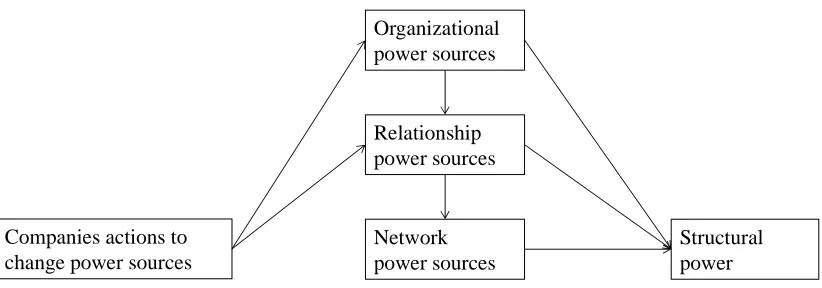
Figure 1. A synthesized framework of the links among companies’ actions to change the sources of power, the three categories of the power sources, and realized structural power.
In summary, the literature finds that companies within a solution provision network
take action to shape their power sources and that changes in these sources are realized
as improved (or weakened) inter-organizational power. The most powerful companies
can then utilize their power to affect others and thereby promote their ultimate
business objectives. Figure 1 above presents the key constructs and their
interrelationships based on the synthesized perspectives in the literature on integrated
solutions and inter-organizational power. Companies take action to change their
power sources related to organizational resources and relationships with other
network actors. The changed organizational power sources then affect relationships,
which then alter the network’s power sources. The changes in these three types of
power sources lead to changes in inter-organizational power such that the effects of
the power sources do not accumulate in linear fashion, but complementarities are
crucial. The synthesized framework shown in Figure 1 is utilized to guide our
empirical analysis. To investigate how power is achieved in solution networks, we
conducted a multiple case study, which will be discussed below.
3 METHODS
Our research objective was to study how companies take action to achieve power in
solution provision networks. To understand this process, we also studied the links
among the actions, changes in power sources, and the companies’ views of the
realized power. We adopted an inductive case study approach (Eisenhardt and
Graebner, 2007) because we aimed to contribute to the theoretical knowledge on a
topic that required deep understanding (Eisenhardt and Graebner, 2007; Wacker,
1998). The case study design offered the best fit to investigate a subject that still
requires an exploratory research design (Eisenhardt, 1989; Yin, 1984). A case study
Companies actions to change power sources
Organizational power sources
Structural power Relationship
power sources
design enabled us to observe the phenomenon in its natural context to reach the most
thorough understanding of it (Meredith, 1998). In addition, we applied Eisenhardt’s
(1989) recommendation to use a large number of cases to improve the transferability
of the results, which in our research also served the essential goal of gathering
sufficient amounts of data from different types of companies (see Table 2). Regarding
the supply network position, we focused the analyses on solution integrators and their
suppliers. Solution integrators considered their offering to be service based and the
primary goal was to fulfil customers’ needs by providing solutions. On the other hand,
the suppliers provided the integrators with the components of the total solution; that
is, with services, goods, or a combination of both.
3.1 Sampling
We applied a theoretical sampling method to select the cases (Eisenhardt, 1989; Miles
and Huberman, 1984; Yin, 2003). This method enabled us to include a wide spectrum
of companies, which increased our understanding of different types of context
variables. We focused on selecting companies that represented theoretical extremes:
either being the central part of it (integrator) or supplying these integrators with
varying degrees of goods or services. This provided a perfect context to observe the
varying degrees to which the companies relied on different types of strategies. In their
quest for power, they used different approaches to change organizational, relationship,
and network power sources (Kähkönen and Virolainen, 2011). To increase the
dispersion of our data and to enable a fruitful comparison, we searched for companies
with varying emphasis on these aspects. Because the approaches to power could not
be thoroughly identified beforehand, only “educated guesses” could be made. The
second criterion for the case selection was that the company candidates had to be part
of a wider solution (comprising service and goods components) provision network, in
which a triad could be identified as the reference point in our analysis. This was
essential to establish a basis for the empirical analysis. Third, to enable us to observe
the practices of the best-performing networks, the selected companies had to be well
known for their high performance in solution provision networks. These companies
were identified in data gathered from the business press, academic publications, and
financial reports. Fourth, to reach a rich understanding of the contextual
mainly served manufacturing- and construction-related industries utilizing high
technologies in their businesses.
Initially, we identified 10 companies as potential candidates for the sample, from
which five were finally chosen for the analysis. The included companies were
evaluated as the most suitable with regard to the theoretical sampling criteria
described previously. The decision to leave five companies out of the sample was
based on criteria such as a relatively low proportion of the manufactured goods
component in the solution of the delivery network in relation to the service
component, which would not serve our purpose of comparing well-performing
companies within typical solution provision networks. This was identified in the
preliminary analysis of the potential cases. The five selected companies were all large
multinational organizations, and many of them were operating in a number of
industries. In each company, we decided to set the level of analysis to one division
(Barratt et al., 2011). This satisfied the sampling criteria because of the wide variety
of industries and modes of operations logic among different divisions within single
companies. The unit of analysis is therefore a company division (for simplicity, we
refer hereafter to the analyzed company divisions as “company” because they operate
independently) and the unit of reference is the triad in which the division operated.
For each company, we selected a solution provision network in which the company
participated and which played a critical role in determining the success of its solution
provision. In the analysis phase, one of the five companies, TechCo (all company
names in this paper are pseudonyms), was identified as involved in two key networks
that required separate analyses as embedded cases. For clarity, the focal companies in
both embedded cases were renamed, which was inspired by the characteristics of the
cases: TechProjects and TechAssemblies. Therefore, the final analysis covered six
embedded cases/networks: three analyzed cases were suppliers and three were
integrators (see Table 2).
3.2 Data collection
Data were collected mainly through semi-structured interviews conducted in the six
selected cases (see Table 2). Further, in most cases, we carried out interviews with
each company’s supplier and/or customer to incorporate the perspective of business
the context. In the case of ProsCo, in which interviewing other parties was not
possible, we aimed to balance this shortcoming by increasing the number of
interviews within the focal firm. We also utilized supplemental secondary data from
archives, internal documents, marketing material, IT systems, and annual reports.
Because they were collected from different sources, these data enabled triangulation
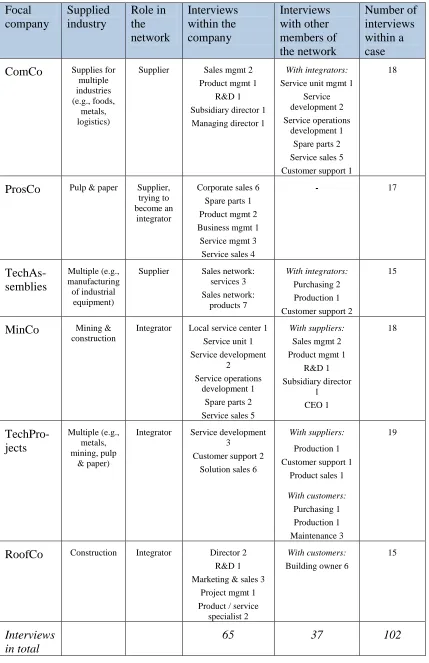
Table 2. Sample, data, and industrial coverage. Focal company Supplied industry Role in the network Interviews within the company Interviews with other members of the network Number of interviews within a case
ComCo Supplies for
multiple industries (e.g., foods,
metals, logistics)
Supplier Sales mgmt 2 Product mgmt 1
R&D 1 Subsidiary director 1
Managing director 1
With integrators:
Service unit mgmt 1 Service development 2 Service operations
development 1 Spare parts 2 Service sales 5 Customer support 1
18
ProsCo Pulp & paper Supplier, trying to become an
integrator
Corporate sales 6 Spare parts 1 Product mgmt 2 Business mgmt 1
Service mgmt 3 Service sales 4
- 17 TechAs-semblies Multiple (e.g., manufacturing of industrial equipment)
Supplier Sales network: services 3 Sales network: products 7 With integrators: Purchasing 2 Production 1 Customer support 2
15
MinCo Mining & construction
Integrator Local service center 1 Service unit 1 Service development
2 Service operations
development 1 Spare parts 2 Service sales 5
With suppliers:
Sales mgmt 2 Product mgmt 1
R&D 1 Subsidiary director 1 CEO 1 18 TechPro-jects Multiple (e.g., metals, mining, pulp & paper)
Integrator Service development 3
Customer support 2 Solution sales 6
With suppliers:
Production 1 Customer support 1
Product sales 1
With customers:
Purchasing 1 Production 1 Maintenance 3
19
RoofCo Construction Integrator Director 2 R&D 1 Marketing & sales 3
Project mgmt 1 Product / service
specialist 2
With customers:
Building owner 6
15
Interviews in total
To answer our research questions, we designed interview questions related to (a)
value offering, (b) power focus, (c) demand and supply network, (d) risks associated
with each solution regarding power, (e) the actions and decisions taken to achieve
power, and (f) the power position that the company had established. Regarding
network information, the questions covered member identification, network
dynamics, information sharing, and power structures. Value offering was scrutinized
for its content (goods and service components), specialization, and competition. The
actions and decisions taken to achieve power were analyzed based on Kähkönen and
Virolainen’s (2011) categories of organizational, relationship, and network power
sources. The questions also covered the structure, nature of demand, and partnering of
the delivery system.
In order that we could gather data from informants with the most thorough insights
into the studied phenomena, the interviewees were chosen according to their position
in the given organization (Wacker, 1998). Our aim was to interview personnel with
different perspectives on the provided solution, network, power focus, company
offerings, actions taken to change power sources, and the realized structural power. In
practice, a primary contact was first identified in each company, which was typically
a division CEO or sales/development director. This person was asked to provide the
contact information of the intended informants within the company. In addition,
access to informants among suppliers and customers was sought from the personnel
working in that interface. The informants included solution managers, sales directors,
sales managers, sales representatives, research and development (R&D) managers,
and R&D engineers from both service and product units. On average, the interviews
lasted between 60 and 90 minutes (the extremes were 20 and 120 minutes). All 102
interviews, except 10, were recorded and transcribed. Permission to record was
denied in 10 interviews, so extensive notes were taken. Interview outlines based on
the notes were written and the outlines were sent to the interviewees to confirm their
agreement with the contents. The interviewees could supplement the outlines with
details that they felt were missing. The transcripts and interview outlines were
3.3 Data analysis
To analyze the data, we began by establishing a general analytic strategy (Yin, 2003).
The analysis was based on interview themes and quotes were transferred from the
transcripts to the data file and grouped according to themes. During the within-case
analysis, themes were added if something appeared to differ from the interview theme
structure. Throughout the analysis, we used an approach in which different qualitative
data sources were combined (Yin, 2003). The data collection for each case continued
until no new themes emerged, which indicated that theoretical saturation had been
reached (Eisenhardt, 1989).
The analysis and interpretation of the data proceeded as recommended by Miles and
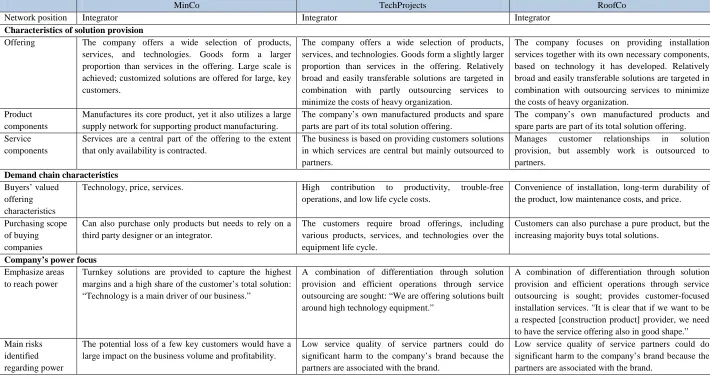
Huberman (1984). First, we conducted a within-case analysis of each case (see Tables
3 and 4 below for a summary of the analyzed suppliers and integrators). At this stage,
we conducted the analysis by “drawing and verifying conclusions about a single site”
(Miles and Huberman, 1984, p. 79). Hence, each company and embedded case was
first investigated in turn according to its own site, to distinguish company-specific
findings. The three researchers involved in this process analyzed each embedded case.
The researchers then compared their analyses and discussed possible disagreements.
Second, we established a cross-case analysis, in which the findings of each embedded
case were interpreted in conjunction with the others. This cross-case analysis was
useful in increasing the generalizability of the findings and identifying patterns. As
expressed by Miles and Huberman (1984, p. 151), a cross-case analysis is useful
because it reveals “how such processes are bent by specific local contextual
variations.” We conducted both stages after the data collection in the
above-mentioned order because this type of analysis is most useful when a complete
database has been collected (Miles and Huberman, 1984). Next, we describe the
findings across the six embedded cases. We start with the actions taken by suppliers
to increase their power (subsection 4.1) and in subsection 4.2, we describe the actions
of the integrators. In subsection 4.3, we explain how the changed power sources
Table 3. Summary of the analyzed supplier companies.
ComCo ProsCo TechAssemblies
Network position Supplier Supplier, trying to become an integrator Supplier
Characteristics of solution provision
Offering The company focuses on providing specialized technology and transactional services. Goods and services form approximately equal shares of the offering. Solutions are built on standard technological components, by which services can be offered.
The company offers a wide selection of products, services, and technologies. Goods form a slightly larger proportion than services in the offering. Relatively broad and easily transferable solutions are targeted, but services are outsourced for minimizing the costs of heavy organization.
The company focuses on providing products based on the technology it has developed. Offerings comprise almost entirely goods. New applications and delivery channels for the products are sought to improve economies of scale in sourcing and manufacturing.
Product components
The company’s own manufactured products are central in their offering.
The company utilizes a large supply network for product assembly and manufacturing.
The company’s business is based on selling the products and spare parts that it manufactures. Service
components
The services are a central part of the offering, yet are mostly offered via the integrator.
The services are a central part of the offering, yet the company has the ability to offer only transactional services supporting its own technology.
The company supports integrators by providing support and training related to its product.
Demand chain characteristics
Buyers’ valued offering characteristics
High quality, long-lasting technology, and easy configuration of the product.
Technology, price, and services. High quality, low cost, and easy configurability of the product.
Purchasing scope of buying companies
The integrators buy focused offerings, but often with accompanying services.
Also purchase only products, but then need to rely on an integrator that is able to employ a variety of technologies from different manufacturers.
The integrators buy focused offerings with varying degrees of services.
Company’s power focus
Emphasize areas to reach power
Combination of differentiation through technology and efficient manufacturing: “Our future is in intelligent technology.”
Turnkey solutions are aimed to capture the highest margins and a high share of the total solution: “We are a product company.”
Advanced product functionalities, good quality, and strong branding are sought to balance the strong pressures on efficient manufacturing operations: “We obtain the money from goods.”
Main risks identified regarding power
Losing the position of technology leader. Inability to maintain and service competing technologies; inefficiency in service delivery system.
Table 4. Summary of the analyzed integrator companies.
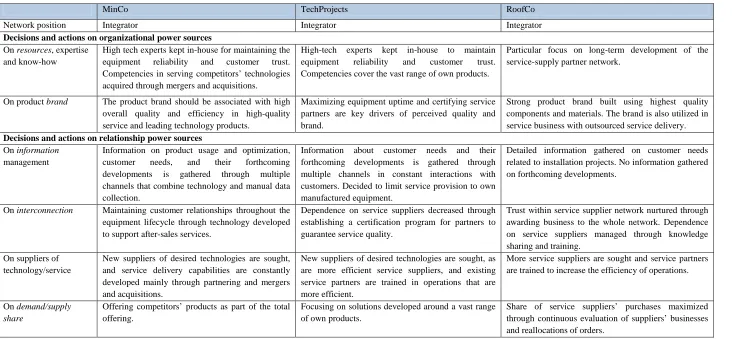
MinCo TechProjects RoofCo
Network position Integrator Integrator Integrator
Characteristics of solution provision
Offering The company offers a wide selection of products, services, and technologies. Goods form a larger proportion than services in the offering. Large scale is achieved; customized solutions are offered for large, key customers.
The company offers a wide selection of products, services, and technologies. Goods form a slightly larger proportion than services in the offering. Relatively broad and easily transferable solutions are targeted in combination with partly outsourcing services to minimize the costs of heavy organization.
The company focuses on providing installation services together with its own necessary components, based on technology it has developed. Relatively broad and easily transferable solutions are targeted in combination with outsourcing services to minimize the costs of heavy organization.
Product components
Manufactures its core product, yet it also utilizes a large supply network for supporting product manufacturing.
The company’s own manufactured products and spare parts are part of its total solution offering.
The company’s own manufactured products and spare parts are part of its total solution offering. Service
components
Services are a central part of the offering to the extent that only availability is contracted.
The business is based on providing customers solutions in which services are central but mainly outsourced to partners.
Manages customer relationships in solution provision, but assembly work is outsourced to partners.
Demand chain characteristics
Buyers’ valued offering characteristics
Technology, price, services. High contribution to productivity, trouble-free operations, and low life cycle costs.
Convenience of installation, long-term durability of the product, low maintenance costs, and price.
Purchasing scope of buying companies
Can also purchase only products but needs to rely on a third party designer or an integrator.
The customers require broad offerings, including various products, services, and technologies over the equipment life cycle.
Customers can also purchase a pure product, but the increasing majority buys total solutions.
Company’s power focus
Emphasize areas to reach power
Turnkey solutions are provided to capture the highest margins and a high share of the customer’s total solution: “Technology is a main driver of our business.”
A combination of differentiation through solution provision and efficient operations through service outsourcing are sought: “We are offering solutions built around high technology equipment.”
A combination of differentiation through solution provision and efficient operations through service outsourcing is sought; provides customer-focused installation services. "It is clear that if we want to be a respected [construction product] provider, we need to have the service offering also in good shape.” Main risks
identified regarding power
The potential loss of a few key customers would have a large impact on the business volume and profitability.
Low service quality of service partners could do significant harm to the company’s brand because the partners are associated with the brand.
4 CROSS-CASE FINDINGS AND DEVELOPED PROPOSITIONS
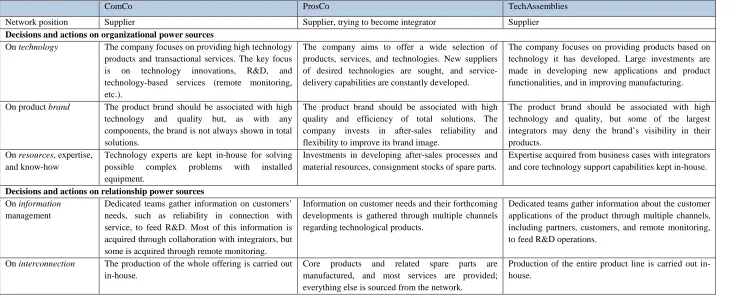
The findings from our cross-case analysis are summarized in Tables 5 (subsection
4.1) and 6 (subsection 4.2). According to our analysis, three integrator companies
(MinCo, TechProjects, and RoofCo) operated with the primary intention of achieving
power mainly through changing relationship power sources. All three supplier
companies were operating with an emphasis on organizational power sources. ComCo
and TechAssemblies were satisfied with the achieved position, while ProsCo was
striving for the integrator role in the network. For the sake of clarity, we will
summarize our key findings in short paragraphs and highlight them in italics. The
findings providing the most novel contribution to existing knowledge are structured as
propositions. The findings from different subsections are summarized in Figure 2 in
subsection 4.3. We start with the actions taken by the three suppliers to achieve
power, continue with the integrators’ actions, and conclude by discussing how the
changed power sources enabled power in the networks.
4.1 Supplier companies’ actions taken to shape the power sources in solution
provision networks
Our sample included three supplier companies. One supplier, TechAssemblies, relied
mostly on manufacturing operations, while ProsCo and ComCo emphasized both
service and product provision. TechAssemblies was among the companies that were
the most satisfied with their realized power. This setting offered us an opportunity to
compare extremes. ComCo was very satisfied with its position as a supplier, whereas
ProsCo was dissatisfied and therefore aimed to change its situation and transition
toward the integrator role. Theoretically, we perceived this change as a challenge
because the re-positioning would require changes in both organizational and
relationship power sources. The case served as an excellent point of comparison
between the positions. We first describe how these companies took action to increase
power (subsection 4.1). In subsection 4.3, we explain how changes in different power
sources, especially those related to the network structure, enabled suppliers to achieve
power.
Our analysis of supplier companies demonstrated the importance of developing the
core source of power and the power sources that are essential in supporting the core.
organizational level—technology, human resources, and brand—and power sources
at the relationship level—information. Because these power sources were found to be
interdependent, development actions were needed in all of them, at least to a certain
extent. Failing to appreciate fully the need to develop all these interacting power
sources could place the companies in less-powerful positions. We became aware of
this finding from our comparison of the two supplier companies, ComCo and
TechAssemblies, both satisfied with their power, with the third company, ProsCo,
which was dissatisfied and striving for the integrator position.
The findings showed certain similarities between the actions taken by these suppliers
to achieve power. All three companies were technology-based manufacturing firms
that targeted their actions toward the development of technology utilized in their
products, instead of relationship management within the network. The companies
seemed to invest heavily in technology research and development (R&D) and in
gathering information from integrators and customers to develop high-technology
products. However, we found substantial differences with regard to technological
aspects, especially in the choices of development areas emphasized in achieving
power. Specifically, ComCo and TechAssemblies had decided to build their
businesses around delivering technology-based products and spare parts manufactured
in-house, whereas ProsCo had to use multiple suppliers for some basic components.
ProsCo was simultaneously developing its own technology by combining several
components and trying to build relationship-oriented capabilities for close cooperation
with integrators, customers, and suppliers of components and technologies. In
contrast, ComCo and TechAssemblies had identified the need to choose between
prioritizing the building of either relationship capabilities or technology. Based on
these strategic choices, ComCo and TechAssemblies managed most integrator and
supplier relationships at arm’s length. For example, TechAssemblies was supplying
several hundred integrators but had developed a customized support model for only
four of them; others were served through routine processes that usually required only
order handling. The company also made a strategic decision to provide services only
to equipment manufactured and designed in-house because it lacked the resources to
acquire the knowledge and information required to service a variety of brands.
Despite their arm’s-length relationships with integrators, ComCo and TechAssemblies
developed technology. Specifically, information was gathered about customers’
product and service needs, experiences in product usage and reliability, and directions
of customers’ future business agendas. The information gathered about the equipment
that was delivered and installed at customer sites (i.e., installed base information
[IBI]) was perceived as an extremely important source of power. This information
was needed to promote the visibility of the installed base toward which the service
and support operations were targeted. Both ComCo and TechAssemblies developed a
technology through which they could monitor the equipment remotely. In addition,
TechAssemblies had designed a semi-automated IT tool for storing and managing
information about delivered products, and they encouraged integrators and customers
to use it to give TechAssemblies visibility to the installed base. Both companies
utilized the gathered information in their search for new product applications by
creating novel functionalities that allowed multiple varieties of products. One way to
achieve this was TechAssemblies’ programmable interface through which the
equipment could be optimized to serve very different types of customer applications.
Both ComCo and TechAssemblies had also organized product development around
customer application teams that specialized in certain industries. These key account
teams gathered information from customers through multiple channels: partners,
consultants, customers, and business cases in which they collaborated with
integrators. The extent to which companies had established partnerships with
integrators for data collection varied. ComCo gathered information about product
usage and reliability mostly through integrators and remote monitoring, whereas
TechAssemblies extensively utilized different channels such as integrators, customers,
and consultants. The ultimate goal of these actions was to support the utilization of
the product technology; therefore, new customer applications and delivery channels
were sought constantly and systematically. The solid basis of this search derived from
an extensive effort to understand the market and customer needs. Findings regarding
Table 5. Cross-case analysis of actions taken by suppliers to change power sources.
ComCo ProsCo TechAssemblies
Network position Supplier Supplier, trying to become integrator Supplier
Decisions and actions on organizational power sources
Ontechnology The company focuses on providing high technology
products and transactional services. The key focus is on technology innovations, R&D, and technology-based services (remote monitoring, etc.).
The company aims to offer a wide selection of products, services, and technologies. New suppliers of desired technologies are sought, and service-delivery capabilities are constantly developed.
The company focuses on providing products based on technology it has developed. Large investments are made in developing new applications and product functionalities, and in improving manufacturing.
On productbrand The product brand should be associated with high technology and quality but, as with any components, the brand is not always shown in total solutions.
The product brand should be associated with high quality and efficiency of total solutions. The company invests in after-sales reliability and flexibility to improve its brand image.
The product brand should be associated with high technology and quality, but some of the largest integrators may deny the brand’s visibility in their products.
Onresources, expertise, and know-how
Technology experts are kept in-house for solving possible complex problems with installed equipment.
Investments in developing after-sales processes and material resources, consignment stocks of spare parts.
Expertise acquired from business cases with integrators and core technology support capabilities kept in-house.
Decisions and actions on relationship power sources
Oninformation
management
Dedicated teams gather information on customers’ needs, such as reliability in connection with service, to feed R&D. Most of this information is acquired through collaboration with integrators, but some is acquired through remote monitoring.
Information on customer needs and their forthcoming developments is gathered through multiple channels regarding technological products.
Dedicated teams gather information about the customer applications of the product through multiple channels, including partners, customers, and remote monitoring, to feed R&D operations.
Oninterconnection The production of the whole offering is carried out in-house.
Core products and related spare parts are manufactured, and most services are provided; everything else is sourced from the network.
Supplier companies tried to affect power sources not only through improving
technology and information control but also by carefully developing their resources
and personnel competencies to support technology products. A strong product brand
and technology leadership were perceived as essential. Although integrators and
customers serviced a significant portion of the equipment delivered by both ComCo
and TechAssemblies, the companies assigned teams of technology experts within
their own organizations to be responsible for handling the most demanding service
requests. This task force was utilized when the customer or integrator encountered
equipment malfunctions that they could not solve. The teams of high tech experts
were formed to guarantee that equipment users would not encounter problems that
would cause significant downtime in their operations. This support, in addition to the
companies’ actions to constantly improve product quality, ensured high valuation of
their product brand by customers and the wider network. However, ProsCo focused
its resource development efforts on basic after-sales processes and material resources
such as designing consignment stocks of spare parts and basic maintenance.
Consequently, ProsCo was able to provide a basic offering with a wide selection of
technologies, but it was not able to support fully equipment that utilized technologies
other than their own. Like the other two suppliers, ProsCo emphasized the role of
after-sales support in improving its brand image by focusing on reliability and
flexibility. However, this was hindered by a lack of capability to support the full
range of products provided. It seemed that, in the suppliers’ cases, the depth of
technology competence and the ability to utilize it in a variety of customer industries
and applications made up for the breadth offered by the provision of different
technologies.
Accordingly, in these cases, the deciding factor in actions to achieve power was
resource allocation. ComCo and TechAssemblies directed investments to developing
their unique organizational power sources, which were mainly technologies utilized
in products and services such as remote monitoring and supporting capabilities. This
enabled these companies to create product varieties based on information that they
could acquire regarding the usage of their technology. This also meant that they were
not able to integrate broad customized offerings from different types of technologies;
nor could they build excellent relationship management capabilities or close