http://wrap.warwick.ac.uk
Original citation:White, Leroy. (2015) Behavioural operational research : towards a framework for
understanding behaviour in or interventions. European Journal of Operational Research doi:10.1016/j.ejor.2015.07.032
Permanent WRAP url:
http://wrap.warwick.ac.uk/70996
Copyright and reuse:
The Warwick Research Archive Portal (WRAP) makes this work by researchers of the University of Warwick available open access under the following conditions. Copyright © and all moral rights to the version of the paper presented here belong to the individual author(s) and/or other copyright owners. To the extent reasonable and practicable the material made available in WRAP has been checked for eligibility before being made available.
Copies of full items can be used for personal research or study, educational, or not-for-profit purposes without prior permission or charge. Provided that the authors, title and full bibliographic details are credited, a hyperlink and/or URL is given for the original metadata page and the content is not changed in any way.
Publisher’s statement:
© 2015, Elsevier. Licensed under the Creative Commons Attribution-NonCommercial-NoDerivatives 4.0 International http://creativecommons.org/licenses/by-nc-nd/4.0/
A note on versions:
The version presented here may differ from the published version or, version of record, if you wish to cite this item you are advised to consult the publisher’s version. Please see the ‘permanent WRAP url’ above for details on accessing the published version and note that access may require a subscription.
ACCEPTED MANUSCRIPT
Highlights
The paper provides a theoretical background for behavioural OR
The paper provides a narrative review of the practical literature on OR and behaviour
The paper advocates that research on OR and behaviour should focus collective behaviour
ACCEPTED MANUSCRIPT
BEHAVIOURAL OPERATIONAL RESEARCH: TOWARDS A FRAMEWORK FOR UNDERSTANDING BEHAVIOUR IN OR INTERVENTIONS
Leroy White
Warwick Business School University of Warwick [email protected]
ABSTRACT
Stimulated by the growing interest in behavioural issues in the management sciences, research scholars have begun to address the implications of behavioural insights for Operational Research (OR). This current work reviews some foundational debates on the nature of OR to serve as a theoretical backdrop to orient a discussion on a behavioural perspective and OR. The paper addresses a specific research need by outlining that there is a distinct and complementary contribution of a behavioural perspective to OR. However, there is a need to build a theoretical base in which the insights from classical behavioural research is just one of a number of convergent building blocks that together point towards a compelling basis for behavioural OR. In particular, the focus of the paper is a framework that highlights the collective nature of OR practice and provides a distinct and interesting line of enquiry for future research.
Keywords
ACCEPTED MANUSCRIPT
INTRODUCTION
Without doubt, behavioural research is making a significant impact on many academic disciplines. Now interest in ‘Behaviour’ and ‘Operational Research’ (OR) is burgeoning (Royston, 2013). A recent article emphasised the importance of this interest, in which it was stated that “OR is about real-life problem solving and thus it is subject to behavioural issues and effects” (Hämäläinen, et al 2013). While the authors provided an excellent overview of behavioural matters relating to OR, and underlined some potential areas for research, they also lamented that, overall, behavioural studies on the process of OR is almost completely lacking. In considering this dearth of studies, the authors stated that future research, focusing on the OR process at the individual, group and organisational levels of analysis, would need to find and apply distinctive theoretical perspectives and empirical research methodologies, pointing to a specific research gap.
This gap seems to stem from three main interrelated issues. First, there may be some uncertainty as to the precise definition of Behavioural OR, even though there is now a growing number of articles that are incorporating behavioural issues in their studies (Brailsford and Schmidt, 2003; Morton and Fasolo, 2009; Bayley and French, 2008; Hämäläinen, et al 2013). There are also a number of aligned fields, where theories on behaviour, as well as the theoretical and empirical developments in the behavioural sciences, are beginning to contribute to the rapidly growing interest in behaviour and OR (Bendoly et al, 2006; Gino and Pisano, 2008; Ackert and Deaves, 2009). Some of these perspectives have already merged into new disciplines focusing on choice and judgment (e.g. behavioural decision theory:- see Maule and Hodgkinson (2003) for an overview), while others are continuing to evolve autonomously (e.g. System dynamics (eg Sterman, 1989)). Furthermore, given the extent to which behavioural research has been developed in other fields (e.g. Economics, Finance and Operations Management), it is also unclear whether there are distinctive theoretical and empirical perspectives for behavioural OR.
ACCEPTED MANUSCRIPT
behavioural ideas were invoked, if somewhat casually, particularly from disciplines such as group and social psychology (Phillips and Phillips, 1993; Friend, et al 1998). Yet, these ideas have not penetrated OR theory or practice in any significant way (Bendoly, 2006). This may be due to the fact that most scholars in the OR field do not have a deep knowledge of behavioural theory and thus it is no surprise to find that the studies tended to assume some fairly basic behavioural assumptions or ideas (see Eden (1989) for a similar argument). This oversimplification has resulted in questionable theory and an ill-conceived basis for the efficacy of OR processes, where there is now a particular concern about the lack of empirical validity of the outcomes and claims of OR processes (Keys, 1989; Mingers, 2011). Most of the discussions on the validity of OR processes are based on a few comparative reports and reviews of observations from different case studies (Mingers and Rosenhead, 2004). The vast majority of claims about the effects of OR processes are based on little more than authors’ reflections on single case-studies, with other sources of information (e.g., participant evaluations and/or data collected across interventions) being used in only a minority of cases (see White (2006b) and Midgley et al (2013) for a discussion). Perhaps behavioural concerns are just too difficult to address in evaluating OR processes (Eden, 1995; Connell, 2001; White, 2006b, 2009; Midgley et al, 2013). Whatever the reasons, there is a clear sense that behavioural concerns are under-developed in OR (Eden 1989; Hämäläinen, et al 2013; Bendoly et al, 2006).
ACCEPTED MANUSCRIPT
as significant components of complex OR interventions. Arguments for these devices are drawn from several streams of research, which are reviewed in an attempt to address the research gap. The paper, therefore, follows a somewhat retroductive/ abductive approach1 (Bhaskar, 1979; Sayer, 2000), that links the theoretical and empirical in an expressly iterative way.
First, in terms of the distinct basis for Behavioural OR, the scientific rationale for OR is revisited before considering recent critiques of this approach (Keys, 1989; Jackson, 2006; 2012; 2014a). Then, an outline of the benefits of middle range theories is detailed, in particular the work of Bhaskar and Hacking as providing a compelling theoretical basis for Behavioural OR. Following this, a narrative review of some literature on OR practice is used in order to develop a framework conceived broadly so as to encompass behaviour at the internal and external levels. Accordingly, this framework is an improvement and extension of Ackoff’s (1978; 1983; 1989), for thinking about the behavioural assumptions commonly used in OR. Finally, a discussion on how the framework will be helpful for research concerning behavioural issues and OR more generally is provided.
IS THERE A THEORETICAL BASIS FOR BEHAVIOURAL OR?
Uncontroversially, it is commonly accepted that traditional OR originally focused on the scientific method in order to maintain objectivity, and the adopted models assumed a singular version of rationality (Mingers, 2000; Keys, 1997; Jackson, 2006). Defined by pioneers and borrowing from the natural sciences, the aim was to use both method and models for identifying an optimal solution to problems independent of perceptions, appreciations and the feelings of human beings (Ackoff, 1962; 1978; Raitt, 1979; Lesoume, 1990; Mingers 2000). While there is a large literature both within and outside OR that has addressed the problem of these assumptions, the critique within OR tended neither to focus on biases nor on behaviour directly. By aligning itself with scientific method, OR located itself in a hotly contested philosophical territory (Miser, 1991; 1993; Dando et al, 1977; Mingers, 2000), where several theoretical strands have sprung out of the debates
1 Scholars suggest that philosophers use the terms retroduction and abduction interchangeably.
ACCEPTED MANUSCRIPT
that have implications for behavioural issues in OR (Ormerod, 2012). Some of these are considered below.
Subjectivity and Rationality revisited
First, in relation to the scientific approach, this has had a sustained critique focusing on OR’s relations to the social world, subjectivity (Ackoff, 1977, Eden and Sims, 1981; Keys, 1989; Mingers 2000) and inter-subjectivity (Checkland, 1981). The emphasis on (inter)subjectivity led to a series of views on the nature of OR itself (Mingers, 1984, Mingers 2000; Ormerod, 2012; 2014a). These views ranged from OR as a technology (Keys, 1989, 1998), to OR as socially constructed (White, 2006b), and all could be construed as OR’s sociological turn (Keys, 1997). However, implicit in these debates is the idea that OR operates in a subjective and inter-subjective world where behaviour and human factors are crucially important to address. This was particularly seen in the development of soft OR. Indeed, soft OR scholars have for long criticised OR for being too narrowly concerned with mathematical models only (Ackoff, 1977). They challenged the claim for methodological objectivity in that it appeared to most to be an illusion or ill-suited to the social world (see Mingers (2000; 2003) for a decent overview of the arguments).
These questions about the process of OR, mainly addressed by UK scholars, led to a growth in interest to incorporate (inter)subjectivity, through mainly qualitative models, exemplified by the development of a series of approaches termed problem structuring methods (PSMs) (Mingers and Rosenhead, 2004; Ackermann, 2012). Indeed, soft OR has continued to investigate the possibility of using qualitative methods, including subjective beliefs and values to support decision-making (Davis et al, 2010; Checkland, and Holwell, 2004; Eden and Ackermann, 2006; Mingers, 2011, White and Bourne, 2007; Yearworth and White, 2011).
ACCEPTED MANUSCRIPT
found in OR (see also Bendoly et al, 2006). These include the implicit assumptions that people are assumed to be deterministic and predictable in their actions and that they are emotionless, observable and independent of each other. Recently, Ormerod (2012; 2014a) explored the philosophical development of the Critical Rationality,
which explicitly attempts to disregard all subjective (hence inductive) claims by the
uncompromising application of deductive logic. He argued that it should find favour
with OR, particularly for those who want to claim that OR is logically rational.
However, he concluded that although, as Critical Rationality suggests, it may be
possible to drive out subjective claims in OR, subjective choice is an essential
element of situations in which OR practice is applied and therefore cannot be
ignored or assumed away.
ACCEPTED MANUSCRIPT
According to Simon, actors attempting to make good decisions are not capable of an objectively rational approach and do not therefore conform to the requirements of a normative model. They do nonetheless engage on a form of analytic problem solving that reflects attention to process. From this perspective, rationality is seen as a particular way to approach action in a complex, intractable problem setting. As Pidd argued (2004), OR approaches aim to provide decision support that is procedurally rational, although how they do this varies. Here, optimisation may not be the goal or even desirable, and as was pointed out in an early example of soft OR, “decisions …are a matter for judgement rather than for optimising” (Best et al, 1986: pg 474). Thus, even if it can be shown that there is an optimal solution or decision based on the model of the real world, the process by which the real world is simplified into a model is a process subject to other, and sometimes behavioural, effects (Simon, 1976; Bendoly et al, 2006).
What operationally (and more interestingly behaviourally) does rationality as a process mean in such circumstances? There may not be an agreement with all the details provided above, but there seems to be a consensus about using a rational approach in structuring problems (Mingers and Rosenhead, 2004; Pidd, 2004; Ormerod, 2012). More formally this approach generally involves a group identifying the problem, potential solutions, relevant information, and then evaluating and selecting the options. There is also the belief that these rational processes will lead to good decisions or actions. As stated earlier, this is hard to prove. Research is in the main inconsistent and equivocal where it is observed that the rational processes in groups perform sometimes well and sometimes poorly (– the process-performance puzzle — White (2006b)).
ACCEPTED MANUSCRIPT
response to the understanding of nature and the social world, while pragmatism involves more of an agnostic response; a sense that the problems are not as serious as critics would believe (see Ormerod, 2006; 2014b). Both approaches suggest important views about the nature of OR, albeit generally at different strata. Both are not necessarily exclusive approaches. They are broadly similar in their intent to serve as reconstructive endeavours, especially in their response to the excesses of relativism and social constructivism. Both are probably more powerful taken together than when considered separately. Both admit that all knowledge is partial and to a certain degree relativism is unavoidable. Jointly, they can point to a fruitful response to questions arising from the social constructivist nature of OR argument. However, for the purposes of this paper, it is impossible, in the space allotted here, to do justice to these arguments and literature. The focus instead will be just on CR. Critical Realism
In the wake of its spreading intellectual influence across the social sciences, OR scholars are increasingly positing CR as a foundation for moving beyond the paradigm wars (Mingers, 2000; 2003; Kotiadis and Mingers 2014). It is claimed that CR exists in the space between objectivism and (radical) social constructionism (Sayer, 2000; Mingers, 2014). The CR view attempts to re-invite a realist view of being in the ontological domain whilst accepting the relativism of knowledge as socially and historically conditioned in the epistemological domain (Mingers, 2000; 2003; 2014; Sayer, 2000). According to Mingers, CR fits well with the debates on OR as an applied discipline, and he claims an argument could be made that it is a relevant, and an appropriate theory for OR, or it can be used empirically to look at its practice (Mingers, 2000; 2003).
ACCEPTED MANUSCRIPT
Sayer, 2000). In particular, and relevant for this study, is that the CR position on information systems (and in fact other similar disciplines) has been well presented in the literature, which has been followed by some important exchange among scholars (see Smith, 2006). It was also suggested that CR could be the basis for understanding the social situatedness of OR (Keys, 1997; Sayer, 2000). These ideas and their extensions are inspired by prominent social scientists that suggested that the social sciences should give up the quest for general laws and focus instead on the more fine-grained identification of middle range (intermediary) levels of explanation (e.g. Elster, 2007). Thus, it is no surprise that CR, and Bhaskar in particular, appears relevant to this study (Mingers, 2003; Kotiadis and Mingers, 2014; Midgley, 2000; White 2006b; Yearworth and White, 2014)
In sum, Bhaskar argued against the dualisms and splits that dominate contemporary social sciences. These dualisms were between positivism and hermeneutics; between collectivism and individualism; structure and agency; reason and cause; mind and body; fact and value. In each case, Bhaskar argued for a third sublating position which could reconcile these oppositions, and which could situate the two extremes as special cases. Importantly, with the dualism of collectivism and individualism, he argued for relationalism – that is, the conception of society as essentially relational in character, as not consisting either of collectives of individuals or individuals, but as concerned with the relations between individuals. He argued for a transformational model of social activity, which is not to identify structure or agency, but to trace their distinctive features and mutual interdependency.
ACCEPTED MANUSCRIPT
their own and others’ actions, and ultimately to regulate their own performance (Bandura, 1991). A further reminder of this condition is that behaviour pervades the capacities for agency and self-awareness, such that agents attach meaning to the social world as behaving organisms (Bhaskar, 2008).
Secondly, Bhaskar (1989) outlines emergence as the principle that higher-level phenomena such as behaviour and cognition emerge from, but are irreducible to, matter. Cognition is said to be an emergent power of matter (Bhaskar, 1989). It is
emergent in the sense that it is a power that would not exist if the parts concerned were not organised into a certain type of whole. In this way, if the material world is organised in such a way that emergent properties are found, it cannot be predicted from any single part, but only in the organisation of these parts into open systems. This notion of emergence holds implications for a behavioural analysis of OR. The emergent properties of a social entity are generated by the relation of parts in the whole, rather than being a power possessed by the individual parts. Emergence is synchronous in that ‘the operation of a causal power at any given moment depends on the presence of those parts and relations at that specific moment in time’ (Elder-Vass 2007: 30).
ACCEPTED MANUSCRIPT
operation of the lower-level mechanisms that gave rise to them, acting as constraints.
Bhaskar’s logic can be extended to human social systems. For instance, the emergence of organisational activity considers the case of how behaviour bounds organisational decision-making (Bhaskar et al, 2008). Individuals and groups draw on behaviour to make organisational decisions; decision makers use behaviour to variously guide attention to the external environment, change or reinforce mental representations, and impel action toward alternative courses of action (Hodgkinson and Healey, 2011). Behaviour sets the boundary conditions for organisational decisions because it seems unlikely that important organisational decisions can occur without indirectly invoking human feelings, and specific emotions shape the social processes of decision making (e.g., Janis and Mann, 1977). The link between behaviour, emotion and decision-making, however, needs further clarification.
Mingers's work in bringing together the cognitive autopoietic theories of
Maturana and critical realism of Bhaskar is an important connection. In particular, it
is argued that Maturana's radical subjectivism can be seen as compatible with critical
realism (Mingers, 1992). This is important because autopoiesis has strongly
subjectivist implications leading to the view that explanations and descriptions
reflect the structure of the subject, rather than that of an objective world, and that
the world is therefore constructed via experience (Mingers, 1999). The idea
proposes that people operate in collectively constructed 'rational domains' (sets of
interrelated propositions in the context of action), and can shift from one rational
domain to another through the invocation of emotion (an insight that has since been
ACCEPTED MANUSCRIPT
views support a theoretical shift on emotion: treating emotion primarily as a behavioural processrather than an object of decisions.
A more appealing perspective would be that behaviour is produced more by contextual factors and people’s attempts to respond to them than by unchanging characteristics within people. From a CR perspective the link between emotion, behaviour and decision making remains, however, somewhat unclear. But, by adopting a CR perspective, an attempt can be made to identify emotion’s role among the many factors that produce behaviour. Thisimplies that people’s actions will be influenced by innate psychological mechanisms as well as well as wider social mechanisms, it may be possible to show the nuanced complex nature of behaviour and how there may be other mechanisms curtailing its expression. In this way, from a CR standpoint, it can be suggested that behaviour and decisions both emerge from interactions among cognitive, linguistic and social forces – but their basic nature is partly rooted in the human physiological condition (March and Simon, 1993).
The example of behaviour in decision processes is noteworthy because it illustrates the real value of the behavioural aspect for understanding OR practice in general. That is, without appreciation of the embodied nature of human cognition, there is the risk in perpetuating models of organisational activity that run contrary to contemporary understanding of human nature. For example, computational models of human thinking and action still predominate in management science and organisation theory (Hämäläinen, et al 2013; Hodgkinson and Healey, 2011). Continuing to build theory on computational models that are themselves based on the classical experimental psychology of the mid-20th century is problematic (Hämäläinen, et al, 2013) and is not based on behavioural phenomena such as attention and sense-making. This necessitates a change in OR theories that make assumptions concerning human behaviour.
ACCEPTED MANUSCRIPT
aspects be like for characteristic OR activity to be possible; and (iv) what must OR activity be like for behavioural aspects to be possible?
Representing and Intervening
In answering these questions the work of Hacking (1983; 1999) is drawn on as the missing piece of a compelling theory for OR, and may provide a means to identify a theoretical basis for a behavioural perspective for OR. An important element of the approach by Hacking is the role of interventions in (experimental) practice. The position taken here follows Hacking, where, scholars are encouraged to move from puzzles of rationality to problems of reality, and to consider practice as concerning
representing and intervening.
“We represent and we intervene. We represent in order to intervene,
and we intervene in the light of representations “ (Hacking, 1983 pg 31)
Hacking showed how the dichotomy ‘real or socially constructed’ is inadequate in
addressing such problems of change. He claimed, however, that a proper understanding of the role of representing and intervening could save at least some of the realist claims of science and incorporate some of the constructivist critiques. A notable feature of Hacking’s idea is that it sees epistemological common ground for the physical and social sciences, even while maintaining a unique ontology for the transitive objects of social scientific study (Hacking, 1983). Hacking’s view (Hacking, 1995) offers an alternative to the realisation of rationality in interventions and addresses possible criticisms of Critical Rationality (Ulrich, 2007). His theory suggests that, when involved in OR interventions, actors are seeking to conform to the normative ideal of rationality, where the use of models as representation is part of that rationality-seeking approach. Using representations in interventions enable actors to feel rational and to convey an appearance of rationality to others. Indeed, representing becomes intervening, where new “kinds of people” are created, with
enormous human and social consequences. However, this entails a need to attend to
the complex relationships between theory and practice; between facts and values;
and between representing and intervening (Hacking, 1995).
ACCEPTED MANUSCRIPT
scientists. Hacking criticised the positivist philosophy of science for its single-minded obsession with representation, thinking and theory, at the expense of intervention, action and experiment. Even with an anti-positivist position within OR it can be uncontroversially contended that many OR theorists pursue a fixation with representation through models that persists despite their declaration of an opposition to positivism (e.g., Checkland, 1985) and/or a distaste for traditional metaphysical oppositions between representations and objects (White and Taket, 1994; Midgley, 2000; Tsoukas, 1991). The topic of representation is often elevated to a high ground status that covers a broad range of practical activities, together with their theoretical, instrumental and textual resources and products (Midgley and Pinzón, 2011; Franco, 2006; White and Taket 2000; Yearworth and White, 2013).
Hacking suggested reversing this trend to focus on intervening. He illustrated how interventions often have a life independent of theory. He argued that intervening presents a sustained treatment of (experimental) science to give a new direction to
the debates about realism. He also argued that although the philosophical problems
of scientific realism cannot be resolved when put in terms of theory alone, a sound
philosophy of intervention provides compelling grounds for a realistic attitude. He thus claimed that the theoretical entities that feature in (scientific) theories can be regarded as real if and only if they refer to phenomena that can be routinely used to create effects in domains that can be investigated independently. He referred to this as ‘manipulative success’, where this becomes the criterion by which to judge the reality of (typically unobservable) “scientific” entities.
ACCEPTED MANUSCRIPT
consensus and agreement. This infers an emergent, organisational or system level change, in that members of the organisation can move towards a set of improvements and decisions to resolve a problematic situation (Mingers, 2011).
Mapping the underlying problem into a simple representation which, in turn, is amendable to mediating behaviour within a process as an intervention is an important aspect in understanding the process of OR. Thus, while under the allure of the style and power of the OR process or intervention, the fact that the basis for this process is an act of representation is often under-theorised or under-reflected (Ackoff referred to this an attention to the “aesthetic value” in modelling (see White (2006a)). This relative neglect deprives scholars the opportunity to think more carefully about the relationship between representing and intervening, as there is an implicit notion that the representation is, in fact, a characterisation of the true problem setting and not simply one out of a vast sea of possible options (Taket and White, 2000; Mingers, 2011; Franco, 2013). Also, a failure to recognise the inherent connection between models of the world and the actual situations is likely to lead to misinformed readings of interventions on the part of decision makers (Neale and Bazerman, 1985). The question haunting these ideas is whether the forms of representation in OR interventions will lead to the counter-intuitive suggestion that the interventions might exhibit emergent (group) properties. Scholarship continues, however, to use evaluative notions such as group learning or group decision making. But, there is little to suggest whether emergent behaviour is possible or even desirable.
ACCEPTED MANUSCRIPT
mechanisms which appear to explain the phenomenon of an OR intervention project? (ii) what properties must exist for the particular intervention to be what it is? A narrative review of the literature on behaviour and OR is now presented to develop a focus on a relevant basis for a theory of Behavioural OR.
METHOD FOR A LITERATURE REVIEW
From the outset, the aim in this paper is to develop a framework for understanding behavioural issues in relation to OR interventions. This made it challenging to identify a coherent and precise set of keywords for a search process to conduct a literature review. In a similar field, the article published by Bendola and colleagues (2006) relied on a more circumspect review. This was also the case in the article by Hämäläinen et al (2013). It is anticipated here that a similar strategy would yield even more chaff and less wheat because the disciplinary traditions targeted are broad and the amount of articles that would pass the threshold of evidence would be small. Instead, a non-keyword-based reviewing process is relied on that is akin to a systematic snowball approach. The goal was to identify articles that made a core contribution, either conceptually or empirically, to addressing behavioural phenomenon in soft OR.
The starting point, here, was to identify some formative papers (both hard and soft OR) that are considered to have shaped the discussion and debates on behaviour and OR. For this, the list of citations provided by Hämäläinen, et al (2013) was used to highlight seminal works on OR and behaviour. Papers that focused on Soft OR and PSMs were then looked at and included papers involving the evaluation of the use of PSMs, and on organisational-level literature on decisional processes and learning (Simon, 1991). The ISI Web of Science Citation Index was then used to identify all documents that cited these seminal papers. The results were triaged using the titles and (if present) the abstracts, using a decision grid based on the definition of the phenomena under review, as discussed in the previous section, e.g., emergence.
ACCEPTED MANUSCRIPT
avoiding the pitfall of mere data description. This is quite close to a realist review approach described by Pawson and Tilley (1997), where the aim is to synthesise the material as a new integrated theoretical model.
Thus, the ontological and epistemological position in this study can best be characterised as a version of critical realism that focuses attention on the crucial role of representation in the social construction of interventions, but places representation in its socio-material context (Mingers, 2000; 2014; Yearworth and White, 2014). Interventions were considered as constructed by individuals and provide them with the basis for interpretation. Likewise behaviour may be affected and expressed as part of the intervention, but are not necessarily directly represented in the objective circumstances in which individuals in the interventions find themselves. The analysis also includes a pragmatist element (Kirsh and Maglio, 1994; Ormerod, 2006; White, 2006b; Locke et al, 2008) in the sense that an
abductive approach was pursued where alternative counterfactual explanation played a key role in the development of the framework.
FINDINGS
The papers reviewed here have comparable typologies categorising agents in OR interventions into three groups (e.g., Friend et al, 1998, Eden and Radford, 1990)— problem owners, users or stakeholders, and the process experts, called facilitators,
who can contribute to both process and content or just to process (Phillips, 1984; Taket, 1994; Ackermann, 2013), i.e., they are particularly concerned with the welfare of the group. This typology should, however, be used with caution in that actual OR processes are composed of numerous individuals, and the intra-group diversity of positions, opinions, preferences, biases and interests should never be discounted (Eden and Radford, 1990; Yearworth and White, 2014). Indeed, an important consideration is of more general OR practices and consultancy (Ormerod, 2014b). Here it is concluded that competences should be considered under the same broad headings as those for traditional OR processes, but the skills, context and the
process of obtaining them make new specific demands on practice.
ACCEPTED MANUSCRIPT
efforts similar to the distinction between naturally occurring exchange and facilitated group behaviour as proposed by some scholars (Connell, 2001; Franco and Montebelier, 2010; Rouwette, 2011). Facilitated group intervention efforts was described as deliberate or instrumental, in the sense that some people use them as instruments to influence the opinions or actions of others (Eden and Radford, 1990; Franco, 2006; White, 2006b Rouwette, 2011).
Second, opinions and actions from OR processes encompass what are usually described as ‘decisions’. The study of OR processes is greatly influenced by the concepts of ‘decision’ and ‘decision making’. Yet, the operation of these concepts in OR interventions is highly problematic (Anderson et al 1997; Taket and White, 2000; Eden, 2004). Therefore, rather than relying on the concept of decision, the notion of ‘action’ was used instead (Taket and White 2000, Friend and Hickling, 2004).
Third, from OR use, it was found that the interventions seldom, if ever, directly solve organisational or policy-level problems (Friend and Hickling, 2004). To be relevant, usable, and meaningful, model use needs to be embedded in what, following Friend and Hickling (2004) and Checkland (1985; 1987), could generically be called action proposals (Starbuck, 1983). Action proposals are assertions that employ rhetoric to embed information in arguments to support a causal link between a given course of action and its anticipated consequences. The framework was developed from a narrative synthesis reading of the literature.
Dimension 1: Individual and Group level
The review to date implies that behavioural issues in OR can occur at two complementary levels that should be theoretically and analytically distinguished. On the one hand, some OR applications are aimed at autonomous individuals. Here
autonomy refers to the fact that the potential users of OR targeted by the OR processes are usually sovereign in their capacity to assemble information and/or knowledge and, consequently, to modify practices (Checkland, 1985). The individuals targeted will respond to the OR process to varying degrees, and both the context and the individuals’ characteristics will have an impact.
ACCEPTED MANUSCRIPT
participants has enough autonomy or power to translate the information into practices on his or her own (Huxham, 1990; Friend and Hickling, 2004). In such contexts, individuals are embedded in systemic relations in which behaviour and learning are important (Simon, 1991) and depend on processes such as sense making (Weick 1995; Bougon et al. 1990; Ledington and Donaldson, 1997; Franco, 2006), negotiation (Eden, 1989; Eden and Ackermann, 1998; Friend, et al, 1998; Walsh and Hostick, 2005; Walsh and Fahey 1986), coalition building (Friend and Hickling, 2004; Susskind et al, 1999), and social networks (Carley and Palmquist, 1992; White, 2008).
Although group oriented, the interventions analysed here are, in the end, actuated by individuals (Kaplan and Miller, 1997; Schweiger et al, 1986). All these individuals are also exposed to institutional incentives and broader social norms and values. Thus, it is suggested that relations between OR processes and behaviour are sufficiently different at the individual and group levels to warrant different approaches. But, as many scholars have implied (Eden and Ackermann, 1998; Franco and Rouwette, 2011; Shaw et al, 2003; White, 2002), individual-level interventions alone cannot achieve objectives; group and organisational-level interventions play a major role. Thus, in essence, separating individual versus group level allows emergent, group-level cognitive constructs to be hypothesised. It is posited that an emphasis on behaviour at the group level is to strengthen an understanding of the collective level processes in OR interventions. However, it is recognised that a group level perspective involves numerous individuals and usually produces systemic outcomes that cannot be easily specified (Eden et al, 1979, Phillips, 1984; Friend and Hickling, 2004) and, as such, can considerably complicate (or preclude) a valid measurement of the effects (Rouwette, 2011). This difference explains the gap between the strength of available evidence regarding the effectiveness of OR interventions and the relative weakness of the evidence on group-level processes. This point is returned to shortly.
Dimension 2: Instrumental and symbolic forms of model use
ACCEPTED MANUSCRIPT
process in specific, direct ways, and a symbolic use which involves using models or representations to legitimate and sustain positions (Cropper, 1990; Tomlinson, 1990), where models have little or no extra-discursive effects, being entirely socially constructed, lacking any material properties that significantly constrain and enable their construction. Similar arguments are found, where there have been important debates regarding the underlying philosophy and methodology for IS research. Best known are the debates on the dissatisfaction with the polarisation of across the positivist and interpretive philosophical traditions. Some have argued that the sublating third way can be found through adopting the ontology of critical realism (Mingers, 2004; 2014). Here, critical realist contributions aim to overcome the extremes of scientific determinism, on the one hand, and what might be termed socio-constructivism, on the other hand; these have also been equated with hard and soft OR (Mingers, 2000).
In a similar way, instrumental could refer to and be associated primarily with hard OR interventions, although it is acknowledged that soft OR models could also be used in an instrumental way (Montibelier, et al, 2008; Kotiadis and Mingers, 2006). For simplicity sake, symbolic model use is referred to mainly as associated with soft OR. It seems from the papers reviewed that the symbolic models or representations appear to be used in one or either of two senses that relate to behaviour. The first sense is designative. This refers to the act of associating behaviour, behaviour patterns, persons or words with other behaviour (Kunc and Morecroft, 2009). This mental act of association is significant in group situations when the chain of associations ends with an emotion laden referent or somebody or the group gets excited (see Eden, 2004). The second sense refers to communicative use. This use seems to imply that essentially through dialogue, emotional exchanges are enhanced and take place through social interaction (Cropper, 1990).
Dimension 3: Issue divergence
ACCEPTED MANUSCRIPT
central to each user’s individual assessment of the problem’s characteristics. If a user’s understanding of the implications of a given piece of information is contrary to either his or her opinions or preferences, the user will ignore, contradict, or, at least subject this piece of information to strong scepticism and low use. Moreover, not all individual users and groups in an OR setting should be presumed to have similar perceptions about any given piece of information, which introduces the notion of issue divergence.
Contexts are said to be characterised by low issue divergence when potential stakeholders/users share similar opinions and preferences regarding, the problematisation of the issue (consensus on the perception that any given situation is a problem and not the normal or desirable state of affairs), the prioritisation and salience of the issue (compared with other potential issues), and the criteria against which potential solutions should be assessed.
Conversely, as the level of consensus on those aspects diminishes, issue divergence grows. In the literature reviewed, there is view that high issue divergence is a core feature of the soft OR intervention context (Rosenhead, 1986; Mingers and Rosenhead, 2004), although it is noted there are exceptions (Ormerod, 1995; 1996; 1998; 1999). Low issue divergence is an essential condition for technically focused debates, in which participants try to resolve differences though ‘rational’ models or models based on shared worldviews (Kunc and Morecroft, 2009). This seems to also describe the concerns associated with information systems and interpretivism
(Mingers, 2004; 2011). Conversely, high issue divergence leads to ‘politically aware’ deliberations and strategic-type processes in which dialogue is unlikely to bring consensus and participants try to impose their views on others (Stensfor et al, 2007; Friend and Hickling, 2004).
ACCEPTED MANUSCRIPT
much of the hard OR literature suggests that a divergent context is intrinsically incompatible with success in soft OR interventions (Joldersma and Roelofs, 2004).
Nevertheless, this view is not shared by all the soft OR scholars, for which a high divergence context is the normal state of affairs (Mingers and Rosenhead, 2004). In the soft OR tradition, the way in which divergences in opinions, preferences, and interests are organised explains the extent of involvement in the soft OR activities, and the content of the information exchanged (Mingers and Rosenhead, 2004); divergence is also the core variable explaining the intervention’s shape and structure (Friend and Hickling, 2004). In contested situations or settings with a high degree of uncertainty, information and knowledge have both a price and a value (Ormerod, 1998; Mingers, 2000; Midgley et al, 2013), and they should be shared with allies and strategically used (Friend, et al, 1998). Thus, according to this view, the crucial element in understanding or designing OR interventions is not so much the level of divergence as the way in which the system is divided and polarised.
Operationalising the Framework for Behavioural OR
Earlier, it was illustrated that different behavioural perspectives have been the focus of many debates and discussions of OR theory and practice, sometimes without recognising the underlying commonalities in their work. In order to pinpoint the importance of behaviour in OR studies, the preceding discussion illustrates from both a theoretical and empirical perspective that the essential aspects of behavioural OR are: whether the concern is with individuals or the group; whether the concern is characterised as low or high divergence; and whether the use of representation or models is instrumental or symbolic. In order to provide further guidance on how behaviour in OR can be further explored the framework is developed below.
ACCEPTED MANUSCRIPT
(2002) suggested that critical realism offers a ‘third way’ by providing an alternative to some of the ‘unhappy dualisms’ (2002: 2) of the more traditional methodologies in the social sciences. In order to reinforce the difference in approach, critical realists often use new terms in place of traditional methodological descriptors. However, this has been criticised due to its lack of clear guidelines for empirical work (see Sayer, 2000), where, it is claimed that the basis of inferences can be made with suitable ontological justification (Lawson, 1997). Instead, a number of critical realist researchers propose the terms intensive or extensive to describe the types of procedure that can be adopted for analysis (eg Sayer, 2000; Danermark, 2002). An extensive procedure is concerned with patterns and regularities, whereas an intensive approach seeks to understand the meaning in specific situations, i.e. it looks at a particular case or small number of cases to produce causal explanations of objects and events. It attempts to locate the structures and causes that produce the concrete conjunctions being studied (Sayer, 2000). Danermark (2002) suggests that an intensive approach is needed to explore potential generative mechanisms. The presence of the operation of the mechanisms can then go on to be tested using extensive approaches. The main difference in adopting an ontological focus, is the recognition of the complex interactions between different ways of understanding of a phenomenon. In this sense, the general mode of inference implied in, and entailed by, the conception of the framework presented here is that which premises partial conclusions.
ACCEPTED MANUSCRIPT
suggests the idea of a ‘demi-regularity’. He defines this as ‘a partial regularity which indicates the occasional, but less than universal actualisation of a mechanism or tendency, over a definite region of time-space’ (Lawson, 1997:204). This suggests there is an intrinsic unpredictability associated with mechanisms and producing knowledge would be problematic. Thus, theories and frameworks can be assessed according to their abilities to illuminate a wide range of (empirical) phenomena. This may entail accommodating precisely such dichotomies as are recorded or are found. Thus, in developing the framework, it is recognised that for each aspect the pure forms are discerned that have been articulated in the literature, and it is recognised that they are likely to be artificial extremes, with the behavioural concerns for most interventions falling somewhere in between. The framework is offered as a way to formalise the range of possibilities of behavioural issues pertaining to OR interventions and in particular to provide a means of thinking about these issues for OR (Franco, 2009). The framework is considered in more detail below.
To begin with it is suggested that behavioural issues in OR can be represented by a three-dimension cube. This cube is shown in Figure 1. The x-axis depicts dimension 3: Issue divergence. The y-axis of the cube depicts dimension 1: Individual and Group level. The z-axis depicts dimension 2: Instrumental and symbolic forms of model use
or the type of use of models in the intervention. The three dimensions can be graphically described by filling in the sections of the cube that portrays the type of intervention of concern. In order to illustrate this, and for the reasons provided above, scenarios based on the two ends of the continuum on each of the three dimensions are considered. It is of no surprise that interventions characterised by “individual-instrumental model use”; group-low divergence-instrumental model use and “group-high divergence-symbolic model use” could represent classical or hard OR, information systems and soft OR respectively (see Mingers (2003) for a similar discussion and attempt at a typology for OR methods).
Insert Figure 1 here
ACCEPTED MANUSCRIPT
(Ackoff 1983). He suggested an approach to understanding OR processes that involved two dichotomies (Ackoff 1989): subjective versus objective, and two behavioural aspects; one representing internalisation — an inclination to act on oneself, to adapt oneself and modify one’s own behaviour to solve problems – and externalisation — an inclination to act on and modify the environment in problem-solving efforts. Thus, for Ackoff (1978; 1989), the question on the possibility for behavioural OR has, in turn, relied on the debate concerning what may be called the ‘internalisation’ versus ‘externalisation’ of behavioural processes, namely, whether such processes occur uniquely within individual minds, or whether they can occur outside of individuals. The framework is offered as an improvement on Ackoff’s conception.
Insert Figure 2 here
Raising this question can help to map relevant conceptual territory as a first step toward clarifying BOR scholarship. To lay out this territory, Ackoff’s two conceptual, and hypothetical, extreme positions are built on; the first, ‘internalisation’, posits that no behaviour is possible outside of individuals (this is represented by the shaded plane in Figure 2), whereas the second, ‘externalisation’, allows for a behaviour free entirely from individual cognition (represented by the shaded plane in Figure 3). These positions, functioning as ‘ideal types’, exaggerate most actual positions found in philosophical discussions of internalism (e.g. Adams and Aizawa, 2008) and externalism (e.g. Clark, 2008). Between these extreme positions can be found a plethora of intermediate and hybrid positions, to be understood based on how they integrate internalist and externalist positions (Theiner et al., 2010). Much of the literature reviewed for this study implicitly contains internalisation and externalisation components, which can be clarified by making their claims explicit, showing previously occluded points of similarity and difference.
Insert Figure 3 here
ACCEPTED MANUSCRIPT
and decision making, drawing on Tverksy and Kahneman’s (1981) classic work on choice under uncertainty, which are all now commonplace. The rational choice solution to these problems (that is choices, that are mutually consistent and obey the axioms of expected utility theory) is known and can readily contrast those choices with actual behaviour. This has been and continues to be a tremendously important and vibrant line of inquiry for behavioural decision-making (for an overview see Maule and Hodgkinson, 2003). This body of work began to address cognitive biases in decision-making. In particular, studies focusing on why managers make poor decisions, when planning, find that observed psychological biases are innate and play an important role in influencing the decisions of OR managers. So, according to this perspective, even if through the model, people know and understand the facts, they may still take poor or different decisions due to personality/individual characteristics.
The position adopted here is that most of the reported outcomes of the OR process, however, remains an individual reaction at the confluence of individual, contextual, and process factors. Interventions aimed at understanding (and modifying) the behaviour of stakeholders mostly fall within this definition of individual-level interventions. Recent studies such as Kotiadis and Mingers (2006), and Franco and Meadows (2007) are examples of such studies, where the foci were on traits and personalities of individuals in the interventions. However, that individuals/organisations may benefit when people come together to work collectively on defining and solving problems is probably not in dispute. The empirical research suggests that decisions made in groups will sometimes be better and sometimes worse than decisions made by individuals (Kerr and Tyndale, 2004). There is thus, a need to deepen an understanding of how or whether problem structuring matters to the performance of the group and whether any externalisation is possible.
ACCEPTED MANUSCRIPT
override their motivation to realistically appraise alternative courses of action (Janis, 1989). The theory of groupthink describes the conditions that induce distortions in how the group views itself, making it closed minded and suffering from conformity pressures. These are seen to preclude high quality outcomes and result in decisions that are likely to fail (Mullen and Copper, 1994). This has a bearing on soft OR.
On the other hand, there is strand of empirical research that has pointed to a more positive view of groups, focusing on the often quoted dilemma as to whether “two or more heads are better than one”. However, empirical studies are equivocal and often state that it depends on whether the task is based on judgment or reasoning (Maule and Hodgkinson, 2003). In relation to the first, Bahrami et al (2010; 2013) show that multiple decision makers jointly adopt the more confident judgment, which often tends to be the more accurate, particularly if they communicate with each other. Alternatively other research shows that communication is not necessary, and that directly adopting the most confident judgment is often the better way of aggregating information, in that the ‘wisdom of the crowd’ could most easily boil down to identifying the collective’s most confident member(s), and that confidence is linked to consensus.
ACCEPTED MANUSCRIPT
In reviewing the articles, it is clear that both the brainstorming and group decision-making (GDM) literature represent interesting parallels to soft OR (Diehl and Stroebe, 1987; Delbecq, 1995; Shaw, 2003). In contrast to the work on groupthink, scholars believe that group interaction would increase the ability of the group to function effectively, and that interaction would increase the number and quality of the ideas generated and thus allow for better decision making, although empirical research does not support these claims. Interestingly, Paulus (1998) found that brainstorming groups have the illusion that they function very effectively, which is consistent with the illusion of effectiveness of cohesive groups cited by Janis (1982).
Similarly, the soft OR community have argued that groups engaged in supported problem solving will outperform those that do not and this is backed up by research that claims that processes produce better outcomes by increasing the levels of expressed cognitive conflict (Laughin et al, 2002; Eden and Ackermann, 2006). Here, it is claimed that highly structured methods (at eliciting cognitive conflict) generally produce better outcomes (effective decisions) on complex (high divergence) ambiguous task in group decision making (Schulz-Hardt, et al, 2002). The techniques appear to enhance the quality of decisions by encouraging the expression of cognitive conflict and minority viewpoints in groups making complex decisions (Nemeth, 1986, Eden, 2004; Shaw et al, 2003). More importantly, the interventions have a number of other salutary effects, including strengthening the degree of group acceptance of and satisfaction with the eventual choice (Priem, et al 1995). So why do organisations not use soft OR when the benefits are clear? The answer is uncertain (Connell, 2001). Overall, group oriented OR interventions could claim group-level behaviour insofar as these are limited to shared individual cognition. However, the ‘meaningful’ nature of collective behaviour would not be evidenced by such output, in that collective behaviour would have to have a higher burden of proof than in aggregating information processing views.
ACCEPTED MANUSCRIPT
and actions in OR used here rests mainly on the work of Bhaskar (1989). As mentioned earlier, he also argued for a synchronicity and emergence, in which behaviour is seen as an emergent matter. According to the Bhaskar’s perspective, humans internalise the results of their daily interactions with the social world. Every
world is unique to the extent that it is the product of the individual’s history, past practices, and interactions with social structures; yet it also reflects the emergent
objective cultural, social, and institutional structures within which the individual lives. This could explain the overall convergence of perceptions among individuals exposed to similar experiences and conditions (Bhaskar, 1989). At a rather mundane level, the institutional and social positions of actors in OR interventions shape their views of their role in these systems, which in turn interact with their cognitive processes, which do not resemble simple rational models suggested by traditional behaviouralists (Kahneman, 2003; Tversky and Kahneman 2000). Running across these perspectives is the question of how individual information processing behaviour, through OR interventions, coalesce into collective behaviour, which when framed in terms of internalisation/externalisation, different theoretical scenarios emerge from which behavioural insights can be made.
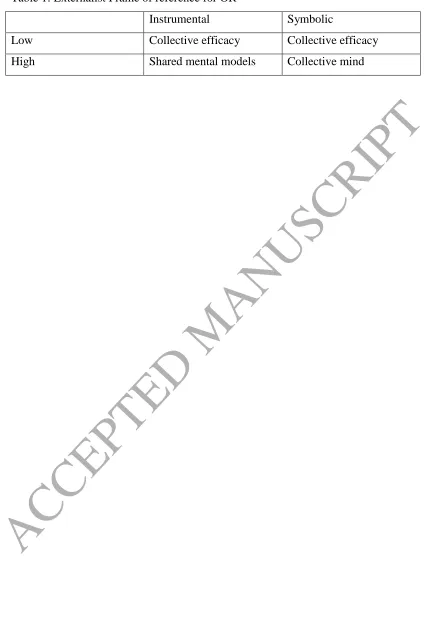
For the rest of the article, the focus is on behaviour under the conditions of the externalist plane in the framework (see Figure 3 and Table 1). The literature review is used to draw out some themes on externalisation, particularly collective behaviour. It is suggested that even though first-person experience is difficult to establish outside of individual agency, the case may be plausibly made for some kind of externalisation through models as the means for representing and intervening. From the review of the literature there seems to be three notions of the externality of a collective behavioural context. The first reflects the simple view of collective efficacy (see Figure 3(a)). The second refers to current views of shared mental models (see Figure 3 (b)). While the third is the collective mind perspective (see Figure 3 (c)). This is becoming an extremely important issue in organisational research (see Weick and Roberts, 1993; Weick et al, 2008). Each is discussed in turn.
Table 1 here
Applying the framework—Towards the idea of Collective behaviour in OR
ACCEPTED MANUSCRIPT
In terms of the first perspective, as stated earlier, much of the group decision making research is useful in that it is claimed that because the information-sharing or informational output processes among group members would be observable, they could be used to infer collective behaviour in terms of outputs such as efficacy (Bandura, 1991).
The above seems to relate to the framework in that it provides some insights on situations that refer to group perspective and instrumental model use (Table 1). Here the findings suggest that in attempting to understand collective behaviour less should be given to the insights from groupthink and instead the notion of collective efficacy (CE) should be introduced. This is defined as a group’s belief in their conjoint capabilities to organise and execute the course of action required to produce given levels of attainment (Bandura, 2001). CE refers to a group’s shared perception of its ability to successfully perform a task. It is a prospective rather than a retrospective assessment of a group’s capability. The task-specific performance perceptions in turn can influence the type of future the group members seek to achieve, how they manage the plans and strategies they construct, how much effort they put into their group behaviour, their staying power when the collective efforts fail to produce quick results or encounter forcible opposition (Gully et al, 2002). Bandura described four sources of efficacy: past performance, vicarious experience, verbal persuasion, and physiological and affective states. CE also arises through group interaction and forms as group members acquire, store, manipulate, and exchange information about each other and about their task, context, process, and prior performance (Gibson, 1999). Thus, efficacy perceptions are dynamic and so may change as experiences changes (Lindsley et al, 1995).
ACCEPTED MANUSCRIPT
ambition, motivation (Bandura, 2001) and a form of learned helplessness (Seligman, 1997). Thus, it may be that groups with more moderate levels of CE are most conducive to soft OR.
Also interestingly studies imply that defective decision-making practices are mainly associated with high cohesive groups through groupthink, but this might also be explained by an excess or deficit of collective efficacy (Whyte, 1998). Thus it is well advised to assess or be conscious of and take into account or be systematic about the processes by which the groups make decisions. These groups are likely to display the types of behaviour that produces unsatisfactory results or may miss seeing the advantages of soft OR interventions.
Shared mental models
In terms of the second perspective, there is a large literature on shared mental models. This focuses on shared content as evidence for collective behaviour (see Mohammed et al., 2010). This version would be compatible with organisational approaches stressing thinking with objects, where thought is realised in conjunction with external objects linking team members (e.g. Franco, 2013), but not with the claim that people think through objects or that objects participate in thought itself (which will be addressed shortly). With the former, the exemplar here is the use of cognitive maps and system dynamics modelling and group model building (Eden, 2004; Sterman, 1989; Kunc and Morecroft, 2009; Anderson et al, 1997; Vennix, 1997; Howick and Eden, 2011). Here, individuals are able to access common meanings, and partake in a common present through which they pass together, thus creating a shared world; yet, even in this ‘collective sharedness’, individuals must interpret and infer the intentionality of others, and thus it might be possible for no collective-level behavioural domain to emerge at all from the shared referential objects of individuals (see Joldersma, and Roelofs, 2004). The latter is consistent with Bhaskar's notions of stratification and emergence and Bateson's (1972) view that mind and
matter are a necessary unity. This would suggest that objects do actually participate
in thought processes.
ACCEPTED MANUSCRIPT
culture and values can persist in the face of individual member attrition while maintaining a focus on individuals (Eden et al, 1979). These mental states are structured around representations of cognition that instantiate thought through systems of representation (e.g. Eden, 2004). However, it is also claimed that these shared mental models while placing cognition at the individual level also open the possibility of group processes emerging through coordination, i.e., thinking at the group level. In the main, this is metaphorical, creating a vivid image of thinking groups yet remaining rooted at the individual level.
Collective mind
But these discussions do not help to answer how collective problem structuring happens, particularly if there is the context of high divergence and a desire for symbolic model use (Table 1). For this, the third perspective, draws on recent theoretical and empirical work developed around the notion of collective cognition in organisations in order to explain collective cognitive processes. Weick and Roberts (1993) outlined the concept of collective minds as a means for understanding how individuals working together perform effectively as an ensemble. Another line of investigation is to consider the ‘mindfulness’ notion. This is the amount of attention and effort that individuals allocate to a particular interaction. Participation in group interactions is therefore not a product of membership or presence within the group, but of the attention and energy that an individual commits to particular interaction with others in the group. In this way collective cognition connects individual ideas and experiences in ways that both redefine and resolve the demands of emerging situations.
ACCEPTED MANUSCRIPT
Putnam and Cooren, 2004; Daft and Weick, 1984). It is also consistent with approaches linking individual and collective cognition to affordances that support sensemaking (Gibson; 1977; Stigliani and Ravasi, 2012).
How is this associated with OR? Well, the collective mind resides in the mindful inter-relations between individuals in a social system. One person’s action, when considered by others shapes theirs, which in turn shapes the next. Introducing soft OR creates particular instances when people’s perspectives and experiences are brought together to bear on problematic situations in ways that may lead to distinctly new solutions (Eden and Ackerman, 1998; White, 2002). In these instances what to think of as the problem and how to think of it becomes a product of a collective process. This is not very well understood. OR scholars have explored the idea of understanding the collective mind though an understanding of network learning and to explore the effects on problem structuring exercises (Grandori and Soda, 1995; White, 2008). Other studies explored the notion of “social learning” in large group settings (Shaw et al, 2006; Bell and Morse, 2007; White, 2002).
ACCEPTED MANUSCRIPT
seem more deeply integrated into the cognitive apparatus itself, as models for cognition. To this extent, the case for externalism could be bolstered by pointing to model affordances provided by diverse means whether via a model or via the social (Franco, 2013).
Similarly, beyond language and communication, some studies highlight the cognitive importance of models and representations as intervening devices or tools and other material artifacts as ‘scaffolds’ of behaviour. On the one hand, tools are described as ‘aids’ for cognition (Smith and Semin, 2004), being adapted to human processing capabilities and thus interacting with individual cognition, as a kind of external heuristic (e.g. Saenger, 1997). On the other hand, the use of models, and particularly tools involving symbols such as language, reproduce cognitive features and facilitate cognition instrumentally (Clark, 2008), forming part of the cognitive apparatus itself. Models for representing and intervening have even been attributed
actant status (e.g. White, 2009; Law, 1992), weaving together human and non-human loci of thought. While for this view actants are not conscious beings per se, but only nodes in a meaning network, their role in a behavoural system has yet to be explored, and the term suggests an extended view of cognition and behaviour (White, 2009). A clue to exploring the relation between objects, intention and human action could be via Pickering’s idea of the Mangle (1995) (see Ormerod
(2014c) for a good introduction). Pickering argued that the material (objects) does
not have intention. However, it is non-the-less important to explore how human and nonhuman agency temporally intertwine. Pickering’s (1995) perspective focuses upon achieving a ‘real-time understanding of practice’. Material artefacts, can offer resistance to human intention in the form of material agency, defined as ‘the failure to achieve an intended capture of agency in practice’. Pickering described this as the ‘dialectic of resistance and accommodation’ – the Mangle. This idea has potential for understanding the process of OR (Ormerod, 2014c) and behaviour (White et al, 2015).
DISCUSSION
ACCEPTED MANUSCRIPT
OR interventions and theories. It seems reasonable to identify some themes emerging from the above research that indicate potential areas for future research.
First, the focus on collective behaviour: It could be argued that collective behaviour is not yet a coherent field, particularly in one dominated by the work of Kahneman and others. Also, do the interventions of interest constitute a generically different type of collective behaviour? Much of the work on OR does not yet suggest that there is a unity in the set of conditions that are engendered through collective OR interventions, but refer to the fascinating characteristics of the interventions themselves (it is noted in passing, that there was a pre-occupation with collective behaviour by the pioneers of OR e.g., Blackett, 1962; Waddingtom, 1973). Collective behaviour, despite its loose formulation, is concerned with crucial problems and is pre-occupied with relating social psychological phenomena to (social) change. These two considerations alone ensure that there could be a fruitful and active agenda for soft OR. It is also contended that collective behaviour will be of vital interest to those concerned with OR theory development.