University of Warwick institutional repository: http://go.warwick.ac.uk/wrap
A Thesis Submitted for the Degree of PhD at the University of Warwick
http://go.warwick.ac.uk/wrap/60496
This thesis is made available online and is protected by original copyright.
Please scroll down to view the document itself.
Cliques, Colouring and Satisfiability:
from structure to algorithms
by
Christopher Purcell
Thesis
Submitted to the University of Warwick
for the degree of
Doctor of Philosophy
Mathematics Institute
Contents
List of Figures iv
Acknowledgments v
Declarations vii
Abstract viii
Chapter 1 Introduction 1
1.1 Definitions and Notation . . . 4
I Colouring and Related Problems 8 Chapter 2 Vertex 3-Colourability in Claw-free Graphs 11 2.1 Introduction . . . 11
2.2 NP-completeness results . . . 14
2.3 Polynomial-time results . . . 18
2.3.1 Infinitely many forbidden induced subgraphs . . . 18
2.3.2 Finitely many forbidden induced subgraphs . . . 19
2.4 (claw,Φk,Φk+1)-free graphs . . . 28
2.5 Conclusion . . . 30
Chapter 3 Dominating Induced Matchings in graphs without a skew star 31 3.1 Introduction . . . 31
3.2 Preliminaries . . . 33
3.3 Solution to the problem in the class ofS1,2,2-free graphs . . . 36
3.3.1 Reduction to graphs of bounded vertex degree . . . 36
3.4 Solution to the problem in the class ofS1,2,3-free graphs . . . 40
3.5 Conclusion . . . 52
II Independent Sets and Related Problems 53 Chapter 4 The Maximum Weight Independent Set Problem in Graphs Without Large Apples 56 4.1 Introduction . . . 56
4.2 A Sufficient Condition for Claw-Freeness of (Ak, Ak+1, . . .)-free Atoms 59 4.3 Polynomial Results . . . 66
4.3.1 Graphs of Bounded Vertex Degree . . . 67
4.3.2 Apex-Minor-Free Graphs . . . 67
4.4 Conclusion . . . 71
Chapter 5 Sparse Regular Induced Subgraphs in 2P3-free Graphs 73 5.1 Introduction . . . 73
5.2 Finding maximumk-regular graphs containing aP3 . . . 74
5.3 Finding maximumP3-free k-regular graphs . . . 75
5.3.1 Step 1: generation of the familyS . . . 76
5.3.2 Step 2: solving the problem . . . 80
5.4 Conclusion . . . 81
Chapter 6 Independent Domination in Finitely Defined Classes of Graphs 82 6.1 Introduction . . . 82
6.2 Preliminaries . . . 83
6.3 Generation of maximal independent sets . . . 86
6.3.1 Independent domination in P2+P3-free graphs . . . 87
6.3.2 Weighted independent domination in (P5,2P3)-free graphs . . 92
6.3.3 More subclasses P5-free graphs . . . 96
6.4 Modular Decomposition . . . 97
6.5 Decreasing graphs . . . 104
6.6 Conclusion . . . 106
III Satisfiability and Related Problems 108
7.1 Introduction . . . 109
7.2 Hereditary, limit and boundary properties of graphs . . . 112
7.3 A limit property of satisfiability . . . 113
7.4 Minimality of the limit property . . . 114
7.5 Is S a unique boundary property? . . . 116
List of Figures
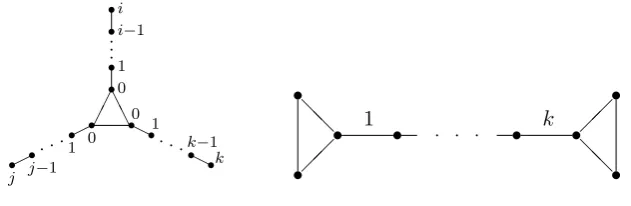
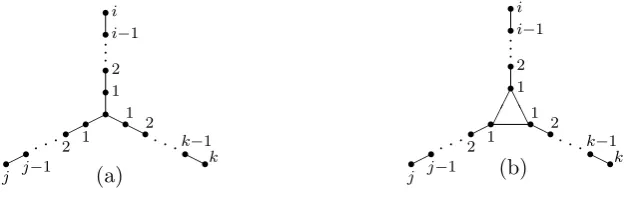
2.1 The graphsTi,j,k1 (left) and Φk (right) . . . 12
2.2 Thediamond, gem and crystal graphs, left to right. . . 13
2.3 Diamond implantation . . . 13
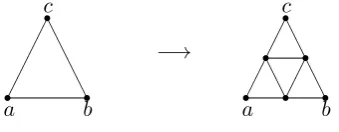
2.4 Triangle implantation . . . 14
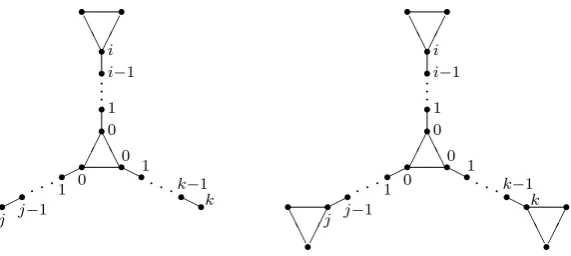
2.5 Graphs Φ0k, Φ00k and Φk,p (from top to bottom) . . . 15
2.6 The graphTi,j,k∆ (left) and the graph Ti,j,k3∆ . . . 20
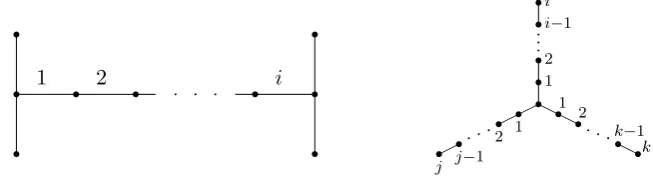
3.1 GraphsHi (left) and Si,j,k (right) . . . 32
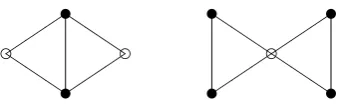
3.2 A diamond (left) and a butterfly (right). . . 35
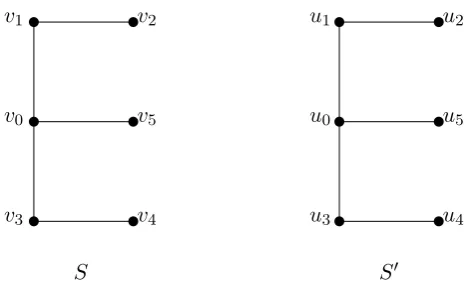
3.3 Two copies of an inducedS1,2,2 with their labellings . . . 41
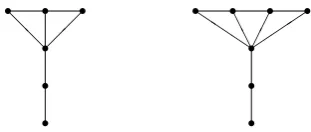
4.1 Two smallest apples A4 and A5 . . . 57
6.1 The graphsSi,j,k (a) andTi,j,k (b) . . . 84
6.2 The graphsbull,banner and A (listed from left to right). . . 101
6.3 The graphsP3∗ (left) andP4∗ (right) . . . 102
Acknowledgments
This thesis is dedicated to the memory of Tom Smith, whose delight in mathematics
and fierce desire to understand the universe were and always will be a constant source
of inspiration. Chapter 4, being concerned with the so-calledlarge-apple-freegraphs,
would have been of particular interest to Tom, fond as he was both of the fruit and of
idiosyncratically named mathematical objects. Without his encouragement I would
never have embarked upon a Ph.D., and I am eternally grateful to him.
There are of course many people without whom this thesis would not have
been possible, starting with my family. My parents, David and Su Purcell, have
given me sefless, unconditional love and support. My sister Helen is my oldest
friend and closest confidant, and I am so proud of her achievements. I am very
lucky to have their three loves. My whole family deserve thanks for their part in
my life. I couldn’t possibly list them all, but I’d like to mention my grandmothers
June Purcell and Angeles Pearson, and my godparents Jeremy Purcell and Miriam
Pearson, for all they’ve done for me.
I am extremely lucky to have many wonderful friends, and again I can’t
possibly list all those who deserve my thanks here. However, I owe a great deal to
Ellie Bagnall, Luke Turner, Steve Marchant, James Kay and Puck Rombach, who
have each been an integral part of my support network. Hopefully they can say the
same of me, and long may it continue.
At Royal Holloway, University of London, I received a great education and I
thoroughly enjoyed my time there. I also owe a debt to St Mary’s Catholic Secondary
School in Bishop’s Stortford, where I began my mathematical journey. I would like
me into a combinatorialist; Mrs Parry and Miss Gallard for helping me fall in love
with mathematics; Mrs Hogarth, who recognised that I might have been educatable
in the first place.
Not quite last, and nowhere near least (and in many ways most), I thank my
supervisor Vadim V. Lozin. His teaching, advice and research expertise have been
excellent and his patience has been frankly superhuman. I also thank him for the
research on which we collaborated and extend these thanks to all my co-authors.
Finally, my research and education at Warwick was supported by the Centre
for Discrete Mathematics and its Applications (DIMAP) and I thank all its staff
and students as well as the staff of the Mathematics Institute. I would especially
like to thank Yvonne Carty and Carole Fisher, whose patience I no doubt tested.
As a member of DIMAP, my research is partially funded by the EPSRC Science and
Declarations
All the work in this thesis is original work that has not been submitted for a degree
at another university.
Chapter 2 is based on [1], which is joint work with Vadim V. Lozin.
Chapter 3 is based on [2], which is joint work with Nicholas Korpelainen and
Vadim V. Lozin. A proof of the results of the third section of this chapter first
appeared in [3]; here we correct an error in the original proof and make some other
improvements.
Chapter 4 is based on [4], which is joint work with Vadim V. Lozin and
Martin Milaniˇc.
Chapter 5 is based on [5], which is joint work with Vadim V. Lozin and
Raffaele Mosca.
Chapter 6 is based on [6], which is joint work with Vadim V. Lozin and
Raffaele Mosca.
Abstract
We examine the implications of various structural restrictions on the
com-putational complexity of three central problems of theoretical computer science
(colourability, independent set and satisfiability), and their relatives. All problems
we study are generally NP-hard and they remain NP-hard under various restrictions.
Finding the greatest possible restrictions under which a problem is computationally
difficult is important for a number of reasons. Firstly, this can make it easier to
establish the NP-hardness of new problems by allowing easier transformations.
Sec-ondly, this can help clarify the boundary between tractable and intractable instances
of the problem.
Typically an NP-hard graph problem admits an infinite sequence of
narrow-ing families of graphs for which the problem remains NP-hard. We obtain a
num-ber of such results; each of these implies necessary conditions for polynomial-time
solvability of the respective problem in restricted graph classes. We also identify
a number of classes for which these conditions are sufficient and describe explicit
algorithms that solve the problem in polynomial time in those classes. For the
satisfiability problem we use the language of graph theory to discover the very first
boundary property, i.e. a property that separates tractable and intractable instances
Chapter 1
Introduction
In 1996, the American Mathematical Society published a volume of research papers originally presented as part of the Second DIMACS1Implementation Challenge. The
Challenge began in September 1992, and culminated in a three-day workshop held
at the DIMACS Center at Rutgers University in October, 1993. The volume con-tains 28 of the papers presented at the workshop under the common title “Cliques,
coloring and satisfiability” [8]. These are three central problems of combinatorial
optimization and theoretical computer science that are of fundamental importance from both a practical and theoretical point of view.
The practical importance of these problems is due to the fact that they
find numerous applications across various fields. For instance, graph colouring is often used in scheduling algorithms. The problem of finding maximum cliques is at
the heart of any clustering algorithm and finds applications in bioinformatics [9],
computer vision and pattern recognition [10], while SAT-solvers are central tools in artificial intelligence, software testing [11], etc.
Developing our understanding of these problems is also of great theoretical
importance. The universe of computational problems is a deep and beautiful one. The class of NP-complete problems, to which each of the titular problems belongs, is
a vital part of our understanding of that universe. This class is sometimes thought of
as being “at least as difficult” as any problem in NP. Indeed, any problem in NP may be reduced to an NP-complete problem, and thus knowledge about such problems
may lead to an answer to the most famous problem in theoretical computer science,
i.e. whether or not P and NP coincide. Each of the three main problems considered in this thesis remains difficult under substantial restrictions on the input instance.
1
On the other hand, for each of them there are restrictions under which the problem
becomes polynomial-time solvable. The goal of this thesis is to analyse how the structure of the input instances influences the complexity of solving the problems.
In other words, the goal is to identify restrictions under which the problems either
remain NP-complete or can be solved in polynomial time.
For the graph theory problems we study restrictions given in the form of
forbidden induced subgraphs. For satisfiability, we develop a similar approach
by associating a graph with each instance of the problem.
A graph properties (or class of graphs) admits a description in terms of
for-bidden induced subgraphs if and only it is closed under vertex deletion. In other
words, every induced subgraph of a graph in the class is also in the class. These prop-erties are known ashereditaryproperties. The world of hereditary properties is rich
and contains many classes of theoretical or practical importance, such as chordal,
bipartite, planar, perfect, interval, comparability graphs, etc. All these classes have been defined in different terms, but all of them admit a uniform description in terms
of forbidden induced subgraphs.
The induced subgraph characterization is a useful tool for considering inclu-sion relationships between hereditary classes of graphs. It is not difficult to see that
a hereditary classX contains a hereditary classY if and only if every graph which is forbidden forX contains an induced subgraph which is forbidden forY. Showing that, for example, a bipartite graph is a perfect graph is therefore a simple task.
Such results might otherwise be very difficult to obtain, and the tools used might be clumsy and ad hoc. Indeed, in 1969, theJournal of Combinatorial Theory
pub-lished a paper entitled “An interval graph is a comparability graph” [12]. One year
later, the same journal published another paper entitled “An interval graph is not a comparability graph” [13]. Both the interval graphs and the comparability graphs
form hereditary classes. Apparently, in 1969 the induced subgraph characterization
was not available for at least one of them. Nowadays, it is available for both classes. This example shows that the problem of finding the set of minimal forbidden
induced subgraphs for a hereditary class X is an important task. However, this problem is generally far from being trivial. For instance, for the class of perfect graphs this problem was open for several decades [14].
The induced subgraph characterization is also important because it provides
a systematic way to study various problems on hereditary classes. When we look at a particular problem from the NP-complete side, we want to identify the best possible
restrictions under which the problem remains NP-complete by extending the list of
classes. The role of such classes is as important as the role of minimal forbidden
induced subgraphs. The difficulty is that such classes may not exist and typically an NP-complete problem admits an infinite narrowing sequence X1 ⊃ X2 ⊃. . . of hereditary classes each of which is difficult for the problem. This information is also
valuable, because it suggests that if we want to identify a polynomially solvable case for the problem, we need to exclude (forbid) a graph from each class of the sequence
X1 ⊃X2 ⊃. . . Moreover, if we want to develop a polynomial-time algorithm in a hereditary class Y defined by finitely many forbidden induced subgraphs, we need to exclude a graph from the intersection of all classes in the sequenceX1 ⊃X2⊃. . . This intersection is called alimit classand a minimal limit class is called aboundary
class for the problem. The importance of this notion is due to the fact that an NP-complete problem is polynomial-time solvable in a hereditary class Y defined by finitely many forbidden induced subgraphs if and only if Y does not contain any boundary class for the problem. However, identifying boundary classes is even harder than identifying minimal forbidden induced subgraphs for a hereditary class.
Therefore, in some cases we restrict ourselves to the weaker task of identifying limit
classes. For a general discussion of boundary properties of graphs and a short survey of related results, see [15]
We apply this approach to several NP-complete problems closely related to cliques, colouring and satisfiability. We start by looking at two problems related to
vertex colouring in Part 1 of the dissertation. In particular, we identify several limit
classes and several polynomially solvable cases for vertex 3-colourability. In Part
2, we switch to independent sets, which is the notion complement to cliques. The
reason we study independent sets instead of cliques is that they provide a more
con-venient language to describe restrictions in terms of forbidden induced subgraphs. In this part, we deal with the maximum independent set problem, some of its
generalizations (maximum sparse regular induced subgraphs), andminimum maximal independent set (also known as independent domination). The
latter problem restricted to the class of so-called SAT-graphs is equivalent to sat-isfiability. We switch to this problem in Part 3 of the dissertation, where we use
the language of graph theory in order to identify the first boundary property for the
1.1
Definitions and Notation
Graph Theory
All graphs in this dissertation are finite, simple graphs. The vertex set of a graph
Gis denotedV(G) and the edge setE(G).
If there is an edge between vertices u and v, we say they are adjacent or neighbours, and non-adjacent or non-neighbours otherwise. The set of all vertices adjacent to v is called the neighbourhood of v, denoted by N(v). The degree of a vertex, d(v), is the size of its neighbourhood. The antineighbourhood of a v is the set of vertices outside v which are non-adjacent to v, and is denoted A(v). For a given set of verticesU, we define NU(v) andAU(v) to be the intersection ofU with
the neighbourhood and antineighbourhood ofv respectively. The neighbourhood of
U is the union of the neighbourhoods of its members, and its antineighbourhood is the union of the antineighbourhoods of its members in V(G)\U. If X, Y are sets of vertices in a graph G, and every member of Y is in N(X), then X is said to dominateY.
A path between two verticesu, vin a graphGis a set of vertices{u, x1, x2, . . . ,
xk−1, v}such thatE(G) includes the edgesux1, xi, xi+1, xk−1v. We sometimes refer to such a path as au−v path and we say it haslength k. The distance from u to
v, denoted d(u, v), is the length of a shortest path between them and those vertices at distance kfrom u are sometimes called thek-neighbourhood of u. If u and v are adjacent,{u, v} is a u−v path and the distance between them is 1. The distance between two sets of vertices U1, Y2 ⊆V(G) is the minimum shortest u1−u2 path
foru1 ∈U1, u2 ∈U2. If there is a path between any two vertices in G, we say that
Gisconnected.
Two graphsG1, G2are said to beisomorphicif there is a bijectionφbetween their vertex sets that preserves edges. In other words uv ∈ E(G1) if and only if
φ(u)φ(v)∈E(G2).
A subgraph ofGis a subset of the vertices and edges ofG, and is said to be induced by a set of verticesU if it can be obtained from Gby deleting the vertices outside U and their incident edges. We denote such a subgraph by G[U]. If G
contains no induced subgraphs isomorphic to a graph in a setM, we say thatG is
M-free. The complement of G, denoted ¯G, has the same vertex set as Gand with
uv∈E( ¯G) if and only ifuv /∈E(G).
possible edge between those two parts is in the graph.
As usual,Pn,CnandKnstand, respectively, for a chordless path, a chordless
cycle and a complete graph on n vertices. Kn,m is the complete bipartite graph
with parts of size n and m. A wheel Wn is obtained from a cycle Cn by adding a
dominating vertex, i.e. a vertex adjacent to every vertex of the cycle. Aforest is a graph with no cycles and atree is a connected forest.
Thedisjoint unionof two graphsG1, G2is the graphGwithV(G) =V(G1)∪
V(G2) and E(G) = E(G1)∪E(G2), and is denoted G1+G2. The disjoint union
of a graphG and itself is denoted 2Gand this notation is extended to the disjoint union ofm copies ofG, denoted mG.
For positive integers i, j, k, the graph Si,j,k is the tree with three leaves,
at distance i, j and k from the unique vertex of degree 3. For example, S1,1,1 is isomorphic to K1,3 The value of i, j or k may be 0, in which case Si,j,k is just a
path. The class of graphs whose every connected component is of the formSi,j,k is
denotedS. This class is important and appears a number of times in this thesis. For some particular graphs we use special names:
• aclaw is K1,3;
• atriangle is aK3;
• adiamond is the graph obtained fromK4 by removing one edge;
• abutterfly is two triangles sharing a vertex.
For positive integers i, j, k, the graph Si,j,k is the tree with three leaves, at
distancei, j and kfrom the unique vertex of degree 3. For example,S1,1,1 is a claw orK1,3 The value of i, jorkmay be 0, in which caseSi,j,k is just a path. The class
of graphs whose every connected component is of the formSi,j,k is denotedS. This
class is important and appears a number of times in this thesis.
A vertex v is said to distinguish a set of vertices U if it has at least one neighbour and one non-neighbour in U. A set of vertices M in G that is not distinguished by any vertex inV(G)\M is called amodule. Clearly a single vertex is a module, as is the empty set and the set of all vertices in a graph. These are calledtrivial modules, all other modules are said to be non-trivial. A graph whose
every module is trivial is aprimegraph.
A tree decomposition of a graph G= (V, E) is a pair (T,X) consisting of a tree T = (I, F) and a collection of subsets of the graph’s vertex set X ={Xi :i∈
I, Xi⊆V}such that
• S
i∈IXi=V,
• for everye={u, v} ∈E, there exists an i∈ I such thatu, v∈Xi, and
• for everyv∈V, the subgraph of T induced by{Xi ∈ X :v∈Xi} is a tree.
Thewidth of a tree decomposition(T,X) isw((T,X)) = max{|Xi|:i∈ I} −1. The
tree-widthof a graphG,tw(G), is the minimum width of a tree decomposition ofG. Graphs of tree-width 0 are precisely the edgeless graphs, and graphs of tree-width
at most 1 are forests. We refer to [16] for an excellent tutorial on tree-width. The clique-width of a graph G is the minimum number of labels needed to constructGusing the following four operations:
1. Creating a new vertexv with labeli (denoted byi(v)).
2. Taking the disjoint union of two labelled graphsGandH (denoted byG⊕H). 3. Joining each vertex with labelito each vertex with labelj fori6=j (denoted
byηi,j).
4. Renaming label itoj (denoted by ρi→j).
An intuitive understanding of the tree-width parameter is that it measures
how “tree-like” a graph is. This author knows no similar visualisation of clique-width. However, a graph class where either parameter is bounded has a simple
structure in some sense. Often, restricting a problem to such graph classes yields
an efficient solution.
Algorithms and Complexity
Here, we briefly outline the basic definitions and concepts necessary to understand
the results of this thesis. For a full treatment of the topic see e.g. [17].
In this thesis, a problem is a mathematical question to be answered, along
with a description of the variables involved in the question (input), and a description
of the properties that the answer must have (output). Many of the problems we consider in this thesis aredecision problems, in other words the answer is either yes
or no. An instance of a problem is obtained by specifying values for the variables
algorithm is only said tosolve a problem Π if it can be applied to any instanceI of Π and always produce a correct output orsolution.
In general, we wish to find the “fastest” algorithm to solve a given problem.
We define therunning timeof an algorithm to be the number of elementary
opera-tions the algorithm makes as a function of the size of the input, usually denotedn. We say an algorithm runs in polynomial time if its running time is bounded by a
polynomial in n. We say that a problem is polynomially solvable if an algorithm exists which solves the problem in polynomial time. The class of polynomially solv-able decision problems is usually denoted P. Informally, we think of problems that
are in P as “easy” to solve. In other words, an algorithm that runs in polynomial
time is considered “efficient”. If no such algorithm exists, we consider the problem to be “hard”.
The other main class we consider in this thesis is denoted NP and is intuitively
thought of as the class of decision problems whose “yes” answers can be checked efficiently. More formally, a decision problem Π is in NP if each instanceI for which the correct answer is “yes” admits a proof of this answer that can be verified in
polynomial time. For example, consider the problem whose input is a graphGand whose output should be “yes” or “no” in answer to the question “doesGcontain an independent set of size k”. This problem is in NP because, if the answer is “yes”, specifying the independent set would constitute such a proof.
In order to compare the complexity of solving problems more formally, we
introduce the notion of reduction between problems. Apolynomial time reduction from a problem Π1 to a problem Π2 is an algorithm which solves Π1 in polynomial
time, given polynomially many uses of a hypothetical algorithm that solves Π2
called an oracle. If Π1 can be reduced to Π2, then any polynomial time algorithm that solves Π2 can be converted to a polynomial time algorithm that solves Π1.
Informally, we think of Π2 as being “at least as hard” as Π1. A problem Π ishard
for a complexity class C if every problem in C may be reduced to Π in polynomial time. The class of such problems is denoted C-hard. If Π is itself in C, it is said to be complete for the class C, or C-complete. Many of the problems considered in this thesis are NP-complete, and these problems are thought of as the “hardest” problems in NP.
There is no known proof that NP contains any problem that is not in P. In
other words it may be the case that efficiently checkable problems are also efficiently solvable problems. as we’ve mentioned, this is one of the most famous open problems
Part I
Colouring
and
Introduction
Many graph problems fall into the broad category of colouring problems. The main problem in this category isvertex colouring. We say that a colouring of the
ver-tices of a graph isproperif no two adjacent vertices have the same colour. Vertex colouringis the problem of finding a proper colouring with the minimum number
of colours.
One may also consider colouring the edges of a graph in a similar manner.
A total colouring is a colouring of both the vertices and edges of the graph. Edge and total colourings of a graphGare equivalent to colouring the vertices of special graphs obtained fromG. The line graphL(G) has a vertex for each edge ofGand an edge between two vertices if and only if the corresponding edges of G share an endpoint. Clearly colouring the vertices of L(G) corresponds exactly to colouring the edges of G. The total graphT(G) can be defined in a similar manner, i.e. for each vertex or edge in G there is a vertex in T(G), with an edge in T(G) for each vertex-vertex, edge-edge and edge-vertex adjacency inG. Famously, the faces of any planar graph may be coloured with four colours so that two faces sharing an edge have different colours. This is equivalent to colouring the vertices of the dual of a
plane graphG, whose vertex set is the faces ofG, with an edge between two vertices if the corresponding faces share an edge. One may also consider a list colouring, that is a colouring of the vertices of a graph where each vertex is restricted to some
finite list of colours.
In this thesis we use the language of vertex colouring. The problem of decid-ing whether there exists a proper colourdecid-ing ofG using at most k colours is known as thek-colourability problem. It was one of Karp’s 21 NP-complete problems
given in [18], and was in fact the first to be mentioned in the introduction to that seminal paper. It remains a difficult problem under a variety of substantial
restric-tions, and yet in some cases efficient solutions are known, i.e. a polynomial time
algorithm exists to solve the problem.
of vertex degree at most four, but for graphs of vertex degree at most 3, a polynomial
time solution exists (the complexity gap is made more precise in [19]). The problem can also be solved efficiently for locally connected graphs [20].
Given the rich possibilities for research into such restrictions, it is hardly
surprising that colourability remains a central problem of graph theory and compu-tational complexity theory. Indeed, a number of papers have recently investigated
restricting the problem to various classes of graphs defined by a set of forbidden
induced subgraphs, otherwise known as hereditary classes.
Maffray and Preissmann showed that, fork≥4,k-colourability remains
NP-complete for triangle-free graphs, reducing from graphs of vertex degree at most
4 to triangle-free graphs of vertex degree at most 4, by replacing certain vertices with a special gadget based on the Mycielski Graph [21].
A series of papers by Randerath gave a number of similarly framed results.
In [22], Randerath identified every pair of connected graphs A, B such that every
{A, B}-free graph is 3-colourable. Randerath, Schiermeyer and Tewes gave good examples of different approaches to the problem of graph colouring in [23]. Firstly,
they gave structural analyses of certain hereditary classes of graphs. Then a struc-tural analysis of only the non-perfectK4-free members of the considered graph class, making use of Tucker’s polynomial solution for perfectK4-free graphs [24]. Finally, they make use of a reformulation of 3-colourability in terms of propositional logic,
and also consider precolouring a special set and extending the colouring to the rest
of the graph.
In this part of the thesis, we study two problems related to vertex colouring.
One of them is 3-colourability. This problem is also closely related to a number of
partition problems. For example, thestable-Π partitionproblem asks if a graph
can be partitioned into an independent set and a graph in the class Π. If Π is the
class of all bipartite graphs,stable-Πpartitioncoincides with 3-colourability, and
in that sense generalises the problem. In Chapter 3 we consider the dominating induced matching problem, sometimes called efficient edge domination in
the literature. This problem can be formulated in a number of ways, for example one
might ask if a graph can be partitioned into an induced matching and an independent set, and in this sense the problem is also a special case of stable-Π partition.
Alternatively, one could ask for a 3-colouring of the graph such that two colour
Chapter 2
Vertex 3-Colourability in
Claw-free Graphs
2.1
Introduction
In an attempt to find the greatest restrictions under which colourability
re-mains NP-complete, we consider two types of restrictions. We restrict ourselves to claw-free graphs, a class which has received considerable attention in the
litera-ture due to the many attractive properties of graphs in this class (see for example
[25, 26, 27, 28]). We also restrict ourselves to 3-colourability, which is minimal
in the sense that k-colourability is NP-complete for k ≥3, but there exists an
algorithm to solve 2-colourabilitywhich runs in polynomial time. The restriction
to claw-free graphs is also minimal in a certain sense. For any induced subgraphH
of a claw, 3-colourabilitycan be solved in polynomial time in the class ofH-free
graphs. On the other hand in the class of claw-free graphs, 3-colourability is
NP-complete. This is because the 3-colourability problem in claw-free graphs
includes, as a subproblem,edge3-colourabilityof general graphs, i.e. the
prob-lem of determining whether the edges of a given graph can be assigned colours
from set {0,1,2} so that any two edges sharing a vertex receive different colours. Indeed, by associating with a graph G its line graph L(G) (i.e. the graph with
V(L(G)) = E(G) and two vertices being adjacent in L(G) if and only if the re-spective edges of G have a vertex in common), one can transform the question of edge 3-colourability of G into the question of vertex 3-colourability of L(G). In conjunction with the NP-completeness ofedge3-colourability [29], this implies
the NP-completeness of (vertex) 3-colourabilityof line graphs. It is known that
of claw-free graphs, which can be characterized by 8 additional forbidden induced
subgraphs (see e.g. [30] for the complete list of minimal non-line graphs). In this chapter we study the computational complexity of the problem in other subclasses
of claw-free graphs. First, we derive a necessary condition for the polynomial-time
solvability of the problem in such classes and then reveal several areas where this condition becomes sufficient. In the remainder of this section we introduce and
re-call some notation, and define three operations on graphs with which we obtain our
results. r r r r pp p A A r r r r p pp
r r r r p p p
H H
0 1
i−1
i
0 1
j−1
j
0 1
k−1
k
s s
s s p p p s s
[image:24.595.193.509.253.356.2]@ @ @ @s s 1 k
Figure 2.1: The graphs Ti,j,k1 (left) and Φk (right)
By Ti,j,k1 and Φk we denote the graphs represented in Figure 2.1 on the left
and right, respectively. Note than each case the subscript values are non-negative, for example T1
0,0,0 is a triangle, and Φ0 is the so-called butterfly graph, obtained from two triangles by joining them at a single vertex.
We can assume that every vertex has degree at least 3. Indeed, ifvis a vertex of G of degree less than three, then G has a 3-colouring if and only if the graph obtained fromG by deletingv has one. Moreover, whenever we deal with claw-free graphs, we can restrict ourselves to graphs of vertex degree at most four. Indeed, it is not difficult to verify that every graph with five vertices contains either a triangle
or its complement or a C5. Therefore, every graph with a vertex of degree five or more contains either aK4 or a claw orW5. Since K4 and W5 are not 3-colourable, we conclude that every claw-free graph, which is 3-colourable, has maximum vertex
degree at most 4.
Let us repeat that a diamond is the graph obtained from a K4 by deleting an edge. Diamonds are of special interest in the vertex 3-colourability problem.
So we will introduce special terminology related to this graph. In a diamond, the
diamond. If additionally both peripheral vertices of D have degree at most 3 in
G, then D will be called a perfect diamond. We also define two extensions of the diamond, thegemand crystal, represented in Figure 2.2
[image:25.595.176.473.169.225.2]t t t t Q Q Q Q Q Q t t t t t A A A A A A A A t t t t t t A A A A A A A A
Figure 2.2: Thediamond, gem and crystalgraphs, left to right.
The importance of diamonds for the vertex 3-colourabilityproblem is due
to the obvious fact that the peripheral vertices of any diamond have the same colour
in any 3-colouring ofG, ifGhas any. This allows us to introduce the following three operations.
The first of the operations is called diamond implantation and consists of splitting the neighbourhood of a vertexv into two subsets, say A and B, replacing
v by two new vertices, say aand b, connecting ato each vertex in A, connecting b
[image:25.595.194.447.474.563.2]to each vertex in B, and creating a diamond with peripheral vertices a and b (see Figure 2.3 for an illustration). If we denote by G0 the graph obtained from G by implanting a diamond, then clearlyG0 is 3-colourable if and only ifGis. Also, ifG
is claw-free and bothAand B are cliques, thenG0 is claw-free too.
r r r
r r L L L L L L @ @ @ @ @ D D D D D D H H H H H H H L L L L L L v a
A B A B
b
−→
Figure 2.3: Diamond implantation
The second operation is calledpure diamond contractionand it is opposite to
diamond implantation. It consists of deleting the central vertices of a pure diamond
and identifying its peripheral vertices. In other words, this is the operation that transforms the graph on the right of Figure 2.3 to the graph on the left. Again, it
Gis claw-free, thenG0 also is claw-free.
The third operation is perfect diamond deletion. If a graph G contains a perfect diamond D, then deletion of the vertices of D results in a graph which is 3-colourable if and only ifG is, and which is claw-free if and only ifGis.
[image:26.595.222.392.252.318.2]Finally, we introduce one more useful transformation, which is shown in
Figure 2.4 and which is called triangle implantation. Clearly, if G0 is the graph obtained fromGby implanting a triangle into a triangle ofG, thenG0is 3-colourable if and only ifG is.
r r r A A A
A r r
r A A A A r r r A A −→ a b c a b c
Figure 2.4: Triangle implantation
2.2
NP-completeness results
In this section we establish several results on the NP-completeness of the 3- colour-abilityproblem in subclasses of claw-free graphs. We start by proving three
lem-mas. The first of them improves the following known fact: the 3-colourability
problem is NP-complete in the class of (claw,diamond)-free graphs of maximum
vertex degree at most four. Now we strengthen this result in the following way. Denote
Mk1={claw, diamond, K4, C4, C5, . . . , Ck}.
Lemma 1. For any natural k ≥ 4, the 3-colourability problem in the class of
M1
k-free graphs of maximum vertex degree at most four is NP-complete.
Proof. It is known that theedge3-colourabilityproblem is NP-complete in the
class of (C3, C4, C5, . . . , Ck)-free cubic graphs (i.e. graphs in which every vertex
has degree 3) for any naturalk [31]. Colouring edges of a graph Gis equivalent to colouring vertices of L(G), the line graph of G. It is known that the line graph of any graph is claw-free. Also, it is not difficult to see that if G is a C3-free cubic graph, thenL(G) is a (diamond,K4)-free regular graph of degree four. Finally, ifG is (C3, C4, C5, . . . , Ck)-free, thenL(G) is (C4, C5, . . . , Ck)-free.
To prove our next two lemmas, we introduce the following notation. We
s s s
s s p p p s s
@ @ @ @s s 1 k
s s s
s
s s p p p s s
@ @ @ @s s 1 k s s
s s p p p s s
A A s s A A
1 k s p p p s s
[image:27.595.167.476.117.296.2]s s A A 1 p
Figure 2.5: Graphs Φ0k, Φ00k and Φk,p (from top to bottom)
Now we denote
Mk2 ={claw, gem, K4, C4, C5, . . . , Ck,Φ01,Φ30, . . . ,Φ02k+1,Φ000,Φ002, . . . ,Φ002k}.
Lemma 2. For any natural k≥4, the 3-colourability problem is NP-complete
in the class ofMk2-free graphs of maximum vertex degree at most four.
Proof. We prove the lemma by a reduction from the same problem in the class
of (claw, gem, K4,C4, C5, . . . , Ck)-free graphs of maximum degree four, where the
problem is NP-complete by Lemma 1 (since Lemma 1 deals with a smaller class of
graphs).
Let G be a (claw, gem, K4, C4, C5, . . . , Ck)-free graph of maximum degree
four. It is not difficult to see that every diamond D in G is pure, i.e. the central vertices ofDhave no neighbours in GoutsideD, since otherwise a claw, gem or K4 arises.
In polynomial time, we will transformGinto anMk2-free graphG∗ of degree at most four, which is 3-colourable if and only if G is. Without loss of generality, we will assume that G is connected and has no vertices of degree 1 or 2. We will also assume thatk is large enough, say k= 10. To describe the transformation, let us introduce some terminology.
A triangle inGwill be calledbranchingif it is contained in an inducedT11,1,1
either branching or is contained in a diamond, and that it is sufficient for a triangle
to be contained in an inducedT01,1,1 for it to be branching.
A vertex x of G will be called splittable if the neighbourhood of x can be partitioned into two disjoint cliques with no edges between them. It is easy to see
that every vertex of a branching triangle is splittable, with one clique comprising of the other vertices of the triangle.
Now we describe the transformation. LetT be a branching triangle andv a vertex of T. We split the neighbourhood ofv into two cliquesA and B and apply the diamond implantation k+ 1 times, i.e. replace v with two new verticesa and
b, connect a to b by a chain of k+ 1 diamonds, and connect a to every vertex in
A and connect b to every vertex in B. We apply this operation to every vertex of every branching triangle of G and denote the resulting graph by G∗. It is not difficult to see thatG can be transformed into G∗ in polynomial time and that G∗
is 3-colourable if and only ifGis.
Obviously,G∗ is (claw, gem, K4, C4, C5, . . . , Ck)-free, since diamond
implan-tation cannot create an induced claw, gem, orK4, and by applying diamond implan-tation to a vertexv we increase the length of any cycle Cp withp≥4 containingv.
Now let us show thatG∗is (Φ000,Φ100, . . . ,Φ002k)-free. AssumeG∗contains an in-duced Φ00t for some value oft. Clearly, both triangles in Φ00t are branching. Therefore, both of them belong toG, since during the transformation we did not introduce any new branching triangle. Also, according to the transformation all triangles in the 2k -neighbourhood of any branching triangle belong to implanted diamonds. Therefore, the value oftmust be strictly greater than 2k, i.e. G∗ is (Φ000,Φ001, . . . ,Φ002k)-free.
Similarly we show thatG∗ is (Φ01,Φ03, . . . ,Φ02k+1)-free. Indeed, letG∗contain an induced Φ0t and let T1 be the triangle of this Φ0t with a pendant edge and T0 the triangle without one. Clearly T1 is branching and therefore belongs to G. If
T0 is also branching, then the result follows as before. If T0 belongs to a diamond, then its vertex meeting the path connecting it toT1 must be a peripheral vertex of a diamond. On the other hand, we know that every vertex of an odd distance at
most 2k+ 1 from T1 in G∗ is a central vertex of one of the implanted diamonds. Therefore,G∗cannot contain an induced Φ0twith an oddt≤2k+ 1. This completes the proof of the lemma.
Finally, we prove one more lemma for which we introduce one more notation:
Lemma 3. For any natural k≥4, the 3-colourability problem is NP-complete
for Mk3-free graphs of maximum vertex degree at most four.
Proof. We reduce the problem from the class of Mk2-free graphs of degree at most four. Let G be a graph in this class, and let G0 be obtained from G by im-planting a triangle into each branching triangle. It is not difficult to see that
this operation does not create any of the following forbidden induced subgraphs:
{claw, K4, C4, C5, . . . , Ck}. It does create a gem, but not a crystal.
In order to see thatG0 does not contain copies of Φ00t for 1≤t≤k, observe that triangle implantation breaks every branching triangle into three new branching triangles. We will call these three new branching trianglesadjacent. Obviously, no
two adjacent branching triangles belong to the same induced Φ00k, and the distance between any two non-adjacent branching triangles is greater than k, since it was greater thank inG. Therefore,G0 is (Φ100,Φ002, . . . ,Φ00k)-free.
Finally, we show that G0 does not contain graphs in the set {Φi,j : i, j are
even andi, j≤k}. LetT be a branching triangle. Every vertex ofT starts a branch which we call an even branch if it contains a triangle which together withT create a Φp-graph with an even p≤k. In G every branch of a branching triangle is even.
However, by implanting a triangle we change the parity of two branches. Therefore, inG0 every branching triangle has only one even branch. Since the central triangle in a Φi,j-graph is branching, we conclude that Φi,j-graphs with two even branches
are forbidden inG0.
To further strengthen the NP-completeness results, let us denote by
S1
k the class ofMk1-free graphs of maximum vertex degree at most four,
S2
k the class ofMk2-free graphs of maximum vertex degree at most four,
S3
k the class ofMk3-free graphs of maximum vertex degree at most four.
Also, with every graph G we associate the following three parameters: for i ∈ {1,2,3}, let κi(G) be the maximum k such thatG ∈ Si
k. If G belongs to no class
Si
k, we defineκi(G) to be 0, and ifGbelongs to all classesSki, then κi(G) is defined
to be∞. Also, for a set of graphsM, we defineκi(M) = sup{κi(G) : G∈M}. Theorem 4. Let M be a set of graphs and X the class of M-free graphs of vertex degree at most 4. If κi(M) <∞ for any i ∈ {1,2,3}, then the 3-colourability
Proof. Let i ∈ {1,2,3}. To prove the theorem, we will show that if κi(M) < ∞
then there is a k such that Si
k ⊆ X. Denote k := κi(M) + 1 and let G belong to
Si
k. Assume that Gdoes not belong to X. ThenG contains a graph A ∈M as an
induced subgraph. From the choice ofG we know that A belongs to Si
k, but then
k≤κi(A)≤κi(M)< k, a contradiction. Therefore,G∈Xand hence, Si k⊆X.
2.3
Polynomial-time results
We now proceed to polynomial-time results. LetM be a set of graphs. The results of the previous section suggest that, unlessP =N P, the 3-colourabilityproblem
is polynomial-time solvable in the class of claw- andM-free graphs only if
κ1(M) is unbounded and κ2(M) is unbounded and κ3(M) is unbounded. (2.1)
In the present section, we identify several areas where condition 2.1 is sufficient for
polynomial-time solvability of the problem. First of all, let us reveal two major
ways to push the parametersκi(M) to infinity. In order to unbind κi(M) we need to include inM a graph from the classSi
k for each value of k. This is possible if
• eitherM contains infinitely many graphs, one for each value of k,
• orM includes a graph which belongs to classes Si
k for all values of k, i.e. a
graph from the intersection T
k≥4
Si k.
2.3.1 Infinitely many forbidden induced subgraphs
The chordality of a graph is the length of the largest chordless cycle. Therefore,
(Cp, Cp+1, . . .)-free graphs have chordality at most p−1. It is not difficult to see that for each value of p the set {Cp, Cp+1, . . .} satisfies the necessary condition 2.1 for polynomial-time solvability of the 3-colourability problem in subclasses of
claw-free graphs. Now let us show that boundedness of the chordality is also a sufficient condition.
Theorem 5. For each value ofp, the3-colourabilityproblem is polynomial-time
solvable in the class of claw-free graphs of chordality at most p.
at most p is at most f(d, p). Therefore, G is of bounded tree-width and hence is of bounded clique-width. According to [33] for each fixedk, the k-colourability
problem is polynomial-time solvable for graphs of bounded clique-width.
One more way to satisfy condition 2.1 by infinitely many subgraphs is to in-clude in the setM of forbidden graphs large graphs of the form Φk, i.e. Φk,Φk+1, . . . for some value ofk. Let us show that this way also leads to a polynomially-solvable case.
Theorem 6. For each value ofk, the3-colourabilityproblem is polynomial-time
solvable in the class of (claw,Φk,Φk+1, . . .)-free graphs.
Proof. Again we assume that a (claw,Φk,Φk+1, . . .)-free graphGis of degree at most 4, since otherwise it is not 3-colourable. We also assume without loss of generality thatGis connected. IfGcontains no triangle then the maximum vertex degree is at most 2 sinceGis claw-free. In this case the problem is trivial (andGis of bounded tree- and clique-width). Now assumeGcontains a triangle. Then the set of vertices ofG of distance at leastk+ 2 from the triangle must be K3-free, since otherwise a Φt with t≥k arises (due to connectedness of G). Therefore, the set of vertices of
Gof distance at leastk+ 2 from the triangle induces a graph of bounded tree- and clique-width. As a result, we conclude thatG is of bounded tree- and clique-width, because there are only finitely many vertices of G of distance at most k+ 1 from the triangle (as the degree ofGis bounded). Thus, the problem is polynomial-time solvable forG.
2.3.2 Finitely many forbidden induced subgraphs
In the rest of this chapter we prove several polynomial-time results for subclasses of
claw-free graphs with special emphasis on subclasses defined by additionally forbid-ding a single induced subgraphH, in which caseH must belong to the intersection of all three classesS1,S2 and S3, since otherwise the problem is NP-complete. The structure of graphs in this intersection is characterized in the following theorem, where byTi,j,k∆ we denote the graph represented in Figure 2.6 (left).
Theorem 7. A graph G is in the intersection S1∩ S2 ∩ S3 if and only if each of its connected components is either a Φi with an odd i or a Ti,j,k∆ with an even i or
an induced subgraph of one of these two graphs.
Proof. In order to prove this theorem let us recall the forbidden induced subgraphs
r r r r pp p A A r r r r p pp
r r r r p p p
H H A A r r 0 1
i−1
i
0 1
j−1
j
0 1
k−1
k r r r r pp p A A r r r r p pp
r r r r p p p
H H A A r r A A r r A A r r 0 1
i−1
i
0 1
j−1
j
0 1
k−1
[image:32.595.183.469.114.242.2]k
Figure 2.6: The graphTi,j,k∆ (left) and the graphTi,j,k3∆
S1 ⊂Free({claw,diamond, K4} ∪ {Ck:k≥4})
S2 ⊂Free({claw,gem, K4} ∪ {Ck:k≥4} ∪ {Φ0i: odd i} ∪ {Φ 00
i : eveni})
S3⊂Free({claw,crystal, K4} ∪ {Ck :k≥4} ∪ {Φ00i :i≥0} ∪ {Φi,j : even i, j})
It is easy to check that the graphs Φi for odd iand Ti,j,k∆ for even i do not
contain any of the graphs listed above as induced subgraphs. Therefore if every
connected component of a graph G is a Φi with an odd i or a Ti,j,k∆ with an even
ior an induced subgraph of one of these two graphs, then Gis in the intersection. Now let us show the reverse inclusion.
Clearly, every graph in the intersectionS1∩ S2∩ S3 is diamond-free, since every graph in S1 is diamond-free. It is not difficult to see that every connected diamond-free graph inS2is of the formT3∆
i,j,krepresented in Figure 2.6 with all three
indicesi, j, k being even or an induced subgraph of a graph of this form. Similarly, every connected diamond-free graph in S3 is of the form T3∆
i,j,k with at most one
index being even.
LetG be a connected diamond-free graph belonging both to S2 and to S3. IfGcontains no induced Φi with an oddi, then clearlyGis of the formTi,j,k∆ or an
induced subgraph of a graph of this form.
Now assume G contains an induced subgraph H isomorphic to Φi with an
oddi. SinceG belongs toS2, it is of the form T3∆
subgraph of a graph of this form. Therefore, neither of the triangles of H is the central triangle of Ti,j,k3∆. If G contains at least one more triangle (except those contained in H), then it must contain an induced Φk,p with even k and p (see
Figure 2.5). But then G does not belong to S3. This contradiction shows that G coincides withH = Φi.
According to this theorem and the results of the preceding section, the
3-colourabilityproblem in a class of (claw, H)-free graphs is solvable in polynomial
time only ifH contains at most two triangles in each of its connected components. The case of one triangle in each component of H is solved in polynomial time by combining the following two facts:
• ifH is a graph every connected component of which is of the formTi,j,k1 , then the clique-width of (claw, H)-free graphs of bounded vertex degree is bounded by a constant [34],
• thek-colourability problem on graphs of bounded clique-width is solvable in polynomial time [33].
In the case of two triangles in the same connected component of H there are only two results available in the literature. One of them deals with the class of (claw, H )-free graphs, where H = Φ0 = T0∆,0,0. A polynomial-time solution for the problem in this class was presented in [23]. Unfortunately, the authors of [23] did not claim any time complexity for their solution. A linear-time algorithm for this class was
also presented in [35]. Moreover, in [35] the polynomial-time solvability of the
problem was extended from (claw, T0∆,0,0)-free graphs to (claw, T0∆,0,k)-free graph for an arbitrary value of k. Below we extend this short list of polynomially solvable cases by two new classes of (claw, H)-free graphs with H containing two triangles in the same connected component.
2.3.2.1 (claw,Φ1)-free graphs
We start with the following two technical lemmas.
Lemma 8.IfGis a (claw,Φ1)-free graph containing a pure diamond, then the graph obtained from G by contracting the diamond is also (claw,Φ1)-free. Moreover, the new graph is3-colourable if and only if G is.
Proof. Let G contain a pure diamond D induced by vertices a, b, c, d with b and
deletion of vertices b and c and identification of vertices a and d. We denote the vertex obtained by identifying aanddby ad and the resulting graph byG0.
If G0 contains an induced copy of one of the forbidden graphs claw or Φ1, then vertexad must belong to this copy. Moreover, it is not difficult to see thatad
must be a vertex of degree 3 in the copy. But then eitheraordis a vertex of degree 3 in an induced copy of a claw or Φ1 in the graph G. This contradiction shows that G0 is (claw,Φ1)-free. Since the peripheral vertices in any induced diamond must have the same colour in any 3-colouring of the graph, we conclude that G0 is 3-colourable if and only ifG is.
Lemma 9. Let Gbe a connected (claw,Φ1)-free graph such that (1) Gcontains no K4,
(2) Gcontains no pure diamond,
(3) Gcontains a chordless cycle Ck withk >10,
(4) 3≤deg(v)≤4 for every vertex v∈V(G),
then every vertex of G not in C which has a neighbour on C is adjacent to exactly two consecutive vertices of the cycle.
Proof. Denote the vertices ofCbyu0, u1, . . . , uk−1. Letvbe a vertex outsideCwith a neighbour onC, sayvis adjacent tou1. To avoid the claw induced byu0, u1, u2, v, we conclude thatv has a neighbour in{u0, u2}, sayv is adjacent to u2. Ifv has no other neighbours on C, we are done. So, assumev has more neighbours onC. We split the analysis into two cases according to the number of neighbours ofv onC.
Case 1: v has three neighbours on C. Denote the third neighbour by ui. If
neitheri= 0 nori= 3, thenui is the centre of the claw induced byui−1, ui, ui+1, v, a contradiction. Therefore, assume without loss of generality thati= 3. To avoid a pure diamond induced byv, u1, u2, u3 we conclude without loss of generality that
u2 has a neighbour w, and to avoid the claw induced by w, u1, u2, u3 we conclude without loss of generality that w is adjacent to u3. Since G is K4-free, vertex w cannot be adjacent tov. Therefore,wis adjacent tou4, since otherwise the vertices
u3, u4, v, w induce a claw in G, and hence w is not adjacent to u0, since otherwise the verticesw, u0, u2, u4 induce a claw inG.
Assume first thatx is not adjacent tou1. Thenx must be adjacent touk−1 to avoid the claw induced byu0, uk−1, u1, x. But thenGcontains Φ1 induced either by x, uk−1, u0, u1, u2, v (if x is not adjacent to v) or by uk−1, u0, x, v, u2, u3 (if x is adjacent tov), which is a contradiction.
Assume now thatx is adjacent tou1. Ifxis not adjacent tow, then vertices
x,u0,u1,u2,u3,winduce a Φ1, a contradiction. Ifxis adjacent tow, then it must also be adjacent tou4 (to avoid the claw induced byw, x, u2, u4), and consequently,
xmust be adjacent tou5 (to avoid the claw induced byu4, u3, u5, x), but thenxhas degree more than 4. This final contradiction completes the proof of Case 1.
Case 2: v has four neighbours onC. It is not difficult to see thatv must be adjacent to two pairs of consecutive vertices ofC, since otherwise a claw arises.
Case 2.1: Assume first that v is adjacent to two sets of two consecutive vertices, separated by a single vertex, sayu1, u2, u4, u5. Sincedeg(u6)>2, we know thatu6 must have a third neighbour, sayw.
Case 2.1.1: Assume w is not adjacent to u5. Then it must be adjacent to
u7 to avoid a claw centred atu6. Also,w must be adjacent to u4 (to avoid the Φ1 induced by v, u4, u5, u6, u7, w) and hence to u3 (to avoid a claw). Now we consider the vertex u8 which also must have a third neighbour, say x. This neighbour must be different fromw, sincew already has four neighbours.
Case 2.1.1.1: Assumexis not adjacent tou7. Then it must be adjacent tou9 (to avoid a claw), which implies it must be adjacent tou6 (to avoid the Φ1 induced byw, u6, u7, u8, u9, x), and tou5 (again to avoid a claw). But nowv, u4, u5, x, u8, u9 induce a Φ1, a contradiction.
Case 2.1.1.2: Supposexis adjacent tou7. Sinceu4is of degree 4, we conclude that x is adjacent to u3 (to avoid the Φ1 induced byu3, u4, w, u7, u8, x) and hence tou2 (to avoid a claw). But now v, u1, u2, x, u7, u8 induce a Φ1. This contradiction completes the proof of Case 2.1.1
Case 2.1.2: Assume w is adjacent to u5. To avoid the Φ1 induced by
u1, u2, v, u5, u6, w, we conclude that w has a neighbour in {u1, u2}. Since w must have four neighbours onC which are two pairs of consecutive vertices ofC, we know thatwhas no neighbours outside the cycle and thatwis not adjacent tou7. There-fore, any third neighbourxofu7 is different fromw. Thenxis adjacent tou6, since otherwisexmust be adjacent tou8(to avoid a claw) in which casew, u5, u6, u7, u8, x induce a Φ1. Now we conclude that x is adjacent to u4 (to avoid a Φ1 induced by
We know thatw must have two consecutive neighbours onC one of which is from{u1, u2}. If the second of these two neighbours is different from u3, then these neighbours together withw, u6, u7, xinduce a Φ1. Therefore, we must conclude that
wis adjacent to u2, u3.
To complete the proof of this case, we consider a third neighbour z of u0, which is clearly different fromv, w, x since all of them have degree 4. By analogy with Case 2.1.1 (i.e. by symmetry with vertexw) we conclude thatz is adjacent to
u1. Also, sinceu4 and u5 have degree 4 already, we know that zis not adjacent to
u4 and u5. But thenz, u0, u1, v, u4, u5 induced a Φ1. This contradiction completes the proof of Case 2.1.2, and hence of Case 2.1.
Case 2.2: Assume now that v is adjacent to two sets of two consecutive vertices, say u1, u2, uj, uj+1, such that C contains at least two vertices between u2 anduj and at least two vertices between uj+1and u1. Without loss of generality we will assume that the path connectingu2touj is not shorter than the path connecting
uj+1 to u1 on the cycle. This implies in particular that j ≥ 7. Now consider the vertexu3, which must have some neighbour not on the cycle, sayw.
Case 2.2.1: Assume w is not adjacent to u2. Then it must be adjacent to u4 to avoid a claw. Therefore, it is adjacent to u1 (to avoid a Φ1 induced by
v, u1, u2, u3, u4, w) and hence tou0(again to avoid a claw). But now the neighbour-hood ofw satisfies conditions of Case 2.1, which is impossible.
Case 2.2.2: Suppose w is adjacent to u2. In order to avoid the Φ1 induced by w,u3,u2, v, uj,uj+1, we conclude that vertex w must have two more consecu-tive neighbours onC at least one of which must belong to{uj, uj+1}. This implies in particular that any third neighbour x of u0 must be different from w. Also by symmetry with w we conclude that x is adjacent to u1 and has two more consec-utive neighbours on C at least one of which must belong to {uj, uj+1}. But then
x, u0, u1, u2, u3, winduce a Φ1 inG. This contradiction completes the proof of Case 2.2.2, and hence of Case 2.2.
Case 2.3: Assume that all four neighbours of vare consecutive on the cycle, say v is adjacent to u1, u2, u3, u4. Since deg(u5) > 2, vertex u5 must have some other neighbour outside the cycle, sayw.
Case 2.3.1: Assumew is not adjacent tou4. Then it must be adjacent tou6 to avoid a claw. This implies thatw is adjacent to u3, since otherwise the vertices
v, u3, u4, u5, u6, w induce a Φ1, and therefore w is adjacent to u2, since otherwise
u3, u2, u4, w induce a claw. But now the vertices v, u1, u2, w, u5, u6 induce a Φ1 in
Case 2.3.2: Suppose now thatwis adjacent tou4. Ifwis adjacent tou1, then it must also be adjacent tou2oru3to avoid a claw, in which case the neighbourhood of vertexwsatisfies conditions either of Case 2.1 or of Case 2.2, which is impossible. Thereforewis not adjacent tou1. Then it must be adjacent tou2 (to avoid the Φ1 induced by u1, u2, v, u4, u5, w) and hence it must also be adjacent to u3 (to avoid the claw induced byu1, u2, u3, w). Since deg(u0)>2, we may consider a neighbour
x of u0. This neighbour must be different from w and not adjacent to w, sincew already has four neighbours, and similarly it is not adjacent tou2, u3. By analogy with Case 2.3.1, x must be adjacent to u1. But then x, u9, u1, u2, u3, w induce a Φ1.
Theorem 10.The3-colourabilityproblem can be solved in the class of (claw,Φ1 )-free graphs in polynomial time.
Proof. If a (claw,Φ1)-free graph contains aK4 or a vertex of degree more than 4, it is not 3-colourable. Therefore, we assume that the maximum vertex degree of the
input graph is 4 and it is K4-free (which can obviously be verified in polynomial time). We also contract any pure diamond if the graph has any. Finally, we delete vertices of low degree (1 or 2). This leaves us with a (possibly disconnected) graph
satisfying conditions (1), (2) and (4) of Lemma 9 and we deal with each connected
componentG separately.
First we verify if G contains a chordless cycle of length at least 10. This can be done in polynomial time as follows. Determine if G contains an induced path P of length 9. If not, then G has no chordless cycle of length at least 10. Otherwise, delete all internal vertices ofP and all their neighbours (which are not inP). Then check if the end vertices ofP belong to the same connected component of the resulting graph. Checking this for each copy of an inducedP9 gives an answer to the question.
If G has no chordless cycle of length at least 10, then we apply a solution of Theorem 5. Otherwise, let C = (u0, u1, . . . , uk) (k≥ 10) be such a cycle. From
Lemma 9 every vertex of Gwhich has a neighbour onC is adjacent to exactly two consecutive vertices of C. Since G has no vertices of degree less than three, each vertex ofC has a neighbour outside C.
they are separated by more than one edge of the cycle.
First we observe that there is no edge connecting the top vertices of two dis-tant triangles, since otherwise an induced Φ1 arises. Then we notice that no triangle
T can have two neighbouring triangles, since otherwise the top vertex of T must be adjacent to the top vertices of both neighbouring triangles (to avoid an induced Φ1), in which case an induced claw arises. Therefore, the set of triangles consists of
pairs of adjacent triangles, i.e. for every triangle there is a unique adjacent triangle
and a unique neighbouring triangle. The top vertices of neighbouring triangles are necessarily adjacent (to avoid an induced Φ1) and hence the top vertices of
adja-cent triangles are necessarily non-adjaadja-cent (since otherwise a claw arises). Thus the
degree of each top vertex is at least 3. To conclude the proof, let us show that the degree of each top vertex is exactly 3. Let us denote by Ti the triangle with base
ui, ui+1 and by vi its top vertex. Suppose Ti−1 is an adjacent triangle and Ti+2 is a neighbouring triangle forTi. Assumevi has a fourth neighbour, say w. Then, to
avoid the claw induced byvi, vi+2, ui, w, vertex w must be adjacent tovi+2. Now, to avoid Φ1 induced byvi−1, ui−1, ui, vi, vi+2, w, vertex wmust be adjacent to vi−1.
This, in turn, implies thatwis adjacent to vi−3 and hence to vi−3, and so on. As a
result, we conclude thatwmust be adjacent to all top vertices, which is impossible, since the degree of w is at most 4. Therefore, we conclude that G consists of the cycle C and |V(C)|/3 top vertices. It is not difficult to see that such a graph is 3-colourable.
2.3.2.2 (claw,Φ3)-free graphs
In the case of (claw,Φ3)-free graphs a polynomial-time solution is based on the following technical lemma.
Lemma 11. Let G be a connected (claw,Φ3)-free graph such that (1) Gcontains no K4,
(2) Gcontains no perfect diamond, (3) Gcontains Φ0,
(4) 3≤deg(v)≤4 for every vertex v∈V(G),
(5) every diamond sequence consists of at most four diamonds,
Proof. LetGcontain an induced Φ0with two trianglesv0v1u1andv0x1y1. AssumeG contains a vertexvk of distancek≥14 fromv0 and let P = (vk, vk−1, . . . , v2, v1, v0) be a shortest path connectingvk tov0. We split the proof into two basic cases, each of which leads to a contradiction.
Case 1: v2 is not adjacent to u1. Consider the vertex v4. Since deg(v4) ≥ 3, this vertex must have at least one more neighbour, say z. Then z must be adjacent tov3, since otherwise z is adjacent to v5 (to avoid a claw), in which case
v0, u1, v1, v2, v3, v4, v5, z induce a Φ3. Consequently, z must be adjacent tov2, since otherwise x1, y1, v0, v1, v2, v3, v4, z induce a Φ3. This implies, in particular, that deg(v4) = 3, since any other neighbourw of v4 must also be adjacent to v3 and v2 (for similar reasons), in which case either v2, v3, z, w induce a K4 (if z is adjacent tow) or v1, v2, z, winduce a claw (if zis not adjacent tow). As a result, deg(v3) = deg(z) = 3. Indeed, ifv3 has a fourth neighbour, sayw, thenwis not adjacent tov4 (since deg(v4) = 3) and thereforewis adjacent tov2 (since otherwiseG[v3, v4, v2, w] is a claw), but then eitherv2, v3, z, winduce aK4 (ifzis adjacent tow) orv1, v2, z, w induce a claw (ifz is not adjacent tow).
If the degree ofv3is also 3, then the diamond induced byv2, v3, v4, zis perfect, which contradicts our assumption. Therefore, we may consider a vertexw adjacent
tov2. We know thatw is not adjacent tov3 (since deg(v3) = 3) and thereforew is
adjacent tov1 (since otherwiseG[v1, v2, v3, w] is a claw). Finally, since deg(v5)≥3 we may consider a vertexs(different fromv4 and v6) which is adjacent tov5. This vertex is not adjacent to v4 (since deg(v4) = 3) and therefore it is adjacent to v6 (since otherwiseG[v4, v5, v6, s] is a claw). But thenw, v1, v2, v3, v4, v5, v6, sinduce a Φ3. This completes the proof that this case leads to a contradiction.
Case 2: v2 is adjacent tou1. Assumev1 has a fourth neighbour, sayz. Then
z is not adjacent tov0 (since deg(v0) already has four neighbours) and therefore z is adjacent tov2 (since otherwise G[v0, v1, v2, z] is a claw). We know that z is not adjacent to u1 (since G is K4-free), which implies that z is adjacent to v3 (since otherwise G[u1, v2, v3, z] is a claw). But then we can obtain from the path P a new path satisfying the condition of Case 1 by replacing the vertex v2 by z. This argument allows us to assume that deg(v1) = deg(u1) = 3, i.e. the diamond induced byv0, v1, u1, v2 is pure.
Ifv3 would have one more neighbour, say w, then similarlyw is adjacent to v4, in which case either v3, u3, v4, w induce a K4 (if u3 is adjacent to w) or v5, v4, u3, w induce a claw (ifu3 is not adjacent to w). This argument shows that the diamond induced byv2, v3, u4, v4 is pure.
Now we repeat the arguments of the last paragraph with respect to the vertex
v5 and conclude that G contains a pure diamond induced by vertices v4, v5, u5, v6. Repeating the arguments once more we conclude that G contains a pure diamond induced by verticesv6, v7, u7, v8. One more repetition leads to one more pure dia-mond and therefore to a contradiction, since G cannot contain a sequence of five pure diamonds according to our assumption. We conclude that this case also leads
to a contradiction.
The above analysis shows that every vertex of G is of distance at most 13
fromv0. Now it is not difficult to show thatG has at most 13·213 vertices.
Theorem 12.The3-colourabilityproblem can be solved in the class of (claw,Φ3
)-free graphs in polynomial time.
Proof. If a (claw,Φ3)-free graph contains aK4or a vertex of degree more than 4, it is not 3-colourable. Therefore, we assume that the maximum vertex degree of an input
graph is 4 and it is K4-free (which can obviously be verified in polynomial time). We delete vertices of low degree (1 or 2) and delete any perfect diamond (if there is any). This leaves us with a (possible disconnected) graph satisfying conditions (1),
(2) and (4) of Lemma 11 and we deal with each connected componentGseparately. IfGis Φ0-free, then we apply a known algorithm [23, 35] to solve the problem forGin polynomial time. Now assumeGcontains a Φ0. As long asGhas a sequence of five pure diamonds, contract the middle diamond. It is not difficult to see that
this operation does not create a claw or a Φ3 inG. This preprocessing reducesGto a graph satisfying all conditions of Lemma 11, in which case the problem becomes
trivial.
2.4
(claw,
Φ
k,
Φ
k+1)-free graphs
In this section, we show that the 3-colourability problem is polynomial-time
solvable in the class of (claw,Φk,Φk+1)-free graphs for any fixed value ofk. On the
one hand, this result improves Theorem 6. On the other hand, these two results can
be viewed as incomparable, since Theorem 6 proves more than just polynomial-time
(claw,Φk,Φk+1)-free graphs, we prove polynomial-time solvability only. The proof follows the same strategy as in the case of of (claw,Φ3)-free graphs. We start with a technical lemma characterizing those (claw,Φk,Φk+1)-free graphs that contain a Φ0.
Lemma 13. Let G be a connected (claw,Φk,Φk+1)-free graph for some fixed value of k, such that
(1) Gcontains Φ0,
(2) 3≤deg(v)≤4 for every vertex v∈V(G), (3) Gcontains no K4,
thenG has at most2k+4+ 1vertices.
Proof. LetGcontain an induced Φ0with two trianglesv0v1u1andv0x1y1. AssumeG contains a vertexvk+4of distancek+4 fromv0and letP = (vk+4, vk+3, . . . , v2, v1, v0) be a shortest path connecting vk+4 to v0. We observe that v2 is adjacent neither tox1 nor to y1, since otherwisev3, v2, v1 together withx1 ory1 induce a claw. We again split the proof by contradiction into two basic cases.
Case 1: v2 is not adjacent to u1. Consider the vertex vk+2. Since every
vertex has degree at least 3, vk+2 must have a neighbour z. Vertex z cannot be adjacent to any vertexvi with i≤k−1, since otherwise P is not a shortest path.
On the other hand, to avoid a claw, z must be adjacent tovk+1, since otherwise z is adjacent to vk+3, in which case z, vk+3, vk+2, . . . , v1, v0, u1 induce a Φk+1. But now either the verticesz, vk+2, vk+1, . . . , v1, v0, u1 induce a Φk (if z is not adjacent
tovk) or the verticesz, vk+1, vk, . . . , v1, v0, x1, y1 induce a Φk (ifzis adjacent tovk).
Therefore, Case 1 is impossible.
Case 2: v2 is adjacent to u1. Consider the vertex vk+3. As before, vk+3 must have a neighbour z, and this neighbour cannot be adjacent to any vertex
vi with i ≤ k. To avoid a claw, z must be adjacent to vk+2, since otherwise z is adjacent to vk+4, in which case z, vk+4, vk+3, . . . , v1, u1 induce a Φk+1. But now
either the verticesz, vk+3, vk+2, . . . , v1, u1 induce a Φk (ifz is not adjacent tovk+1) or the verticesz, vk+2, vk+1, . . . , v1, v0, x1, y1 induce a Φk+1 (ifzis adjacent tovk+1). Therefore, Case 2 is also impossible.