warwick.ac.uk/lib-publications
Manuscript version: Author’s Accepted Manuscript
The version presented in WRAP is the author’s accepted manuscript and may differ from the
published version or Version of Record.
Persistent WRAP URL:
http://wrap.warwick.ac.uk/109797
How to cite:
Please refer to published version for the most recent bibliographic citation information.
If a published version is known of, the repository item page linked to above, will contain
details on accessing it.
Copyright and reuse:
The Warwick Research Archive Portal (WRAP) makes this work by researchers of the
University of Warwick available open access under the following conditions.
Copyright © and all moral rights to the version of the paper presented here belong to the
individual author(s) and/or other copyright owners. To the extent reasonable and
practicable the material made available in WRAP has been checked for eligibility before
being made available.
Copies of full items can be used for personal research or study, educational, or not-for-profit
purposes without prior permission or charge. Provided that the authors, title and full
bibliographic details are credited, a hyperlink and/or URL is given for the original metadata
page and the content is not changed in any way.
Publisher’s statement:
Please refer to the repository item page, publisher’s statement section, for further
information.
ON THE ROLE OF HEAD MOTION IN AFFECTIVE EXPRESSION
Atanu Samanta, Tanaya Guha
Electrical Engineering, Indian Institute of Technology, Kanpur, India
ABSTRACT
Non-verbal behavioral cues, such as head movement, play a signif-icant role in human communication and affective expression. Al-though facial expression and gestures have been extensively stud-ied in the context of emotion understanding, the head motion is relatively less understood. This paper studies the significance of head movement in adult’s affect communication using videos from movies. These videos are taken from the Acted Facial Expression in the Wild (AFEW) database and are labeled with seven basic emotion
categories: anger, disgust, fear, joy, neutral, sadness,andsurprise.
Considering human head as a rigid body, we estimate the head pose at each video frame in terms of the three Euler angles, and obtain a time-series representation of head motion. First, we investigate the importance of the energy of angular head motion dynamics (dis-placement, velocity and acceleration) in discriminating among emo-tions. Next, we analyze the temporal variation of head motion by fitting an autoregressive model to the head motion time series. We observe that head motion carries sufficient information to distinguish any emotion from the rest with high accuracy and this information is complementary to that of facial expression as it helps improve emo-tion recogniemo-tion accuracy.
Index Terms— affect analysis, head motion, facial expression.
1. INTRODUCTION
Automatic recognition and analysis of human emotion from non-verbal behavioral cues is important in many applications involving human-human and human-computer interaction. Among the vari-ous non-verbal cues, facial expressions is studied most extensively [1, 2, 3, 4], partly due to its obvious importance in affective ex-pression. Since the development of the facial action coding system (FACS) [1] for decoding static facial expressions, significant effort has been put towards developing automated techniques for FACS-based action unit (AU) detection [2, 5, 6], and generic vision-FACS-based expression recognition systems [4, 7]. A handful of work has also attempted to use body gestures to understand human emotion [8, 9]. Rigid head motion is another non-verbal behavioral cue that plays important role in human communication. A spontaneous affec-tive behavior is often supported by certain dynamics of head move-ments along with facial expressions and speech. Head motion is rel-atively well studied in the context of speech synthesis, where the objective is to synthesize realistic head motion from speech fea-tures [10, 11, 12]. Interpersonal coordination of head motion has been studied in the context of interaction between distressed couples [13], and between a mother and her infant [14]. A psychological experiment [15] reported that participants are able to recognize
vo-calists’ emotional intent with70−80% accuracy fromonlyhead
movements. This clearly shows that head motion is important for communicating affect. However, computational or engineering work on studying head motion for emotion understanding is scarce. One
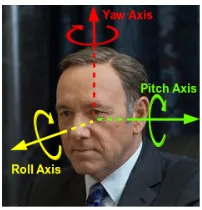
work focused on predicting emotions in continuous dimension (va-lence, arousal, expectation, intensity, and power) from magnitude and direction of two-dimensional head motion and head gestures, such as nods and shakes [16]. A recent work studied the significance of head motion in positive and negative emotions of infants [17]. This work noted that the angular velocity and acceleration of the head along pitch, yaw, and roll (see Fig. 1) are significantly higher for negative emotions as compared to the positive emotions.
In this work, we study the significance of head motion in adults’ emotional expressions using video data. Our goal is to understand
how much information does head motionalonecontain about an
ex-pressed emotion. We use the Facial Expression in the Wild (AFEW) database [18] consisting of more than 1000 video clips labeled with the seven basic emotion categories (anger, disgust, fear, joy, neu-tral, sadness, and surprise). Unlike previous studies that consider only two to three emotions (positive/negative and neutral), we study head motion for all seven emotion classes which allows for more fine-grained analysis. Considering human head as a rigid body, we first estimate the 3D head pose in terms of the three Euler rotation
angles (pitch, yaw, roll) at each video frame, and obtain a
time-series representation of head motion. We analyze these data using both non-parametric and parametric methods. Our non-parametric method computes the root-mean-square (RMS) values of the angu-lar displacement, velocity, and acceleration of the human head for pitch and yaw and roll. Statistical tests are performed to understand whether or not these RMS measurements are significantly different among various emotions. We use the autoregressive (AR) model (parametric method) to capture the time evolution of head motion. In order to investigate the discriminative ability of head motion, emo-tion classificaemo-tion is performed using the AR coefficients and RMS measurements. We also investigate whether head motion is comple-mentary or redundant to the information that facial expression pro-vides for emotion recognition. Our study shows that the head mo-tion dynamics alone has significant informamo-tion to distinguish among emotions, and carries additional information that can improve facial expression-based emotion recognition systems.
2. DATABASE AND HEAD POSE ESTIMATION
Database: For our study on head motion analysis, we consider
the Acted Facial Expression in the Wild (AFEW) [18] database.
This database is chosen because it is one of the largest publicly available databases that contains emotions as close to spontaneous emotions as possible. This database contains video clips collected from fifty-four movies and labeled with seven basic emotion
cate-gories i.e.anger, disgust, fear, joy, neutral, sadness,andsurprise.
Fig. 1. Head pose defined in terms of the rotation of head about three principal axes - pitch, yaw and roll.
Table 1. Video clips used in our study for each emotion class.
Anger Disgust Fear Joy Neutral Sadness Surprise
161 107 103 192 180 147 105
Data preparation: The database (being ‘in-the-wild’) contains
many videos where the apparent head movements are not entirely due to the persons’ affective behavior, and instead, may be caused due to other factors, such as camera motion. In some videos only a part of the face is visible. In such situations, the estimated head pose (and subsequently the head motion) would be erroneous. For sim-plicity and to adhere to our original goal of studying head movement in emotion, we manually removed such videos from the database. Even after removal of these clips, each class contains more than 100 samples (see Table 1).
Head motion estimation: Considering human head as a rigid
body, let us define 3D head pose or orientation atith frame as
θi =
θi p, θiy, θri
T
where θi
p, θyi,and θri are the three Euler
an-gles, referred aspitch,yaw, androll(see Fig.1). The head motion
for a given video sequence is thus represented as a time-series
Θ =
θ1,θ2, ...,θN
whereNis number of frames in the video
sequence. The 3D head poseθi at a given frame (see Fig.2) is
estimated using theincremental face alignmentmethod [19]. This
method uses a parameterized facial shape model which combines the non-rigid shape variation and the rigid transformation of the global
shape. The parameters depend on the 3D head pose/orientation
(θp, θy, θr), scale, and translation responsible for the rigid trans-formation required to align the face shape on the face image in the video frame. At the frames where face could not be detected, cubic interpolation is used to estimate the missing head pose. Gaussian smoothing is applied to remove small noise that may be present due to errors in estimation and interpolation.
3. HEAD MOTION ANALYSIS
The objective of this study is to understand how much information
does head motion carry about an adult’s expressed emotion. We
hy-pothesizethat humans have different head motion characteristics for
different emotions. The first step towards validating this hypothesis is to obtain an effective representation of head motion activity. We employ two methods for characterizing head motion from its time series representation. One approach is to represent head motion in terms of the RMS values of the angular displacement, velocity and acceleration of pitch, yaw, and roll. This is a non-parametric ap-proach and the RMS values are indicative of the overall head motion
[image:3.612.124.225.70.175.2]θp= 7.66◦,θy= 36.48◦,θr=−0.64◦ θp= 1.25◦,θy= 9.99◦,θr= 1.88◦
Fig. 2. Examples of detected facial landmark points and estimated head pose in terms ofθp, θy,andθr(best viewed in color).
dynamics. In order to capture the temporal variation in head motion, we use an autoregressive (AR) model - a popular parametric method for time series modeling. To test our hypothesis, a set of statistical significance tests and classification experiments are performed.
3.1. RMS measurements of head movement dynamics
We compute theangular displacement,Θd =θ1d,θ
2 d, ...,θ
N d
by subtracting the mean head pose from the head pose at each video
frame. Note thatΘd∈R3×N, where the three rows correspond to
pitch, yaw and roll. Then the first and second derivatives ofΘdis
computed to obtain theangular velocityΘv =
θ1
v,θ2v, ...θN −1 v
,
and theangular accelerationΘa=
θ1
a,θ2a, ...,θN −2 a
.
θid=θi− 1 N
N X
j=1
θj (1)
θiv=
θid+1−θid
×F rameRate (2)
θia=
θiv+1−θ i v
×F rameRate (3)
The RMS values of the nine time-series (angular displacement, ve-locity, and acceleration of pitch, yaw, and roll) are computed for ev-ery video, for each emotion class. Fig.3 shows the nine RMS values for all videos pertaining to anger and neutral. Qualitative observa-tion of the plots in Fig.3 suggests that the RMS measurements of the head motion dynamics are quite different for the two emotions.
Statistical significance tests: To test our hypothesis that the head
motion characteristics (measured in terms of the nine RMS values) of different emotions are significantly different we perform analy-sis of variance (ANOVA) followed by post-hoc multiple comparison and paired t-test. We perform ANOVA separately for each of the
nine RMS measurements. The ANOVA results (p < 0.05, for all
RMS measurements) indicate that RMS measurements of the head motion dynamics of at least one emotion category are significantly different from those of other emotion categories.
Following the results of ANOVA (suggesting significant differ-ence in head dynamics across emotions), a post-hoc multiple com-parison and paired t-tests are performed (see Table 2). The post-hoc multiple comparison (in Fig.4) provides a detail report of the emo-tions for which the measurements are significantly different. The RMS measurements of the emotions are considered significantly
dif-ferent (with5%significance or with95%confidence level) if their
[image:3.612.362.552.380.449.2]20 15 10
Pitch RMS Angular Displacement (°)
5 0 0 Yaw 20 0 20
10
40
Roll
Anger Neutral
(a) Angular displacement (◦)
200 150 100
Pitch
RMS Angular Velocity (°/sec)
50 0 0 Yaw 100 50
0 100
200
Roll
Anger Neutral
(b) Angular velocity (◦/sec)
4000 3000 2000
Pitch RMS Angular Acceleration (°/sec2)
1000 0 0 2000
Yaw 500 1500
1000
0 4000
Roll
Anger Neutral
[image:4.612.65.559.73.167.2](c) Angular acceleration (◦/sec2)
[image:4.612.66.286.240.351.2]Fig. 3. Scatter plots of RMS measurements of head motion dynamics for anger vs. neutral. (best viewed in color)
Table 2. Paired t-test results for one vs. all emotions. The reported numbers are p-values.
Displacement Velocity Acceleration Emotion Pitch Yaw Roll Pitch Yaw Roll Pitch Yaw Roll Anger 0.000 0.432 0.851 0.000 0.024 0.015 0.000 0.015 0.041
Disgust 0.389 0.000 0.002 0.222 0.031 0.167 0.001 0.839 0.220 Fear 0.322 0.096 0.067 0.083 0.052 0.722 0.496 0.405 0.605 Joy 0.007 0.747 0.001 0.000 0.000 0.000 0.000 0.000 0.000
Neutral 0.000 0.000 0.002 0.000 0.000 0.000 0.000 0.000 0.000
Sadness 0.510 0.693 0.876 0.000 0.002 0.001 0.000 0.000 0.000
Surprise 0.000 0.414 0.005 0.000 0.310 0.000 0.000 0.006 0.000
Table 3. Accuracy of one-against-all emotion classification using RMS measurements of head motion dynamics.
Anger Disgust Fear Joy Neutral Sadness Surprise
0.81 0.82 0.79 0.83 0.83 0.82 0.83
(ii) the emotions - anger, joy, and neutral - are highly distinguishable from other emotion classes in terms of almost all RMS measure-ments, (iii) the RMS measurements for sadness, surprise, and neutral are low and of similar values, (iv) the angular velocity and
accelera-tion ofpitchof the head are significantly higher for anger and joy as
compared to the most of the emotions, (v) the angular velocity and acceleration ofrollare significantly higher for joy than those for any of the six other basic emotions.
Classification experiments: We next investigate how
discrimina-tive the RMS measurements are in terms of emotion classification. A classification experiment was performed using the RMS measure-ments as features of head motion. We use a k-Nearest Neighbor
(kNN) classifier (k= 5) where the head motion extracted from each
video clip is represented as a 9-dimensional feature (corresponding
to the9RMS measurements). Table 3 presents the results (10-fold
cross validation) of classifying anyone emotion from the rest, where
the accuracy is around80%. This results comply with the
previ-ously reported psychological study [15], where participants have
rec-ognized one of the three emotions with about70−80%accuracy.
Next, we perform a multiclass classification with7classes. For this
purpose,80%of the data is used for training, and the rest for
test-ing. The overall classification accuracy is about34%(see Table 4),
[image:4.612.323.551.244.339.2]which is approximately double the accuracy of a random guess. Con-sistent with the significance test results, emotion classes, anger, joy, and neutral are recognized with a higher accuracy, and sadness, and surprise is often miss-classified as neutral.
Table 4. Confusion matrix for emotion classification using RMS measurements of head motion dynamics.
Anger Disgust Fear Joy Neutral Sadness Surprise
Anger 0.47 0 0.04 0.25 0.16 0.08 0
Disgust 0.16 0.13 0.06 0.09 0.25 0.31 0
Fear 0.17 0.07 0.030.23 0.43 0.07 0
Joy 0.25 0.05 0.050.56 0.05 0.04 0
Neutral 0.07 0.02 0.02 0.06 0.61 0.20 0.02
Sadness 0.20 0.05 0.07 0.07 0.38 0.18 0.05
Surprise 0.09 0.07 0 0.22 0.50 0.09 0.03
3.2. Autoregressive modeling
AR models are popular for describing time-varying processes. We use an AR model to capture the temporal dynamics of the head mo-tion data. We fit a third order auto-regressive model, AR(3), (Eq.4) to each of the three time-series corresponding to pitch, yaw and roll. The order three is detrmined based on the Baysian information cri-teria (BIC) computed using a set of randomly selected typical time series from each emotion class.
θ(t) =a0+a1θ(t−1) +a2θ(t−2) +a3θ(t−3) (4)
Classification experiments: A multiclass emotion recognition
ex-periment is performed (as before) using the AR(3) coefficients as
features. The resulting average accuracy is22%(lower than that
ob-tained using RMS values). We suspect that this is due to the video clips in the database being too short, and not having the entire emo-tion profile (neural-emoemo-tion-neutral). From the confusion matrix in Table 5, we observe that anger, joy and neutral emotions have higher accuracy while sadness and surprise are confused with neutral and happy. This is consistent with the RMS-based results presented in Table 4.
3.3. Comparison with facial expression
RMS displacement of pitch (°)
2 2.5 3 3.5 4 4.5 5 5.5
Surprise Sadness Neutral Joy Fear Disgust Anger
Confidence Intervals
RMS displacement of pitch (◦) 3 groups have means significantly different from Neutral
2 3 4 5 6 7 8
Surprise Sadness Neutral Joy Fear Disgust Anger
Confidence Intervals
RMS displacement of yaw (◦) 2 groups have means significantly different from Neutral
1.5 2 2.5 3 3.5 4
Surprise Sadness Neutral Joy Fear Disgust Anger
Confidence Intervals
RMS displacement of roll (◦)
4 groups have means significantly different from Neutral
10 15 20 25 30 35 40
Surprise Sadness Neutral Joy Fear Disgust Anger
Confidence Intervals
RMS velocity of pitch (◦/sec) RMS velocity of yaw (°/sec)
10 15 20 25 30 35 40 45 Surprise
Sadness Neutral Joy Fear Disgust Anger
Confidence Intervals
RMS velocity of yaw (◦/sec) 4 groups have means significantly different from Neutral
5 10 15 20 25
Surprise Sadness Neutral Joy Fear Disgust Anger
Confidence Intervals
RMS velocity of roll (◦/sec)
4 groups have means significantly different from Neutral
200 300 400 500 600 700
Surprise Sadness Neutral Joy Fear Disgust Anger
Confidence Intervals
RMS acceleration of pitch (◦/sec2) 4 groups have means significantly different from Neutral
200 300 400 500 600 700 800 900
Surprise Sadness Neutral Joy Fear Disgust Anger
Confidence Intervals
RMS acceleration of yaw (◦/sec2) 4 groups have means significantly different from Neutral
100 150 200 250 300 350 400 450 500 Surprise
Sadness Neutral Joy Fear Disgust Anger
Confidence Intervals
[image:5.612.63.546.67.331.2]RMS acceleration of roll (◦/sec2)
Fig. 4. 95%confidence intervals of in-class means of RMS measurements. The RMS measurements are significantly different for emotion
[image:5.612.318.557.419.476.2]categories for which the confidence intervals are non-overlapping. For example measurements for neutral emotion (blue) are significantly different from the measurements for emotions whose confidence intervals are displayed in red.
Table 5. Confusion matrix for emotion classification using AR(3) coefficients of head motion dynamics.
Anger Disgust Fear Joy Neutral Sadness Surprise
Anger 0.31 0.10 0.06 0.28 0.19 0.06 0
Disgust 0.18 0.09 0.05 0.27 0.23 0.18 0
Fear 0.19 0 0.100.19 0.42 0.05 0.05
Joy 0.19 0.06 0.050.30 0.24 0.16 0
Neutral 0.17 0.08 0.03 0.22 0.42 0.08 0
Sadness 0.10 0.04 0 0.41 0.31 0.14 0
Surprise 0.25 0.15 0 0.25 0.35 0 0
is done using landmark points obtained by incremental face align-ment [19]. For classification using both facial expression and head motion, the nine RMS measurements of the head motion dynamics are concatenated with the LBP-TOP features. The results are pre-sented in Table 6. Clearly, the addition of head motion dynamics im-proves the emotion recognition performance of the facial-expression based system. To put the results into context, we also mention the baseline facial expression classification accuracy obtained for this database as part of an emotion recognition in the wild challenge [20].
4. CONCLUSION
The main contribution of this paper is to present a systematic study of analyzing the significance of head motion in conveying affect or
1This paper uses LBP-TOP with support vector machine (SVM), and a sophisticated face alignment method. This result is mentioned to give an idea of the standard classification accuracy on this database.
Table 6. Classification results for facial expressions and head motion
Non-verbal cue Accuracy (in %)
Facial expression (LBP-TOP) 26.84
Head motion (RMS measures) 34.23
Facial expression + Head motion 36.15
Facial expression AFEW baseline1[20] 39.33
emotion. Considering human head as a rigid body, head motion was represented as a time-series of head pose (defined in terms of pitch, yaw and roll), estimated at each frame of video sequence. We in-vestigated the dynamics of head motion along pitch, yaw and roll for seven basic emotions. Through statistical tests and
discrimina-tive analysis (classification) we have shown that head motionalone
carries adequate information to distinguish any basic emotion from the rest. More importantly, the information contained in head move-ments is noted to be complementary to that contained in facial ex-pressions, since adding head motion information can significantly improve the accuracy of facial expression-based emotion classifica-tion system. Another observaclassifica-tion is that head moclassifica-tion (angular
veloc-ity and acceleration) is significantly faster forangerandjoy, while
slower forsadness,surprise, andneutral. Due to very short video
[image:5.612.62.293.429.525.2]5. REFERENCES
[1] Paul Ekman and Wallace V Friesen, “Measuring facial
move-ment,” Environmental psychology and nonverbal behavior,
vol. 1, no. 1, pp. 56–75, 1976.
[2] Y-I Tian, Takeo Kanade, and Jeffrey F Cohn, “Recognizing
action units for facial expression analysis,”IEEE Transactions
on pattern analysis and machine intelligence, vol. 23, no. 2, pp. 97–115, 2001.
[3] Zhihong Zeng, Maja Pantic, Glenn I Roisman, and Thomas S Huang, “A survey of affect recognition methods: Audio,
vi-sual, and spontaneous expressions,”IEEE transactions on
pat-tern analysis and machine intelligence, vol. 31, no. 1, pp. 39– 58, 2009.
[4] Caifeng Shan, Shaogang Gong, and Peter W McOwan, “Facial expression recognition based on local binary patterns: A
com-prehensive study,” Image and Vision Computing, vol. 27, no.
6, pp. 803–816, 2009.
[5] Yan Tong, Wenhui Liao, and Qiang Ji, “Facial action unit
recognition by exploiting their dynamic and semantic
relation-ships,” IEEE transactions on pattern analysis and machine
intelligence, vol. 29, no. 10, pp. 1683–1699, 2007.
[6] Michel F Valstar and Maja Pantic, “Fully automatic
recogni-tion of the temporal phases of facial acrecogni-tions,” IEEE
Transac-tions on Systems, Man, and Cybernetics, Part B (Cybernetics), vol. 42, no. 1, pp. 28–43, 2012.
[7] Guoying Zhao and Matti Pietikainen, “Dynamic texture recog-nition using local binary patterns with an application to facial
expressions,” IEEE transactions on pattern analysis and
ma-chine intelligence, vol. 29, no. 6, pp. 915–928, 2007.
[8] Caifeng Shan, Shaogang Gong, and Peter W McOwan, “Be-yond facial expressions: Learning human emotion from body
gestures.,” inBMVC, 2007, pp. 1–10.
[9] Hatice Gunes and Massimo Piccardi, “Bi-modal emotion
recognition from expressive face and body gestures,”
Jour-nal of Network and Computer Applications, vol. 30, no. 4, pp. 1334–1345, 2007.
[10] Hani C Yehia, Takaaki Kuratate, and Eric Vatikiotis-Bateson, “Linking facial animation, head motion and speech acoustics,” Journal of Phonetics, vol. 30, no. 3, pp. 555–568, 2002.
[11] Carlos Busso, Zhigang Deng, Ulrich Neumann, and Shrikanth Narayanan, “Natural head motion synthesis driven by acoustic
prosodic features,” Computer Animation and Virtual Worlds,
vol. 16, no. 3-4, pp. 283–290, 2005.
[12] Carlos Busso, Zhigang Deng, Michael Grimm, Ulrich Neu-mann, and Shrikanth Narayanan, “Rigid head motion in
ex-pressive speech animation: Analysis and synthesis,” IEEE
Transactions on Audio, Speech, and Language Processing, vol. 15, no. 3, pp. 1075–1086, 2007.
[13] Zakia Hammal, Jeffrey F Cohn, and David T George, “In-terpersonal coordination of headmotion in distressed couples,” IEEE transactions on affective computing, vol. 5, no. 2, pp. 155–167, 2014.
[14] Zakia Hammal, Jeffrey F Cohn, and Daniel S Messinger, “Head movement dynamics during play and perturbed
mother-infant interaction,”IEEE transactions on affective computing,
vol. 6, no. 4, pp. 361–370, 2015.
[15] Steven R Livingstone and Caroline Palmer, “Head movements
encode emotions during speech and song.,” Emotion, vol. 16,
no. 3, pp. 365, 2016.
[16] Hatice Gunes and Maja Pantic, “Dimensional emotion predic-tion from spontaneous head gestures for interacpredic-tion with sen-sitive artificial listeners,” inInternational conference on intel-ligent virtual agents. Springer, 2010, pp. 371–377.
[17] Zakia Hammal, Jeffrey F Cohn, Carrie Heike, and Matthew L Speltz, “What can head and facial movements convey about
positive and negative affect?,” inAffective Computing and
In-telligent Interaction (ACII), 2015 International Conference on. IEEE, 2015, pp. 281–287.
[18] Abhinav Dhall, Roland Goecke, Simon Lucey, and Tom Gedeon, “Collecting large, richly annotated facial-expression
databases from movies,”IEEE MultiMedia, vol. 19, no. 3, pp.
34–41, 2012.
[19] Akshay Asthana, Stefanos Zafeiriou, Shiyang Cheng, and
Maja Pantic, “Incremental face alignment in the wild,” in2014
IEEE Conference on Computer Vision and Pattern Recogni-tion. IEEE, 2014, pp. 1859–1866.
[20] Abhinav Dhall, OV Ramana Murthy, Roland Goecke, Jyoti
Joshi, and Tom Gedeon, “Video and image based emotion
recognition challenges in the wild: Emotiw 2015,” in
Proceed-ings of the 2015 ACM on International Conference on Multi-modal Interaction. ACM, 2015, pp. 423–426.
[21] Guoying Zhao and Matti Pietikainen, “Experiments with fa-cial expression recognition using spatiotemporal local binary
patterns,” inIEEE International Conference on Multimedia