warwick.ac.uk/lib-publications
Original citation:Vanderhallen, Miet and Hodgson, Jacqueline (2016) Research methodology. In: Panzavolta, Michele and de Vocht, Dorris and van Oosterhout, Marc and Vanderhallen, Miet, (eds.) Interrogating Young Suspects II: Procedural Safeguards from an Empirical Perspective. Maastricht series in human rights (16). Cambridge, United Kingdom: Intersentia, pp. 7-54. ISBN 9781780683010
Permanent WRAP URL:
http://wrap.warwick.ac.uk/84878
Copyright and reuse:
The Warwick Research Archive Portal (WRAP) makes this work of researchers of the University of Warwick available open access under the following conditions.
Publisher’s statement:
Link to the edited collection’s website: http://intersentia.com/en/interrogating-young-suspects-ii.html
Link to Intersentia’s website: www.intersentia.com
This article is made available under the Attribution-NonCommercial-ShareAlike 4.0 Unported (CC BY-NC-SA 4.0) license and may be reused according to the conditions of the license. For more details see: https://creativecommons.org/licenses/by-nc-sa/4.0/
A note on versions:
The version presented in WRAP is the published version, or, version of record, and may be cited as it appears here.
R ESEARCH METHODOLOGY
Miet Vanderhallen and Jackie Hodgson
1. INTRODUCTION
Th is chapter describes the approach of the empirical study as well as the integrated analysis of the legal and empirical fi ndings, which in turn enabled us to develop a set of proposed minimum rules informed by both law and practice. Providing a minimum level of eff ective legal protection for juvenile suspects depends not only on a proper legal framework being in place but also on good practices that address the nature of the vulnerability of juvenile suspects. Th e objective of the empirical study was to gain insight into the extent to which practices live up to the domestic legal frameworks of the fi ve countries which are described in detail in volume I (Belgium, England & Wales, Italy, Netherlands and Poland).1 Additionally, the empirical study was aimed at identifying good practices in these jurisdictions, with a view to developing improved standards and safeguards which could be implemented across the EU. As discussed in volume I, this objective should be seen against the background of current legislative developments at the EU level which have led to the tabling of a draft Directive on procedural safeguards for children suspected or accused in criminal proceedings.2 In order to achieve these improved EU wide standards and safeguards, it was necessary to understand how legal actors3 deal with the interrogation of juvenile suspects, which factors drive their behaviour, and how juvenile suspects are dealt with more generally. In addition to the examination of the practices of legal actors, the study also focused on the experiences of the juvenile suspect who is being interrogated, in order to grasp the interaction between all parties involved, and to understand the behaviour of the young
1 Panzavolta et al. 2015.
2 Proposal for a Directive of the European Parliament and the Council on procedural
safeguards for children suspected or accused in criminal proceedings (COM(2013) 822/2). See Panzavolta et al. 2015, chapter 1.
3 Although appropriate adults are oft en parents or volunteers they are included in this general
person as a vulnerable suspect. In this way, the empirical study also sought to identify the nature of the possible vulnerability of juvenile suspects when being interrogated and how legal procedural protections might be most eff ective in providing protection, where necessary.
Th e empirical study started from the fi ndings of the comparative legal study which suggested a two-stage approach to the empirical study. First, the type of interrogation needed to be selected. Th e legal study showed that whilst some countries dealt with juvenile suspects simply by way of police interrogation, others adopted diff erent or mixed models, involving prosecutors, judges and the family court, as well as criminal proceedings. Second, the legal analysis showed diff erences in the legal actors involved in interrogating juvenile suspects Th erefore, the relevant key actors per country were selected with regard to the interrogation of juvenile suspects.
2. THE EMPIR ICAL STUDY: METHODOLOGY
Whereas most studies on the interrogation of suspects concern adults4, this research focused only on the interrogation of juvenile suspects. In order to maximise the comparability of the data produced, the empirical study needed to focus on one type of interrogation which was most common in all fi ve jurisdictions. In consultation with all project partners, it was decided to focus on the police interrogation in which information is collected about possible criminal behaviour that can be used as evidence at trial or in determining other forms of case disposition since it is mostly the police who interrogate juvenile suspects in fi rst instance. Furthermore, it was decided to give special attention to the fi rst police interrogation since juveniles might be most vulnerable when being interrogated for the fi rst time about an alleged off ence.
Existing research on the interrogation of juvenile suspects mainly examines the capacity of juveniles to understand their legal rights and to make legal decisions.5 Th ese studies almost always make use of self-reports or an experimental design. In
4 See in this respect for example: Baldwin 1993, Beauregard et al. 2010, Beune et al. 2009,
Blackstock et al. 2014, Bull and Soukara 2010, Deslauriers-Varin et al. 2011, Edwards and Stokoe 2011, Gudjonsson 2003, Hodgson 2005, Hodgson and Bridges 1995, Holmberg 2004, Kassin et al. 2010, Kassin et al. 2003, Kassin and Gudjonsson 2004, Kemp 2010, Kemp 2013, Kemp and Balmer 2008, Moston and Engelberg 2011, Moston and Stephenson 2009, McConville and Hodgson 1993, McConville, et al. 1994, Sellers and Kebbell 2009, Skinns 2011, Snook et al. 2010, Walsh and Bull 2011 and Walsh and Bull 2012.
5 See in this respect for example: Evans 1993, Feld 2013, Goldstein et al. 2003, Grisso and
the present study, a mixed-method approach was used consisting of a combination of data collection methods.6 Th e fi rst method employed was focus group interviews, which are purely qualitative in nature and are oft en combined with other qualitative and/or quantitative methods.7 Th is study used a qualitative approach in order to obtain a suffi ciently rich account of the experiences reported by juveniles and to build a picture of the interrogation of juvenile suspects from various perspectives. Th ese focus group interviews are useful because they are well suited to exploratory research, to obtain insights into the nature of complex behaviour and motivations8 such as the behaviour and motivations of legal actors and of juveniles involved in the interrogation. Moreover, they provide data at an aggregated rather than an individual level, in order to be able to obtain data from various groups.
Th e second data collection method is characterised by a combination of a qualitative and a quantitative approach and concerns observations of the records of interrogation of juvenile suspects. Th e records included audiotapes or videotapes of interrogations, but if tapes were not available, written records of the interrogations with juvenile suspects were analysed. In this case, the observation was replaced by document analysis using a similar measurement instrument. While experimental research provides insights into the possible vulnerabilities of juveniles, analysis of interrogation records enabled to understand better what happens during actual interrogations.
Th is mixed-method approach resulted in a triangulation of data, which can increase the validity of the fi ndings. Whereas the focus group interviews obtained qualitative data, the observations of audio- or video-recordings of interrogations or their documentary analysis where recordings were not available, gathered both qualitative and quantitative data in order to obtain a fuller perspective on the interrogation of juvenile suspects. Without the aim of being representative these data can provide valuable information on what happens in practice. Th e integration of these research results mainly focuses on complementarity, namely to add another perspective such as an insider versus outsider (observer) perspective.9 By doing so, fi ndings can be convergent as well as divergent. Because of the small samples both in the number of focus group interviews as well as the observations, results are of an indicative value rather than a source for fi rm conclusions. Th us, fi ndings from this empirical study should be used carefully and serve as the basis for critical refl ection and raise suggestions for future research.
6 Erzberger and Kelle 2003, p. 458. 7 Morgan 1996, p. 133–134. 8 Morgan 1996, p. 139.
Th e empirical study started with focus group interviews with (i) key actors and (ii) juveniles (who had been interrogated as juvenile suspects). Th ese focus groups aimed at the development of an inventory of various practices on a national level by means of opinions and experiences. Second, recordings or documentary analysis of interrogations with juvenile suspects were analysed.
Given the sensitivity of the topic and in particular the vulnerability of juveniles who were also actively involved in the focus group interviews, ethical approval from the ad hoc ethical scientifi c committee of Maastricht University was obtained for all project partners by the Maastricht University project management team. Th is request for ethical approval entailed general principles as well as specifi c guarantees for the focus group interviews (see infra paragraph 2.2) and the observations (see infra paragraph 2.3). Th e general principles encompassed four principles with regard to the empirical research. First, researchers would ensure the anonymity and confi dentiality of all respondents and juveniles in particular. Th erefore, references to locations are limited to general information and if necessary, coded information. Second, the data will be kept in a secure environment with limited access and will only be stored as long as necessary. Th e third principle states that the research will be conducted independently, which means that there will be no steer or infl uence by governmental organisations or other interested parties. Th e research was also wholly disconnected from the actual investigation concerning the juvenile, if still on-going. Fourth, all respondents will be thoroughly informed about the design and aim of the research. If necessary, permissions will be requested as appropriate.
Th e committee reviewed the overall design positively on the basis of the following criteria: the research does not cause harm to the respondents, participation is voluntary, anonymity and confi dentiality are guaranteed, and the researchers handle the data with great care and store them in a secure environment in such a way that they cannot be accessed by others.
Th e empirical research combined a top-down approach (legal framework driven) and a bottom-up approach (practice-driven) in order to capture both the application of relevant legal provisions on the one hand and actual practices on the other hand. Hereaft er, the methodology of both parts of the empirical study will be discussed followed by a description of the working method for the integrated analysis (chapter 8) and the guidelines (chapter 9).
2.1. COOR DINATION AND PR EPAR ATION
carrying out the research itself was managed with the utmost care. Th erefore the empirical research was coordinated by the project management team, which set out the rules for the empirical studies and provided all researchers with the necessary documents for seeking access permissions, as well as with basic data collection instruments, including a practice manual. In order to ensure workable procedures, this was done in consultation with project partners, including discussions at meetings held throughout the course of the study. With regard to the data collection instruments, the project management team provided the project partners with basic common instruments, which could be adapted to the national context, i.e. completed with country specifi c variables. Such a common basis was needed with a view to the subsequent integrated analysis. As mentioned above, the empirical research consisted of two parts: focus group interviews and observations. Th e focus group interviews were held in all countries, but the respondent groups diff ered. Th e observations of audio- or video-recorded interrogations were replaced by document analysis of written records in two of the countries because of diff erences in practice or the lack of necessary permissions. Central coordination made sure that data were compatible notwithstanding that various data collection methods were required.
2.1.1. Training
Each country employed its own national researcher to conduct the empirical study in order to guarantee that researchers had a good knowledge of the legal system, and of interrogation procedures and practice. Moreover, linguistic issues could be avoided by using native speakers. All the national researchers were specifi cally trained and/or were experienced in collecting and analysing empirical data. In order to ensure a similar approach in the conduct of the fi eldwork, these country researchers received a collective two-day training, which consisted of four components. First, the type of interrogation which would be examined empirically was discussed in order to collect comparable data in the fi ve countries. Second, procedures for obtaining necessary permissions were explained and discussed. Th ird, the data collection methods (including analysis) were explained. For focus group interviews this consisted of the basic principles for conducting these, as well as the identifi cation of the relevant respondent groups in the respective countries. For the observations the basic principles of both observational research and document analysis were discussed. Finally, the group of researchers developed a list of common topics for data collection in order to ensure a degree of uniformity in the fi ve countries involved.
2.1.2. Development of data collection instruments
lawyers) as well as with juveniles.10 In order to ensure that comparable data were collected across the fi ve countries, these interview schemes were accompanied by a manual to guide researchers and to explain the research variables. Th e interview schemes were draft ed in line with the aim of a top-down approach combined with a bottom-up approach to conduct the empirical research. Th is means that the schemes were based upon a legal psychology literature study on the interrogation of (juvenile) suspects, the topics from the legal framework, and the general patterns coming from the legal analysis. Country researchers subsequently adjusted these common interview schemes with country specifi c questions under the respective relevant headings. For example, the Belgian focus group interview scheme for police offi cers included questions on the mandatory provision of legal assistance, which was not part of the common scheme since the other countries allow (some) juvenile suspects to waive the right to a lawyer. Th e Italian and English project partners draft ed a separate interview scheme for the focus group interview with appropriate adults (hereaft er: AAs) since this safeguard is only a requirement in these two jurisdictions.11
Th e interview schemes started with a ‘thinking aloud’ exercise on the ‘interrogation of juvenile suspects’. In this exercise respondents were asked to recall fi rst thoughts when talking about ‘the interrogation of juvenile suspects’. Th is fi rst exercise was followed by the discussion of several topics addressing the chronological order of the judicial proceedings: fi rst contact between police and juvenile; police proceedings from arrest until the point of custody; information on rights legal assistance before and during interrogation; the appropriate adult (hereaft er: AA) role; assessment of the juvenile; interrogation practice and the behaviour of the suspect; interrogation recording. Th e phase of fi rst contact referred to the initial contact between the police and the juvenile. Th is was followed by the police proceedings which outline the steps taken aft er arresting a juvenile suspect and before informing him about his rights which entails the third phase. Th e information on rights concerned all rights that need to be delivered to the juvenile suspect when invited or arrested. Next, legal assistance was focused upon hereby addressing the decisions which need to be made by the juvenile as well as the interpretation of legal assistance by means of the confi dential consultation as well as the presence of a lawyer during the interrogation. Next to the legal assistance, the role of an AA in practice was discussed aft er which the assessment of the juvenile was taken into account. Subsequently, the phase of the interrogations focused upon both the model and techniques used as well as the juvenile suspect’s behaviour. Finally, the recording of the interrogation was examined. In a fi nal part of the focus group interviews,
10 See annex 1.
11 In Poland and the Netherlands a juvenile has the right to be assisted by a trusted person, but a
the respondents were asked about their opinion and experiences with juvenile suspects’ vulnerabilities, adequate safeguards and good practices.
For each focus group interview, short questionnaires12 were draft ed which were fi lled in by the respondents to gather their basic biographical information, enabling the researchers to describe the respondent group and note any trends in responses as between diff erent groups – such as those offi cers who have and have not been trained in interviewing vulnerable people; those AAs with and without social work training.
With a view to the observations, the project management team draft ed a common observation scheme13, consisting of four separate modules. Th ese modules were draft ed on the basis of the legal frameworks combined with topics derived from a legal psychology literature study. Moreover, observation schemes from earlier research by Walsh and Bull14, which was subsequently used and adapted by Tersago15, were used as a starting point. Th e fi rst module contained general information which could be derived from the written record: characteristics of the juvenile, the off ence, activities prior to the interrogation, people present during the interrogation, and information on the format and content of the written record. Th e second module focused on information which was predominantly present in audio- and video-recorded interrogations. However, a number of variables could also be assessed from the written records. Th is module included for example information on proceedings during the interrogation, the behaviour of the interrogators, the juvenile suspect, and – if applicable – the behaviour of the lawyer, AA and interpreter. With regard to the interrogation model, a distinction was made between an information gathering approach and an accusatory approach in which the fi rst refers to a more calm and empathic style aimed at fi nding the truth while the latter refers to a more dominant style aimed at obtaining a confession.16 Within these models various (manipulative) techniques can be used. Some of these techniques were also explored such as minimisation17 and maximisation18, suggestive questioning19,
12 See annex 2. 13 See annex 3.
14 Walsh and Bull 2011 and Walsh and Bull 2012. 15 Tersago (forthcoming).
16 Hartwig et al. 2005.
17 Th e interrogator minimises the seriousness of the crime or consequences in the suspect
confesses.
18 Maximisation is a technique in which the interrogator increases anxiety about denial for
example by exaggerating the evidence or consequences to the suspect (Gudjonsson 2006, p. 133).
19 Suggestive questioning refers to suggestion included in the question, specifi c types are
persuasion20, active listening21 and empathy.22 Th e third module entailed variables relevant to the video-recording only such as interruptions in recording and camera perspective.23 Th e fi nal module included analysis of identifi ed vulnerabilities, safeguards, and good practices. Th ese served as a basis for the observations of audio-recorded and video-recorded interrogations as well as the documentary analysis of written records. Th ey also included variables on the comparison of tapes and written records where both sources were analysed. As with the interview schemes, all observation schemes were accompanied by a manual, which explained the variables as well as coding procedure, to ensure the collection of comparable data across the fi ve countries and a similar coding process.
2.1.3. Data analysis
For the analysis and processing of the fi ndings, the project management team developed a three part template, which served as the format for each empirical country report. In the fi rst part the respondents in the focus groups and the sample of observed interrogations/written records are described in brief, in order to set out clearly the basis of the fi ndings that follow. Th e second part entails an in-depth picture of practice on the basis of the topics explored in the focus group interviews, as well as in the observations/document analysis. Th e third part provides an overview of vulnerabilities, safeguards and good practices reported by the respondents and identifi ed by the researchers. Th is template was accompanied by a manual to explain the completion of the template. In the analysis, researchers point to similarities as well as diff erences between (i) the various respondent groups and (ii) between focus groups and observations/ document analysis.
Transcribed focus group interviews resulted in qualitative data, which were coded according to the topics in the template. Researchers summarised the fi ndings throughout the various focus group interviews in which a respective topic was discussed. Quotations were used to enliven and illustrate opinions and experiences reported in the focus group interviews.
20 Techniques to convince the suspect to confess such as pointing out the futility of denial or
telling the suspect that it is in his interest to confess (Bull and Milne 2004, p. 182).
21 With active listening the interrogator reinforces the suspect to participate by using
non-biasing behavior such as echo probing, summarising and monitoring (Milne and Bull 1999, p. 67).
22 Here the interrogator demonstrates understanding of the situation from the suspect’s
perspective (Milne and Bull 1999, p. 41).
23 Is the camera on the suspect only (suspect focus), the suspect and interrogators (equal focus),
Th e analysis of written records of interrogations, and of audio-recorded and video-recorded interrogations, consisted of both a quantitative as well as a qualitative part. For the purpose of statistical analysis, the project team developed a database including all quantitative variables in the observation schemes and information on coding procedures. Th ese databases were fi lled in by all country researchers and sent to the project team who conducted the statistical analysis by means of SPSS24 to ensure a similar approach for all countries. Subsequently, the country researchers integrated the analysed data into the analysis of the focus group interviews in their empirical country report. Quantitative data of the focus group interviews were amplifi ed with qualitative data from the observations/document analysis. Th ese qualitative fi ndings were illustrated by examples of practices from interviews and observations/document analysis. Th e analysis of the observations/document analysis primarily focused on the identifi cation of (good) practices based upon the observation schemes. Finally, the empirical country reports discussed the country fi ndings in light of existing national research with regard to the interrogation of juvenile suspects.25
2.2. FOCUS GROUP INTERVIEWS
Focus group interviews were held with key legal actors and juveniles in order to obtain a picture of what happens during the interrogation of juvenile suspects from the perspective of the various parties involved. Th ese focus group interviews are not necessarily representative of actual practice but provide valuable information on how interrogations are perceived by the actors involved, including perspectives that might be similar, complementary or even contradictory. Focus group interviews do not strive for consensus and therefore are considered an interesting method to obtain a variety of perceptions on the interrogation of juvenile suspects in practice.
Th e aim was to conduct focus groups in each jurisdiction with all nationally relevant key legal actors and two focus group interviews with juveniles – one with boys and one with girls. Because of diff erences in practices and diffi culties in obtaining access, the number of focus group interviews between countries varied slightly. If conducting a focus group interview was not feasible, it was – when and where possible – replaced by individual semi-structured interviews. In total 16 focus group interviews were conducted in the period of March until June 2013. Five focus group interviews were held with police offi cers and one
24 Version.22.
25 Th is includes research on adult suspects or juvenile victims and witnesses as well to the extent
additional focus group was organised with prosecutors in Italy since they also interrogate juvenile suspects in similar circumstances as the police. Four focus groups were organised with lawyers (Belgium, England and Wales, Italy and the Netherlands) and two focus group interviews were conducted with AAs – one in each jurisdiction where presence of an AA is a mandatory safeguard (England and Wales, and Italy). Th e remaining four focus groups were conducted with juveniles (England and Wales, Italy, the Netherlands and Poland). Unfortunately, it did not prove possible to gain access to juvenile respondents in Belgium. In Poland, it was not possible to hold a focus group with lawyers, but this was replaced by semi-structured interviews with two lawyers. Th e majority of focus group interviews were moderated by two researchers since research shows that the quality of the focus group interview also depends on the moderator who has a demanding and complex role. Having a moderator and an assistant – who focuses on practical matters such as time, recording, et cetera – gives the leading moderator the opportunity to fully focus on the group interview itself.26 For feasibility reasons, location and time was chosen which suited the respondents best. Th is means that some focus groups were organised at the university and others at a police station or at an external location (such as a business centre). Besides, some focus groups were organised outside working hours in order for respondents (e.g. lawyers) to be able to attend.
Focus groups with key actors consisted of three to ten respondents. Due to several reasons explained below, the ideal number of six to ten respondents was not always achieved. Relevant key actors were identifi ed from the legal study and included police offi cers, prosecutors, AAs and lawyers. Th e selection of respondents from each professional group specifi cally aimed at the realisation of as much variation in opinions and experiences as possible. Th erefore, a purposive sample was used. Th e focus groups with key actors were tape recorded and lasted between two and three hours.
In order to gain insights from a range of perspectives and experiences, it was a prerequisite for all legal actors to have experience with the interrogation of juvenile suspects, and for juveniles to have been interrogated by the police at least once. To enhance diff erentiation, the composition of the police (and prosecutor) focus group was balanced with regard to the following criteria: gender, years of experience as an interrogator, interrogation training, and function of the police offi cer. In addition to this, respondents had to come from at least two diff erent police stations. With regard to the lawyer focus group, all lawyers needed to be experienced as a juvenile lawyer. Four additional criteria were used to strive for diff erentiation in their practices: gender, training, judicial region or bar association, and years of experience.
For practical reasons the focus group interview with AAs consisted of social workers, youth justice workers and volunteers of varying degrees of experience, but not family members (e.g. parents) who acted as an AA. It was not possible to arrange a focus group with such a disparate group of individuals like family members who could not be contacted through any professional grouping or organisation.
Th is limits the study to a specifi c group of AAs. However, given the fi ndings from earlier research in which social workers are considered a better option,27 this choice was acceptable with a view to obtaining examples of good practices. Moreover, the observation sample also included examples of parents acting as AAs.
Additional safeguards were put in place in the process of organising focus groups with juveniles. First, explicit and informed consent to participate was required from the juveniles themselves. Juveniles were invited to sign an informed consent form, which provided them with the necessary information about the research. Second, in order to guarantee their understanding of the research, the moderator explained the goal of the research as well as the interview proceedings mentioned on the form, before the juveniles were invited to sign the form. Th ird, the researcher explained that participation was fully voluntary and the juvenile could withdraw from the focus group at any time. It was also made clear to those in custody or subject to some form of supervision order, that participation would not interfere with their detention or sentence order in any way. Fourth, the focus group interview was held in a safe and familiar environment and/or under the supervision of a juvenile facility or probation location. If possible, the focus group was conducted in the presence of a trusted person, for example a social worker from the institution. Th e attendance of social workers of the institution or involved organisations such as youth off ending teams, took the juveniles’ welfare into account by providing them with an opportunity to talk about the focus group aft erwards, if necessary. Juveniles were also informed that the research is about their opinions and experiences and there are no good or bad answers to the questions. Moreover, juveniles were informed that the interview was not about the content of their case but only about the (circumstances of the) interrogation(s). Finally, if permission from the parent(s) was required by the government or the institution, this permission was also obtained.
Juveniles were recruited through youth care (ambulant or residential) and/or youth detention centres, which means that only convicted juveniles took part in the focus group interviews. In order to facilitate the focus group interviews with juveniles from the perspective of social desirability, group pressure, et
cetera, the preparatory work was conducted in consultation with professionals from the institutions. When possible, focus groups were organised within an institutions existing unit so interviews could benefi t from pre-existing familiarity between juveniles.28 Sensitive topics were avoided since the focus group interviews were not intended to discuss their case as such.29 Th is approach was chosen to enhance the focus group but could also provide a biased picture with regard to the reported experiences and opinions. In order to ensure that the juveniles interviewed were as comfortable as possible in discussing their experiences, the goal was to have boys and girls in separate focus groups if possible. Th e exception to this rule was England and Wales, where both boys and girls under the supervision of a youth off ending team were spoken to together.
Except for Belgium, where it was impossible to interview young people, focus groups were attended by juveniles with a minimum age of 12 years and consisted of fi ve to eight respondents. Th e duration of the focus group interviews with juveniles was shorter than those with key legal actors, since juveniles might have a shorter concentration span than adults. Th e approximate length of the juvenile focus groups was between one and a half and two and a half hours (including breaks).
Focus group data were gathered in locations where researchers had contacts or were able to gain permissions, where key legal actors were available to participate, and where language or dialect issues were least problematic.
Th e following sections set out a more detailed account of the empirical data gathered in each of the fi ve jurisdictions.
2.2.1. Belgium
In Belgium, the empirical data were gathered from one single region. Two focus group interviews were held, one with police offi cers and one with lawyers, neither requiring any offi cial permission.
2.2.1.1. Police focus group
Two additional criteria were added to comprise the focus group with police offi cers. Th e fi rst was that of specialised training for interrogating juvenile witnesses in the sense that police offi cers with and without this special
28 With the exception of England and Wales, where focus groups were organized by bringing
together juveniles from more than one YOT.
training took part. Th e second criterion was that of federal and local police, both being represented in the focus group. Eight police offi cers participated in the focus group interview from both federal and the local police, across six diff erent police regions in the area. Table 1 provides an overview of police respondents.
Table 1. Overview of police focus group respondents, Belgium
No. Gender Local / Federal
Years exp./ interrogation exp.
Special training Function
1 F Local 7 / 7 Basic Detective – Intervention
2 F Federal 0 /0 TAM30
TAM-S31
Scientist (civilian) Unit behavioural sciences 3 M Federal 30 /20 Basic / TAM Support and coordination
(federal) questioning juveniles
4 F Local 11/5 Basic / TAM Detective / Supervisor juvenile unit
5 F Local 14/12 Advanced
interrogation techniques / video-recorded interrogation
Detective
6 F Local 30/25 Basic Commissioner /
Supervisor youth and family unit
7 M Federal 37/ unknown Advanced interrogation techniques / TAM
Detective general crime unit
8 M Local 8/3 Basic Detective juvenile crime
unit Total 5 F and
3 M
local (5) and federal (3)
0/0 – 37/25 Basic (5), TAM (4), TAM-S (1), Video-interrogation (1)
Behavioural sciences (2) / detectives (4) /
commissioner (1)
Police offi cers came from seven diff erent police stations. With one exception, all police offi cers were experienced in interrogating juvenile suspects. One police offi cer worked as a behavioural scientist at the behavioural science unit of the federal police and followed a course on the Belgian interrogation model for juvenile suspects, which was the reason for his participation in the focus group. With regard to training, half of the respondents had experienced at least basic interrogation training, combined with specifi c training for interviewing juvenile witnesses (TAM). Other respondents had received advanced training for interrogation of suspects and one respondent
had received training on the video-recorded interrogation of adult suspects. Th us, the respondent group varied in terms of both level as well as type of interrogation training.
2.2.1.2. Lawyer focus group
[image:15.595.128.455.400.588.2]Recruitment of lawyers was organised through the regional bar association. Th is overarching association contacted the local associations of which one was willing to participate in a focus group interview. Since only lawyers from one local bar association participated, the focus group was homogenous with regard to region or bar association. On the other hand, this local bar association is at the forefront of provision of legal assistance at the police station, as well as assisting juveniles. Th erefore, it was considered an excellent opportunity to gather insight into good practices. Moreover, all lawyers came from diff erent law fi rms. Th e focus group was attended by nine lawyers who work with juveniles. Table 2 gives an overview of the characteristics of the lawyers who participated in the focus group interviews.
Table 2. Overview of lawyer focus group respondents, Belgium
No. Gender Years exp. Lawyer / juvenile lawyer)
Special training
1 F 22 / 17 Training legal assistance at the police station / special training assisting juveniles
2 F 22 / 17 Training legal assistance at the police station
3 M 38 / 30 Training legal assistance at the police station
4 M 14 / 10 Training legal assistance at the police station
5 F 22 / 12 Training legal assistance at the police station
6 M 19 /8 Training legal assistance at the police station
7 M 46 / 17 Training legal assistance at the police station
8 F 27 / 17 Training legal assistance at the police station
9 F 28 / 24 Training legal assistance at the police station
Total 5 female / 4 male 14 / 8 up to 46 / 30 Training legal assistance (9) and special training juvenile assistance (1)
2.2.1.3. Juvenile focus group
Organising a focus group with juveniles was not possible due to on-going changes within the national institutions. Offi cial permission was needed for the focus group with juveniles, but this was declined by the federal authorities because of national reforms taking place at that time with regard to juvenile detention centres. Subsequently, a request was sent to the community authority in order to receive permission to conduct a focus group interview at a youth care centre. Th is request was also declined because of too many requests being made to interview juveniles. Th e alternative procedure was to organise individual interviews with juveniles who were interrogated. Th erefore, a request was sent to the president of the bar association who was involved in the focus group interview and who is a member of the regional bar association. Th e procedure envisaged was to have lawyers invite their juvenile clients to take part in the research. However, the president said this procedure would be too intrusive for the lawyers’ clients and refused to assist us in recruiting in this way. In consultation with the president it was decided not to proceed in contacting individual lawyers. Th is resulted in the absence of a focus group interview or individual interviews with juveniles in Belgium.
2.2.2. England and Wales
Th ere were four focus group interviews conducted in England and Wales with, respectively, police offi cers, lawyers, AAs and juveniles. In order to arrange the focus group interviews existing contacts within the Midlands region were utilised, which proved to be a successful. strategy. Th ree of the focus group interviews were based in one part of the region and the fourth in another part.
2.2.2.1. Police focus group
Table 3. Overview of police focus group respondents, England and Wales
No Gender Police station
Average time in interviewing juveniles
Years exp. as offi cer/ interviewer
Training Specialist training
Function
1 F 1 2 times / month 11/11 PEACE Tier 2 ABE32 Basic
2 F 2 2 times /month 12/12 PEACE Tier 2 ABE Violence/ serious assaults 3 M 3 2 times /week 13/13 Interview skills
course Volume crime and priority witness course Basic – previously a social worker 4 M 2 3 times /week 10/10 Basic –
PEACE Tier 2
ABE Robbery squad 5 M 2 2 times/ month 12/12 None None Basic 6 M 4 2 times /week 20/20 PEACE Tier 2
and investigators course ABE Robbery, burglary and drugs team 7 F 5 1 time/week 13/13 Basic ABE Robbery
squad 8 M 2 4 times /month 13/13 PEACE Tier 2 ABE CID – serious crime 9 M 2 Seldom 11/11 PEACE Tier 2 ABE CID –
acquisitive crime
Total 3 F and 6 M
5 police stations
2 times /week up to 2 times /month
10/10 up to 20/20
Basic (2), PEACE Tier 2 (6) and investigators course (1)
None (1), ABE for juvenile witnesses and victims (7) and volume crime and witness priority course (1) Basic offi cers to specialised units and CID
Respondents in the police focus group diff ered on the general selection criteria. Th ere was a balance between males and females who had received diff erent training and came from various units.
2.2.2.2. Lawyer focus group
For the focus group interview with lawyers no offi cial permission was needed. Several lawyers’ fi rms were contacted in the Midlands region to invite police station legal advisers to participate in the focus group. Th e timing of the focus group was unfortunate because it coincided with the government announcement of legal aid reforms which included achieving a two-thirds reduction in the number of solicitors’ fi rms contracted to provide publicly funded work by early 2015. Despite
32 Achieving Best Evidence – includes training in audiovisual recorded interviewing of juvenile
numerous attempts to bring together a group of lawyers in the Midlands, they were too preoccupied with responding to the reforms to be able to participate. Instead a senior lawyer involved in an earlier study was contacted and brought together a group of seven police station legal advisers. Notwithstanding lawyers came from the same region, they worked at three diff erent law fi rms. Table 4 provides an overview of those respondents, including additional selection criteria: (i) frequency of acting for a juvenile and (ii) duty lawyer or accredited representative.
Table 4. Overview of lawyer focus group respondents, England and Wales
No. Gender No. of years experience as lawyer
Av. times acting for juveniles
Duty lawyer or accredited rep
Training
1 M 16 years 6 times / month DL PSQ33
2 M 7 years 8 times / month DL PSQ
3 M 25 years Unknown34 DL PSQ
4 F 14 years 8 times / month DL PSQ
5 F 20 years 4 times / month DL Solicitor qualifying exams
6 F 7 years Unknown Accredited rep Accredited representative exams
7 M 10 years Unknown DL PSQ
Total 4 M and 3 F
7 years up to 25 years
4 times/month up to 8 times/month
DL (6) and accredited representative (1)
PSQ (5), Sols exam (1) and accredited representative exams (1)
Because in England and Wales, legal advice can be provided by accredited representatives, as well as duty solicitors/lawyers, this criterion was added to the general selection criteria. Th is resulted in the presence of six duty solicitors/lawyers and one accredited representative. All lawyers had received training, mainly the Police Station Qualifi cation (PSQ) for providing legal assistance at a police station.
2.2.2.3. Appropriate adult focus group
When arranging the focus group with AAs a local Youth Off ending Team (YOT) manager was contacted, who was extremely helpful in encouraging other YOT managers in the Midlands area to engage, resulting in ten respondents attending the focus group. In one of the YOT areas there had recently been set up a ‘Justice Hub’, which brought together police investigators, police custody offi cers and YOT offi cers in the same building. Th e AAs varied by gender, geographic area
33 Th ere is a police station accreditation scheme for non-lawyers and ‘police station qualifi cation’
(PSQ) for lawyers providing police station legal advice. Th e schemes require applicants to submit a portfolio of cases where they had provided police station legal advice for assessment and also to undertake a ‘critical reasoning test’ based on police interrogations.
of work, and whether they worked with a volunteer scheme or were employed in youth protection work more broadly. Table 5 gives an overview.
Table 5. Overview of appropriate adult focus group respondents, England and Wales
No. Gender Area Av. times
interviewing juveniles
Years exp. as an AA
Details of training
Role as AA
1 F 1 Twice a week 1 year Police Volunteer
2 F 2 4 times a week 10 years YSS35 Volunteer
3 M 2 Twice a week 10 years YSS Volunteer
4 F 3 Twice a month 2.5 years In-house and PACE training36
YOT worker
5 F 4 Twice a month 12 years In-house and PACE training
YOT worker
6 M 5 Twice a week 8 years In-house YOT manager 7 M 6 Once a month 28 years Arranges
training
YOT manager
8 M 3 – 10 years YOT training Now an
academic
9 M National – – National
training
National AA coordinator
10 M 1 Once a week 3 years Police Volunteer
Total 4 F and 6 M
6 areas and 1 national repr.
One a month up to 4 times a week
1 year up to 28 years
Training provision varies by institution
YOT AAs (4), volunteers (4) and others (2)
Respondents in the AA focus group came from six diff erent areas and there was a balance of males and females who had been trained in various ways.
2.2.2.4. Juvenile focus group
Th e focus group with juveniles was more diffi cult to organise, but in consultation with a YOT manager it was discussed whether it would be possible to bring together a group of juveniles who were reporting to the YOT as a requirement of their sentence. Th e YOT manager agreed to undertake this work, subject to obtaining permission from the County Council and the agreement of the young people themselves. A research governance form was completed which required a detailed account of the focus group, highlighting any ethical issues that might arise and how these would be addressed. Th e scheme was submitted for approval to the County Council as part of the application together with a draft of the consent form to be signed by the juveniles. Th is form stressed that their participation in
35 Th e YSS is the Youth Support Service.
36 Th e Police and Criminal Evidence Act 1984 (PACE) and the PACE codes of practice provide
the focus group was on a voluntary basis and they could refuse to participate. Th e application was successful and two YOT workers volunteered to bring together juveniles for the focus group, taking into account several criteria: age (14–17 year), gender, experience with police. For juvenile welfare reasons it was decided that a YOT worker would attend the focus group interview. Th e juveniles appeared to enjoy a good relationship with the YOT worker and their responses did not appear to be inhibited by her presence. Of the ten juveniles who agreed to participate in the focus group interview, fi ve were able to attend. An overview is shown in table 6.
Table 6. Overview of juvenile focus group respondents, England and Wales
No. Gender Age How many
times arrested
How many convictions Most serious court order
1 M 18 More than 4 More than 4 2 year supervision 2 M 17 More than 4 More than 4 Intensive supervision
3 M 18 More than 4 Twice Intensive supervision
4 F 16 More than 4 A few Supervision order
5 M 17 Twice One Referral Order
Total 4 M and 1 F
16 up to 18
2 (1) and more than 4 (4)
persistent off enders (2) and less experienced (3)
Referral Order to alternatives to custody
Table 6 shows that the group of juveniles mainly consisted of adolescent male repeat off enders.
2.2.3. Italy
Th e National Associations of Lawyers and Magistrates assisted in setting up the focus group of lawyers.
2.2.3.1. Police focus group
[image:21.595.126.456.400.679.2]Th e focus group with police offi cers was held in the region of Sicily and in line with the general selection criteria, the researchers tried to involve the four districts of Sicily. Th e fi rst contacts with the police concerned the Criminal Investigation Department for Juveniles, in particular an informal contact with the chief of the Juvenile Prosecution Division in one of the districts. Aft er consultation, agreement was reached on which steps needed to be taken to get the offi cials to participate in the focus group interviews. Subsequently, an offi cial letter was sent and the director of the Prosecutor General approved the request. Th e same type of procedure was followed to involve respondents from the other two Sicilian districts. One additional criterion (next to gender, experience, training, and function) was used, namely the police force (state police or local police). In total nine police offi cers participated, of which an overview is given in table 7.
Table 7. Overview of police focus group respondents, Italy
No. Gender Police force Districts Years exp. offi cer/ interrogator
Training Function
1 M State Police 1 25/25 None Commissioner / Supervisor juvenile crime unit 2 M State Police 1 17/10 Basic
(refresher courses)
Superior detective juvenile crime unit
3 M Arma dei Carabinieri
2 13/13 None Detective juvenile crime unit
4 M Arma dei Carabinieri
2 26/23 None Detective juvenile crime unit
5 M State Police 2 30/30 Degree in Law
Commissioner / Supervisor juvenile crime unit 6 F State Police 2 15/8 None Assistant Police – juvenile
crime unit
7 M State Police 3 30/30 None Commissioner / Supervisor juvenile crime unit 8 F State Police 3 13/7 None Superior detective juvenile
crime unit
9 M State Police 3 6/3 None Detective juvenile crime unit
Total 2 F and 7 M
Arma dei Carabinieri (2) and State Police (6)
3 regions / 1 region
6/3 – 30/30 Basic (1) and None (7)
Th e police respondents came from both state police as well as local police across three diff erent districts (and thus at least three diff erent police stations) in Sicily. All respondents were experienced and diff ered in function. With regard to training, the degree of variation was less since most police offi cers had not received special training for the interrogation of juveniles.
2.2.3.2. Prosecutor focus group
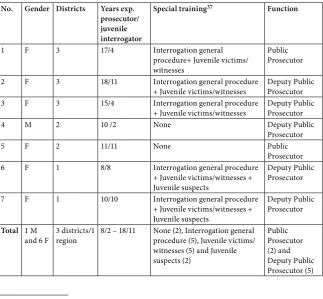
[image:22.595.144.468.398.697.2]Since it was not possible to organise a focus group with prosecutors at the national level because of time constraints, with the help of the National Association of Youth Magistrates, a focus group was held in the region of Sicily. First, the director of the Juvenile Prosecutors Division was contacted to test the possibility of organising a focus group with prosecutors from each district. Aft er informal contacts were made, a formal request was sent to the Chief Prosecutor for Juveniles, who authorised deputy prosecutors to participate. Th e same procedure was followed to ensure the participation of prosecutors operating in other Sicilian districts. Table 8 provides an overview of the prosecutors’ focus group.
Table 8. Overview of prosecutor focus group respondents, Italy
No. Gender Districts Years exp. prosecutor/ juvenile interrogator
Special training37 Function
1 F 3 17/4 Interrogation general
procedure+ Juvenile victims/ witnesses
Public Prosecutor
2 F 3 18/11 Interrogation general procedure + Juvenile victims/witnesses
Deputy Public Prosecutor 3 F 3 15/4 Interrogation general procedure
+ Juvenile victims/witnesses
Deputy Public Prosecutor
4 M 2 10 /2 None Deputy Public
Prosecutor
5 F 2 11/11 None Public
Prosecutor 6 F 1 8/8 Interrogation general procedure
+ Juvenile victims/witnesses + Juvenile suspects
Deputy Public Prosecutor
7 F 1 10/10 Interrogation general procedure + Juvenile victims/witnesses + Juvenile suspects
Deputy Public Prosecutor
Total 1 M and 6 F
3 districts/1 region
8/2 – 18/11 None (2), Interrogation general procedure (5), Juvenile victims/ witnesses (5) and Juvenile suspects (2)
Public Prosecutor (2) and Deputy Public Prosecutor (5)
In total seven prosecutors, both public prosecutors and deputy public prosecutors from three districts participated in the focus group. Th ey were mostly female and had at least two years of experience in interrogating juvenile suspects. A minority had received no training in interrogation but most had received general interrogation training as well as training in interviewing juvenile victims and witnesses.
2.2.3.3. Lawyer focus group
[image:23.595.126.457.439.626.2]Th e fi rst contact for the focus group with lawyers was made at the annual meeting of the national association of lawyers for juveniles (Unione nazionale camere minorili) in order to check the possibility of organising a focus group with lawyers coming from diff erent areas of the country. A member of the national board of the association and coordinator of its criminal area and the former coordinator from the same area were willing to support the research and brought together six lawyers. Th e focus group with lawyers was organised in mainland Italy because of travel considerations. Th e constellation of the group of six respondents was balanced according to the general selection criteria (gender, region/bar association, training). Enrolment in the duty scheme was an additional criterion, which is shown in table 9.
Table 9. Overview of lawyer focus group respondents, Italy
No. Gender Years exp. (Lawyer / juvenile lawyer)
Enrolment in the duty lawyer scheme
Special training
1 M 13/9 No Juvenile proceedings
2 M 14/13 Yes Juvenile proceedings /
Juvenile interrogations
3 M 22/17 Yes Juvenile proceedings /
Juvenile interrogations
4 F 17/12 Yes Juvenile proceedings
5 M 9/8 Yes Juvenile proceedings /
Juvenile interrogations
6 F 22/17 Yes Juvenile proceedings /
Juvenile interrogations
Total 2 F and 4 M
9/8 – 22/17 1 no / 5 yes Juvenile proceedings (2), Juvenile proceedings and interrogations (3)
2.2.3.4. Appropriate adult focus group
Th e focus group with AAs consisted of social workers. In order to receive permission, a request was put to the authority, namely the regional Centre for Juvenile Justice in Palermo. Th e Regional Centre for Juvenile Justice gave permission and sent a letter to the four offi ces, requiring them to authorise two social workers from each offi ce to take part.
[image:24.595.142.471.308.526.2]Subsequently, the directors of these four offi ces in Sicily were contacted to organise the focus group, which was attended by seven experienced AAs. Table 10 provides an overview of the respondents in the focus group with AAs.
Table 10. Overview of appropriate adult focus group respondents, Italy
No. Gender Department of Juvenile Social Services
Years exp. / Juvenile operator38
Special training39 Annual frequency of social assistance in interrogations 1 F 3 24/14 Criminal proceedings Participation in 5
interrogation /year
2 F 2 25/21 None None
3 F 2 23/13 None None
4 F 1 24/23 Criminal proceedings + Interrogations
Participation in 10 interrogation /year 5 F 1 23/14 Criminal proceedings Participation in
10–15 interrogation /year
6 F 1 29/14 Criminal proceedings+
Penal mediation
Participation in 10–13 interrogation /year
7 F 1 38/37 Criminal proceeding None actually (management role) Total 7 F 3 districts / 1
region
23/13 – 38/37
None (2), Penal Mediation (1), Interrogations (1), Criminal proceeding (5)
None (3), 5–10 (2), 10–15 (2)
AAs were all social workers from three districts in Sicily who were very experienced with a minimum of 13 years as a juvenile operator. Respondents diff ered with regard to training, ranging from no training in criminal proceedings or interrogation to training in both criminal proceedings and interrogation. Th ree respondents had no recent experience in assisting juvenile suspects in interrogations but were valuable respondents in light of their experience as a social worker.
38 Th e fi rst number is the years of experience as social worker and the second number the years
of experience as USSM operator (Department of Juvenile Justice).
39 Modalities identifi ed are: 1) Job training on assistance to juveniles in criminal proceedings
2.2.3.5. Juvenile focus group
[image:25.595.127.456.410.571.2]Th e focus group with juveniles was the most diffi cult to organise since permissions were required at the regional as well as the national level. Th e fi rst contact was with the director of the Juvenile Detention Centre in Catania, who was willing to cooperate. Th en, a formal request was submitted to the Director of this institution, which was then forwarded, with her approval, to the Head of the regional Centre for Juvenile Justice in Palermo, and to the Head of the Department of Juvenile Justice at the Ministry of Justice in Rome. All required permissions were obtained aft er providing the required explanations about the research, its goals and the fi nal outcome. Only a focus group with juvenile boys was held since there is only one juvenile detention centre left in Sicily aft er the closing down of the centre for female juveniles some months before the empirical research, due to a too low number of residents. Th e other three (out of 19) juvenile institutions in Italy which, at that time, hosted girls, also each had too limited a number of girls to organise a focus group of an acceptable size. Th e focus group was attended by eight juvenile boys. Table 11 provides an overview of characteristics of respondents in the juvenile focus group.
Table 11. Overview of juvenile focus group respondents, Italy
No. Gender No. contact with police
Crime type Previous detention in institution
No. interrogation for this event 1 M 2 Th eft and drug
dealing
No 1
2 M 1 Murder No 2
3 M 5 Drug dealing Yes 5
4 M 3 Drug dealing Yes 2
5 M 3 Robbery Yes 3
6 M 9 Attempted robbery
and burglary
Yes 1
7 M 4 Th eft and extortion Yes 10
8 M 1 Robbery No 1
Total 8 males 1 time (2), 2–5 times (4), 9 (1)
Various crime types
First detention(3), earlier detection (5)
1 time (3), 2–5 times (4), 10 times (1)
[image:25.595.127.456.413.570.2]2.2.4. Th e Netherlands
In the Netherlands a total of three focus groups were conducted. One with police offi cers, one with lawyers, and one with juveniles. No focus group with AAs was organised since the involvement of an AA is not guaranteed by statutory law and no formal scheme with professionals exists. Th e focus group with juveniles only consisted of a focus group with only boys since it was impossible for the juvenile institutions to obtain permission with girls within the time frame of the empirical research.
2.2.4.1. Police focus group
[image:26.595.142.471.516.659.2]Police offi cers were contacted through the chiefs of police and an existing contact person who is the coordinator of one of the special interrogation rooms for children. Aft er receiving the permission of the national police department responsible for research and the permission of the chiefs of police, this coordinator suggested respondents who satisfi ed the general selection criteria. Th e size of the focus group was small because, due to unforeseen circumstances, fi ve of the ten respondents had to cancel at the very last minute. Accordingly, an additional semi-structured interview was organised with an expert in interviewing juvenile victims and witnesses. Th is expert is involved in designing and providing training for the interrogation of juveniles as well as vulnerable suspects. Th e focus group was balanced based on the general selection criteria of gender, police station, experience and training as is shown in table 12. One additional criterion was added, namely special training since special training exists on interrogating juvenile victims and witnesses in the Netherlands.
Table 12. Overview of police focus group respondents, the Netherlands
No. Gender Police station
Years exp. Offi cer / interrogator
Training Function
1 F 1 4 / 4 Basic interrogation Detective in training 2 F 2 29 / 14 Questioning juvenile
victims/witnesses
Detective /
interrogator / assistant Public Prosecutor 3 M 1 37 / 25 Basic training youth Detective / supervisor
youth
4 F 3 19 / 11 Unknown Detective
5 F 3 32 / 28 VUG40 Detective
Total 4 F and 1 M
3 police stations
4 /4 – 37 / 28 Basic (3 ), VUG (1) and questioning juvenile witnesses (1)
4 detectives / 1 in training
Most respondents were female and were from three diff erent police stations. Respondents diff ered in experience with a minimum of at least four years of experience as an offi cer. At least one of the respondents had experienced special training for interrogating juvenile victims and witnesses.
2.2.4.2. Lawyer focus group
[image:27.595.128.456.413.482.2]For the focus group with lawyers, no offi cial permission was required. Recruitment of lawyers was organised through existing contacts and the website of the association of juvenile lawyers in the Netherlands.41 When inviting lawyers to participate, a balanced composition on the basis of the general selection criteria was strived for. Th e focus group with lawyers depicted a similar pattern as the one with police offi cers. Out of the seven lawyers who subscribed to the focus group, four cancelled on the day itself because of other last minute obligations. Th is resulted in a small focus group interview with three respondents consisting of one female and two male respondents from two regions who all received training to become a juvenile lawyer.
Table 13. Overview of lawyers focus group respondents, the Netherlands
No. Gender Region Years exp. (Lawyer / juvenile lawyer)
Special training
1 F 1 13 / 10 Courses juvenile law
2 M 2 11 / 9 Course juvenile criminal law
3 M 2 18 / 15 Courses juvenile law
Total 1 F and 2 M 2 regions 11 / 9 – 18 / 15 Course juvenile (criminal) law
Table 13 shows that the three respondents had at least nine years of experience as a juvenile lawyer and 11 years as a lawyer in general. Th ey came from two diff erent regions and all had experienced a course in juvenile law or juvenile criminal law.
2.2.4.3. Juvenile focus group
For the focus group with juveniles, permission was requested from the overarching governmental organisation as well as the board of the juvenile institutions who were contacted with a request to participate aft er receiving the necessary permission. Only one institution gave permission within the time frame of the project. Th e juveniles who participated in the focus group all came from one and the same unit within this institution for boys. In total four juveniles participated in the focus group in which one of the social workers of
the institution was present. Th e juveniles seemed to have a good relationship with the social worker whose presence did not seem to inhibit the responses of juveniles. An overview is provided in table 14.
Table 14. Overview of juvenile focus group respondents, the Netherlands
No. Gender Age Crime type
1 M 18 Criminal off ence
2 M 17 Street-robbery
3 M 21 Violence
4 M 19 Unknown
Total 4 M Between 17 and 21 Various off ences
Notwithstanding the fact that the focus group aimed at interviewing juveniles and respondents who were residents of a juvenile institution, respondents were in fact – with the exception of one 17 year old – young adults (18–22 years). However, it was nonetheless valuable to interview these young adults who were serving sentences which were imposed on them when they were still juveniles enabling them to speak about their experiences with the police as a juvenile. Th ey had been convicted for a range of diff erent crimes.
2.2.5. Poland
In Poland three focus groups were conducted with police offi cers, juvenile boys, and juvenile girls. Additionally, individual semi-structured interviews with two lawyers were conducted since it turned out to be impossible to organise a focus group with lawyers. Th ere is no legal rule or requirement for social workers or others to act as AAs in Poland, thus no focus group interview was held with these individuals. Interrogations are oft en conducted in the presence of a parent, guardian or teacher, but as was the case in England and Wales, it was not possible to arrange a focus group with such a disparate group of individuals who could not be contacted through any professional grouping or organisation.
2.2.5.1. Police focus group
and permission was received. Subsequently, individual police offi cers working in units for juveniles were invited according to the general selection criteria. Because police offi cers work in shift s, it was diffi cult to bring together a group. Finally, the focus group was only allowed to take place in the free time of police offi cers, which hampered recruitment. In total, four police offi cers took part in the focus group, which can be seen in table 15.
Table 15. Overview of police focus group respondents, Poland
No. Gender Police station
Years exp./ interrogator exp.
Training in interrogation
Function
1 F Kraków 5 /1,5 Basic Employed in unit for juveniles (referent) 2 M Kraków 12 / 10 Basic Employed in unit for
juveniles (specjalista) 3 M Kraków 16 / 5 Basic Th e chief of the unit for
juveniles (kierownik referatu) 4 M Kraków 8 / 5 Basic Employed in unit for
juveniles (asystent) Total 1 F and
3 M
Kraków (4) 5/1,5 up to 16/10 Basic training (4) Unit for juveniles (4)
Although all respondents were experienced in interrogating juvenile suspects, none of them had received specialised training in the interrogation of juvenile suspects or juvenile witnesses and victims. Both males and females participated and they all came from a specialised unit.
2.2.5.2. Juvenile focus group
participate in the focus group. Finally, eight juvenile boys took part, as can be seen in table 16.
Table 16. Overview of juvenile boys focus group respondents, Poland42
No. Number of events of contact with the police
Type of crime Previous detention in institution
Number of interrogations (including interrogations for other cases)
1 13–20 Truancy and diff erent punishable acts42
no 13
2 15–20 Punishable acts yes 10
3 12 Truancy and punishable acts
yes 12
4 30 Robbery no 30
5 35 Robbery, truancy and using alcohol
no 35
6 12–19 No answer no 8
7 10 Battery, burglary no 8
8 5 Truancy and punishable acts
no 4
Total 5 up to 35 Property crimes, punishable acts, truancy and alcohol.
Earlier detention (2) and fi rst detention (6)
4 up to 35
Th e juvenile boys had experience of coming into contact with the police on a number of occasions – ranging from fi ve to 35. With regard to the number of interrogations, a similar diversity was found. Most juvenile boys had been detained for the fi rst time with the exception of two boys. Additional general information was provided by the institution. First, the age of the juvenile boys, though not provided in an individualised way, ranged from 15 to 17 years. Second, the juveniles were said to be behind at school due to a variety of reasons, such as truancy and coming from dysfunctional families.
Th e focus group with girls was organised at a correctional institution for girls also situated in the southern part of Poland. A written request for permission was sent to the director of this institution. Th e researchers were aware that juvenile girls placed in institutions were almost continuously being invited to take part in research by scholars and students writing their master or PhD thesis, which obviously resulted in a high level of reluctance shown by both the girls and the administration of the institution. Th erefore, the researchers visited the institution in order to ask the director of the centre for permission
42 Punishable acts mean acts prohibited by criminal law as off ences, fi scal off ences and certain
in person and to personally invite girls to participate in the focus group. Th e necessary informed consent forms for the girls as well as their parents were sent to the director of the institution aft er receiving permission. It turned out that only one juvenile girl (aged 17) was willing to participate but seven girls aged 18 or 19 also agreed. Th e 17 year old had obtained the consent of her parent.
Table 17. Overview of juvenile girls focus group respondents, Poland
No. Number of events of contact with the police
Type of crime Previous
detention in institution
Number of interrogations
1 12 Robbery, battery, theft yes 11
2 Appr. 40 Many off ences of diff erent types yes 30
3 10 Robbery, theft no 2–3
4 30–35 Robbery yes 3
5 25 Battery, burglary yes 15
6 50 Drug off ences, robbery, burglary yes 30
7 15 Battery yes 10
8 10 Battery yes 10
Total 10 up to 40 Various crime types First detention (1), earlier detention (7)
2 up to 30
Table 17 shows that juvenile girls had several contacts with the police ranging from ten up to 50. Again, the number of interrogations varied between two up to 30. Th e type of crime for which the juvenile girls were in the institution mainly concerned robbery and assaults. All juvenile girls received a correctional measure and stayed at one of the three correctional institutions for girls in Poland. One of the legal criteria for the application of correctional measures is the fact that educational measures were found to be ineff ective. For this reason girls interviewed in the correctional institution constituted a specifi c sub-group of all juvenile girls adjudicated due to punishable acts.
2.2.5.3. Lawyer focus group – semi-structured interviews