Talk at Mealtimes
Christina Clark July 2013
This short report explores how many young people sit down with their family at mealtimes, how often they talk with their family when they do and the relationship between mealtime talk and young people’s confidence in and attitudes towards communication skills.
It shows that a vast majority of children and young people sit down with their family at mealtimes and most talk daily with their family at mealtimes. However, 1 in 4 children and young people (25.8%) don’t have a daily mealtime chat. Talking daily at mealtimes is related to higher communication confidence and more positive views about
communication skills. Interestingly, children and young people who sit down with their family at mealtimes but who never or rarely talk are less confident in their communication skills and have more negative attitudes towards communication than children and young people who do not sit down with their family at mealtimes at all.
There is a renewed focus on speaking and listening skills in primary schools from
September 2014 as part of the Government’s proposals for a revised National Curriculum. The findings in this short report show that families can play their part in giving their
children a solid foundation in speaking and listening skills by taking simple steps like chatting together at mealtimes.
_______________
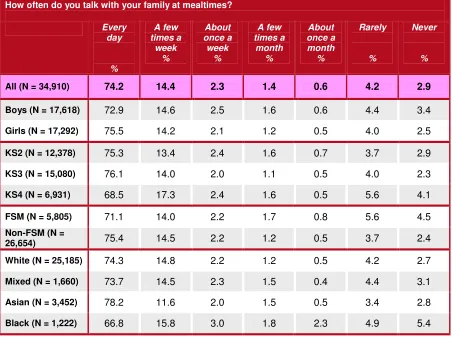
Data from our latest annual survey of 34,910 children and young people1 show that the majority of children and young people (87%) say that they sit down with their family at mealtimes; of those, 74.2% talk with their family daily when they do. However, 7.1% never or rarely talk with their family when having their meals.
than young people who do (83.5%). Fewer young people from Black ethnic backgrounds (79.3%) say that they sit down with their family at mealtimes compared with young people from White (87.3%), Mixed (85.5%) or Asian (89.8%) ethnic backgrounds.
Not only are KS4 pupils less likely to say that they sit down with their family at mealtimes but if they do they are also less likely than KS2 or KS3 pupils to talk with their family daily at the dinner table (see Table 1). Indeed, nearly 1 in 10 14 to 16-year-olds says that they rarely or never talk with their family at mealtimes.
Similarly, not only are pupils who receive free school meals less likely to say that they sit down with their family at mealtimes but they are also less likely to then talk with them on a daily basis at the table than are pupils who do not receive free meals (71.1% vs 75.4%). Indeed, pupils who receive free school meals are nearly twice as likely to say that they rarely or never talk with their family at mealtimes than are pupils who do not receive free schools meals (10.1% vs. 6.1%).
Finally, not only are children and young people from Black ethnic backgrounds least likely to say that they sit down with their family at mealtimes but when they do they are also less likely to say that they talk with their family on a daily basis (66.8%) compared with children and young people from White (74.3%), Mixed (73.7%) and Asian (78.2%) ethnic
[image:2.595.80.532.385.722.2]backgrounds.
Table 1: Frequency of mealtime talk in 2012 for whole sample and broken down by demographic background
How often do you talk with your family at mealtimes?
Every day
%
A few times a
week %
About once a week
%
A few times a
month %
About once a month
%
Rarely
%
Never
%
All (N = 34,910) 74.2 14.4 2.3 1.4 0.6 4.2 2.9
Boys (N = 17,618) 72.9 14.6 2.5 1.6 0.6 4.4 3.4
Girls (N = 17,292) 75.5 14.2 2.1 1.2 0.5 4.0 2.5
KS2 (N = 12,378) 75.3 13.4 2.4 1.6 0.7 3.7 2.9
KS3 (N = 15,080) 76.1 14.0 2.0 1.1 0.5 4.0 2.3
KS4 (N = 6,931) 68.5 17.3 2.4 1.6 0.5 5.6 4.1
FSM (N = 5,805) 71.1 14.0 2.2 1.7 0.8 5.6 4.5
Non-FSM (N =
26,654) 75.4 14.5 2.2 1.2 0.5 3.7 2.4 White (N = 25,185) 74.3 14.8 2.2 1.2 0.5 4.2 2.7
Mixed (N = 1,660) 73.7 14.5 2.3 1.5 0.4 4.4 3.1
Asian (N = 3,452) 78.2 11.6 2.0 1.5 0.5 3.4 2.8
Linking frequency of talk at mealtimes with wider communication
Previous research has shown that mealtimes are good for young people’s mental health2. So, what, if any, is the relationship between mealtime talk, communication confidence and attitudes towards communication skills?
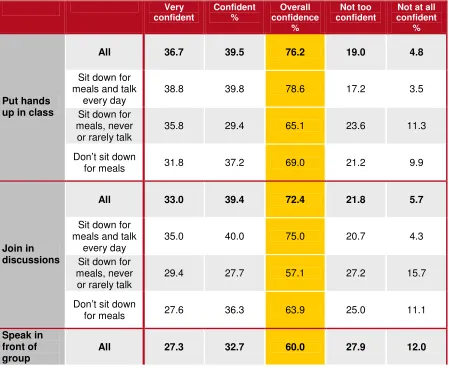
[image:3.595.78.533.343.729.2]When we look at children and young people who sit down and talk daily with their family compared with those who sit together but rarely or never talk, those who talk daily are more confident in their communication skills (see Table 2). For example, while 75% of children and young people who sit down at mealtimes and talk daily with their family at the table feel confident to join in class discussions, only 57% of young people who sit together but never or rarely talk feel similarly confident. Similarly, while 62.5% of those who sit down at mealtimes and talk daily at the table feel confident to speak in front of their class, the figure is just 47.3% among those who sit together but rarely or never talk.
Interestingly, our data also show that those children and young people who sit with their family in silence at mealtimes are slightly worse off in terms of their confidence and attitudes than young people who don’t sit with their family for meals at all.
Table 2: Levels of confidence for sample as a whole and by whether or not they sit down with their family at mealtimes and how frequently they talk at the dinner table
Very confident
Confident %
Overall confidence
%
Not too confident
Not at all confident
%
All 36.7 39.5 76.2 19.0 4.8
Sit down for meals and talk
every day
38.8 39.8 78.6 17.2 3.5
Sit down for meals, never
or rarely talk
35.8 29.4 65.1 23.6 11.3
Put hands up in class
Don’t sit down
for meals 31.8 37.2 69.0 21.2 9.9
All 33.0 39.4 72.4 21.8 5.7
Sit down for meals and talk
every day
35.0 40.0 75.0 20.7 4.3
Sit down for meals, never
or rarely talk
29.4 27.7 57.1 27.2 15.7
Join in discussions
Don’t sit down
for meals 27.6 36.3 63.9 25.0 11.1
Speak in front of group
All 27.3 32.7 60.0 27.9 12.0
[image:3.595.83.532.350.726.2]Very confident
Confident %
Overall confidence
%
Not too confident
Not at all confident
%
Sit down for meals and talk
every day
28.9 33.6 62.5 27.5 10.1
Sit down for meals, never
or rarely talk
26.3 21.1 47.3 29.3 23.4
Don’t sit down
for meals 23.6 28.6 52.2 28.7 19.1
All 45.7 41.8 87.5 9.6 2.9
Sit down for meals and talk
every day
48.1 41.4 87.5 8.6 1.9
Sit down for meals, never
or rarely talk
41.4 34.6 76.0 15.5 8.5
Work in a team
Don’t sit down
for meals 40.0 40.2 80.2 12.9 6.9
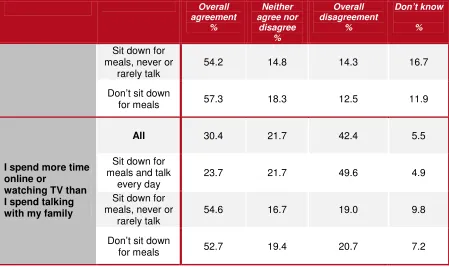
Children and young people who sit down and talk with their family daily at mealtimes also tend to hold more positive attitudes towards communication skills compared with those who sit together but never or rarely talk (see Table 3). For example, while 81.3% of young people who sit down with their family and talk daily with them at mealtimes agree overall that good communication skills are the most important skills to have, only 66% of young people who do not talk with their family at mealtimes agree. Similarly, while nearly 80% of young people who talk daily with their family at meal times agree that good
communication skills give them more confidence in social situations, only 63% of young people who rarely or never talk with their family at meal times agree. Even though most young people, regardless of their mealtime routine, agree that good communication skills will make it more likely that they find a good job, young people who talk daily with their family at mealtimes are more likely to agree with it than young people who rarely or never talk with their family at the dinner table.
[image:4.595.79.530.71.364.2]As already noted with respect to confidence, those children and young people who sit down with their family at mealtimes but who rarely or never talk are again slightly worse off in terms of their attitudes than young people who don’t sit down with their family for meals at all.
Table 3: Levels of agreement with communication skills statements for sample as a whole and by whether or not they sit down with their family at mealtimes and how frequently they talk at the dinner table
Overall agreement
%
Neither agree nor
disagree %
Overall disagreement
%
Don’t know %
Good
communication skills are some of the most
Overall agreement
%
Neither agree nor
disagree %
Overall disagreement
%
Don’t know %
Sit down for meals and talk
every day
81.3 11.3 2.6 4.9
Sit down for meals, never or
rarely talk
66.0 14.5 7.4 12.1
Don’t sit down
for meals 71.7 13.4 5.6 9.3
All 76.8 12.2 3.2 5.8
Sit down for meals and talk
every day
79.4 11.1 3.0 6.5
Sit down for meals, never or
rarely talk
63.1 14.7 7.9 14.4
Good
communication skills give me more confidence in social
situations
Don’t sit down
for meals 68.9 14.3 6.9 10.9
All 86.1 7.5 2.1 4.3
Sit down for meals and talk
every day
88.2 6.6 1.6 3.5
Sit down for meals, never or
rarely talk
75.8 8.8 5.2 10.2
Good
communication skills are
important to get a job
Don’t sit down
for meals 78.8 10.4 3.6 7.2
All 58.4 21.7 5.6 14.2
Sit down for meals and talk
every day
59.4 21.3 5.4 13.5
Sit down for meals, never or
rarely talk
53.8 18.4 7.2 20.5
People often take good
communication skills for granted
Don’t sit down
for meals 55.1 21.8 6.2 16.8
All 54.3 21.8 13.7 10.2
People judge you by the words and phrases you use
Sit down for meals and talk
every day
Overall agreement
%
Neither agree nor
disagree %
Overall disagreement
%
Don’t know %
Sit down for meals, never or
rarely talk
54.2 14.8 14.3 16.7
Don’t sit down
for meals 57.3 18.3 12.5 11.9
All 30.4 21.7 42.4 5.5
Sit down for meals and talk
every day
23.7 21.7 49.6 4.9
Sit down for meals, never or
rarely talk
54.6 16.7 19.0 9.8
I spend more time online or
watching TV than I spend talking with my family
Don’t sit down
for meals 52.7 19.4 20.7 7.2
[image:6.595.81.530.71.338.2]When asked what the most important skill is to succeed in life, ICT is considered to be twice as important by young people who do not sit down with their family at mealtimes and those who rarely or never talk with their family when having meals compared with those who talk daily with their family at the dinner table (see Figure 1). Compared with the other two groups, fewer young people who rarely or never speak with their family at mealtimes believe that speaking is the most important skill, while fewer young people who do not sit down with their family at all at mealtimes believe that the most important skill to succeed in life is listening.
Figure 1: Most important skill to succeed in life by sample as a whole and whether or not children and young people sit down with their family at mealtimes and how often they talk with their family at mealtimes.
11.2%
9.4%
32.8%
20.6%
18.8%
7.2%
11.6%
9.3%
33.8%
21.5%
18.0%
5.8%
10.9%
11.0%
21.6%
21.0%
22.3%
13.3% 9.7%
9.4%
32.2%
16.8%
21.0%
11.0% Reading
Writing
Speaking
Listening
Maths
ICT