Abstract - For a stable flight, it is required adequate
stability of the aircraft to have good conditions of navigability. The wing dihedral angle, the format, the position and the amount of wings are factors affecting the lateral stability of any aircraft (small or large). The purpose of this paper is study the applicability of dihedral wings in aircrafts, simulating the applications in a small aircraft. Thus, through theoretical analysis, we can observe the use of dihedral angle implies some viability and it is going to bring significant improvement in performance and stability of the aircraft during the flight. The parameters used in this study were based on the project of a cargo radio controlled aircraft designed by Urutau Aerodesign, Research and Competition team, to the SAE Brazil Aerodesign Competition in which engineering students must design a robust and light cargo radio controlled aircraft.
Index Terms: dihedral, static stability, AeroDesign,
navigability.
I. INTRODUCTION
ITH the goal of clarifying the importance of studying and understanding the stability area, the key issues 1 Part of the results presented in this paper were obtained via the project for
research and human resources qualification, under- and-undergraduate levels, in the areas of aerodynamics, stability and control, aeronautics and aerodesign,.This research was part of The Program of Scientific Initiation (PAIC) supported by FAPEAM 26982/2014 grants.
E.R.S. Teixeira is studying Mechanical Engineering and is member of Urutau Aerodesign R&D Center at University of State of Amazonas, Manaus, Amazonas, Brazil (e-mail: [email protected]).
B.H.F. Yokota is studying Mechanical Engineering and is member of Urutau Aerodesign R&D Center at University of State of Amazonas, Manaus, Amazonas, Brazil (e-mail: [email protected]).
D. Ferreira Neto is studying Automation and Control Engineering and is member of Urutau Aerodesign R&D Center at University of State of Amazonas, Manaus, Amazonas, Brazil (e-mail: [email protected]).
P.A.M. Pimentel is studying Electrical Engineering and is member of Urutau Aerodesign R&D Center at University of State of Amazonas, Manaus, Amazonas, Brazil (e-mail: [email protected]).
S.P.S. Santos is studying Electrical Engineering and is member of Urutau Aerodesign R&D Center at University of State of Amazonas, Manaus, Amazonas, Brazil (e-mail: [email protected]).
L.B. Santos is studying Mechanical Engineering and is member of Urutau Aerodesign R&D Center at University of State of Amazonas, Manaus, Amazonas, Brazil (e-mail: [email protected]).
A.C. Kieling is Doctor in Business Administration and coordinator of Urutau Aerodesign R&D Center at University of State of Amazonas, Manaus, Amazonas, Brazil (e-mail: [email protected]).
about and understanding the stability area, the main issues about stability during the process of preparing of the design of a small aircraft will be discussed. Its applicability will also be explained by relating the study of stability with the construction of an airplane model intended to participate in the SAE Brazil Aerodesign Competition.
In large or small aircrafts, the study of stability is essential for the proper functioning of it. According to Anderson Jr. [1], even if a plane is designed carefully to have the aerodynamic and structural needs, it could ensure the takeoff of the plane, but not the continuity of its flight to be disturbed in its journey.
Then it would be responsibility of the stability area to ensure the aircraft to withstand these disorders and maintain a safe and stable flight.
So is necessary to concern about this part of the development, the elements need to be in full combination so it is certain that the aircraft has the capability to return to its initial position after a disturbance during flight. And, in the case of the elements that help to improve the stability of the aircraft, it is possible to obtain the dihedral angle for the wings, which is defined as the spanwise inclination of the wing with respect to the horizontal [1].
Because of the wind against the side of the aircraft, the distribution of stability in the both halves of the wings becomes different. The dihedral is used exactly for these principles. These are curved wings and can have a positive angle (curved up) or negative (curved down). Typically, they use positive dihedral wings, but the negative dihedral applicant has also been applied, especially in high wings as is mentioned in Rodrigues [2] work.
The stability in aircrafts with positive dihedral comes from the difference in root angle of attack and the tip of the wings, in a riot situation. Thus, while the highest part suffers loss of support, the lower part of increases the lift, leading to levels that rolling motion of the wings. In negative dihedral, the difference causes an increase in the scroll that does not help to make the plane stable to lower wings, however improves manoeuvrability as Rodrigues [2] explains.
II. STABILITY CONCEPT
Stability is the tendency of an airplane to return to a previous condition if upset by a disturbance such as a gust of air or turbulence as Anderson Jr. [3] shows in his work. In the case of concepts related to an aircraft, these interruptions are based on gusts of wind or some kind of change caused by the
Erika R. S. Teixeira, Beatrice Harumy de F. Yokota, Dilermando Ferreira Neto, Paulo André M.
Pimentel, Sahmira Paula Santos dos Santos, Luciana Barbosa dos Santos, Antônio Claudio Kieling
The Study and Analysis of Using Wing
Dihedral on the Side of an Aircraft’s Static
Stability
airplane's commands. The stability of an aircraft is directly related to its freedom to perform more complex movements, since there are two parameters inversely proportional to each other. When the stability is high, will be diminished the ability of the aircraft to perform manoeuvres.
A. Static Stability
According to Rodrigues [2], the aircraft itself is subject to two types of stability, they are: static and dynamic. The static stability boils down to the ability of the aircraft to return to its equilibrium point after suffering a disorder, but for this to happen it is necessary that forces act on it. On the other hand, the dynamic stability is related to the time that the aircraft back to its equilibrium after suffering a disorder. If it comes back after some time and remain on the starting point, it will be considered a dynamically stable body. If this aircraft starts to oscillate and does not return to its starting point, it is said that is dynamically unstable.
There are several elements that influence in the stability of an aircraft such as the fuselage, swept wings and emphasis on the centre of gravity (CG), which needs carefully and detailed algebraic calculations to be found its position in the model airplane [4].
[image:2.595.65.283.385.524.2]
Fig. 1. The conditions which the aircraft is subject: stable, unstable and indifferent.
Also the criteria for lateral stability are employed dimensionless coefficients which evaluate the variation in the lift coefficient (Cl) around the longitudinal axis of the aircraft as a function of inclination angle (β) of the wings caused by disturbance suffered [2]. For an aircraft is considered to be laterally stable it is necessary that the angular coefficient of the curve (lateral moment) as a function of the inclination angle of the wings may be slightly negative, so it follows that:
‹ 0 (1)
The lateral stability of the airplane (Fig. 1) is mainly achieved by the design of the wings forming an angle, called the dihedral angle. This angle is formed when the tips of the wings are on a higher plane than the part anchored to the
fuselage. Pamadi [5] wrote that wing with dihedral angle has a stabilizing effect on the aircraft. The lower wing will encounter a relative airflow to a greater angle of attack, producing an increase in lift, while the wing has a higher reduction of its support generating a roll moment. This moment makes that the plane has its wings levelled to return to its original position.
In order to calculate the lift coefficient with angle β (Clβ) according to Pamadi [5], is necessary to use the following formula:
Clβ = ⁄ 0(y)y dy (2)
However, for a rectangular wing, in the case of the aircraft studied, with constant mean chord C and a constant aerofoil profile, simplifying the above formula results:
(3)
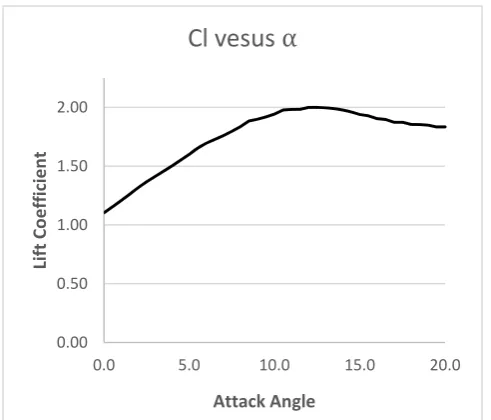
Where Γ is the given dihedral angle of the wing and is the coefficient of the curve Cl x α (shown in the Graph 1).
III. AIRCRAFT’S STRUCTURE
The structure of the aircraft, being large or medium, civil or military, requires detailed choice of all critical components. For each purpose, structural and dimensional characteristics have great significance for the aircraft’s design. During the design of an aircraft, every square of the wing, fuselage and even each joint should be considered in relation to the physical characteristics of the material from which it is made. All parts of the aircraft must be designed to withstand the loads that will be imposed [2].
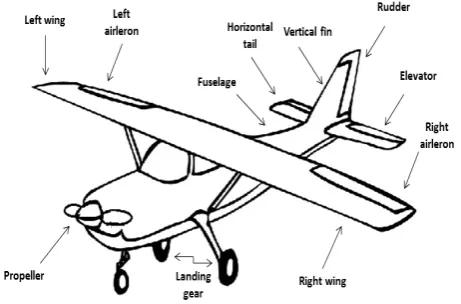
Fig. 2. Structural components of a small aircraft
[image:2.595.308.539.507.659.2]this, these components are constantly studied in order to achieve even more thorough knowledge of these factors and improvement in efficiency and structural safety.
The wings may have different configurations depending on the function that the aircraft will play, and may vary in format (rectangular, trapezoidal, etc.), swept wing (negative or positive), aerofoil profile and even on the amount of wings used ( biplanes or multiplanes aircraft).
IV. DIHEDRAL
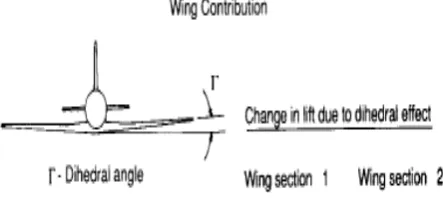
[image:3.595.54.276.294.393.2]One of the main factors that aid in lateral stability is the dihedral angle. Is defined as dihedral the angle between the plane of the wing and the transverse or lateral axis of the aircraft. It is classified as positive when the wing tips are directed upward, or negative, when they are directed down.
Fig. 3. Representation of dihedral angle
On the basis of the dihedral angle allows, after a gust of wind that lowers one wing, this will be submitted to the action of air at a higher angle of attack, increasing its lift as the wing in place more have a high loss of support, generating a scrolling movement which enables the levelling of the wings and therefore its lateral stability [6].
The characteristics mentioned above may be seen more often low-wing aircrafts with positive dihedral and medium settings. The negative dihedral is not recommended for low-wing aircrafts, as these are already unstable, and then this would further undermine the flight, causing the loss of lateral stability of the aircraft. In high-wing aircrafts, in turn, usually dihedral is not required, but if the aircraft is too stable, the negative dihedral can help counteract this phenomenon.
With respect to the negative dihedral configuration states that when the arrangement of forces is inverted, and when the plane suffers a disturbance, the force generates a torque which increases the scrolling, making unstable plane, but rolls easily [7].
In fact, at first people may not understand the reasons to add instability to an aircraft project. However, for example, in aircrafts construction that requires agility and good mobility, as warplanes or specific model aircraft to manoeuvres, it is observed that its application is very useful. In addition, there are cargo aircrafts, such as Antonov AN-225 that also use negative dihedral, in order to balance the high level of stability in its present configuration that degrees instability of the dihedral, allowing sufficient manoeuvrability so the pilot has no major difficulties in controlling it.
Moreover, there should be careful to determine the dihedral angle, since the ability to control and manoeuvre the airplane requires certain degree of instability in the aircraft. If the dihedral angle is small, the airplane may not resist to disturbances during the trip and the wings will not be able to keep level. In contrast, a very high angle of the wings increases the tendency to remain capped, making it difficult for the pilot to perform manoeuvres that require this gap. In short, "if the dihedral is little, there is not enough self-level, and much, steering effort increases too much, compromising manoeuvrability." [8].
V. DIHEDRAL EFFECT AND SWEPT WINGS Dihedral effect is the amount of roll moment produced per degree (or radian) of sideship. The magnitude of dihedral effect contributed by vertical position of the wing is large and may necessitate a noticeable dihedral angle for the low wing configuration [9].
According to Silva [10], positive swept wings also contribute to the lateral stability of the aircraft. When the plane is glissando, which means that it is smoothly going from one height to another, the lowest semi-wing gets a higher normal speed in its leading edge which generates more lift. The support of asymmetry in swept wing positively produces a stabilizing moment.
Since lateral stability (dihedral effect) increases with both the sweep angle and the coefficient of lift, there will be variations in aileron effectiveness depending on the flight regime. During those periods when a swept wing is generating a very large coefficient of lift, roll response may be below acceptable levels. It is therefore imperative to have large ailerons which can produce sufficient power at minimal deflection angles [11].
VI. RESULTS
The results were calculated based in a cargo radio controlled aircraft designed by Urutau Aerodesign, team of research and competition. The basic configuration of this aircraft is: rectangular and high wing with 2 meters of wingspan [12] There was used a hypothetico-deductive method, which involves the traditional steps of observing the subject, in order to elaborate upon an area of study and it allows the generation of a testable and realistic hypothesis [13].
There was chosen a small sample to calculate the results, based on statistical analysis, to answer questions of this research. Thereafter, a calculation strategy was developed to meet the required variables and thus prove the studied concepts described in the theoretical foundation.
A. Variation of dihedral
Fig. 4: lift coefficient by the angle of attack for the wing profile Eppler423
Fig. 5: angular coefficient of the curve versus the Cl to the Eppler 423 wing profile
[image:4.595.44.290.93.303.2]The Fig. 5 was generated combining small positive and negative angular coefficients. The variation chosen was from -0,12 to +0,12. The variation chosen for the attack angle was from zero to 20. This graph was used to generate the Table 1.
Using equation (2) simplified to calculate the static lateral stability coefficient, [5], it was possible to develop series of tests to verify the variation of the dihedral.
Table I was presented according to report the Urutau aircraft’s, which uses rectangular wing and constant profile.
To increase the accuracy of the study, the dihedral angle was calculated from maximum 90 degrees to minimum of -90 degrees and increments of 0.5 degrees. This feature allowed us to calculate the static lateral stability coefficient for 360 dihedral angles in absolute numbers. For each of these angles, was calculated the coefficient of static lateral stability
for all angular coefficient of the graph curve Cl x a, thus totalling 7200 samples calculated.
The samples from the table below refer to the angles of 1, 0.5, 0, -0.5 and -1 degree. Chosen in this way they present the main point of change that runs between the possible forms of stability (positive, negative) as varying the dihedral and the angular coefficient. The results in Table I show that the higher the dihedral angle of the wing, the greater the coefficient of static lateral stability. To a dihedral angle equal to zero the coefficient becomes zero for any value of the angular coefficient of the curve Cl versus alpha, resulting neutral lateral stability. Finally, for negative values of the dihedral angle stability coefficients tend to increase stability by making the negative dihedral angle decreases.
Table I: Statement of static lateral stability coefficient, and the slope dihedral
a (Angular Coefficie
nt)
Cl x Beta 1°
Cl x Beta 0,5°
Cl x Bet
a 0
Cl x Beta -0,5°
Cl x Beta -1°
0,1000 -0,0250 -0,0125 0 0,0125 0,0250 0,1094 -0,0274 -0,0137 0 0,0137 0,0274 0,0998 -0,0250 -0,0125 0 0,0125 0,0250 0,0905 -0,0226 -0,0113 0 0,0113 0,0226 0,0976 -0,0244 -0,0122 0 0,0122 0,0244 0,0840 -0,0210 -0,0105 0 0,0105 0,0210 0,0642 -0,0161 -0,0080 0 0,0080 0,0161 0,0778 -0,0195 -0,0097 0 0,0097 0,0195 0,0308 -0,0077 -0,0039 0 0,0039 0,0077 0,0480 -0,0120 -0,0060 0 0,0060 0,0120 0,0112 -0,0028 -0,0014 0 0,0014 0,0028 0,0336 -0,0084 -0,0042 0 0,0042 0,0084 -0,0104 0,0026 0,0013 0 -0,0013 -0,0026 -0,0258 0,0065 0,0032 0 -0,0032 -0,0065 -0,0430 0,0108 0,0054 0 -0,0054 -0,0108 -0,0472 0,0118 0,0059 0 -0,0059 -0,0118 -0,0474 0,0119 0,0059 0 -0,0059 -0,0119 -0,0370 0,0093 0,0046 0 -0,0046 -0,0093 -0,0102 0,0026 0,0013 0 -0,0013 -0,0026 0,0006 -0,0002 -0,0001 0 0,0001 0,0002 0.00
0.50 1.00 1.50 2.00
0.0 5.0 10.0 15.0 20.0
Lift
Coefficient
Attack Angle
Cl
vesus
α
‐0.1200
‐0.0700
‐0.0200 0.0300 0.0800 0.1300
0.0 5.0 10.0 15.0 20.0
An
gular
Coefficient
Attack Angle
Angular
Coefficient
of
the
Curve
[image:4.595.306.548.275.753.2] [image:4.595.44.289.346.535.2]
However, this behaviour is valid for a maximum angular coefficient:
0,0336 (4)
This value represents a maximum angle of attack:
12° (5)
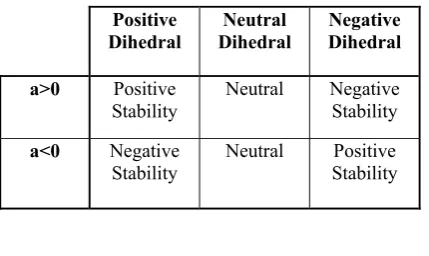
For larger angles of attack, angular coefficients of the curve Cl versus alpha become negative, as can be seen in Table I. Because of this feature, the lateral static stability coefficients change. Therefore, in positive dihedral angles is seen the emergence of a small positive coefficient of stability, which makes unstable aircraft which becomes larger as the coefficient a increases. In negative dihedral angles, there is proportional increase stability as increase the angular coefficient of the curve Cl versus alpha.
So the main variable that defines the way that stability will take is the angular coefficient (a) of the curve Cl versus alpha, as in the Table II:
Table II: Variation of stability as variation of the angular coefficient of the curve Cl versus alpha
VII. CONCLUSION
The analysis of results allows approaching the dihedral angle for an optimal configuration for the studied aircraft. There are three possible settings for the dihedral angle, they are: positive dihedral, neutral and negative dihedral.
So in the case of choosing a positive dihedral angle, there will be an increase in the absolute stability of the aircraft. This is because the value of the static lateral stability coefficient is negative, even if close to zero. High values of dihedral angle make this rate even lower, improving the lateral stability; however, very high values of stability may hinder the ability of the aircraft to make simple manoeuvres. Through the calculation, it was found that there is an angular coefficient of the curve of Cl versus alpha reversing the type of aircrafts stability. This change makes the value of the static lateral
stability index slightly positive, so there is a loss of stability for very high angles of attack.
Likewise, the difficulty of building a high-wing structure with dihedral angle increases according to the dihedral defined increases.
The analysis and influence of using a negative dihedral angle is analogous to that made to the positive dihedral angle, but in reverse. A null dihedral angle makes the static lateral stability coefficient neutral, generating a neutral stability.
Therefore, the best configuration for the dihedral angle of the aircraft studied, with a view to improving the stability index, a slightly positive value must be chosen taking into account the aircraft construction method to avoid compromising its physical structure.
REFERENCES
[1] NELSON, Robert C. Flight Stability and Automatic Control. McGraw-Hill Book Company.
[2] RODRIGUES, Luiz Eduardo Miranda. J. “Fundamentos da Engenharia Aeronáutica – Aplicações ao Projeto SAE-AeroDesign”. Volume Único, Instituto Federal de Educação, Ciência e Tecnologia de São Paulo, São Paulo, 2011.
[3] ANDERSON JR. John D. “Fundamentos de Engenharia Aeronáutica”. 7 ed. McGraw Hill Brasil, 2015.
[4] PABLO, Diego. Estabilidade Longitudinal, Lateral e Direcional, Aeroclube de Brasília.
[5] PAMADI, Bandu N. “Performance, Stability, Dynamics, and Control of Airplanes”. 2 ed. (AIAA Education), 2014.
[6] SAMPAIO, Ronivaldo Passos. Sistema de controle de atitude embarcado para voo autônomo de aviões em escala. 2006. 186 f. Dissertação (Mestrado em Mecatrônica). Escola Politécnica e instituto de matemática - Universidade Federal da Bahia, Salvador. [7] DANTAS, André. “A inteligência das máquinas –
terceira parte”, 2014.
[8] BERTOLINI, Gary, E-Study Guide for: Technical Graphics Communication, Just the Facts 101, Textbook Reviews, Google e-Book, 4th edition, 2012.
[9] HURT JR, Hugh H. Aerodynamics for Naval Aviators, University of Southern California, Federal Aviation Administration, Regulation Policies, consulted in 2015. [10] SILVA, Ramón Eduardo Pereira, Teoria de Voo,
Universidade de Taubaté, 2013.
[11] KUHLMAN, Bill, KUHLMAN Bunny. Swept Wings and Effective Dihedral. RC Soaring Digest, 2000. [12] ANDERSON, David. Understanding Flight, 2 ed [13] SHUTTLEWORTH, Martyn. Hypothetico-deductive
method. Available in: <
https://explorable.com/hypothetico-deductive-method >. Access 10/04/2015.
[14] TEIXEIRA, E. R. S. Relatório da Equipe Urutau Aerodesign, Competição de Aerodesign da SAE Brasil, 2014.
Positive Dihedral
Neutral Dihedral
Negative Dihedral
a>0 Positive Stability
Neutral Negative Stability
a<0 Negative
[image:5.595.42.257.432.560.2]