Development of a Motorized Yam Pounding
Machine Design to Improve Standard of Living for
Sustainable Economic Development in Nigeria
Gbasouzor Austin Ikechukwu, Member IAENG, Mbunwe Josephine Muncho, Member IAENG
Abstract- The aim of this research work is based on the design and development of a motorized yam pounder for pounding yam, this research was considered because of the importance of pounded yam in Africa particularly in Nigeria and because of the time and energy wasted using the traditional mortar and pestle method of yam pounding. The research work aimed at eliminating the labour involved in traditional method of pounding. Through this improvement the possibility of food contamination by sweating while pounding will be control. This project work sought to design a yam pounder that pounds yam right from the peeled cooked stage in a pounding bowl with the help of an electric motor that transmits power through rotary motion together with the help of shaft. The pounding blades functions as the pestle.
The machine is to be operated by electricity and it consists of shaft, electric motor, yam beaters or pounding blades, bowl and the frame. Low cost materials were used so as to make the machine affordable for average Nigerian homes, thereby improving the standard of living. In order to avoid food contamination stainless material were also incorporated for smooth and clean pounding before consumption.
Key words: Contamination, stainless material, Eliminating, Mortar, Peeled, Pestle, Pounder, Rotary motion
I. INTRODUCTION
Yam is another crop cultivated across Nigeria. It is a seasonal crop and very difficult to preserve as it tends to rot. Nearly all Nigerians consume yam on regular basis and in large quantities particularity the Yoruba tribe in Nigeria. Nature allows yam to form a bond when it is pounded or beaten in a mortar, it is then consumed as a meal with a choice soup. Pounded yam is a staple food consumed by all. The indigenous process of pounding yam is very laborious. It requires physical pounding by one or more people depending on the quantity in the mortar.
In a bid to reduce the labor involved in yam pounding came the manufacturing of Habert mixer, the Kenwood mixer and Hammer mill in early 1975. These intended yam pounders failed due to some limitations in their operational functions. The Habert and Kenwood mixers had almost the same operational principle and they had been identified for poor pounding due to the flapping (moving up and down) of their stirrer or mixer which is keyed to the electric rotating shaft. In addition to the poor pounding of both pounders, the Habert mixer was found to heat excessively and as a result, the machine has to be stopped intermittently for cooling purpose
Gbasouzor Austin Ikechukwu is a PhD researcher and Lecturer in the Department of Mechanical Engineering, Anambra State University, P. M. B. 02 Uli. Nigeria, E-mail: [email protected] Phone: +234803427458.
Mbunwe Josephine Muncho is a Lecturer in the Department of Electrical Engineering, University of Nigeria Nsukka Nigeria, E-mail [email protected]
This cooling time takes up to ten minutes and this makes the machine inefficient since the pounding temperature has to be constant throughout the pounding process in order to obtain a fine textured pounded yam.
A. Background
It should be noted that the method employed in preparing food determines in the long run its level of acceptance by the people. For example, our European counterparts have difficulties in accepting our local food simply because they consider the method of preparation to be cruel and unhygienic. Secondly, women liberation and involvement in the work force has completely displaced the concept of full time housewife thereby making it imperative for a mechanized and modernized method of food preparation; hence, this present study and research.
B. Aims and Objectives
Yam is cooked and pounded to ensure easy swallowing and digestion, hence the purpose of this study and the design of this project. This design is aimed at replacing the old, laborious, and cruel method of pounding yam to a more hygienic and mechanized means. This does not only reduce the labor involved in pounding yam but also reduces the time of pounding and ensures cleanliness, efficiency and safety. Many engineers are developing the fabrication of this machine and different operational principle has been employed. While some are employing complex design, others are using very expensive material thereby making the finished product expensive for avenge home. That is to say, that in this research, we consider seriously one of the major factors in selection of materials (cost) thereby employing low cost materials without compromising standard, reliability, safety and durability.
Another purpose for the design was to eliminate the noise and vibrations associated with the traditional method of pounding (pounding with mortar and pestle)
C. Scope of Research
The design and fabrication is considered with only a working model (prototype) commercialization and market feed back is not inclusive in the study. Problem definition is covered in order to realize the purpose of the research. Literature review of past work on this research work was also examined in order to understand the areas that need improvement.
D. Limitations
One of the outstanding limitations of this work is its inability to pound all varieties of yam. It can only pound two varieties namely:
white yam (Discorea rotandata)
There is also the problem of finance, time and voltage problem. The machine can only pound yam for maximum of six [persons and the yam to be pounded must be sliced cooked until it becomes soft.
II. ECONOMIC IMPORTANCE OF YAM POUNDING MACHINE
Yam (Dioscorea spp) is common throughout the world tropical areas; they are staple food throughout Africa but are particularly important in West Africa where they are used as fufu and other fufu-like staples, the Yorubas further process yam into flour for “elubo” (Local yam flour) this flour is highly cherished especially in Ekiti, Ondo, Oyo and Ogun State of Nigeria. Dioscorea rotundata is usually preferred to other species for mass flour production which may be due to its moisture content being lower than others and better colour of the flour after processing. Oleniyi 1973 and Onyekere, 1987.
They come in different varieties - the white yam (dioscorea rotundata), yellow yam (dioscorea cayenesis), water yam (dioscorea alata), Chinese yam (dioscorea esculenta), sweet yam (dioscorea batatas) African bitter yam (dioscorea dunetorum) aerial yam (dioscorea bulbifera) Onwueme, 1978, and Asiedu 1992.e.t.c.
The yam most cultivated in Africa is believed to have come from Asia, Latin America in the first century A.D. It is also believed that the name yam was given by an African slave on North America who used the West African word (nana) which later became yam in English. Although there is a controversy as to whether yam is a monocotyledonous plant or not, it is still classified as a monocot crop.
Yam is a seasonal crop and at present a very difficult to preserve as it tends to rot. It is consumed by both the middle and upper class and nearly all Nigerians consume it on a large scale during harvest season. It can be prepared in many ways for consumption, but the commonest way of preparing it is to pound it into a sticky lump free mesh and after that it can be eaten with soup.
In Africa, the pounding is done traditionally with a wooden mortar and pestle. The mortar is designed in a cuplike shape. The yam is put inside the mortar and then pounded with the pestle.
But yam pounding with mortar and pestle is laborious process and pounding generate a lot of sweat and noise and not all the sweat escapes the food therefore making it to be unhygienic method of pounding. Because of the noise and vibration too, most city dwellers find it inconveniencing to pound yam in their residence because of the noise pollution it causes in the neighborhood.
Furthermore, in most part of Asia, pounding is done with stone and the yam is rolled with a wooden roller on a flat stone until a sticky mesh is obtained. This method is also laborious and unhygienic method of pounding.
In some parts of east and West Africa., yam is pounded by beating and stirring the already boiled yam with a wooden spoon until it is completely smooth. This also is laborious process and might take time unnecessarily as it will need one person to hold the bowl and one person to stir. The pounded yam is shaped into balls known as fufu and served with a choice soup.
However, over the years, the idea of mechanical engineers has been to design a modern or mechanized yam pounder, but this idea suffered a lot of setbacks, basically because of the cultural significance attached to yam. Yam was seen as the king of crops in Africa and it stood for manliness. One who could feed his family on yam from one harvest season to another was considered to be a very great man.
Another setback was that many housewives saw the yam pounding machine as a western culture innovation, accepted that their husbands preferred the traditional way of pounding.
Also, the advert of Cadbury dried yam product popularly called poundo which did not require pounding with mortar and pestle gained much patronage though the fufu made from poundo was not as fresh as pounded yam and it used to be brownish in color.
Yam provides a more sustained form of energy and gives better protection against obesity and diabetes. Traditional ceremonies still accompany yam production, indicating the high status given to it.
In order to facilitate the processing of yam for consumption, a yam pounding machine was designed and developed to hygienically process yam and it was designed to pound from kilograms to kilograms weight of cooked yams for both domestic and commercial uses. The machine entirely eliminated the laborious process of traditional pounding.
A. Material Selection and Components Used
[image:2.612.315.509.47.189.2]The selection of material for any engineering design depends on the following factors among others: Availability, strength, Fabricability, Appearance, Stainless material.
Fig 1: Traditional Pounding Mortar and Pestle
[image:2.612.75.225.518.670.2]B. Pounding Chamber Materials
The pounding pot is made of stainless steel to avoid contamination of food (food poisoning) that may occur due to rusting. In addition, the pounding blade is made of coated corrosion resistant mild steel to avoid contamination too.
C. Body Materials
The body is made of two particular metals:
The frame work: this is made using a square hollow mild steel pipe because of its rigidity and ability to radiate heat from the system.
The cover: the cover is a galvanized mild steel to give a better shape and look .
[image:3.612.65.301.214.636.2]It is worthy to note that the body was thoroughly painted using very good rust resistance paint (Aluminum Paint)
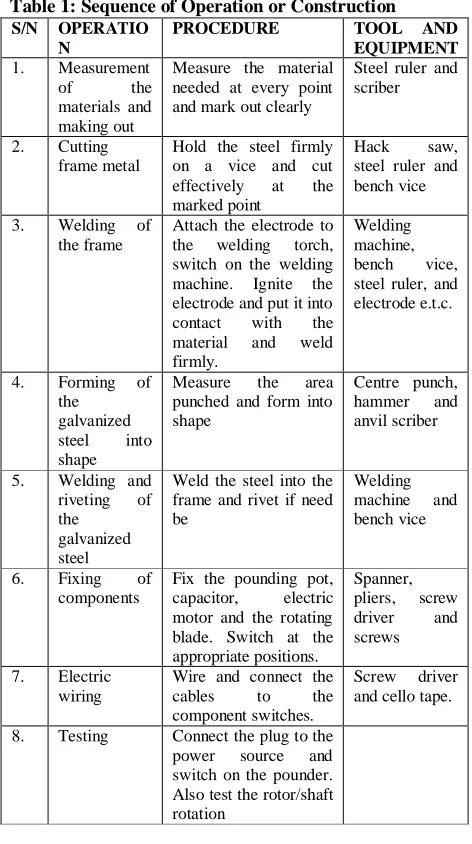
Table 1: Sequence of Operation or Construction S/N OPERATIO
N
PROCEDURE TOOL AND
EQUIPMENT 1. Measurement
of the materials and making out
Measure the material needed at every point and mark out clearly
Steel ruler and scriber
2. Cutting frame metal
Hold the steel firmly on a vice and cut effectively at the marked point
Hack saw, steel ruler and bench vice
3. Welding of the frame
Attach the electrode to the welding torch, switch on the welding machine. Ignite the electrode and put it into contact with the material and weld firmly.
Welding machine, bench vice, steel ruler, and electrode e.t.c.
4. Forming of the
galvanized steel into shape
Measure the area punched and form into shape
Centre punch, hammer and anvil scriber
5. Welding and riveting of the
galvanized steel
Weld the steel into the frame and rivet if need be
Welding machine and bench vice
6. Fixing of components
Fix the pounding pot, capacitor, electric motor and the rotating blade. Switch at the appropriate positions.
Spanner, pliers, screw driver and screws
7. Electric wiring
Wire and connect the cables to the component switches.
Screw driver and cello tape.
8. Testing Connect the plug to the power source and switch on the pounder. Also test the rotor/shaft rotation
III. DESIGN OF YAM POUNDING MACHINE In the design of yam pound many things were considered when analyzing the system.
A. Parts Design and Material Selection
Manufacturing processes includes the processes involved in using various construction methods in producing the extracting machine. In manufacturing, the principal common characteristic is that something physical is being produced
or created i.e. output consists of goods or machine, which differ physically.
Manufacturing therefore requires some physical transformation or a change in utility of resources. The parts are different components that when assembled make up the unit in such processes care precision should be the top most priority when carrying out the construction. As far as the selection of material for the construction of machine component and parts is a vital aspect of design.
Various manufacturing processes were carried out during the fabrication, production and assembling of the components parts of this machine in order to be producing the required or particular goods.
The processes involves in producing the machine are as follows:
Marking out operations or procedures
Cutting operations or procedures
Assembling operations
Welding operation
Machining operation
Marketing out Operations / Procedures
This is done to get the required shape and size of the design according to our dimensions in order to meet out expectation or aim. It is done or carried out by using tapes, marker, squares, vernier caliper etc.
Cutting Operations / Procedures
Power saw: for cutting of thick pipes and circular bars.
Hacksaw: for cutting of rectangular plates and circular bars.
Emery cloth: for smoothing and polishing of rough edges of wood.
Chisel and hammer: for cutting of casing of the yam pounder.
Guillotine machine: for cutting of mark out shit of stainless steel and mild steel into the required dimension or measurement.
Assembling Operations / Procedures
This aspect is bringing together of all required part components to form a unit or a complete machine.
Welding Operations / Procedures
This process is the system of using electric welding and electrode to join the art material in to shape
B. The Design Description
The yam pounder consists of various components and its detailed description illustrated below:
STAINLESS POT: This houses the pounding vanes and contains the yam to be pounded
ONE HORSE POWER GEARED ELECTRIC MOTOR: This impacts the momentum force to the pounding vanes.
POUNDING VANES/BLADES: This does the actual pounding. The blades are twisted at an angle of 45° to each other and the space between them on the rotating shaft is 90°.
SWITCH: is the component that regulates the electric support
THE FRAME: It gives the entire system support.
Electric Components
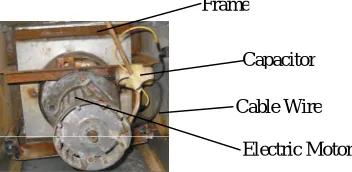
[image:4.612.85.199.81.198.2](A) Electric motor, (B) switches, (C) capacitors, (D) cable wires, (E) power source
Fig 3: Machine Components
C. Brief Description of the Principle Operation
When the yam is cooked and transferred into the pounding pot and the electric motor is switched on, the shaft rotates which carries the blades that pound the yam. At the first rotation, the shorter blade cut the yam into smaller pieces and redirects the yam particles to the longer arm that does most of the actual pounding.
D. Assembly
The work on its construction had the various materials put in place in its various stipulated places. The hollow metal used for the frame work, the pot, the electric motor, the galvanized metal sheets used for covering the frame work were all assembled in their various ways and positions.
Hollow metal: This is used for its frame work because of its strength and weld ability.
Pounding pot: This is made of stainless steel that is ragged to accommodate the heating effect.
Rotor: This rotates the blades/vanes.
Wires: materials that conducts electricity into the motor for the functioning of the machine.
Switch: the controls the on and off of the machine.
E. Safety Considerations
The safety considerations in this work stem up from the fact that as an electromechanical device, injuries and damages are bound to occur.
Thus the safety precautions are as follows:
Ensure that all the electric components are thoroughly earthed.
Avoid hand contact with the pounding blade
Avoid opening the pounding chamber when the machine is on.
IV.FUNDAMENTAL MATHEMATICAL ANALYSIS OF THE DESIGN
We made use of one horsepower electric motor. 1 hp-= T (Nm) x N (r.p.m)/3600
Where:
T = torque in Newton/meters. N= speed in revolution per minute. hp, = horse power
Therefore: hp =T x N/3600
T = hp x 3600/N
But one horsepower (hp) = 745.7 w
Speed (N) =1000 r.p.m
T = 745.7 X 3600/1000 = 2,684.52 Nm
A. Maximum Volume of Yam to be pounded
The volume of yam to be pounded depends on the following:
1. The volume of the pot. 2. Thickness of the blades/vanes. 3. Nature of the yam.
4. Power rating of the shaft.
From the design dimensions, we have the following measurements:
Diameter of the pot (d) = 210mm = 0.21m Height of pounding pot (h=) 100mm = 0.1 m Length of blade (L) =115.5mm = 0.1155m Thickness of the blade (t) = 2.5 mm = 0.0025m Volume of pot (Vp) = πd
2
h/ 4
vp, = π x 0.212x 0.1/ 4 = 0.003463605m3
B. Volume of the Blade
vb = πd2L = π x (0.0025)2 X 0.1155 = 0.000002267m3
For four blades
Vb = 4 x 0.000002267 = 0.000009071m 3
The net volume of the pounding pot Vnet = Vp -Vb = 0.003463605 - 0.000002267
Vnet = 0.003454534m3
But average yam tuber is about 200mm (0.2m) long and has a mean diameter of about 70mm (0.07m)
The volume (v) = d2L/4
v = π x (0.07)2X 0.2/4 = 0.0007696m3
Thus, this can only hold for 11/3 tubers of yam allowing for about 10% increase in volume of yam after cooking.
[image:4.612.70.283.290.501.2]E
Fig 4: The Designed yam pounding machine in
showing front and side views
Fig 5: Pounding Vanes/Blades with Boiled yam Specimen
Fig 6: Interior description of the yam pounding machine
Stainless Pot
Switch Power
Pounding Blades
Frame
Capacitor Cable Wire
Electric Motor
boiled yam
[image:4.612.71.247.550.636.2]C. Frictional Effect Analyses
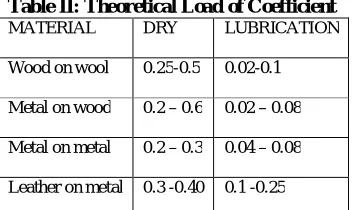
[image:5.612.66.242.111.216.2]Velocity ratio (VR) = Speed of driver/Speed of the driven Efficiency of machine = Actual load/Theoretical load Coefficient of friction for different materials at average pressure and low speed is given below:
Table II: Theoretical Load of Coefficient MATERIAL DRY LUBRICATION
Wood on wool 0.25-0.5 0.02-0.1
Metal on wood 0.2 – 0.6 0.02 – 0.08
Metal on metal 0.2 – 0.3 0.04 – 0.08
Leather on metal 0.3 -0.40 0.1 -0.25
Coefficient of friction = Effect of friction / Pressure between surfaces Effect of friction = Coefficient of fiction x Pressure between surfaces
But pressure between wall and yam = F/A And F = T/D
Where F = Force T = torque A = Area of the pot D = Pot diameter
Therefore, F = 26845.21 0.07 = 383502N/m
Area of pot (A) = πD2= π x (0.21)2 = 0.13854m2 Pressure between wall and yam = 383502/0.13854 = 2.768Nm
Effect of friction = 0.04 x 2.768 = 0.11072N/m minimum Or= 0.08 x 2.678 = 0.22144 N/m minimum
In the effect of friction, the yam serves as a lubricant between the pounding vanes and the pot. Hence friction is assumed to have effect on metal to metal (pot and blade).
D. Testing and Analysis
After fabrication, the system (work) was tested by operating it with electricity and the result was satisfactory. The pounded yam was firm and smooth in texture, compact with adequate hardness. The yam used was cut into small sizes.
E. Evaluation
The machine (yam pounder) was well evaluated to suit its usage. That is, the components parts.
The make up of the machine was duly selected to carrying out its purpose and making it easily operational to the users. The factor considered and evaluated are as follows:
Weight of motor.
Weight of metallic base.
Thickness of pot and blade.
Total weight of the machine.
V. REPAIR / MAINTENANCE SCHEDULE Repairs are affected when a machine fails to function effectively and efficiently as required. The machine parts likely to fail which could have a great effect on this machine are electric motor, electric switches, shaft and blades. The machine is economically fabricated to aid replacement of damaged parts as well as periodic inspection.
The maintenance system or process includes
Cleaning of the pots before and after operation.
Greasing of motor bearings.
Storing the machine in a cool and dry place.
General inspection and cleaning of the worn out parts.
As a matter of fact, the maintenance requirements are categorized into:
Breakdown maintenance.
Overhaul maintenance.
Planned preventive maintenance/ Corrective maintenance VI.CONCLUSION
This research work has successfully presented a functional and highly efficient low cost yam pounding machine by minimizing traditional technique of pounding and health condition of individual, and avoid inconveniency of neighbor hood through noise and vibration of pounding with mortar and pestle. This machine is design for home and restaurant usage, in other to improve a healthy and hygienic condition of an individual. It is expected that an average home in Nigeria can afford the machine.
VII. RECOMMENDATION
From this research, we recommend that some chemical analysis of the end product should be carried out to determine the degree of contamination of the pounded yam by the material employed in the machine construction. Also, there is room for improvement in the efficiency and physical outlook of the machine. We also recommend that this write up in design and fabrication of this project should serve as a stepping stone for further and well defined fabrication.
REFERENCES
[1] Asiedu J.J. (1992). Processing of Tropical Corps Technological Approach. Macmillan publishing Co, Inc. London pp 249-261. [2] Asiedu J.J (1992) Processing of Tropical Corps 1st
edition, Vikas publishing house limited.
[3] Deutschman, Aaron D; Walter Michel, Charles Wilson Jr. (1975) Machine Design Theory and Practice New York’ Macmillan publishing Co, Inc.
[4] Gonsaiez M.A. Alata L. Journal of Agriculture, University of Pueto Rico.
[5] Jamai S.abd, Montford L.C (1980) yam flour for fufu production, Journal of Agricultural Science.
[6] Oleniyi A.O. (1993) Tropical Tubers’ Yam cassava, potato and cocoyam. John Wiley and sons. Section A. Yams.
[7] Onyekwere, O.O (1987) the processing of root and tuber in the theme. The role of food Science and Technology in operation feeding the Nation Conference Nigeria Institution food Science and Technology, 5thMay, 1977 Pp10