Abstract— Software testing is an important activity in software development in terms of quality control. Software testing requires test cases for testing the system. Requirements changes can occur during the development phase, as a result, use case descriptions are changed. Many test cases are unusable because of use case description changes. It is not easy to specify whether they are usable or unusable. This paper proposes an approach for analyzing impact on test cases when use case description are changed.
Index Terms— test case, use case description, impact analysis
I. INTRODUCTION
oftware testing is an important activity in the software development life cycle. Test cases are key factors in software testing. Test cases are created from work products such as use cases and source codes. The construction of use case occurs in requirements gathering phase. Therefore, at the beginning of development life cycle, requirements gathering phase is the appropriate time to emphasize the change. Changes can be occurred to any artifacts such as system requirements documents, use case diagrams, and XML documents [1]. When requirements changes during software development impact existing work products, test cases must be updated to consistently maintain. It has commonly been reported that impacted test cases associate with time consumption and costly.
This paper attempts to propose a framework to identify impacted test cases on requirements changes through use case description. Our approach is divided into three steps: requirements validation matrix generating, use case description changes analysis, and impacted test case analysis. The overall structure of the study takes the form of six sections, including this introductory section. Section II begins by laying out the theoretical dimensions of the research. Section III is concerned with the background of use case description, and requirements validation matrix. Section IV defines use case description changes impact test cases. Section V explains the framework with an example. Finally, the conclusion gives a brief summary, and areas for further research are identified.
Manuscript received December 28, 2014.
T. Sakkarinkul and T. Suwannasart are with the Software Engineering Laboratory Center of Excellence in Software Engineering, Faculty of Engineering, Chulalongkorn University, Bangkok, Thailand (e-mail: [email protected], [email protected]).
II. RELATED WORK
There are relatively few historical studies in the area of test case impact analysis. S. Phetmanee [2] developed a tool for impact analysis of test cases based on changes of a web application. The tool generates new test cases based on the black-box testing techniques by comparing two types of document: HTML document file, and XML Schema file. The HTML document file describes inputs and their forms. Further, the XML Schema file is a description of grammatical rules of XML document which supports boundary value definitions and can be used for well-formed input validation. Consequently, new test cases are generated by either equivalence class or boundary value analysis.
Similarly, J. Jainae [3] proposed a framework for test case impact analysis of database schema changes using use cases. The framework generates new test cases based on black-box testing techniques. There are four steps: analyzing database schema file, finding and repairing affected use cases, analyzing affected test cases, and generating new test cases. In addition, existing test cases generated from the use case description are taken into the analysis. As a result, affected test cases are replaced by new generated test cases which are either valid or invalid test case.
Whereas the previous studies use the black-box testing techniques to generate test cases, M. Raengkla [1] demonstrated a use case description change detection tool. She focuses on three parts: use case description input, output, and procedure. The changes of use case description input and output are detected by the difference of their numbers, types, and sizes. Furthermore, the changes of use case description procedure are detected by the difference of its number, sequence, condition, and loop in the procedures. The inputs of the tool consist of an old use case description, a new use case description, test cases, and a requirements validation matrix. Difficulties arise, however, when the requirements validation matrix does not exist. This paper is based on her approach. Although, we argue that requirements validation matrix is not necessary for an input because it can be generated by other inputs.
III. BACKGROUND
A. Use Case Description
A use case description is a detail of a use case in the use case diagram. Cockburn [4] proposed a use case description format by “One-Column Table”, which is able to understand simply, shown in Table I.
Test Case Impact Analysis from Use Case
Description Changes
Tawan Sakkarinkul,
Taratip SuwannasartTABLE I. USE CASE DESCRIPTION IN ONE-COLUMN TABLE
Use Case # <the name is the goal as a short active verb phrase>
Context of use <a longer statement of the context of use if needed>
Scope <what system is being considered black box under design>
Level <one of summary, primary task, subfunction>
Primary Actor <a role name for the primary actor, or a description>
Stakeholder and interests
Stakeholder Interests <stakeholder
name>
<put here the interest of the stakeholder>
<stakeholder name>
<put here the interest of the stakeholder>
Preconditions <what we expect is already the state of the world>
Minimal Guarantees
<the interests as protected on any exit>
Success Guarantees
<the interests as satisfied on a successful ending>
Trigger <the action upon the system that starts the use case>
Description Step Action
1 <put here the steps of the scenario from trigger to goal delivery and any cleanup after>
2 <…>
Extensions Step Branching Action
1a <condition causing branching>:
1a1 <action or name of sub use case>
1a2 <…>
Technology and Data Variations
1 <list of variations>
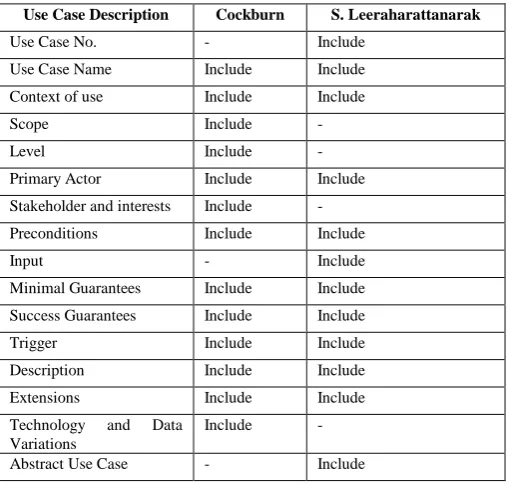
Likewise, S. Leeraharattanarak [5] adapted Cockburn’s format to generating test cases. Table II compares the two formats.
TABLE II. USE CASE DESCRIPTION COMPARING BETWEEN
COCKBURN AND S.LEERAHARATTANARAK
Use Case Description Cockburn S. Leeraharattanarak
Use Case No. - Include
Use Case Name Include Include
Context of use Include Include
Scope Include -
Level Include -
Primary Actor Include Include
Stakeholder and interests Include -
Preconditions Include Include
Input - Include
Minimal Guarantees Include Include
Success Guarantees Include Include
Trigger Include Include
Description Include Include
Extensions Include Include
Technology and Data Variations
Include -
Abstract Use Case - Include
B. Requirements Validation Matrix
Requirements validation matrix [1], [6] shows the relationship between use cases and test cases. It is used for
forward and backward traceability, therefore, it is able to indicate test cases that are not impacted by use case description changes. Table III gives an example of requirements validation matrix.
TABLE III. AN EXAMPLE OF REQUIREMENTS VALIDATION MATRIX.
Use Case Description
UC1 UC2
Test Case TC1-01 X
TC1-02 X
TC2-01 X
TC2-01 X
IV. USE CASE DESCRIPTION CHANGES IMPACT TEST CASES
This paper uses requirements validation matrix to identify test cases which can be categorized into the following types of testing
valid input testing invalid input testing
success scenario testing for pass success scenario testing for fail alternative scenario testing
The differences of use case description changes have an effect on test cases. This paper focuses on five forms of changes.
1) Use Case Name
Use case name changes affect only the test case name. The result of the test case is still valid.
2) Use Case Input
There are four main use case input changes. Firstly, the number of input changes affects the amount of the test case inputs. Secondly, if the input names are changed, the test case input names will be affected. Another input change is that its types can affect the test case input types and values. Although the test cases are valid input testing, and input type changes do not decrease any possible valid input values, the input values are not affected. Finally, the input constraint changes have consequences for the test case precondition and the input values. However, the test cases that are valid input testing, and the input constraint changes do not reduce any possible valid input values. Then, the precondition and input values are not affected.
3) Use Case Output
A use case output is an additional element of use case description. It describes a proper output of the system. Thus, the use case output is related to the expected outputs of test cases. There are three main use case output changes. Firstly, the number of output changes affects the amount of test case expected outputs. Secondly, output name changes affect test case expected output name. Finally, output type changes also have influences on test case expected output type and values.
4) Success Scenario
5) Alternative Scenario
Alternative Scenario condition changes can have an impact on the test case precondition and the input values. Their consequences are similar to the success scenario.
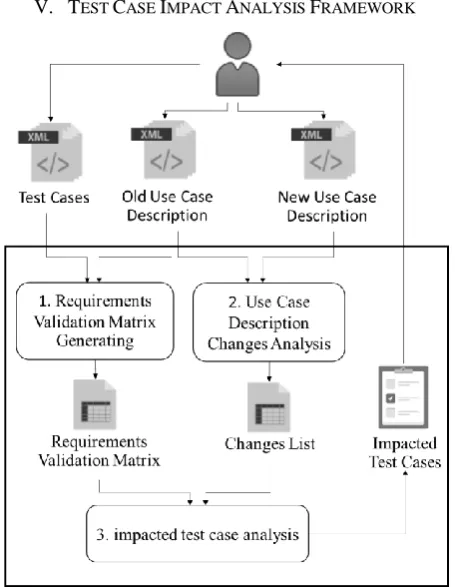
[image:3.595.56.284.114.408.2]V. TEST CASE IMPACT ANALYSIS FRAMEWORK
Fig. 1. The test case impact analysis framework
According to use case description changes, figure 1 shows the three-step test case impact analysis framework: requirements validation matrix generating, use case description changes analysis, and impacted test cases.
A. Inputs
1) Use Case Descriptions
A use case description consists of a use case ID, a use case name, inputs, outputs, a success scenario, and alternative scenarios. The use case description can be in many forms such as database, spreadsheet and text file, then it should be transformed into XML document in well-formedness.
2) Test Cases
A test case consists of a test case ID, a test case name, a precondition, inputs, and expected outputs. Likewise, it has to be transformed into XML document in well-formedness.
B. Requirements validation matrix generating
The framework analyzes use case descriptions in order to map with test cases. This paper focuses on three components of use case description which are name, input and output. The use case name and the test case name should be similar while the use case inputs must be the same as the test case inputs. Moreover, the use case outputs must be the same as the test case outputs. Normally, test cases are generated from a use case description of which name is similar to the test cases. It can be implied that the naming concept is applied.
This study determines the similarity of use case name and
test case name by using the similarity percentage which is calculated by a number of words contained in both use case name and test case name divided by the total number of words in the use case. The similarity percentage is greater than or equal to the acceptable level, and inputs and outputs of the use case and the test case are same, then they have a relationship.
C. Use case description changes analysis
In order to analyze each pair of the use case descriptions, the framework indicates the component changes and their details. The scope of the analysis is focused on four components of use case descriptions including a name, inputs, outputs, and a success scenario. The input type and the input constraints change analysis require additional information to determine whether those changes affect the previous valid values of the inputs or not. Success scenario condition change analysis consists of two types. The first type is constraint reduction determined by adding “OR” or removing “AND” condition. Another is constraint change. The result of the use case description changes analysis is a changes list.
D. Impacted test case analysis
In order to analyze impacted test cases, there are two steps. Firstly, the possible impacted test cases that related to use case description changes are identified by requirements validation matrix. Secondly, the components of impacted test cases are indicated by the changes list and the test case types, including valid input testing, invalid input testing, and success scenario testing for pass. Moreover, additional information is required to describe the type of testing.
E. Framework demonstration
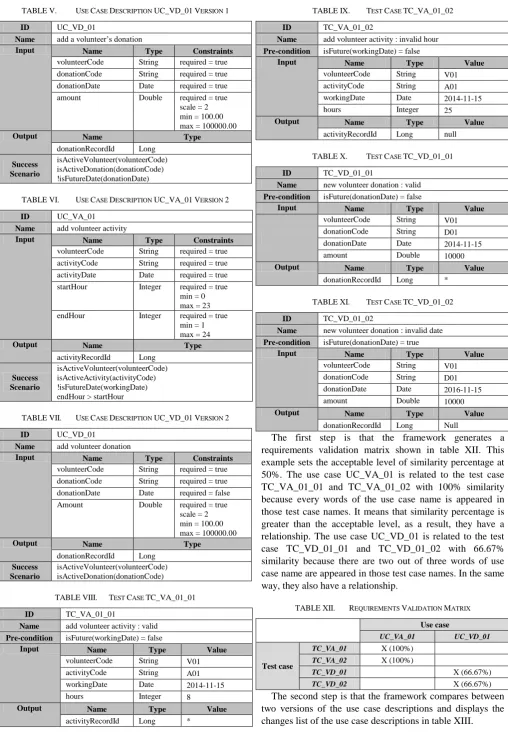
The framework can be illustrated briefly by the following case. There are two use case descriptions with two versions and four test cases as inputs. Table IV and V show the two old use case descriptions. Table VI and VII explain the two new use case descriptions. Table VIII, IX, X and XI are four test cases.
TABLE IV. USE CASE DESCRIPTION UC_VA_01VERSION 1
ID UC_VA_01
Name add a volunteer’s activity
Input Name Type Constraints
volunteerCode String required = true
activityCode String required = true
workingDate Date required = true
hours Integer required = true min = 1 max = 24
Output Name Type
activityRecordId Long
Success Scenario
[image:3.595.299.557.556.737.2]TABLE V. USE CASE DESCRIPTION UC_VD_01VERSION 1
ID UC_VD_01
Name add a volunteer’s donation
Input Name Type Constraints
volunteerCode String required = true donationCode String required = true donationDate Date required = true amount Double required = true
scale = 2 min = 100.00 max = 100000.00
Output Name Type
donationRecordId Long
Success Scenario
isActiveVolunteer(volunteerCode) isActiveDonation(donationCode) !isFutureDate(donationDate)
TABLE VI. USE CASE DESCRIPTION UC_VA_01VERSION 2
ID UC_VA_01
Name add volunteer activity
Input Name Type Constraints
volunteerCode String required = true activityCode String required = true activityDate Date required = true startHour Integer required = true
min = 0 max = 23 endHour Integer required = true
min = 1 max = 24
Output Name Type
activityRecordId Long
Success Scenario
isActiveVolunteer(volunteerCode) isActiveActivity(activityCode) !isFutureDate(workingDate) endHour > startHour
TABLE VII. USE CASE DESCRIPTION UC_VD_01VERSION 2
ID UC_VD_01
Name add volunteer donation
Input Name Type Constraints
volunteerCode String required = true donationCode String required = true donationDate Date required = false Amount Double required = true
scale = 2 min = 100.00 max = 100000.00
Output Name Type
donationRecordId Long
Success Scenario
isActiveVolunteer(volunteerCode) isActiveDonation(donationCode)
TABLE VIII. TEST CASE TC_VA_01_01
ID TC_VA_01_01
Name add volunteer activity : valid
Pre-condition isFuture(workingDate) = false
Input Name Type Value
volunteerCode String V01 activityCode String A01 workingDate Date 2014-11-15
hours Integer 8
Output Name Type Value
activityRecordId Long *
TABLE IX. TEST CASE TC_VA_01_02
ID TC_VA_01_02
Name add volunteer activity : invalid hour
Pre-condition isFuture(workingDate) = false
Input Name Type Value
volunteerCode String V01 activityCode String A01 workingDate Date 2014-11-15
hours Integer 25
Output Name Type Value
activityRecordId Long null
TABLE X. TEST CASE TC_VD_01_01
ID TC_VD_01_01
Name new volunteer donation : valid
Pre-condition isFuture(donationDate) = false
Input Name Type Value
volunteerCode String V01 donationCode String D01 donationDate Date 2014-11-15
amount Double 10000
Output Name Type Value
donationRecordId Long *
TABLE XI. TEST CASE TC_VD_01_02
ID TC_VD_01_02
Name new volunteer donation : invalid date
Pre-condition isFuture(donationDate) = true
Input Name Type Value
volunteerCode String V01 donationCode String D01 donationDate Date 2016-11-15
amount Double 10000
Output Name Type Value
donationRecordId Long Null
The first step is that the framework generates a requirements validation matrix shown in table XII. This example sets the acceptable level of similarity percentage at 50%. The use case UC_VA_01 is related to the test case TC_VA_01_01 and TC_VA_01_02 with 100% similarity because every words of the use case name is appeared in those test case names. It means that similarity percentage is greater than the acceptable level, as a result, they have a relationship. The use case UC_VD_01 is related to the test case TC_VD_01_01 and TC_VD_01_02 with 66.67% similarity because there are two out of three words of use case name are appeared in those test case names. In the same way, they also have a relationship.
TABLE XII. REQUIREMENTS VALIDATION MATRIX
Use case
UC_VA_01 UC_VD_01
Test case
TC_VA_01 X (100%)
TC_VA_02 X (100%)
TC_VD_01 X (66.67%)
TC_VD_02 X (66.67%)
TABLE XIII. CHANGE LIST OF THE USE CASE DESCRIPTIONS
Use Case Description Component Change
Type
Detail
UC_VA_01
Input Rename from “workingDate” to “activityDate” Remove Hours
Add startHours Add endHours Success
Scenario
Increase Constraints
endHour > startHour
UC_VD_01
Input Decrease Constraints
from “require = true” to “require = false”
Success Scenario
Decrease Constraints
!isFutureDate(donationDate)
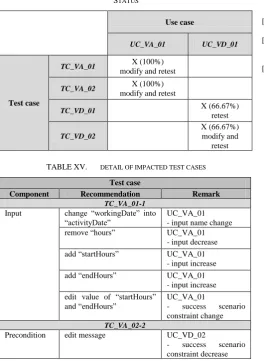
Finally, the framework displays a list of the impacted test case in table XIV and XV. Table XIV shows the status of the test cases, and table XV shows the details of the impacted test cases.
TABLE XIV. REQUIREMENTS VALIDATION MATRIX WITH TEST CASE
STATUS
Use case
UC_VA_01 UC_VD_01
Test case
TC_VA_01 X (100%)
modify and retest
TC_VA_02 X (100%)
modify and retest
TC_VD_01 X (66.67%)
retest
TC_VD_02
X (66.67%) modify and
retest
TABLE XV. DETAIL OF IMPACTED TEST CASES
Test case
Component Recommendation Remark
TC_VA_01-1 Input change “workingDate” into
“activityDate”
UC_VA_01 - input name change remove “hours” UC_VA_01
- input decrease add “startHours” UC_VA_01
- input increase add “endHours” UC_VA_01
- input increase edit value of “startHours”
and “endHours”
UC_VA_01
- success scenario constraint change TC_VA_02-2
Precondition edit message UC_VD_02
- success scenario constraint decrease
VI. CONCLUSION AND FUTURE WORK
This paper aims to propose an approach for test case impact analysis from use case description changes. This study has shown that the test case impact can be identified automatically by the framework. In addition, the framework can be used for generating a requirements validation matrix. Finally, the framework helps to reduce an effort to find
impacted test cases.
For future research, it would be interesting to implement a prototype using the proposed framework. It can be tested by use case description changes focused on the four components including a name, inputs, outputs, and a success scenario. Then, the results of prototype are evaluated by comparing the time reduction and resource consumption with a traditional method. In addition, the information retrieval techniques can be used in order to map use cases and test cases by their names in the requirements validation matrix generating. The further studies could be improved the knowledge of the test case impact analysis.
REFERENCES
[1] M. Raengkla and T. Suwannasart, "A Test Case Selection from Using Use Case Description Changes," presented at the International MultiConference of Engineers and Computer Scientists, Hong Kong, 2013.
[2] S. Phetmanee and T. Suwannasart, "A Tool for Impact Analysis of Test Cases Based on Changes of a Web Application," presented at the the International MultiConference of Engineers and Computer Scientists, Hong Kong, 2014.
[3] J. Jainae and T. Suwannasart, "A Tool for Test Case Impact Analysis of Database Schema Changes Using Use Cases," presented at the Information Science and Applications (ICISA), 2014 International Conference on, 2014.
[4] A. Cockburn, Writing Effective Use Cases: Addison-Wesley Longman Publishing Co., Inc., 2000.
[5] S. Leeraharattanarak, "An Approach for Automatically Generating Test Cases from Use Cases," Master of Science in Compurter Science, Computer Engineering, Chulalongkorn University, 2004. [6] "IEEE Standard Computer Dictionary: A Compilation of IEEE
[image:5.595.42.307.324.686.2]