engineering at Web-scale: The ALIGNED suite
of Ontologies
Resource type: Set of ontologies
Permalink: https://github.com/aligned-h2020/ALIGNED Ontologies
Monika Solanki1, Bojan Boˇzi´c2, Markus Freudenberg3, Dimitris Kontokostas3, Christian Dirschl4, and Rob Brennan2
1
Department of Computer Science, University of Oxford, UK
2 KDEG, School of Computer Science and Statistics, Trinity College Dublin, Ireland 3
AKSW/KILT, University of Leipzig, Germany 4
Wolters Kluwer, Germany
Abstract. Effective, collaborative integration of software and big data engineering for Web-scale systems, is now a crucial technical and eco-nomic challenge. This requires new combined data and software engi-neering processes and tools. Semantic metadata standards and linked data principles, provide a technical grounding for such integrated sys-tems given an appropriate model of the domain. In this paper we intro-duce the ALIGNED suite of ontologies specifically designed to model the information exchange needs of combined software and data engineering. These ontologies are deployed in web-scale, data-intensive, system de-velopment environments in both the commercial and academic domains. We exemplify the usage of the suite on a complex collaborative software and data engineering scenario from the legal information system domain.
1
Introduction
Recent years have seen a significant increase in the demand for data-intensive applications based on large-scale sources of data. However our engineering tech-niques for building data-intensive systems are both immature and often parti-tioned into software engineering and data engineering processes, tasks or teams. There is a need for integrated engineering approaches. The data itself must also be high-quality, which entails a curatorial process to improve and manage data over time. The expressivity of semantic models makes them useful for both ad-dressing data quality [5] and applying model-driven approaches [3] to software engineering. Semantic data, in the form of enterprise linked data is also useful for describing, fusing and managing the combined data and software engineering lifecycles to increase productivity, agility and system quality.
In this paper, we present a suite of ontologies developed within the ALIGNED5 project, that aim to align the divergent processes encapsulating data and soft-ware engineering. The key aim of the ALIGNED ontology suite is to support
5
lifecycle specifications and data lifecycle specifications; (2) support data qual-ity engineering techniques, by documenting data curation tasks, roles, datasets, workflows and data quality reports at each data lifecycle stage in a data in-tensive system; and (3) support the development of tools for unified views of software and data engineering processes and software/data test case interlink-ing, by providing the basis for enterprise linked data describing software and data engineering activities (tasks), agents (actors) and entities (artefacts) based on the W3C provenance ontology6.
This ontology suite has been deployed for validation and incremental im-provement in the ALIGNED project on four, large-scale data-intensive systems engineering use cases: the Seshat Global History Databank [10], which is com-piling linked data time series relating to all human societies over the past 12,000 years; JURION7, a legal information platform developed by Wolters Kluwer Ger-many; PoolParty8, a semantic technology middleware developed by the Semantic Web Company; and the DBpedia+9 data quality and release processes.
The paper is structured as follows: Section 2 presents an overview of the ALIGNED suite. It provides a brief description of the core ontologies in the suite. Section 3 shows how the vocabularies have been applied to a complex collaborative software and data engineering scenario from the legal information system domain. Section 4 presents an evaluation of the ontologies in the suite. Section 5 briefly discusses related work. Finally, Section 6 presents conclusions.
2
Overview of the ALIGNED suite
Figure 1 illustrates the ALIGNED suite of ontologies split into the provenance, generic, and domain-specific layers. As can be seen from the figure, a high em-phasis has been placed on reusing existing, well known and standardised speci-fications where available. At the top layer, the W3C provenance standard forms the baseline for all our specifications and all our models extend it in some way. The split of the ALIGNED ontology suite between a generic layer and a domain specific extensions layer allows rapid evolution of domain-specific extensions for the ALIGNED use cases/trial environments (JURION, Seshat, DBpedia, Pool-Party) based on a stable set of core concepts modelled in the generic layer. As the project progresses these extensions will be evaluated and incorporated into the generic layer if they prove valuable or more widely applicable than a single
6http://www.w3.org/ns/prov-o 7
https://www.jurion.de/
8https://www.poolparty.biz/ 9
Fig. 1.The ALIGNED Suite of Ontologies
domain. Within the project the suite of ontologies is known as the ”ALIGNED metamodel” due to the links with software engineering practices.
We briefly present here the core ontologies from the suite. Further details of the ontologies including the axiomatisations, graphical representation, seri-alisations in multiple formats via content negotiation, examples illustrating the usage of the ontologies, typical SPARQL queries that can be formulated using the ontologies as the data model and HTML documentation are available from the individual deployments at their persistent URIs. Due to space constraints we deliberately do not include these in this paper. The ontologies are grouped as follows:
– Design intent: This model is used to document the design decisions about data intensive system artefacts such as requirements, designs or datasets. It is based on the design intent ontology (DIO)10, which allows users to express the design intent or design rationale while undertaking the design of an artefact. DIO [9] is a generic ontology that provides the conceptualisation needed to capture the knowledge generated during various phases of the overall design lifecycle. DIO provides definitions for design artefacts such as requirements, designs, design issues, solutions, justifications and evidence, and relationships between them.
– Software engineering: This model defines the major agents (e.g. project roles), activities (e.g. lifecycle stages), and entities (design artefacts) involved in a software engineering project and their relations with a special focus on capturing the engineering lifecycle. Two ontologies make up this model: the
10
defined by ALIGNED for the DBpedia association, for describing datasets. DLO provides a set of conceptual entities, agents, activities, and roles to represent the general data engineering process. Furthermore, it is the basis for deriving specific domain ontologies which represent lifecycles of concrete data engineering projects such as DBpedia or Seshat. DataID is a multi-layered meta-data system, which, in its core, describes datasets and their different manifestations, as well as relations to agents like persons or organi-sations, in regard to their rights and responsibilities. Depending on context, type of data and use case, this core ontology can be augmented by multiple existing extensions (e.g. Linked Data, repository descriptions etc.).
– Unified quality reports: Defines a unified reporting representation for data quality metrics, ontology reasoning errors, test cases, and test case results based on the W3C SHACL reporting vocabulary. It is based on four ontologies/vocabularies, three of which are externally developed: W3C SHACL15, W3C Data Quality16, and University of Leipzigs test-driven RDF validation ontology [5] (RUT); and one ontology developed within ALIGNED: the reasoning violation ontology (RVO)17. RUT is designed to capture the lifecycle of RDF validation with the test driven validation methodology. It is implemented by the RDFUnit tool. RVO describes both ABox and TBox rea-soning errors for the integration of reasoners into data lifecycle tool-chains. The ontology covers violations of the OWL 2 direct semantics and syntax detected on both the schema and instance level over the full range of OWL 2 and RDFS language constructs. An overview of RVO and its design, im-plementation and use cases has been published in [1].
– Domain data model: This describes the domain of the data-intensive ap-plication being developed and is specific to that apap-plication, e.g. the Seshat ontology for historical time-series describing human societies. The lower layer includes the domain-specific extensions to the metamodels. ALIGNED has developed four domain-specific metamodels based on each of our use cases, with a focus on model elements needed for the ALIGNED phase 2 trials. – Enterprise information processing: extensions and models for the
JU-RION use case.
– E-research in the Social Sciences and Humanities: extensions and models for the Seshat use case.
11
https://w3id.org/slo
12https://w3id.org/sip 13
https://w3id.org/dlo
14http://dataid.dbpedia.org/ns/core# 15
https://www.w3.org/TR/shacl/
16https://www.w3.org/TR/vocab-dqv/ 17
– Crowd-sourced public datasets: extensions and models for the DBpedia use case.
– Enterprise software development: extensions and models for the Pool-Party use case.
3
Example deployment: the ALIGNED suite in Wolters
Kluwer’s JURION
JURION is an innovative legal information platform developed by Wolters Kluwer Germany that merges and interlinks over 1 million documents of content and data from diverse sources such as national and European legislation and court judgements, extensive internally authored content and local customer data, as well as social media and semantic web data (e.g from DBpedia). This data is then presented to users (such as law offices) in the form of highly customised appli-cations for semantic search, annotation, case management and legal information retrieval.
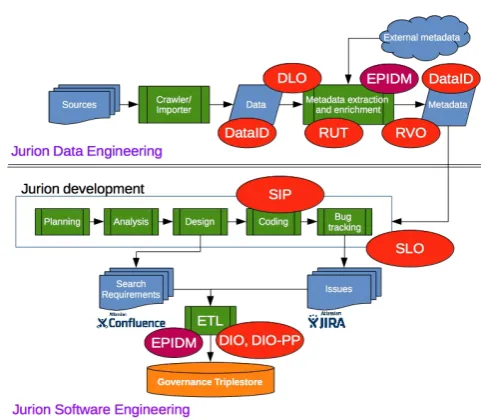
Currently, the software development process and data life cycle are highly independent from each other. Figure 2 illustrates where ontologies from the ALIGNED suite contribute towards facilitating interoperability between the software and data engineering processes and tools used to build and maintain JURION. The two main uses are tool integration and unified governance. Tool integration includes both cases within a single domain (data or software engineer-ing) and cross-domain tool-chain integration. Unified governance uses ALIGNED provenance records, data extraction and uplift from enterprise engineering tools and data fusion to provide end to end and cross-domain views of the JURION platform engineering processes. We elaborate on the deployment of ALIGNED ontologies for these use cases below.
RUT has been used in JURION for validating & verifying the extraction of metadata [6]. In particular, RDFUnit is used as a data validation tool integrated in JURION’s continuous integration (CI) platform (Jenkins). RVO, the reasoning violations ontology, has been used to integrate advanced OWL reasoning-based data quality checks with RDFUnit’s triple-query oriented tests to expand the scope of testing possible. DataID descriptors of all the JURION datasets are under evaluation and it is planned to use this to provide consistent meta-data which will be available to all tools thus facilitating further integration. The EIP, enterprise information processing, ontology has been used to describe the JURION environment, systems, artifacts and engineering processes in terms of the ALIGNED software and data lifecycle models.
Fig. 2. Usage of the ALIGNED suite of ontologies in the JURION semantics-based legal information system
4
Evaluation
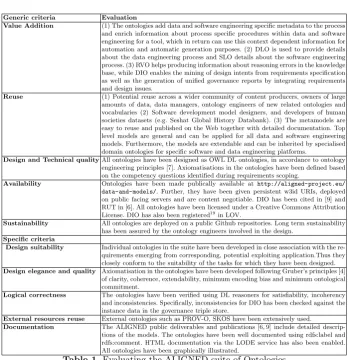
Table 1 presents the evaluation of the ALIGNED suite in accordance to the desired criteria18.
5
Related work
SEON20is a family of ontologies that describe concepts in the context of software engineering, software evolution and software maintenance. SWO21 is a resource for describing software tools, their types, tasks, versions and provenance. While they cover some general aspects of software engineering, they do not address the description of design intents and software lifecycles. Representing design intents or design rationales as ontologies have been captured for various spe-cialised domains such as software engineering [2] however there is no generic, domain-independent design intent capture model available as a design pattern. OOPS! [8] is a tool with a catalogue for validating ontologies by spotting com-mon pitfalls, however it detects design flaws rather than logical errors and does not use an ontology for error reporting. Thedcatvocabulary includes the spe-cial class Distribution for the representation of the available materialisations of
18https://figshare.com/articles/ISWC2016_Resources_Track_Review_
Instructions/2016852
20http://se-on.org/#publications 21
Generic criteria Evaluation
Value Addition (1) The ontologies add data and software engineering specific metadata to the process and enrich information about process specific procedures within data and software engineering for a tool, which in return can use this context dependent information for automation and automatic generation purposes. (2) DLO is used to provide details about the data engineering process and SLO details about the software engineering process. (3) RVO helps producing information about reasoning errors in the knowledge base, while DIO enables the mining of design intents from requirements specification as well as the generation of unified governance reports by integrating requirements and design issues.
Reuse (1) Potential reuse across a wider community of content producers, owners of large amounts of data, data managers, ontology engineers of new related ontologies and vocabularies (2) Software development model designers, and developers of human societies datasets (e.g. Seshat Global History Databank). (3) The metamodels are easy to reuse and published on the Web together with detailed documentation. Top level models are general and can be applied for all data and software engineering models. Furthermore, the models are extendable and can be inherited by specialised domain ontologies for specific software and data engineering platforms.
Design and Technical qualityAll ontologies have been designed as OWL DL ontologies, in accordance to ontology engineering principles [7]. Axiomatisations in the ontologies have been defined based on the competency questions identified during requirements scoping.
Availability Ontologies have been made publically available at http://aligned-project.eu/ data-and-models/. Further, they have been given persistent w3id URIs, deployed on public facing servers and are content negotiable. DIO has been cited in [9] and RUT in [6]. All ontologies have been licensed under a Creative Commons Attribution License. DIO has also been registered19in LOV.
Sustainability All ontologies are deployed on a public Github repositories. Long term sustainability has been assured by the ontology engineers involved in the design.
Specific criteria
Design suitability Individual ontologies in the suite have been developed in close association with the re-quirements emerging from corresponding, potential exploiting application.Thus they closely conform to the suitability of the tasks for which they have been designed. Design elegance and quality Axiomatisation in the ontologies have been developed following Gruber’s principles [4]
of clarity, coherence, extendability, minimum encoding bias and minimum ontological commitment.
Logical correctness The ontologies have been verified using DL reasoners for satisfiability, incoherency and inconsistencies. Specifically, inconsistencies for DIO has been checked against the instance data in the governance triple store.
External resources reuse External ontologies such as PROV-O, SKOS have been extensively used.
[image:7.595.133.482.103.464.2]Documentation The ALIGNED public deliverables and publications [6, 9] include detailed descrip-tions of the models. The ontologies have been well documented using rdfs:label and rdfs:comment. HTML documentation via the LODE service has also been enabled. All ontologies have been graphically illustrated.
Table 1.Evaluating the ALIGNED suite of Ontologies
a dataset. These distributions cannot be described further within dcat. The Asset Description Metadata Schema22 (
adms) is a profile of dcat, which only
describes a specialised class of datasets: so-called Semantic Assets.
6
Conclusions
Combining data and software engineering processes to increase productivity and agility, is a challenge being faced by several organisations aiming to exploit the benefits of big data. Ontologies and vocabularies developed in accordance to competency questions, objective criteria and ontology engineering principles can provide useful support to data scientists and software engineers undertaking the
22
on a real-world use case from the legal domain and evaluated it against the desired criteria. As ontologies from the suite are now in various stages of adoption by the ALIGNED use cases, the next steps would incorporate their empirical evaluation.
Acknowledgement
This research has received funding from the European Unions Horizon 2020 research and innovation programme under grant agreement No 644055, the ALIGNED project (www.aligned-project.eu).
References
1. B. Bozic, R. Brennan, K. Feeney, and G. Mendel-Gleason. Describing reasoning results with rvo, the reasoning violations ontology. In ESWC 2016 (to appear), 2016.
2. A. P. de Medeiros, D. Schwabe, and B. Feij´o. Kuaba ontology: Design rationale representation and reuse in model-based designs. In Proceedings of the 24th In-ternational Conference on Conceptual Modeling, ER’05, Berlin, Heidelberg, 2005. Springer-Verlag.
3. D. Gasevic, D. Djuric, and V. Devedzic. Model Driven Engineering and Ontology
Development. Springer Publishing Company, Incorporated, 2nd edition, 2009.
4. T. R. Gruber. Toward principles for the design of ontologies used for knowledge sharing. Int. J. Hum.-Comput. Stud., 43(5-6):907–928, Dec. 1995.
5. D. Kontokostas, M. Br¨ummer, S. Hellmann, J. Lehmann, and L. Ioannidis. Nlp data cleansing based on linguistic ontology constraints. InESWC 2014, 2014. 6. D. Kontokostas, C. Mader, C. Dirschl, K. Eck, M. Leuthold, J. Lehmann, and
S. Hellmann. Semantically enhanced quality assurance in the jurion business use case. InESWC 2016 (to appear), 2016.
7. N. F. Noy and D. L. Mcguinness. Ontology development 101: A guide to creating your first ontology. Technical report, Stanford Center for Biomedical Informatics Research (BMIR), 2001.
8. M. Poveda-Villal´on, M. C. Su´arez-Figueroa, and A. G´omez-P´erez. Validating on-tologies with oops! InKnowledge Engineering and Knowledge Management, pages 267–281. Springer, 2012.
9. M. Solanki. DIO: A pattern for capturing the intents underlying designs. In
Proceedings of the 6th Workshop on Ontology and Semantic Web Patterns (WOP
2015), volume Vol-1461. CEUR-WS.org, 2015.