Award no. R000222722
Award Holders: Dr. K. Harrison, Dr. G. Allan
Title: Patterns of marital commitment in the late 20th century
R000222722
Patterns of Marital Commitment in the Late Twentieth Century Full report on research activities and results
Background
Recent changes in the patterning of domestic life have resulted in the character of marital solidarities being questioned in popular discourse as well as in academic debate. As a result there has been a growth in theoretical analyses of contemporary >coupledom=, particularly concerning the extent to which the nature of personal and sexual commitment has altered (Beck and Beck-Gernsheim, 1995; Cancian, 1987; Duncombe and Marsden, 1993; 1995; Giddens, 1992; Hawkes, 1996; Jackson, 1993; 1995; Jamieson, 1998; 1999). Moreover it is becoming clear that marriage, sex and childbearing, which appeared a highly consolidated >package= for much of the twentieth century (Kiernan, Land and Lewis, 1997), are no longer so tightly bound together. By the turn of the twenty-first century, neither sexual expression nor child-bearing were as strongly linked to marriage as they were; and marriage itself was no longer so uncritically perceived as a monogamous, life-long relationship. Marital affairs are now discussed much more openly and with greater ambiguity about their moral status. Importantly too, cultural shifts in understandings of
sexuality have reduced the traditional sexual >double standard= and lessened the stigma attached to wives= involvement in extra-marital relationships.
However there is rather less empirical research on contemporary marital
commitment, and very little indeed on marital affairs at the level of either attitudes, behaviour or responses to them. To date, the main British studies have been Lawson (1987); Lawson and Samson (1988); and Reibstein and Richards (1992). (See also Wellings et al, 1994.)The research on which this Report is based was concerned to explore these issues, focussing explicitly on how affairs are
understood within the context of marriage. Objectives
As detailed in the initial proposal, the research had three principle objectives. 1. To explore the meanings attached to contemporary discourses about affairs. This element of the study sought to explore the different meanings attached to affairs in the context of marriage. Responses to affairs can reveal how such elements as intimacy, commitment, loyalty, and trust are interpreted, understood and, thus, constructed in context.
2. To examine the impact that knowledge of an affair has on relationships outside the marriage.
The second element of the research sought to analyse the responses of those indirectly involved in marital affairs. We wanted to understand how people
interpreted different affairs and what emotional and practical support was provided by family members and close friends.
marriages.
The third element of the research concerned the consequences for marriages once affairs become known to the spouse. We wanted to understand the complexity of factors which undermine or foster marital solidarity and examine the different processes of negotiation and resolution that developed.
These objectives did not change during the course of the research. They were each addressed through analysing the data generated from the Directive issued for this study by the Mass-Observation Archive at the University of Sussex. Inevitably there was some variation in the extent to which the data collected allowed these three issues to be analysed. Far more correspondents provided information on the first of these objectives than on the second or third. However despite our initial concerns, in particular over how adequately the third of these objectives could be met from the Archive data (see our correspondence with the ESRC at the beginning of the project), the correspondents reporting on their own or others= affairs provided sufficiently detailed information to allow all three issues to be explored.
Methods
Mass-Observation Archive
The research was predominantly based on data collected by the Mass-Observation Archive (M-O A). In March, 1998, we had arranged for one of the Archive=s tri-annual Directives to include a major section asking correspondents to write about their views and experiences of marital affairs (see Appendix 1).The M-O A maintains a large panel of correspondents who are free to respond as they wish to the issues raised in the Archive=s different Directives. Although not representative (Sheridan, 1993), these correspondents, drawn from all over the UK, are committed to writing frank and relatively full accounts of their views and experiences. Generally between 60% and 80% of the M-O A=s correspondents reply to each of the Archive=s
Directives. The form the responses take varies widely. Correspondents determine how much or how little they wish to write on particular topics, whether they write about personal experiences and how closely matched their responses are to the specific questions posed in any Directive.
When the Directive on marital affairs was first negotiated, the M-OA=s panel of correspondents was over 500. However as part of its routine operation, the Archive staff periodically >cull= correspondents who have consistently failed to respond to recent directives. At the time of the proposal, we had not realised that the panel of correspondents had been >culled= prior to the Directive on marital affairs being sent. As a result, the Archive=s panel contained 354 correspondents in March, 1998 rather than the 500+ we had understood it would contain. This also resulted in the average age of the correspondents being somewhat older than we had realised. As our correspondence with ESRC indicates, we consequently had some concerns at the start of the project that we could adequately achieve our objectives.
Responses
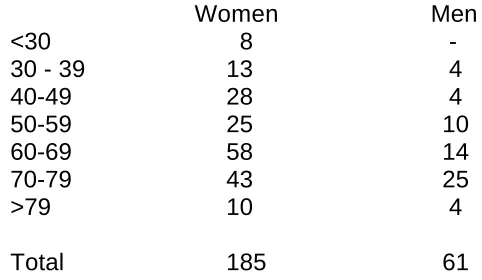
detailed in Table 1. This is significantly fewer than the 400 responses initially
anticipated by the Archive but represents a >response rate= of 69%. While we were initially disappointed at having only this number of responses, as the analysis
[image:4.595.175.416.237.377.2]developed it became evident that the range of detail generated in the responses submitted allowed us to address fully the concerns of the research.
Table 1
Correspondents: Gender and age Women Men
<30 8
-30 - 39 13 4
40-49 28 4
50-59 25 10
60-69 58 14
70-79 43 25
>79 10 4
Total 185 61
As expected, the responses to the Directive were diverse. Some were short, reporting they had no experience of affairs or did not wish to contribute. Others contained relatively abstract discussions of marriage and the impact of affairs, though the majority provided information on affairs which had impinged, either directly or indirectly, on the correspondents= lives. For example, they recounted details of affairs their parents, children or friends had had, how these had worked out and how they had affected the correspondent, in the process providing detailed and sometimes complex information about the correspondents= understandings of the nature of marriage and marital infidelity. Unsurprisingly, the fullest accounts of the course and impact of affairs were provided by those had been more directly involved. Correspondents who had had one or more affairs frequently provided graphic details of their histories and consequences, while those who knew about their spouses= affairs also often provided trenchant descriptions of the ways this had impinged on their marriage.
Details of the numbers of people who had direct experience of affairs are provided in table 2, though these figures need to be treated cautiously as defining and
categorising affairs proved a more complex task than we had imagined. A number of correspondents hinted at having been involved in affairs without explicitly saying so; other correspondents reported on love affairs which remained unconsummated. Cohabitation also creates some definitional problems, particularly in its early phases when commitment is less assured. Overall 42 of the female and 9 of the male
had no direct experience of marital affairs, while the rest did not say either way.
Table 2
Correspondents reporting affairs
Women Men
Have had an affair 28 8
Spouse/partner has had affair 17 2
Both self and spouse/partner have had an affair 14 1
No affair specified 126 50
Of course, these accounts of affairs which correspondents gave are just that: accounts. They are narratives constructed in the main some time after the affair developed. While not all sexual infidelities are emotionally significant, many of those which were described in detail in the responses clearly were. They were events which, from the correspondents= perspectives, needed to be located within their biography and in this sense >explained= and >understood=. As significant episodes in their lives, the accounts produced for the Archive were clearly reconstructions of events the correspondents had visited many times before. In Lawson=s (1987, p.20) terms they were acts of >creative rewriting=, and cannot be regarded simply as descriptions of >what happened=. They reflect experiences which have been sculptured in their re-telling as well as by knowledge of their outcomes. However while this raises >facticity= issues, the accounts remain highly valid as
representations of the correspondents= current understandings of the impact that particular affairs had on their marriages (Duncombe and Marsden, 1996; Grote and Freze, 1998; Plummer, 1995).
Analysis
All the responses are held at the Mass-Observation Archive in Brighton. Our initial plan had been to photocopy the responses and principally work with them at Southampton. At the time this was in line with the Archive=s policy. Unfortunately, for reasons unconnected to this project, the Archive altered its rules governing access to its data. The new rules specified that visitors to the Archive could only photocopy a maximum of 30 sheets of paper per visit. This severely curtailed the speed at which we could process the responses and resulted in our needing to be more flexible about how the responses were transcribed. As specified in the proposal, the material was analysed with the aid of The Ethnograph.
As already mentioned, in the early stages of the project, we were concerned that the >culling= of the Archive=s panel of correspondents would affect our ability to
produce an analysis of all the issues with which the proposal was concerned. In addition, as with hindsight might be expected, some of the early responses tended to be rather brief and >unrevealing= about the conduct of actual affairs.
able to explore the research issues. However, once all the responses were available to us, it became clear that collectively the responses satisfactorily met the project=s criteria. Consequently, as envisaged in the initial proposal, it is the M-OA responses which form the principal data upon which our analysis is based.
Qualidata Archive
Three exploratory visits were made to the Qualidata Archive, Essex to examine Lawson's data. The archived material includes individual interview transcripts, focus group transcripts, audio-tapes of some interviews and group discussions, and 306 completed questionnaires. There are also over 600 letters, received in response to Lawson's appeal for volunteers through the media. While initially we envisaged this material would inform the current study, the brief time we had allocated proved insufficient for this. With hindsight we would argue that incorporating such varied data into a new study requires a more intense interrogation than we had budgeted for. In the end, we learnt little from the visits that could not be derived from
Lawson=s reports (Lawson, 1987; Lawson and Sampson, 1988). In general, we now think that for such secondary data is to be analysed properly, far more resources are needed than we allocated.
Interviews
As outlined above, because of our original concerns over the reduced number of responses to the M-OA Directive, we negotiated with the ESRC the possibility of complementing the archival material with a small number of one-to-one interviews. After analysing the data more rigorously however, we found our worries to be unfounded; the data submitted to the Archive did allow our three principal research questions to be explored. Nevertheless, we conducted four >pilot= interviews with people who had been involved in affairs, three in marriages which had continued once an affair had became 'known'. However we have not drawn explicitly on our interviews in this analysis, instead relying on the MO-A data.
Results
Objective 1: CONTEMPORARY DISCOURSES
The first part of the study was concerned with contemporary understandings of affairs. The M-OA correspondents provided a great deal of information about their attitudes and beliefs. We summarise these below under four headings: diversity; ambiguity; types of affair; and betrayal and trust. (A fuller discussion of these topics is provided in Allan and Harrison, 2000). As structural characteristics like age and gender did not appear to discriminate between the views people expressed, these divisions are not highlighted in this section. For other matters, including attribution of motive and the ways in which correspondents described their own affairs, gender in particular was of importance, as Lawson (1987) emphasised in her study. These issues will be addressed in a forthcoming paper on >The gendering of affairs=. Diversity
desirable, but problematic; and some argued that expectations of fidelity were unrealistic in relationships potentially spanning the majority of the life course. While those who had had an affair tended to express less censure, the two most common views were (a) that marital infidelity was morally wrong; and (b) that the character of contemporary social organisation made sexual attraction outside marriage likely. The language correspondents used - >affair=,= infidelity= and >adultery= - itself mirrored the diversity of the perspectives they took.
Ambiguity
This cultural diversity in understandings of the place of affairs in contemporary
marriage was also reflected in the ambiguity which some correspondents expressed. While some held firmly that infidelity was wrong under all circumstances, others, including a number who had once thought the matter equally clear-cut, argued that such views were far too simplistic. Their ambiguity took a number of forms,
depending in part on their own direct and indirect experience of affairs. However, the principle tension referred to by correspondents, often quite subtly, concerned
individuals= rights to achieve personal happiness versus their responsibility to honour marital and parental commitments. These correspondents recognised inevitable changes in personality, interests and compatibilities over the course of a (long) marriage, as well as the emergence of new emotional and sexual needs. Yet at the same time, they emphasised the importance of sustaining committed
relationships. Such ambiguity tended to be most marked in the responses of those who had had affairs, with the pathways these affairs took highlighting for them the different moral and personal >pulls= that affairs entail.
Types of affair
A number of correspondents, and proportionately more men than women,
differentiated between types of affairs. The most basic distinction was between, on the one hand, short-lived sexual infidelities which provided little beyond sexual gratification and an opportunity to demonstrate continued personal attractiveness, and, on the other, >grand passions= based around powerful emotional and sexual feelings. While liberating and fulfilling at a personal level, these later affairs were typically seen as highly damaging to existing relationships. While some
correspondents produced a more complex classification, relatively few affairs were characterised by an intermediary position, suggesting that narratives framed in terms of >lust= and >passion= are given most credence culturally.
Betrayal and trust
The commonest theme to emerge in the responses concerned issues of trust, betrayal and guilt. A large number of correspondents indicated that any marital infidelity inevitably damaged the trust which they saw as essential to the continuation of a meaningful marriage. Many emphasised a sense of guilt, either citing it as a prime reason for avoiding involvement in extra-marital affairs or reporting,
felt that in theory at least it would be possible to re-establish trust after an affair, given sufficient time, effort and love. For this to happen though, the affair needed to be over.
Some correspondents indicated that while sexual infidelity clearly represented betrayal, this only became pertinent when the other knew about the affair(s). Generally these correspondents did not condone affairs, but nor did they condemn them out of hand. What mattered most was that partners and children were not hurt; the art lay in keeping affairs secret. A few correspondents disagreed that sexual liaisons outside marriage were necessarily of consequence, arguing that true marital trust was not premised on sexual and intimate exclusivity but had a deeper, more profound basis, some describing how their understandings of what >trust= and >commitment= really represented had become less= romantic= and more >realistic= over time. In addition, a small number of correspondents indicated that issues of betrayal and trust were no longer pertinent in their marriage because their partners had changed in ways which effectively revoked any earlier commitment.
Objective 2: IMPACT OF AFFAIRS
Knowledge of an affair is clearly likely to have a significant impact on the marriage(s) of those involved. However it often also has impact on other people who are less directly involved, in particular other family members and close friends. The impact will be greatest when the affair leads to the ending of the marriage, but even when this does not happen, its ripples often extend beyond the couple. As would be expected, the issues raised in this section of the Directive were less frequently addressed than the more general questions about the significance of affairs, as some correspondents claimed to have little experience of affairs within their personal networks. Equally, the detail with which correspondents reported on the impact of others= affairs in their lives varied, as did their relationships with those they discussed.
Many correspondents recounted the impact that affairs had had on their kinship and family lives. Older correspondents discussed affairs their children or children-in-law had been involved in. Others wrote about their parents= affairs, or about affairs which had affected siblings, nieces or nephews. As would be expected given that these were affairs which had become known about, they were principally ones which had serious repercussions for the marriage, often leading to separation and divorce. Very few kin reported colluding in these affairs, though some recognised why
particular liaisons had developed and viewed the consequent ending of
unsatisfactory marriages as positive, at least in the long-run. However the tone of most of the accounts about family affairs was negative. Even if understandable, these affairs were seen as damaging not simply to those involved but also to others in their immediate kinship network. Much pain, anger and remorse was expressed about the impact which particular affairs had had on the kin caught up in them, with children often being seen as the ones suffering the most.
others discussed how particular friends had responded when affairs had been disclosed to them. Not all these friends necessarily approved of the affairs, but they generally did appear to understand why they had arisen and to provide support. Some correspondents reported working to sustain a friend=s marriage, particularly when they were friends of the couple; others took a more neutral stance. A minority, usually >individual= rather than >couple= friends, were more active in colluding in the affair because, for whatever reasons, they felt that the relationship was
beneficial for their friend.
Occasionally affairs were reported which appeared to have led to the rupture of existing friendship networks, though this was usually associated with an acrimonious separation. More generally, most friendships discussed by correspondents were characterised as showing understanding of the complexities of emotional and sexual relationships, rather than being judgmental. Of course, those friends who were confided in were likely to be ones who could be expected to express empathy and compassion rather than overt censorship.
Objective 3: NEGOTIATING AFFAIRS
Infidelities within marriage may be ignored or even countenanced. However as we argued above, most correspondents reported that they would see an affair as an act of betrayal which would fundamentally undermine their marriage. Many of these views were hypothetical, in the sense that the correspondents did not believe their spouses had ever been unfaithful. But what happened to marriages when an affair did became known to the spouse? In addressing this issue, we will focus on those minority of responses which detailed how marriages were affected by one or other spouse=s affairs. It is particularly important to recognise here that the accounts on which we draw are inevitably reconstructions of events and emotions that often occurred some years previously. Precisely because they were personally
momentous, the accounts will have been re-ordered both through re-telling and hindsight. Of course, they remain valid reflections of the correspondents= current perceptions of the impact the affair(s) had on their marriage.
From the responses, it is evident that known affairs affect marriages in complex ways. Certain outcomes are more common than others, but throughout there is diversity as people grapple with the emotional and other consequences of actions which are readily denoted as >betrayal=. Broadly speaking though, four pathways can be identified from the correspondents= accounts.
a) Leaving
Some known affairs came to light when the spouse who was having the affair
announced that they were leaving the marriage, usually to live with their new partner. Often this was experienced as devastating by the spouse, who was left to confront the emotional and practical impact of such rejection in a context that was usually highly visible. There were significant differences in the way these stories were told by those who had been left and those who had done the leaving. The latter
perspectives of the spouse, except in cases where there was a recognition that the marriage had been >a mistake= with both spouses benefiting from its ending. In these instances, the affair was portrayed as a symptom of marriage breakdown rather than its underlying cause.
b) Forced out
In other marriages, an individual had insisted their spouse leave once they became aware of the affair. As would be expected, this narrative was most frequently
reported by those whose spouses were involved in the affair. What was evident in their accounts was the degree to which they felt that trust once betrayed could never be recaptured. At one level, people taking this line could be seen as inflexible and unforgiving. Yet, what comes over most strongly was the centrality of the betrayal they experienced. It was not simply that they were being judgmental but that what they took to be the relatively secure emotional world they had constructed through their marriage had been fundamentally undermined by the spouse=s actions. Their involvement in another sexual relationship had extinguished whatever feelings of love they had felt.
c) Sustaining marriages
Those correspondents who did not separate as a result of the known affair often wrote about their attempts to resurrect their marriage. For most, the affair proved to be traumatic and resulted in their relationship needing to be renegotiated. In the majority of instances this took some time. The affair raised fundamental questions about their relationship and as many of the correspondents attested could not easily be forgiven or forgotten. Not all the attempts at re-establishing the marriage were successful. In a small number of cases, couples separated some years after the affair had become known with the correspondents clearly identifying the affair - and the deceit it entailed - as the catalyst of the breakdown. In other instances, the marriage was re-established after the couple had spent some period living apart. Some marriages survived knowledge of the affair, though correspondents reported that the marital relationship had changed as a consequence, usually in ways which were portrayed with a sense of regret or loss (see Allan and Harrison, 2000). A number of correspondents reported that they could come to terms with their spouse having one affair but would not tolerate any further infidelity. Many also claimed that the marriage only survived because the affair was accepted as being either
emotionally unimportant, a temporary aberration or else a result of exceptional (and in this sense understandable) circumstances. In other cases, the non-involved spouse had proceeded to engage in one or more affairs of their own, a response Lawson (1987) also found among some of her respondents. In a very small number of instances, correspondents reported that their marriage had in some sense
benefited from the affair. The most extreme example was provided by a female correspondent who reported that her husband had become far more attentive and affectionate since she had confessed her affair to him. The accounts
d) Acceptance
There were a small of number of correspondents who appeared to accept their spouse=s affair(s). Some were simply indifferent. They remained married but felt little or no love for their spouse. They were quite happy for their spouse to be involved with other people as they no longer wished for sexual involvement with them. Aside from domestic interactions, their marriages appeared to be >empty shell= ones. There were also some >open= relationships reported in which each partner was free to become involved with others. Usually such relationships were managed discreetly and defined as purely sexual, only threatening the couple=s relationship if they became emotionally significant.
CONCLUSION: MARRIAGE AND AFFAIRS
As noted, correspondents reported diverse views and experiences; there is no simple >reading= that can be made of these narratives. Nonetheless, the majority of correspondents saw affairs as inappropriate and undesirable, though some took a more judgmental stance over this than others. Some affairs were recognised as being about sexual attraction and expression; some as consequent on a life-phase desire for greater self-validation. Some remained highly significant for the individual involved long after the physical relationship had ended. (See Morgan, 2000 on the ending of affairs.) Though elements of them had been painful, correspondents described these relationships as deeply fulfilling.
Where affairs became known to spouses, their effects on marriages were largely negative. Whilst many correspondents recognised that emotional and sexual commitment was often difficult to sustain in long-term marriage, the reality of a spouse=s affair usually generated powerful feelings of betrayal and broken trust. Coping with the sexual act itself created difficulties for many; where this was compounded by an emotional involvement, the sense of betrayal was often
experienced as overwhelming. Some marriages >survived= knowledge of an affair, but usually not without high levels of distress. Whether a move towards a mode of >pure relationship= can be distilled from this data is moot. What is clear is that for the great majority of correspondents the ideal of marital commitment remained strong; most considered extra-marital affairs to be highly damaging, even if at times they were understandable.
Activities
We have presented at the following conferences:
International Network on Personal Relationships, Louisville, Kentucky, June, 1999 European Sociological Association, Amsterdam, August, 1999
British Society of Gerontology, Bournemouth, September 1999 British Sociological Association, April, 2000
In addition, Harrison attended an ESRC/JRF residential Media Training Workshop. Outputs 50/128
>Marital affairs= to appear in R. Goodwin and D. Cramer (eds) Inappropriate Relationships, New Jersey: Lawrence Erlbaum, 2001.
We also plan to re-draft the BSA paper for publication in an academic journal, in the first instance submitting it to Sociology.
In addition, we are proposing to write two further academic articles, provisionally entitled >The gendering of affairs= and >Marriage work in the aftermath of affairs=, for journal submission.
We are also proposing to hold a one-day conference to discuss the methodological problems of collecting data on intimate relationships and would hope to publish the papers from this seminar.
The data from this study are already archived in the Mass-Observation Archive at the University of Sussex. They are available for use there by all bona fide
researchers. Impacts
There has already been interest from the media in this project. In the main, we have resisted commenting to the press until the report is finished. We have already received advice from the ESRC=s External Relations Division and will draw further on their expertise in releasing a press report and publicising our results.
Future Research Priorities
1. A study specifically concerned with cohabitation and sexual exclusivity. 2. A study looking at different types of family secrets.
3. A study of changing patterns of emotion and commitment in marriages that have lasted 20 - 30 years.
Bibliography
Allan, G. and Harrison, K. (2000), >Marital affairs= Attached draft of paper to be included in R. Goodwin and D. Cramer (eds) Inappropriate Relationships, New Jersey: Lawrence Erlbaum, 2001.
Beck, U. and Beck-Gernsheim E. (1995), The Normal Chaos of Love, Cambridge: Polity.
Cancian, F. (1987), Love in America, Cambridge: Cambridge University Press.; Duncombe, J. and Marsden, D. (1993), >Love and intimacy=, Sociology, 27: 221-41. Duncombe, J. and Marsden, D. (1995), '≅Workaholics and whingeing women≅:
Theorising intimacy=, Sociological Review, 43: 150-169.
Duncombe, J. and Marsden, D. (1996), >Can we research the private sphere?=, in L. Morris and E. S. Lyon (eds), Gender Relations in Public and Private, London: Macmillan.
Grote, N. and Frieze, I. (1998), >Remembrance of things past: perceptions of marital love from its beginnings to the present=, Journal of Social and Personal
Relationships, 15: 91-109.
Hawkes, G. (1996), A Sociology of Sex and Sexuality, Buckingham: Open University Press.
Jackson, S. (1993), >Even sociologists fall in love: an exploration in the sociology of emotions=, Sociology 27: 201-20.
Jackson, S. (1995), >Women and heterosexual love=, in L. Pearce and J. Stacey (eds), Romance Revisited, London: Lawrence and Wishart.
Jamieson, L. (1998), Intimacy, Cambridge: Polity.
Jamieson, L. (1999), >Intimacy transformed?=, Sociology, 33: 477-94.
Kiernan, K, Land, H. and Lewis, J. (1997), Lone Motherhood in Twentieth Century Britain, Oxford: Oxford University Press.
Lawson, A. (1989), Adultery, Oxford: Blackwell.
Lawson and Samson. C, (1988), >Age, gender and adultery=, British Journal of Sociology, 39: 409-440.
Morgan, D. (2000), >How brief an encounter? Time and relationships, pure or otherwise=, Paper presented to the BSA Conference, Making Time/Marking Time, University of York, April.
Plummer, K. (1995), Telling Sexual Stories, London: Routledge.
Reibstein, J. and Richards, M. (1992), Sexual Arrangements: Marriage and Affairs, London: Heinemann.
Sheridan, D. (1993), >Writing to the archive: mass-observation as autobiography=, Sociology, 27: 27-40.