A
9/18
KBD WIRELESS VIDEOPHONE SCHEME
J. Streit
and
L.
Hanzo
Dept.
of
Electr. and Comp.
Sc.,
Univ.
of
Southampton, SO17
l B J ,
UK.
Tel.:
+44
1703593 125, Fax: $44 1703 593 045
A B S T R A C T
A highly b a n d w i d t h efficient, fixed but a r b i t r a r - ily p r o g r a m m a b l e rate, p e r c e p t u a l l y weighted D i s c r e t e C o s i n e T r a n s f o r m ( D C T ) b a s e d video c o m m u n i c a t o r f o r q u a r t e r c o m m o n i n t e r m e d i a t e f o r m a t ( Q C I F ) videophone-sequences i s presen- ted. P e r c e p t u a l l y w e i g h t e d c o s t / g a i n controlled m o t i o n c o m p e n s a t i o n and quad-class D C T - b a s e d c o m p r e s s i o n i s a p p l i e d w i t h o u t variable rate com- p r e s s i o n t e c h n i q u e s and w i t h o u t a d a p t i v e buf- fering i n o r d e r to m a i n t a i n a fixed t r a n s m i s s i o n
rate, w h i c h c a n be a d j u s t e d to a n y r e q u i r e d value. I n t h i s t r e a t i s e w e opted f o r a s o u r c e c o d e d rate of 11.36 k b p s a n d the sensitivity- m a t c h e d f o r w a r d error correction ( F E C ) c o d e d
P rate b e c a m e 20.32 kbps. A p a r t i a l f o r c e d up-
date t e c h n i q u e was invoked i n order to keep t r a n s m i t t e r a n d receiver a l i g n e d a m o n g s t hostile c h a n n e l conditions. W h e n u s i n g coherent pilot s y m b o l a s s i s t e d 16-level q u a d r a t u r e a m p l i t u d e m o d u l a t i o n ( 1 6 - P S A Q A M ) , a n overall signalling r a t e of 9 k B d was yielded. O v e r lower q u a l i t y channels 4 Q A M had to be invoked, which re-
q u i r e d twice as m a n y t i m e slots to accommod- ate the r e s u l t i n g 1 8 k B d s t r e a m . O v e r the b e s t G a u s s i a n and w o r s t R a y l e i g h channels signal- to-noise ratio ( S N R ) values in the r a n g e of 7 t o 20 d B w e r e n e e d e d f o r t h e s e m o d e m s i n or- d e r t o m a i n t a i n n e a r - u n i m p a i r e d i m a g e quality. I n a b a n d w i d t h of 200 kHz, similarly to the G S M s p e e c h channel, 1 6 and 8 videophone u s e r s c a n be s u p p o r t e d , w h e n u s i n g the 1 6 Q A M and 4 Q A M s y s t e m s , respectively.
1. I N T R O D U C T I O N
In recent years there has been an increased research activity in the field of videophony [ I , 2, 31, in particular for mobile channels. In this treatise we propose a fixed- rate videophone codec, which can adjust its coding rate
P MOMUC-2, 2ND INTERNATIONAL WORKSHOP ON
MOBILE MULTIMEDIA COMMUNICATIONS, 11-13 APR.,
1995, BRISTOL, UK @IEEE
in order to accommodate its stream in a conventional speech channel, such a s for example that of the Pan- European GSM system. In order to contrive such a GSM-like vidophone scheme the source rate was fixed at 11.36 kbps, and this stream was then transmitted using a transceiver, which can configure itself a s a ro- bust but less bandwidth efficient scheme or can double its bandwidth efficiency at the cost of requiring better channel conditions.
Section 2 outlines the design of the programmable video source codec, Section 3 investigates the bit sensit- ivities of the video source codec, while Section 4 details the design of the proposed re-configurable transceiver. The system's performance is characterised in Section 5, before offering some conclusions in Section 6.
2. V I D E O P H O N E C O D E C
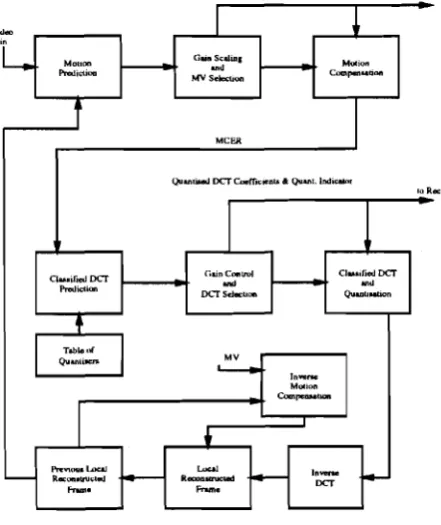
Let us now focus our attention on the proposed video codec. In order to curtail error propagation across im- age frames the codec was designed to switch between intra- and inter-frame modes of operation. In the i n t r a - f r a m e m o d e the encoder transmits the coarsely quant- ised block averages for the current frame, which provides a low-resolution initial frame required for the operation of the inter-frame codec at both the commencement and during later stages of communications in order to pre- vent encoder/decoder misalignment.
Gun Sc.lm'
MCFR
I
@ a n d DCT Camrmls C Quanl. Indscamr
Clu.,r,al DCI ClusnOal DCT
DCI Sdcurn
Figure 1: Encoder Schematic
Gain Controlled Motion Detection: At the com-
mencement of the encoding procedure the motion com- pensation (MC) scheme determines a motion vector (MV) for each of the 8 x 8 blocks. The MC search window is fixed to 4 x 4 pels around the centre of each block. Before the actual motion compensation takes place the codec tentatively determines the potential benefit of the compensation in terms of motion compensated error en- ergy reduction. In order to emphasize the subjectively more important eye and mouth region of the videophone images the potential gains for each motion compensated block are augmented by a factor of two in the centre of the screen. Then the codec selects the thirty blocks resulting in the highest scaled gain, and motion com- pensation is applied only to these blocks, whereas for all other so-called passive blocks the codec applies simple frame differencing.
Gain Controlled Quadruple-Class DCT: Pur-
suing a similar approach, gain control is also applied to the DCT-based compression. Every block is DCT transformed and quantised. Because of the non-stationary nature of the motion compensated error residual (MCER) the energy distribution characteristics of the DCT coef- ficients vary. Therefore four different sets of DCT quant- isers are available, all of which are tentatively invoked in order to select the best set of quantisers resulting in the highest energy compaction gain. Ten bits are allocated for each quantiser, each of which are trained Max-Lloyd quantisers catering for a specific frequency- domain energy distribution class. Again, the energy
Figure 2: PSNR Codec Performance
compaction gain values are scaled to emphasise the eye and mouth region of the image and the DCT coefficients of the thirty highest-compression blocks are transmit- ted to the decoder.
Partial Forced Update: The disadvantage of inter-
frame codecs is their vulnerability to channel errors. Every channel error results in a misalignment between the reconstructed frame buffer of the encoder and de- coder. The errors accumulate and do not decay, un- less a leakage-factor or a partial forced update (PFU) technique is employed. In our proposed codec in every frame 22 out of the 396 blocks, scattered over the entire frame, are periodically updated using the 4-bit quant- ised block means, which are partially overlayed on to the contents of the reconstructed frame buffer. The overlaying is performed such that the block's contents in the local buffer is weighted by 0.7 and superimposed on to the received block average, which is scaled by 0.3.
Bit Allocation Strategy: The bit allocation scheme
[image:2.551.305.533.6.108.2] [image:2.551.50.271.9.272.2]Frame index
Figure 3: PSNR degradation profile for Bits 2 & 11 of the MV
3. SOURCE SENSITIVITY
In order to apply source-sensitivity matched protection the video bits were subjected to sensitivity analysis. In reference [3] we have consistently corrupted a single bit of a video coded frame and observed the image peak signal-to-noise ratio (PSNR) degradation inflicted. Re- peating this method for all bits of a frame provided the required sensitivity figures and on this basis bits hav- ing different sensitivities can be assigned matching FEC codes. This technique, however, does not take adequate account of the phenomenon of error propagation across
F
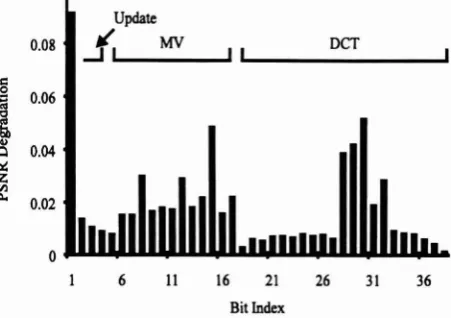
image frame boundaries. Therefore in this treatise we propose to use the method suggested in [4], where we corrupted each bit with a cettain fixed error probabil- ity and observed the PSNR degradation in consecutive frames due to a single error event in the current frame. As an example, the PSNR degradation profile is shown for Bits 2 and 11 of the MV in Figure 3, where these bits were corrupted in all the 30 MVs.
In order to quantify the overall sensitivity of any specific bit we have integrated (summed) the PSNR degradations over the consecutive frames, where they have had a measurable effect and averaged these values for all the occurances of the corresponding bit errors. These results are shown in Figure 4 for the 13 MV bits, 21 DCT bits and 4 partial forced update bits.
4. SOURCEMATCHED TRANSCEIVER
System Concept: The proposed system was designed for mobile packet video telephony and we experimented with two different modem schemes, namely 4-level and 16-level quadrature amplitude modulation (QAM). Our intention was to contrive a system, where the more be- nign propagation environment of indoors cells would benefit from the prevailing higher signal-to-noise ratio (SNR) by using 16QAM and thereby requiring only half the number of packets compared to 4QAM. When the
1 6 11 16 21 26 31 36
Bit Index
Figure 4: Integrated PSNR bit sensitivities
portable station (PS) is handed over to an outdoors microcell or roams in a lower SNR region towards the edge of a cell, the base station (BS) instructs the PS to lower its number of modulation levels to 4 in order to maintain an adequate robustness under lower SNR conditions.
Sensitivity-matched Modulation: Best robust- ness against channel errors is achieved, if sensitivity- matched forward error correction coding is used. In our proposed videophone scheme we will exploit that 16- level pilot symbol assisted quadrature amplitude mod- ulation [5] (16-PSAQAM) provides two independent 2- bit subchannels having different bit error rates (BER). Specifically, the BER of the higher integrity C1 subchan- nel is a factor 2-3 times lower than that of the lower quality C2 subchannel. Both subchannels support the transmission of two bits per symbol. This implies that the 16-PSAQAM scheme inherently caters for sensitivity- matched protection, which can be fine-tuned using a p propriate FEC codes to match the source requirements. This property is unfortunately not retained by the 4QAM scheme, but the required different protection for the source coded bits can be ensured using appropriately matched channel codecs, if the associated higher sys- tem complexity is acceptable.
Source Sensitivity: In order to find the appro-
[image:3.535.297.523.11.170.2] [image:3.535.34.268.13.153.2]0 5 10 15 20 25 30 35 4 0 CHANNEL SNRIDBI
-
RAV.YODIV -RAY,DIv +- r*YGN,FEC 8 *VGM,MOFECFigure 5: 16QAM PSNR versus channel SNR perform- ance over various channels
One bits to the C1 16-PSAQAM subchannel, while the Class Two bits to the C2 subchannel.
Forward Error Correction: Both convolutional
and block codes can be successfully used over mobile radio links, but in our proposed scheme we have fa- voured a binary Bose-Chaudhuri-Hocquenghem (BCH) code. BCH codes combine a good burst error correction capability with reliable error detection, a facility useful to invoke image post-enhancement and to control han- dovers between traffic cells. The preferred R=71/127 x
0.56-rate BCH(127,71,8) code can correct 8 errors in a block of 127 bits, a correction capability of about 6.3 %.
The number of channel coded bits per image frame be- comes 1136 x 127171 = 2032, while the bit rate is 20.32 kbps at an image frame rate of 10 framesls.
Transmission Format: The transmission pack-
ets are constructed using one Class One BCH(127,71,8) code, one Class Two BCH(127,71,8) code and a third one is allocated to the packet header, yielding a total of 381 bits per packet. In case of 16QAM these are represented by 96 symbols and after adding 11 pilot symbols using a pilot spacing of P = 10 as well as 4 ramp symbols to ensure smooth power amplifier turn onloff the resulting 11 1-symbol packets are transmit- ted over the radio channel. Eight such packets repres- ent a whole image frame and hence the signalling rate b e c ~ m e s 111 symbl12.5 ms
=
9 kBd. When using a time division multiple access (TDMA) channel band- width of 200 kHz, such as in the Pan-European second generation mobile radio system known as GSM and a modulation excess bandwidth of 38.8 %, the signalling rate becomes 144 kBd. This allows us to accommodate 144/9=16 users, which coincides with the number of so-called half-rate speech users supported by the GSM system.When the prevailing channel SNR does not allow 16QAM communications, 4QAM must be invoked. In
,
-
0 5 10 15 20 25 30 3 5 40 CHANNEL SNRfDB)
Figure 6: 4QAM PSNR versus channel SNR ~ e r f o r m - ance over various channels
this case the 381-bit packets are represented by 191 2-bit symbols and after adding 20 pilot symbols and 4 ramp symbols the packet-length becomes 225 symbl12.5 ms, yielding a signalling rate of 18 kBd. In this case the number of videophone users supported becomes 8, as in the full-rate GSM speech channel. The system also facilitates mixed-mode operation, where 4QAM users must reserve two slots in each 12.5 ms TDMA frame towards the fringes of the cell, while in the central sec-
tion of the cell 16QAM users will only require one slot
-
per frame in order to maximize the number of userssupported. Assuming an equal proportion of 4QAM and 16QAM users the average number of users per car- rier becomes 12. The equivalent user bandwidth of the 4QAM PSs is 200 kHz/8=25 kHz, while that of the 16QAM users is 200 kHz/16=12.5 kHz.
5. SYSTEM PERFORMANCE
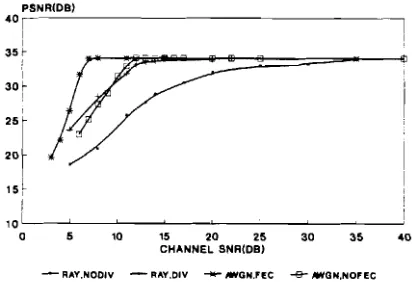
The video PSNR versus channel SNR performance of our videophone schemes is shown in Figures 5 and 6 for the 16QAM and 4QAM systems, respectively. The signalling rate was 144 kBd, the propagation frequency was 1.8 GHz and the vehicular speed was 30 mph. The system's performance was evaluated for the best-case additive white Gaussian noise (AWGN) channel and the worst-case Rayleigh (RAY) channel both with and without diversity (DIV). Observe in the Figure that the AWGN performance was evaluated also without for- ward error correction (FEC) coding in order to indic- ate the expected performance in a conventional tethered AWGN environment.
As expected, best performance is achieved over AWGN channels with FEC, requiring a channel SNR of about
15 and 7 dB in case of the 16QAM and 4QAM mo-
[image:4.587.52.261.6.148.2] [image:4.587.312.518.7.148.2]dB. Without FEC coding over AWGN channels these SNR values must be increased to about 20 and 12 dB, respectively. The system performance over Rayleigh
r-
channels with second order diversity is similar to the AWGN, NOFEC scenario, while without diversity SNRs of about 30 and 20 d B were needed for near-unimpaired PSNR performance.
6. CONCLUSIONS
A highly bandwidth efficient, fixed-rate mobile video- phone transceiver has been presented. The video source rate can be fixed to any arbitrary value in order be able to accommodate the videophone signal by conven- tional speech channels. In this treatise a source rate of 11.36 kbps was used, which is similar to the 13 kbps speech rate of the GSM system. After BCH(127,71,8) coding the channel rate becomes 20.32 kbps. When us- ing an adaptive transceiver, which can invoke 16QAM and 4QAM depending on the channel conditions ex- perienced, the signalling rate becomes 9 and 18 kBd, respectively. Accordingly, 16 or 8 videophone users can be accommodated in the GSM bandwidth of 200 kHz, which implies user bandwidths of 12.5 and 25 kHz, respectively. Over line-of-sight AWGN channels SNR values of about 15 and 7 d B are required to main- tain unimpaired PSNR values of about 35 dB, which is increased to around 20 and 12 dB for the diversity- assisted Rayleigh scenario.
- -
7. REFERENCES
[I.] IEEE Transactions on Circuits and Systems for Video Technology, Special issue on Very Low Bit Rate Video Coding, June 1994, Vol 4, No. 3, pp 213-357
[2] L. Hanzo et al: A Mobile Speech, Video and
Data Transceiver Scheme, Proc. of VTC'94, June 8-10, 1994, Stockholm, Sweden, pp 452-456
[3] R. Stedman, H. Gharavi, L. Hanzo, R. Steele, Transmission of Subband-Coded Images
via Mobile Channels, IEEE Tr. on Circuits and Systems for Video Technology, Feb 1993; Vo1.3,
. No. 1, pp 15-27
[4] L. Hanzo, J.P. Woodard An intelligent cord-
less voice terminal for indoors communications, submitted to IEEE Tr. on Veh. Technology, 1994
[5] W.T. Webb, L. Hanzo Modern Quadrature
Amplitude Modulation: Principles and Applica- tions for Wireless Communications, IEEE Press-