Abstract— In pursuance of increasing power plants’ competitiveness in energy market, these power plants need to embrace a proper operating and maintenance methodology in order to lessen the level of O & M (operation and maintenance) costs. Similar to this, Geothermal Power Plants ought to embrace as well the corresponding strategy, so that they can vie for their productivity and competitiveness. The prominence methodology needed should be able to achieve the equipment’s availability at maximum level whilst attaining cost of maintenance at optimum level. Reliability is a parameter which is successfully used to serve as a warning signal for maintenance managers to respond to the lower level of availability.
This paper demonstrates the application of Reliability Centred Maintenance (RCM) in Geothermal Power Plants. A case study of a geothermal power plant in Dieng - Central Java, Indonesia- operated by PT. Geo Dipa Energi was conducted. In this research, a framework for the implementation of RCM into Geothermal Power Plants was developed. The results include recommendations for 52 maintenance tasks to eliminate 36 malfunction of equipment that never happened, in the form of four lubricating task, four visual check task, 15 inspection tasks,18 scheduled restoration task, one scheduled discard task, and 10 no scheduled maintenance task..
Index Terms—RCM, geothermal power plant, maintenance, assets management
I. INTRODUCTION
ndonesia is one country in the world that have high levels of production and generating capacity of geothermal power is great. According to the US. Energy Information Administration [1], Indonesia is ranked third, after the United States and the Philippines, as the country with the level of production of electricity and geothermal power generation capacity by 2014. Currently, Indonesia is able to generate electrical energy for 1.3 gigawatts of all geothermal power plants in Java, Bali, North Sumatra and North Sulawesi. According to the Ministry of Energy and Mineral Resources [2], the amount of electrical energy generated currently uses only five percent of a total of 29
Manuscript received July 23, 2017; revised August 16, 2017. This work was supported in part by Islamic Development Bank, Jeddah, Saudi Arabia.
1Ir. Hari Agung Yuniarto, MSc, PhD, IPU works for the Industrial
Engineering Universitas Gadjah Mada, Yogyakarta 55281, Indonesia (corresponding author’s e-mail: [email protected]).
gigawatts of electric potential that can be generated from geothermal power. Seeing the potential of electrical energy produced from geothermal power in Indonesia is still very large, the potential development of geothermal power plants in Indonesia is expected to grow rapidly.
In pursuance of increasing power plants’ competitiveness in energy market according to Misra [3], these power plants need to embrace a proper operating and maintenance methodology in order to lessen the level of O & M (operation and maintenance) costs. Similar to this, Geothermal Power Plants ought to embrace as well the corresponding strategy, so that they can vie for their productivity and competitiveness. The prominence methodology needed should be able to achieve the equipment’s availability at maximum level whilst attaining cost of maintenance at optimum level. Reliability is a parameter which is successfully used to serve as a warning signal for maintenance managers to respond to the lower level of availability [4]. These problems can arise due to many factors, ranging from the life of the equipment, maintenance procedural error, until contact between the equipment and the working environment and equipment continuously. Based on research conducted by Akar and his colleagues [5], there are five maintenance problems are most common in geothermal power plants, namely corrosion, defects in the installation, maintenance errors, defects in electronic components, and the issues that have an impact on the environment.
Some researchers are trying to find solutions to the problems in geothermal power plants. Bore in 2018 [6] investigated the comparison between the methods of management (six-sigma, RCM, and lean maintenance) used in the maintenance system with AHP and cost modeling. Kariuki in 2013 [7] researched the relationship between the operation and maintenance costs and outages forces on the availability of equipment in geothermal power plants. Adele in 2009 [8] examines the evaluation methods for systems of geothermal power plants with a method of benchmarking with other geothermal power plants. Unfortunately, to date no single study has offered a systematic procedure of applying RCM (Reliability Centred Maintenance) to geothermal power plants [9].
This paper demonstrates the development of a framework for implementing RCM to a geothermal power plant. A case study of a geothermal power plant in Dieng - Central Java, Indonesia- operated by PT. Geo Dipa Energi was conducted.
Development of Procedure for Implementing
Reliability Centred Maintenance in Geothermal
Power Plant
Hari Agung Yuniarto1, Imam Baskara2
II. RESEARCH METHOD
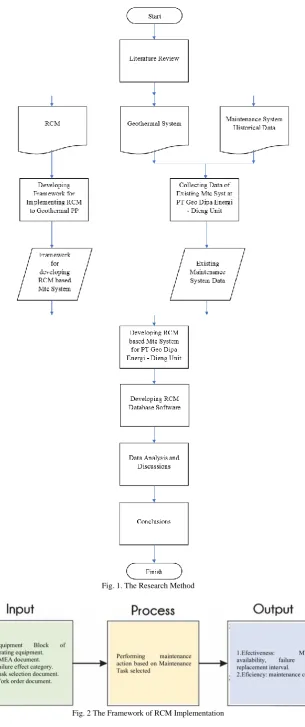
The first step in this research is to conduct literature study which includes gathering information and knowledge related to this research, that is RCM method as compilation of maintenance system built in this research, geothermal power plant system as a research object and historical data of maintenance at PT. Geo Dipa Energi - Dieng Unit. Literature studies on geothermal power plant system generate knowledge about the types of plants, equipment that work on each type of the plant, how each type of plant works, and common problems occur in a geothermal power plant system. The literature study of RCM produces knowledge and steps that must be taken in designing an integrated systematic maintenance system. Literature study of historical data of maintenance at PT. Geo Dipa Energi - Dieng Unit - produces operation procedure on geothermal power plant systems, equipment working on geothermal power plant and documents of historical data of equipment failure.
Next step is to develop framework for implementing RCM to the geothermal power plant. And parallel to this is to collect data of existing maintenance system at PT Geo Dipa Energi - Dieng Unit. Whilst the framework is established and the existing maintenance data is available, RCM is then applied to the geothermal power plant at the case study company. The following step is a stage where a web-based database software is built. This devised software will be used to store the input documents required by the maintenance system. The developed database software aims to support the maintenance system for recording documents that were initially done manually changed to online so that the resulting maintenance system could be more effective and efficient. Fig. 1 shows all steps of the research method explained above.
III. RESULTS AND DISCUSSIONS
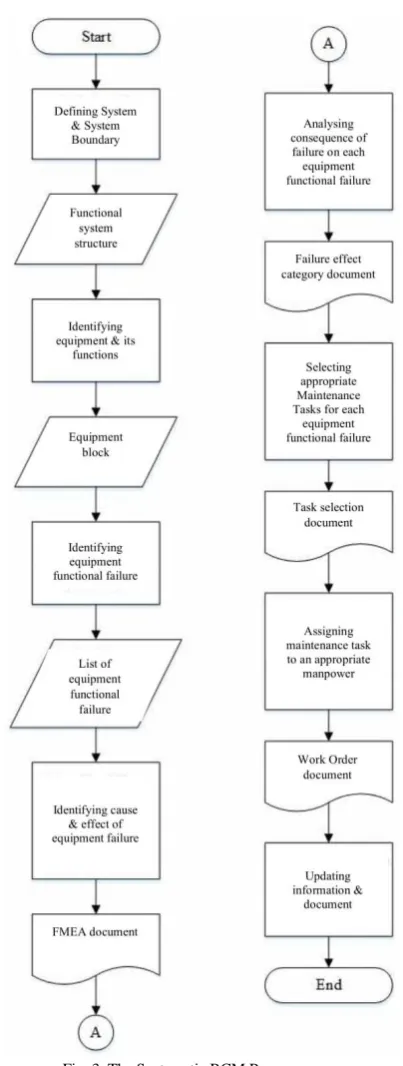
The devised framework for implementing RCM to a geothermal power plant consists of three parts namely Input, Process and Output. As can be seen in Fig. 2, the inputs used (Input) at the beginning of implementation of a maintenance system (Process) come from all documents generated during the implementation of the systematic RCM programme which is comprised of eight activities (see Fig. 3). In the Process, the maintenance tasks that have been selected in the final outcome of the systematic RCM programme are applied accordingly, so that it is expected the maintenance activities could effectively improve reliability of the system to be maintained and optimally solve the existing maintenance problems with cost efficient
(Output).
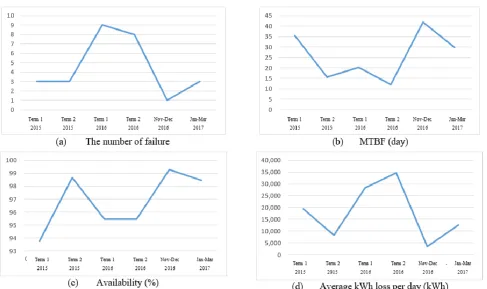
The implementation of the devised framework alongside the systematic RCM programme on the case study company results in the selection of 52 particular maintenance tasks comprised of 4 lubricating task, 4 visual/operational check tasks, 15 inspection/functional check tasks, 18 scheduled restoration tasks, 1 scheduled discard task, and 10 no scheduled maintenance tasks. The results of implementation are represented by certain parameters which are tabulated in Table 1. Four parameters are measured to assess performance of the RCM based maintenance system applied to the geothermal power plant of PT. Geo Dipa Energi - Dieng Unit - in which they are the number of equipment failure, mean time between failure, availability and average kWh loss per day. Compared to the performance before the RCM based maintenance system was implemented, the results after implementation shows that the number of equipment failure decreases, MTBF increases, availability increases as well as average kWh loss per day decreases as illustrated in Fig. 4. In conclusions, Fig. 4 provides evidence that performance of the case study’s geothermal power plant shows an upward trend.
IV. CONCLUSIONS
A devised framework for implementing RCM to geothermal power plants alongside its systematic RCM programme has been well established. Once validated in the case study company, it can help select 52 appropriate maintenance tasks comprised of 4 lubricating task, 4 visual/operational check tasks, 15 inspection/functional check tasks, 18 scheduled restoration tasks, 1 scheduled discard task, and 10 no scheduled maintenance tasks. The results of implementation show an upward trend in the performance of the case study’s geothermal power plant compared to the condition before the devised framework was implemented. Those parameters of performance are represented by the number of equipment failure, mean time between failure, availability and average kWh loss per day.
ACKNOWLEDGMENT
The authors wish to acknowledge support of Dr Khasani of the Mechanical Engineering UGM, Mr Ruly Husnie Ridwan of PT Geo Dipa Energi (Persero) and management
of The Geothermal Capacity
Building Programme Indonesia-Netherlands (GEOCAP) for the accomplishment of this research.
Fig. 1. The Research Method
Fig. 3. The Systematic RCM Programme
TABLE 1.
THE IMPLEMENTATION RESULTS OF RCM BASED MAINTENANCE SYSTEM
[image:4.595.201.403.44.578.2]Fig. 4. Before and After Implementation
REFERENCES
[1] US. Energy Information Administration, 2015. Indonesia has significant potential to increase geothermal electricity production.
[Online]. Available at: https://www.eia.gov/todayinenergy/detail.cfm?id=23392
[2] Ministry of Energy and Mineral Resources, 2014. Handbook of Energy & Economic Statistics of Indonesia. Jakarta: Pusdatin ESDM. [3] Misra, K. B., 2008. Maintenance Engineering and Maintainability: An
Introduction. In: Handbook of Performability Engineering. London: Springer-Verlag, pp. 755 - 772.
[4] Moubray, J., 1997. Reliability-Centered Maintenance. 2nd ed. New York: Industrial Press.
[5] Akar, N. et al., 2013. Risk Analysis of Geothermal Power Plants Using Failure Modes and Effects Analysis (FMEA) Technique. Energy
Conversion and Management, Volume 72, pp. 69 - 76.
[6] Bore, C. K., 2008. Analysis of Management Methods and Application
to Maintenance of Geothermal Power Plants, Iceland: United Nation
University.
[7] Kariuki, S. K., 2013. Maintenance Practice and Performance of Power Sector in Kenya, s.l.: University of Nairobi.
[8] Adele, M. A., 2009. Evaluation of Maintenance Management Through
Benchmarking in Geothermal Power Plant, Iceland: United Nations
University.