Abstract— Thermoelectric generator, (TEG) unit, utilizing the absorbed heat energy from manhole and chamber covers caused by solar radiation has the potential to replace the disposable batteries of instrumentation components like data loggers and flow meters. They are being used by water utility companies for flow and pressure measuring purposes and other water supply management applications. The TEG unit is installed directly in contact under a chamber cover. The radiant heat energy captured by the cover will be transferred to the TEG by conduction; thus, will be kept at high temperature as long as the cover is exposed to sun’s radiance. A pressure reducing valve (PRV), which is also installed in the piping system inside the chamber, is used to circulate cold water into the TEG system. The existence of the PRV substitutes the need for a pump to supply water by utilizing the pressure difference between its inlet side which is connected to the tube that would supply water to the TEG’s cold side and then from the TEG cold side to the outlet side of the PRV for the release of the heated water coming from the TEG. This would prevent thermal equilibrium since there will be continuous flow of water coming from the PRV cold source setup. The objective is to maintain the temperature difference between the two sides of the TEG in order to harvest electrical energy.
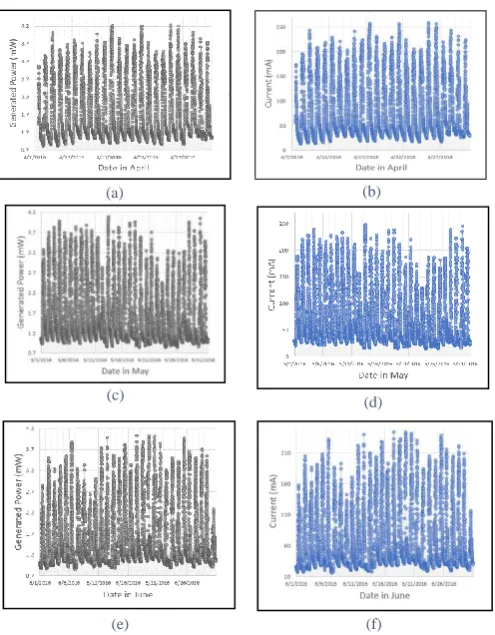
Both the temperatures of the hot side and the cold side are known, in which the maximum temperature difference is 40°C With these boundary conditions, the unknown temperatures in the system are solved, allowing estimation of the power generated by the TEGs using ANSYS. The results of numerical simulation showed the system generated an average power of 1.5 mW with a peak power of 5 mW during the hottest month of the year (April). Continuous operation would yield an energy which is competitive with the capacity of disposable batteries and this kind of harvesting system can provide an option for primary power for low power remote sensing instruments wherein constant and effective data gathering operation will not be affected.
Index Terms—energy harvesting, finite element method, thermoelectric generator, wireless sensor.
Manuscript received March 06, 2017; revised March 31, 2017. This work was supported in part by Maynilad Water Services Inc.
V. Valdez is a Master’s student from University of the Philippines Diliman and currently employed with Maynilad Water Services Inc. under Technical Services Division (tel:+63(2)9313416; e-mail:[email protected])
M. Berana is with the Mechanical Engineering Department, University of the Philippines Diliman and currently the Project Leader of Engineering Research and Development for Technology (ERDT) Program (tel: +63(2)9818500 loc 3159 to 60; e-mail: [email protected])
I. INTRODUCTION
t is estimated that more than half of energy consumed worldwide are being rejected primarily as waste heat [1]. Recovering and converting the waste heat into electrical power would be a big opportunity for many possible applications. A practical solution for reprocessing and harvesting waste heat is to use thermoelectric generators through thermoelectric energy harvesting. Thermoelectric generators (TEG) are devices that directly convert net heat transferred through temperature differences into usable electricity.
Thermoelectric energy harvesting has been regarded to be a promising method in converting waste heat to electrical power and has become one of the preferred thermal energy harvesting systems due to its well-known advantages such as absence of moving components, reduction of maintenance and also for mitigating global energy crisis without detrimental consequences on natural resources. The application of thermoelectric technologies from road infrastructure exposed from solar radiation is a beneficial topic that encompasses technologies that harvest waste energy which can be stored and eventually used to power small wireless sensors, switches and other wireless devices.
The idea of harvesting thermoelectric energy from road structures and pavements to power low power electronics is not new. Installation of thermoelectric modules that harvest thermal energy, such as the Road thermal energy conversion (RTEC), developed by Hasebe et al. [2] has already been presented in the literature. The basic mechanism of pavement cooling is heat absorption from the pavement through a heat collection tube installed in the pavement, in which, the water in the heat collection tube is circulated by a pump. In another study [3], the thermal fluctuations were used to predict the complex behavior of pavements and allowed to harvest thermal energy and supply this to buildings for various uses. The solar radiation and the inlet water flow, which is provided by a pump, are used as input signals whereas the temperature fluctuation of the smart pavement system is used for the output signal. Apparently, the aforementioned existing thermoelectric harvesting systems used pumps primarily for water circulation and to prevent the cold side to be in thermal equilibrium with the hot side of the TEG. However, electricity is required to
Modeling and Performance Analysis of a
Thermoelectric Energy Harvesting System from
Manhole, Logger Housing and Chamber
Structure for Water Utility Company
Applications
Victor Valdez and Menandro Berana
operate a pump, and this means a portion of the harvested energy has to be used just to operate this device. For this particular situation, harvested thermoelectric energy might not be sufficient during night time or days with minimal amount of solar radiation. Therefore, it is necessary to study and implement a new method in order to effectively utilize the harvested electrical energy.
The focus of this paper is to present an effective method of thermoelectric harvesting that uses the pressure difference between the inlet and outlet side of pressure reducing valve (PRV) to circulate cooling water into the system and mitigate thermal equilibrium (heat flow through the TEG will cease as will the electrical current) as well as to prevent previously mentioned flaw of the current thermoelectric harvesting systems.
As will be shown later in the paper, a thermoelectric generator is used as an energy harvesting device, converting the thermal gradient between two surfaces into electrical energy. To verify the feasibility and evaluate the performance of the proposed idea, a finite element based software with thermal-electric conduction capability was employed to simulate the system. The results demonstrate the feasibility of harvesting ambient thermal energy to power remote monitoring instruments such as data loggers and flow meters.
II. BACKGROUND OF THE STUDY
In 1821, Thomas Johann Seebeck found that a circuit made from two dissimilar metals, with junctions at different temperatures would deflect a compass magnet. Seebeck initially believed this was due to magnetism induced by the temperature difference and thought it might be related to the Earth's magnetic field [4]. However, it was quickly realized that a "Thermoelectric Force" induced an electrical current, which by Ampree's law deflects the magnet. More specifically, the temperature difference produces and electric potential (voltage) which can drive an electric current in a closed circuit. Today, this is known as the Seebeck effect [5]. The Seebeck effect is defined as:
o
V
T
(1)Where Vo is the emf generated, ΔT is the temperature difference between the junctions, and α is the Seebeck coefficient defined as the ratio of the electric field to the temperature gradient along the conductor. He also concluded that the magnitude of the emf generated was proportional to the temperature difference, depended on the type of conducting material, and is not a function of temperature distribution along the conductors [6].
A thermoelectric generator (TEG) converts heat into electricity in solid or liquid conductors by means of the phenomenon of Seebeck effect. TEG is a solid-state with no moving parts, light weight, and environment friendly energy conversion instrument which can represent a method that recovers waste heat from the thermal gradient of pavement structures like manhole covers, road asphalts or concrete pavements. Roads and pavements receive large amount of solar energy which is eventually dissipated as thermal energy. The heat involved in the difference in temperature between these structures and the ambient temperature can be harvested and converted into electricity that can be used to
power sensors, like for example, flow and pressure recording instruments for network monitoring purposes.
The efficiency (η) of thermoelectric generator, which is the ratio of the power delivered by the unit to the heat flow through the module, can be expressed as
0.5
0.5
1
1
1
1
h c avg
h avg
T
T
ZT
T
ZT
(2)Where the first term is the Carnot efficiency and ZT is the figure of merit, which is based on parameters Seebeck coefficient α, the electrical conductivity σ, the thermal conductivity K and dependent materials properties (T) is defined as
2
ZT
T
K
(3)Conversely, figure of merit ZT of n-type and p-type semiconductors has to be redefined too
22
`
p np n
p n
T
ZT
K
K
(4)
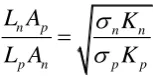
Furthermore, ZT is maximum when the product of the total resistance of the legs and the thermal conductance has minimum value. This happens when
n p n n
p n p p
L A
K
L A
K
(5)Lastly, assuming that temperature difference ΔT is spread over across the n-type and p-type legs of the thermoelectric module. This sets a maximum ΔT that can be sustained and it is defined as [7]
2 max
T
ZTc
(6)III. STATEMENT OF THE PROBLEM
Water utility companies in the Philippines, like Maynilad and Manila Water are continuously innovating to improve processes that will further enhance operational efficiencies [8]. Numerous flow and pressure measuring instruments are installed all over their concession areas for water distribution and management monitoring. It is important to monitor the activities of the water network closely, in order to identify which areas are experiencing low pressure, or even too much water pressure.
[image:2.595.388.465.376.415.2]Fig. 1. Representation of a thermoelectric generator with its main components.
[image:3.595.343.545.124.347.2]Fig. 2. The architecture of data gathering for the thermoelectric harvesting
[image:3.595.322.556.380.498.2]Fig. 4. Temperature of hot junction from April-June 2016 Fig. 3. A thermocouple to measure the temperature on the hot side of the system
Nobody would anticipate a problem with less than a hundred batteries, but when there are more than a thousand instruments being installed in the field, the eventual enormous scale of battery replacement and other maintenance expenses will become a major concern.
As of April 2017, almost four thousand data loggers and flow meters are installed in the entire Maynilad concession area. Most of these instruments are powered by disposable batteries to be able to collect flow and pressure data and then send these data directly via short message service (SMS). These instruments are being maintained, and batteries are replaced yearly which amounts to about 4, 000 batteries (cost is about 320,000 USD). But the massive battery replacements and impractical maintenance cost can be reduced and this can be made possible through utilization of energy from naturally occurring energy sources.
IV. DATA GATHERING ARCHITECTURE AND METHODOLOGY A complete data gathering architecture consisting of components is shown in Figure 2.
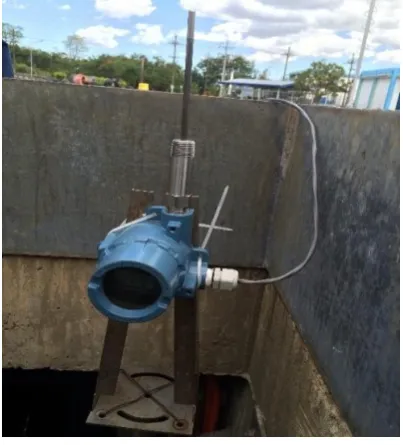
1. The thermocouple is installed and its sensor is in contact with chamber cover to measure the temperature of the hot side of the system (Figure 3). The instrument has the capability to measure up to 150°C but barely configured to 65 degree Celsius at maximum (for hot side) to attain accurate measurements. Data are gathered in a span of almost three months from April to within June to determine the possible maximum temperature that can be recorded (Figure 4). Conversely, only few samples were taken on the
cold side of the system as the temperature change on this part is negligible. The data shows that the maximum and minimum temperature differences between the cover and the pipe are 40°C and 5°C, respectively, which are enough to power small wireless sensors [9].
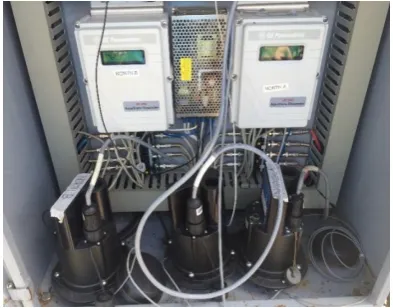
2. A data logger is also installed (Figure 5) to log the measured temperature by the thermocouple on the hot side of the system. The logger is configured to send logged data every eight hours to the base station via short message service (SMS).
3. A GSM modem which is installed in the base station receives data from the data logger.
4. A machine server receives and then decrypts the compressed data files and convert these to comma separated value (CSV) file which can now be imported to another table-oriented applications like Microsoft excel.
[image:3.595.48.290.490.620.2]Fig. 5. A 3-channel Cello logger is installed to log the
measured temperature by the thermocouple MATERIAL PROPERTIESTABLE I
Fig. 6. Thermoelectric harvesting using data logger housing as heat source
V. STEADY-STATE THERMAL-ELECTRIC CONDUCTION MODELING
The transient thermal-electric analysis was used to determine temperatures and other quantities that vary over time and also to represent each material of the TEG which are: bismuth telluride for the module legs, copper for the terminals and alumina ceramic for the module casing. Likewise, meshing, boundary conditions and material properties were also done in this model wherein isotropic thermal conductivity was identified for thermal materials.
A. Meshing and Boundary Conditions
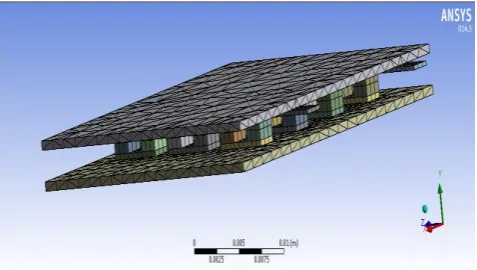
This study used finite element method by means of commercial software package ANSYS Academic Release 14.5 and SOLID226 [10] were selected to discretize the computational domain. Meshing of the computational domain composed of 63, 770 elements and total nodes of 31, 903 with element size of 3x10⁻⁴ m was built in order to
examine thermal distributions. In order to test the mesh-independent performance of the grid system in the numerical simulation, three models with nodes numbers of 23, 104 (coarse), 42,349 (medium) and 63,770 (fine) were used to examine the result of the harvesting system. Setting the probe voltage at 0.008V, the maximum percent difference of the reaction probe between the three models is only 0.5%, which only determines that numerical calculations were grid-independent.
For the boundary conditions, the input temperature over the hot side is variable with a time step of 300 s, while the cold side is set to constant temperature of 25°C, which is the initial reading of the thermocouple. Initially, a voltage of 0 V and 0.008 V are set for the low potential and high potential boundary conditions, respectively. Other values and conventions are used to calculate the model based on some reasonable assumptions, which aimed at simplifying the model without too much deviation from the real conditions: (a) all the surfaces except the hot-end and cold-end have very small heat convection of 3 W/m2K; (b)
cooling water conveyed on the cold side of the TEG makes the temperature constant at 25°C; (c) conductive resistance through the wall of the structures is negligible; (d) electrical contact resistance and thermal contact resistance are taken into consideration, but contact layer thickness is neglected; and (e) the axial heat conduction within the TEG is negligible, as the transverse conduction along the TEG will be dominant.
B. Material Properties
There are relativity few materials known to date that can be considered thermoelectric materials such as alloys of chalcogenides (materials 49 with a chalcogen or IUPAC group 16 anion). Specifically, these materials are either based on bismuth telluride (Bi2Te3) or lead telluride (PbTe)
[11]. Bismuth telluride (Bi2Te3) is the most common TEG
material and was used as the simulation material in this paper. The properties of this material such as the Seebeck coefficient and thermal conductivity all depend on temperature. The physical properties of the thermoelectric module legs that were taken from [12] were used for the simulation.
Material Properties Bi2Te3 Copper Alumina Ceramic
Density
kg/m3 7530 8960 3570
Thermal Conductivity
W/m-K 1.5 386 35.3
Specific Heat
J/kg-K 544 385 837
Isotropic Resistivity
Ω-m 1e-5 1.7e-8 5e-9
Seebeck Coefficient
μV/K 225 - -
VI. THERMOELECTRIC ENERGY HARVESTING
Figure 6 shows the setup for thermoelectric harvesting on logger housing.
[image:4.595.305.549.257.506.2]Fig. 7. Sample pressure profile of the inlet and outlet of a PRV collected from April to June 2016
[image:5.595.305.549.226.287.2]Fig. 8. Thermoelectric energy harvesting system flow diagram
[image:5.595.311.550.624.759.2]Fig. 9. Mesh model of the thermoelectric energy generator TABLE II
COST COMPARISONS BETWEEN DISPOSABLE BATTERIES AND THERMOELECTRIC GENERATION
the pipe. The main objective is to maintain the temperature gradient between the two sides of the TEG in order for the semiconductor materials to continue creating the desired electrical energy to power remote measuring instruments.
Due to the relatively small power output of a typical thermoelectric generator, a boost converter and low power DC to DC converter are to be used to increase the thermoelectric output voltage of the installed TEGs. As a result, the augmented electrical power output from the DC to DC converter is then accumulated and stored which can harvest more power from the entire harvesting system. A flow diagram of a thermoelectric energy harvesting system is shown in Figure 8. A boost converter is to be used as the expected temperature difference of the harvesting system ranges from 5°C to 40°C—which might not be enough to directly operate a DC to DC converter. The output of the DC to DC converter is to be connected directly to an electrical load in order to power the flow meter sensors or recharge the battery of a data logger. Likewise, it can also be connected to a super capacitor for electrical storage purposes. The energy stored in the super capacitor can then be collected over time, and released to the load when required such as power shortage during night time, power interruption or battery exhaustion. The addition of the super capacitor in the system enables much higher levels of current to be drawn by a load, if only for a short period of time, and makes the system more versatile [13]. Commercially available boost converters and low power DC to DC converters can operate from very low thermoelectric output voltages of 20mV, outputting a DC output voltage between 2.2 V to 5 V.
VII. THERMOELECTRIC ENERGY HARVESTING ECONOMIC FEASIBILITY ASSESSMENT
The feasibility assessment of the thermoelectric harvesting involves investigation whether this technology is likely to succeed. Furthermore, this section gives emphasis to the evidence if the prototype model system can be built within budget and how the cost differs from the current setup being used.
It is estimated that the possible product cost would be 400 USD per unit. This includes the thermoelectric modules, the
DC-to-DC converter, connections and bonding materials (soldering iron, electrical tape, thermal paste, etc.). However, the initial cost does not account the potential savings from mass production, system specification reduction or alteration. Variable costs and operating costs for the fabrication of the system are also not included since there will be no yearly maintenance nor annual operational cost required since life expectancy of the TEG module is about ten years [14].
Below is the cost comparison between the use of disposable batteries and thermoelectric generation.
Description Disposable Batteries Thermoelectric Generation
Life Expectancy (hours) 8760 87600
Cost (USD) 100 400
Cost per hour 0.0114 0.00457
Cost Comparison 0.4 2.5
Based on the above table, it is evident that thermoelectric generation is 2.5 times cheaper compared to disposable batteries currently used in data loggers. Therefore, the benefits to utilize the harvested thermoelectric energy as a substitute to disposable batteries is recommendable and feasible.
VIII. RESULTS AND DISCUSSION
[image:5.595.45.291.695.741.2]Fig. 10. Temperature distribution of the thermoelectric generator
(d)
(a) (b)
(c)
(e) (f)
Fig. 11. Generated power and current from May-June 2016 IX. CONCLUSION
Continuous thermal energy can be harvested from pavement structures like road, asphalts and even buildings. For this study, thermoelectric energy are being harvested from the manhole covers and data logger housing that all day long receive huge amount of solar energy. The estimation of generated power of the harvesting design was done using ANSYS Academic Release 14.5. The maximum recorded temperature of the hot side is almost 65°C while the cold side is constant at 25°C. With these boundary conditions, the unknown temperatures in the system are solved, allowing estimation of the power generated by the TEGs. The results of numerical simulation showed the system generated an average power of 1.5 mW with a peak power of 5 mW during the hottest month of the year (April). Continuous operation at 1.5 mW would yield an energy which is competitive with the capacity of disposable chemical batteries; and this kind of thermoelectric harvesting system can provide an option for power autonomy for low power remote sensing instruments like data loggers and flow meters, wherein constant and effective data gathering operation will not be affected.
X. RECOMMENDATIONS FOR ADVANCEMENT Thorough and generalized procedures for verification and validation of the simulation results through experimentation are still in the early stage of development. While the data gathering methodology and simulation procedures to generate estimated power and other parameters have already been established, much work is needed to develop the hardware of the thermoelectric harvesting to complement the established computational model and to produce quantifiable results. These experimental procedures should also be utilized to further improve the intelligence and increase the confidence in the predictive capability of the computational model. Furthermore, providing the thermoelectric hardware can establish validation metric between computational results and experimental data, which is an essential substance in a research.
Regarding the simulation method that was used in this research, one-dimensional analysis is sufficient to predict the main characteristics such as power generated, total current density and output voltage. But thermoelectric generator unit is highly customizable. Simulating the multiple same-type elements and analyzing an assembly process, which is often designed in parallel groups, a three-dimensional finite element method shall be used to model the much complex thermal and electrical system.
REFERENCES
[1] J. Limardo, "NREL discovers nanotubes may be key to heat waste capture," Daily Energy Insider, 08 April 2016. [Online]. Available: https://dailyenergyinsider.com/innovation/270-nrel-discovers-nanotubes-may-key-heat-waste-capture/.
[2] M. Hasebe, Y. Kamikawa and S. Meiarashi, "Thermoelectric Generators using Solar Thermal Energy in Heated Road Pavement," 25th International Conference on Thermoelectrics (ICT), 2006. [3] Y. Kim, R. Mallick, S. Bhowmick and B.-L. Chen, "Nonlinear
System Identification of Large-scale Smart Pavement Systems," Expert Systems with Applications, pp. 3552-3553, 2012.
[4] J. C. Pérez, "Integration of thermoelectricity to stretchable electronics," Stretchable Thermoelectronics, p. 40.
[5] California Institute of Technology, "Thermoelectrics: Caltech Materials Science," 1895. [Online]. Available: http://thermoelectrics.caltech.edu/thermoelectrics/history.html. [6] M. A. Karri, "Modeling of an Automotive Exhaust," pp. 10-11, 2005 [7] D. Paul, "Thermoelectric Energy Harvesting," in Thermoelectric
Energy Harvesting, ICT - Energy - Concepts Towards Zero - Power Information and Communication Technology, 2014.
[8] "Changing Tides," Maynilad Water Services Inc. 2012 Annual Report, pp. 24-25, 2012.
[9] S. Priya and D. J. Inman, Energy Harvesting Technologies, Springer Science & Business Media, 2008, p. 338.
[10] ANSYS Academic Release version 14.5, SOLID226, Software packages of ANSYS, Inc., http://www.ansys.com/
[11] U.S. Department of Energy, "Direct Thermal Energy Conversion Materials, Devices, and Systems,” Quadrennial Technology Review 2015
[12] Laird Tech. [Online] Laird Technologies.
http://cdn.lairdtech.com/home/brandworld/files/THR-BRO-Thermal20Handbook200110.pdf.
[13] C. A. Gould, A. Shammas, S. Grainger and I. Taylor, "Thermoelectric power generation: Properties, application and novel TCAD simulation," 14th IEEE European Conference on Power Electronics and Applications (EPE2011), Aug 30th to 1st Sept 2011, pp. 1-10. [14] Lombardo, Tom. 2014. World's Most Powerful Thermoelectric
Generator. Engineering.com. [Online] 12 October, 2014. [Cited: April
01, 2017.]
[image:6.595.34.282.461.779.2]