A Study on Applying Interactive Multi-objective
Optimization to Multiagent Systems
Toshihiro Matsui
Abstract—Constraint optimization problems in multiagent systems have been studied as fundamental problems of decision making and resource allocation. When each agent has its own specific interest in a problem, that task is defined as a multi-objective optimization problem with asymmetric functions. Since multi-objective problems have a number of Pareto optimal solutions in general cases, a preferred solution is selected using an appropriate criterion. The interactive methods are approaches of solution methods for multi-objective optimization problems, where a solution is repeatedly modified based on user-specified parameters. While interactive methods are developed for single users, such a framework can be considered as the base of analysis or games on multiagent systems by replacing single users with sets of agents. To study such an approach, this paper investigates a framework that resembles the interactive aspiration level methods employing a scalarization criterion that addresses unfairness among agents, and evaluates an example case of interaction.
Index Terms—multiagent, multi-objective, interactive method
I. INTRODUCTION
Constraint optimization problems in multiagent systems have been studied as fundamental problems of decision making and resource allocation. When each agent has its own interest in a problem, it is defined as a multi-objective optimization problem with asymmetric functions. In an asymmetric problem, each agent has its own individual evaluation on part of the problem, which is represented as its own objective function. Such classes of problems have been recently studied for decentralized optimization in multiagent systems [1], [2], [3], [4], [5]. While traditional optimization problem optimize the summation of objective functions, multiple objectives should be simultaneously op-timized. This formalization is critical for several practical resource allocations such as task allocation with battery consumption, and collaborative team generation considering both the efficiency and the fairness of all members. For multi-objective problems in multiagent systems, each multi-objective cor-responds to an individual agent. Since multi-objective prob-lems have a number of Pareto optimal solutions in general cases, a preferred solution is selected using an appropriate criterion [6], [7]. The interactive methods are approaches of the solution methods for multi-objective optimization problems, where a solution is repeatedly modified based on user-specified parameters [8]. While interactive methods are developed for single users, such a framework can be considered as a base of analysis or games on multiagent systems by replacing single users with sets of agents. For example, agents may require information about the current
This work was supported in part by JSPS KAKENHI Grant Number JP16K00301.
T. Matsui is with the Nagoya Institute of Technology, Gokiso-cho Showa-ku Nagoya 466-8555, Japan. e-mail: [email protected].
f1
x3
1 2
3
a g en t
f3
[image:1.595.372.487.166.273.2]x1 x2 f2
Fig. 1. Asymmetric multi-objective COP
solution to review their positions in the current solution to investigate the possibilities of selecting another solution based on their other preferences. To study such an approach, this paper investigates a framework that resembles interactive aspiration level methods employing a scalarization criterion that considers unfairness among agents, and evaluates an example case of interaction.
The rest of this paper is organized as follows. In the next section, several preliminaries of this study, including problem settings, the concepts of multi-objective problems, the scalar-ization criteria, and interactive methods, are presented. In Section III, a framework of an interactive solution method for agents is presented. The proposed approach is experimentally evaluated in Section IV and discussed in Section V. Then the paper is concluded in Section VI.
II. PRELIMINARIES
A. Multiobjective problem among agents
Asymmetric multiple objective problems for multiagent systems have been recently studied [1], [2], [3], [4], [5]. This paper investigates such problems assuming central-ized solution methods. Here a class of asymmetric multi-objective constraint optimization problems, which resembles an asymmetric multi-objective distributed constraint opti-mization problem [4], [5], is addressed. An asymmetric multi-objective constraint optimization problem (asymmetric multi-objective COP) is defined as follows.
Definition 1 (asymmetric multi-objective COP for agents):
An asymmetric multi-objective COP is defined by
xi,1,· · ·, xi,k ∈ Xi. fi(xi,1,· · ·, xi,k) is simply denoted by fi(Xi). Although ideally, objective functions should be simultaneously maximized, there are trade-offs among them in general cases. The goal is to find an optimal solution under a criterion.
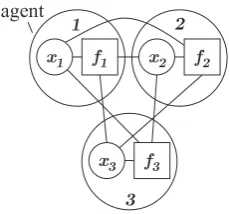
Figure 1 shows an asymmetric multi-objective COP with three agents, each of which corresponds to its variable and function. In this example, each agent has a ternary function, which represents an objective of the agent.
Since each agent prefers to maximize the utility values of its own objective function, this is a multi-objective problem. A tuple of the utility values of all the objective functions for an assignment is defined as an objective vector.
Definition 2 (Objective vector): Objective vectorvis de-fined as [v1,· · · , vK], where vj is an objective value for agent j. Vector F(X) of the objective functions is defined as [f1(X1),· · · , fK(XK)], where fj(Xj) is an objective function for agent j. For assignment A, vector F(A) of the functions returns objective vector [v1,· · ·, vK]. Here vj =fj(A↓Xj).
Since there are trade-offs among objective functions in general cases, those objectives cannot be maximized simul-taneously. Therefore, the objective vectors are compared with Pareto dominance [6], [7]. The dominance between two objective vectors is defined as follows.
Definition 3 (Pareto dominance): Vector v dominates v′ if and only ifv≥v′, andvk> vk′ for at least one objective k.
Based on Pareto dominance, Pareto optimality is defined as follows.
Definition 4 (Pareto optimality): Assignment A∗ is Pareto optimal if and only if there is no other assignment A, such that F(A)≥F(A∗), and Fk(Ak)> Fk(A∗k)for at least one objectivek.
In general cases, there are multiple Pareto optimal solu-tions. The set of objective vectors corresponding to the Pareto optimal solutions is called a Pareto front.
When the objective functions represent cost values, the problem is defined as a multi-objective minimization prob-lem. In this case, the comparisons of the values are inverted.
B. Scalarization and optimization
The order on objective vectors is defined by scalarization or a social welfare criterion. With scalarization, a single objective problem whose optimal solution is Pareto optimal is defined from the original multi-objective problem. There are several scalarization and social welfare criteria [7], [6].
Summation ∑Kj=1fj(Xj) of the objectives is traditional social welfare. The summation is a ‘utilitarian’ criterion, since it represents the total value of the objectives. Even though the maximization on summation ensures Pareto opti-mality, it does not capture the equality of these objectives.
Maximin maximizes the minimum objective value. Al-though maximin improves the worst case, it is not Pareto optimal. Maximin is also improved by a summation that breaks the ties of maximin ordering. See the literature [6], [7] for the details of the above criteria.
Leximin is a lexicographic order on the objective vectors whose values are sorted in ascending order.
Definition 5 (Sorted vector): A sorted vector based on vector v is a vector where all the values in v are sorted in ascending order.
Definition 6 (Leximin): Let v = [v1,· · ·, vK] and v′ =
[v1′,· · · , v′K] respectively denote the sorted vectors of iden-tical lengthK. The relation of leximin ordering≺leximinis defined as follows. v ≺leximin v′ if and only if ∃t,∀t′ < t, vt′=v′t′∧vt< vt′.
The leximin is an ‘egalitarian’ criterion, since it reduces the inequality of the objectives. Maximization on leximin ordering ensures Pareto optimality.
The above scalarization and social welfare criteria can be applied to minimization problems by inverting the com-parisons. Maximin is redefined as ‘minimax’. In this case, the maximization function is called a Tchebycheff function. Maximization on leximin is redefined as minimization on ‘leximax’.
C. Interactive method based on aspiration levels
Since scalarization approaches only capture a part of the original Pareto front, they are modified as the para-metric criteria to find other Pareto optimal solutions. Several parametric criteria cannot fit in part of the original Pareto front. For example, weighted summation
∑K
j=1wifj(Xj) cannot fit several non-convex parts of the original Pareto front. Since weighted min/max(Tchebycheff function) min/maxKj=1wifj(Xj) is not Pareto optimal, its variant with a tie-break by summation is Pareto optimal and fits the original Pareto front well. Therefore, this scalarization function is commonly used.
In this approach, the appropriate parameters depend on a user’s preferences. To determine the parameters, interactive solution methods are employed, where a problem is repeat-edly solved with different user-specified parameters [8]. In interactive methods, ideal points are employed as the base levels of objective values. Ideal pointfi∗of fiis determined as the ideal value of fi. For a minimization problem1, the following type of interactive methods is employed.
minimize
[max
fi∈F
wi(fi(Xi)−fi∗),
∑
fi∈F
wifi(Xi)].(1)
Here the summation part is employed as a tie-break on the maximization part. While the user can modify parameterswi by referring to the previous results in this framework, weight valueswi are not intuitive.
As an intuitive approach, the aspiration level is em-ployed [8], [9]. Aspiration level fti is a desirable value of fi at the tth interaction step. For a minimization problem, an interactive method employsfti as follows.
minimize
[max
fi∈F
wi(fi(Xi)−f t i),
∑
fi∈F
wifi(Xi)] (2) where wi= 1/(f
t
i−fi∗). (3)
In this case, the user directly determines the desirable value offi, andwi becomes a normalization value.
1Here a simple case of minimization problems is shown to combine
f1
f2
f1
f2
u s er
age nt
me d i ato r s o
l ver
Fig. 2. Interactive method for agents
III. FRAMEWORK OF INTERACTIVE SOLUTION METHOD FOR AGENTS
A. Interactive method for agents
The original interactive methods were developed for single users to provide an intuitive user interface. On the other hand, in multiagent settings, such methods can be considered as interaction between a solver and a set of agents. In such a framework, the solver serves as a mediator among the agents. In the interaction, the agents repeatedly set their aspiration levels and the mediator solves the problem. To determine the next aspiration level, the mediator must reveal some information about the current solution.
Figure 2 shows the concept of the proposed framework, where user and solver correspond to a set of agents and a mediator. In the case of a multiagent, the mediator might hide the details of individual private objectives for all agents. Instead, some statistical information can be provided about the solution quality as well as some suggestions or strategies to choose another solution. Based on such information, agents adjust the aspiration levels for their own objectives, and the mediator solves the problem again.
For the above framework, two major parts of the system must be addressed: (i) the solver should manage the fairness among agents. (ii) some schemes are necessary to choose the next aspiration levels. Below, the leximax criterion for fairness is applied to modify the weighted Tchebycheff function for aspiration levels. Also, an experimental strategy to determine the aspiration levels for the interactions of agents is investigated.
B. Criteria for agents
Here we focus on the maximization problem. While utility functions can be redefined as cost functions, Eqs. (2) and (3) are modified for maximization problems as follows:
minimize
[max
fi∈F
wi(f t
i−fi(Xi)),−
∑
fi∈F
wifi(Xi)](4)
where wi= 1/(fi∗−f t
i). (5)
Note that the ‘unsatisfactory’ values are still minimized. On the other hand, the summation values for tie-breaks are maximized in this case.
While the minimization on the Tchebycheff function op-timizes the worst case, it does not capture fairness among objective values. In multiagent settings, it is natural to employ another criterion for fairness. Therefore, we employ leximin-based criteria. Since each wi(fi(Xi)−f
t
i) should be minimized in such cases, the sorted objective values are compared in descending order. Therefore, minimization on ‘leximax’ is applied to the sorted vectors:
minimize
[v1,· · ·, vK]based on leximax (6) where vi=wi(f
t
i−fi(Xi)) (7) wi= 1/(fi∗−f
t
i). (8)
Note that the summation part for the tie-break is now unnecessary, since leximax repeats it between the values of the vectors in descending order.
As shown above, a criterion based on the aspiration level can be applied to interactive methods. On the other hand, in the case of multiagents, the scale of the criterion might be common for all agents, while weight value wi in the above criterion emphasizes aspiration levels that are closer to ideal points. In some interaction strategies for agents, simpler weight values will be intuitive.
The simplest weight value is a constant valuewi= 1. In this case, the criterion directly represents the ‘unsatisfactory’ values of agents with a common scale.
A different weight value can be defined based onfi⊤ and fi⊥, which are the maximum and minimum values offi(Xi), as follows.
wi= (fi⊤−minj fj⊥)/(maxj fj⊤−minj fj⊥). (9) This emphasizes the agents, whosefi⊤ values are relatively large, when the summation of all the objective values is considered.
C. Interaction among agents
When the interactive solution method is considered to be a mediator, the solution method should provide information of the current solution to determine the next aspiration levels of the agents. Such information includes the number of agents, the summation of the objective values, the minimum objective value, and other statistic values, so that agents are aware of their position in the current solution. Based on the solution’s information, the agents modify their aspiration lev-els to search for another solution. This approach is considered as analysis or games performed by agents. Since there are various strategies and criteria to choose the aspiration levels, here a simple case of trade-offs among agents is addressed as the preliminary study.
TABLE I PARETO FRONT
func. arity Pareto Pareto
a opt. slts. front sz.
uniform 3 707 654
5 4285 4268
gamma 3 1362 1297
5 9057 9053
TABLE II
SOLUTIONS OF ASPIRATION LEVEL METHODS
func. uniform gamma
aritya 3 5 3 5
asplb[%] criteria P N P N P N P N
100 wgttbc 1 0 1.2 0 1 0 1 0
lexmax 1 0 1.1 0 1 0 1 0
75 wgttbc 1 0 1 0 1 0 1 0
lexmax 1 0 1 0 1 0 1 0
50 wgttbc 1 0 1 0 1 0 1 0
lexmax 1 0 1 0 1 0 1 0
0 wgttbc 1 0 1 0 1 0 1 0
lexmax 1 0 1 0 1 0 1 0
P: Pareto optimal solutions. N: Non Pareto optimal solutions.
TABLE III
SOLUTIONS IN ASPIRATION LEVEL METHOD(UNIFORM,a= 3)
asplbcriteria asp. org.
[%] min max sum mTheil var. min max sum Theil var. 100 wgttbc 0 31.97 134.4 0.313 145.95 6.8 10 85.7 0.0103 1.425
lexmax 0 31.97 134.4 0.313 145.95 6.8 10 85.7 0.0103 1.425 75 wgttbc -0.913 2.80 4.6 0.234 1.97 4.72 10 82.25 0.0304 3.262 lexmax -0.903 2.80 5.1 0.233 1.87 4.7 9.99 81.61 0.0308 3.257 50 wgttbc -0.951 1.11 -2.0 0.230 0.68 4.62 10 82.03 0.0312 3.343 lexmax -0.946 1.11 -1.7 0.227 0.64 4.61 9.99 81.38 0.0321 3.375 0 wgttbc -0.977 0.13 -5.7 0.231 0.20 4.55 10 81.78 0.0354 3.559 lexmax -0.974 0.13 -5.6 0.228 0.19 4.52 9.99 81.25 0.0357 3.557
is necessary, since the agents already have a Pareto optimal solution.
For a maximization problem with leximin, the agents of the minimum objective value are basically ‘bottle-neck’ agents that relate to implicit constraints on the criterion. How they affect the solution can be an interest. The bottle-neck agents are aware of that when the solver provides a current partial solution for each agent and the statistic information of the objective values. Then such agents reduce their aspiration levels and the solution method is performed again. Here the influences of the aspiration levels on the solution quality, in-cluding Pareto optimality, are mainly addressed with simple cases.
IV. EVALUATION
A. Fairness among agents in aspiration level method
In the first experiment, the effects of the criteria on the aspiration level methods are evaluated. The problem consists of ten ternary (i.e.,|Di|= 3) variables and ten functions for ten agents. Since the Pareto optimal solutions and the Pareto front were enumerated using a brute-force search, the size of the problems was restricted. Aritya(i.e., the scope sizes) of the functions was either three or five. The following two cases of function values were evaluated:
• uniform: an integer value in [1,10] based on uniform distribution.
TABLE IV
SOLUTIONS IN ASPIRATION LEVEL METHOD(UNIFORM,a= 5)
asplbcriteria asp. org.
[%] min max sum mTheil var. min max sum Theil var. 100 wgttbc 0 33 152 0.396 155.8 6.7 10 84.8 0.0111 1.558
lexmax 0 33 154 0.375 138.4 6.7 10 84.6 0.0098 1.384 75 wgttbc -0.8947 2.07 4.32 0.284 1.16 4.76 10 81.85 0.0304 3.304 lexmax -0.8863 2.07 4.51 0.285 1.13 4.79 10 81.53 0.0306 3.302 50 wgttbc -0.9297 0.63 -2.18 0.279 0.31 4.71 10 81.24 0.0328 3.447 lexmax -0.9292 0.63 -2.16 0.278 0.31 4.72 10 81.25 0.0324 3.407 0 wgttbc -0.9619 -0.15 -5.91 0.279 0.09 4.67 10 81.18 0.0330 3.485 lexmax -0.9617 -0.15 -5.89 0.277 0.08 4.69 10 81.09 0.0329 3.464
TABLE V
SOLUTIONS IN ASPIRATION LEVEL METHOD(GAMMA,a= 3)
asplbcriteria asp. org.
[%] min max sum mTheil var. min max sum Theil var. 100 wgttbc 4.88 52.9 326.2 0.376 254.25 17.8 31.5 236.9 0.0150 17.66
lexmax 4.88 52.9 330.1 0.341 225.92 17.5 31.7 236.3 0.0153 17.86 75 wgttbc -0.76 5.8 18.8 0.259 5.80 13.58 35.28 236.01 0.0416 45.74 lexmax -0.69 5.8 19.7 0.250 5.27 13.25 35.08 232.31 0.0435 46.53 50 wgttbc -0.86 2.9 5.5 0.250 1.99 13.45 34.98 235.11 0.0419 45.64 lexmax -0.82 2.9 6.1 0.242 1.82 13.26 34.88 231.81 0.0431 45.86 0 wgttbc -0.93 1.1 -1.9 0.245 0.62 13.06 35.21 235.05 0.0445 47.82 lexmax -0.91 1.1 -1.6 0.234 0.57 13.2 35.02 231.91 0.0440 46.69
TABLE VI
SOLUTIONS IN ASPIRATION LEVEL METHOD(GAMMA,a= 5)
asplbcriteria asp. org.
[%] min max sum mTheil var. min max sum Theil var. 100 wgttbc 20.66 56.2 437.5 0.447 149.70 18.7 33.5 240.2 0.0166 20.84
lexmax 23.63 56.2 438.8 0.423 132.41 18.8 32.8 239.9 0.0155 19.45 75 wgttbc 0.06 6.9 32.4 0.283 6.42 12.19 37.68 233.94 0.0591 64.14 lexmax 0.08 6.9 33.1 0.276 6.12 12.16 37.57 230.32 0.0597 63.28 50 wgttbc -0.45 3.9 13.2 0.263 2.94 11.98 38.1 233.38 0.0621 67.08 lexmax -0.43 3.9 13.5 0.256 2.85 11.94 38.09 229.66 0.0632 66.89 0 wgttbc -0.70 1.8 2.3 0.248 1.07 11.86 38.31 233.01 0.0629 67.81 lexmax -0.68 1.8 2.5 0.241 1.03 11.59 38.22 228.79 0.0650 68.03
• gamma: a rounded integer value based on a gamma distribution with(α= 9, β= 2), similar to [5], [10]. Also, the following criteria were employed2:
• wgttbc: a weighted Tchebycheff function in Eqs. (4) and (5).
• lexmax: a leximax criterion in Eqs. (6), (7), and (8). Aspiration level fti is randomly set from (fi⊤−asplb·
(fi⊤−fi⊥), fi⊤]with uniform distribution based on parameter asplb = 100,75,50,0%. The results are averaged for ten problem instances with ten random parameters ofasplb. For multiple optimal solutions, these results are averaged, while a single solution is found in most cases.
Table I shows the Pareto front of the original problems. Also, Table II shows the average number of solutions re-ported by aspiration level methods. Note that the optimiza-tion of soluoptimiza-tion methods are based on the aspiraoptimiza-tion levels, while these evaluations are for the Pareto optimality in the original problems. Although the aspiration level methods
2Ideal pointf∗
i =fi⊤+ 0.01(fi⊤−fi⊥)is used to avoid zero-division,
TABLE VII
MODIFICATION ON ASPIRATION LEVELS(SUM,UNIFORM,a= 3)
weight last·first [%] best·first [%] best step [%] LT EQ GT EQ GT first others last
wsu 20 60 20 80 20 80 20 0
wa1 10 50 40 60 40 60 40 0
wah 10 50 40 60 40 60 40 0
·: comparison. LT: less than. EQ: equal to. GT: greater than.
TABLE VIII
MODIFICATION ON ASPIRATION LEVELS(SUM,UNIFORM,a= 5)
weight last·first [%] best·first [%] best step [%] LT EQ GT EQ GT first others last
wsu 30 50 20 80 20 80 20 0
wa1 30 50 20 80 20 80 20 0
wah 30 50 20 80 20 80 20 0
TABLE IX
MODIFICATION ON ASPIRATION LEVELS(SUM,GAMMA,a= 3)
weight last·first [%] best·first [%] best step [%] LT EQ GT EQ GT first others last
wsu 20 40 40 60 40 60 40 0
wa1 10 60 30 70 30 70 30 0
wah 30 40 30 70 30 70 30 0
optimized their own criteria, their optimal solutions were on the Pareto front of the original problems because the aspiration level method does not limit the improvement of the solutions even if the aspiration level is satisfied.
Tables III-VI show the statistic information of the solutions both in the aspiration level method and the original problems. Note that here the original problems were not directly solved. The results show the summation/minimum/maximum values, the variance, and the Theil index, a well-known measurement of inequality, which is defined as follows.
T = 1
|A|
∑
ai∈A (vi
v ln vi
v
)
(10)
Herevdenotes the average value for allvi. For the aspiration level methods, the following modified Theil index ‘mTheil’ is used so that negative values are allowed.
T = 1
|A|
∑
ai∈A (
v′i
v′ ln vi′
v′
)
(11)
wherev′i= (max
i vi)−vi (12) These criteria take a minimum value zero when all the values are equal.
The result shows that both methods minimized the maxi-mum value of the aspiration level criteria. The method with leximax also improved the fairness among agents in the aspiration level criteria in most cases. This means that the fairness among agents with similar requirements is relatively well optimized using leximax.
B. Modification of aspiration levels
Next, the influence of modification on part of the aspiration levels was investigated. In this experiment, the simple case shown in Section III-C was employed. In the first step, the problem is solved with the aspiration levels of the maximum
TABLE X
MODIFICATION ON ASPIRATION LEVELS(SUM,GAMMA,a= 5)
weight last·first [%] best·first [%] best step [%] LT EQ GT EQ GT first others last
wsu 70 20 10 90 10 90 10 0
wa1 30 50 20 80 20 80 20 0
wah 20 60 20 80 20 80 20 0
values of the objective functions. Then in the following steps, the aspiration levels of the agent, whose objective values are the minimum values in the current solution, are decreased. Based on the new aspiration levels, the problem is solved again. In this experiment, ten interaction steps were performed. To clarify the margin of the trade-offs, each aspiration level is evenly decreased in each step so that the final value is to be the minimum objective value.
Here how the aspiration levels with different weight values affect the solutions was addressed. The leximax was em-ployed as a criterion of the aspiration level and the following weight valueswi shown in Section III-B were compared.
• wsu: the weight values for a single user as shown in Eq. (8).
• wa1: the weight values for the agents. All are set to 1.
• wah: the weight values for the agents. Higher objective values are preferred as shown in Eq. (9).
Tables VII-X show the results of the modifications of the aspiration levels. ‘last · first’ and ‘best · first’ denote comparisons among the first, last and best summation val-ues. Since these interaction strategies simply decrease the aspiration levels that are selected based on the results in the first step, a decrement of several aspiration levels decreased the summation of the objective values in several cases. It was also observed that other agents are affected by the modification of some of the aspiration levels. In addition, the summation value can be non-monotonic to the aspiration levels. Such influences were varied in different weight values and problems. While wsu was relatively ineffective in the cases of (uniform, a = 3) and (gamma, a = 5), the results are different in other cases. The results reveal that the interactive approach is affected by both interaction strategies and ‘unsatisfactory’ values.
The tables also show the information of the step when the best summation value was obtained (‘best step’). The ratio of steps are categorized into the first, last and other steps. Since the aspiration level only gives a bias on the objective values, there are thresholds that change the solutions before the last aspiration levels, which are the minimum objective values.
V. DISCUSSION
hidden preferences, such solution methods resemble a plat-form of games.
In this work, a brute-force search was employed for the preliminary study, but there are several opportunities of effi-cient solution methods, including the pruning of search space and the decomposition of problems. Genetic algorithms are another well-known approach for multi-objective problems. On the other hand, the quality of the approximation method might need several investigations.
The aspiration level method was originally developed for a single user. For multiagents, other weighting approaches might be necessary, since the aspiration level can easily affect other objectives. This idea also relates to how Pareto optimal-ity is ensured. Sensitivoptimal-ity analysis is another important issue to provide wider information to agents and reduce redundant computations.
VI. CONCLUSION
In this study, the framework of an interactive solution method for asymmetric multi-objective constraint optimiza-tion problems on multiagent systems was investigated. This framework is based on an approach of the interactive aspira-tion level methods. For multiagents, a scalarizaaspira-tion criterion leximax that considers unfairness among agents was applied and the proposed approach was experimentally evaluated with an example interaction case.
The future work will include more sophisticated pa-rameterizations/strategies in interactive methods, norms to represent additional preferences of agents, efficient solution methods, and investigations in practical domains.
REFERENCES
[1] A. Netzer and A. Meisels, “SOCIAL DCOP - Social Choice in Distributed Constraints Optimization,” in5th International Symposium on Intelligent Distributed Computing, 2011, pp. 35–47.
[2] A. Netzer and A. Meisels, “Distributed Envy Minimization for Re-source Allocation,” in5th International Conference on Agents and Artificial Intelligence, vol. 1, 2013, pp. 15–24.
[3] A. Netzer and A. Meisels, “Distributed Local Search for Minimizing Envy,” in2013 IEEE/WIC/ACM International Conference on Intelli-gent AIntelli-gent Technology, 2013, pp. 53–58.
[4] T. Matsui, M. Silaghi, K. Hirayama, M. Yokoo, and H. Matsuo, “Leximin multiple objective optimization for preferences of agents,” in17th International Conference on Principles and Practice of Multi-Agent Systems, 2014, pp. 423–438.
[5] T. Matsui, M. Silaghi, T. Okimoto, K. Hirayama, M. Yokoo, and H. Matsuo, “Leximin asymmetric multiple objective DCOP on factor graph,” in18th International Conference on Principles and Practice of Multi-Agent Systems, 2015, pp. 134–151.
[6] A. K. Sen,Choice, Welfare and Measurement. Harvard University Press, 1997.
[7] R. T. Marler and J. S. Arora, “Survey of multi-objective optimization methods for engineering,”Structural and Multidisciplinary Optimiza-tion, vol. 26, pp. 369–395, 2004.
[8] Y. Sawaragi, H. Nakayama, and Y. Tanino,Theory of Multiobjective Optimization. Academic Press, 1985.
[9] A. Lewandowski and A. P. Wierzbicki, Eds.,Aspiration based Decision Support Systems. Springer-Verlag, 1989.