Abstract— Wireless health monitoring systems are becoming increasingly important with the development of new medical systems that require increased mobility and faster data rates. Ultra wideband (UWB) communication is becoming one of the most prevailing technologies that can accommodate some of the most critical requirements of a medical communication system. Since UWB has limited range capabilities due to the low signal power constrain by the spectral mask, performance could be impaired dramatically due to the interference that may exist in a medical environment such as an operating room. In this paper, we investigate a UWB communication system with simple Hadamard coding at the transmitter and energy detection at the receiver. The resulting system can be extremely compact and energy-efficient, making it suitable for implantable devices. We show simulation and analysis results with the proposed system in this paper.
Index Terms— Wireless health, Ultra wideband radio, Noncoherent detection and Hadamard coding.
I. INTRODUCTION
here are several medical applications that can be implemented using the new wireless technologies. Many medical conditions can benefit from the optimization of safe wireless communication systems. An example is monitoring the condition of a patient remotely, which may entail large amounts of data that may need to be transmitted in real time while maintaining information accuracy and precision. Other medical devices such as implantable devices and other applications such as chronic disease management, wellness and preventative medicine and telemedicine may benefit from the concepts presented in this paper.
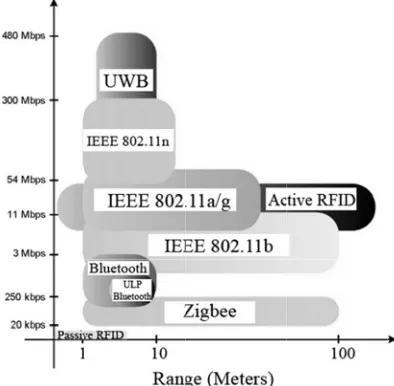
Fig. 1, shows a relative comparison of several wireless standards that may fit to be used for medical applications, the figure shows the data rate capability range of each standard versus the possible relative operation range. The operation range becomes an obstacle for medical device communication, since it can impair the mobility of the device and may result in a reduction in the possible data rate.
Authors are with the College of Engineering, San Diego State University, San Diego, CA 92182, USA, Email: [email protected], {msarkar2, snagaraj, kmoon}@mail.sdsu.edu
This work has been funded by National Science Foundation – Engineering Research Center (NSF-ERC).
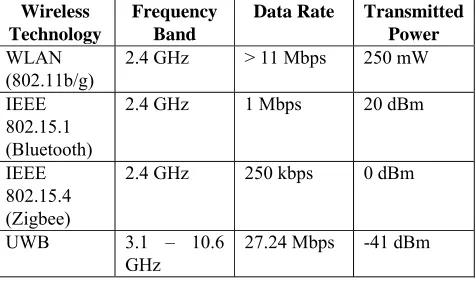
[image:1.612.310.548.306.447.2]There are several wireless technologies currently being used for wireless medical applications, those may include but not limited to, Bluetooth, Zigbee, and WiFi. Those technologies suffer from limited bandwidth, but can potentially provide various transmission ranges. UWB offers the luxury of high data rate transmission at the expense of a somewhat constrained range. A more detailed comparison between the various technologies can be found in [5]. Table I, shows a list of some common wireless technologies that can be used for wireless medical applications.
Table I: Potential Wireless Technologies for medical applications
Wireless Technology
Frequency Band
Data Rate Transmitted Power
WLAN (802.11b/g)
2.4 GHz > 11 Mbps 250 mW IEEE
802.15.1 (Bluetooth)
2.4 GHz 1 Mbps 20 dBm
IEEE 802.15.4 (Zigbee)
2.4 GHz 250 kbps 0 dBm
UWB 3.1 – 10.6
GHz
27.24 Mbps -41 dBm
Some of the medical applications that may benefit from wireless radio technologies include: wireless ECG/EKG and respiratory information Systems, for patients with heart stroke risks; Accelerometer, Gyroscope and Electromyogram (EMG) sensor systems for monitoring patients with strokes; wearable BAN systems that collect vital sign and bio signals and transmission over a high speed phone link such as 4G LTE; wireless physiological sensors for implantable applications, for monitoring heart and prosthetic limb functions over a long period of time; some other applications may include monitoring blood pressure and weight, automatic emergency communications, and monitoring locations of equipment, doctors and patient via wireless links.
UWB operates over a safe wireless band and it offers a number of major benefits that makes it most desirable over other technologies for the very low power consumption required for data transmission which helps in extending battery life of the transmitting device (wearable or implantable), also it has low interference effect on the other wireless systems in use in medical centers, and it offers high data rate to achieve the appropriate level of resolution required for physiological signals.
Ultra Wideband Transceiver Design for Compact
and Implantable Medical Devices
Faris Rassam, Mahasweta Sarkar, Santosh Nagaraj and Kee Moon
U co si tra ba hi ac da ca in w Th el ch th re co or Se U sim th an an A an UWB technol ompeting wir gnal power sp ansmissions c andwidth for U igh data rates chievable. Th ata rate and d an also be em nterference. L wireless transm he need for b liminated. All hoice for med he relative ope eduction in the oding metho rthogonal chan
The remaind ection II show UWB systems
[image:2.612.85.282.343.536.2]mulation setu he system with nd V conclude nd potential ex
Fig 1: A Data
A. Block Dia The block d nd receiver are
logy has sev eless standard pectral density can be unlicen UWB is the r s or very low his gives rem
data reliability mployed to c Lastly, since U mission, the tra
bulky oscillat of these facto dical applicatio eration range o e possible dat od; for simp nnel coding. der of this p ws the system s may func up and the re h the proposed
e the paper w xtensions and
a rate vs. Range C
II. SYST agram diagrams repr
e shown in Fig
Fig 2: UWB Tra
veral major ds. First, sinc y (PSD) is bel nsed. Second, ange 3.1 GHz w error contr markable flexi y. Spread spe ombat multiu UWB is a ca ansceivers can tors, mixers ors make UW ons. Our obje of UWB syste ta rate, by em plicity; we’r
paper is orga m diagram and ction. Section esults obtaine
d coding tech with our comm
applications.
Comparison of W
TEM MODEL
resenting the g. 2 and Fig. 3
ansmitter Block D
advantages ce the transm ow the noise since the avai z – 10.6 GHz, rol code rate ibility to trad ectrum techno user and mult
arrier-less for n be very com and filters ca WB a very attra ctive is to inc em, at a reason mploying a ch
re going to
anized as fol d explains how
n III shows d from simul hnique. Section ments, observa Wireless Standards UWB transm 3, respectively Diagram over mitted floor, ilable , very es are de-off ology tipath rm of mpact. an be active crease nable annel use lows: w the s the lating ns IV ations s. mitter y. UW recta mask comm (I-UW mult powe gene I-U orde duty powe and fadin and non-band OFD durin Time distin for fr I-U pulse carri shap bit b shift to be rates data thru recei ortho A achie cons appli timin UWB dispe solut Th cons scav anten squa at th is ea Fi WB transmi angular pulse k requirement munication ca WB) and m tiplexing (MB
er consumpti erated, and the UWB uses ex r of nanoseco y cycle pulse
er to be smal no RF power ng. On the ot it divides the -overlapping s dwidth (per F DM symbols a ng a certain tim e-Frequency-C nguishing fac frequency dive UWB is going e shape is ach ier will be re pes. A UWB b by transmitting ts, for N time
e assigned per s and ranges is encoded b the system iver, the opera ogonal code d
non-coheren eves low c sumption dev
ications. The ng with the tr B systems cou ersive channe tion suggested he radio inter sumption mu enging limit) nna and pass ares the receiv he pulse locati ach time slot,
ig 3: UWB Recei
ission is do trains that is ts of the FCC an broadly be multiband orth
B-OFDM). I ion at the t ey are easier to xtremely short onds to trans es which cau
l and it doesn r amplifiers, a ther hand MB available ban sub-bands eac FCC requirem are transmitted me slot. The t Code (TFC ctor between m
ersity. g to be used in hieved through equired, whic binary PPM en g a single puls s per bit, this r bit to accom
for the same by an orthogo for UWB w ation is revers decoder where nt receiver b
omplexity, l vice that is e receiver is
ransmitted sig uld suffer fro els, such probl
d in [12]. rface is a maj ust be reduc ) [8]. After t sed thru a b ved binary PPM
ons in order t , and based o
iver Block Diagra
one by gen filtered to me C. In general, classified into hogonal freq -UWB signa transmitter fo o be generated t pulses with mit informati use the requi n’t require car also it is robu B-OFDM is b ndwidth of UW ch has more th ments for UW d one of the s time slots are C) which
multiple users
n this paper, a h pulse shapin ch result in ncoder encode se in one of tw s method allow mmodate vario
e system. At onal coder and waveform gen sed and data is e data is recon
based on en low cost an
suitable fo assumed to gnal [3]. Energ m multipath p lems can be m
or challenge, ced below 1 the signal is band-pass filte M signal for a
o measure the on the energy
am
erating narro eet the spectru ultra wideba o impulse UW quency divisi als require le
or them to d.
duration on t ion, having lo ired transmit rrier modulati ust to multipa
ased on OFD WB into smal han 500MHz WB systems) small sub-ban determined by
acts like s and is requir
and the requir ng, such that Gaussian pu es each messa wo possible tim
ws more ener ous transmissi the transmitt d is then pass neration. At t s decoded by t
structed. nergy collecti
nd low pow or the medic have acquir gy detection f problems due mitigated by t
since its pow 100μW (ener
received at t er, the receiv at both time slo e energy conte y content at t
pu co bi
w ex
fo
su ca fo
co pr
ra si
ulse location f ontent, the re inary 1.
B. Orthogon A data set can words, describe xample shown
T
Data Set 0 0 1 1 1 0 1 1
Orthogonality ollowing simp
where: x = number o y = number o i,j are the two Thus
Like M-ary s uch as frequen an be improve
The codeword ollowing form
where m equa odeword.
Bit error pr robability by t
Thus,
C. Expected The bit error ate for an
un-gnal.
for a number o eceiver declar
[image:3.612.331.540.56.216.2]nal Coding n be transform ed by the rows n, in Table II,
Table II: Exampl
O
y of codeword le equation:
,
of digit agreem of digit disagr
o codewords b
, 1 0
ignaling with ncy shift keyi ed by using co d error probab mula
(
al to 2k, where
robability is the following
( ) ( )
( )
Results r rate graph, s -coded UWB
of pulses repre res receiving
med, using orth s of a matrix a
below:
e of Orthogonal C
Orthogonal Cod
0 0 0 1 0 0 0 1
ds is determine
ments reement
being checked
1 0
h orthogonal m ing (FSK), th odes with lowe
bility has an u
1)
e k is the num linked to th formula.
/2
( 1)
2
shown in Fig. signal and a
esenting the b a binary 0
hogonal code-as per the simp
Coding
deword Set
0 0 0 1 1 1 1 0
ed by the
d for orthogon
modulation for he error proba
er code rates. upper bound b
mber of data bit he codeword
4, compares a 3/8 coded U
binary or a
-ple
nality.
rmats ability by the
ts per error
error UWB
Th have Eb/N than Fi repre
Fi repre
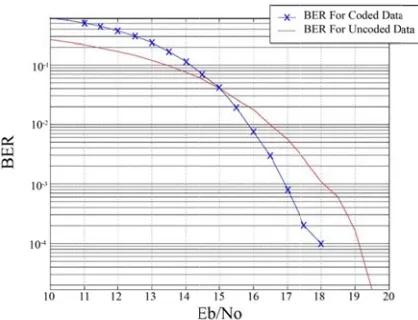
Fig 4: UWB B
[image:3.612.65.307.154.236.2]his graph show e lower bit err No > 15 dB, th that of the un ig. 5 shows esentation for
Fig 5:
ig. 6 shows esentation for
Fig 6: UWB Tim
Bit Error Rate Gra
ws that the un ror rate for E he bit error ra n-coded data.
the time dom the UWB sig
UWB Time Dom
the time dom the UWB sig
me Domain Wav
aph for coded and
n-coded UWB Eb/No < 15 dB
ate of the cod main and fre gnals used in s
main Waveform an
main and fre gnals when Eb
veform and PSD a
d un-coded data
B signals tend B, however, f ed data is low equency doma
imulation.
nd PSD
equency doma b/No = 20dB.
at Eb/No = 20dB
d to for wer ain
[image:3.612.322.530.324.493.2]ho of
w x-18
Fi w im im pi on
Figures abov ow UWB sign f noise can be
III. Based on the was done. This
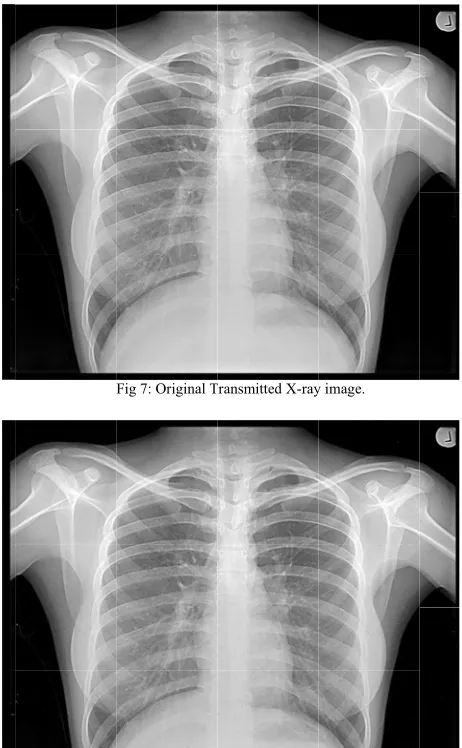
[image:4.612.313.543.46.245.2]-ray image us 8dB. The resu Fig. 7 shows ig. 8 shows t without coding mage when or mage sent with
ixels) that can ne where codi
Fig
ve should giv nals are affect mitigated by
MATLAB SIM
e results obta s time the UW sing coded an ults of the simu
the original X the received g; while Fig. rthogonal cod
[image:4.612.69.300.275.649.2]hout coding s n rapidly incre ing was used s
Fig 7: Original T
g 8: Received X-r
ve the reader ted by noise, a
using orthogo
MULATION RE
ained above, a WB system is u nd un-coded d
ulation are sho X-ray image a
X-ray image . 9 shows th ing is used. A suffers some i ease as SNR d shows no imp
Transmitted X-ray
ray image (with n
a good idea a and how the e onal codes.
ESULTS
another simul used to transm data, with Eb/
own below. at the transmitt
when transm he received X As can be see
imperfections ecreases, whil erfections.
y image.
no coding)
about effect
lation mit an /No =
ter. mitted
X-ray en the s (lost le the
In syste trans the u empl adap desig used wire syste
Th simp medi bette impl when
M simu poss envir
An SNR when the c Rate
Th Rese Dieg
[1]
[2]
[3]
[4]
Fig 9
n this paper, w em that is w smitter is mad use of Hadam loying energy pted to differen gn can be ver d in several ap
less devices. em in this pap
V. POSSIBL
here are man ple type of co ical field and er mobility, pr lement any do n implemente More work is ulated results ible signal t ronments whe nother possib R estimation th n SNR drops coding method e at low SNR.
his work has earch Center go State Unive
Bernard Sklar, Applications” 2n Glenn Weeks, P Radi, J. Townsen Sinit Vitavasir Algorithms and D Xingxin (Grace)
Coding, Rich Yao
9: Received X-ray
IV. CONC
we proposed a well suited fo de extremely s mard codes. Th y detection. nt data rates a ry compact an pplications th
We showed per.
LE APPLICATIO
ny application oding that can d yield highe rovided that t oes not requi d at the transm
required in o in this pap o noise ratio ere UWB syst ble enhancem hat can have th
below a certa d to a differen
ACKNOWLE
been support (ERC) on Se ersity.
REFERE “Digital Com nd ed., Prentice H Performance of H nd, James Freebe ri, A non-coh Digital Implemen ) Gao, Multi-Ba o, Zhenming Fen
y image (with co
CLUSIONS
a novel UWB or medical ap simple and po he receiver is The system and reliabilitie
nd power-effi hat require sm simulation r
ONS AND FUTU
ns that can m n enhance UW er data rate c
this type of co red a big dea mitting device order imperia per, and for o for UWB tems can be us ment that can he system run ain threshold nt one to yield
EDGMENT
ted by the N ensorimotor S
ENCES mmunications, F Hall P T R, 2008, c Hard Decision De
ersyser,1999. herent Ultra-Wi ntation, MIT, 200
and UWB system ng, 2003.
ding)
communicati pplications. T ower efficient made simple can easily es. The resulti ficient. It can mall implantab results with th
URE WORK
make use of th WB usage in t
capabilities w oding is easy al of processi e.
ally validate t evaluating t signals for t sed.
be done is n without codi or even chan d better Bit Err
NSF Engineeri Systems at S
Fundamentals a ch 6.
etection for Impu
ideband Receiv 07.
m with Hadama
ion The by by be ing be ble his
his the with to ing the the the by ing nge ror
ing San
and
ulse
ver:
[image:4.612.71.300.276.463.2][5] Jin-Shyan Lee, A comparative Study of Wireless Protocols: Bluetooth, UWB, ZigBee, and Wi-Fi, Yu-Wei Su, Chung-Chou Shen, 2007.
[6] Jee-Hey Lee, Improved Performance of Soft Decision Decoding for DCM in MB-OFDM system, Myung-Sun Baek, Hyoung-Kyu Song, 2008.
[7] Asawari Chinchanikar, Overview:MB-OFDM UWB System, RS Kawitkar, VSRD International Journal of Electrical, Electronics and Communication Engineering, VSRD-IJEECE, vol.2 (6), 2012, 314-321.
[8] Julien Ryckaert1, Ultra-WideBand Transmitter for Wireless Body Area Networks, Claude Desset, Vincent de Heyn, Mustafa Badaroglu, Piet Wambacq, Geert Van der Plas, Bart Van Poucke, IMEC. [9] Nazlı Guney, Capacity and Mutual Information of Soft and Hard
Decision Output M-ary PPM over UWB Channels, Hakan Delic, Fatih Alagoz, Bogazici University.
[10] Nadir.M.A.Aziz, Performance of UWB Signals with Different Transmission and Reception Schemes in Multipath Channels, Sh.Shaaban, Kh.El-Shennawy, Arab Academy for Science & Technology and Maritime Transport, and Alexandria University, Egypt.
[11] Jae Ho Hwang, The Spectrum Sensing Algorithm Using the Soft Decision Algorithm in Cognitive UWB System, Jong Seok Park, Jae Moung Kim.
[12] Benoıt Miscopein, Multipath Decision Fusion for Low Complexity UWB-IR Non-Coherent Receivers, Jean Schwoerer, Orange LABS, Jean-Marie Gorce, University of Lyon.