
JOURNAL OF FOREST SCIENCE, 53, 2007 (9): 400–405
Stem wood density (SWD) is the most important determinant of the wood quality. It allows estimation of biomass and carbon mass contained in terrestrial vegetation (Fearnside 1997). The SWD is defined as the dry mass to fresh volume ratio and ranges typi-cally within the interval from 0.1 to 1 g/cm3
(Rode-rick 2001). SWD depends mainly on the cell size and the cell wall thickness. Specifically, SWD of forest trees is influenced by many factors. There are physi-cal factors influencing SWD – weight of the crown, ice or snow loading. From the abiotic factors – soil moisture is recognized as a major factor controlling wood properties (Hansmann et al. 2002). Air tem-perature and soil type are the other significant fac-tors (Roderick 2001), which depend on latitude and altitude. Thus SWD markedly decrease with latitude and altitude as well (Sopushynskyy et al. 2005). In
response to nitrogen fertilization, SWD either de-clines or remains constant (Fearnside 1997).
Generally, SWD shows higher values compared to the branches (Panshin, De Zeeuw 1980). SWD of conifers varies directly with age in the radial direc-tion and inversely with vertical direcdirec-tion. Thus, the highest SWD values occur in outer rings in lower stem parts and decreases from the bark inward and from the stem-base upward to the tree top (Pan-shin, De Zeeuw 1980).
In most cases, elevated CO2 induce enhanced wood density. Compared to natural growing condi-tions, a doubling of air’s CO2 concentration would increase wood density of Norway spruce trees about 2–5% (Makinen et al. 2002). Kilpelainen et al. (2003) states that the increases in latewood density and maximum density in response to elevated CO2
Supported by the Ministry of Environment of the Czech Republic, Project No. VaV/640/18/03, the Ministry of Education, Youth and Sports of the Czech Republic, Project No. 2B06068, and the Research Intention of ISBE AS CR, Project No. AV0Z60870520.
Influence of stand density, thinning and elevated CO
2
on stem wood density of spruce
I. Tomášková
1, R. Pokorný
1, M. V. Marek
1,21
Laboratory of Plants Ecological Physiology, Institute of Systems Biology and Ecology,
Academy of Sciences of the Czech Republic, Brno, Czech Republic
2
Faculty of Forestry and Wood Technology, Mendel University of Agriculture and Forestry Brno,
Brno, Czech Republic
ABSTRACT: Stem wood density (SWD) of young Norway spruce trees (Picea abies [L.] Karst.) growing at ambient (A variant, 350 µmol(CO2)/mol) and elevated (E variant, A + 350 µmol(CO2)/mol) atmospheric CO2 concentration inside of the glass domes with adjustable windows was estimated after six and eight years of the cultivation. Stand density of two subvariants (s – sparse with ca 5,000 trees/ha and d – dense with ca 10,000 trees/ha) and thinning impact (intensity of 27%) on SWD and its variation along the stem vertical profile were investigated. After six years of CO2 fumigation, stems of sparse subvariant had about 10% lower values of SWD comparing to dense ones, although the difference was not statistically significant. In 2004 (two years after thinning), the SWD values were higher in all subvariants along the whole stem vertical profile. This increase was more obvious in E variant (about 6% in d subvariant and only3% in s subvariant). The highest increase of SWD values was found in Ed subvariant, particularly in the middle stem part (about 8%, statistically significant increase).
may imply improvements in wood strength proper-ties. Variations in environmental conditions induce unequal response of wood density to elevated CO2. For example, at ambient temperatures, approxi-mately 60% increase of the air’s CO2 concentration significantly enhance latewood density (by 27%) and maximum wood density (by 11%), while elevated-temperature conditions enhance less significantly latewood density (by 25%) and, in contrary, more significantly maximum wood density (by 15%) (Beismann et al. 2002). These changes lead to mean overall CO2 – induced wood density increases of 2.8% at the ambient-temperature and 5.6% atthe elevated-temperature (Beismann et al. 2002). Fur-thermore, elevated atmospheric CO2 concentration increase wood toughness of spruce seedlings grown on acidic soils by 12 and 18% under low and high levels of nitrogen deposition, respectively. Elevated atmospheric CO2 also increase the same mechani-cal wood properties in spruce seedlings grown on calcareous soils by about 17 and 14% under low and high levels of nitrogen deposition (Beismann et al. 2002).
The objectives of this study were:
(a) to evaluate an influence of elevated atmospheric CO2 concentration on SWD,
(b) to describe the changes of SWD values along the stem vertical profile,
(c) to investigate changes of SWD with respect to stand density and thinning.
MATERIALS AND METHODS
Site and stand description:There were two vari-ants of glass domes with adjustable windows (DAW) – ambient (A, 350 µmol(CO2)/mol) and elevated (E, A + 350 µmol(CO2)/mol) – established a for simulation of elevated atmospheric CO2 concen-tration at the Experimental Research Site Bílý Kříž (Czech Republic, 49°30´N, 18°32´E, 908 m a.s.l.) in
the Beskydy Mts. (for detail description see Urban et al. 2001).
Both variants of artificially established pure stands of Norway spruce (Picea abies [L.] Karst.) showed the identical arrangements of the tree spacing (Po-korný et al. 2001), which enabled to distinguish the two subvariants: sparse (s, ca 5,000 trees/ha) and dense (d, ca 10,000 trees/ha). Total number of trees per variant in each DAW was 56. The trees were planted at the age of 10–12 years in autumn 1996.
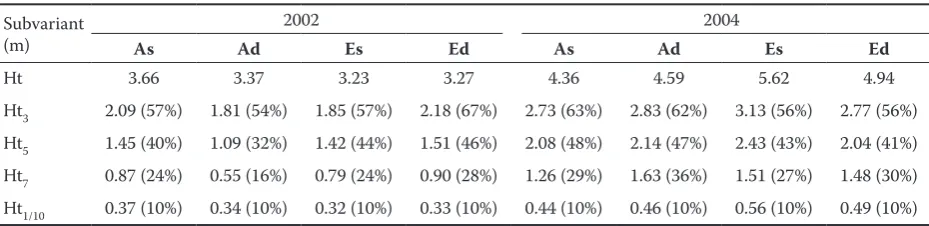
Sampling procedure:In 2002, the first schematic thinning (intensity of 27%) was carried out. After the two years, the next one (intensity of 35%) was performed. Thus, seven trees per subvariant, i.e. ambient/elevated sparse/dense, were analyzed in 2002 and 2004, respectively. SWD was obtained for chosen stem discs that were cut at the middle parts of internodial sections under the 3rd, 5th, and
the 7th whorl (t
3, t5, t7), and in the one tenth of tree
height (Ht1/10) (Table 1). Fresh stem discs volume was measured as a volume of cylinder. Afterwards, stem discs were dried for 48 hours in 105°C. After drying, dry weight was precisely estimated (balance model 1405 B MP8-1, Sartorius, Germany). Then, SWD was calculated using the common formula for basic wood density calculation (Roderick 2001). SWD of the stem disc t3 was assorted to block of internodial sections from the tree top to the t3 section, SWD of t5 disc to sections t4 + t5, SWD of t7 disc to sections t6 + t7 and SWD of disc from 1/10 of H to internodial sections t8 and below.
Methodology for stem volume calculation was based on the length of internodial section and its middle cross-sectional circle area measurement. SWD of tree was calculated as the weighted average (according to length of internodial sections).
Processing of statistical values: One-way and two-way ANOVA were used for detection of statis-tically significant differences (SSD, not significant = NS). All data were tested on normality and
homoge-Table 1. Position of stem discs in stem vertical profile grown in elevated (E) and ambient (A) concentration of CO2 and sparse (s) and dense (d) subvariant; Ht – total tree height, Ht3,5,7 – tree height from the tree base to the appropriate whorl (low index indicates whorl), Ht1/10 – tree height in one tenth of the tree height. Numbers in bracket mean relative height
Subvariant (m)
2002 2004
As Ad Es Ed As Ad Es Ed
Ht 3.66 3.37 3.23 3.27 4.36 4.59 5.62 4.94
[image:2.595.65.530.642.755.2]neity (S-W and Lewene tests; differences were tested on the level α = 0.05). Scheffe and Duncan test were used for detection of SSD. Statistica software (Stat-Soft Inc., Tulsa USA) was performed for statistical analysis.
RESULTS AND DISCUSSION
After six years of the cultivation under two differ-ent CO2 concentrations, A ambient and E elevated average stem wood density SWD was comparable in both variants (A > E, 358 versus351 kg/m3, NS).
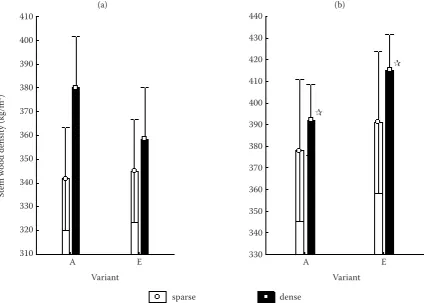
After schematic thinning (i.e. two years later), SWD increased about 60 kg/m3 in E variant and 30 kg/m3
in A variant (Fig. 1). Thus, SWD of young Norway spruce trees grown under elevated atmospheric CO2 was higher on average about 6% comparing to ambi-ent conditions (412 versus 390 kg/m3, NS, P = 0.055).
Thinning also affected the stem volume (increase about 13% in E variant) and stem biomass (increase about 17% in E variant). These results are consistent with the results of Makinen et al. (2002), who pre-sented increase of SWD in Norway spruce trees up to 5% under the doubling of atmospheric CO2 (results are from 12 year long experiment without the effect of thinning).A positive correlation between
atmos-pheric CO2 and SWD for Pinus radiata and Pinus sylvestris was also described by Hättenschwiler et al. (1996), Conroy et al. (1990), Ceulemans and Jach (2002). However, Pinus taeda did not respond to elevated CO2 unambiguously. SWD of this species was increased (Doyle 1987) or decreased (Oren et al. 2001) and also remained stable (Murthy, Dougherty 1997; Telewski et al. 1999; Roder-ick 2001). These inconsistent results obtained for individual coniferous species can be also caused by differences in cultivation design and also in fumiga-tion durafumiga-tion.
Presented values of SWD distinctively showed higher values (about 10%) for trees grown in more dense spacing (two times denser comparing to sparse one) for both investigated years (i.e. before and after thinning). Considering spacing of subvariants, the higher SWD values were observed in both E and
A subvariants (Es > As, by 3%, NS; Ed > Ad, by 6%, SSD). This observation supports a phenomenon of the sink strength effect described by Urban (2003). SWD was found to be higher in d subvariant grow-ing under elevated CO2, therefore enhanced CO2 effect seems to be forced by the stand density. The growth competition between trees of the d subvari-ant caused more probably sink strength, so the CO2
410
400
390
380
370
360
350
340
330
320
310
St
em
w
oo
d
de
ns
ity
(k
g/
m
3)
440
430
420
410
400
390
380
370
360
350
340
330
(a) (b)
A E A E
Variant Variant
[image:3.595.83.509.414.717.2]sparse dense
Fig. 1. Average stem wood density in elevated (E) and ambient (A) concentration of CO2 and sparse (s) and dense (d) subvariant independent from vertical stem profile; (a) 2002, i.e. after 6 years of the cultivation and (b) 2004, i.e. after 8 years of the cultiva-tion and 2 years after thinning. Stars denote statistical significant difference
effect was more obvious. These results are in ac-cordance with findings of Lindstrom (1996), who described strong effects of thinning on the Norway spruce trees SWD values.
SWD for European Norway spruce ranges on av-erage within the interval 320–420 kg/m3 (Hakkila
1989). Thus, SWD values obtained in our experiment for elevated CO2 treatment became close to upper interval limit of natural values.
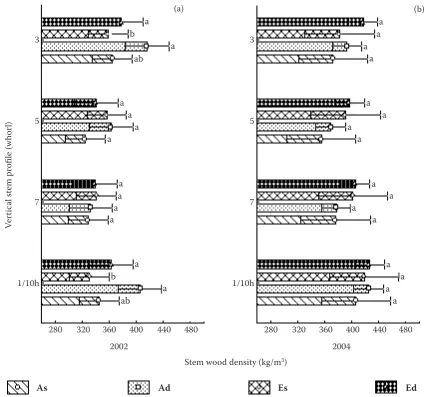
Before the thinning, the SWD values alongside the whole stem as well as the stem biomass (SB) and stem volume (V), were comparable for both CO2 variants. After thinning, the SWD values increased from 358 to 390 kg/m3 in A variant and from 351 to
411 kg/m3 in E variant. After the thinning, SSD were
found among SWD values in the middle parts of the stem vertical profile (i.e. between 5 and 7 whorl). The average SWD in the upper part of the crown was 373 kg/m3 in A variant compared to 346 kg/m3
in E variant (Fig. 2). The highest SWD occurred at the stem-base and it was comparable with the SWD of upper part of the stem as pointed also Panshin et al. (1980).
Before the thinning, the average SWD at the stem base gained value of 388 and 367 kg/m3 in A and E
variants, respectively. After thinning, these values increased up to 393 and 417 kg/m3, respectively.
CONCLUSION
The wood densities alongside the whole stem were comparable in the both ambient and elevated CO2 treatments; therefore just elevated CO2 had no sig-nificant effect on the stem wood density of Norway spruce after six years of cultivation. The thinning (tree reduction of 27%) resulted in the significant increase of the stem wood density along the whole stem vertical profile under elevated CO2, especially
280 320 360 400 440 480 280 320 360 400 440 480
2002 2004
Stem wood density (kg/m3)
As Ad Es Ed
(a) (b)
Ve
rt
ic
al
st
em
p
ro
fil
e
(w
ho
rl)
3
5
7
1/10h
3
5
7
[image:4.595.74.505.52.449.2]1/10h
Fig. 2. Stem wood density in subvariants in elevated (E) and ambient (A) concentration of CO2 and sparse (s) and dense (d) subvariant within vertical stem profile in (a) 2002 and (b) 2004. Whiskers denote standard deviation. Letters denote homog-enous groups
a
ab a
b
a a
a a
aa a a
b
ab a
a
a a a
a
a a a
a
a a a a a
a a
in the middle part of stem. Participation of elevated CO2 and thinning had a positive effect on stem wood density.
References
BEISMANN H., SCHWEINGRUBER F., SPECK T., KORNER C., 2002. Mechanical properties of spruce and beech wood grown in elevated CO2. Trees – Structure and Function,
16: 511–518.
CEULEMANS R., JACH M.E. et al., 2002. Elevated atmo-spheric CO2 alters wood production, wood quality and wood strength of Scots pine (Pinus sylvestris L.) after three years of enrichment. Global Change Biology, 8: 153–162. CONROY J.P., MILHAM P.J., MAZUR M. et al., 1990.
Growth, dry-weight portioning and wood properties of
Pinus radiata after 2 years of enrichment. Plant, Cell and
Environment, 13: 329–337.
DOYLE T.W., 1987. Seedling response to CO2 enrichment under stressed and non-stressed conditions. In: JACOBY G.C., HORNBECK J.W. (eds.), Proceedings of the Inter-national Symposium on Ecological Aspects of Tree-Ring Analysis. Springfield, National Technical Information Service: 501–510.
FEARNSIDE P.M., 1997. Wood density for estimating forest biomass in Brazilian Amazonia. Forest Ecology and Man-agement, 90: 59–87.
HAKKILA P., 1989. Investigations of the basic density of Finnish pine, spruce and birch wood. Communicationes Instituti Forestalis Fenniae, 75: 60.
HANSMANN C., WIMMER W.G.R., TEICHINGER A., 2002. Permeability of wood – A review. Drevársky výskum, 47: 1–16.
HÄTTENSCHWILER S., SCHWEINGRUBER F.H., KöRNER C., 1996. Tree ring responses to elevated CO2 and increased N deposition in Picea abies. Plant, Cell and Environment,
19: 1369–1378.
KILPELAINEN A., PELTOLA H., RYYPPO A., SAUVALA K., LAITINEN K., KELLOMAKI S., 2003. Wood properties of Scots pines (Pinus sylvestris) grown at elevated tempera-ture and carbon dioxide concentration. Tree Physiology,
23: 889–897.
LINDSTROM H., 1996. Basic density of Norway spruce. Predicted by stem taper, mean growth ring width, and fac-tors related to crown development. Wood Fiber Science,
28: 240–251.
MAKINEN H., SARANPAA P., LINDER S., 2002. Wood-density variation of Norway spruce in relation to nutrient optimization and fiber dimensions. Canadian Journal of Forest Research, 32: 185–194.
MURTHY R., DOUGHERTY P.M., 1997. Effect of car-bon dioxide fertilization and irrigation on loblolly pine branch morphology. Trees – Structure and Function, 11: 485–493.
OREN R. et al., 2001. Soil fertility limits carbon sequestra-tion by forest ecosystems in a CO2 enriched atmosphere. Nature, 411: 469–472.
PANSHIN A.J., DE ZEEUW C., 1980. Textbook of Wood Tech-nology. 4th ed. New York, Mc-Graw-Hill: 176–177, 207. POKORNÝ R. et al., 2001. Growth and transpiration of
Norway spruce trees under atmosphere with elevated CO2 concentration. Ekológia (Bratislava), 20: 14–28.
RODERICK M.L., 2001. Linking wood density with tree growth and environment: a theoretical analysis based on the motion of water. New Phytology, 149: 473–485. SOPUSHYNSKYY I., VINTONIV I., TEISCHINGER A.,
MI-CHALAK R., 2005. The influence of site factors on wood density and moisture content of beech in the Ukrainian Carpathians. Wood Research, 50: 43–49.
TELEWSKI F.W., SWANSON R.T., STRAIN B.R., BURNS J.M., 1999. Wood properties and ring width responses to long-term atmospheric CO2 enrichment in field-grown loblolly pine (Pinus taeda L.). Plant, Cell and Environment,
22: 213–219.
URBAN O. et al., 2001. Glass domes with adjustable windows: A novel technique for exposing juvenile forest stands to el-evated CO2 concentration. Photosynthetica, 39: 395–401. URBAN O., POKORNÝ R., KALINA J., MAREK M.V., 2003.
Control mechanisms of photosynthetic capacity under el-evated CO2 concentration: evidence from three experiments with Norway spruce trees. Photosynthetica, 41: 69–75.
Received for publication May 21, 2007 Accepted after corrections June 12, 2007
Vliv hustoty porostu, prořezávky a zvýšené koncentrace CO
2na hustotu dřeva
kmene smrku
a jeho změny v podélném profilu kmene. Po šesti letech fumigace CO2 byly hodnoty SWD kmenů řídké subvarianty v průměru o 10 % nižší ve srovnání s hustou subvariantou. V r. 2004 (dva roky po prořezávce) byla SWD kmenů vyšší podél celého profilu kmene ve všech subvariantách. Tento nárůst byl výrazný především ve variantě E (v průměru o 6 % v husté subvariantě a o 3 % v řídké subvariantě). K nejvyššímu nárůstu hodnot SWD kmenů husté subvarianty E došlo ve střední části kmene (o 8 %, statisticky průkazný rozdíl).
Klíčová slova: zvýšená koncentrace CO2; Picea abies; hustota porostu; hustota dřeva kmene; prořezávka
Corresponding author:
Ing. Ivana Tomášková, Ph.D., Ústav systémové biologie a ekologie AV ČR, v.v.i., Laboratoř ekologické fyziologie rostlin, Poříčí 3b, 603 00 Brno, Česká republika
![(E) 3 [4 (Hexyloxy)phenyl] 1 (4 hydroxyphenyl)prop 2 en 1 one](data:image/gif;base64,R0lGODlhAQABAIAAAP///wAAACH5BAEAAAAALAAAAAABAAEAAAICRAEAOw==)