Coded Modulation Assisted Genetic Algorithm Based
rn
Multiuser Detection for CDMA Systems
S.X.
Ng,
K.
Yen
and
'L.
Hanzo
Dept. of ECS, University
of
Southampton, SO17IBJ,
CK.
Tel: +4423-8059 3123,Fax:
+44-23-8059 4508 Email: lIhOecs.soton.ac.uk,http://www-mobile.ecs.soton.ac.uk
Abrtnxcl-In this contribution wa p r ~ p a ~ a now1 Coded Mod- ulation auhtad Genatic Algorithm based hrfultirwr Detection (CM-GA-MUD) scheme for synchronous CDhrIA systems. The parfonnnnce of the p r o p 4 acheme WIU invatigatad ruing Qus- draturaPhsraShift-Keying (QPSK), when communiuting over AWGN m d narrowband Rqyleigh fading chnnneb. When cum- pard with the optimum MUD acheme. the CA-MUD subsyttam ia capable ofraducing the computatiorul complexity signiflckatly. On the other hand, the C M subayxstem is capable of obtaining considarable coding gains despite being fed with sub-optimal In- formation provided by the GA-MUD output.
The optimal CDMA Multiuser Detector (MUD) [I] based on the Maximum-Likelihood (ML) detection rule performs an a-
haustive search of all the possible c o m b i o n s of the users'
transmitted bit or symbol sequences and then selects the most likely combination as the detected bit or symbol sequence. Since an exhaustive search is conducted, the computational complex- ity of the detector increases exponentially with the number of
users as well as with the number of levels in the modulation scheme employed. Since a CDMA system is required to sup
port a large number of users, the optimum ML multiuser detec- tor is impractical to implement due to its excessive complexity. This complexity constraint led to numerous so-called subopti- mal multiuser detection [2] proposals.
Genetic Algorithms
(GAS)
have been used for &ciently solv- ing combinatorial optimisation problems in many applications (31.Recently, GA assisted Multiuser Detection (MUD) has been
studied using Binary-Phase-Shift-Keying (BPSK) modulation in the context of a CDMA system [4]. In an effbrt to increase the system's performance with the aid of channel coding, but without increasing the required bandwidth, in this contribution we will investigate the performance of Coded Modulation (CM) assisted Genetic Algorithm Based Multiuser Detection (CM- GA-LMUD) using QPSK modulation.
Trellis Coded Modulation (TCb1) [5,6], which is based on combining the functions of coding and modulation, is a band- width efficient scheme that has been widely recognised as an ex- cellent error control technique suitable for applications in mobile communications. Turbo 3ellis Coded hIodulation (TTCY) [6, 71 is a more recent channel coding scheme, which has a struc- ture similar to that of the family of power efficient binary turbo codes [6,8], but employs TCM codes as component codes. In our TCM and TTCM schemes, random symbol interleavers were utilised for both the turbo interleaver and the channel inter- leaver. Another powerful Coded SIodulation (CM) scheme util-
king bit-based channel interleaving in conjunction with Gray signal labelling, which is referred to as Bit-Interleaved Coded hlodulation (BICM), was proposed in [6,9]. It combines con-
The ruppon of the European Union a d that of the EPSRC. UK is gmtafully . c k n o w l d ~ e d .
W i n l o u 1 0 0 2 . 8-10 July 2002. C a l g u y . C a n a d a
ventional non-systematic convolutional codes with several inde- pendent bit interleavers. The number of parallel bit-interleavers used equals the number of coded bits in a symbol [9].
RR
cently, iteratively decoded BICM using Set Partitioning (SP) based signal labelling, referred to as BICM-ID has also been proposed [6,10].
The rest of this treatise is organisxi as follows.
Our
system overview is presented in Section11,
the GA algorithm used is highlighted in Section11-A
and the CM principle is sumrnarised in Section 11-B.Our
simulation parameters and results are dis-cussed in Section ITI and finally our conclusions are offered in Section TV.
Each
user invokes a Cbf encoder, which provides a block ofM QPSK modulated symbols before spreading. We consider a synchronous CDMA uplink as illustrated in Figure 1, where
K users simultaneously transmit data packets of equal length
using QPSK modulation to a single receiver. The transmitted
signal of the kth user can be expressed in an equivalent lowpass representation as :
where
4
is thekth
user's signal energy per trausmitted sym- bol, b$'=
dab;
OrE
(0, $ , T , !f) denotes the mth CM- coded data symbol of the kth user for the QPSK signals of {0(00), 1(01),2(10), 3(11)), a t ( t ) is the kth user's signature se- quence,Tb
is the data symbol duration and M is the number of data symbols transmitted in a packet. The superscript (m) canbe omitted, since no dispersion-induced interference is inflicted by symbols outside a single symbol duration Tb in narrowband channel.
Each user's signal dk(t) is assumed to propagate over a nar- rowband slowly Rayleigh fading channel, as shown in Figure 1 and the fading envelope of each path is statistically independent for all users. The complex lowpass channel impulse response
(a)
for the link between the kth user's transmitter and the base station's receiver, as shown in Figure 1, can be written as :where the amplitude ok(t) is a Rayleigh distributed random variable and the phase +k(t) is uniformly distributed between [O, 2 4 .
Hence, when the kth user's spread spectrum signal &(t) given by Equation 1 propagates through a slowly Rayleigh fading channel having an impulse response given by Equation 2, the re- sultant output signal Sk(t) defined over asingle symbol duration
Wireless 2002, Calgap, Albertc.
Canada
Jrrly
8-10, 2002
User
User
User
Encoder I Decoder I
E n c ~ d e r 2 Multiuser
Detector
fading channel
Fig. 1. Block diagram of the K-user synchronous CDMA uplink model in a flat Rayleigh fading channel.
Upon combining Equation 3 for all K users, the received sig- nal at the receiver, which is denoted by r ( t ) in Figure 1, can be written as :
K
where n ( t ) is the zero-mean complex Additive White Gaussian Noise (AWGN) associated with independent real and imaginary components, each having a double-sided power spectral density of uZ
=
No12 W/Hz.Invoking Equation 3 describing the transmitted signal of each
user, the sum of the transmitted signals of all users can be expressed in vectorial notation as :
where
a
=
[a1( t ) ,
.
.
-
,
a K ( t ) ]C
=
diag[CYldd)l,...lCYKddK]€
=
[&*.
...
6
1
b
=
[bl, . . . , b K ] ~ .@I
Hence the received signal of Equation 4 can be written as :r ( t )
=
s ( t )+
n ( t ) . (7)Based on Equations 5 and 7, the output vector Z of the bank of matched filters portrayed in Figure 1 can be formulated as :
=
[ Z I,
Z K ] T=
R C ( b + n , (8)where R is the K x K dimensional user signature sequence cross-
correlation matrix and
n
=
[nl,.. .
, n ~ ] Tis a zero-mean Gaussian noise vector having a covariance ma- trix
Rn
=
O.5NoR Based on this discrete-time model, we will next derive the optimum multiuser detector based on the max- imum likelihood aiterion for the synchronous CDMA system considered [ I ] .The joint optimum decision rule for the QPSK-modulated K-user CDMA system based on the synchronous system model can be derived from that of the BPSK-modulated system [ I l l , which is expressed in vectorial notation as:
n
(b)=
2R [bH(c' Z ]-
~"[c'RcE~,
( 9 )where (.)" is the complex conjugate transpose of the matrix
(.) and (.)' is the complex conjugate of the matrix (.). More specifically, for BPSK modulation the term bH in Equation 9 is substituted by.bT, which is the transpose of the matrix b, since only the real component is considered in the context of BPSK modulation.
The decision rule for the optimum CDMA multiuser detec- tion scheme
based
on the maximum iikelihood criterion is tochoose the specific symbol combination b, which maximiss the correlation metric of Equation 9, yielding:
Finally, based on the decision vector
6
output by the GA-MUD, the CM decoder of user k will be invoked for generating the final estimate of the information of user k.The maximktion of Equation 9 is a combinatonal optimisa- tion problem. Specifically, Equation 9 has to be evduated for each of the 2'" possible combinations of the QPSK modulated symbols of the K users, in order to find the s p d c vector b that maximises the correlation metric of Equation 9. Explic- itly, since there are 22K different possible QPSK vectors b, the optimum multiuser detection has
a
complexity that increases exponentially with the number of users K.A . The GA-ossisted Multiucr Detector Subsystem
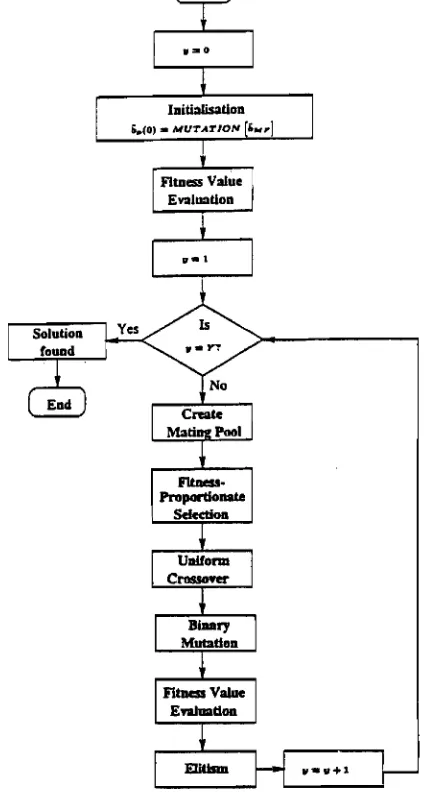
The ftowchart depicting the structure of the genetic algorithm adopted for our GA-assisted multiuser detection technique is :hewn in Figure 2. Firstly, an initial population consisting of P
number of s o - d e d individuais is created in the 'Initialisation' block, where P is known a s the population size. Each individual represents a legitimate K-dimensional vector of QPSK symbols constituting the solution of the given optimisation problem In other words, an individual can be considered as a K-dimensional vector consisting of the QPSK decision variables to be opti- mised.
In order to aid our GA-assisted search at the beginning, we employed the hard decisions offered by the matched filter out-
Wireless
2002, Calgary, Alberta,
Canada
430
July 8- 10, 2002
[image:2.584.70.503.90.242.2]Mutation
UI
Fig. 2. A BoRhart depicting the structure of tho genetic algorithm
adopted for our GA-auisted multiurar detection technique.
puts Z of Equation 8, which were denoted as:
where ~ I . M F for 1 = 1,.
. . ,
K
is given by:In Equation 12 the mnltiplication by a,$g1 is necessary for coherent detection, because the phase rotation introduced by the channel has to be taken into account.
.-I different raudomly 'mutated' version [4,12] of the hard decision vector ~ M of Equation 11 F was assigned to each of the individuals in the initial population, where the same probability of mutation, namely p, was adopted for all individu*. Note that we cannot assign the same hard decision vector ~ M F to all the individuals, since the process of incest prevention [13] is
invoked, which will not allow identical individuals to mate. The so-called fitness value [3] associated with each individual in the population is evaluated by substituting the candidate
solution represented by the individual under consideration into the objective function, as indicated by the 'Evaluation' block of Figure 2. Individuak having the
T
number of highest fitness values are then placed in a so-called matrng pool [3,4] where we stipulate 2T
P. Using a kind of natural selection scheme [3] together with the genetically-inspired operators ofcrossover [12] and mutation [I?], the individuals in the mating pool are then evolved to a new population.
Our objective function, or synonymously, fitness value is de- b e d by the correlation metric of Equation 9. Here, the legit- imate solutions are the 22K possible combinations of the K-
symbol vector 6, where there are 2 bits in each of the QPSK
symbols. Hence, each individual will take the form of a K -
symbol vector corresponding to the
K users'
QPSK symbols during a single-symbol interval. We-will denate the pth indi- vidual here as bp(y)=
Fp,r (y),. . .
,
b p . ~ ( y ) ] , where y denotes the yth generation.Our
goal is to find the specific individ- ual that corresponds to the highest fitness value in the sense of Equation9. In order to ensure that the fitness d u e s are positive for all combinations of b for the s o d e d fitnws-proportionate selection scheme [3], we modify the correlation metric of Equa- tion 9 according to [14]:exp
{R
(b))=
exp (292 [ b H ( ~ Z ]-
b R ( c ' R C ( ~ }.
(13)q e associated probability of fitness-proportionate selection pi of the ith individual is defined as [3]:
where f i is the fitness d u e associated with the ith individual.
NJire!ess
2002, C a l g a ~ . ,
A!berta,Canada
July
8-10.2002
Once a pair of parents is selected, the crossover and mutation operations are then applied to this pair of parents.
The m s s o v e r [12] operation is a process in which arbitrary decision variables are exchauged betwwn a pair of selected par- ents, 'mimicking the biological recombination process between two single-chromosome organisms'. Hence, the crossover oper- ation creates two new individuals, known as offspring in GA parlance [3], which have a high probability of having better fit-
ness values than their parents. In order to generate P number of near ofEspring, PI2 number of crossover operations are required. A new pair of parents is selected &om the mating pool for each crossover operation. The newly a e a t e d afhpring w i l l form the basis of the ne-w population During the mutation operation [12], each decision variable in the ofEspring is perturbed, i.e. corrupted, with a probability of p,, by either a predetermined or a random value. This allows new areas in the search space to be explored. The mutation probability of a decision variable
is usually low, in the region of 0.1-0.01 [3]. This value is often reduced throughout the search, when the optimjsation is likely to approach the 6naI solution. In this contribution, uniform
crossover [4] and binary mutation [12] m e employed.
In order to ensure that high-merit individuals are not lost from one generation to the next, the best or a few of the best individuals are copied into the forthcoming generation, replac- ing the worst ~Espring of the new population. This technique is
known as elitism (121. In our application, we will terminate the GX-assisted search a t the Yth generation and the individual associated with the highest fitness d u e at this point will be the detected solution. The configuration of the GX employed in our system is characterised in Table
I.
B. The
Coded
Modulation Subsystem [image:3.590.55.267.18.414.2]TABLE I
THE CONFIGURATION OF THE GA EMPLOYED I N OUR SYS7TM.
I S e t u ~ I P a r a m e t e r I M e t hod /Value I
-
-I
Individual i n ~ t i a l i s a t i o n M & t i o n of ~ M F of1
method
1
Equation 11Selection method
I
Fitness-vrovortionateI
Crossover operationI
Uniform crossoverMutation o~eration
I
Standard binarv mutation ElitismIncest Prevention Pooulation size P
I
Termination generation Y1
20Yes Yes 40
~ -
-Mating pool size T
Probabilitv of mutation o,
detailed description of the various CM schemes the interested readers are referred to the literature [6]. S p d c a l l y , [5,6,15,16] are recommended for TCM, TTCM is discussed in [6,7], BICM is considered in [6,9,17] and BICM-ID in [6,10,17,18]
T
5
P depends on the no. of non-identical individuals 0.1TABLE I1
THE CENEIUTOR WLYNOUUL.
Ili,
OF n m TCM AND TTCM C O N ~ E N T CODES IN OCPAL FORMAT.Code Rate
1
CodingI
State1
Hu
.)H'
I
f
112I
TTCM1
81
131
061
Table II shows the generator polynomials of the TCM and TTCM codes, which are presented in octal format. These are M v eSystematic Convolutional (RSC) codes and the en- coder attaches only one parity bit to the information bits. More spedfically, in the context of QPSK modulation the number of
useful information Bits Per Symbol (BPS) is 1 and the cod- ing rate is R =
$.
TableIII
shows the BICM and BICM-IDTABLE I11
THE CENER.ATOR POLYNOMIAL, gi, OF TFIE CONWLUIlORAL CODES SMPWYED
IN m s BICM ENCODER tN OCTAL PORUAT.
codes' generator polynomials in octal format, which were ob- tained from page 331 of [19]. These are non-systematic con- Iutional codes, which also produce one parity bit only. Hence, the code rates of these codes are similar to those of the TCM and TTCM codes, seen in Table
11.
Soft decision trellis decoding utilising the Log-Maximum A Posteriori (Log-MAP) algorithm (201 was invoked for decoding. The Log-MAP algorithm is a numerically stable version of the
MAP algorithm operating in the log-domain, in order to reduce its complexity and to mitigate the numerical problems associ- ated with the MAP algorithm [Zl].
The complexity of the CM schemes is compared in terms of the number of decoding states and the number of decoding it- erations. For a TCM or BICM code of memory
M ,
the corre-Code Rate 112 (QPSK)
sponding complexity is proportional to the number of decoding states
S
=
ZM. Since TTCM schemes invoke two component TCM codes, a TTCM code employing t iterations and using angU
23 113 Coding
1
State BICM-ID ( 16BICM ) 64
S-state component code exhibits a complexity proportional to 2 . t
.
S . As for BIC41-ID schemes, only one decoder is used, but the demodulator is invoked in each decoding iteration. However, the complexity of the demodulator is assumed to be insignifi- cant compared to that of the CM decoder. Hence, a BICbf-ID code invoking t iterations using an S-state code exhibits a com- plexity proportional to t.
S. The codes shown in Tables I1 and I11 exhibit similar complexity, where both TTCM and BIC>I-I-ID utilise four decoding iterations.111. SIMULATION RESULTS AND DISCUSSIONS
Our performance metric is the average Bit Error Ratio (BER) evaluated over the course of several GA generations. The detec- tion time of the GA is governed by the number of generations
Y required, in order to obtain a reliable decision. The com- putational complexity of the GA, quantified in the context of the total number of objective function evaluations, is related t o
P x Y. Since our GA-assisted multiuser detector is based on optimising the modified correlation metric of Equation 13, the computational complexity is deemed to be acceptable, if there is a significant amount of reduction in comparison to the opti- mum multiuser detector, which requires 22K objective function evaluations, in order to reach the optimum decision.
g'
35 171
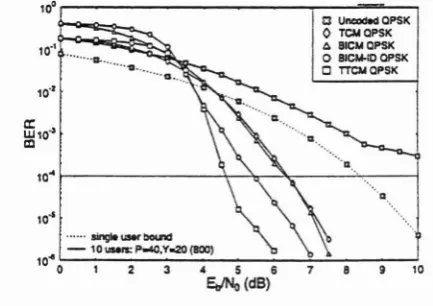
Fig. 3. BER versus ELINO performance of the w i o u a CM-GA-MUD achemes for transmissions over the AWGN channels utilising the rim- ulation parameten of Table I. I1 and 111. A codevord length of 1000
symbols and a spreading factor of 31 chips were employed.
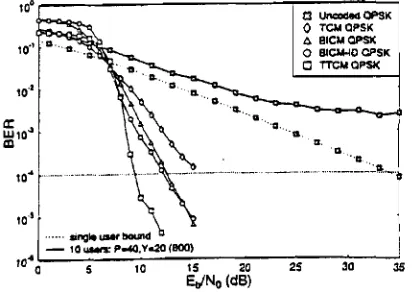
The BER versus Signal t o Noise Ratio (SNR) per bit, namely EbINo, performance of the CM-GA-MUD schemes is shown in
Wireless 2002, Calgaly, Alberta,
CanadaJuly 8-10, 2002
~ i & r e s 3 and 4 for transmissions over AWGN channels and uncorrelated Rayleigh fading channels, respectively. The sim- ulation parameters were summarised in Table I,
II
and III. A 'codeword length' of 1000 symbols and a spreading factor of 31 chips were employed. As determined by the 'codeword length', the turbo interleaver of TTCM and the internal bit intaleavers of BICM and BICCM-ID had a memory of 1000 spmbol duration. The employment of a n uncorrelated Rayleigh fading channel implies ideal channel interleaving, which has an infinitely long interleaver depth. [image:4.587.298.515.345.498.2] [image:4.587.64.260.525.563.2]Fig. 4. BER venus Eb/No performance of the various CM-GA-MUD schemes for transmiuions over the uncomlated Rayleigh fading &an-
nek utiliing the simulation p u a m e t e n of Table I. I1 and 111. A code- word length of 1000 symbols a n d a spreading factor of 31 c h i p r c r e employed.
a QPSK signal is transmitted in a CDMA system. Hence the BER of QPSK is not identical t o that of BPSK in the context of a MAI-limited CDMA environment. Therefore, the uncoded QPSK performance of a K
=
10-user CDMA system is worse than that of the single uses bounds illustrated in Figures 3 and 4.As an example, t h e c o m p u t a t i o n a l c o m p l e x i t y of t h e
GA-MUD
is&
=
1310.72 t i m e s lower, than t h a t of t h e o p t i m u m MUD, w h e n s u p p o r t i n g K = LO users employ- i n g QPSK modulation. T h e penalty for this complexity re- duction is the error floor experienced by the GA-MUD schemesa t high SNRs, as shown in Figures 3 and 4. However, this dis- advantage is eliminated, when t h e CM schemes are utilised. In
particular, the TTCM assisted GA-MUD constitutes the best cadidate, followed by the BICM-ID assisted GA-MUD, as ev- idenced in Figures 3 and 4 for t r a m n k i o n s over the M G N and nncorrelated Rayleigh fading channels encountered. More specifically, b r a throughput of 1 BPS and a target BER of the K = l0-user TTCM-GA-MUD assisted CDMA sys-
tem is capable of providing SNR gains of about 4 and 25 dBs in AWGN and perfectly interleaved narrowband Rayleigh fad- ing channels, respectively, against the single-user bounds of the uncoded BPSK scheme.
IV. CONCLUSION
In this contribution, TCM, TTCM, BICM and BICM-ID as-
sisted GA-based MUD schemes were proposed and evaluated in performance terms, when co~nmunicating over the AWGN and narrowband Rayleigh fading channels encountered. It was shown that the GA-MUD ,ii capable of significantly reducing the computational complexity of the optimum-MUD, but ex- periences a n error floor a t high SXFk due to invoking an in- sufficiently large population size and a low number of genera- tions. However, with the advent of the bandwidth efficient
CM
schemes proposed, this problem is eliminated. When comparing the four Chi schemes a t the same decoding complexity, TTCM
REFERENCES
[I] S. Verdri, 'Minimum probability of ermr for aoynchronous Gaussian multiplbaccasr channel," I E E E Tronroctioru on Communrcottoru.
MI. 32. pp. 85-96. January 1986.
[2] S. Moshavi. ')rlulti-user detection for DS-CDMA communications," I E E E Communrcotioru Magazine, vol. 34, pp. 124-136, October
1996.
(31 D. E. Goldberg, Genetic Algorithms i n Seorch, Optimirotron. and Machine Leorning. Reading, Maosachusetts: Addison-Wesley, 1989. [41 K. Yen and L. Hanzo. "Hybrid Genetic Algorithm bared hlulti-
user Detection schemea for synchronous CDMA systems," in submrt- ted to the I E E E Vehicular Technology Conference (VTC). (Tokyo. Japan), pp. 1400-1404. 2000.
[5j G. U n g e r b f i , 'Channel coding with multilevei/phase signals," I E E E Tmruoctionr on Infonnotion Theory, vol. 28, pp. 55-67, Jan- uary 1982.
[6] L. Hanao, T.H. Liew and B.L. Yeap. Turbo Coding, Turbo E q u d -
uation ond Spoce Time Coding for ~ n r m G s z o n over Wireless channelr. New York. USA: John Willy IEEE Prsss. 2002. [7] P. Robertson, T. W k , YBandwidth-Efficient Turbo Trellis-Coded
Modulation Using Punctured Component Coda," I E E E Journol on Selected A n o r in Communicationa, MI. 16. pp. 206-218. February
1988.
(81 C. Burmu. A. Clavicux and P. Thitirnajshima, 'Near Shannon Limit Enor-Correcting Coding and Decoding : Turbo Codes." in Pmecding., I E E E I n t e m a t i o n d Conference o n Communicotioiu. pp. 1064-1020. 1893.
[9] E. Zehavi. 'bPSK trellis cod- for a Ibyleigh fading channel." I E E E Tt~nroctiorrr on Communicationr. voi. 40, pp. 873-883, May 1992. [lo] X. Li. J . A. Rikey, 'Bit-interleaved coded modulation with itera- tive decoding using loft feedback." I E E Electronics Letters, vol. 34,
pp. 942-943, May 1998.
[ll] S. Verdti, Multiuser Detection New York. USA: Cambridge Uniwr- sity Presa. 1998.
[12] M. Mitchell. An Introduction to Genetic Algorithms. Cambridge. Maaapehusetta: MIT P r w , 1996.
(131 L. J . Eshelman and J. D. Schaffer. 'Preventing premature conver- gence in genetic algorithm by praventing incwt," in Proceedings of the Fourth I n t e m d i o n d Conference on Genetic AlgoriUIm (R K.
Belcw and L. B. Booker, eds.), (Cdifomia, USA), pp. 115-122, Mor- gan Kaufrman. 1991.
(141 M. J. Juntti, T. S c h l h r , and J. 0. Lilleberg, "Genetic algorithms for multiuser d e t u t i o n in aynchmnous CDMA." in I E E E Interna- tional Symposium on Information Theory
-
ISIT'97, (Ulm. Ger- many). p. 492. 1997.[15] D. Divsalar and M. K. Simon, T h e design of trellis coded MPSK for fading channel: Perfo-ce criteria,' I E E E T r o ~ ~ o c t i o n a on Communicotionr, vol. 36, pp. 1004-1012. September 1988. [l6] D. D i d a r and M. K. Simon. T h e design of trellii coded MPSK
for fading channel: Set partitioning for optimum code design," I E E E Tronaactions on Communicationa, pol. 36, pp. 1013-1021, Septem- ber 1988.
[l7] S. X. Ng, T. H. Liew, L-L. Yang and L. Hanzo, *Comparative Study of TCM, 'TTCM, BICM and BICM-ID sehemea." I E E E Vehicular
Technolopy Conference. pp. 2450-24%, May 2001.
1181 X. Li. J. A. Ritcey, T r e l b C o d e d Modulation with Bit Interlcav- ing and Iteratiw Decoding," I E E E J o u r n d on Selected Arew i n Communicationa, vol. 17, pp. 715-724, April 1999.
[19] S. Lin and D. J. Coatello, Jr, E r r o r Control Coding: Fundomen- t d s ond Applicotiona. Inc. Engleaood Cliffs, New Jersey 07632:
Prentice-Hall. 1983.
[20] P. Robertson. E. Villebrun and P. Hiher, 'A Comparison of Opti- mal and Sub-Optimal MAP Decoding Algorithm Operating in Log Domain," in Proceedings of the Internotiond Conference on Com- municotioru. pp. 1009-1013. June 1995.
[21] L. R Bahl, J . Cocke. F. Jelinek and J . Raviv, 'Optimal Decoding of Linear Codes for Minimizing Symbol Error &.ire." I E E E Trow- octionr on Infonnotron Theory. vol. 20. pp. 284-281, March 1974. was found to be the best candidate for assisting the operation
of the GA-MUD system.
eless 2C02, Calgary, Alberta. C a ~ a d a
[image:5.493.24.231.10.156.2]