
D. Weaire and S. Hutzler
School of Physics, Trinity College Dublin, Dublin 2, Ireland
E-mail: [email protected]
Abstract. What is a “complex system”? The two-dimensional (2D) foam, as originally popularised by Cyril Stanley Smith, provides an ideal context to explore this question.
PACS numbers: 83.80.Iz Emulsions and foams, 89.75.-k Complex systems
1. Introduction
In the first half of the twentieth century, solid state physics evolved towards an ever greater concentration with the perfect single crystal. There can be no denying its spectacular success: indeed it largely exhausted the interest of some of its traditional preoccupations. For example, it required only a couple of decades to progress from questioning the reality of the Fermi Surface [1] to establishing its every detail for all the many cases of interest. A definite feeling of ennui was detectable (or directly expressed) among the leading practitioners of the subject. This was entirely misguided. Even within its narrow definition, solid state physics was to pose fresh challenges and applications right up to today and no doubt beyond.
At the same time, there was a move to broaden the field by admitting to it a range of disordered materials that had been set aside as too ill-defined to be worthy of much consideration. Polycrystalline and amorphous solids, emulsions, liquid and solid foams and biological materials are examples.
Neville Mott, whose long career took him far and wide in the physics of solids, turned to amorphous semiconductors. While recognizing the dilemma of the theorist when faced with results that varied from one laboratory to the next (everyone spoke of “my germanium”, he complained at international conferences), Mott managed to extract some generic problems that could be tackled by the theorist.
Whenever Smith wished to explain where his ideas were headed, he turned to his favourite system, the two-dimensional (2D) soap froth. He was proud of having identified it as a prototype for what we today call “soft matter”, but he might be astonished to know that it remains a focus of research today. In his own time, his was a voice crying in the wilderness.
Liquid foam, particularly its 2D form, is indeed an ideal test-bed for the exploration of much more general problems: the geometry and topology of disordered structures, their aging and evolution, eventual collapse, internal fluid dynamics, rheology etc.. All can be directly witnessed in the 2D foam. Many of the properties of interest are generic: that is, they do not depend on the particular constituents of the foam. For example, aqueous foams stabilised by different surfactants have similar properties, up to a point.
So may we call a 2D foam a complex system?
2. Complexity
In the present rush to develop research programmes in complexity, the very meaning of the word has often been poorly specified. In particular, there is some confusion between mathematical “complexity theory” and the physicist’s use of the term.
Complexity theory has arisen in mathematics out of the need to characterize the degree of difficulty of computational problems. This in turn has deeply influenced pure mathematicians, so that current notions of the meaning of “randomness” are expressed in terms of programming and information content [5]. This kind of complexity theory may well overlap with the physicist’s conception, but it is not the same. In physics “complexity” is close to “emergence”. It speaks of those properties that emerge from systems of interacting entities (particles, network nodes, even people) that are not simply inherent in their individual characteristics, or derivable from them by simple averaging procedures.
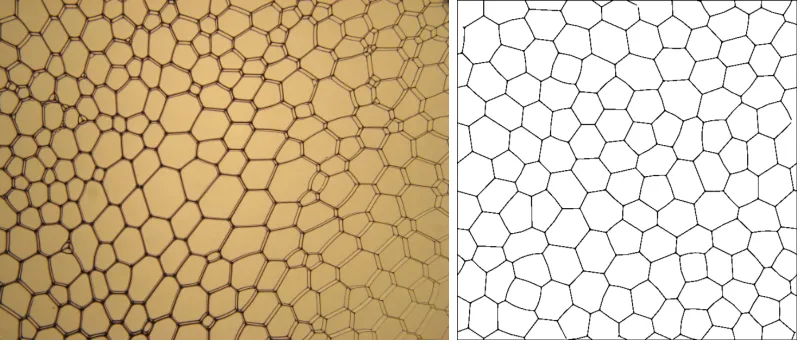
Figure 1. Two realisations of a two-dimensional foam. Left: Soap suds squeezed between two glass plates, separated by a few millimetres. Right: Computer simulation using the software PLAT [6, 7, 8]. Recently, simulations of 2D foam are often performed using the Surface Evolver software of by Ken Brakke [9, 10].
3. The complexity of foam
Figure 1 shows a 2D foam of the kind that Smith made, i.e. an ordinary foam squeezed between two glass plates, together with an example of a computer simulation.
An example of a physical property that is not, at first sight, complex is the shear modulus of the foam, which may be well estimated by simple arguments based on its local structure and surface tension [11]. Only if we look for great precision does the subtle disordered arrangement (and the consequent non-affine displacements under shear) come into play. The complex pattern of the local displacements becomes ever more important in wetfoams of high liquid fraction, and the 2D foam promises to help in understanding the problems of “jamming” [12]. But even for the dry foam, it presents us with a problem, through its effect on the Herschel-Bulkley relation, that has yet to be solved, as will be discussed below.
Smith’s own immediate interest in 2D foam was in the equilibrium structure itself. Locally it conforms to the equilibrium rules of Plateau [13] (see also [11]), balancing liquid surface tension and gas pressure everywhere, and requiring all vertices to be three-fold. Plateau’s rules of equilibrium have at least one trivial consequence, that the average number of sides of the polygonal cells is exactly six in the limit of a large sample (Euler’s theorem). But other statistical measures such as Aboav’s correlation of the number of sides of neighbouring cells [14, 15, 16] pose a complex problem and remain largely unexplained. It is curious that this particular correlation holds for many quite different cellular systems, although there are some notable exceptions [17].
It takes the form
m(n) = 6−a+6a+µ2
n , (1)
rigorous manner, although approximate treatments based on rate equations yield results consistent with this dependence [18]. Equally the constant of proportionality (d/t1/2) is
largely unexplained.
A further area of complexity is prescribed byfoam rheology, going beyond elasticity to plasticity and flow. Here we encounter a further ambiguity of terminology. Foam is a “complex fluid”, but this usually is taken to mean little more than “non-Newtonian”. In 2001, D´ebregeas et al. [19] performed a rheological measurement on Smith’s 2D foam, which had the simplicity and directness that makes for a definitive experiment. They used a 2D Couette rheometer with a rotating inner boundary and found that the consequent shear was localized close to the moving boundary. Subsequent contributions by experimental and theoretical groups have not yet settled upon a full explanation of this phenomenon of “localization” [20, 21, 22, 12, 23, 24, 25]. It is illustrated in Figure 2 which shows results of recent computer simulations [26].
At least for high rates of shear, the effect seems not to be essentially “complex”: that is, it can be explained as a consequence of the drag of the confining plates exerted upon the moving foam, in an elementary continuum theory [28], or by elementary arguments based on the principle of minimum dissipation.
However, looking deeper we perceive complexity in the parameters of that continuum theory, and make contact with a much wider scenario that includes the mechanical properties of glasses, gels and granular materials. The matter in question is the power-law which enters the Herschel-Bulkley constitutive relation. This has been a traditional part of the empiricism of rheometry for a long time. Once the yield stress is exceeded, the excess stress varies as some power of the strain rate. Whereas we might naively expect a linear dependence (the Bingham model) this is hardly ever found in soft matter. Instead the index is usually close to 1/2, and in the present case, experiments and simulations find values roughly in the range 0.3 - 0.6 [29, 12, 30, 31, 26].
Figure 2. Snapshots of a 2D foam under continuous shear, obtained from dynamic viscous froth model simulations [27, 26]. Bubble rearrangements take mainly place close to the moving upper boundary, corresponding to a localization of flow. The topology of the foam in proximity of the lower, non-moving boundary remains largely unchanged. Note the change in the relative arragnements of cells 1 to 4, but not 5 to 10. (Strain is defined as the ratio of displacement of the top boundary to the width of the sample.)
elusive.
Power laws are a common feature in the description of the dynamics of complex systems and have often been linked to the concept of self-organised criticality [32]. This has been directly invoked in a number of papers devoted to foam properties, including cascades of bubble rearrangements in foam rheology [33, 34] (although questioned by Durian [35]) and cascades of popping bubbles in foam collapse [36, 37, 38].
4. Conclusion
The 2d foam has more than fulfilled C.S. Smith’s original statement of its promise, which was to lead us into complexity along a comparatively well-defined path. Whenever the 2d foam presents us with complex phenomena to think about, it does so in the ideal context of a system that is clearly stated, visualised and simulated. It still has much to teach us about complexity, and is, for example, invoked in addressing the form and development of cellular tissues in biology [39].
References
[1] L. M. Falicov and V. Heine. The many-body theory of electrons in metal or has a metal really got a Fermi surface? Advances in Physics, 10:57 – 105, 1961.
[2] C.S. Smith. The shapes of metal grains, with some other metallurgical applications of topology.
Metal Interfaces (ASM Cleveland), 1952.
[3] M. Goodway. Cyril Stanley Smith’s translations of metallurgical classics. Resonance, 11:63 – 66, 2006.
[4] L. Pietronero. Complexity ideas from condensed matter and statistical physics. europhysics news, 39/6:26–29, 2008.
[5] G. Chaitin. Meta Math: The Quest for Omega. Atlantic Books, UK, 2006.
[6] F. Bolton. Software PLAT: A computer code for simulating two-dimensional liquid foams.
http://www.tcd.ie/Physics/Foams/plat.php, 1996.
[7] F. Bolton and D. Weaire. The effects of Plateau borders in the two-dimensional soap froth. I. Decoration lemma and diffusion theorem. Phil. Mag. B, 63:795–809, 1991.
[8] F. Bolton and D. Weaire. The effects of Plateau borders in the two-dimensional soap froth. II. General simulation and analysis of rigidity loss transition. Phil. Mag. B, 65:473–487, 1992. [9] K. A. Brakke. The surface evolver. Experimental Mathematics, 1, 1992.
[10] K. Brakke. http://www.susqu.edu/brakke/evolver/evolver.html.
[11] D. Weaire and S. Hutzler. The Physics of Foams. Oxford University Press, Oxford, 1999. [12] G. Katgert, M.E. M¨obius, and M. van Hecke. Rate dependence and role of disorder in linearly
sheared two-dimensional foams. Phys. Rev. Lett., 101:058301, 2008.
[13] A.F. Plateau. Statique Exp´erimentale et Th´eorique des Liquides soumis aux seules Forces Mol´eculaires. Gauthier-Villars, Paris, 1873.
[14] D.A. Aboav. The arrangement of grains in a polycrystal. Metallography, 3:383 – 390, 1970. [15] D. Weaire. Some remarks on the arrangement of grains in a polycrystal. Metallography, 7:157 –
160, 1974.
[16] D. Weaire and N. Rivier. Soap, cells and statistics: Random patterns in two dimensions. Contemp. Phys., 25:59, 1984.
[17] H. J. Hilhorst. Planar voronoi cells: the violation of aboav’s law explained. J. Phys. A: Math. Gen., 39:7227–7243, 2006.
[18] H. Flyvbjerg. Model for coarsening froths and foams. Physical Review, 47:4037 – 4054, 1993. [19] G. Debr´egeas, H. Tabuteau, and J.-M. di Meglio. Deformation and flow of a two-dimensional foam
under continuous shear. Phys. Rev. Lett., 87:178305, 2001.
[20] A. Kabla and G. Debr´egeas. Local stress relaxation and shear banding in dry foam under shear.
Phys. Rev. Lett., 90:258303, 2003.
[21] Y. Wang, K. Krishan, and M. Dennin. Impact of boundaries on velocity profiles in bubble rafts.
[22] R. J. Clancy , E. Janiaud, D. Weaire and S. Hutzler. The response of 2d foams to continuous applied shear in a couette rheometer. Eur. Phys. J. E, 21:123–132, 2006.
[23] A. Wyn, I.T. Davies, and S.J. Cox. Simulations of two-dimensional foam rheology: localization in linear couette flow and the interaction of settling discs. Euro. Phys. J. E, 26:81–89, 2008. [24] K. Krishan and M. Dennin. Viscous shear banding in foam. Physical Review E, 78:051504, 2008. [25] D. Weaire, R.J. Clancy, and S. Hutzler. A simple analytical theory of localisation in 2d foam
rheology. Philosophical Magazine Letters, 89:294–299, 2009.
[26] J.D. Barry, D. Weaire, and S. Hutzler. Shear localisation with 2d visous froth and its relation to the continuum model. Rheologica Acta, submitted, 2009.
[27] N. Kern, D. Weaire, A. Martin, S. Hutzler, and S.J. Cox. Two-dimensional viscous froth model for foam dynamics. Phys. Rev. E, 70:041411, 2004.
[28] E. Janiaud, D. Weaire, and S. Hutzler. Two-dimensional foam rheology with viscous drag. Physical Review Letter, 93:18303, 2006.
[29] N.D. Denkov, V. Subramanian, D. Gurovich, and A. Lips. Wall slip and viscous dissipation in sheared foams: Effect of surface mobility. Colloids Surf. A, 263:129–145, 2005.
[30] V.J. Langlois, S. Hutzler, and D. Weaire. Rheological properties of the soft disk model of 2d foams. Phys. Rev. E, 78:021401, 2008.
[31] N.D. Denkov, S. Tcholakova, K. Golemanov, K.P. Ananthapadmanabhan, and A. Lips. Viscous friction in foams and concentrated emulsions under steady shear. Physical Review Letters, 100:138301, 2008.
[32] P. Bak, C. Tang, and K. Wiesenfeld. Self-organized criticality: An explanation of the 1/f noise.
Physical Review Letters, 59:381 – 384, 1987.
[33] T. Okuzono and K. Kawasaki. Intermittent flow behavior of random foams: A computer experiment on foam rheology. Physical Review E, 51:1246 – 1253, 1995.
[34] S. Hutzler, D. Weaire, and F. Bolton. The effects of Plateau borders in the two-dimensional soap froth, III. Further results. Phil. Mag. B, 71:277, 1995.
[35] D.J. Durian. Bubble-scale model of foam mechanics: Melting, nonlinear behavior, and avalanches.
Phys. Rev. E, 55:1739–1751, 1997.
[36] W. M¨uller and J.-M. di Meglio. Avalanches in draining foams. J. Phys.: Condens. Matter, 11:L209–L215, 1999.
[37] N. Vandewalle, J. F. Lentz, S. Dorbolo, and F. Brisbois. Avalanches of popping bubbles in collapsing foams. Physical Review Letters, 86:179 – 182, 2001.
[38] H. Ritacco, F. Kiefer, and D. Langevin. Lifetime of bubble rafts: Cooperativity and avalanches.
Physical Review Letters, 244501:244501, 2007.
![Figure 2. Snapshots of a 2D foam under continuous shear, obtained from dynamicviscous froth model simulations [27, 26]](https://thumb-us.123doks.com/thumbv2/123dok_us/1048431.620697/5.612.74.522.40.218/figure-snapshots-continuous-shear-obtained-dynamicviscous-froth-simulations.webp)
