Varun D. Vaidya,1, 2, 3 Yudan Guo,1, 3 Ronen M. Kroeze,1, 3 Kyle E. Ballantine,4 Alicia J. Koll´ar,2, 3 Jonathan Keeling,4 and Benjamin L. Lev1, 2, 3
1Department of Physics, Stanford University, Stanford, CA 94305 2
Department of Applied Physics, Stanford University, Stanford, CA 94305
3
E. L. Ginzton Laboratory, Stanford University, Stanford, CA 94305
4SUPA, School of Physics and Astronomy, University of St Andrews, St Andrews KY16 9SS UK (Dated: December 4, 2017)
Optical cavity QED provides a platform with which to explore quantum many-body physics in driven-dissipative systems. Single-mode cavities provide strong, infinite-range photon-mediated interactions among intracavity atoms. However, these global all-to-all couplings are limiting from the perspective of exploring quantum many-body physics beyond the mean-field approximation. The present work demonstrates that local couplings can be created using multimode cavity QED. This is established through measurements of the threshold of a superradiant, self-organization phase transition versus atomic position. Specifically, we experimentally show that the interference of near-degenerate cavity modes leads to both a strong andtunable-rangeinteraction between Bose-Einstein condensates (BECs) trapped within the cavity. We exploit the symmetry of a confocal cavity to measure the interaction between real BECs and their virtual images without unwanted contributions arising from the merger of real BECs. Atom-atom coupling may be tuned from short range to long range. This capability paves the way toward future explorations of exotic, strongly correlated systems such as quantum liquid crystals and driven-dissipative spin glasses.
I. INTRODUCTION
Cavity QED provides strong light–matter coupling [1]. For example, exotic nonlinear optical properties arise in cavity systems with atom-mediated photon-photon inter-actions [2]. Realizations of topologically nontrivial states of interacting photons are within reach [3]. Adiabatically eliminating the photonic field, rather than the atomic, yields photon-mediated atom-atom interactions. These interactions may be sufficiently strong to create novel quantum phases of matter [4]. Indeed, single and few-mode cavity QED in the optical domain have already provided demonstrations of supersolidity [5, 6] and ex-otic Mott physics [7, 8] in addition to supermode-density-wave-polariton condensation [9]. Moreover, the driven-dissipative, open-quantum-system nature of cavity QED can change the character of quantum phase transitions, providing a new window into quantum nonequilibrium physics [10, 11].
An outstanding challenge has remained to create many-body cavity QED systems whose description re-quires physics beyond mean-field approximation. Do-ing so enables, e.g., exploration of spin glass physics beyond the Sherrington-Kirkpatrick model where mean-field, replica-symmetry-breaking solutions may no longer hold [12–14], or quantum liquid crystals and intertwined orders such as those found in strongly correlated mate-rials like high-Tc superconductors [15–18]. More gen-erally, strongly fluctuating, inhomogeneous (and frus-trated) systems may organize in unexpected ways and the resulting surprises may lead to a deeper understanding of how quantum matter organizes. A crucial limitation to exploring such physics using cavity QED stems from the fact that the single or few-mode cavities employed so far admit photon-mediated interactions that are all-to-all in
x y z, g
x y z, g
(b) (a)
[image:1.612.325.555.323.519.2]coupling [4]. The global (infinite-range) nature of these interactions necessarily implies that mean-field approx-imations are adequate to explain observed physics [19]. However, it has been suggested that this challenge may be met either by employing networks of single-mode cav-ities [20–22], using squeezed light to engineer interac-tions [23], photonic crystal waveguides [24, 25], or by using a single multimode cavity [13, 17, 26].
This work presents a realization of a multimode cav-ity QED system and demonstrates that such a system does indeed provide strong, tunable, and local interac-tions among intracavity atoms. While no beyond-mean-field physics is yet explored, we show that the crucial ingredient of local interactions is present in the system, opening the road to future investigations where beyond-mean-field physics may be manifest.
We measure the interaction range versus tunable pa-rameters by manipulating the position of Bose-Einstein condensates (BECs) within the cavity. The symmetry of our confocal cavity is exploited to measure the interac-tion between real BECs and their virtual images without unwanted contributions arising from the merger of real BECs. The experimental results are compared to theory, with good agreement. Furthermore, we show that the reduction in interaction range is accompanied by an in-crease in the effective atom-light coupling strength (geff) and an emergence of a continuous translational symme-try in the plane transverse to the cavity axis.
Our work is the first to demonstrate the regime of multimode cavity QED wherein structural, super-radiant phase transitions may take place. The em-ployed adjustable-length confocal cavity-BEC appara-tus was first demonstrated in Ref. [27]. Several groups have explored the superradiant, self-organization phase transition with thermal atoms or BECs in single-mode cavities [28–30]. Previous work with multimode cavi-ties explored this phase transition with thermal atoms, though without attention to the character of the photon-mediated interactions among the atoms [31]. Refer-ence [32] observed supermodes in a thermal-gas multi-mode cavity QED system, where a supermulti-mode is the mix-ture of bare cavity modes by the atomic dielectric, in a configuration where the cavity modes were close to reso-nance with bare atomic transitions. This contrasts with the single-mode experiments mentioned above, where the bare cavity modes are non-resonant, and the su-perradiant state arises from a two-photon transition in-volving an external transverse pump. With this trans-versely pumped, far-detuned configuration, condensation of supermode-density-wave-polaritons was subsequently demonstrated in Ref. [9] in the regime of a few degen-erate modes. Two crossed single-mode cavities with a BEC coupled to both was shown to exhibit aU(1) sym-metry in the superradiant, self-organization phase as well as a Higgs mode [5, 6]. Though BECs were employed in the latter two experiments, the number of modes were insufficient to mediate short-range interactions. In addi-tion to the experimental platform described in this paper,
prospects are bright also for the future observation of the self-organization of atoms coupled to photonic bandgap waveguides [33] and for creating and exploring topolog-ical states with Rydberg atoms coupled to multimode twisted ring cavities [3, 34].
The paper is organized as follows. Section II describes in general terms how tunable-range, photon-mediated interactions arise in a transversely pumped multimode cavity QED system undergoing a superradiant, self-organization transition. Section III then describes the cavity apparatus and BEC production and manipula-tion. Section IV presents the experimental results while Sec. V compares these to theory. Appendix A discusses in greater detail the theoretical calculation of the photon-mediated atom-atom interaction.
II. PHOTON-MEDIATED INTERACTIONS IN A MULTIMODE CAVITY
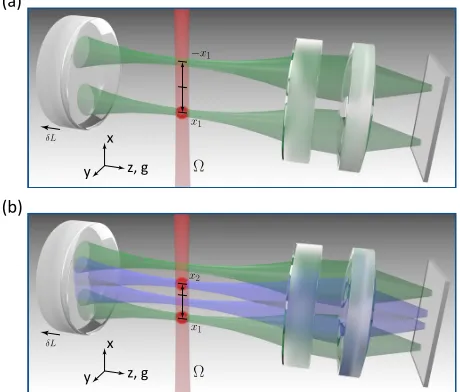
Atomic gases placed in transversely-pumped optical cavities have been shown to undergo a superradiant, self-organization transition arising from the competition be-tween their free-particle dispersion and cavity-mediated interactions [28–31, 35]. Figure 1 shows examples of transversely pumped cavities. For a pump laser red-detuned from the cavity resonance, atoms separated by a pump wavelength λalong the cavity axis ˆz construc-tively scatter pump photons into the cavity mode, leading to a buildup of intracavity light. Conversely, scattering from atoms separated byλ/2 is suppressed. The result-ing atomic light shift from the intracavity field creates an optical lattice potential that further localizes the atoms at integer-λseparations. The cavity may be interpreted to mediate a periodic, infinite-range interaction along ˆz
that lowers the energy of aλ-period atomic density wave. Above a critical pump strength Ω = Ωc, the cavity-mediated interaction energy of the density wave over-comes kinetic energy 2Er=h2/mλ2 and the atoms self-organize into aλ-periodic pattern [36]. In doing so, the atoms spontaneously choose to localize at either the even or odd antinodes of the standing wave. Interference be-tween the pump and cavity beams means this even/odd choice is staggered along the pump direction and leads to a 2D checkerboard lattice in thexz-plane [35, 37]. Con-comitantly, the atoms superradiate into the cavity. This second-order nonequilibrium phase transition is heralded both by a change in the atomic distribution [28] and by an increase in cavity emission proportional toN [31]. The momentum distribution of the atoms may be detected in time-of-flight imaging, where Bragg peaks appear at wavevectors associated with the λ-period checkerboard lattice [28].
larger than the mode waist w0. We now describe the explicit form of this interaction. Atoms at position x
coherently scatter pump photons into the cavity mode at a rateη =g0ΩΞ0,0(x)/∆a, according to second-order perturbation theory, where g0 is the single-atom atom-cavity coupling rate at x = 0. This expression is valid when the atomic excited state can be adiabatically elim-inated from the dynamics for sufficiently large detuning ∆a of the pump. A virtual photon may be exchanged between atoms within a time given by the inverse of the pump-cavity detuning ∆c. This virtual photon mediates an interaction given by (to second-order in perturbation theory) [17]
U(x,x0) = η(x)η(x 0) ∆c
= g 2
0Ω2Ξ0,0(x)Ξ0,0(x0) ∆2
a∆c
. (1)
As mentioned above, this interaction energy smoothly vanishes versus distance forx−x0larger thanw0. Atoms in gases much smaller thanw0interact with a global, all-to-all coupling, up to the sinusoidal variation in ˆz due to the standing-wave field modulation between the cavity mirrors.
This coupling need not be global in a multimode cav-ity, such as a confocal Fabry-Per´ot resonator in which the cavity lengthLequals the mirrors’ radius of curvature
R[38]. A multimode cavity can support several Hermite-Gaussian transverse modes at the same frequency, but with orthogonal mode functions Ξl,m(x). Ξl,m(x) is the Hermite-Gauss function, describing the functional form of the TEMl,mmode at (x, y) positionx. An atom scat-tering a pump photon into the cavity does so into a su-perposition of Ξl,m. The weights of the superposition are given by the mode strengths at the atomic position. These weights also depend on any differences in detun-ing ∆l,m between the (l, m) modes and the pump aris-ing from the residual differencesin their mode frequen-cies. WhenδL=L−Ris increased to move the system away from confocality, the Hermite-Gaussian modes of our near-confocal cavity exhibit a linear frequency dis-persion with mode number: ∆l,m= ∆0,0+ (l+m). In the limit δL L, =cδL/L2, where c is the speed of light [38].
We write the interaction energy as a sum over these modes weighted by ∆l,m:
U(x,x0) = g 2 0Ω
2
∆2 a∆0,0
D(x,x0) (2)
D(x,x0) =X l,m
Ξl,m(x)Ξl,m(x0) 1 + (l+m)/∆0,0
Sl,m, (3)
where the spatial dependence of the interaction is en-coded in the dimensionless interaction energy function D(x,x0). The factor Sl,m, discussed in detail in Ap-pendix A, accounts for the overlap between the atomic density wave and the photon mode profiles along the cavity axis. Due to the nature of confocal cavities, the sum over (l, m) is restricted to l+m being either odd
or even [38]. Additional dispersion, present even at
δL= 0, is due to mirror aberrations and mirror surface defects [27].
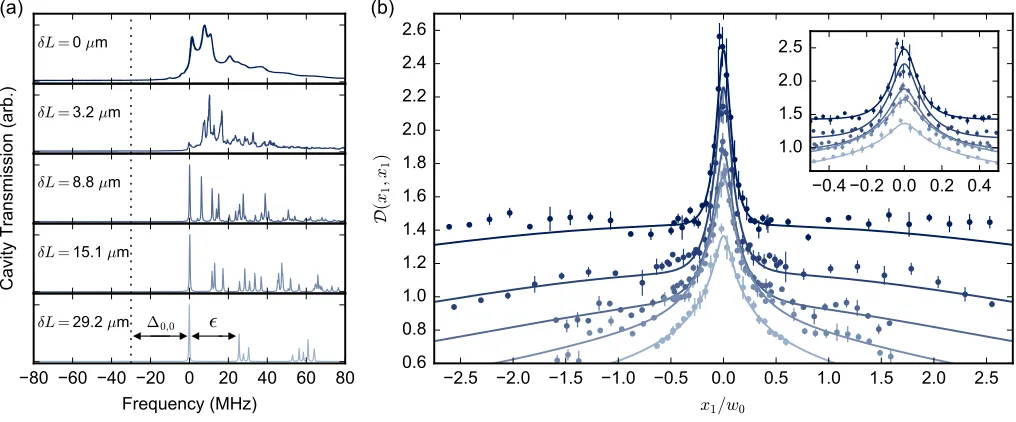
As we discuss in more detail below, the restriction to either odd or even modes means that this function can be thought of predominantly as containing two contri-butions, a direct interaction Dloc(x,x0) and its mirror image, Dloc(x,−x0). We will see that the dimensionless interaction energy functionD(x,x0) appearing in Fig. 2b, evaluated at equal positionsx=x0 contains two contri-butions: a broad background of self interaction providing a flat plateau from the direct term, and a sharp peak from the mirror term for small values ofx1. The range of the cavity mediated interactions can be extracted from the width of this peak.
For an ideal cavity, supporting an infinite number of modes, there would be a delta-function interaction peak fromDloc(x,−x0) because the Hermite-Gaussian polyno-mials form a complete basis [39], and the background self-interaction contribution from Dloc(x,x0) would be entirely flat and nonzero. However, real cavities support only a finite number of modes, yielding a finite-range in-teraction: A photon is scattered into a wavepacket local-ized around the atom, and only atoms with overlapping polaritonic excitations—dressed atom-photon states— can interact.
As discussed further below, the overall magnitude of the flat plateau also changes depending on the number of modes contributing to the sum in Eq. 3. Nonetheless, because the central peak has a clear length scale, we can identify the range of the short-distance part of the inter-action. Because the cavity waist is a fundamental length scale that remains (almost) unchanged for each cavity, it is reasonable to compare the characteristic length scale of the peak to this fundamental length scale and use this single number as the range of interactions. We note that the flat plateau (which originates from self interactions) eventually falls to zero energy as the atoms reach the edge of the highest-order mode supported by the cavity. While Fig. 2b shows the plateau out to a feww0forδL= 0, we measured that it persists out to ∼6w0, indicating that several thousand modes are supported at confocality.
x
1/w
0
D
(
x
1,x
1)
E
δL
=
µ
PD
δL
=
µ
P&DYLW\7UDQVPLVVLRQDUE
δL
=
µ
PδL
=
µ
P[image:4.612.55.563.53.264.2]
)UHTXHQF\0+]
δL
=
µ
P∆
0,0²
FIG. 2. Dimensionless interaction strengths D(x1, x1) versus position of a single BEC for various cavity lengths L. (a) Transmission spectra of the five cavities studied. The spacing between even-mode families is≈25 MHz forδL= 29.2µm. Individual transverse modes are unresolvable at confocality (δL = 0 µm). The dotted vertical line indicates the frequency difference ∆0,0= 30 MHz between the pump beam and the TEM0,0 mode. Images of the superradiant emission are shown in Fig. 4. (b) The spatial dependence of the dimensionless interaction energyD(x1, x1), also with ∆0,0= 30 MHz. The color of each trace corresponds to the cavity lengths presented in panel (a). The error bars represent one standard error in the mean over three runs. The solid lines are fits of Eq. 9 to our data and neglect the effect of astigmatism and spherical aberrations on our cavity spectrum. A close-up of data near the cavity center is displayed in the inset.
tion.
The form of D(x,x0) is set by the parameter /∆ 0,0, which may be experimentally controlled to tune the in-teraction range. The length scale of the range may be tuned between that of waist w0 for a single-mode cav-ity to a small fraction of w0 for a multimode cavity. This is analogous to thephonon-mediated interaction in ion traps, where large pump-detunings from resonances in the phonon spectrum generate shorter-ranged interac-tions [40–42].
To characterize the interaction profileD(x,x0), we use local measurements of the self-organization threshold for a small BEC. Using the expression for interactions in Eq. 3, we may write a mean-field threshold condition for self-organization as
g2 0Ω2cN2 ∆2
a∆0,0 Z
ρTF(x)Dc(x,x0)ρTF(x0)dxdx0= 2NEr, (4)
where ρTF(x) is the Thomas-Fermi density distribution of the BEC. See Ref. [17, 26] for the beyond-mean-field expression. For BEC radii much smaller than w0, we may approximate the density byρTF(x)≈δ(x−x1xˆ) to obtain an expression forD(x1, x1) at threshold,
Dc(x1, x1) =
2Er∆2a∆0,0
N g2 0Ω2c(x1)
= Ω
2 0 Ω2
c(x1)
, (5)
where Ω0 is the threshold Rabi frequency for a delta-function-width gas localized at the center of a single-mode cavity. Measuring Ωc(x1, x2) for a pair of atomic
gases located at x1 and x2 allows one to determine Dc(x1, x2) via the relation
Ω2 0 Ω2
c(x1, x2)
=U2(x1, x2)
≡ D(x1, x1) +D(x2, x2) + 2D(x1, x2), (6)
where we have dropped the subscript on theD’s for con-venience here and below. The value of Ωc(x1, x2) at which the superradiant, self-organization transition oc-curs allows us to measure the photon-mediated atom-atom interaction strength versus position through a closed form expression related to Eq. 8 described in Sec. IV.
When considering a pair of gases, we may exploit the mirror symmetry to cleanly measure the interactions be-tween atoms in different gases without physically merging two real BECs. That is, we use the fact that atoms in one gas can overlap and thus interact with the image of the other gas. By avoiding overlap of the real gases, we avoid unwanted systematics due to the change in atomic density and mean-field energy from collisions as the two traps merge. From the standpoint of photon-mediated atom-atom interactions, atoms atxi interact with their virtual images at −xi just like dipoles near a dielectric can be thought of as interacting with their mirror images in classical electrodynamics [43].
)UHTXHQF\0+]
&DYLW\WUDQVPLVVLRQDUE
δL
=
µ
PD
x
1/w
0
D
(
x
1,x
1)
E
∆0,0=0+] ∆0,0=0+] ∆0,0=0+]
[image:5.612.55.299.55.341.2]∆0,0=0+] ∆0,0=0+]
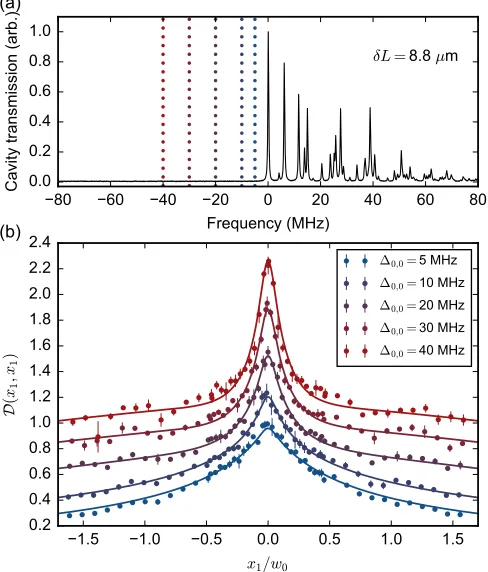
FIG. 3. Dimensionless interaction strengths versus position of a single BEC for various pump-cavity detunings ∆0,0. Images of the superradiant emission are similar to those in Fig. 4. (a) Transmission spectrum of theδL= 8.8µm cavity presented in Fig. 2a. The dotted lines indicate the five values of ∆0,0at which the interaction energy of a single BEC was measured. The corresponding interaction energies are presented in (b). The solid lines are fits of Eq. 9 to our data and neglect the effect of astigmatism and spherical aberrations in our cavity spectrum. The error bars represent one standard error in the mean over three runs.
tance given byw0 √
2M∗, where (M∗)2is a measure of the effective number of modes coupled to the atoms, see Ap-pendix A. This provides a translationally invariant inter-action energy over a large distance in the xy-plane. For example, this distance is∼200 µm on either side of our near-confocal cavity, far larger than typical BEC widths. We now describe the characterization of the strength and range of cavity-photon-mediated interactions for various pump and cavity configurations.
III. EXPERIMENTAL APPARATUS
We investigate the behavior of photon-mediated inter-actions by trapping within an adjustable-length multi-mode optical cavity a BEC of 2.5(3)×105 87Rb atoms in the |F = 1, mF = −1i state. See Ref. [27] for BEC preparation procedure and Fig. 1 for illustration of exper-iment. The BEC is confined in a crossed optical dipole trap (ODT) formed by a pair of 1064-nm laser beams
propagating along ˆxand ˆy with waists of 40 µm in the
xy-plane and 80µm along ˆz. The resulting trap frequen-cies of (ωx, ωy, ωz) = 2π×[224(2),86(1),102(1)] Hz create a compact BEC with Thomas-Fermi radii (Rx, Ry, Rz) = [4.0(1),11.3(3),8.3(1)] µm that are significantly smaller than thew0= 35 µm waist of the TEM0,0cavity mode. Acousto-optic deflectors (AODs) placed in the path of each ODT control the intensity and location of the ODTs, allowing us to translate the BEC to any point in thexy -plane with an uncertainty of 0.9µm. Some of the exper-iments discussed require two intracavity BECs that can be moved relative to one another. We use dynamic trap shaping techniques [44] to split the BEC into two smaller BECs of 1.0(3)×105atoms each, with an imbalance un-certainty of <10%. These BECs may be separated in ˆ
xby any relative distance using the AOD; see Fig. 1(b). Absorption imaging of the BECs is performed along ˆy af-ter a 15-ms time-of-flight (TOF) to reveal the momentum distribution of either the single or double BECs.
The cavity is operated in a near-confocal regime in which the cavity lengthLis set to be close to the mirrors’
R= 1 cm radius of curvature. Due to astigmatism, there are two orthogonal radii of curvature that are slightly different. BecauseLmay only be set to match one radius at a time, the cavity is never perfectly confocal. This contributes, along with spherical aberration and mirror surface defects, to the finite bandwidth (small spread) of modes seen in Fig. 2(a) forδL= 0µm [9, 27]. The mode degeneracy is maximal whenL=R, as shown in Fig. 2(a) forδL =L−R = 0 µm. A slip-stick piezo attached to one of the mirrors allows us to changeLin situ [27]. The frequency spacing between each family of transverse modes is controlled byδL, which provides tunability of mode density; see the transmission spectra in Fig. 2(a). By family, we mean TEMl,m modes that satisfyl+m= const. We have observed modes in cavity transmission with indices up tol+m= 300. This indicates that up to ∼104modes are supported by the cavity near degeneracy. The system with an atom at the field maximum of the TEM0,0 mode has a single-atom cooperativity of 2.2(1), a vacuum Rabi splitting ofg0= 2π×1.47(3) MHz, and
κ = 2π×167(4) kHz [27]. A laser propagating along ˆ
ͲϬ͘ϰϲ
w
0;ũͿ ;ďͿ
ͲϬ͘ϯϭ
w
0;ŬͿ ;ĐͿ
ͲϬ͘ϭϱ
w
0;ůͿ ;ĚͿ
Ϭ͘Ϭ
w
0;ŵͿ ;ĞͿ
w0
Ϭ͘ϭϱ
w
0;ŶͿ ;ĨͿ
Ϭ͘ϯϭ
w
0;ŽͿ ;ŐͿ
Ϭ͘ϰϲ
w
0;ƉͿ ;ŚͿ
x
1=Ͳϭ͘ϵϮ
w
0w0
dž
LJ
;ĂͿ
ϭ͘ϵϮ
w
0 [image:6.612.54.564.51.154.2];ŝͿ
FIG. 4. Superradiant emission into the cavity supermode above the self-organization threshold for the data similar to that shown in Fig. 2b. (a)-(i) Spatial structure of superradiant emission into the modes of a near-confocal cavity (δL= 0µm) as the BEC is translated fromx1=−1.92w0 to 1.92w0. The two peaks merge at the center of the cavity, yielding a spot size smaller than the TEM0,0mode waist. Images (j)-(p) show superradiant emission for BECs in a single-mode cavity. The BECs are in the same locations as in the above panels. The cavity is set toδL= 65.1µm,≈60 MHz to achieve near-single-mode operation. We see that the profiles are close to the width and shape of a TEM0,0mode. All images are plotted with identical length scales, including panels a and i, which have larger fields of view. Data are taken at a pump-cavity detuning of ∆0,0 = 20 MHz. The white bars in (a) and (e) represent the length of the waist of the TEM0,0 mode.
in Figs. 2, 3, 5, and 7. This is done so as not to generate a lattice potential along ˆxin the absence of intracavity light. The absence of such a lattice leads to a simpler dependence of threshold pump power on the cavity me-diated interaction: For a standing wave, one must calcu-late the kinetic energy for atoms in the band-structure of the standing-wave lattice potential, and this means that pump power would appear on both sides of Eq. (4), mak-ing extraction of interaction strength less direct. We do, however, use a standing-wave pump for the cavity out-put and atomic density images presented in Figs. 4, 5, and 6 to avoid distortions due to atomic motion excited by running-wave pump.
IV. MEASUREMENTS OF CAVITY-INDUCED
INTERACTIONS
We first measure the interaction energy of a single BEC as a function of its location in ˆx. With the BEC trapped at a location x1, the transverse pump power is linearly increased in time while the cavity emission is monitored on a single-photon counter. A sharp increase in emission heralds the onset of the superradiant, self-organization transition and allows us to measure Ωc(x1), and conse-quently, using Eq. (5), extract the interaction strength D(x1, x1).
Figure 2a shows the transmission spectra of the even modes in the five near-confocal cavities studied. Fig-ure 2b presentsD(x1, x1) measured at a fixed pump de-tuning of ∆0,0= 30 MHz in the aforementioned cavities. For large values ofδL, and consequently large, the in-teraction strength would follow a single Gaussian decay as the BEC is moved further away from the center of the cavity. This is because D(x1, x1) is following the mode profile of the TEM0,0mode in this near-single-mode cav-ity. By contrast, as is reduced by shrinking δL, we observe a form with two components. There is a flat-ter, more translationally-invariant background, falling off
over a length scalewcoming from the self interaction of the gas. Furthermore, we observe the emergence of a prominent peak at the cavity center that decays over a much shorter rangeξdue to the interaction of the cloud with its mirror image. Asbecomes smaller, the scalew
grows andξ shrinks. A similar behavior is observed for holdingfixed but varying ∆0,0, as presented in Fig. 3.
The length scale w of the background component re-flects an overall envelope of the interactions, while the scaleξ of the sharp peak reflects the interaction range. Both the growth ofw and shrinking of ξ can be under-stood as the result of superposing ever-larger high-order Hermite-Gaussian polynomials, allowing the interaction to both extend to larger distances and resolve finer fea-tures. That we can measure the short-range interaction with only a single, compactly localized BEC is a conse-quence of the mirror symmetry inherent to confocal cav-ities. The interaction energy increases as the real atoms come near to their virtual images, even though there is only one real BEC present. Viewed equivalently, as the two spots of the supermode begin to overlap, the intra-cavity field magnitude increases, leading to a lower Ωc.
Images of the supermode can be directly observed in superradiant cavity emission patterns. Figures 4a–i show examples in which the superradiant spots pass through each other. One cannot differentiate the spots from the picture alone, though from the orientation of the cam-era and apparatus, we know that the lower (upper) spot is the real image in panels a–d (f–i). The waists of the spots are smaller than that of a TEM0,0 mode and their size at the object plane are similar to the BEC Thomas-Fermi radius, as expected. Their small size stands in stark contrast to the single-mode cavity’s size shown in Fig. 4(j)-(p): The superradiant emission pattern main-tains its TEM0,0structure as the BEC is moved over the same distance in ˆx, only dimming as the gas nears the edge of the single Gaussian mode [47].
ϴϬ ϲϬ ϰϬ ϮϬ Ϭ ϮϬ ϰϬ ϲϬ ϴϬ &ƌĞƋƵĞŶĐLJ;D,njͿ
Ϭ͘Ϭ Ϭ͘Ϯ Ϭ͘ϰ Ϭ͘ϲ Ϭ͘ϴ ϭ͘Ϭ
ĂǀŝƚLJƚƌĂŶƐŵŝƐƐŝŽŶ;Ăƌď͘Ϳ
δL
=
Ϭµ
ŵ ;ĂͿϭ͘Ϭ Ϭ͘ϴ Ϭ͘ϲ Ϭ͘ϰ Ϭ͘Ϯ Ϭ͘Ϭ Ϭ͘Ϯ Ϭ͘ϰ Ϭ͘ϲ Ϭ͘ϴ ϭ͘Ϭ
(
x
1+
x
2)
/w
0Ϭ͘ϱ ϭ͘Ϭ ϭ͘ϱ Ϯ͘Ϭ Ϯ͘ϱ ϯ͘Ϭ ϯ͘ϱ ϰ͘Ϭ
U
2(
x
1,x
2)
;ďͿ
∆0,0=ϭϱD,nj
∆0,0=ϮϬD,nj
∆0,0=ϯϬD,nj
∆0,0=ϰϬD,nj
[image:7.612.347.533.48.307.2]w0
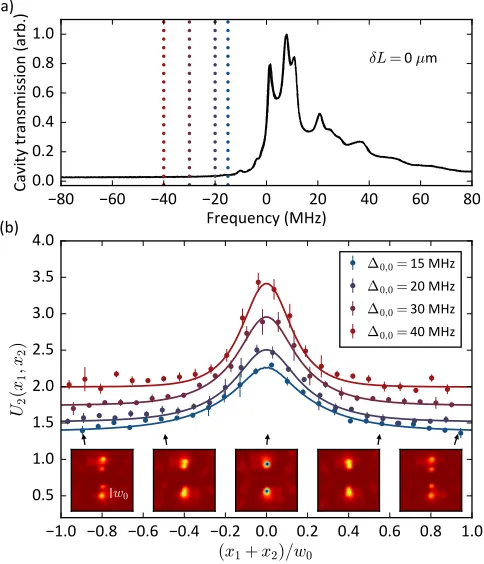
FIG. 5. Dimensionless interaction strengths for two intra-cavity BECs versus their center-of-mass position for various pump-cavity detunings ∆0,0. (a) Transmission spectrum of the δL = 0 µm cavity. The dotted lines indicate the four values of ∆0,0 at which the interaction energy was measured. (b) The local interactions versus position between a real BEC at x1 and the virtual BEC at −x2 of a different real BEC at x2. The data were taken in the confocal configuration (δL= 0µm) with the two BECs located on opposite sides of the cavity; see Fig. 1b. Similar behavior is seen withδL6= 0 cavities. Insets: The observed superradiant emission patterns for the data indicated. The white bar in panel b shows the length of the waist of the TEM0,0mode. Error bars represent standard error.
45 µm from either side of the confocal cavity center, at
x1 and x2 as illustrated in Fig. 1(b). Each real BEC can then overlap and interact with the nearby virtual image of the other BEC. This is accomplished by mov-ing x1 and x2 by the same amount in ˆx while keeping
x1−x2 fixed. Again, this allows us to probe the be-havior of the photon-mediated interaction while avoiding any energy shifts due to density changes ands-wave col-lisions between the two BECs. As shown in Figure 5, we observe four distinct spots in the superradiant emis-sion pattern—two at the BEC locations (x1, x2) and two at the locations of their virtual images (−x1,−x2). At
x1+x2 = 0, the BECs merge with each other’s virtual images, and we again observe a peak inD(x1, x2) arising from a photon-mediated local interaction. The sequence of BEC momenta observed by time-of-flight imaging in Fig. 6 further demonstrates how the interaction energy of two nearby BECs can push a system above threshold:
(c)
(b)
(a)
x
z
FIG. 6. Absorption images in time-of-flight expansion of two intracavity BECs located on opposite sides of the cavity atx1 andx2. The image is not purely of a momentum distribution due to the short time of flight. The images show the con-tributions from each BEC along with the diffraction peaks from each gas. (a) Time-of-flight expansion with no trans-verse pumping (Ω = 0). In this and the subsequent panels, the left BEC has 60% fewer atoms than the one on the right. (b) Time-of-flight expansion for a spacing ofx1 =−x2; i.e., each real BEC spatially overlaps with the other BEC’s virtual image. The BECs self-organize at the same threshold pump Rabi frequency Ω = Ω0c. First-order Bragg peaks are visi-ble for both the left BEC (red dashed circles) and right BEC (white dashed circles), heralding self-organization [28]. Addi-tional diffraction peaks from the standing-wave pump beam are found to the left and right of each BEC. (c) Separating the BECs from each other’s virtual image by 32.4µm, close to a cavity waistw0, reduces the interaction energy, causing the small BEC to be unable to reach threshold at the same pump power as the larger BEC. (Ω = Ω0c is the same as in panel b.) That is, the larger (smaller) BEC at right (left) ex-hibits (no) Bragg peaks, indicting (no) self-organization into a checkerboard lattice. The color scale has been increased in panels b and c with respect to panel a to make the Bragg peaks more visible.
A smaller BEC can undergo self-organization at a lower threshold power when it is near a larger BEC than when it is far away.
V. MEASUREMENT OF INTERACTION
RANGE
[image:7.612.57.299.53.335.2]closed-Ϭ ϭϬ ϮϬ ϯϬ ϰϬ ϱϬ ϲϬ ϳϬ Ϭ
ϭϬ ϮϬ ϯϬ ϰϬ ϱϬ ϲϬ
M
∗
;ĂͿ
δL
=
Ϭµ
ŵδL
=
ϯ͘Ϯµ
ŵδL
=
ϴ͘ϴµ
ŵδL
=
ϭϱ͘ϭµ
ŵϬ ϭϬ ϮϬ ϯϬ ϰϬ ϱϬ ϲϬ ϳϬ
|
∆
0,0|;D,njͿϬ͘Ϭ Ϭ͘Ϯ Ϭ͘ϰ Ϭ͘ϲ Ϭ͘ϴ ϭ͘Ϭ ϭ͘Ϯ
ξ/
w
0;ďͿ
Ϭ ϭϬ ϮϬ ϯϬ ϰϬ ϱϬ ϲϬ ϳϬ
[image:8.612.55.298.49.334.2]Ϭ͘Ϭ Ϭ͘ϭ Ϭ͘Ϯ Ϭ͘ϯ Ϭ͘ϰ Ϭ͘ϱ
FIG. 7. Tunability of the effective number of coupled modes, proportional to the square of M∗, and interaction range ξ versusδL and ∆0,0. (a) The dependence ofM∗on ∆0,0 for various cavity lengths δL. The solid lines are a fit to the theoretical expectation, M∗ ∼∆0,0/. (b) The dependence of the interaction range ξ/w0 = 1/
√
2M∗ on ∆
0,0 inferred from the data in panel (a). We measure an interaction range ofξ/w0= 0.09(1) at the largest value of ∆0,0 studied in the confocal configuration. This is over an order-of-magnitude smaller than the TEM0,0 waistw0. Solid lines are the same fits to the theoretical interaction profile as above. The dashed lines are extensions of the fitted curve outside the regions of validity; i.e., where M∗ < 1. Inset: Agreement between interaction ranges extracted from the single-cloud (unfilled squares) and two-cloud (filled circles) datasets forδL= 0µm. The solid line is a fit to the single-cloud data. All error bars represent standard error.
form expression of D(x,x0)—valid under the condition
/∆0,01—to fit the data in Figs. 2(b), 3(b), and 5. See Appendix A for details. This expression can be separated into three terms:
D(x,x0) =Dloc(x,x0) +Dloc(x,−x0) +Dnon(x,x0), (7)
where Dloc(x,x0) is a local interaction between two atoms and Dloc(x,−x0) represents its corresponding atom-image interaction. The third term Dnon(x,x0) is a weaker, non-local oscillatory interaction which will be discussed later.
The local terms have the form
Dloc(x,x0) =
M∗
4π K0
|δx|√2M∗
w0 s
1 + X
2 cm
w202M∗ !
, (8)
(a)
x
[image:8.612.252.548.55.347.2]z, g
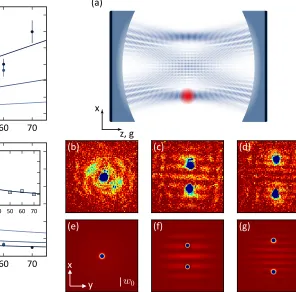
FIG. 8. Manifestation of the non-local interactionDnon(x,x0). (a) Illustration of the hourglass structure in the supermode field (blue) when populated by photons scattered into the confocal cavity from the BEC (red). The field displays a weak oscillatory behavior between the two spots at x1 and −x1. (b)–(d) Observed superradiant emission patterns for BECs placed at x1 = 0 µm, 45.0 µm, and 67.5 µm, respectively. (e)–(g) Simulations of the intracavity field with the BEC at these locations.
where K0 is the modified Bessel function of the second kind andδx=x−x0is the separation between the atoms, and the center-of-mass coordinate of the two atoms is
Xcm = (x+x0)/2. This interaction function falls off ase−δx/ξ/p
δx/ξ for largeδxand increases as−lnδx/ξ
forδx →0, where ξ =w0/ √
2M∗. This simple behav-ior requires that the center of mass coordinate is near the center of the cavity, |Xcm| w0
√
2M∗. Note that whenM∗ 1, the interaction range ξ is much smaller thanw0
√
2M∗, and so one may simultaneously have both
δx ξ and Xcm w0
√
2M∗. Thus, we see that the strength and range of this interaction are controlled by the parameter M∗ = ∆
0,0/. The quantity (M∗)2 may loosely be associated with the effective number of cavity modes that maximally couple in 2D to the BEC to form the supermode (see Sec. A 4);M∗is the number of modes that couple in 1D. We stress that the value ofM∗depends on the pump detuning and any aberration of the mirrors. Therefore one should not equate (M∗)2with the number of modes supported by the cavity near degeneracy, which is ∼104. A second length scale w =√2M∗w
the strength of this interaction as the pair of atoms is moved far from the cavity center. SmallM∗ dilutes the strength of this interaction versus distance from the cav-ity center: w may be interpreted as a measure of the degree to which the system is translationally symmetric.
wdiverges in an ideal confocal cavity as→0, resulting in translationally-invariant interactions determined only by atomic separationδx, with no dependence on absolute position.
We characterize the range of the local interactions in our cavity by fitting our data in Fig. 2 and 3 to the theoretical model in Eq. 7, while neglecting the weak non-local termDnon. To account for the finite size of the BEC, D(x1, x1) is evaluated by numerically integrating over the BEC’s Thomas-Fermi distributionρTF instead of aδ-function:
Deff(x1, x1;M∗) = Z Z
ρTF(x−x1)[Dloc(x,x0;M∗)+
Dloc(x,−x0;M∗)]ρTF(x0−x1)dxdx0. (9)
We fit the above expression to our data using M∗ and an overall scale-factor as free fit parameters. Details of how this integral may be efficiently evaluated are given in Sec. A 3. The results of these fits are shown as solid lines in Figs. 2(b), 3(b), and 5. Extracted values of M∗
and the interaction rangeξare presented in Fig. 7(a) and (b) respectively, for several values of δL and ∆0,0 using the single BEC configuration. Large values of ∆0,0/ result in a more uniform coupling to transverse modes of the cavity and a shorter-ranged interaction. With this control parameter, we can tune the interaction range to be as low as ξ = 3.4(4) µm. This is over an order-of-magnitude shorter than the range set byw0for a single-mode cavity. Moreover, this close agreement between the data and fits for values ofM∗&1 highlights the validity of the theoretical model presented in Appendix A. We note that we do not reliably inferM∗forM∗<1 because the closed-form expression in Eq. 8 is only valid for ∆0,0.
We now turn our attention to the non-local interaction term in Eq. 7, which displays oscillatory behavior of the form
Dnon(x,x0)∝cos x·x0
w2 0
. (10)
As discussed below, the form of this term can be traced to the Gouy phase shifts of the bare-cavity modes. The Gouy phase shift between modes arises due to the need to satisfy the mirror boundary conditions despite the slight change ink-vectors between transverse modes [38]. The nodes in the intracavity field transverse to the cavity axis in Fig. 8a are due to the Gouy phase shifts. While we cannot resolve the effects of this term in our interaction measurements, we do observe a weak signal in our im-ages of superradiant cavity emission shown in Fig. 8. The cavity emission is recorded by imaging the plane contain-ing the atoms onto the camera, so this emission records
the light profile at the atom plane. For a single BEC atx1, the image at positionx corresponds toD(x,x1),
and so the non-local term creates fringes in the cavity emission with a wavelength that becomes shorter as x1 is increased, as shown in Fig. 8b–d. The oscillatory be-havior can most easily be understood by considering the “hourglass” structure of confocal cavity modes. While familiar ray-tracing representations of these modes de-pict the parallel and diagonal “arms” of the closed hour-glass path [38], they do not account for interference of the paths. A full calculation of the field of a confocal cavity supermode is shown in Fig. 8a: The parallel arms of the hourglass path create two spots at x1 and −x1, while the diagonal arms interfere with each other to cre-ate fringes along x. A calculation of the superradiant intracavity field pattern shown in Fig. 8e–g, using the theory presented in the next section, reveals a similar structure and is in qualitative agreement with our data.
VI. CONCLUDING DISCUSSION
The ability to engineer tunable-range interactions among intracavity atoms and, equivalently, high-M∗ sys-tems, opens several research directions. We conclude with a discussion of three such directions, one involv-ing exotic spatial organization of superfluid atoms and two involving spin organization.
The nature of the superradiant, self-organization phase transition can differ in a multimode cavity. In the single-mode cavity, the behavior is governed by mean-field the-ory, due to the all-to-all coupling. In contrast, the multi-mode cavity allows transverse variations of phase across the cavity. The atomic gases studied in this paper are (purposefully) too small to allow such variations, but by combining much larger intracavity BECs with the confo-cal cavity, transverse phase variation becomes possible. This has a number of consequences.
An immediate consequence of transverse phase vari-ation is the possibility of topological defects and phase textures. This is because atoms are no longer constrained to organize with respect to the profile of a single mode, but may fluctuate between the Hermite-Gaussian profiles of the multiple degenerate modes. Similar to classical systems like diblock copolymers [48] and fluids under-going Rayleigh-B´enard convection [49], the organization should exhibit wandering stripe-like (smectic) patterns of atoms [17, 26]. The interaction length scaleξcontrols the minimum size of a patch of stripes pointing in the same direction with the same spatial period, while the enve-lope of the interactionswcontrols the maximum size of an atomic gas that can fully couple to the cavity. As a result, the number of patches in the 2D transverse profile is∼(M∗)2. The fact that we can engineer systems with
and iron-based high-Tc superconductors [50]. Controlla-bility of quenched disorder and dimensionality using ex-ternal optical dipole trap beams and speckle would pro-vide unique ways to investigate the intertwined nature of the order—crystalline, superfluid, and even magnetic (see below)—found in these systems [51].
A second consequence of transverse degrees of freedom is their effect on the universality class of the phase tran-sition. For a single-mode cavity, the all-to-all coupling means the phase transition—analogous to the Hepp-Lieb-Dicke transition [4]—falls within the mean-field-Ising uni-versality class. This second-order mean-field phase tran-sition is expected to become weakly first-order as the number of degenerate modes increases [17, 26]. This occurs in a scenario akin to that of a quantum version of the Brazovskii transition known from classical liquid crystal physics [52, 53]. As one approaches the criti-cal pump strength for the second-order transition, soft modes emerge corresponding to long-wavelength trans-verse fluctuations. The additional, beyond-mean-field contribution to the effective action that arises from these fluctuations drives the transition first order.
In addition to modifying the universality class of the phase transition, the presence of soft transverse modes can be seen in other ways. The dispersion relation of such modes could be measured through established methods for observing dynamical susceptibilities [54]. Just like x-ray diffraction patterns of classical liquid crystals are arc-shaped [55], signatures of this quantum liquid crystalline state might appear as arc-like Bragg diffraction peaks in time-of-flight measurements. Because of the small size of the atomic gases, no such patterns are seen in Fig. 6, but may become apparent by expanding the size of the intracavity BEC. This may easily be accomplished by lowering the optical dipole trap frequencies.
In the current configuration, the cavity mediates inter-actions between atomic density-wave excitations. One can also consider cavity-mediated interactions between atomic spins. These can be engineered if the trans-verse pump lasers drive a Raman transition between atomic Zeeman states representing a pseudospin-1/2 sys-tem [13, 56, 57]. If the atoms are trapped at random posi-tions inside the cavity to realize quenched disorder, then the multiple modes of the cavity can in principle mediate frustrated spinful interactions resulting in a spin glass-like state [13, 14]. However, there is a subtlety regarding the effects of summing many cavity modes: in some ge-ometries, the sum over cavity modes may yield a short range interaction, in which case the degenerate limit pro-duces a short-range spin model. However, as we have shown in this paper, the Gouy phase naturally present for a confocal cavity also induces a long-range sign-changing interactionDnon(x,x0)∼cos(x·x0/w2
0). Such an RKKY-like sign-changing interaction is exactly the ingredient needed to enable glassy physics [12]. The ability to tune the relative strengths between this long-range interac-tion and the short-range interacinterac-tionDloc(x,x0) provides a unique means (outside of numerical simulation) to
ex-perimentally compare the dynamics of infinite-range spin glasses to those with short-range interactions. While the former has an order known to be described by mean-field replica-symmetry breaking, the latter’s order defies expli-cation despite many decades of investigation [58]. Direct spin-state detection combined with repeatable atomic disorder from shot-to-shot will allow us to create, ob-serve, and compare system replicas. This may pro-vide sufficient experimental information to discriminate among various theories of short-range spin glass order.
Spin glasses may serve as models for neural networks. Realizing spin glasses would provide the means to create a neural network comprised of atomic spins serving as neurons, cavity modes serving as synapses, and photons within the modes serving as action potentials [13, 59]. Wiring the network to implement a particular graphi-cal combinatorial optimization problem simply involves placing the atoms in specific locations within the cavity modes. This may be possible with optical tweezer ar-rays [60, 61]. The combination of local and non-local in-teractions demonstrated here will enable the construction of a wide variety of graphical combinatorial optimization problems, not just those of a complete graph. In this way, Hopfield associative memories [13, 59, 62, 63] and coher-ent Ising machines [64, 65] may be implemcoher-ented in the presence of quantum effects like spin entanglement and quantum criticality, providing a new route to quantum neuromorphic computation.
ACKNOWLEDGMENTS
We thank Sarang Gopalakrishnan for insightful discus-sions. We are grateful for funding support from the Army Research Office. K. E. B. and J. K. acknowledge support from EPSRC program TOPNES (EP/I031014/1). J. K. acknowledges support from the Leverhulme Trust (IAF-2014-025).
Appendix A: Theoretical model
Primary goals of this appendix are to find a functional form forD(x,x0) and to find an expression forM∗.
1. Hamiltonian and equations of motion
interacting with cavity modes ˆaµ by the Hamiltonian
H =−X
µ
∆µˆa†µˆaµ
+N
Z
d3rΨ∗(r)
−∇ 2
2m+V(r) +U|Ψ(r)|
2
Ψ(r)
+ N
∆a Z
d3rΨ∗(r)|φˆ|2Ψ(r), (A1)
where for compactness we use µ = (l, m) to index the transverse modes of our cavity. The first term is the Hamiltonian of the cavity modes with detuning ∆µ = ∆0,0+ (l+m). The remainder is the standard Hamilto-nian for a weakly interacting BEC with contact interac-tions of strength U in an external trapV(r) and with a Stark shift proportional to ∆1
a due to the light in the cav-ity. This light field ˆφconsists of the running-wave pump and a sum over all cavity modes with their transverse and longitudinal spatial dependence
ˆ
φ(r) = Ωeikx+g0 X
µ ˆ
aµΞµ(r) cos [kz−θµ(z)], (A2)
where Ω is the pump Rabi frequency, Ξµ(r) is a Hermite-Gauss mode of the cavity and θµ contains other contri-butions to the phase which vary slowly compared to kz. In particular, its dependence on µ = (l, m) is due to the Gouy phase term (l+m)[π/4 + arctan(z/zR)], where
zR = L/2 is the Rayleigh range, and this formula as-sumesz is measured from the center of the cavity. This term accounts for the fact that in order to have equal frequencies, a mode with higher order transverse struc-ture must have a slower rate of change of longitudinal phase [38]. The form of Eq. (A2) results in a spatially varying single-photon Rabi frequencyg0Ξµ(r)/Ξ00(0) for the modeµ[66].
To study the location of threshold, we assume that most of the condensate is in the ground state, with a small fraction having a momentum kick from either scat-tering a photon from the pump into the cavity or vice-versa. Hence we write
Ψ(r) =Z(z−z0) [ψ0(r)+ √
2 ψF(r)eikx+ψB∗(r)e −ikxi
, (A3)
whereZis an envelope function which describes the con-finement of the gas in ˆz, ψ0(r) is the wavefunction of
the ground state of the gas in the transverse plane, and
ψF(B) is the wavefunction of the gas which has been scattered forward (backward) by scattering between the pump beam and the cavity modes. Due to scattering into the cavity modes, these functionsψF,B have a sinusoidal variationkz along the cavity. However, because of the different Gouy phase terms of different cavity modes, it is not a priori clear what phase the atomic density wave should take. To allow the possibility of coupling to any cavity mode we further decompose the scattered atomic wavefunctions into two out-of-phase density waves
ψF(r) =ψF1(x) cos (kz−θ0,0(z0))
+ψF2(x) sin (kz−θ0,0(z0)), (A4) and similarly for ψB. Here, x = (x, y) is the trans-verse coordinate vector, and ψF(1,2)(x) are now slowly varying envelope functions. As we see below, different cavity modes couple preferentially to ψF1 or ψF2. For convenience, the phase offset θ0,0(z0) corresponding to the Gouy phase of the (0,0) mode at the position of the atomic gas is introduced. We can now use Eq. A1 to find the mean-field equations of motion for ψ0,F,B and
αµ ≡ hˆaµi. As the threshold is where the normal state
αµ, ψF,B = 0 becomes unstable, we need only do this to leading order in these fields.
To write equations in terms of only the transverse co-ordinates x we must perform the z integral in Eq. A1. This can be done straightforwardly in the limit where we assumeZ(z−z0) has a widthσzand thatλσzzR. The first inequality allows us to drop any terms oscil-lating at wavevectork; this imposes momentum conser-vation so that recoiling atoms pick up the difference of pump and cavity momenta. The second condition means we can evaluate the slowly varying phase terms as being effectively constant over the width of the gas: we can approximateθµ(z)'θµ(z0)≡θ0,0(z0) + (l+m)θ0 with
θ0≡π/4 + arctan(z/zR). In the linearized treatment, all relevantz integrals involve the cross pump-cavity term causing scattering between at-rest atomsψ0(x) and the functionsψF,B(r). We then find thezintegrals yield two possible values,
Oi µ =
(
cos [(l+m)θ0] i= 1 cos [(l+m)θ0−π/2] i= 2
(A5)
i∂tαµ=−(∆µ+iκ)αµ−
g2 0N 2∆a
Z
dx|ψ0(x)|2Ξµ(x)Ξν(x)αν−
g0NΩ √
2∆a Z
dxΞµ(x)ψ0(x) X
i=1,2
[ψF i∗ (x) +ψBi(x)]Oµi (A6)
i∂tψF i(x) =
−∇ 2
2m+V(x) + 2ωr+U|ψ0(x)|
2
ψF i(x) + 1 2U ψ
∗2
0 (x)ψBi(x)−
g0Ω √
2∆a X
µ
α∗µΞµ(x)ψ0(x)Oiµ, (A7)
where we have included photon lossκandωris the recoil momentumk2/2m. The ground state condensate has no linear perturbations, so at leading order we have:
i∂tψ0(x) =
−∇ 2
2m+V(x)
ψ0(x), (A8)
whileψBi(x) obeys an identical equation to Eq. A7 with
F ↔B andαµ →α∗µ. The ground state density profile is that of a Thomas-Fermi gas ρ(x) =ρ0[1−(x/x0)2− (y/y0)2], and so we have takenψ0(x) to be real.
2. Calculation of effective interactionD(x,x0)
We wish to study the effective photon-mediated atom-atom interaction. Since we expect the cavity field to reach a steady state on a timescale much faster than the atomic motion, we adiabatically eliminate the photons by setting the time derivative in Eq. A6 to zero and solving forαµ. We also neglect the corrections to the bare cavity modes caused by the ground state atomic gas; i.e., the term proportional to the integral of|ψ0(x)|2in Eq. A6 is set to zero. Substituting this back into the equation of motion of the atomic condensate gives
i∂tψF i(x) =HAψF i(x) + 1
2U ψ0(x) 2ψ
Bi(x) + g
2 0Ω2N 2∆2
a∆0,0 Z
dx0 X
j=1,2
Dij(x,x0)ψ0(x)ψ0(x0)
×hψF j(x0) +ψBj(x0) i
, (A9)
where we defined an atomic Hamiltonian,
HA=− ∇2
2m+ 2Er+V(x) +U|ψ0(x)|
2, (A10)
and the cavity-mediated interaction takes the form:
Dij(x,x0) = ∆0,0 X
µ
Ξµ(x)Ξµ(x0) ∆µ+iκ
OµiO j
µ. (A11) To simplify further, we assume that the atoms are close enough to the cavity center that θ(z0) ≈ π/4. In this case one may see that as long as l+m is even, either O1
µ= 0 or O2µ= 0, so the interaction becomes diagonal,
Dij(x,x0) = δijDi(x,x0) . Furthermore, using standard trigonometric identities we can reduce the expression to:
Di(x,x0) = ∆0,0 X
l,m
Ξl,m(x)Ξl,m(x0) ∆l,m+iκ
Si
l,m (A12)
Sl,mi=1,2=1
2[1±cos [(l+m)π/2]]
1 + (−1)l+m
.
(A13)
In writing this, we introduced the factor
1 + (−1)l+m into Sl,m so that the sum in Eq. (A12) is now over all modes. This extra factor serves to cancel odd modes. This rewriting will enable us below to make use of known expressions for sums of Gauss-Hermite functions multi-plied by phase factors, exp[iϕ(l+m)]. As a reminder, the detuning in the denominator takes the form ∆l,m = ∆0,0+(l+m)
This term Di(x,x0) is the expression given in Eq. (3), the interaction between atoms at different pointsx and
x0 due to the cavity modes (except that in Eq. (3) we neglected cavity loss). Again, an identical equation to Eq. A9 holds for ψB(x) with F ↔ B and D(x,x0) re-placed with its complex conjugate.
3. Analytic forms of interaction near confocality
In this section, we discuss those cases where it is possi-ble to extract an analytic closed form for the interaction term, Eq. (A12). We are able to find expressions for both an ideally confocal system ( = 0) and a near-confocal cavity with6= 0. Moreover, we show that restricting the number of modes contributing to the interaction and in-cluding deviations from confocality affect the interaction profile similarly. This connection allows us to identify, in Sec. A 4, an effective number of modesM∗ that couple to the atoms.
har-monic oscillator Green’s function,
G(x,x0, α) =X l,m
Ξl,m(x)Ξl,m(x0)e−α(l+m)
= 1
π(1−e−2α)exp "
− x 2+x02 2w2
0tanh(α)
+ x·x 0
w2
0sinh(α) #
.
(A14)
In terms of this, the interaction can be written as
Di(x,x0) = 1
4(1 +iκ˜)αlim→0
G(x,x0, α) +G(x,−x0, α)
±G(x,x0, α−iπ
2) +G(x,−x
0, α−iπ 2)
, (A15)
where ˜κ=κ/∆0,0and we have made use of the relation
G(x,x0, α−iπ) =G(x,−x0, α). If we then take the limit of Eq. A15 forα→0, we find the simple expression
Di(x,x0) = 1 4(1 +iκ˜)
δ
x−x0
w0
+δ
x+x0
w0
±1
πcos
x·x0
w2 0
(A16)
consisting of a local interaction between atoms, a local interaction between atoms and virtual atoms at their mir-ror image, and a non-translationally invariant oscillatory interaction.
We can extend this result at confocality to find the in-teraction function in the limit of near confocality, where
∆0,0. Defining ˜ = /∆0,0 we rewrite the l, m de-pendence of the denominator as an integral:
Di(x,x0) =X l,m
Ξl,m(x)Ξl,m(x0) 1 + (l+m)˜+i˜κS
i l,m
= Z ∞
0
dτ e−τ(1+i˜κ)X
l,m
Ξl,m(x)Ξl,m(x0)Sl,mi e
−(l+m)(˜τ)
= 1 4
Z ∞
0
dτ e−τ(1+i˜κ)
G(x,x0, τ) +G(x,−x0, τ)
±G(x,x0, τ−iπ
2) +G(x,−x
0, τ−iπ 2)
. (A17)
We may group the terms together as discussed in Eq. (7) to write
Di(x,x0) =Dloc(x,x0) +Dloc(x,−x0)± Dnon(x,x0).
The non-local contribution comes from the last two terms in Eq. (A17). By using the identities sinh(θ−
iπ/2) =−icosh(θ), cosh(θ−iπ/2) =−isinh(θ), we can write:
Dnon(x,x0) = 1 4
Z ∞
0
dτ e
−τ(1+iκ˜)
π(1 +e−2˜τ) ×exp
" −x
2+x02 2w2
0
tanh(˜τ) #
2 cos
x·x0
w2
0cosh(˜τ)
.
(A18)
Because the first exponential suppresses contributions where τ 1, we may consider the small ˜ behavior by making a small ˜τ expansion, tanh(˜τ) ' ˜τ and cosh(˜τ)' 1 along with 1 +e−2˜τ ' 2. The τ integral then becomes straightforward, yielding:
Dnon(x,x0)'
cosx·x0
w2 0
4πh1 +iκ˜+ ˜x2+x02 2w2
0
i. (A19)
For the local terms, a similar expansion for small ˜τ
is possible, however here we must note the prefactor in-volves 1−e−2˜τ '2˜τ. We thus find:
Dloc(x,x0) =1 4
Z ∞
0
dτe
−τ(1+i˜κ) 2π˜τ
×exp "
−˜τ 2
x+x0
2w0 2
− 2 ˜
τ
x−x0
2w0 2#
. (A20)
Theτ integral here can be shown to produce a modified Bessel function of the second kind, i.e.
Dloc(x,x0) = 1 4π˜
×K0 r 2 ˜
x−x0
w0 s
1 +iκ˜+ ˜ 2
x+x0 2w0
2
.
(A21)
Because the Bessel function diverges at zero argument, it is crucial to consider the smoothed version of this func-tion when comparingDeff(x1, x1) in Eq. (9) to experimen-tal results. In doing this, we may note that the two terms in the argument of the Bessel function have very differ-ent dependence on coordinates. The first term depends strongly on the separation, with a characteristic length scalew0
p ˜
/2, while the second term (inside the square root) has a much weaker dependence, with a characteris-tic length scalew0
p
2/˜w0. In the smoothed function Deff(x1, x1), we integrate over Thomas-Fermi distribu-tions of the atom cloud. Assuming the cloud width is small compared to the length scalew0
p
2/˜, we may ne-glect any difference betweenx,x0andx1when evaluating the term in the square root. This leads to the expression:
Deff(x1, x1) = 1 4π˜
Z Z
dxdx0ρTF(x−x1)ρTF(x0−x1)
" K0 r 2 ˜
x−x0
w0 s
1 +iκ˜+ ˜ 2 x2 1 w2 0 ! + K0 r 2 ˜
x+x0
w0 √ 1 +i˜κ
!#
.
form of a convolution,
Deff(x1, x1) = 1 4π˜
Z
dzρ2(z)
" K0 r 2 ˜ z w0 s
1 +iκ˜+ ˜ 2 x2 1 w2 0 ! + K0 r 2 ˜
2x1−z
w0 √ 1 +i˜κ
!#
, (A22)
whereρ2(z) =RdyρTF(y)ρTF(z−y). This is the proce-dure used in fitting Figs. 2 and 3.
Note that the first Bessel function in Eq. (A22) de-scribes the “self” interaction of the cloud, and its only dependence on x1 is via the square root in the Bessel function, which ultimately leads to a slow fall off with length scale w ≡ w0
p
2/˜ w0. The second term is the mirror interaction, and falls of exponentially withx1 with a length scaleξ≡w0
p ˜
/2w0. To see this behav-ior more clearly, we can consider the analytic expressions that result if we replace ρTF(x) by a Gaussian of width
σ. In this caseρ2(z) is a Gaussian with width √
2σ. For the first term, which we denote Deff,self(x1), we may use the result:
Z
dze −z2/4σ2
4πσ2 K0(2A|z|) = 1 2
Z
dτ e
−τ
τ+ 4σ2A2,
which comes from an integral representation of the Bessel function and defining A = (1/2ξ)p1 +iκ˜+x21/w2. In this expression, the quantityAσ >(σ/2ξ)1, and thus for the typical values ofτ that dominate the integral, we have 4A2σ2τ. We thus find the first part of Eq. (A22) has the form:
Deff,self(x1) = (w0/σ) 2
16π(1 +i˜κ+x2 1/w2)
(A23)
There is no such simple closed form for the image term. However, using the same approach as above we can write the expression in the form
Deff,img(x1) = 1 8π˜
Z
dτ
exp−τ− 4x21A2 τ+4σ2A2
τ+ 4σ2A2 ,
where nowA= (1/2ξ)√1 +iκ˜. We still have thatAσ 1, however the extra terms in the exponent means it is no longer always true that the integral is dominated by terms for which τ 1. At large x1, the saddle point of the integral occurs when τ ' 2Ax1, and so for large enoughx1we have that the dominant contribution comes from values for which τ A2σ2. The crossover occurs whenx1'σ2/ξ. We thus have two asymptotic limits:
Deff,img(x1) =
(w0/σ)2e−x 2 1/σ2
16π˜(1 +i˜κ) x1σ 2/ξ
1 4π˜K0
2x 1
ξ
√ 1 +i˜κ
x1σ2/ξ
.
(A24)
4. Relating the ratio of mode dispersion to mode detuning ˜to the effective number of coupled modes
(M∗)2
In order to make precise the sense in which we regard a non-zero ˜=/∆0,0 as corresponding to a finite mode cutoff, we discuss here the results for such a cutoff. For simplicity we consider a “square” cutoff, where we remove all modes Ξl,m(x) with either l, m > M. This means we may write expressions in terms of the 1D Green’s functions. Neglecting non-local terms we have
DM(x,x0) = 1 4
GM1D(x, x0)G 1D M (y, y0) +G1D
M (x,−x0)G 1D
M (y,−y0) +. . .
. (A25)
The 1D Green’s functions with finite cutoff can be written in terms of the Christoffel-Darboux identity to give:
G1D
M (x, x0) = M X
n=0
Ξn(x)Ξn(x0)
= ΞM+1(x)ΞM(x 0)−Ξ
M(x)ΞM+1(x0)
x−x0 .
(A26)
Here and throughout this section we measure all lengths in units of the cavity beam waist, i.e.,w0≡1. Using the 1D Green’s functions we want to evaluate:
DM,self(x1) = 1 4G
1D
M (x1, x1)GM1D(y1, y1) DM,mirror(x1) = 1
4G 1D
M (x1,−x1)GM1D(y1,−y1). In the following, we will find approximate forms for these terms at large M. For simplicity, we assume M
is even; similar results occur for oddM, but with vari-ous sign changes in intermediate formulae. To consider the behavior at large M, we make use of the Wenzel-Kramers-Brillouin (WKB) approximation for a Gauss-Hermite function:
Ξn(x)'En(x) cos h
Sn(x)−n
π
2 i
,
Sn(x) = Z x
0
dzp2n+ 1−z2,
En(x) =
1 4 p
π(2n+ 1−x2).
The mirror term has a simple form as we may write
G1D
M (x,−x) =
ΞM+1(x)ΞM(x)
x .
functionSM(x)' √
2M + 1xand the envelope function asEM(x)'1/4
√
2M+ 1, and so we find
GM1D(x,−x)'
sin(2√2M + 1x) 2xpπ(2M + 1) =
sinc(2√2M + 1x) √
π .
Thus, we find that the mirror term describes a sharp peak with a width that scales as 1/√2M+ 1. Comparing this to the results at non-zero, we can identify an “effective” mode number,M∗= ∆0,0/, as parameterizing this finite peak width.
The self interaction term is more subtle. We can first rewrite the Green’s function atx0→xin terms of deriva-tives
GM1D(x, x+ 0) = ΞM(x)Ξ0M+1(x)−ΞM+1(x)Ξ0M(x) and then use the recurrence relation on Gauss-Hermite functions: Ξ0M(x) =√2MΞM−1(x)−xΞM(x) to obtain:
G1D
M (x, x) = p
2(M+ 1)ΞM(x)2
−√2MΞM+1(x)ΞM−1(x). One may now use that for large M, we can neglect differences between the envelope functions, EM(x) '
EM±1(x), and approximate √
2M ' p
2(M+ 1) ' √
2M+ 1 in the prefactors to write:
G1D
M (x, x) = √
2M+ 1EM(x)2 2
cos(2SM(x))−cos (SM+1(x) +SM−1(x))
+ 1 + cos (SM+1(x)−SM−1(x))
.
If we consider that:
SM±1(x) = Z x
0
dzp2M+ 1−z2×
×
1± 1
2M + 1−z2 +O M −2
,
one may readily see thatSM+1(x)+SM−1(x) = 2SM(x)+ O(M−2), and so to leading order in 1/M we have:
G1D
M (x, x) = √
2M + 1EM(x)2 2
1 + cos (δSM(x))
δSM(x)≡ Z x
0
dz√ 2
2M+ 1−z2 = 2 arcsin
x
√ 2M+ 1
.
Finally, using double angle formulae gives the result
G1MD(x, x) = r
2M+ 1−x2
π . (A27)
This shows the self interaction term gives a broad semi-circular function. Its algebraic form does not match the finite ˜result, but we can again identify the width of this function,√2M + 1 with the width of the non-zeroself interaction, to again give the identificationM∗= ∆0,0/.
[1] H. J. Kimble,“Strong Interactions of Single Atoms and Photons in Cavity QED,” Phys. Scr.T76, 127 (1998). [2] T. Peyronel, O. Firstenberg, Q.-Y. Liang, S. Hofferberth,
A. V. Gorshkov, T. Pohl, M. D. Lukin, and V. Vuleti´c,
“Quantum nonlinear optics with single photons enabled by strongly interacting atoms,” Nature488, 57 (2012). [3] N. Schine, A. Ryou, A. Gromov, A. Sommer, and J.
Si-mon,“Synthetic Landau levels for photons,”Nature534, 671 (2016).
[4] H. Ritsch, P. Domokos, F. Brennecke, and T. Esslinger,
“Cold atoms in cavity-generated dynamical optical poten-tials,” Rev. Mod. Phys.85, 553 (2013).
[5] J. L´eonard, A. Morales, P. Zupancic, T. Esslinger, and T. Donner, “Supersolid formation in a quantum gas breaking a continuous translational symmetry,” Nature
543, 87 (2017).
[6] J. L´eonard, A. Morales, P. Zupancic, T. Donner, and T. Esslinger, “Monitoring and manipulating Higgs and Goldstone modes in a supersolid quantum gas,” (2017), arXiv:1704.05803.
[7] R. Landig, L. Hruby, N. Dogra, M. Landini, R. Mottl, T. Donner, and T. Esslinger, “Quantum phases from competing short- and long-range interactions in an opti-cal lattice,” Nature532, 476 (2016).
[8] J. Klinder, H. Keßler, M. R. Bakhtiari, M. Thorwart, and A. Hemmerich,“Observation of a Superradiant Mott Insulator in the Dicke-Hubbard Model,”Phys. Rev. Lett.
115, 230403 (2015).
[9] A. J. Koll´ar, A. T. Papageorge, V. D. Vaidya, Y. Guo, J. Keeling, and B. L. Lev, “Supermode-density-wave-polariton condensation with a Bose-Einstein condensate in a multimode cavity,” Nat. Commun.8, 14386 (2017). [10] S. Diehl, A. Tomadin, A. Micheli, R. Fazio, and P. Zoller,
“Dynamical Phase Transitions and Instabilities in Open Atomic Many-Body Systems,” Phys. Rev. Lett. 105, 015702 (2010).
[11] L. M. Sieberer, S. D. Huber, E. Altman, and S. Diehl,
University Press, Cambridge, 1991).
[13] S. Gopalakrishnan, B. L. Lev, and P. M. Goldbart,
“Frustration and Glassiness in Spin Models with Cavity-Mediated Interactions,” Phys. Rev. Lett. 107, 277201 (2011).
[14] P. Strack and S. Sachdev,“Dicke Quantum Spin Glass of Atoms and Photons,” Phys. Rev. Lett. 107, 277202 (2011).
[15] E. Fradkin, S. A. Kivelson, M. J. Lawler, J. P. Eisen-stein, and A. P. Mackenzie, “Nematic Fermi Fluids in Condensed Matter Physics,” Annu. Rev. Condens. Mat-ter Phys.1, 153 (2010).
[16] E. Fradkin, S. A. Kivelson, and J. M. Tranquada, “Collo-quium : Theory of intertwined orders in high temperature superconductors,” Rev. Mod. Phys.87, 457 (2015). [17] S. Gopalakrishnan, B. L. Lev, and P. M.
Gold-bart, “Emergent crystallinity and frustration with Bose-Einstein condensates in multimode cavities,” Nat. Phys.
5, 845 (2009).
[18] S. Gopalakrishnan, Y. E. Shchadilova, and E. Demler,
“Intertwined and vestigial order with ultracold atoms in multiple cavity modes,” (2017), arXiv:1707.03907. [19] A. Altland and B. Simons,Condensed Matter Field
The-ory (Cambridge University Press, 2006).
[20] S. Schmidt and J. Koch,“Circuit QED lattices: towards quantum simulation with superconducting circuits,”Ann. Phys. (Berlin)525, 395 (2013).
[21] C. Aron, M. Kulkarni, and H. E. T¨ureci, “Photon-Mediated Interactions: A Scalable Tool to Create and Sustain Entangled States of Atoms,” Phys. Rev. X 6, 011032 (2016).
[22] C. Noh and D. G. Angelakis, “Quantum simulations and many-body physics with light,” Rep. Prog. Phys.80, 016401 (2016).
[23] S. Zeytino˘glu, A. ˙Imamo˘glu, and S. Huber, “Engineer-ing Matter Interactions Us“Engineer-ing Squeezed Vacuum,” Phys. Rev. X 7, 021041 (2017).
[24] J. S. Douglas, H. Habibian, C. L. Hung, A. V. Gorshkov, H. J. Kimble, and D. E. Chang,“Quantum many-body models with cold atoms coupled to photonic crystals,” Na-ture Photon9, 326 (2015).
[25] J. D. Hood, A. Goban, A. Asenjo-Garcia, M. Lu, S.-P. Yu, D. E. Chang, and H. J. Kimble, “Atom–atom interactions around the band edge of a photonic crystal waveguide,” PNAS113, 10507 (2016).
[26] S. Gopalakrishnan, B. L. Lev, and P. M. Goldbart,
“Atom-light crystallization of Bose-Einstein condensates in multimode cavities: Nonequilibrium classical and quantum Phase Transitions, emergent lattices, superso-lidity, and frustration,” Phys. Rev. A82, 043612 (2010). [27] A. J. Koll´ar, A. T. Papageorge, K. Baumann, M. A. Ar-men, and B. L. Lev, “An adjustable-length cavity and Bose-Einstein condensate apparatus for multimode cav-ity QED,” New J. Phys.17, 43012 (2015).
[28] K. Baumann, C. Guerlin, F. Brennecke, and T. Esslinger, “Dicke quantum phase transition with a superfluid gas in an optical cavity,” Nature 464, 1301 (2010).
[29] K. J. Arnold, M. P. Baden, and M. D. Barrett, “Self-Organization Threshold Scaling for Thermal Atoms Cou-pled to a Cavity,” Phys. Rev. Lett.109, 153002 (2012). [30] J. Klinder, H. Keßler, M. Wolke, L. Mathey, and A.
Hem-merich, “Dynamical phase transition in the open Dicke
model,” PNAS112, 3290 (2015).
[31] A. T. Black, H. W. Chan, and V. Vuleti¸c, “Observa-tion of Collective Fric“Observa-tion Forces due to Spatial Self-Organization of Atoms: From Rayleigh to Bragg Scat-tering,” Phys. Rev. Lett.91, 203001 (2003).
[32] A. Wickenbrock, M. Hemmerling, G. R. M. Robb, C. Emary, and F. Renzoni,“Collective strong coupling in multimode cavity QED,”Phys. Rev. A87, 043817 (2013). [33] D. E. Chang, J. I. Cirac, and H. J. Kimble, “Self-Organization of Atoms along a Nanophotonic Waveg-uide,” Phys. Rev. Lett.110, 113606 (2013).
[34] N. Jia, N. Schine, A. Georgakopoulos, A. Ryou, A. Som-mer, and J. Simon,“A Strongly Interacting Polaritonic Quantum Dot,” arXiv:1705.07475 (2017).
[35] P. Domokos and H. Ritsch,“Collective Cooling and Self-Organization of Atoms in a Cavity,” Phys. Rev. Lett.
89, 253003 (2002).
[36] The atomic recoil energy isEr.
[37] J. K. Asb´oth, P. Domokos, H. Ritsch, and A. Vukics,
“Self-organization of atoms in a cavity field: Threshold, bistability, and scaling laws,” Phys. Rev. A 72, 053417 (2005).
[38] A. E. Siegman,Lasers (University Science Books, 1986). [39] While this is true transverse to the cavity axis, it is mis-match in Gouy phase, not the destructive interference of Hermite-Gaussian polynomials, that would reduce the interaction range along the cavity axis.
[40] D. Porras and J. I. Cirac,“Effective quantum spin sys-tems with trapped ions.” Phys. Rev. Lett. 92, 207901 (2004).
[41] K. Kim, M. S. Chang, R. Islam, S. Korenblit, L. M. Duan, and C. Monroe, “Entanglement and Tunable Spin-Spin Couplings between Trapped Ions Using Multiple Trans-verse Modes,”Phys. Rev. Lett.103, 120502 (2009). [42] J. W. Britton, B. C. Sawyer, A. C. Keith, C.-C. J.
Wang, J. K. Freericks, H. Uys, M. J. Biercuk, and J. J. Bollinger,“Engineered two-dimensional Ising inter-actions in a trapped-ion quantum simulator with hundreds of spins,” Nature484, 489 (2012).
[43] J. D. Jackson,Classical electrodynamics (Wiley, 1975). [44] T. A. Bell, J. A. P. Glidden, L. Humbert, and I. Bloch,
“Experimental demonstration of painting arbitrary and dynamic potentials for Bose-Einstein condensates,” New J. Phys.11, 043030 (2009).
[45] A. T. Papageorge, A. J. Koll´ar, and B. L. Lev,“Coupling to modes of a near-confocal optical resonator using a dig-ital light modulator,”Opt. Express24, 11447 (2016). [46] H. Keßler, J. Klinder, M. Wolke, and A.
Hem-merich, “Steering Matter Wave Superradiance with an Ultranarrow-Band Optical Cavity,” Phys. Rev. Lett.
113, 070404 (2014).
[47] The slight elongation at x1 = ±1.92w0 may be due to the residual presence of higher modes in this near-single-mode cavity.
[48] L. Leibler, “Theory of Microphase Separation in Block Copolymers,” Macromolecules13, 1602 (1980).
[49] J. Swift and P. C. Hohenberg, “Hydrodynamic fluctua-tions at the convective instability,”Phys. Rev. A15, 319 (1977).
[50] E. Fradkin and S. A. Kivelson,“High-temperature super-conductivity: Ineluctable complexity,” Nature Phys. 8, 864 (2012).