Emanuele Strano1, Saray Shai2,3, Simon Dobson2, and Marc Barthelemy4,5,⇤
1 Laboratory of Geography Information Systems (LaSig), Polytechnic School of Lausanne (EPFL), Lausanne CH
2 School of Computer Science, University of St Andrews, St Andrews, Scotland UK 3 Department of Mathematics, University of North Carolina, Chapel Hill US
4 CEA, Institut de Physique Theorique, Gif-sur-Yvette FR and 5 EHESS, Centre d’Analyse et de Math´ematique Sociales, Paris FR
(Dated: August 31, 2015)
Most large cities are spanned by more than one transportation system. These di↵erent modes of transport have usually been studied separately: it is however important to understand the impact on urban systems of the coupling between them and we report in this paper an empirical analysis of the coupling between the street network and the subway for the two large metropolitan areas of London and New York. We observe a similar behaviour for network quantities related to quickest paths suggesting the existence of generic mechanisms operating beyond the local peculiarities of the specific cities studied. An analysis of the betweenness centrality distribution shows that the introduction of underground networks operate as a decentralising force creating congestions in places located at the end of underground lines. Also, we find that increasing the speed of subways is not always beneficial and may lead to unwanted uneven spatial distributions of accessibility. In fact, for London – but not for New York – there is an optimal subway speed in terms of global congestion. These results show that it is crucial to consider the full, multimodal, multi-layer network aspects of transportation systems in order to understand the behaviour of cities and to avoid possible negative side-e↵ects of urban planning decisions.
Keywords. Spatial networks, multilayer networks, transportation, urban geography
INTRODUCTION
In the last decade, urban transportation networks have been largely studied by means of spatial networks [1] in order to understand aspects of urban systems and their evolution. These studies comprise the morphology of street networks [2–17], their evolution [18–21], and their relationships with socio-economical indicators [22, 23]. In parallel, there are also studies on the structure of subway networks [24–26], their evolution [27], and their robustness [28, 29]. However, these networks arenot independent, and the important result in [30] showed that coupling between networks can be critical and can a↵ect the global behaviour of a system. It is in this context that multilayer (or multiplex) networks [31–34] are studied and provide the convenient conceptual framework. A few recent studies considered the impact of the multilayer structure on various general processes [35, 36], and specifically in the case of transportation networks [37, 38]. Multilayer networks o↵er a good theoretical framework for understanding how interconnected transportation networks are shaping cities and how they may a↵ect their operation. Moreover, given the increasing interest in urban systems, an empirical study of the impact of the multilayer structure of transport systems on mobility appears both crucial and timely.
In this study we consider the mutually connected underground and street networks in the large metropolitan areas of Greater London and New York City, and explore how their coupling a↵ects their global properties. In particular, we analyse the e↵ect of varying the subway speed and show that increasing it can lead to unexpected counter-e↵ects. Our analysis focuses on three main network features and findings: i) the behavior of quickest paths at the city scale; ii) the local outreach and the urban horizon; and iii) the spatial distribution of betweenness centrality. It is important to stress that studies of urban transportation networks have important implications for urban policies and private investment, and in general play an important role in the urban planning chain. In fact, inter-modality transportation efficiency and simulations have been extensively studied in the transportation engineering literature [39], where the typical supply-demand approach prevails but where the analysis of topological properties of networks is almost wholly neglected and where the di↵erent transportation modes are often treated separately. One goal in this study is to shift the focus onto this topological coupling aspect of transportation network design: we show this to be extremely
⇤Corresponding author ([email protected])
relevant, and suggests that the multilayer network view of these systems should be integrated into elaborated models of urban planning.
DATA AND NETWORK CONSTRUCTION
Using data from Open Street Map [40], we construct both the street and the subway networks for London (UK) and New York City (USA). We downloaded data on street networks and underground in geo-referenced vectorial format from Open Street Map, which contains detailed streets and rail tracks networks, including train depots and double tracks. (The rationale behind the geographical extent of these networks is to include the full underground systems and surrounding street networks.) In addition, a series of automatic and manual topological cleaning operations were needed in order to extract consistent and usable graphs.The size and geography of the two cities is clearly di↵erent as we can observe it in Fig. 1a,b.
10 Km 10 Km
N a b c !"#$ !"#% !"#& !"#' !"#( !"#) !"#* !"#+ !, !,#,
!" !"#$ !"#& !"#( !"#* !, !-./ β 012312 456!7189 d 0 0.01 0.02 0.03 0.04 0.05 0.06 0.07 0.08 0.09
0 0.5 1 1.5 2 2.5 3 3.5 4 4.5
p(z(
τm
))
z(τm) LON, β=0.3
NY, β=0.3 LON, β=0.5 NY, β=0.5 LON, β=0.8 NY, β=0.8 ln N(-0.15,0.65) c d 0 0.05 0.1 0.15 0.2 0.25 0.3 0.35 0.4 0.45
-3 -2 -1 0 1 2 3 4 5 6
p(z (
τm
))
z (τm) LON, β=0.3
NY, β=0.3 LON, β=0.5 NY, β=0.5 LON, β=0.8 NY, β=0.8
0.2 0.3 0.4 0.5 0.6 0.7 0.8 0.9 1 1.1
0 0.2 0.4 0.6 0.8 1
〈 qms 〉 β London New York β β
FIG. 1: (a,b) The spatial extent of the two metropolitan areas considered here. Note that the Greater London area is not covered by the underground system, in contrast with New York where most areas are connected by the subway. (c) Distribution of normalised quickest path times (computed in the multilayer system)z (⌧m) = p⌧m h⌧mi
V ar(⌧m).
(d) The quantityhqmsiaveraged over all nodes as a function of (the error bars indicate here the dispersion around the average). The average ratio of travel times with and without the subway layer is typically of order 0.5 and does
not vary much with . (The figures 1a,b were created using vectorial map extracted in ArchMap environment and assembled with Adobe Illustrator.)
[image:2.612.85.529.234.414.2]THE GENERIC NATURE OF QUICKEST PATHS
New York is composed of two large and almost disconnected components with the underground systems covering a similar spatial extent and carving-up the di↵erent boroughs. London instead presents – at a large scale – a typical radiocentric urban structure with the underground systems connecting satellite districts and peripheries to the urban core. Di↵erences both in size and geography between these cities are also reflected by basic network descriptors shown in Table I.
Case N M Total length (km) lgeoij (km)l
topo
ij Diamgeo(km)Diamtopo
p
A(km) Node density (km 2)
London streets 324536 427920 34493.73 25.83 178.16 89.31 368 73.68 59.78
London tube 263 296 385.98 18.55 14.26 60.3 42 - 0.048
London multi 324799 428479 34886.52 25.78 96.16 89.27 288 -
-New York street 68417 112827 12153.81 17. 94 106.64 55.18 278 34.93 56.07
New York subway 454 489 416.12 18.87 19.10 57.28 62 - 0.37
New York multi 68871 113770 12579.44 17.91 54.45 55.18 205 -
-TABLE I: The number of nodesN, the number of linksM, the cost defined as the total length of all links, the average geographical and topological shortest path length, lgeoij (km) andl
topo
ij respectively; the maximum geographical and topological shortest path length,Dgeo (km) andDtopo respectively; the density of streets⇢
s=NAs and the density of underground stations⇢u=NAu, whereAis the area of each city.
For both cities, the (spatial) diameter of the multiplex is essentially dominated by the street network. We also observe that the topological diameter of the multiplex is lower than the street layer, thanks to the subway structure allowing for topologically shorter paths. The efficiency of the subway is however also due to its speed which is in general larger than that of overground modes such as private cars, taxis, or buses. In order to reflect this, we introduce a parameter 0< 1 that describes the ratio of speeds in both systems, similarly to the theoretical analysis proposed in [37]. This parameter measures the travel cost in time units associated to the underground links. This means that the number of time units taken to traverse an underground link of lengthlmeters is l, which is 1 times faster than the time taken to traverse the same length on the street network. Thus a smaller corresponds to a faster underground speed, as compared with the speed on the street network. The introduction of this parameter allows us to study the properties of the multilayer system as a function of underground speed. Na¨ıvely one could expect that the system as a whole will be more efficient for faster subways, but we will show here that it is not always the case and that in some cases we can observe an optimal value for . Finally can be measured empirically, and we obtain for London London⇡0.48 and a slightly larger value for NY N Y C ⇡0.55.
We denote by ⌧s(i, j) the travel cost (i.e., the number of time units) of the quickest path between street nodes
i, j2Vs, and by⌧m(i, j) the cost of the quickest path betweeniand j in the multilayer network (i.e., a path which can traverseboth streetand underground links). The normalised quantity
z (⌧m) = p⌧m h⌧mi
V ar(⌧m) (1)
displays a behaviour that is roughly constant for larger than 0.2 0.3, as shown in Fig. 1c, demonstrating that the e↵ect of , is essentially contained in the average and variance of ⌧m. This is a rather surprising result, given that the two cities display many geographical and structural di↵erences. The cost ⌧m(i, j) between nodes i and j can be written as
⌧m(i, j) = X e2P(i,j)
⌧(e) (2)
[image:3.612.52.578.147.239.2]proximity of their origin or destination to subway stations. In this respect, a very high relative subway velocity enhances spatial di↵erences in the city and may lead to an uneven distribution of accessibility, a fact that will be confirmed below with the local outreach analysis.
We also compute the average ratio between the travel costs from i to other street nodes through the multilayer network and through the street network, defined as
qms(i) = 1
Ns 1 X
j2Vs
⌧m(i, j)
⌧s(i, j) (3)
whereNsis the number of street nodes. The larger this ratio, the larger the e↵ect of the underground on travel costs. We see in Fig. 1d that typical values are of order 0.5 for both cities and that the e↵ect of is rather weak: a decrease from = 1 to = 0.5 leads to a decrease of hqmsi of order 20%. In addition, it seems that the e↵ect of subways in London is less important than in New York, which is probably due to the lesser extent of the subway in the Greater London area.
A central quantity for describing the importance of inter-modality is given by
(i, j) = multi i,j
i,j
(4)
where i,j is the total number of shortest paths betweeni andj (using either one or two networks), and i,jmultithe number of paths using edges of both networks at least once. It characterizes the importance of multi-modality for the path fromi to j. If we sum over all possible destination nodesj, we can quantify the added value of the interlayer coupling to the reachability of nodes, and obtain the interdependency [37] of a street nodei2Vsdefined as
(i) = 1
Ns X
j2Vs
multi i,j
i,j
(5)
(Note that a similar measure has been used in the transportation design literature under the name of inter-modal connectivity[39].) In order to understand the e↵ect of scale on the interdependence, we also define the interdependence profile as
Q (d) = 1
N(d) X
i,j2Vs
de(i,j)=d
(i, j) (6)
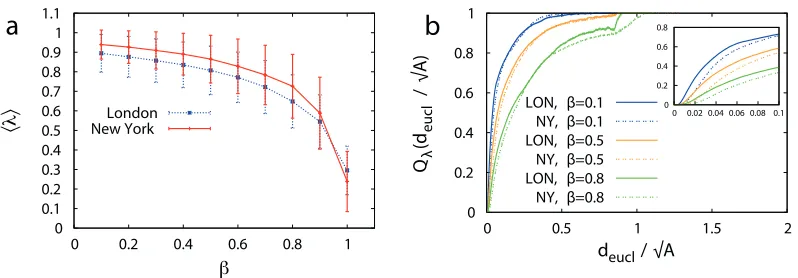
where de(i, j) is the Euclidean distance between i and j and N(d) is the number of pairs of nodes at Euclidean distance d. In Fig. 2a we show the average interdependence among all street nodes as a function of and the resulting interdependence profile Fig. 2b.
We see from these figures that, in both cities, the existence of the underground has a very large impact. For example, for = 0.8 we obtain around 0.7, meaning that even when the underground is only 1.25 times faster than the street network, already about 70% percent of the quickest paths are going through the underground. A slight decrease of for close to one thus has a large impact on structure of quickest paths, while for smaller values of , improving the subway speed does not bring a significant improvement of the structure of quickest paths. In both cities there is a sharp increase in for small Euclidian distance, meaning that already for relatively short trips, it is worth “hopping on” to the underground. (Note that we neglect here waiting, walking, and connecting times which can significant [38].) The slope of the interdependence profile at small deucl ' 0 is increasing as is decreasing, suggesting that a slight increase in the underground speed could make the networks highly interdependent even at very small scales.
0 0.1 0.2 0.3 0.4 0.5 0.6 0.7 0.8 0.9 1 1.1
0 0.2 0.4 0.6 0.8 1 London
New York
a
0 0.2 0.4 0.6 0.8 1
0 0.5 1 1.5 2
Qλ
(d
eucl
/
√
A)
deucl / √A
LON, β=0.1 NY, β=0.1 LON, β=0.5 NY, β=0.5 LON, β=0.8 NY, β=0.8
0 0.2 0.4 0.6 0.8
0 0.02 0.04 0.06 0.08 0.1
b
FIG. 2: (a) Average interdependence,h i as a function of . (b) Normalised interdependence profile computed for di↵erent values of . Both cities exhibit a similar behaviour despite very di↵erent geographical structures.
We note that it is not trivial that the central limit theorem applies here and it doesn’t mean that the network topology is irrelevant. The fact that we can sum a large number of quantities, which are uncorrelated (a necessary condition for the central limit theorem to apply) comes from the specific structure of these transportation systems (spatial constraints for example certainly play an important role). In addition, more complex quantities (such as the interdependence for example) also display a large level of similarity for the two cities, a fact that cannot at this stage be simply related to a central limit theorem. These di↵erent results point to the potentially useful fact that actually few parameters seem to govern the behavior of these quantities, which could lead to many useful simplifications in more elaborated models that contain a large number of parameters.
LOCAL OUTREACH AND THE URBAN SPATIAL HORIZON
The presence of a transportation mode such as a subway a↵ects the overall performance of a city in terms of efficiency of transport and the accessibility of certain locations, but also has an important impact on how pairs of locations are connected. In order to measure this e↵ect, we define thespatial outreachof a street nodei2Vstreet as the average Euclidean distance fromito all other street nodes that are reachable within a given travel cost,⌧:
L⌧(i) = 1
N(⌧) X
j|⌧m(i,j)<⌧
de(i, j) (7)
where de(i, j) is the Euclidean distance between node i and j, and N(⌧) is the number of nodes reachable on the multilayer network within a given travel cost⌧. In Fig. 3 we show the average local outreach as a function of the travel cost threshold⌧, which displays a non-linear behaviour due to the di↵erent speeds achievable in the two transportation modes. This provides support for a general e↵ect already known: for longer trips, faster transportation modes are used (see for example [38] for the UK case).
For New York, the unit of time is given by the average car speed on the street network which is of order 15.6km/h (see for example [41]). Rescaling ⌧ by this velocity, we then obtain an e↵ective maximum speed (for = 0.1) of order 30km/h (close to the 28km/h discussed in [42]). For London, the same calculation with an average car speed of 16km/h (see [43]) yields an e↵ective maximum speed of order 21km/h. (This di↵erence in speeds is due to the areas considered, as New York is almost entirely covered by the underground network.)
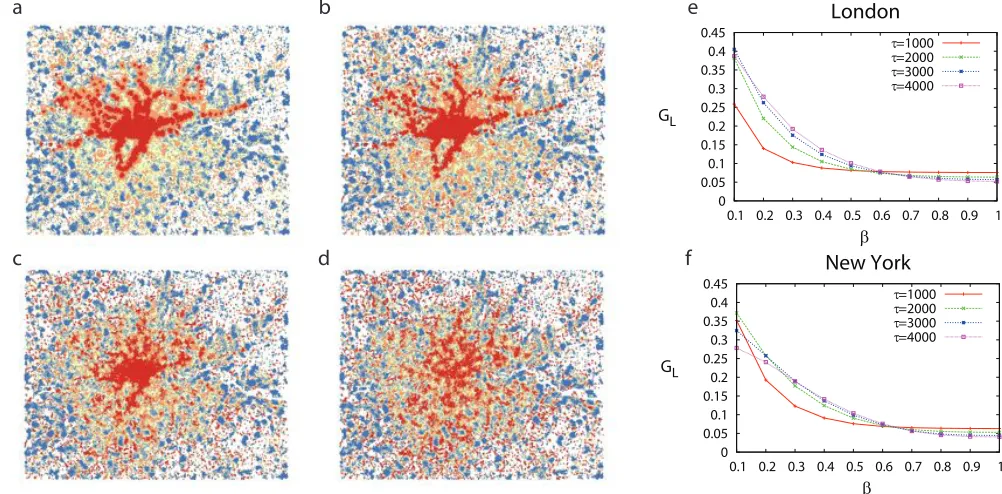
As shown is Fig. 4,a,b,d,e as decreases, the nodes having a high local outreach are concentrated close to under-ground stations where the underunder-ground is the most accessible, and the graph consisting of high-outreach nodes (red nodes on the map) becomes less fragmented.
[image:5.612.105.504.55.194.2]0 0.01 0.02 0.03 0.04 0.05 0.06 0.07 0.08
0 1000 2000 3000 4000
/
√
A
τ
London
β=0.1β=0.2 β=0.3 β=0.5 β=0.8 β=1.0
L
a
0 0.05
0.1 0.15 0.2 0.25
0 1000 2000 3000 4000
L
/
√
A
τ
New York
β=0.1
β=0.2
β=0.3
β=0.5
β=0.8
β=1.0
[image:6.612.106.506.56.193.2]b
FIG. 3: Average local outreachhLinormalised by the square root of area, for London (a) and New York (b).
0 0.05 0.1 0.15 0.2 0.25 0.3 0.35 0.4 0.45
0.1 0.2 0.3 0.4 0.5 0.6 0.7 0.8 0.9 1 GL
New York
=1000 =2000 =3000 =4000 00.05 0.1 0.15 0.2 0.25 0.3 0.35 0.4 0.45
0.1 0.2 0.3 0.4 0.5 0.6 0.7 0.8 0.9 1 GL
London
=1000 =2000 =3000 =4000a
b
e
[image:6.612.63.564.238.485.2]c
d
f
FIG. 4: Maps showing for London the spatial distribution of the local outreach defined in Eq. 7 for a travel cost ⌧ = 2000 and speed ratio ( a) =0.1, (b) =0.7, (c) =0.4 and (d) =1. As the underground’s speed is increasing
compared to the speed of the street network (i.e., decreasing ) the nodes having a high local outreach are concentrated at the center along the underground network, where the underground is most accessible. Theses figures
were created using ESRI ArchMap 10.1 and Adobe Illustrator. (e, f) The graphs show the Gini coefficient of the local outreach versus for both cities.
displays a very interesting result demonstrated by its Gini coefficient GL2[0,1]. Indeed, in Fig. 4e,f we see that for both cities for >0.5 the accessibility is distributed almost uniformly amongst all the places in the cities, while for smaller (faster underground) the shift to an uneven distribution of accessibility is clear. This result suggests that transportation policies that focus on increasing the speed on a single travel modality may lead to the undesirable spatial heterogeneity in the accessibility of di↵erent locations.
We show in Fig. 5 the probability that the outreach is larger than a certain fraction↵Lof the size of the city, and we observe the existence of a threshold↵c.
0 0.1 0.2 0.3 0.4 0.5 0.6 0.7 0.8
0.9 1
0.01 0.1 1
P(L >
α L, β , τ ) α
London, τ = 30min
β=0.1 β=0.2 β=0.3 β=0.5 β=0.8 β=1.0
a
β 0 0.1 0.2 0.3 0.4 0.5 0.6 0.7 0.8 0.9 10.01 0.1 1
α
New York, τ = 30min
β=0.1 β=0.2 β=0.3 β=0.5 β=0.8 β=1.0
b
P(L >
α L, β , τ ) β 0 50 100 150 200 250 300 350 400 450
0 10000 20000 30000 40000
αc
L
3 / N
u
τ/β
London β=0.1 β=0.2 β=0.3 β=0.5 β=0.8
c
0 5 10 15 20 25 30 35 40 450 10000 20000 30000 40000
αc
L
3 / N
u τ/β New York β=0.1 β=0.2 β=0.3 β=0.5 β=0.8
d
FIG. 5: (a)-(b) Fraction of nodes with a local outreach larger than↵pAfor London (a) and New York (b). (c)-(d) when both axis are rescaled according to Eq. 8, we observed a data collapse with all curves collapsing on a single one.
given by v/ , and the probability that a station is within reach (in circle of radiusd0 corresponding to the typical walking distance to reach the subway) is
p=⇢u⇡d20 (8)
where ⇢u =Nu/A is the density of subway station (A=L2 is the area of the city andNu is the number of subway stations). The maximal outreachLm is then given by
Lm=
Nu
L2⇡d 2 0
v
⌧ (9)
and↵c=Lm/Lis then given by
↵c=
Nu
L3⇡d 2 0v
⌧
(10)
This last equation shows in particular that the quantity↵cL3/Nushould increase linearly with⌧/ , with a constant of proportionality depending on geometry the city, and we observe that this scaling in is agreement with simulations (see figures 5c, d). In particular, we see that the slopes for London and New York are di↵erent: the ratio of the constant pre-factors is about 10, suggesting that the subway system in London is more efficient in terms of the outreach that can used as a measure of the “urban horizon”.
THE GEOGRAPHY AND DISTRIBUTION OF URBAN CENTRALITY
[image:7.612.136.482.55.308.2]systems: in particular, it is correlated with the locations of shops and other micro-economic activity [22, 23], urban growth [19, 20], and land-use intensity [45].
In the case of car traffic and congestion, the absence of detailed traffic models or mobility data leads us to use the BC in order to identify the potentially congested locations and the e↵ects of spatial structure on the shortest path structure. Even if we know that the assumptions used in the BC calculation can lead to some inacurracies [46], it is the simplest proxy that contains some level of information about real traffic. We thus explore in this section the spatial distribution of BC in the street network and how it is a↵ected by the underground system. The BC of a street nodev2Vsin the street network is defined as
bcs(v) = 1
(Ns 1)(Ns 2) X
i,j2Vs
street i,j (v)
street i,j
(11)
where street
i,j is the number of quickest paths betweeni andj in the street network, of which streeti,j (v) goes through street nodev. Similarly, we define the betweenness centrality of a street nodev2Vsin the multilayer network as
bcm(v) = 1
(Ns 1)(Ns 2) X
i,j2Vs
multi i,j (v)
multi i,j
(12)
where multi
i,j is the number of quickest paths betweeniandjin the multilayer network, of them i,jmulti(v) goes through street nodev.
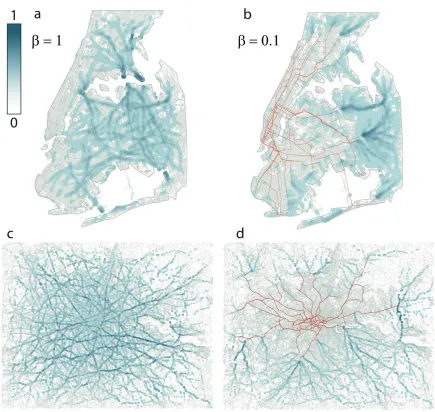
We can then observe how the parameter impacts the mobility distribution and the geography of potentially congested areas. The maps in Fig. 6(a,b,c,d) show the BC spatial distribution for both cities computed on streets for
= 1 (a,b) and = 0.1 (b,c).
These maps clearly display a dramatic change in the spatial distribution of central places when introducing an underground system, shifting congestion from internal street routes and bridges to inter-modal places located at the terminal points of the underground networks, which presumably are used as entry/exit gates for suburban flows to reach core urban areas. Remarkably enough, in both cities, these places are located in urban areas that do not overlap with the underground system, thus possibly creating congestion in unexpected places. In other words, the introduction of underground networks operate as a decentralising force creating congestion in places located at the ends of underground lines and not, for example, in the city centre as one might expect referring to classical results on rewiring processes for chain or lattice networks [1] in which BC is correlated to the distance to the gravitational centre. The statistical dispersion of BC can be measured by its Gini coefficient and also suggests that congested places always become more critical in the system as decreases. In fact, as shown in figure 7, the Gini coefficient of BC increases as the underground becomes more efficient (faster, decreasing ), meaning that a larger fraction of quickest paths use it; and the BC distribution is less homogeneous, making the system more fragmented and less resilient.
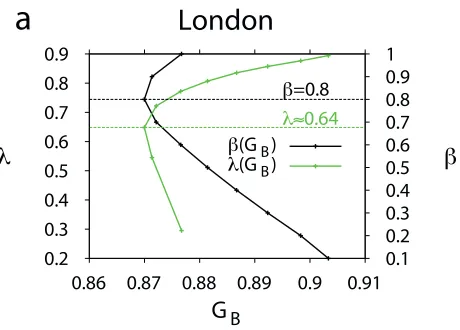
Examining BC Gini as a function of and the interdependency in London (Fig. 7), we observe a non-trivial optimal value for for which flows are the most homogeneously distributed across street junctions. In New York, however, there seem to be room for small and small congestion and the absence of a non-trivial optimum for New York suggests (as discussed theoretically in [37]) that – surprisingly – it has a more marked monocentric aspect than London. In other words, the congestion in central places in New York is so large that introducing an efficient subway system is always better, even if it creates congestion at other points. Remarkably, these results on BC and on the existence of an optimal point are thus in agreement with a recent theoretical model of coupled transportation networks, where – depending on the distribution of trip targets – two regimes were observed: one in which the optimal coupling is trivially the maximum, an another one where a non-trivial optimal coupling exists [37].
DISCUSSION
FIG. 6: The spatial distribution of BC on the New York (top) and London (bottom) street network for di↵erent values of . We observe a clear crossover from congested road locations for = 1 to “focal points” of the underground system for small (The maps have been obtained using the classical interpolation method Inverse Distance Weigh (IDW) on the street junctions with Z = BC). This figure was created using ESRI ArchMap 10.1 and
Adobe Illustrator.
for a reasonable range of subway speeds. More involved quantities such as the local outreach and the urban horizon also display a simple common behaviour that cannot be recovered using a back-of-the-envelope argument about the quickest path. This possible universality suggests that few parameters seem to govern the behavior of quickest paths, which could lead to many useful simplifications in more elaborated models that contain a large number of parameters. More data on more cities is however needed in order to validate this universal idea and to understand its origin.
0.2 0.3 0.4 0.5 0.6 0.7 0.8 0.9
0.86 0.87 0.88 0.89 0.9 0.91 0.1 0.2 0.3 0.4 0.5 0.6 0.7 0.8 0.9 1
G
BLondon
=0.8
0.64
(GB) (GB)
[image:10.612.187.417.57.222.2]a
FIG. 7: and interdependency as a function of the dispersion of the multilayer BC measured by the Gini coefficientGB for the BC.
empirical studies are however needed in order better to understand the complex coupling between land-use and the structure of multimodal networks.
It thus seems to be clear that it is important to consider full multimodal, multi-layer network aspects in order to understand the behaviour of an urban transport system – and thus understand the e↵ects of transport on other features of interest. Even if these studies are still very theoretical, they show convincingly that reasoning with only one transportation mode can be extremely misleading, and that policy-makers cannot limit themselves to a single aspect of an urban system without risking making decisions that are locally correct but globally wrong.
DATA ACCESSIBILITY
Original network data is available on Open Street Map [40]. The cleaned and topologically corrected networks are also freely available [49]. They include ArchMap shape file (.shp) containing streets and underground networks with their adjacency lists. These files can be opened on any GIS platform.
COMPETING FINANCIAL INTERESTS
The authors declare no competing financial interests.
AUTHOR CONTRIBUTIONS STATEMENT
SS wrote computational scripts and performed the computations on the multiplex networks. ES prepared the data and produced the maps. ES, SS, SD and MB designed research and wrote the paper.
ACKNOWLEDGEMENTS
FUNDING
MB acknowledges funding from the European Commission FET-Proactive project PLEXMATH (Grant No. 317614). SS thanks the James S. McDonnell Foundation 21st Century Science Initiative - Complex Systems Scholar Award (grant 220020315) and the Scottish Informatics and Computer Science Alliance for financial support.
[1] Barthelemy, M. Spatial Networks.Phys. Rep.499, 1-101 (2011).
[2] Jiang, B., & Claramunt, C. Topological analysis of urban street networks.Environ. Plann. B31, 151-162 (2004).
[3] Roswall, M., Trusina, A., Minnhagen, P., & Sneppen, K. Networks and cities: an information perspective.Phys. Rev. Lett.
94, 028701 (2005).
[4] Marshall, S. 2006Streets and Patterns.Abingdon: Spon Press.
[5] Porta, S., Crucitti, P., & Latora, V. The network analysis of urban streets: a primal approach. Environ. Plann. B33,
705-72 (2006).
[6] Porta, S., Crucitti, P., & Latora, V. The network analysis of urban streets: a dual approachPhysica A369, 853866 (2006).
[7] Lammer, S., Gehlsen, B., & Helbing, D. Scaling laws in the spatial structure of urban road networks.Physica A363, 89–95
(2006).
[8] Crucitti, P., Latora, V., & Porta, S. Centrality measures in spatial networks of urban streets.Phy. Rev. E73, 0361251-5
(2006).
[9] Cardillo, A., Scellato, S., Latora, V., & Porta, S. Structural properties of planar graphs of urban street patterns.Phys.
Rev. E73, 066107 (2006).
[10] Xie, F., & Levinson, D. Measuring the structure of road networks.Geogr. Anal.39,336-356 (2007).
[11] Jiang, B. A topological pattern of urban street networks: universality and peculiarityPhysica A384, 647-655 (2007).
[12] Masucci, A. P., Smith, D., Crooks, A. & Batty, M. Random planar graphs and the London street networkEur. Phys. J.
B71, 259271 (2009).
[13] Chan, S. H. Y., Donner, R. V., & Lammer, S. Urban road networks- spatial networks with universal geometric features?
Eur. Phys. J. B84, 563577 (2011).
[14] Barthelemy, M., & Flammini, A. Modeling urban street patterns.Phys. Rev. Lett.100, 138702 (2008).
[15] Courtat, T., Gloaguen, C., & Douady, S. Mathematics and morphogenesis of cities: A geometrical approach.Phys. Rev.
E83, 036106 (2011).
[16] Strano, E. et al. Urban street networks, a comparative analysis of ten European cities.Environ. Plann. B401071-1086
(2013).
[17] Louf, R., & Barthelemy, M. A typology of street patterns.J. R. Soc. Interface,11, 20140924 (2014).
[18] Xie, F., & Levinson, D.M.Evolving transportation networks.Vol. 1. New York, NY: Springer 2011.
[19] Strano, E. et al. Elementary processes governing the evolution of road networks.Sci. Rep.2296 (2012).
[20] Barthelemy, M., Bordin, P., Berestycki, H. & Gribaudi, M. Self-organization versus top-down planning in the evolution of
a city. Sci. Rep.3, 2153 (2013).
[21] Porta, S. et al. Alterations in scale: Patterns of change in main street networks across time and spaceUrban Stud. 51
3383-3400 (2014).
[22] Porta, S. et al. Street centrality and densities of retail and services in Bologna, Italy.Environ. Plann. B36, 450-465 (2009).
[23] Venerandi, A., Zanella, M., Romice, O., & Porta, S. The Form of Gentrification.arXiv preprintarXiv:1411.2984 (2014).
[24] Latora, V., & Marchiori, M. Is the Boston subway a small-world network? Physica A314, 109-113 (2002).
[25] Derrible, S., & Kennedy, C. Network analysis of world subway systems using updated graph theory.Transp. Res. Rec.
2112, 17-25 (2009).
[26] Derrible, S., & Kennedy, C. Characterizing metro networks: state, form, and structure.Transportation37, 275-297 (2010).
[27] Roth, C., Kang, S.M., Batty, M., & Barthelemy, M. A long-time limit for world subway networksJ. R. Soc. Interface9,
2540-50 (2012).
[28] Derrible, S., & Kennedy, C. The complexity and robustness of metro networks.Physica A389, 3678-3691 (2010).
[29] Costa, L.F., Travencolo, B.A.N., Viana, M.P., & Strano, E. On the efficiency of transportation systems in large cities.
Europhys. Lett.9118003 (2010)
[30] Buldyrev, S.V. et al. Catastrophic cascade of failures in interdependent networks.Nature464, 1025-1028 (2010).
[31] Kivela, M. et al. Multilayer networks.J. Complex Networks.2, 203-271 (2014).
[32] Shai, S., Dobson, S. Coupled adaptive complex networks.Phys. Rev. E.87, 042812 (2013).
[33] De Domenico, M. et al. Mathematical formulation of multilayer networks.Phys. Rev. X3, 041022 (2013).
[34] Boccaletti, S. et al. The structure and dynamics of multilayer networks.Phys. Rep.544, 1-122 (2014).
[35] Gomez, S. et al. Di↵usion dynamics on multiplex networks.Phys. Rev. Lett.110, 028701 (2013).
[36] De Domenico, M., Sol´e-Ribalta, A., Gomez, S., & Arenas, A. Navigability of interconnected networks under random
failures.Proc. Natl Acad. Sci. (USA)111, 8351-8356 (2014).
[37] Morris, R. G., & Barthelemy, M. Transport on coupled spatial networks.Phys. Rev. Lett.109, 128703 (2012).
[39] Farahani, R.Z., Miandoabchi, E. , Szeto, W.Y., & Rashidi, H. A review of urban transportation network design problems.
Eur. J. Oper. Res.229, 281-302 (2013).
[40] OpenStreetMaphttp://www.openstreetmap.org/(Date of access: 8/12/2014).
[41] NYC transit forums, Subway System Average Speed, By Line (2010)http://www.nyctransitforums.com/forums/topic/
17313-subway-system-average-speed-by-line/, (Date of access 7/12/2014).
[42] The New York Times,http://www.nytimes.com/2010/03/24/nyregion/24traffic.html?_r=0M.M. Grynbaum, Gridlock
May Not Be Constant, but Slow Going Is Here to Stay (2010) (Date of access 8/12/2014).
[43] Transport for London,http://www.tfl.gov.uk/(Date of access: 8/12/2014).
[44] Freeman, L.C. A set of measures of centrality based on betweenness.Sociometry40, 35-41 (1977).
[45] Wang, F., Antipova, A., & Porta, S. Street centrality and land use intensity in Baton Rouge, Louisiana.J. Transp. Geogr.
19, 285-293 (2011).
[46] Colak, S., Schneider, C. M., Wang, P., Gonz´alez, M.C. On the role of spatial dynamics and topology on network flows.
New J. Phys.15, 113037 (2013)
[47] Levinson, D. Density and dispersion: the co-development of land use and rail in London.JOEG8, 55-77 (2008).
[48] King, D. Estimating the e↵ect of subway growth on New York City land use.JTLU4, 19-32 (2011).
[49] doi: 10.6084/m9.figshare.1317306. Direct link to data: http://figshare.com/s/56135c96bcd311e4b49106ec4b8d1f61