ELABORATION OF AN ALGORITHM OF SCHEDULING
RESSOURCES BY THE PARALLEL HOURISTIC METHOD
Ngor SARR
1,*, Mame Faty MBAYE Fall
Kader Niakar Diogoul
1
EcolePolytechnique de Thiès, Sénégal,
2
Ecole Polytecnique de Thies (Senegal), Department genie civil
3
Moussa DIA, Associate Professor, Ecole Polytechnique de Thies (Senegal)
4
Ing, Graduate student at Ecole Polytechnique de Thiès (Sénégal)
ARTICLE INFO ABSTRACT
Ensuring the technical and economic consistency of carrying out a project with the contract that binds it to its client, in particular by respecting the deadlines set, the budget set and the technical specifications defined is the main objective of the project manager. However, he is limited in his freedom of choice by a certain number of constraints notabl
resources to carry out his project. The aim of this article is to design an algorithm for planning projects subject to a resource constraint. The methodology used is based on the theoretical and methodological approaches propos
objectives including in particular the critical path and critical chain method, mathematical programming as we
modification to the
have computerized. The result obtained in this article is the development of a realistic project implementation plan which minimizes its duration of realization in the event of a
the allocated resources. The major innovation of this work is the proposed tools which allow the project manager to be able to simulate the impact on the duration of realization of different scenarios of resource allocation.
Copyright © 2019, Ngor SARR et al. This is an open access distribution, and reproduction in any medium, provided
INTRODUCTION
The main objective of the project manager is to carry out his project within the deadlines, the budget set and the specifications defined, all in a risky context.
action is limited by a certain number of constraints, notably in terms of timing, budget, quality and resources. Different theoretical and methodological approaches are used to enable the project manager to achieve these objectives, including the Critical Path Method (CPM) and that the critical chain. However, there are still many scheduling problems under constraints that have not yet been resolved. This article is part of the search for solutions to these project scheduling problems under resource constraints.
*Corresponding author: Ngor SARR,
Ecole Polytechnique de Thiès, Sénégal, génieélectromécanique.
ISSN: 0975-833X
Article History:
Received 24th September, 2019 Received in revised form 18th October, 2019
Accepted 15th November, 2019 Published online 30th December, 2019
Citation: Ngor SARR, Mame Faty MBAYE Fall, Moussa DIA, MamadouSalla GUEYE, Kader Niakar Diogoul and Ibrahima Ly
an algorithm of scheduling projects with limited ressources by the parallel houristic method
Key Words:
Projects, Constraints, Resources, Critical Path,
Critical Chain, Optimization, Heuristics in Parallel.
RESEARCH ARTICLE
OF AN ALGORITHM OF SCHEDULING PROJECTS WITH LIMITED
RESSOURCES BY THE PARALLEL HOURISTIC METHOD
MBAYE Fall
1, Moussa DIA
2, Mamadou Salla GUEYE
Kader Niakar Diogoul
4and Ibrahima Ly
1EcolePolytechnique de Thiès, Sénégal, Département genie Électromécanique
Ecole Polytecnique de Thies (Senegal), Department genie civil
Associate Professor, Ecole Polytechnique de Thies (Senegal)
student at Ecole Polytechnique de Thiès (Sénégal)
ABSTRACT
Ensuring the technical and economic consistency of carrying out a project with the contract that it to its client, in particular by respecting the deadlines set, the budget set and the technical specifications defined is the main objective of the project manager. However, he is limited in his freedom of choice by a certain number of constraints notabl
resources to carry out his project. The aim of this article is to design an algorithm for planning projects subject to a resource constraint. The methodology used is based on the theoretical and methodological approaches proposed in the field to allow the project manager to achieve its objectives including in particular the critical path and critical chain method, mathematical programming as well as a multitude of heuristics and meta heuristics. We propose a modification to the parallel parallel heuristic method and develop a planning algorithm that we have computerized. The result obtained in this article is the development of a realistic project implementation plan which minimizes its duration of realization in the event of a
the allocated resources. The major innovation of this work is the proposed tools which allow the project manager to be able to simulate the impact on the duration of realization of different scenarios of resource allocation.
access article distributed under the Creative Commons Attribution the original work is properly cited.
The main objective of the project manager is to carry out his project within the deadlines, the budget set and the specifications defined, all in a risky context. However, its action is limited by a certain number of constraints, notably in terms of timing, budget, quality and resources. Different theoretical and methodological approaches are used to enable the project manager to achieve these objectives, the Critical Path Method (CPM) and that the critical chain. However, there are still many scheduling problems under constraints that have not yet been resolved. This article is part of the search for solutions to these
ource constraints.
Ecole Polytechnique de Thiès, Sénégal, Département
We offer an algorithm for planning a project subject to resource constraints. We introduce a priority criterion in the allocation of limited resources to different activities, the concept of start-up margin for the calculation of the criticality of an activity. First we present the state of research on the optimization of the planning of projects subject to constraints and then design a planning algorithm in the case where the realization of the project is subject to a resource constraint.
Literatures on the optimization of the planning of
constrained projects: One of the most difficult tasks for the
project manager today is probably managing deadlines and optimizing the allocation of re
characterized in particular by continuous and increasing restrictions on resources. To ensure compliance with the deadlines, the project manager must focus his attention on the
critical path of his project but also on the critical reso
International Journal of Current Research Vol. 11, Issue, 12, pp.8689-8696, December, 2019
DOI: https://doi.org/10.24941/ijcr.37485.12.2019
SARR, Mame Faty MBAYE Fall, Moussa DIA, MamadouSalla GUEYE, Kader Niakar Diogoul and Ibrahima Ly
an algorithm of scheduling projects with limited ressources by the parallel houristic method”, International Journal of Current Available online at http://www.journalcra.com
z
PROJECTS WITH LIMITED
RESSOURCES BY THE PARALLEL HOURISTIC METHOD
Salla GUEYE
3,
3Moussa Dia
Électromécanique,
Ecole Polytecnique de Thies (Senegal), Department genie civil
Associate Professor, Ecole Polytechnique de Thies (Senegal)
student at Ecole Polytechnique de Thiès (Sénégal)
Ensuring the technical and economic consistency of carrying out a project with the contract that it to its client, in particular by respecting the deadlines set, the budget set and the technical specifications defined is the main objective of the project manager. However, he is limited in his freedom of choice by a certain number of constraints notably in terms of time, time and resources to carry out his project. The aim of this article is to design an algorithm for planning projects subject to a resource constraint. The methodology used is based on the theoretical and ed in the field to allow the project manager to achieve its objectives including in particular the critical path and critical chain method, mathematical and meta heuristics. We propose a method and develop a planning algorithm that we have computerized. The result obtained in this article is the development of a realistic project implementation plan which minimizes its duration of realization in the event of a limitation of the allocated resources. The major innovation of this work is the proposed tools which allow the project manager to be able to simulate the impact on the duration of realization of different
License, which permits unrestricted use,
We offer an algorithm for planning a project subject to We introduce a priority criterion in the allocation of limited resources to different activities, the up margin for the calculation of the First we present the state of research on the optimization of the planning of projects then design a planning algorithm in the case where the realization of the project is subject to a
Literatures on the optimization of the planning of
One of the most difficult tasks for the project manager today is probably managing deadlines and optimizing the allocation of resources in a context characterized in particular by continuous and increasing restrictions on resources. To ensure compliance with the deadlines, the project manager must focus his attention on the
critical path of his project but also on the critical resources
INTERNATIONAL JOURNAL OF CURRENT RESEARCH
used, especially those which are distributed over several projects. Several methods for optimizing project planning are proposed in the literature. Many researchers have studied the problem of optimizing project planning, in particular the optimal allocation of resources to the different tasks of a project when the resources allocated are limited. This type of project scheduling problem with limited resources is not resolved (Koné 2009). The researchers' objective is to propose a solution that minimizes the end date of the project, while respecting both the constraints of prior art and resources, which ensures that at all times of the project, the sum of the needs of the activities running should not exceed the capacity of the resource.
Other researchers have dealt with the problem of leveling such resources by trying to both allocate the resources to be allocated to the project and allocate them to different tasks while minimizing the overall duration of the project and thus its cost. In practice, the solution is to breakdown the problem into two stages. For our contribution, we will first try to determine the optimal resources to allocate to the project. The amounts of resources thus allocated to the project become limits. Next, we will plan the execution of the project tasks. By adopting this decomposition approach, several researchers leave the determination of the resources to be allocated to the discretion of managers and limit themselves to proposing methods to solve the problem of planning projects which consider the limits on the resources to be used as an exogenous decision (Herroelen et al. (1998) and Kolisch and Padman (2001)). There are two classes of contributions in this area: those dealing with the problem where it is assumed that each task can be performed in one way (characterized by a duration and a combination of fixed required resources) and those where there are several ways for the execution of each of the tasks (with variable execution times).
Many works aiming at solving this problem relate in particular to exact resolution methods and approximate methods. This work is based on various theoretical tools such as linear programming in whole numbers (PLNE), constraint programming, heuristics and meta-heuristics, and exact branch-and-bound methods. However, despite all this work, there are no exact methods for systematically resolving instances of more than sixty activities (Koné 2009). In the case where it is assumed that the duration of the tasks and the combination of resources required are fixed, some researchers have proposed optimal methods (Demeulemeester and Herroelen 1992) but most of them propose the use of heuristic methods (Boctor 1990,2005, Lee et al. 1996, Baar et al. 1997, Gemmil et al. 1997, Hartman 1998, Hartman et al. 2000 and Fleszar et al. 2003) notably the parallel heuristic method, the heuristic method in series, the Muller, de Wiest, Dewitte, Burgess and Killebrewmethods. This problem of leveling of resources consists in modifying the execution dates of tasks according to the resources available in order to reduce the fluctuation of their load by performing a scheduling in multiple stages. The literature on this methodology is abundant, see Bandollini et al. (1994), Younis (1996), Hegazi (1999), Son et al. (1999) and Hiyassat (2001). The serial algorithm reviews activities in order of priority. The scheduling of
activities is carried out according to their start date at the earliest, respecting the constraints of precedence and resources. The parallel algorithm advances the project start date to the end date and schedules, for each date, activities that meet the precedence and resource constraints. If several activities can start on the same date but the resources are insufficient, the activities are selected according to the order of priority determined by the criticality of the activities. Rabbani et al. (2007) present a method combining multiple stage scheduling and the principles of the critical chain. They introduce a new priority rule used at decision points. The priority of an activity is the multiplication between its average duration and its criticality. Bruni et al. (2011) have developed a heuristic that uses the concept of joint probabilities to find a schedule that has a good probability of being respected. The SDGS heuristic (stochastic dynamic generation scheme) inspired by the parallel algorithm assumes that the functions for distributing the durations of activities are known. At each decision point, when one or more activities start, a conditional probability problem is solved. It allows you to choose the duration of the activities started, so that the probability that these activities delay the rest of the project does not exceed the chosen risk factor. This method has the advantage of solving this problem. However, the quality of the solutions found is comparable to that of the solutions found by the parallel algorithm in terms of the total duration of the project, often far from the minimum duration. For the optimization of project planning, some authors recommend the "critical chain" approach. which is an application of the theory of constraints to project management the fundamental principle is that the flow generated by an organization is limited by at least one process, that is to say a bottleneck or bottleneck. The critical chain proposes to provide practical answers to practices deemed ineffective, in particular:
the overestimation of the time security margins
allocated to each task,
starting work at the last moment (or student
syndrome),
the use of the entire planned duration of a task even
if the effective time for completion is much lower (Parkinson's law).
The critical chain approach helps the project manager to plan and manage a project through an optimization process linking the critical task-dependent path to the critical chain, that is to say the resource-dependent tasks, which determine the end date of the project. Although the method works well, Herroelen and Leus (2001) explain that its simplicity is dangerous and that it can generate unnecessarily large time buffers that do not protect the end date of the project well Zhang et al. (2011) also conclude that time stamps do not have to be as large as suggested in the literature. In addition, although this technique protects the end date of the project, it does not allow to know a priori the start date of the different activities of the project.
margin as a new criticality criterion for activities used at decision points as a priority rule for the allocation of available resources. It uses the Critical Path Method (CPM) which is a planning algorithm which identifies the critical path.
Basic notions of the CPM method
The main basics of a CPM network are the activity (task), the duration of the activity, the event (stage, milestone or decision point), the dates of an event, the start dates and end of an activity, margins and paths. The activity (task, operation) is the actual accomplishment of a job. The event (step, milestone) is an important decision point in the job such as starting or ending an activity. A path is a set of sequential tasks (having an interdependent link) which connect two stages. There are two methods of representing the ordering of logical relationships between the activities of a CPM / PERT network: representing activities in nodes or boxes (used in MsProject) and representing activities on arcs (arrows) In this last case that we use in this article, we find two basic elements: the activity and the event.
An event is characterized by its earliest date (ED) and latest dzte(LD) as well as by a serial numberi.
i = event i immediate predecessor of j ;j = event j immediate successor to I; ES earliest date of event I ; LS Latest date of event I ; D duration /of activity ij ; ES earliest start time of activity ij; LS Latest start time of activity ij of activity ij ; EF earliest finish time of activity ij ; LF latest finish time of activity ij ; TSLK total slack of activity ij
Le calcul des dates et des marges
ij ij ij ij ij ij ij j ij i ij ij j i ij iD
LS
fLF
t
ES
fEF
D
LD
LS
ED
ES
D
LD
Minimum
LD
D
ED
Maximum
ED
(
)
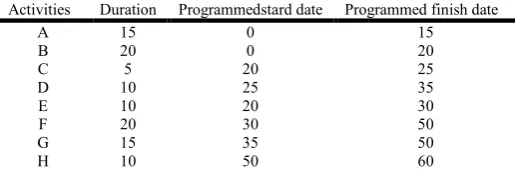
= − = −In table 1 we have the data of the treated example and the result of the calculations are given in table 2. The CPM network of the example is shown in Figure 1.
Presentation of the algorithm: In the case where resources
are limited, a heuristic (approximate) method is used, the principle of which is to allocate resources so as to minimize delays. The scheduling of project activities consists in scheduling their execution over time, by allocating the necessary resources to them, without violating the constraints imposed (resource and priority constraints for example).
The heuristic method in parallel which constitutes an iterative process which begins at the first period corresponding to the beginning of the project and plans, period by period, the activities likely to start will be preferred. If, at a given period, two or more activities are competent for the same resource, it is allocated in priority to the activity that can start on this date and with the smallest start-up margin but whose need for the resource is lower. availability of the latter. The start-up margin is the difference between the activity start date and the current launch date (decision bridge). For activities that can start but do not have the resources available to do so, will be delayed until the next release of resources. If there is equality of priority between activities, the conflict is lifted by the use of a second priority criterion. We notably offer SPT (Shortest Processing Time) which gives priority to the task with the shortest completion time or MCF (Most Critical Followers) where priority is given to the task which is followed by the greatest number of tasks criticism.
Without resource limitation figure 2 shows the GANTT of the project with the start dates at Figure 3 shows the histogram of resource requirements and shows that the periodic resource requirements fluctuate from 2 to 14 in the case of planning without resource constraints. If a resource constraint is imposed, it will be necessary to redo the planning of activities so as to complete the project in a minimum duration. Suppose, for example, that only 6 resources are assigned to execute the project. We propose here the optimization procedure which is a modification of the heuristic method in parallel:
Determine the amount of resources allocated to the project (given the problem);
for each activity:
determine its duration and resource requirements (given the problem)
calculate its start date at the latest (dA),
On the start date of the project, ie the period T = 0,
Determine the list of activities that can start;
Calculate their margin on start-up (start date at the latest minus current start date) which gives their degree of criticality.
Allocate the available resources as a priority to activities in ascending order of margins at start-up;
Start activities that allocate sufficient resources;
Calculate the end dates of the activities started;
Determine the quantity of resource not allocated on this start date;
Determine the date of the next release of resources (end of task closest);
Determine the activities in the list in (3) that cannot be launched for lack of sufficient resources and delay them until the next date of release of resources;
Determine the new start date T which is equal to the next release date of resources,
determine the quantity of resources available (those released by activities completed on this date plus those not allocated on the previous start date)
determine the new list of activities that can start (those previously delayed plus those that can start due to the completion of tasks)
return to step 4 until all the activities have started;
Determine the total duration of the project under resource constraint (it corresponds to the end date of the last activity to be completed).
Figure 3. Unrestricted resource use histogram Figure 3. Unrestricted resource use histogram
v
[image:5.595.54.529.352.659.2]Figure 5. The Resources sheet
Figure 6. Scheduling sheet
Figure 7. Extract of the application results
The application of the method requires knowledge of the critical path method. The limitation imposed by the availability of resources leads to delaying the start of certain activities. The method aims to minimize delays by determining, according to an iterative process that respects the constraints of resources and priority of activities, the scheduled start dates of the activities and the resources allocated to these activities. The allocation obeys selected priority rules making it possible to settle resource conflicts, if necessary. The result obtained at the end of the process is a final schedule for a balanced project in terms of resource use. The start and end dates for each task in this calendar become the scheduled start and scheduled end dates, respectively. Although the example treated only concerns the case of a single resource, the method is applied to cases of multi-resources for a project, it will be necessary to apply the procedure simultaneously on the different activities. This procedure applies to multi-projects, however, distinguishing between the activities of the different projects. A manual application of the algorithm is shown in Table 3. We note that under the limitation of resources to 6, the duration of the project goes to 60 time units. For large-scale projects, manual application becomes very tedious, hence the need to use computers.
Computerized implementation of the algorithm: The
manual application of the method can be tedious but it is easy to implement thanks to a computer application developed to lighten the task for managers. We used Visual Basic for Applications (VBA), for programming the procedure. The use of the application does not require knowledge of VBA because
the user works only on an Excel workbook comprising five sheets: Home, Resources, Activities, Scheduling and Guide. Accueil the Home sheet briefly indicates to the user the procedure to follow to carry out the scheduling of his project.
Tableau 1. Data of the example treated
Activities Prédécessors Duration Need of ressources
A - 15 2
B - 20 3
C B 5 3
D A,C 10 2
E B 10 3
F A,C 20 4
G D,E 15 2
H B 10 5
Tableau 2. Calculation of dates and total margin
Activities Duration Programmedstard date Programmed finish date
A 15 0 15
B 20 0 20
C 5 20 25
D 10 25 35
E 10 20 30
F 20 30 50
G 15 35 50
H 10 50 60
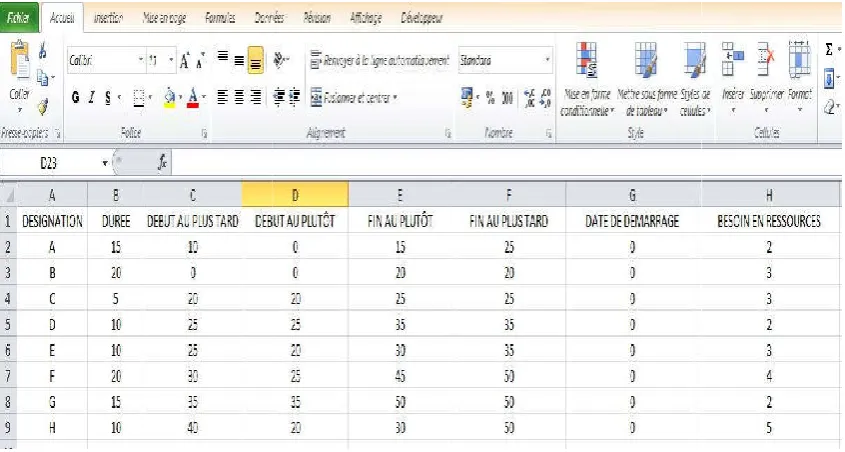
The Activities sheet in Figure 4 collects information on activities
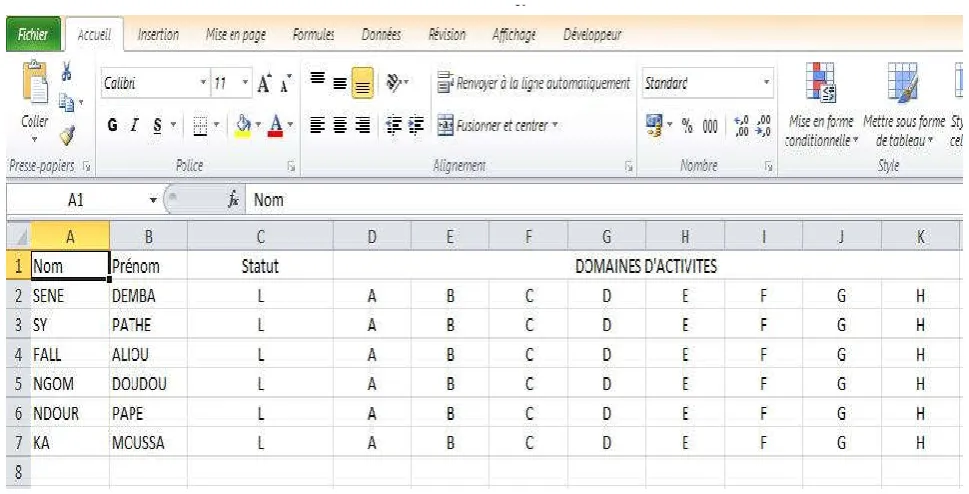
[image:6.595.315.548.536.626.2] He Resources sheet in Figure 5 collects information about resources.
Figure 8. Constrained resource use histogram
[image:6.595.304.562.661.746.2] The Scheduling sheet, it is on this sheet that the scheduling results are displayed as shown in Figure 6.
The Guide sheet: by means of examples, it can guide the user as to how to fill in the information in the Activities and Resources sheets.
To test the application, we took the example of the project whose scheduling was manually processed above in Table 1 following the same planning procedure as that of the application. By launching the application, we obtained exactly the same results as those of the manually processed example. Figure 7 shows an extract from the results provided by the computer application. Under the resource constraint, the total duration of the project goes from 50 to 60, a delay of 10 time units compared to the schedule without resource constraint. This delay is due to the delay in starting activity H from its start date at the latest. Here the maximum load never exceeds 6 men. As shown in the load histogram in Figure 8.
Conclusion
The problem of optimizing resource allocation and project completion times remains a major concern for project managers. The various theoretical and methodological approaches, including in particular the critical path and critical chain method as well as many heuristic methods constitute a significant advance but have not yet made it possible to find the optimal solution. The planning procedure that we propose in this article is intended to contribute to this quest for optimal methods in the case of planning projects subject to resource constraints. It proposes a modification of the parallel planning algorithm. Our algorithm applies to both multi-projects and multi-resources. The computer application developed under VBA is a significant help for project managers who will thus be able to carry out What If? in the allocation of project resources. As the project manager rarely does a single constraint in the conduct of his project, there is still much to do in the quest for optimal solutions in project management.
REFERENCES
Baar, T., Brucker, P., and Knust, S., 1997. “Tabu Search Algorithms for Resource-Constrained ProjectScheduling Problems”, in: S. Voss et al. (Eds.), Metaheuristics: Advances and Trends in Local Search Paradigms for
Optimization, Kluwer Academic Publishers, p1-18. 1997
Bandelloni, M., Tucci, M., Rinaldi, R., 1994. “Optimal Resource Leveling Using Non-Ser Dynamic Programming”, European Journal of Operational
Research, N)78, 2, p162-178. 1994
Baradaran, S., S. M. T. F. Ghomi, M. Mobini, and S. S. Hashemin. 2010. A hybrid scatter search approach for resource-constrained project scheduling problem in PERT-type networks. Advances in Engineering Software N°41 p7-8. 2010
Bhaskar, T., M. N. Pal, and A. K. Pal. 2011. A heuristic method for RCPSP with fuzzy activity times. European
Journal of Operational Research N°208 . 2011
Bianco, L., Dell Olmo, P., Speranza, M.G., 1998. “Heuristics for Multimode Scheduling Problems with dedicated resources” European journal of Operationnal Research, N°107 p260-271. 1998
Boctor, F. F., 1993. Heuristics for Scheduling Projects with Resource Restrictions and
Boctor, F. F., 1996a, A New and Efficient Heuristic for Scheduling Projects with Resource
Boctor, F. F., 1996b, Resource-Constrained Project Scheduling by Simulated Annealing,
Boctor, F.F. 1990. Some efficient multi-heuristic procedures for resource-constrained project scheduling. European Journal of Operational Research, N°49, p3– 13. 1990 Boctor, F.F., le problème d’allocation et de nivellement des
ressources, ASAC conférence 2005
Bouleimen K. et H. Lecoq. 2003. A new efficient simulated annealing algorithm for the resource-constrained project scheduling problem and its multiple mode version.
European Journal of Operational Research, N°149:p268–
281.
Tableau 3. Project work program
Activities Duration Need of ressources ES LS EF LF TSLK
A 15 2 0 10 15 25 10
B 20 3 0 0 20 20 0
C 5 3 20 20 25 25 0
D 10 2 25 25 35 35 0
E 10 3 20 25 30 35 5
F 20 4 25 30 45 50 5
G 15 2 35 35 50 50 0
H 10 5 20 40 30 50 20
Tableau 4. Results of the manual application of the algorithm
Stard date Avelableressources Activity be
can stard
Need of ressouces
LS Marge in
stard date
Activirtstarted Finish
date
Retardedactivity Nextstard
date
Non allocated ressources
o 6 A 2 10 10 A 15 15 1
B 3 0 0 B 20
15 3 - - - 20 3
20 6 C 3 30 10 C 25 25 0
E 3 25 5 E 30
H 5 40 20 H - 25
25 3 H 5 40 15 H - 30 30 1
D 2 25 0 D 35
F 4 30 5 F - 30
30 4 H 5 40 10 H - 35 35 0
F 4 30 0 F 50
35 2 H 5 40 5 H - 50 50 0
G 2 35 0 G 50
50 6 H 5 40 -10 H 60 - - 1
Bruni, M. E., P. Beraldi, F. Guerriero, and E. Pinto. 2011. A heuristic approach for resource constrained project scheduling with uncertain activity durations. Computers &
Operations Research N°38 . 2011
De Reyck, B. and Herroelen, W., 1998a. "A branch-and-bound algorithm for the resource constrained
De Reyck, B. and Herroelen, W., 1998b. "An optimal procedure for the resource-constrained
De Reyck, B., 1998. Scheduling Projects with Generalized
Precedence Relations - Exact and
Demeulemeester, E. et Herroelen, W. S., 1992. A Branch-and-Bound Procedure for the Multiple Resource-Constrained Project Scheduling Problem, Management Science, N°38: p1803-1818. 1992
Demeulemeester, E., De Reyck, B., Herroelen, W. 2000, “The Discrete Time/Resource Trade-Off Problem in Project Network: A Branch-and-Bound Approach”, IIE
Transactions, N°32, p1059-1069. 2000
Diogoul Kaker Niakar, Construction du poste ONEE 225/60KV de JBEL MOUSSA : suivi et optimisation du budget en heures pour la réalisation du poste, projet de fin d’études, Ecole Polytechnique de Thiès, 2017, 123 pages Duchesne A. : Ordonnancement de projets avec contraintes de
ressources dans un contexte incertain mémoire présenté en vue de l’obtention du diplôme de maîtrise ès sciences appliquées, école Polytechnique de Montréal 2013.
Gemmill, D.D., Tsai, Y.-W., 1997, “Using a Simulated Annealing Algorithm to Schedule Activities of Resource-Constrained Projects”, Project Management, p8-20. 1997 Hartmann, S., 1998, “A Competitive Genetic Algorithm for
Resource-Constrained Project Scheduling”, Naval
Research Logistics, N°45, p733-750. 1998
Hartmann, S., Kolisch, R., 2000, “Experimental Evaluation of the State-of-the-Art Heuristics for the Resource-Constrained Project Scheduling Problem”, European
Journal of Operational Research, N°127, p394-407. 2000
Hegazy, T., 1999, “Optimization of Resource Allocation and Levelling Using Genetic Algorithms”, Journal of
Construction Engineering and Management, N°125,
p167-175. 1999
Herroelen, W., and R. Leus. 2001. On the merits and pitfalls of critical chain scheduling. Journal of Operations
Management N°19. 2001.
Herroelen, W., De Reyck, B. and Demeulemeester, E., 1998, "Resource-constrained project scheduling: A survey of recent developments", Computers and Operations
Research, N°25,p279-302 1998
Herroelen, W., Demeulemeester, E. and De Reyck, B., 1998, "A classification scheme for project
Heuristic Procedures, Ph.D. Dissertation, Department of
Applied Economics, Katholieke Universiteit Leuven. 1998
Hiyassat, M., 2001, “Applying Modified Minimum Moment Method to Multiple Resource Levelling”, Journal of
Construction Engineering and Management, N°127,
p192-198. 2001
International Journal of Production Research, N°34:
p2335-2351. 1996
Kolisch, R., 1996. Serial and parallel resource-constrained project scheduling methods revisited: Theory and computation. European Journal of Operational Research N°90, p320-333. 1996
Kolisch, R., and Padman, R. 2001. An Integrated Survey of Deterministic Project Scheduling. Omega N°29:p249–272. 2001
Kolisch, Rainer. 1996. Serial and parallel resource-constrained project scheduling methods revisited: Theory and computation. European Journal of Operational Research N°90 .1996
KONE Oumar Nouvelles approches pour la résolution du problème d’ordonnancement de projet à moyens limités, thèsedoctorat de l'Université Toulouse III - Paul Sabatier 2009
Lee, J.K., & Kim Y.D. (1996). Search heuristics for resource constrained project scheduling. Journal of the Operational Research Society, N°47 p678– 689. 1996
Long, Luong Duc, and ArioOhsato. 2008. Fuzzy critical chain method for project scheduling under resource constraints and uncertainty. International Journal of Project
Management N°26, 2008.
project scheduling problem with discounted cash flows and generalized precedence relations", Computers and
Operations Research, N°25, p1-17. 1998
project scheduling problem with generalized precedence relations", EuropeanJournal of Operational Research, 1998.
Rabbani, M., S. M. T. F. Ghomi, F. Jolai, and N. S. Lahiji. 2007. A new heuristic for resource-constrained project scheduling in stochastic networks using critical chain concept. European Journal of Operational Research N°176 . 2007
Restrictions and Multiple Execution Modes, European Journal
of Operational Research, N°90: p349-361. 1996
scheduling problems", in: Weglarz J. (Ed.), Handbook on
Recent advances in Project Scheduling, Kluwer Academic
Publishers, 1998.
Several Resource-Duration Modes, International Journal of
Production Research, N°31: p2547-2558. 1993
Son, J., Skibniewski, M.J., 1999, “Multiheuristic Approach for Resource Levelling Problem in Construction Engineering: Hybrid Approach”, Journal of Construction Engineering
and Management, N°125, p23-31. 1999
STP PHARMA PRATIQUES - volume 21 - N° 5 - septembre-octobre 2011
Younis, M.A., Saad, B., 1996, “Optimal Resource Leveling of Multi-Resource Projects”, Computers & Industrial
Engineering, N°31, p1-5. 1996