Adam David Barwell
A Thesis Submitted for the Degree of PhD
at the
University of St Andrews
2018
Full metadata for this item is available in
St Andrews Research Repository
at:
http://research-repository.st-andrews.ac.uk/
Please use this identifier to cite or link to this item:
http://hdl.handle.net/10023/15641
Pattern Discovery for Parallelism
in Functional Languages
Adam David Barwell
This thesis is submitted in partial fulfilment for the degree of
Doctor of Philosophy
at the University of St Andrews
Abstract
No longer the preserve of specialist hardware, parallel devices are now ubiquitous. Pattern-based approaches to parallel-ism, such asalgorithmic skeletons, simplify traditional low-level approaches by presenting composable high-level patterns of parallelism to the programmer. This allows optimal parallel configurations to be derived automatically, and facilitates the use of different parallel architectures. Moreover, parallel pat-terns can be swap-replaced for sequential recursion schemes, thus simplifying their introduction. Unfortunately, there is no guarantee that recursion schemes are present in all functional programs. Automatic pattern discoverytechniques can be used to discover recursion schemes. Current approaches are limited by both the range of analysable functions, and by the range of discoverable patterns. In this thesis, we present an approach based onprogram slicingtechniques that facilitates the analysis of a wider range of explicitly recursive functions. We then present an approach using anti-unification that expands the range of discoverable patterns. In particular, this approach is
Acknowledgements
First and foremost, I would like to thank my supervisor, Professor Kevin Hammond, for his guidance throughout my studies. His advice and patience has been invaluable for not only developing ideas, but also for providing encouragement.
I would also like to thank Dr Christopher Brown for his ongoing assistance as my second supervisor. His knowledge and perspective on a wide range of topics has never not been a great help.
My special thanks to my fellow PhD students, Chris S., Matus, and Franck, with whom I have had the honour to share an office throughout my studies. Our conversations have always been full of insights, ideas, and information that I would be all the poorer for without. My special thanks also to David, a fellow student under Kevin, without whom the final stretch would have been a lot harder. Thanks to Jan, for his friendship and advice on all things St Andrean. I am also grateful to the other members of the St Andrews Functional Programming group.
Contents
Contents ix
1 Introduction 1
1.1 Parallelism . . . 2
1.2 Automatic Pattern Discovery . . . 5
1.3 Contributions . . . 10
1.4 Publications . . . 12
2 Existing Parallelisation Approaches 15 2.1 Automatic Approaches to Parallelisation . . . 16
2.2 Semi-Automatic Approaches to Parallelisation . . . 17
2.3 Summary . . . 24
3 Automatic Pattern Discovery for Parallelisation 25 3.1 Program Calculation Approaches . . . 26
3.2 Non-Calculational Approaches . . . 31
3.3 Summary . . . 33
4 Automatic Pattern DiscoveryviaProgram Slicing 35 4.1 Illustrative Example . . . 36
4.2 Preliminaries and Assumptions . . . 42
4.3 Determining Obstructiveness . . . 47
4.4 Implementation . . . 56
4.6 Examples . . . 64
4.7 Summary and Discussion . . . 93
5 Automatic Pattern DiscoveryviaAnti-Unification 101 5.1 Introduction . . . 102
5.2 Preliminaries and Assumptions . . . 107
5.3 Argument Derivationvia Anti-Unification . . . 112
5.4 Deriving Pattern Arguments . . . 121
5.5 Implementation . . . 126
5.6 Findingunfold . . . 128
5.7 Examples . . . 133
5.8 Summary and Discussion . . . 148
6 Conclusions and Future Work 151 6.1 Main Achievements . . . 151
6.2 Future Work . . . 163
6.3 Concluding Remarks . . . 164
A Proof for Soundness of Slicing Algorithm 165
B Proof for Soundness of Anti-Unification Algorithm 175
C Patterns Used in the Anti-Unify Module Refactoring 179
C
hapter
1
Introduction
The overall goal of this thesis is to develop new approaches to discover
par-allelism. Current pattern discovery approaches are often limited both in the range of functions they can analyse, and in the range of patterns that they can discover. This limits the number of recursion scheme instances that can be discovered for a given program, and therefore also oppor-tunities for parallelism. The automatic pattern discovery approaches presented in this thesis build upon existing approaches, and address both of these limitations. We use program slicingandanti-unificationtechniques to enable the discovery of patterns in pure functional code. In particular, our anti-unification approach is user-extensible, where patterns developed by the programmer can be discovered without requiring significant effort to extend the approach. To the best of our knowledge, this is the first user-extensible approach to automatic pattern discovery. Improving auto-matic pattern discovery techniques simplifies the parallelisation process by making it increasingly automatic, without sacrificing the range of par-allel structures that we can introduce, or the performance gains that they provide. Consequently, this allows programmers to easily take advantage of heterogeneous parallel hardware, and so improve the performance of their programs, with minimal effort or opportunities for error.
1.1 Parallelism
No longer the preserve of servers and supercomputers, parallel processors are now ubiquitous [11]. Multi-core processors can be found in many of the devices with which we surround ourselves; from laptop and tablet computers, mobile telephones, to portable games consoles. This is a trend that is set to continue, as epitomised by Intel’s new 18-core i9-7980XE X-series desktop processor. Moreover heterogeneous systems, including distributed computing power such as Amazon AWS, and increased prevalence of accelerators, such as FPGAs, discrete GPUs, and Digital Signal Processors, are becoming more common. Consequently, parallel programming is an increasingly necessary skill.
synchronisa-1.1. Parallelism
Input
x1, . . . , xn
Emitter
x1, . . . , xn
. . .
Worker
s1x↵
Worker
smx!
Collector
x0
1, . . . , x0n
Output
x01, . . . , x0n
Workers
[image:12.595.161.474.108.371.2]Task Farm
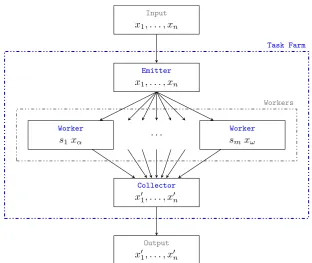
Figure 1.1: A task farm, or parallel map, skeleton. Applies a nested skeleton or function, si, to each input, xj, in parallel.
tion, etc. These low-level components often mean that traditional ap-proaches are tedious, difficult, and error-prone [56]. This makes parallel programming largely inaccessible to the average programmer. More recent structured approaches to parallelism, such as algorithmic skelet-ons [38], simplify the parallelisation process by abstracting away these low-level components. There is a close, and long-observed, correspond-ence between these structured approaches and functional programming. Futures [110], the Strategies library [111], the Par Monad [87], the Ac-celerate library [33], the actor model [7], and algorithmic skeletons are all structured approaches for functional languages, where the algorithm and parallel structure of a program are defined separately.
number of workers as a parameter, allowing the programmer to control the amount of parallelism that is introduced. Since skeletons can be composed and nested, a wide range of parallel structures can be repres-ented by a small set of skeletons. Moreover, a skeleton can have multiple implementations, including those for GPUs [70] and or high performance systems [113, 42] This makes swapping between the different imple-mentations as simple as calling a different function, and equivalences between configurations of skeletons can be used to further improve per-formance [31]. In functional languages, skeletons are often implemented as higher-order functions. For example, the task farm skeleton in Figure 1.1 has implementations in the Strategies library (parList), the Par Monad (parMap), and the Accelerate library (map), amongst others.
Recursion schemes describe how data structures can be traversed or constructed [90]. The well-known map, for instance, applies a function to each element in a data structure without changing the spine of the structure itself. In functional languages, recursion schemes are often implemented as higher-order functions. For example, the standard map
over cons-lists can be defined in Haskell as
1 map : (a -> b) -> [a] -> [b]
2 map f [] = []
3 map f (x:xs) = f x : map f xs
Recursion schemes are generic descriptions and so can be implemented for arbitrary types; e.g. binary trees, rose trees, and octtrees. Since many parallel patterns have sequential recursion scheme equivalents, e.g. the task farm and map, it follows that we can use instances of sequential
recursion schemes asloci of potential parallelism. A scheme can then be swap-replaced for an equivalent parallel pattern, just as the introduced pattern can then be swap-replaced for other equivalent parallel patterns or configurations thereof. For example, given the simple Sudoku solver [86]
1 sudoku ps = map solve ps
wherepsis a list of puzzles, andsolveis a function that solves a given
1.2. Automatic Pattern Discovery
1 sudoku ps = runPar $ parMap solve ps
Here, parMap is the task farm skeleton that applies solve to each element in ps in parallel, and runPar lifts the result out of the Par Monad. By taking advantage of equivalent recursion schemes and parallel patterns, parallelism can, in principle, be introduced quickly, easily, and (potentially) automatically and in a way that can take advantage of a range of architectures and parallel structures.
Despite the advantages of abstraction that are provided by both pattern-based parallelism and functional programming, introducing par-allelism can still be a non-trivial task. Whilst we can in principle replace recursion schemes with their parallel equivalents, parallelising all recur-sion scheme instances in a program does not guarantee good parallel speedups. Choosing the recursion schemes, orlociof potential parallelism that are best suited for parallelism, and which of the potentially infinite equivalent configurations of patterns will produce good speedups, can be guided by the use of cost models or by profiling tools [32]. Another, more fundamental, problem is that there is no guarantee that the pro-grammer will use recursion schemes in all possible instances, or that the best recursion scheme will be used. This means that opportunities for parallelism may limited, including the discovery of equivalent parallel structures that may confer performance gains.
1.2 Automatic Pattern Discovery
In order for recursion schemes to be effective and optimal lociof paral-lelism, they must i) be used in the source code, ii) be used in the right places, andiii)be the recursion scheme that best represents the traversal behaviour. Despite the prevalence of higher-order functions in func-tional programs, there is no guarantee that all programmers will always choose to use recursion schemes over explicit recursion. For example, the
programmer may not use a valid recursion scheme. For example, the programmer may not know a certain recursion scheme exists. Whilstmap,
foldr, and foldl are well-known recursion schemes, other schemes are less well-known; e.g. scanl, unfold, or one of the many general
morphisms[59]. Alternatively, the choice may be deliberate: an explicitly recursive function may express its behaviour more clearly. For example,
wc, as defined in [59], calculates the number of words in a string,
1 wc :: [Char] -> Int
2 wc cs =
3 para (\x xs z ->
4 if not (isSpace x)
5 && (null xs isSpace (head xs))
6 then z+1
7 else z) 0 cs
Here,parais aparamorphism, a less common recursion scheme where the fixpoint function, i.e. the anonymous function passed to para, has access
to both the results,z, of the recursive calls but also to the substructures, xs, that producedz. To understandwc, the programmer must be familiar
with the definition ofparabefore understanding the fixpoint function. We can definewcto use explicit recursion,
1 wc :: [Char] -> Int
2 wc [] = 0
3 wc (c:cs)
4 | not (isSpace c) && (null cs || isSpace (head cs)) 5 = wc cs + 1
6 | otherwise 7 = wc cs
Here, it is immediately apparent thatwcis usingstructural recursion [68], and so the programmer only needs to understand the guard expression as before. Similarly, the starting point of any program is to determine
1.2. Automatic Pattern Discovery
schemes may require the programmer to significantly reformulate the problem. Once the program is functionally correct, the programmer may then transform their code to introduce relevant recursion schemes.
A manual approach to pattern discovery can be non-trivial, error-prone, and subject to the same reasons why recursion schemes are not used in the first place. The programmer may not realise that a function can be expressed as a particular scheme; they may know that a relevant scheme exists, e.g. unfold or para; and they may not introduce the
scheme that accurately describes the behaviour of a given function. It follows, therefore, that if pattern discovery can be automated, and if all possible recursion schemes can be found and introduced, then more opportunities for parallelism are available while reducing the chances for introducing errors. Classical approaches to automatic pattern discovery have focussed on program calculational approaches. These are based on the Bird-Meertens Formalism [15] and equational reasoning [101] techniques, and reformulate function definitions into a desired pattern.
Most program calculation approaches use the Third List Homomorph-ism theorem [46], which states that if an operation can be expressed as both a leftwards-fold and a rightwards-fold, then that operation can be performed as part of a divide-and-conquer (parallel) pattern. For example, a function to sum a list of numbers,sum, can be defined as both a leftwards- and rightwards-fold:
1 sum = foldl (+) 0 2
3 sum = foldr (+) 0
This indicates that(+)isassociative, and so may be performed as part of a divide-and-conquer pattern; e.g.
1 sum [x] = x
2 sum (xs ++ ys) = (sum xs) + (sum ys)
Here, xsandysare two halves of the input list and are both passed to recursive calls, the results of those calls are then summed together using
Earlier list homomorphism approaches are limited in that they can only inspect functions that traverse lists, that the programmer must sup-ply two versions of the same function (i.e. a leftwards- and a rightwards-fold), and that operations that do not prove to be associative cannot be used in a divide-and-conquer pattern. Later approaches seek to address these limitations. For example, Morihata et al.demonstrate how to gener-ate a rightwards-fold from a leftwards-fold [94], and how the approach can be extended to trees, using upwards- and downwards-folds [93]. Elsewhere, Geser and Gorlatch rewrite almost-homomorphismsas homo-morphisms using anti-unification[45]. Despite the improvements to the approach these make, they are themselves limited. Deriving rightwards-folds requires the leftwards-rightwards-folds to be in a stylised form that limits the functions to which the technique can be applied. The generalisation to trees converts those trees to zippers [67], i.e. lists of subtrees, which introduces potentially significant overheads. Finally, Geser and Gor-latch’s approach shares the above limitations since it requires that both leftwards and rightwards definitions are provided in the form of cons -and snoc-lists, and is defined for list operations only. Another limitation of the list homomorphism approach is that it only finds one pattern; i.e. divide-and-conquer. Specialisations of the pattern, such as map or
scanl, must be derived as an additional step to take advantage of their parallelisations. Similarly, patterns with different structures cannot be found. For example, unfold is a corecursive pattern that allows the guarded generation of arbitrary data-structures [47].
Other calculational approaches to automatic pattern discovery address these limitations by using a more general pattern: hylomorphisms. These are also divide-and-conquer patterns, but are not limited to lists, or a particular type. Hylomorphisms are comprised of fold and unfold
parts, and can be used to express a wide range of patterns. Moreover, the laws that govern hylomorphisms can be used to calculate equivalent parallel pattern configurations [31]. Unfortunately, hylomorphisms in this form require highly stylistic code that is unlikely to be written by hand [61]. Hylomorphisms must therefore be discovered in arbitrary code, specifically requiring the discovery of foldand unfoldpatterns.
1.2. Automatic Pattern Discovery
hylomorphisms. Little work has focussed on discovering hylomorphisms in arbitrary code, with approaches often limited by the functions that they can inspect and rewrite, and the inability to discover useful specialisations offoldand unfold.
There are few non-calculational approaches to automatic pattern discovery. One approach, introduced by Ahn and Han, uses program slicingto categorise subexpressions in recursive functions, where those categories denote whether the calculation can be performed as part of a particular pattern [2]. While this approach can discover a wider range of patterns than other approaches, it is nevertheless limited by the functions that it can analyse since they must be defined in a certain way.
Another non-calculational approach, introduced by Cook [41], uses
higher-order unification. This approach compares the structure of two functions to infer whether the inspected function is an instance of a pattern that is defined by the second function, and if so, the arguments needed to express the inspected function as that pattern. This approach requires functions to be defined in a very stylistic way, thus reducing the range of functions to which it can be applied. Since the higher-order unification is performed by a proof assistant, any inspected code must be translated into the language of the proof assistant, then back again once analysis is complete. The approach is further limited in the range of functions to which it can be applied and the patterns it can discover, since it cannot e.g. inspect functions that use simultaneous induction (e.g.
zipWith) or corecursive functions (e.g.unfold). Finally, higher-order unification itself isundecidable. Semi-decidable variants exist, but these further limit the range of functions to which the approach can be applied.
In this thesis, we build upon existing automatic approaches to pattern discovery. In Chapter 4, we introduce a novel program slicing approach that can inspect arbitrary pure functions. This expands the range of functions that can be analysed by current approaches. In Chapter 5, we introduce a novel anti-unification approach that can discover arbitrary
techniques. Together, our approaches are able to discover more patterns in a wider range of functions than previously possible. Consequently, our approaches are able to discover more loci of potential parallelism, and so simplify and further automate the parallelisation process.
1.3 Contributions
This thesis makes the following novel contributions.
1. In Chapter 4, we introduce a novel approach that can discover mappable computations in arbitrary pure recursive functions using
program slicingtechniques.
2. In Chapter 5, we introduce a novel approach to determine whether a given function can be rewritten as a call to a given recursion scheme implementation, and if so, to derive the arguments to that recursion scheme that are needed to maintain functional correct-ness. We use anti-unification techniques as the foundation of this approach. Our technique is able to discover instances of schemes that can be represented as fold patterns. We demonstrate how
our approach can be extended to discover schemes with different pattern structures.
3. As part of our approach defined in Chapter 4, we define a novel
program slicing algorithm, where inclusion in a slice indicates that a variable is either used or updated between successive recursive calls. We prove that our algorithm is sound with respect to our definition of a slice and our assumptions, and that the calculated slice is unique for each recursive function and slicing criterion.
1.3. Contributions
5. We have implemented prototypes for bothslicingandanti-unification
approaches to pattern discovery, which we describe in Sections 4.4 and 5.5 respectively. Our prototype for the slicing approach is implemented as a stand-alone Erlang program, and our prototype for theanti-unificationapproach is implemented as an extension to the Haskell refactoring tool, HaRe [18].
6. We have evaluated both of our pattern discovery approaches on a range of examples. These include five standard parallel benchmarks, including benchmarks from the NoFib suite [99]. Other examples in-clude examples from the Haskell Prelude, and examples from Cook and Kannan’s theses [41, 74]. We demonstrate that our approaches are able to discover all instances of a range of common patterns, including map, foldr, foldl, scan, and zip. We present our results in Sections 4.6 and 5.7, respectively.
7. We give the average times taken by our prototype implementations for all examples. Ourprogram slicing approach is able to discover all mappable computations in our largest example in under 0.7ms, and our anti-unification approach is able to discover all patterns in our largest example in under 2s. As a synthetic benchmark, we have tested our prototypes with varying sizes of input. Our results suggest that the prototype implementation of ourprogram slicingapproach runs in quadratic time with respect to the number of operations classified. Similarly, our results suggest that the prototype implementation of ouranti-unificationapproach runs in exponential time with respect to the number of function clauses of both the inspected function and the given pattern, but also that our prototype implementation runs in linear time with respect to the number of functions and patterns that are compared.
shows that standard recursion schemes can be used to introduce parallelism and that they can produces good speedups.
1.4 Publications
Some of the work presented in this thesis has been previously published in a number of journal and workshop papers. In this section, we give an overview of these papers and describe how this thesis expands upon them.
In Search of a Map: Using Program Slicing to Discover Potential Parallel-ism in Recursive Functions, Workshop on Functional High-Performance Computing (FHPC), co-located with ACM International Conference on Functional Programming (ICFP), Oxford, UK, pp 30–41. A. D. Barwell and K. Hammond. In this paper, the author developed and presented the program slicing approach that is described in Chapter 4. Results are also presented. The author wrote the paper with K. Hammond assisting with editing, and advised upon the presentation and correctness of definitions. Chapter 4 extends this work by defining a refactoring to introduce map
operations, and presents additional examples.
Finding Parallel Functional Pearls: Automatic Parallel Recursion Scheme Detec-tion in Haskell FuncDetec-tions via Anti-UnificaDetec-tion, Future Generation Computer Systems, 2017. A. D. Barwell, C. Brown, and K. Hammond. In this paper, the author developed and presented the anti-unification approach that is described in Chapter 5. Results, including those of the parallel benchmarks, are included here. The author wrote the paper with C. Brown assisting with editing the initial submission, and K. Hammond assisting with editing the final version. Chapter 5 extends this paper by:
i) describing our prototype implementation;ii)introducing an approach to discover instances of the unfoldpattern; andiii)presents additional
1.4. Publications
Using Program Shaping and Algorithmic Skeletons to Parallelise an Evolution-ary Multi-Agent System in Erlang, Computing and Informatics 35(4), pp 738–818, 2016. A. D. Barwell, C. Brown, K. Hammond, W. Turek, and A. Byrski. This paper describes a case study that shows how refactoring techniques can introduce parallelism in an Evolutionary Multi-Agent System (EMAS). In this paper, we define novel refactorings, and apply those refactorings to the EMAS, producing a parallel version. The author defined and implemented refactorings to transform the code from sequen-tial to parallel versions. The EMAS itself was developed and described, and parallel results were provided by co-authors at the AGH Univer-sity of Science and Technology in Krakow, Poland. The author wrote the paper with the exception of the background section explaining the EMAS, and the majority of the results section, outlining parallel results. The experiments were also run by AGH. C. Brown and K. Hammond assisted with editing the paper. We cite this paper in Chapter 2 as an example of how refactoring techniques can facilitate the introduction and manipulation of parallelism.
The Missing Link! A New Skeleton for Evolutionary Multi-Agent Systems in Erlang, IJPP, 2017. J. Stypka, W. Turek, A. Byrski, M. Kisiel-Dorohinicki, A. D. Barwell, C. Brown, K. Hammond, and V. Janjic. This paper describes the EMAS in [11] as a generic meta-heuristic framework that may be in-stantiated for different context-specific examples. The author contributed only the experimental results, and the descriptions thereof. AGH and C. Brown wrote and prepared the majority of the paper, with additional editing by K. Hammond.
Discovering Parallel Pattern Candidates in Erlang, ACM Erlang Workshop 2014, pp 13–23, Göteborg, Sweden. I. Bozó, V. Fordós, Z. Horvath, M. Tóth, D. Horpácsi, T. Kozsik, J. Közegi, A D. Barwell, C. Brown, and K. Hammond. This paper reports on the ParaPhrase Refactoring Tool for Erlang. The tool is designed to inspect Erlang source code for par-allelisable computations. Once found, the tool introduces algorithmic skeletons from the Skel library [70], and profiles the produced parallel code in order to find and introduce the optimal parallel configuration. The writing of this paper was led by our co-authors at Eötvös Loránd University in Hungary; the author contributed to the background section on algorithmic skeletons and the development of the Skel library. We discuss this technique in Chapter 3, and explain its relation to the work presented in this thesis.
C
hapter
2
Existing Parallelisation
Approaches
For decades, Moore’s Law has allowed programmers to benefit from performance improvements for free [43]. However, as sequential pro-cessors have tended towards the physical limits of miniaturisation, we have turned to replication in order to continue to find improvements to performance [52]. Consequently, parallel hardware is now ubiquit-ous [11]. Unfortunately, and unlike sequential processors, adding more cores does not confer free performance improvements to programs [43]. The ability to take advantage of parallel hardware, and thus the potential improvements to performance they represent viaparallel programming, has become a necessary skill for expert and average programmers alike. Unfortunately, and unlike sequential programming, taking advantage of parallel hardware requires the programmer to consider additional coordination aspects; e.g. how a computation is decomposed, communic-ated among, and synchronised across available processing elements [14]. Moreover, since parallel hardware is increasingly heterogeneous [8, 42, 70], and that each architecture has its own requirements, such as GPUs needing to apply the same instructions to batches of data, writing paral-lel programs that take advantage of all available hardware can further complicate an already difficult parallelisation process [70].
programming languages. They require the programmer to consider all coordination aspects of parallelism. Due to the complexity of this approach, these approaches are highly susceptible to errors; such as race conditions, deadlocks, and livelocks [11, 14, 52]. In response, a range of techniques have been developed to facilitate parallelisation, including both fully-automatic and semi-automatic approaches, which we describe in this chapter.
2.1 Automatic Approaches to Parallelisation
Automatic approaches to parallelisation seek to simplify parallelisation for the programmer by removing the programmer from the equation. The majority of automatic approaches focus on introducing low-level parallel primitives transparently at compile-time in imperative languages. Amongst others, these include: Lamport’s parallelisation of Fortrando -loops [77]; Burke and Cytron’s improvements to the detection of nested loops [26]; and Artigas’ approach for Java’s loops [5]. These approaches generally use data-dependency information to work out which loops can be parallelised, combined with profiling information to determine whether parallelisation would be profitable [109, 116].
More recent approaches for automatic parallelisation have focussed on the use of GPUs [54, 80] and the polyhedral model[6]. The polyhedral model is a loop optimisation and parallelisation approach that represents each stage in a (potentially nested) loop as a point in a lattice. This ex-poses dependencies between lattice points, and so enables the reordering of statements in the analysed loops to safely optimise their operation and introduce parallelism [13]. One limitation of the polyhedral model, is that it requires the AST of the loop to be translated into a specific linear-algebraic form, and not all statements can be translated to this form [13, 53].
extend-2.2. Semi-Automatic Approaches to Parallelisation
ing these analyses can be difficult; any program transformations must be correct for all cases, for example. An automatic parallelising tool must be trustworthy since the programmer cannot influence the introduced parallelism; they should therefore introduce no errors, and they should improve the performance of the parallel program. Another limitation of automatic approaches is that they can often only introduce one type of parallel structure, and normally for one type of architecture. Approaches that use GPUs can expand the range of architectures automatic parallel-isation approaches can use, but are still limited by both the structures they can analyse and the structure of parallelism they can introduce. Moreover, since automatic approaches often introduce low-level parallel primitives, it can be difficult to easily swap between equivalent parallel implementations. These limitations can reduce the amount of parallel-ism that can be introduced to a program, and so potentially reduce any performance gains that can be achieved.
2.2 Semi-Automatic Approaches to
Parallelisation
Functional programming has a long history with parallelism [12] and can be used to abstract how programs are evaluated, so providing a clear separation between algorithmic code and its evaluation behaviour [86].
Higher-order functions, in particular, facilitate the abstraction of behaviour since e.g. context-specific functions can be accepted as input to functions, suchmap, that denote how a data-structure is traversed, or how an op-eration should be evaluated. Haskell, for example, is a lazy functional language, meaning that evaluation to normal form occurs only when a value is needed. The language is extended using Futures [86], rep-resented by the par and seq operators, that allow the programmer to indicate that a given operation can be performed in parallel. This concept is not limited to functional languages, a similar technique can be found in OpenMP’spragmas, for example, where regions of code are declared as parallelisable [34]. This allows the parallelism to be introduced transpar-ently to the programmer, whilst still allowing the programmer to guide how parallelisation occurs. Similarly, the Task Parallel Library [79] auto-matically maps tasks to threads, but the programmer is responsible for splitting and synchronising the data. Another approach by Calderonet al.
uses strictness analysis to automatically activate and deactivate, and in some cases insert, parand seq operations in Haskell source code [110]. Both par andseqoperators can be further abstracted in order to increase the level of abstraction of parallelism presented to the programmer. The Strategies Library [111], the Par Monad [87], NESL [16], GUM [112], Eden [85], and the Accelerate library for GPUs [33], all present higher-level primitives for introducing and manipulating parallelism. These approaches allow the programmer to better control when and to what level (e.g. normal form) an operation will be evaluated. While these ap-proaches are higher-level than traditional parallel primitives and libraries, they still require the programmer to coordinate the mapping of tasks to threads and communication between those threads.
2.2. Semi-Automatic Approaches to Parallelisation
is designed to express the (parallel) structure of a C++ program in a simplified way, effectively separating what the program does from how it does it [71]. RPL is extended with a series of refactorings that work either directly on the C++ source code, or on its RPL representation. To guide the application of these refactorings, recipesare presented to the programmer to suggest how an optimal parallel configuration can be introduced. Aldinucci’s META tool [3] is similar to RPL, but instead presents the (parallel) structure of a program as a graph. Transform-ations applied to the graphical representation are similarly applied to the underlying source code. The META tool is presented for a generic target-language. DSLs present a simplified interface that the programmer can use to reason about structure and program transformations when introducing parallelism. Whilst this is advantageous, it follows that the source and target language likely need to be transformed to the DSL, which must be expressive enough to describe all possible parallelism in the source and target language(s), and whose syntax must be learnt by the programmer. If the high-level information exposed by DSLs can be encoded into the language itself, these potential problems can be avoided.
have been developed for a number of programming languages since their introduction in 1988. Some skeleton libraries include: Skel for Erlang [69]; the Strategies library [111], the Par Monad [87], Eden [85], and Feldspar [8] for Haskell; FastFlow [72] for C++; Microsoft’s Parallel Patterns Library [29]; and Intel’s Threading Building Blocks library [40]. Other skeleton libraries are available, with the study by González-Vélez in 2010 listing at least 22 [50]. Similarly, a range of skeletons has been developed; including, but not limited to: apipelineskeleton, atask farm, and afeedback skeleton.
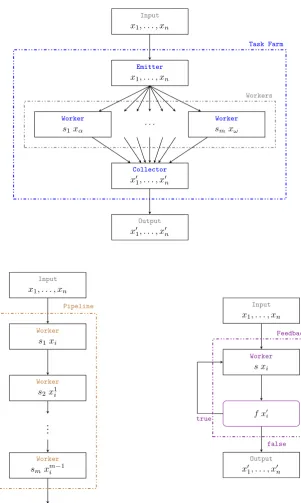
A parallelpipeline(Figure 2.1) applies a sequence of skeletons,s1, . . . ,sn,
in turn to a stream of independent inputs, x1, . . . ,xn, where the result
of si is passed as input to si+1. Parallelism arises from the fact that each si(xj) can be performed in parallel with si+1(xj+1). A task farm,
or parallel map, (Figure 2.1) applies a skeleton, s, to each element in a stream of independent inputs, x1, . . . ,xn. Parallelism arises from the fact
that each s(xi) can be performed in parallel with all other s(xj). Finally, feedback allows looping operations. It repeatedly applies a skeleton,
s, to each independent input in a stream, until a given condition is reached. Skeletons can additionally represent context-specific sequential code, usually in the form of functions. Consequently, nested skeletons are either: i) context-specific sequential code, or ii) another skeleton instance. Other skeletons are possible, including skeletons that can be formed as combinations of other skeletons; e.g. Divide-and-Conquer [50], Branch and Bound [50], Bulk Synchronous Parallelism (BSP) [97], and the butterfly pattern [96].
Despite the benefits of abstraction, skeletons are limited by the re-quirement that the programmer knows whichskeletons should be called,
2.2. Semi-Automatic Approaches to Parallelisation
Input x1, . . . , xn
Emitter x1, . . . , xn
. . . Worker
s1x↵
Worker smx!
Collector x0
1, . . . , x0n
Output x0
1, . . . , x0n
Workers Task Farm
Input
x1, . . . , xn
Worker
s1xi
Worker
s2x1
i
. . .
Worker
smxmi 1
Output
xm
1, . . . , xmn
Pipeline Input
x1, . . . , xn
Worker
s xi
f x0i
Output x0
1, . . . , x0n
false true
[image:30.595.163.465.135.639.2]Feedback
and with what configuration of skeletons. Hammond et al. present a profiling approach to automatically derive skeleton configurations for EDEN, using Template Haskell to automatically change configurations at runtime [57]. Similarly, Scaife et al. developed a parallelising compiler for SML that replaced mapandfoldoperations by equivalent skeletons, using profiling to determine whichmap andfold operations should be replaced [107]. More recently, Castro et al. have combined dependent types, the laws of hylomorphisms, and cost models to automatically derive the optimal configuration of skeletons [31, 32].
While profiling and cost models can be used to suggestwherein the source code a program might benefit from parallelisation, and can be used to determine an optimal configuration of skeletons, these approaches do not consider how an arbitrary program might be restructured to facilitate, or even enable, the introduction of skeletons. Recent work considers how
refactoringtechniques can be used to facilitate the restructuring of source code to introduce skeletons.
The term refactoring was introduced by Opdyke in his thesis [98], but the concept goes back as far as Burstall and Darlington’s fold/unfold system [27]. Refactoring commonly refers to the act of changing the internal structure of a program without changing its functional beha-viour [19]. While such transformations can be performed mechanically, a range of refactoring tools have been developed for a number of languages and IDEs [17, 18, 58, 60, 71, 83, 91]. This reduces the opportunity for error since a refactoring tool can ensure that the correct code is trans-formed. Whilst the majority of refactoring tools have been developed for imperative languages, some refactoring tools do exist for functional languages. These include: Wrangler [83] and RefactorErl [17] for Erlang, and HaRe [18] and Haskell Tools [58] for Haskell. Common refactorings include: rename, where a variable, function, or module is renamed, and all instances are correctly changed; lift function, where a new function is declared and the selected code is lifted into the body that function; and
inline, which takes a function or variable name and replaces an instance of that name with its definition.
2.2. Semi-Automatic Approaches to Parallelisation
complex refactorings [81]. In [43], Dig discusses how refactoring can be used to facilitate the introduction and management of parallelism. A sim-ilar approach has been taken by Brownet al.in [19], where they introduce and manipulate skeletons using a series of refactorings and the Erlang refactoring tool, Wrangler. Brown et al. define four novel refactorings to introduce three skeletons using the Skel library, and to group inputs to increase granularity. Cost models are used to evaluate how well the introduced parallelism performs. Refactorings can be applied multiple times, and can be undone should a refactoring reduce parallel speedups. Both refactorings and Skel were extended in 2015 by Janjicet al.to enable the use of GPUs [70]. Here, Skel is extended with skeletons that utilise GPUs, and refactorings are defined to introduce the new skeletons, and also to generate the GPU kernel code. This approach is not limited to Erlang, with Brown et al.demonstrating how refactoring can be used to introduce skeletons in Haskell [22] and C [20].
These refactorings focus primarily on the immediate introduction and manipulation of skeletons. Since parallelisable code may not be immediately obvious, it is often necessary to first restructure code to facilitate, or even enable, the introduction of skeletons. In [11], the au-thors demonstrate how standard refactorings can be combined with those defined by Brown et al. in order to restructure an Evolutionary Multi-Agent System in Erlang. While this demonstrates how refactorings can be combined to introduce parallelism, it does not discuss how a programmer should know which refactorings to apply, where to apply them, and in
2.3 Summary
Parallelisation allows programmers to take advantage of the increasingly parallel and heterogeneous systems that are now ubiquitous in order to increase the performance of programs. Simplifying traditional, low-level approaches to parallelisation has been the focus of much work, including both fully-automatic approaches described in Section 2.1 and semi-automatic approaches described in Section 2.2.
For this thesis, we have chosen to use algorithmic skeletons for paral-lelisation since skeletons support a wide range of parallel structures and can be expressed using a small set of patterns. Additionally, skeletons can have multiple implementations, and so both a wide range of hardware and a wide range of underlying approaches can be taken advantage of easily. This also facilitates switching between different implementations and architectures. Since parallel patterns are language independent, any techniques that build upon skeletons are also more likely to be language independent, as well as simplifying the understanding of parallel pro-gram structures. Relatedly, and since skeletons can be reasoned about, the optimal configuration of skeletons can be discovered automatically. Finally, since skeletons are an explicit approach to parallelism, the pro-grammer can inspect and affect the introduction of parallelism, meaning the approach is more flexible than fully-automatic techniques.
C
hapter
3
Automatic Pattern Discovery for
Parallelisation
In order to facilitate and further automate the introduction of parallelism
will always be chosen over their more general forms, it is useful to detect patterns in code automatically. A number of approaches to automatic pattern discovery currently exist. The majority of these have their roots in the Bird-Meertens Formalism [15], and calculate instances of patterns from functions. We refer to these asprogram calculationalapproaches, and discuss these in Section 3.1. Non-calculational approaches also exist, and we discuss these in Section 3.2.
3.1 Program Calculation Approaches
Since functional languages provide a good foundation for equational reasoning [115], a number of approaches have been developed based on the Bird-Meertens Formalism [15] to transform programs using a calcula-tionalapproach. This is similar to the Worker/Wrapper transformation technique described by Gill and Hutton [49], which allows the type of data structures and operations to be transformed to allow more efficient accesses. Most calculational approaches to automatic pattern discovery are based on the Third List Homomorphism theorem, or the discovery of another general recursion scheme, hylomorphisms. We discuss both in the below sections.
3.1.1 Using the Third List Homomorphism Theorem
The Third List Homomorphism theorem states that given functionally equivalent leftwards and rightwards folds that express the same opera-tion, then the operation is associative and commutative, and can therefore be performed as part of a divide-and-conquer pattern [46]. In this basic form, list homomorphismsrequire two sequential foldimplementations
of the same operation. This is limiting in two ways: i) twofold defini-tions are required for the same operation; and ii) not all interesting list functions, such as maximum segment sum, are expressible as list homo-morphisms. In order to address these limitations, Geser and Gorlatch present an approach that usesanti-unificationto derive list homomorph-isms from two pure explicitly recursive functions: one defined using
3.1. Program Calculation Approaches
able to produce list homomorphisms fromalmost homomorphismssuch as
maximum segment sum. Since all functions that traverse a single list can be represented as almost homomorphisms [51], the ability to discover almost homomorphisms means that, in principle, all such recursive functions can be represented as a list homomorphism. Anti-unification compares the structure of two functions, to produce a third function, known as the
anti-unifier, that represents the shared structure, and two sets of substitu-tions that represent the rewrites needed to restore the original funcsubstitu-tions from the anti-unifier. Geser and Gorlatch apply anti-unification twice, and use a calculational approach to derive function definitions that com-prise the list homomorphism. While this approach is able to discover list and almost homomorphisms from explicitly recursive functions, it still requires two equivalent sequential functions, only applies to functions that traverse single lists, and the conversion of almost homomorphism to list homomorphism uses a projection function that introduces additional overheads.
homo-morphisms and mutumorphisms[63]. A mutumorphism is a collection of functions that are mutually recursive. Whilst these approaches represent an improvement, they remain limited by the range of patterns that they can discover, and both derive and introduce parallel forms as part of their operation. The derived patterns are unique, and switching between different parallel implementations of patterns is likely to prove difficult. Once again, the authors of these approaches claim that the technique is extensible to data types other than lists, but this is not shown, and is likely to require significant time and effort of anyone who chooses to extend the approach.
Where the above techniques are based on calculational approaches that have been proved sound, Chiet al.synthesise list homomorphisms from proofs of associativity using a proof assistant [35]. Unfortunately, this approach means that it is difficult to extend to other languages since it would require translations between the program language and the proof assistant language.
One key limitation of approaches that are based on list homomorph-isms is the range of patterns that they are able to introduce. Approaches thus far have only been able to introduce list homomorphisms, and in mutumorphisms in [63]. Mu and Morihata address this limitation, and extend the calculational approach to discoverunfoldinstances for func-tions that generate lists [95]. This facilitates the translation of arbitrary data types to lists, and enables examples that handle sub-lists such as those found in the standard quicksort definition; i.e.
1 qsort [] = []
2 qsort (x:xs) = (qsort leq) ++ [x] ++ (qsort gt)
3 where leq = filter (=<x) xs 4 gt = filter (>x) xs
structure/divide-and-3.1. Program Calculation Approaches
conquer pattern introduced/enforced by homomorphisms can be useful and automatically adjusted for a range of hardware/systems [84].
Where theunfoldpattern can be used to translate arbitrary types to lists, an alternative approach is to extend list homomorphisms to other types, such as trees. Morihata et al.generalise homomorphisms on trees, using upwards- and downwards-folds instead of the usual leftwards-and rightwards-folds [93]. This approach uses zippers [67] to divide trees into lists of subtrees and find the list homomorphism over that zipper. It could therefore be argued that the approach presented in [93] translates data types to lists, but as part of the homomorphism approach, instead of being left as an exercise to the programmer. Bothunfoldand zipper translation approaches introduce additional runtime overheads.
Conversely, Diffusion [64] has been shown to be extensible to binary trees without requiring translation. Simple diffusion is based on the third list homomorphism principle, but is described as being too limiting. The full diffusion approach can discovermap,fold, andscanpatterns
using calculation. The approach can also be extended by combining it with external normalisation procedures, since explicit function definitions need to be presented in a stylised form in order to successfully find the recursion schemes. Although Diffusion expands the range of discover-able patterns to include specialisations offold, it cannot discover more general divide-and-conquer patterns like other calculational approaches. Since Diffusion is also a deforestation technique, it mayremovepatterns from code in addition to exposing them. While this may optimise se-quential programs, it canreduceopportunities for parallelism in parallel programs [36, 41].
A similar approach, introduced by Launchbury and Sheard, uses standard fusion techniques in combination with a dynamic set of rewrite rules to discover folds in source code [78]. Once again, extending this approach to other patterns is likely to be difficult, and whilst folds are useful, more specific forms, or other forms of patterns can also be useful in deriving the optimal configuration. Finally, and since fusion is another deforestation technique, it too can reduce opportunities for parallelisation.
a comprehensive approach to automatically discovering homomorph-isms. Despite this, a number of general limitations remain. As the name suggests, list homomorphism approaches are primarily concerned with the discovery of list homomorphisms. Some approaches have extended this to other patterns, including mutumorphisms, specialisations such as
map, andunfold, but these still represent a limited subset of patterns. Moreover, as these extensions demonstrate, extending the approach fur-ther to ofur-ther patterns is a difficult challenge. Anofur-ther limitation of list homomorphism approaches is the range of functions they are able to analyse. Whilst the ability to convert almost homomorphisms to list homomorphisms expands the range of analysable functions, this range is still limited to explicitly recursive functions that traverse a single list. Moreover, transforming almost homomorphisms to list homomorphisms introduces additional overheads. The extensions to trees and other pat-terns are similarly limited with respect to analysable functions, and also introduce additional overheads. Extensibility, range of analysable func-tions, and range of discoverable patterns all limit the number and range of patterns that can be discovered, and therefore limits possibilities for parallelism.
3.1.2 Hylomorphisms
A hylomorphism is a more general expression of a divide-and-conquer skeleton. They comprise a combination of an unfoldand afold.
hyloF f g= f F(hyloFf g) g
Here, g describes how the input is split (i.e. an unfold) and f
de-scribes how it is combined (i.e. a fold). The hylomorphism is indexed
3.2. Non-Calculational Approaches
Despite hylomorphisms being more general than list homomorphisms, and so allowing them to represent arbitrary data-types and a wider range of operations without producing additional overheads through projection functions and translations, they are not a standard recursion scheme. This limits their usefulness as loci of potential parallelism. Moreover, they are often represented in very stylised forms and/or programming styles, such as point-free. To address this, Hu, Iwasaki, and Takeichi present an approach to derive structural hylomorphisms from recursive definitions [61]. Entire functions are rewritten using program calculation techniques to represent the transformed functions as hylomorphisms. No inverse transformation is presented, and since the entire function is used, near patterns cannot be found. As a result, hylomorphisms cannot be transformed back into explicit recursive style, and some normalisation may be necessary in order to first discover those hylomorphisms. Moreover, this approach finds only hylomorphisms, and not any specialised forms, e.g.map. In Castro’s thesis [30], he presents an
alternative approach that automatically calculates thefoldandunfold
parts of hylomorphisms from an explicitly recursive function using the Applicative functor. Castro does provide a means to restore to a standard form, but again, this can only expose hylomorphisms that are in a specific form. Near patterns, or code that could be written as a hylomorphism, but isn’t, will not be found.
Whilst hylomorphisms present a generalisation over list homomorph-isms, the relative lack of work on hylomorphisms means that current approaches to discovering hylomorphisms are very limited. The range of functions that can be analysed and rewritten must be instances of hylomorphisms, and once again, only hylomorphisms can be discovered.
3.2 Non-Calculational Approaches
for impure code, it is limited to discovering and introducing map and pipeline skeletons. The range of patterns it is able to discover is limited by the heuristics encoded into the system, where the presented heuristics are relatively simple near patterns. Moreover, this approach is limited to only two patterns. Since it introduces skeletons, it is at least simple to swap the introduced skeletons for alternative implementations. Extending this approach to other patterns is a difficult process, as demonstrated in [76], which extends the approach to discover divide-and-conquer patterns. Since this extension is based on the same heuristics approach, it shares the same limitations.
An alternative approach is presented by Ahn and Han in [2]. This approach uses program slicing to categorise subexpressions of explicitly recursive functions according to the pattern in which their computation may be performed. It is able to discover instances ofmap,fold,scan, andzip patterns for a first-order language. Extending the approach to other patterns is likely to be non-trivial. The functions this approach can analyse is similarly limited, where each constructor of the traversed data type must be matched by exactly one clause, and functions must have exactly one argument. One advantage of this approach, however, is its ability to analyse individual expressions and whether they can be performed as part of a pattern. All other current approaches to automatic pattern discovery analyse functions, such that entire functions are instances of a particular pattern.
The final non-calculational approach is similar to the synthesis-via-proof approach in [35]. In his thesis, Cook defines a technique that uses a combination of proof planning and higher-order unification [41]. Cook implemented his approach in the theorem prover lClam, and discovers
higher-order functions in ML code that could then be parallelised using the parallelising compiler designed by Scaife et al. [107]. Cook’s approach focusses on both the range and permutations of discoverable patterns; employing a backtracking algorithm, the technique is able to find mul-tiple configurations of recursion schemes for each function inspected. Demonstrations of the approach include findingmap,foldr,foldl, and
scanlinstances, with implementations defined for lists. By
3.3. Summary
carry inherent proofs of functional equivalence. Cook’s implemented approach requires translation from ML into lClam and vice versa; is
defined for recursion schemes over lists only; and only considers simple induction over a single argument. The approach cannot discover coin-ductive, e.g. zip, or corecursive structures, e.g. unfold. It is likely to be non-trivial to extend this approach to other patterns, both including coinductive and corecursive patterns. An additional complication of this approach originates from the use of higher-order unification. In general, higher-order unification is an undecidable problem [66]. Semi-decidable formulations of higher-order unification have been developed [44], and have proven effective in a number of applications [65], but impose re-strictions on the structure of functions that can be analysed. This is in addition to the inherent restriction that the inspected function must have a very similar structure to the pattern being searched for.
A more recent implementation of the higher-order unification ap-proach is presented by Kannan in his thesis [74]. Kannan is primarily concerned with automatically introducing parallelism in functional pro-grams, and so pattern discovery is presented as only a minor part of the approach. Indeed, Kannan’s approach to pattern discovery is a combina-tion of Distillacombina-tion [55] and higher-order unificacombina-tion. Despite enabling a wider range of analysable functions, and as described in Section 3.1, the use of Distillation can removepatterns and therefore potentially reduce opportunities for parallelism [36, 41]. Here, higher-order unification is used to compare ASTs of Distilled functions with ASTs of skeletons. The range of skeletons that are introduced by this approach is also limited, and is difficult to extend. The skeletons provided are defined for tra-versals over lists only, and therefore operations that traverse non-list data-structures must be first translated, thereby introducing overheads.
3.3 Summary
introduction, and parallelisation of list homomorphisms via program calculational approaches. These approaches are generally limited by the range of functions they can analyse, i.e. functions that traverse a single list, and by the pattern they introduce. Functions that traverse non-list data types must be converted to lists, and almost homomorphisms must be converted to list homomorphisms using a projection function; both intro-duce runtime overheads. Finally, extending the range of patterns that are discoverable is non-trivial and takes significant amounts of programmer time and effort. Other program calculational approaches have focussed on the discovery of hylomorphisms in code. Since hylomorphisms have received less interest, the range of functions that can be rewritten as hylomorphisms is very limited. Indeed, near hylomorphisms cannot be found using current techniques. Non-calculational approaches to pattern discovery are also limited. Heuristics-based approaches are difficult to ex-tend, and highly specific to languages. Program slicing is introduced as a means of automatic pattern discovery, and while it enables the inspection of individual expressions instead of whole functions, it requires ana-lysed functions to have a particular structure, and expanding the range of patterns it can discover is non-trivial. Finally, approaches that use higher-order unification are, in principle, able to discover a wide range of patterns, including specialisations of more general patterns, but cannot discover simultaneously inductive and corecursive patterns. Moreover, these approaches require that extensive normalisation is performed prior to comparing the structures of the inspected function and a given pattern. This is effectively a restriction on the range of analysable patterns.
C
hapter
4
Automatic Pattern Discovery via
Program Slicing
In this chapter we describe a novel approach to discover computations in recursive functions that can be performed as part of a fixpoint function of a call tomap. Explicit calls tomapare effectivelociof potential parallelism, provided that all mapped computations are independent [12]. Program slicing [117] can be used to statically inspect how the values of variables change between recursive calls in a function. Furthermore, by inspecting how values of variables change between recursive calls, it is possible to determine which computations occur independently, and so can be lifted into a mapoperation.
The core content of this chapter was published in the 2017 Workshop on Functional High-Performance Computing (FHPC) [12].
4.1 Illustrative Example
This chapter assumes the existence of a parallel map skeleton, such as those presented in Section 2.2, that can be swap-replaced for the standard sequentialmap operation over lists. Multiple parallelisations are possible;
e.g. parList from the Haskell Strategies library [111], parMap from
the Par Monad [87], or using GPUs via the Accelerate library [33]. The
parallel mapskeleton can be used to safely plug-replace any standard use ofmap,provided that all mapped computations are independent.
Consider a simple Haskell Sudoku solver,sudoku, that solves a list
of Sudoku puzzles [86].
1 sudoku [] = []
2 sudoku (p:ps) = solve p : sudoku ps
Here,sudokuis implicitly sequential: using the functionsolve, it solves
each puzzle, p, in turn. It also contains no map operations that can be
used as lociof potential parallelism. However, the function application expression, (solve p), could, in fact, be performed independently on
each element of the input list,(p:ps). The application ofsolvemight therefore be lifted, perhaps by lambda lifting [73], outside the body of
sudoku. Its result can then be passed as an additional argument to the helper function, sudoku’, derived as part of the lambda lifting.
1 sudoku ps =
2 sudoku' ps (map solve ps)
3 where
4 sudoku' [] [] = []
5 sudoku' (p:ps) (q:qs) = q : sudoku' ps qs
Since sudoku’reconstructs the result of the introducedmap operation,
4.1. Illustrative Example
1 sudoku ps = map solve ps
It is then easy to introduce parallelism tosudokuby replacing the
newly-introducedmap operation with a parallel equivalent, e.g.parMapfrom the Par Monad [87].
1 sudoku ps = runPar $ parMap solve ps
Here, runPar runs a parallel computation and returns its result, and parMapspawns a child process for each input.
As in the above example, the approach described in this chapter in-spects application subexpressions that are not recursive calls, hereafter
operations, to see if they can be performed as part of a fixpoint function passed to a map. In the above example, sudoku had one operation, (solve p), and that operation could be lifted into a map. Whether an
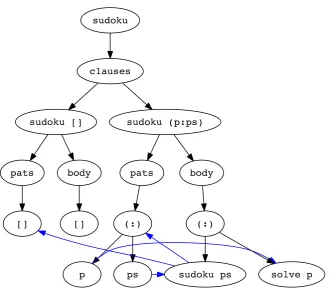
operation might be lifted out of a recursive function and then parallelised depends solely on: i) function arguments occurring as subexpressions in the operation; and ii) how the values of arguments to the recursive function differ between the stages of recursion. In sudoku, for example, the list argument reduces by one element with each recursive call. This can be considered a form of dependency analysis, a topic that has been heavily studied. For example, control- and data-flow analyses [4] are well-known techniques for calculating dependencies between individual statements of a program, and can be used to produce a Program Depend-ence Graph, or PDG. Applying standard control- and data-flow analyses to sudoku might produce a graph similar to Figure 4.1. This graph does not immediately reveal how the values of variables change between recursive calls, or which operations can be lifted.
sudoku
c1auses
sudoku [] sudoku (p:ps)
pats body pats body
[] [] (:) (:)
[image:47.595.113.448.134.430.2]p ps sudoku ps solve p
Figure 4.1: Program Dependence Graph for sudoku; control-flow in
black, data-flow in blue.
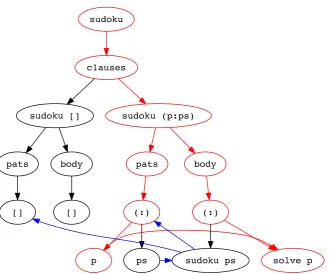
from it, or perhaps both. The slice can then be presented in a number of ways, most commonly as the program where all statements that arenot in the sliceare removed. For example, the slice of sudoku, with criterion
p, is:
1 sudoku _ = undefined
2 sudoku (p:_) = solve p : undefined
4.1. Illustrative Example
sudoku
c1auses
sudoku [] sudoku (p:ps)
pats body pats body
[] [] (:) (:)
[image:48.595.157.493.133.407.2]p ps sudoku ps solve p
Figure 4.2: Program Dependence Graph for sudoku; control-flow in black, data-flow in blue; slice with criterionpin red.
Slicing might therefore be thought of as anarrowing of focuson only the slicing criteria, the any related expressions, and with all the irrelevant parts stripped away. For the purposes of this chapter, however, in the interest of determining how arguments areusedandupdated, the slice can be narrowed further, and so make the decision of whether an operation may be lifted into a mapoperation easier. A slice only needs to be a set
of variables, where inclusion in the slice indicates use, and annotated inclusion in the slice indicates update. Taking a slice of sudoku, with criterionp, now produces the slice {p}, indicating itsuse as an argument to solve, and non-update in the recursive call; i.e. that same p is not accessed in any successive recursive calls. A slicing criterion can be a set of expressions; e.g. a slice ofsudokuwith itsfirst argument, i.e. []in
Formal definitions of bothusageandupdateclassifications are given in Section 4.3; but we provide an intuition here. To determine how arguments areused andupdated, function arguments are used as slicing criteria. A slice is taken for each argument. A variable,vi, where vi is the ith function argument declared, is usedif it appears as a subexpression in the definition of the inspected recursive function, except in the case where that variable is passed as theith argument to a recursive call. For example, given the definition ofelem, which returnsTrueif someais
an element in a list,
1 elem a [] = False
2 elem a (x:xs) = if a == x then True else elem a xs
a, the first declared argument, is usedbecause it exists as an argument to the infix equality check. Conversely, without the infix equality check,
1 elem a [] = False
2 elem a (x:xs) = elem a xs
a isnot considered used. The right-hand side of the equation in Line 2 comprises a recursive call, andais passed as the first argument. Unless
ais to be updated,amustbe passed to all recursive calls to preserve its value.
Although variables in a functional language such as Haskell are immutable, and each function application binds new values to each of its arguments, the differences in the value of a specific argument between successive recursive calls are deemed changes to the corresponding bound variables. A change to the value of the argument vi, is considered to
be significant, and thereforevi is considered to be updated, when the ith
argument of some recursive call is not:
1. vi itself, or a variable declared by case-splitting vi;
2. syntactically equivalent tovi; nor
3. a cons-expression that prepends an expression tovi (or its syntactic
4.1. Illustrative Example
Insudoku, for example, the recursive call takes the tail of the list argu-ment, i.e.ps, which is declared by (implicitly) case-splitting on the list argument. Consequently the list argument isnotconsidered to beupdated. Similarly, the list argument to elem is not considered updated for the same reason. Finally, a, the first argument declared inelem, is also not considered to beupdated because the first argument to the recursive call isaitself. Finally, consider the definition of sum, which accumulatively
sums a given list:
1 sum x [] = x
2 sum x (y:ys) = sum (x+y) ys
Here,xis considered to beupdatedsince the first argument to the recursive call in Line 2 is not: i)xitself or a variable declared by case-splittingx;
ii) syntactically equivalent to x; or iii) a cons-expression that prepends an expression tox. The slice ofsum, with criterionx, is: {x, ¯x}, where ¯x
denotes that xisupdated.
If an argument isusedand notupdated, as for all arguments insudoku
and elem, it follows that the argument can be referred to in somemap
operation independently of each input. Similarly, if the argument is up-dated but not used, it can beupdatedin somemapoperation independently of each input. For example, when constructing state in a monad. In either of these cases, the argument is consideredclean. However, when an argument is bothused and updated, it indicates that theusage andupdate
of the variable is not independent of the other stages of the recursion. For example, insum,xis considered to be both usedandupdated. This indicates that x depends upon at least one other element in the list to
produce a new value, which is propagated through the recursion. Any function using such a variable, e.g. (+) in sum, cannot be safely lifted
into a mapoperation, and that variable is considered to betainted. Having determined for each argument in a recursive function whether they are cleanortainted, each operation within that same function defin-ition can be inspected to see whether it can be safely lifted into a map
operation. An operation can be lifted into a map operation, deemed
unobstructive, when noneof its arguments contain as a subexpression a
to beobstructive. For example,sumhas only one operation,(x+y), which takes onetainted variable, i.e.x, and is therefore classified asobstructive.
elem has two operations, (a == x) and the if-expression, which we treat as syntactic sugar for a function. Here, (a == x)is classified as
unobstructive as both aand x are clean. Conversely, the if-operation is classified as obstructive due to the recursive call in its False branch. Finally,sudokuhas one operation, (solve p), which is considered to
beunobstructive, sincepis classified asclean. Unobstructiveoperations can
potentially be lifted intomapoperations, and by extension are candidates
for parallelisation. Recall that for sudoku, as(solve p)is unobstruct-ive, it can be lifted into amap, andsudokurewritten and parallelised as before:
1 sudoku ps = runPar $ parMap solve ps
4.2 Preliminaries and Assumptions
We illustrate our approach over the simple expression language,E.
e2E ::= true | false
| Z
| var | nilt | conste e
| casevarof nilt !e, constvar var!e | e~e
| lvar~ !e | fixe
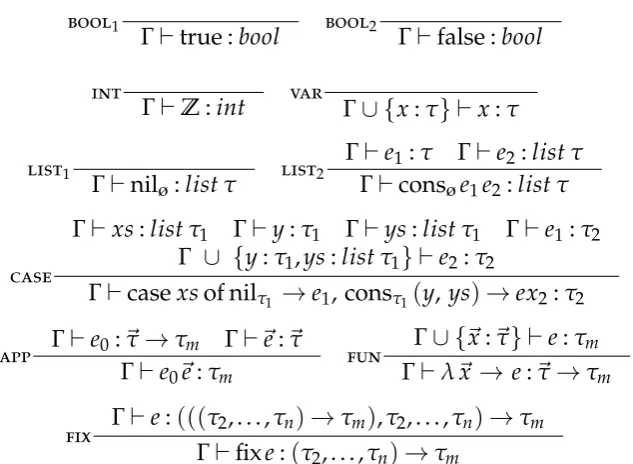
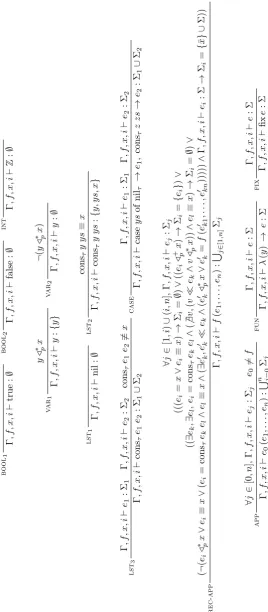
Eis a simple, strict, functional language. Its terms for a common subset of functional languages: boolean constants, true and false; integer constants,
z2Z; variables,var; list constructors, nilt and conste e; case