Proceedings of the 2019 Conference on Empirical Methods in Natural Language Processing and the 9th International Joint Conference on Natural Language Processing, pages 4675–4684,
4675
Multilingual and Multi-Aspect Hate Speech Analysis
Nedjma Ousidhoum, Zizheng Lin, Hongming Zhang, Yangqiu Song, Dit-Yan Yeung Department of Computer Science and Engineering
The Hong Kong University of Science and Technology
[email protected], [email protected], [email protected], [email protected],
Abstract
Current research on hate speech analysis is typically oriented towards monolingual and single classification tasks. In this paper, we present a new multilingual multi-aspect hate speech analysis dataset and use it to test the current state-of-the-art multilingual multitask learning approaches. We evaluate our dataset in various classification settings, then we dis-cuss how to leverage our annotations in order to improve hate speech detection and classifi-cation in general.
1 Introduction
With the expanding amount of text data generated on different social media platforms, current fil-ters are insufficient to prevent the spread of hate speech. Most internet users involved in a study conducted by the Pew Research Center report hav-ing been subjected to offensive name callhav-ing on-line or witnessed someone being physically threat-ened or harassed online.1 Additionally, Amnesty International within Element AI have lately re-ported that many women politicians and journal-ists are assaulted every 30 seconds on Twitter.2 This is despite the Twitter policy condemning the promotion of violence against people on the basis of race, ethnicity, national origin, sexual orienta-tion, gender identity, religious affiliaorienta-tion, age, dis-ability, or serious disease.3 Hate speech may not represent the general opinion, yet it promotes the dehumanization of people who are typically from minority groups (Soral et al.,2017;Martin et al., 2012) and can incite hate crime (Ross et al.,2017). Moreover, although people of various linguistic backgrounds are exposed to hate speech (Waseem
1
http://www.pewinternet.org/2017/07/11/online-harassment-2017/
2
https://www.amnesty.org.uk/press-releases/women-abused-twitter-every-30-seconds-new-study
3 https://help.twitter.com/en/rules-and-policies/hateful-conduct-policy
et al., 2017;Ross et al.,2017), English is still at the center of existing work on toxic language anal-ysis. Recently, some research studies have been conducted on languages such as German (Kratzke, 2017), Arabic (Albadi et al., 2018), and Ital-ian (Sanguinetti et al.,2018). However, such stud-ies usually use monolingual corpora and do not contrast, or examine the correlations between on-line hate speech in different languages. On the other hand, tasks involving more than one lan-guage such as the hatEval task4, which covers En-glish and Spanish, include only separate classifica-tion tasks, namely (a) women and immigrants as target groups, (b) individual or generic hate and, (c) aggressive or non-aggressive hate speech.
Treating hate speech classification as a binary task may not be enough to inspect the motivation and the behavior of the users promoting it and, how people would react to it. For instance, the hateful tweets presented in Figure1show toxicity directed towards different targets, with or without using slurs, and generating several types of reac-tions. We believe that, in order to balance between truth and subjectivity, there are at least five impor-tant aspects in hate speech analysis. Hence, our annotations indicate (a) whether the text is direct or indirect; (b) if it is offensive, disrespectful, hate-ful, fearful out of ignorance, abusive, or normal; (c) the attribute based on which it discriminates against an individual or a group of people; (d) the name of this group; and (e) how the annotators feel about its content within a range of negative to neutral sentiments. To the best of our knowl-edge there are no other hate speech datasets that attempt to capture fear out of ignorance in hate-ful tweets or examine how people react to hate speech. We claim that our multi-aspect annotation schema would provide a valuable insight into
(a) English. (b) French. (c) Arabic.
Figure 1: Annotation examples in our dataset.
eral linguistic and cultural differences and bias in hate speech.
We use Amazon Mechanical Turk to label around 13,000 potentially derogatory tweets in English, French, and Arabic based on the above mentioned aspects and, regard each aspect as a prediction task. Since in natural language process-ing, there is a peculiar interest in multitask learn-ing, where different tasks can be used to help each other (Collobert et al., 2011;Ruder et al., 2017; Hashimoto et al., 2017), we use a unified model to handle the annotated data in all three languages and five tasks. We adopt (Ruder et al.,2017) as a learning algorithm adapted to loosely related tasks such as our five annotated aspects and, use the Babylon cross-lingual embeddings (Smith et al., 2017) to align the three languages. We compare the multilingual multitask learning settings with monolingual multitask, multilingual single-task, and monolingual single-task learning settings spectively. Then, we report the performance re-sults of the different settings and discuss how each task affects the remaining ones. We release our dataset and code to the community to extend re-search work on multilingual hate speech detection and classification.5
2 Related Work
There is little consensus on the difference between profanity and hate speech and, how to define the latter (Schmidt and Wiegand, 2017). As shown in Figure 2, slurs are not an unequivocal indi-cator of hate speech and can be part of a non-aggressive conversation, while some of the most offensive comments may come in the form of sub-tle metaphors or sarcasm (Malmasi and Zampieri, 2018). Consequently, there is no existing human annotated vocabulary that explicitly reveals the presence of hate speech, which makes the
avail-5our code is available on: https://github.com/
HKUST-KnowComp/MLMA_hate_speech
Figure 2: Three tweets in which (1) the first one ac-cuses immigrants of harming society without using any direct insult; (2) the second insults a Hispanic person using a slur; and (3) the third one uses slurs to give a personal account. This shows that profanity is not a clear indicator of the presence of hate speech.
able hate speech corpora sparse and noisy (Nobata et al.,2016).
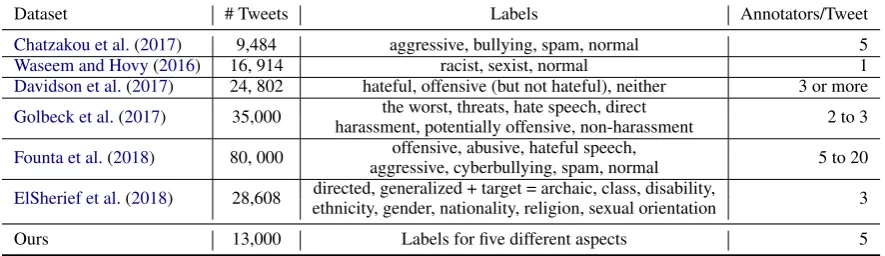
Given the subjectivity and the complexity of such data, annotation schemes have rarely been made fine-grained. Table1compares different la-belsets that exist in the literature. For instance, Waseem and Hovy (2016) use racist, sexist, and normal as labels; Davidson et al.(2017) label their data as hateful, offensive (but not hateful), and nei-ther, whileElSherief et al.(2018) present an En-glish dataset that records the target category based on which hate speech discriminates against peo-ple, such as ethnicity, gender, or sexual orientation and ask human annotators to classify the tweets as hate and non hate. Founta et al.(2018) label their data as offensive, abusive, hateful, aggressive, cy-berbullying, spam, and normal. On the other hand, Qian et al.(2018) have chosen to detect ideologies of hate speech counting 40 different hate ideolo-gies among 13 extremist hate groups.
The detection of hate speech targets is yet an-other challenging aspect of the annotation. Park et al. (2018) report the bias that exists in the current datasets towards identity words, such as
em-Dataset # Tweets Labels Annotators/Tweet
Chatzakou et al.(2017) 9,484 aggressive, bullying, spam, normal 5 Waseem and Hovy(2016) 16, 914 racist, sexist, normal 1 Davidson et al.(2017) 24, 802 hateful, offensive (but not hateful), neither 3 or more
Golbeck et al.(2017) 35,000 the worst, threats, hate speech, direct 2 to 3 harassment, potentially offensive, non-harassment
Founta et al.(2018) 80, 000 offensive, abusive, hateful speech, 5 to 20 aggressive, cyberbullying, spam, normal
ElSherief et al.(2018) 28,608 directed, generalized + target = archaic, class, disability, 3 ethnicity, gender, nationality, religion, sexual orientation
[image:3.595.78.521.64.192.2]Ours 13,000 Labels for five different aspects 5
Table 1: Comparative table of some of the available hate speech and abusive language corpora in terms of labels and sizes.
beddings with additional data for training and tun-ing their binary classifier. We address this false positive bias problem and the common ambiguity of target detection by asking the annotators to label target attributes such as origin, gender, or religious affiliation within 16 named target groups such as refugees, or immigrants.
Furthermore, Klubiˇcka and Fernandez (2018) have reproduced the experiment of Waseem and Hovy (2016) in order to study how hate speech affects the popularity of a tweet, but discovered that some tweets have been deleted. For repli-cation purposes, we provide the community with anonymized6tweet texts rather than IDs.
Non-English hate speech datasets include Ital-ian, German, Dutch, and Arabic corpora. San-guinetti et al. (2018) present a dataset of Ital-ian tweets, in which the annotations capture the degree of intensity of offensive and aggressive tweets, in addition to whether the tweets are ironic and contain stereotypes or not. Ross et al. (2017) have collected more than 500 German tweets against refugees, and annotated them as hateful and not hateful. Hee et al. (2015) detect bullies and victims among youngsters in Dutch comments on AskFM, and classify cyberbullying comments as insults or threats. Moreover,Albadi et al.(2018) provide a corpus of Arabic sectarian speech.
Another predominant phenomenon in hate speech corpora is code switching. Bohra et al. (2018) present a dataset of code mixed Hindi-English tweets, while Galery et al.(2018) report the presence of Hindi tokens in English data and use multilingual word embeddings to deal with this issue when detecting toxicity. Similarly, we use such embeddings to take advantage of the
mul-6In conformity with Twitter terms and conditions.
tilinguality and comparability of our corpora dur-ing the classification.
Our dataset is the first trilingual dataset com-prising English, French, and Arabic tweets that en-compasses various targets and hostility types. Ad-ditionally, to the best of our knowledge, this is the first work that examines how annotators react to hate speech comments.
To fully exploit the collected annotations, we tested multitask learning on our dataset. Multi-task learning (Collobert et al., 2011) allows neu-ral networks to share parameters with one an-other and, thus, learn from related tasks. It has been used in different NLP tasks such as pars-ing (Hashimoto et al., 2017), dependency pars-ing (Peng et al., 2017), neural machine transla-tion (Luong et al.,2016), sentiment analysis (Au-genstein et al., 2018), and other tasks. Multi-task learning architectures tackle challenges that include sharing the label space and the question of private and shared space for loosely related tasks (Ruder et al.,2017), for which techniques may in-volve a massive space of potential parameter shar-ing architectures.
3 Dataset
In this section, we present our data collection methodology and annotation process.
3.1 Data Collection
ques-tioning the results, adding phrases, and taking off unlikely ones in each of the languages. In fact, we started our data collection by searching for com-mon slurs and demeaning expressions such as“go back to where you come from”. Then, we ob-served that discussions about controversial topics, such asfeminismin general,illegal immigrantsin English, Islamo-gauchisme(“Islamic leftism”) in French, orIranin Arabic were more likely to pro-voke disputes, comments filled with toxicity and thus, notable insult patterns that we looked for in subsequent search rounds.
3.2 Linguistic Challenges
All of the annotated tweets include original tweets only, whose content has been processed by (1) deleting unarguably detectable spam tweets, (2) removing unreadable characters and emojis, and (3) masking the names of mentioned users using
@userand potentially enclosed URLs using@url. As a result, annotators had to face the lack of con-text generated by this normalization process.
Furthermore, we perceived code-switching in English where Hindi, Spanish, and French tokens appear in the tweets. Some French tweets also contain Romanized dialectal Arabic tokens gener-ated by, most likely, bilingual North African Twit-ter users. Hence, although we eliminated most of these tweets in order to avoid misleading the an-notators, the possibly remaining ones still added noise to the data.
One more challenge that the annotators and our-selves had to tackle, consisted of Arabic diglossia and switching between different Arabic dialects and Modern Standard Arabic (MSA). While MSA represents the standardized and literary variety of Arabic, there are several Arabic dialects spoken in North Africa and the Middle East in use on Twit-ter. Therefore, we searched for derogatory terms adapted to different circumstances, and acquired an Arabic corpus that combines tweets written in MSA and Arabic dialects. For instance, the tweet shown in Figure 1 contains a dialectal slur that means “maiden.”
3.3 Annotation Process
We rely on the general public opinion and com-mon linguistic knowledge to assess how people view and react to hate speech.7 Given the
subjec-7We have also provided the annotators with the Urban Dictionary definitions of some slang English words they may not be aware of.
tivity and difficulty of the task, we reminded the annotators not to let their personal opinions about the topics being discussed in the tweets influence their annotation decisions.
Our annotation guidelines explained the fact that offensive comments and hate do not necessar-ily come in the form of profanity. Since different degrees of discrimination work on the dehuman-ization of individuals or groups of people in dis-tinct ways, we chose not to annotate the tweets within two or three classes. For instance, a sex-ist comment can be disrespectful, hateful, or of-fensive towards women. Our initial labelset was established in conformity with the prevalent anti-social behaviors people tend to deal with. We also chose to address the problem of false positives caused by the misleading use of identity words by asking the annotators to label both the target at-tributes and groups.
Avoiding scams To prevent scams, we also
pre-pared three annotation guideline forms and three aligned labelsets written in English, French, and Modern Standard Arabic with respect to the lan-guage of the tweets to be annotated.
We requested native speakers to annotate the data and chose annotators with good reputation scores (more than 0.90). We informed the annota-tor in the guidelines, that in case of noticeable pat-terns of random labeling on a substantial number of tweets, their work will be rejected and we may have to block them. Since the rejection affects the reputation of the annotators and their chances to get new tasks on Amazon Mechanical Turk, well-reputed annotators are usually reliable. We have divided our corpora into smaller batches on Ama-zon Mechanical Turk in order to facilitate the anal-ysis of the annotations of the workers and, fairly identify any incoherence patterns possibly caused by the use of an automatic translation system on the tweets, or the repetition of the same annotation schema. If we reject the work of a scam, we notify them, then reassign the tasks to other annotators.
3.4 Pilot Dataset
or other; (c) the target attribute based on which it discriminates against people, specifically, race, ethnicity, nationality, gender, gender identity, sex-ual orientation, religious affiliation, disability, and other (“other” could refer to political ideologies or social classes.); (d) the name of its target group, and (e) whether the annotators feel anger, sadness, fear or nothing about the tweets.
Each tweet has been labeled by three annota-tors. We have provided them with additional text fields to fill in with labels or adjectives that would (1) better describe the tweet, (2) describe how they feel about it more accurately, and (3) name the group of people the tweet shows bias against. We kept the most commonly used labels from our initial labelset, took off some of the initial class names and added frequently introduced labels, es-pecially the emotions of the annotators when read-ing the tweets and the names of the target groups. For instance, after this step, we have ended up mergingrace, ethnicity, nationalityinto one label
origingiven common confusions we noticed and; added disgust andshock to the emotion labelset; and introduced socialists as a target group label since many annotators have suggested these labels.
3.5 Final Dataset
The final dataset is composed of a pilot corpus of 100 tweets per language, and comparable corpora of 5,647 English tweets, 4,014 French tweets, and 3,353 Arabic tweets. Each of the annotated as-pects represents a classification task of its own, that could either be evaluated independently, or, as intended in this paper, tested on how it impacts other tasks. The different labels are designed to facilitate the study of the correlations between the explicitness of the tweet, the type of hostility it conveys, its target attribute, the group it dehuman-izes, how different people react to it, and the per-formance of multitask learning on the five tasks. We assigned each tweet to five annotators, then ap-plied majority voting to each of the labeling tasks. Given the numbers of annotators and labels in each annotation sub-task, we allowed multilabel anno-tations in the most subjective classification tasks, namely the hostility type and the annotator’s senti-ment labels, in order to keep the right human-like approximations. If there are two annotators agree-ing on two labels respectively, we add both labels to the annotation.
The average Krippendorff scores for
inter-Attribute Label En Fr Ar
Directness Direct 530 2,198 1,684 Indirect 4,456 997 754
Hostility
Abusive 671 1,056 610 Hateful 1,278 399 755 Offensive 4,020 1,690 1,151 Disrespectful 782 396 615 Fearful 562 388 41 Normal 1,359 1,124 1,197
Target
Origin 2,448 2,266 877 Gender 638 27 548 SexOrient 514 12 0 Religion 68 146 145 Disability 1,089 177 1 Other 890 1,386 1,782
Group
Individual 497 918 915 Other 1,590 1,085 1,470
Women 878 62 722
SpecNeeds 1,571 174 2 African 86 311 51
Annotator
Disgust 3,469 602 778 Shock 2,151 1,179 917 Anger 2,955 531 356 Sadness 2,775 1,457 388 Fear 1,304 378 35 Confusion 1,747 446 115 Indifference 2,878 2,035 1,825
[image:5.595.309.520.63.381.2]Total number of tweets 5,647 4,014 3,353
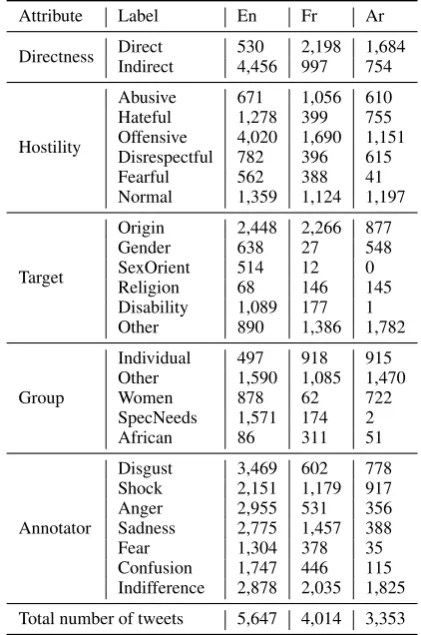
Table 2: The label distributions of each task. The counts of direct and indirect hate speech include all tweets except those that are single labeled as “normal”. Tweet and annotator’s sentiment (Annotator) are multi-label classification tasks, while target attribute (Target) and target group (Group) are not.
annotator agreement (IAA) are 0.153, 0.244, and 0.202 for English, French, and Arabic respec-tively, which are comparable to existing complex annotations (Sanguinetti et al.,2018) given the na-ture of the labeling tasks and the number of labels. We present the labelset the annotators refer to, and statistics of our annotated data in the follow-ing.
Directness label Annotators determine the
ex-plicitness of the tweet by labeling it as direct or
indirectspeech. This should be based on whether the target is explicitly named, or less easily dis-cernible, especially if the tweet contains humor, metaphor, or figurative speech. Table 2 shows that even when partly using equivalent keywords to search for candidate tweets, there are still sig-nificant differences in the resulting data.
Hostility type To identify the hostility type of
la-beled as abusive; (2) according to the degree to which it spreads hate and the tone its author uses, it can behateful,offensiveordisrespectful; (3) if the tweet expresses or spreads fear out of ignorance against a group of individuals, it should be labeled asfearful; (4) otherwise it should be annotated as
normal. We define this task to be multilabel. Ta-ble2shows that hostility types are relatively con-sistent across different languages and offensive is the most frequent label.
Target attribute After annotating the pilot
dataset, we noticed common misconceptions re-garding race, ethnicity, and nationality, therefore we merged these attributes into one label ori-gin. Then, we asked the annotators to determine whether the tweet insults or discriminates against people based on their (1)origin, (2)religious affil-iation, (3)gender, (4)sexual orientation, (5) spe-cial needsor (6) other. Table 2 shows there are fewer tweets targeting disability in Arabic com-pared to English and French and no tweets insult-ing people based on their sexual orientation which may be due to the fact that the labels of gender, gender identity, and sexual orientation use almost the same wording. On the other hand, French con-tains a small number of tweets targeting people based on their gender in comparison to English and Arabic. We have observed significant differ-ences in terms of target attributes in the three lan-guages. More data may help us examine the prob-lems affecting targets of different linguistic back-grounds.
Target group We determined 16 common target
groups tagged by the annotators after the first an-notation step. The annotators had to decide on whether the tweet is aimed at women, people of African descent, Hispanics, gay people, Asians, Arabs, immigrants in general, refugees; people of different religious affiliations such as Hindu, Christian, Jewish people, and Muslims; or from political ideologiessocialists, and others. We also provided the annotators with a category to cover hate directed towards oneindividual, which can-not be generalized. In case the tweet targets more than one group of people, the annotators should choose the group which would be the most af-fected by it according to them. Table 1 shows the counts of the five categories out of 16 that commonly occur in the three languages. In fact, most of the tweets target individuals or fall into the
“other” category. In the latter case, they may target people with different political views such as liber-als or conservatives in English and French, or spe-cific ethnic groups such as Kurdish people in Ara-bic. English tweets tend to have more tweets tar-geting people with special needs, due to common language-specific demeaning terms used in con-versations where people insult one another. Ara-bic tweets contain more hateful comments towards women for the same reason. On the other hand, the French corpus contains more tweets that are offen-sive towards African people, due to hateful com-ments generated by debates about immigrants.
Sentiment of the annotator We claim that the
choice of a suitable emotion representation model is key to this sub-task, given the subjective na-ture and social ground of the annotator’s sentiment analysis. After collecting the annotation results of the pilot dataset regarding how people feel about the tweets, and observing the added categories, we adopted a range of sentiments that are in the nega-tive and neutral scales of the hourglass of emotions introduced byCambria et al.(2011). This model includes sentiments that are connected to objec-tively assessed natural language opinions, and ex-cludes what is known as self-conscious or moral emotions such as shame and guilt. Our labels in-cludeshock, sadness,disgust, anger,fear, confu-sionin case of ambivalence, andindifference. This is the second multilabel task of our model.
Table 2 shows more tweets making the anno-tators feel disgusted and angry in English, while annotators show more indifference in both French and Arabic. A relatively more frequent label in both French and Arabic is shock, therefore reflect-ing what some of the annotators were feelreflect-ing dur-ing the labeldur-ing process.
4 Experiments
We report and discuss the results of five classifica-tion tasks: (1) the directness of the speech, (2) the hostility type of the tweet, (3) the discriminating target attribute, (4) the target group, and (5) the annotator’s sentiment.
4.1 Models
We compare both traditional baselines using bag-of-words (BOW) as features on Logistic regres-sion (LR), and deep learning based methods.
layer on each of the classification tasks. Deeper BiLSTM models performed poorly due to the size of the tweets. We chose to use Sluice net-works (Ruder et al.,2017) since they are suitable for loosely related tasks such as the annotated as-pects of our corpora.
We test different models, namely single task single language (STSL), single task multilin-gual (STML), and multitask multilinmultilin-gual mod-els (MTML) on our dataset. In multilingual set-tings, we tested Babylon multilingual word em-beddings (Smith et al.,2017) and MUSE (Lample et al.,2017) on the different tasks. We use Baby-lon embeddings since they appear to outperform MUSE on our data.
Sluice networks (Ruder et al., 2017) learn the weights of the neural networks sharing parame-ters (sluices) jointly with the rest of the model and share an embedding layer, Babylon embeddings in our case, that associates the elements of an input sequence. We use a standard 1-layer BiLSTM par-titioned into two subspaces, a shared subspace and a private one, forced to be orthogonal through a regularization penalty term in the loss function in order to enable the multitask network to learn both task-specific and shared representations. The hid-den layer has a dimension of 200, the learning rate is initially set to 0.1 with a learning rate decay, and we use the DyNet (Neubig et al.,2017) automatic minibatch function to speed-up the computation. We initialize the cross-stitch unit to imbalanced, set the standard deviation of the Gaussian noise to 2, and use simple stochastic gradient descent (SGD) as the optimizer.
All compared methods use the same split as train:dev:test=8:1:1 and the reported results are based on the test set. We use the dev set to tune the threshold for each binary classification problem in the multilabel classification settings of each task.
4.2 Results and Analysis
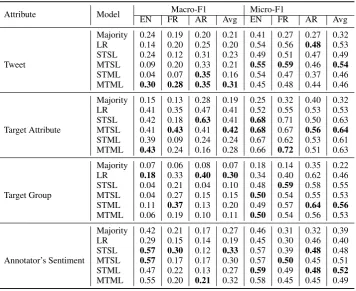
We report both the micro and macro-F1 scores of the different classification tasks in Tables3and4.
Majority refers to labeling based on the majority label,LRto logistic regression,STSLto single task single language models,STMLto single task mul-tilingual models, andMTMLto multitask multilin-gual models.
STSL STSL performs the best among all models on the directness classification, and it is also con-sistent in both micro and macro-F1 scores. This is
due to the fact that the directness has only two la-bels and multilabeling is not allowed in this task. Tasks involving imbalanced data, multiclass and multilabel annotations harm the performance of the directness in multitask settings.
Since macro-F1 is the average of all F1 scores of individual labels, all deep learning models have high macro-F1 scores in English which indicates that they are particularly good at classifying the
direct class. STSL is also comparable or bet-ter than traditional BOW feature-based classifiers when performed on other tasks in terms of micro-F1 and for most of the macro-micro-F1 scores. This shows the power of the deep learning approach.
MTSL Except for the directness, MTSL usually outperforms STSL or is comparable to it. When we jointly train each task on the three languages, the performance decreases in most cases, other than the target group classification tasks. This may be due to the difference in label distribu-tions across languages. Yet, multilingual training of the target group classification task improves in all languages. Since the target group classification task involves 16 labels, the amount of data anno-tated for each label is lower than in other tasks. Hence, when aggregating annotated data in differ-ent languages, the size of the training data also in-creases, due to the relative regularity of identifi-cation words of different groups in all three lan-guages in comparison to other tasks.
Attribute Model Macro-F1 Micro-F1
EN FR AR Avg EN FR AR Avg
Directness
Majority 0.50 0.11 0.50 0.47 0.79 0.41 0.54 0.58 LR 0.52 0.50 0.53 0.52 0.79 0.50 0.56 0.62 STSL 0.94 0.80 0.84 0.86 0.89 0.69 0.72 0.76
[image:8.595.139.455.63.155.2]MTSL 0.94 0.65 0.76 0.78 0.89 0.58 0.65 0.70 STML 0.94 0.79 0.83 0.85 0.88 0.66 0.72 0.75 MTML 0.94 0.78 0.74 0.82 0.88 0.66 0.65 0.73
Table 3: Full evaluation scores of the only binary classification task where the single task single language model consistently outperforms multilingual multitask models.
Attribute Model Macro-F1 Micro-F1
EN FR AR Avg EN FR AR Avg
Tweet
Majority 0.24 0.19 0.20 0.21 0.41 0.27 0.27 0.32 LR 0.14 0.20 0.25 0.20 0.54 0.56 0.48 0.53 STSL 0.24 0.12 0.31 0.23 0.49 0.51 0.47 0.49 MTSL 0.09 0.20 0.33 0.21 0.55 0.59 0.46 0.54
STML 0.04 0.07 0.35 0.16 0.54 0.47 0.37 0.46 MTML 0.30 0.28 0.35 0.31 0.45 0.48 0.44 0.46
Target Attribute
Majority 0.15 0.13 0.28 0.19 0.25 0.32 0.40 0.32 LR 0.41 0.35 0.47 0.41 0.52 0.55 0.53 0.53 STSL 0.42 0.18 0.63 0.41 0.68 0.71 0.50 0.63 MTSL 0.41 0.43 0.41 0.42 0.68 0.67 0.56 0.64
STML 0.39 0.09 0.24 0.24 0.67 0.62 0.53 0.61 MTML 0.43 0.24 0.16 0.28 0.66 0.72 0.51 0.63
Target Group
Majority 0.07 0.06 0.08 0.07 0.18 0.14 0.35 0.22 LR 0.18 0.33 0.40 0.30 0.34 0.40 0.62 0.46 STSL 0.04 0.21 0.04 0.10 0.48 0.59 0.58 0.55 MTSL 0.04 0.27 0.15 0.15 0.50 0.54 0.55 0.53 STML 0.11 0.37 0.13 0.20 0.49 0.57 0.64 0.56
MTML 0.06 0.19 0.10 0.11 0.50 0.54 0.56 0.53
Annotator’s Sentiment
Majority 0.42 0.21 0.17 0.27 0.46 0.31 0.32 0.39 LR 0.29 0.15 0.14 0.19 0.45 0.30 0.46 0.40 STSL 0.57 0.30 0.12 0.33 0.57 0.39 0.48 0.48 MTSL 0.57 0.17 0.17 0.30 0.57 0.50 0.45 0.51 STML 0.47 0.22 0.13 0.27 0.59 0.49 0.48 0.52
MTML 0.55 0.20 0.21 0.32 0.58 0.45 0.45 0.49
Table 4: Full evaluation of tasks where multilingual and multitask models outperform on average single task single language model on four different tasks.
correlations between target attributes and groups along with other tasks, to set logic rules and de-velop better multilingual and multitask settings.
5 Conclusion
In this paper, we presented a multilingual hate speech dataset of English, French, and Arabic tweets. We analyzed in details the difficulties related to the collection and annotation of this dataset. We performed multilingual and multi-task learning on our corpora and showed that deep learning models perform better than traditional BOW-based models in most of the multilabel clas-sification tasks. Multilingual multitask learning also helped tasks where each label had less anno-tated data associated with it.
Better tuned deep learning settings in our
mul-tilingual and multitask models would be expected to outperform the existing state-of-the-art embed-dings and algorithms applied to our data. The dif-ferent annotation labels and comparable corpora would help us perform transfer learning and inves-tigate how multimodal information on the tweets, additional unlabeled data, label transformation, and label information sharing may boost the clas-sification performance in the future.
Acknowledgement
[image:8.595.121.478.192.483.2]References
Nuha Albadi, Maram Kurdi, and Shivakant Mishra. 2018. Are they our brothers? analysis and detection of religious hate speech in the arabic twittersphere. InProceedings of ASONAM. IEEE Computer Soci-ety, pages 69–76.
Isabelle Augenstein, Sebastian Ruder, and Anders Søgaard. 2018. Multi-task learning of pairwise sequence classification tasks over disparate label spaces. InProceedings of NAACL. Association for Computational Linguistics, pages 1896–1906.
Aditya Bohra, Deepanshu Vijay, Vinay Singh, Syed Sarfaraz Akhtar, and Manish Shrivastava. 2018. A dataset of hindi-english code-mixed social media text for hate speech detection. InProceedings of the Second Workshop on Computational Model-ing of People’s Opinions, Personality, and Emotions in Social Media. Association for Computational Lin-guistics, pages 36–41.
Erik Cambria, Andrew Livingstone, and Amir Hussain. 2011. The hourglass of emotions. In COST 2102 Training School. Springer, volume 7403 ofLecture Notes in Computer Science, pages 144–157.
Despoina Chatzakou, Nicolas Kourtellis, Jeremy Blackburn, Emiliano De Cristofaro, Gianluca Stringhini, and Athena Vakali. 2017. Mean birds: Detecting aggression and bullying on twitter. In
Proceedings of WebSci ’17. ACM, pages 13–22.
Ronan Collobert, Jason Weston, L´eon Bottou, Michael Karlen, Koray Kavukcuoglu, and Pavel P. Kuksa. 2011. Natural language processing (almost) from scratch. Journal of Machine Learning Research
12:2493–2537.
Thomas Davidson, Dana Warmsley, Michael W. Macy, and Ingmar Weber. 2017. Automated hate speech detection and the problem of offensive language. In
Proceedings of ICWSM. pages 512–515.
Mai ElSherief, Vivek Kulkarni, Dana Nguyen, William Y. Wang, and Elizabeth Belding. 2018. Hate lingo: A target-based linguistic analysis of hate speech in social media. InProceedings of ICWSM.
Antigoni-Maria Founta, Constantinos Djouvas, De-spoina Chatzakou, Ilias Leontiadis, Jeremy Black-burn, Gianluca Stringhini, Athena Vakali, Michael Sirivianos, and Nicolas Kourtellis. 2018. Large scale crowdsourcing and characterization of twitter abusive behavior. In Proceedings ICWSM. pages 491–500.
Thiago Galery, Efstathios Charitos, and Ye Tian. 2018. Aggression identification and multi lingual word embeddings. InProceedings of the First Workshop on Trolling, Aggression and Cyberbullying. Associ-ation for ComputAssoci-ational Linguistics, pages 74–79.
Jennifer Golbeck, Zahra Ashktorab, Rashad O. Banjo, Alexandra Berlinger, Siddharth Bhagwan, Cody
Buntain, Paul Cheakalos, Alicia A. Geller, Quint Gergory, Rajesh Kumar Gnanasekaran, Raja Ra-jan Gunasekaran, Kelly M. Hoffman, Jenny Hot-tle, Vichita Jienjitlert, Shivika Khare, Ryan Lau, Marianna J. Martindale, Shalmali Naik, Heather L. Nixon, Piyush Ramachandran, Kristine M. Rogers, Lisa Rogers, Meghna Sardana Sarin, Gaurav Sha-hane, Jayanee Thanki, Priyanka Vengataraman, Zi-jian Wan, and Derek Michael Wu. 2017. A large labeled corpus for online harassment research. In
Proceedings of the 2017 ACM on Web Science Con-ference. ACM, WebSci ’17, pages 229–233.
Kazuma Hashimoto, caiming xiong, Yoshimasa Tsu-ruoka, and Richard Socher. 2017. A joint many-task model: Growing a neural network for multiple nlp tasks. In Proceedings of EMNLP. Association for Computational Linguistics, pages 1923–1933.
Cynthia Van Hee, Els Lefever, Ben Verhoeven, Julie Mennes, Bart Desmet, Guy De Pauw, Walter Daele-mans, and V´eronique Hoste. 2015. Detection and fine-grained classification of cyberbullying events. InProceedings of RANLP. pages 672–680.
Filip Klubiˇcka and Raquel Fernandez. 2018. Examin-ing a hate speech corpus for hate speech detection and popularity prediction. InProceedings LREC.
Nane Kratzke. 2017. The #BTW17 Twitter Dataset -Recorded Tweets of the Federal Election Campaigns of 2017 for the 19th German Bundestag. Data2(4).
Guillaume Lample, Alexis Conneau, Ludovic Denoyer, and Marc’Aurelio Ranzato. 2017. Unsupervised machine translation using monolingual corpora only.
arXiv preprint arXiv:1711.00043.
Thang Luong, Quoc V. Le, Ilya Sutskever, Oriol Vinyals, and Lukasz Kaiser. 2016. Multi-task se-quence to sese-quence learning. InInternational Con-ference on Learning Representations.
Shervin Malmasi and Marcos Zampieri. 2018. Chal-lenges in discriminating profanity from hate speech.
J. Exp. Theor. Artif. Intell.30(2):187–202.
Ryan Martin, Kelsey Ryan Coyier, Leah Vansistine, and Kelly Schroeder. 2012. Anger on the internet: The perceived value of rant-sites. Cyberpsychology, behavior and social networking16.
Chikashi Nobata, Joel Tetreault, Achint Thomas, Yashar Mehdad, and Yi Chang. 2016. Abusive lan-guage detection in online user content. In Proceed-ings of WWW ’16. International World Wide Web Conferences Steering Committee, pages 145–153.
Ji Ho Park, Jamin Shin, and Pascale Fung. 2018. Re-ducing gender bias in abusive language detection. In
Proceedings of EMNLP. Association for Computa-tional Linguistics, pages 2799–2804.
Hao Peng, Sam Thomson, and Noah A. Smith. 2017. Deep multitask learning for semantic dependency parsing. InProceedings of the 55th Annual Meet-ing of the Association for Computational LMeet-inguistics (Volume 1: Long Papers). Association for Computa-tional Linguistics, pages 2037–2048.
Jing Qian, Mai ElSherief, Elizabeth Belding, and William Yang Wang. 2018. Hierarchical cvae for fine-grained hate speech classification. In Proceed-ings of EMNLP. Association for Computational Lin-guistics, pages 3550–3559.
Bj¨orn Ross, Michael Rist, Guillermo Carbonell, Ben-jamin Cabrera, Nils Kurowsky, and Michael Wo-jatzki. 2017. Measuring the reliability of hate speech annotations: The case of the european refugee crisis. CoRRabs/1701.08118.
Sebastian Ruder, Joachim Bingel, Isabelle Augenstein, and Anders Søgaard. 2017. Sluice networks: Learn-ing what to share between loosely related tasks.
arXiv preprint arXiv:1705.08142.
Manuela Sanguinetti, Fabio Poletto, Cristina Bosco, Viviana Patti, and Marco Stranisci. 2018. An italian twitter corpus of hate speech against immigrants. In
LREC. European Language Resources Association (ELRA).
Anna Schmidt and Michael Wiegand. 2017. A survey on hate speech detection using natural language pro-cessing. In Proceedings of the Fifth International Workshop on Natural Language Processing for So-cial Media. Association for Computational Linguis-tics, pages 1–10.
Samuel L. Smith, David H. P. Turban, Steven Hamblin, and Nils Y. Hammerla. 2017. Offline bilingual word vectors, orthogonal transformations and the inverted softmax. CoRRabs/1702.03859.
Wiktor Soral, Micha Bilewicz, and Mikoaj Winiewski. 2017. Exposure to hate speech increases prejudice through desensitization. Aggressive Behavior44.
Zeerak Waseem, Thomas Davidson, Dana Warmsley, and Ingmar Weber. 2017. Understanding abuse: A typology of abusive language detection subtasks. In
Proceedings of the First Workshop on Abusive Lan-guage Online. Association for Computational Lin-guistics, pages 78–84.