Proceedings of the 2019 Conference on Empirical Methods in Natural Language Processing 5206
A Context-based Framework for Modeling the Role and Function of
On-line Resource Citations in Scientific Literature
He Zhao1, Zhunchen Luo2, Chong Feng1†, Anqing Zheng1, Xiaopeng Liu2 1Beijng Institute of Technology, School of Computer Science, Beijing, China
2Information Research Center of Military Science, PLA Academy of Military Science, Beijing, China
[email protected] [email protected]
[email protected] [email protected] [email protected]
Abstract
We introduce a new task ofmodeling the role and function for on-line resource citations in scientific literature. By categorizing the on-line resources and analyzing the purpose of resource citations in scientific texts, it can greatly help resource search and recommen-dation systems to better understand and man-age the scientific resources. For this novel task, we are the first to create an annotation scheme, which models the different granu-larity of information from a hierarchical per-spective. And we construct a dataset SciRes, which includes 3,088 manually annotated re-source contexts. In this paper, we propose a possible solution by using a multi-task frame-work to build the scientific resource classifier (SciResCLF) for jointly recognizing the role and function types. Then we use the classifi-cation results to help a scientific resource rec-ommendation (SciResREC) task. Experiments show that our model achieves the best results on both the classification task and the recom-mendation task. The SciRes dataset1 will be released for future research.
1 Introduction
In this paper, we introduce a new task ofmodeling the role and function for on-line resource citations in scientific literature. With the number of scien-tific publications growing dramatically, numerous on-line resources are mentioned, released and used within the scientific literature. Tracing and mod-eling these resources such as software, tools and datasets can greatly help researchers by develop-ing scientific resource searchdevelop-ing and recommen-dation systems or constructing scientific resource knowledge graphs. Google has launched a new search engine2 in 2018 to help scientists find the
†
Corresponding author.
1
https://github.com/zhaohe1995/SciRes
2https://toolbox.google.com/
datasetsearch
Figure 1: Examples for the two types of resource ci-tations in scientific literature. We note the arguments (which are mostly the key verbs before the citation) for identifying the resource function and the arguments (which are mostly the target nominals before the cita-tion) for identifying the resource role.
datasets they need, whereas the retrieved datasets can only be matched with their official names. Other current academic search engines such as Google Scholar can be only used for detecting the relevant papers where a certain resource is men-tioned. However, the limitation actually exists is that the user can not learn more fine-grained infor-mation such as what role the resource plays in its paper and why the resource is cited in its contexts. To improve present works, we propose a context-based framework to model both theresource role
and theresource functionfor on-line resource ci-tations in scientific literature.
scientific paper text, which links to a specific on-line resource. A resource contextis a word se-quence surrounding the resource citation. As Fig-ure 1 shows, we set the context window size to 5 in our work. So that the context includes the sen-tence where the hyperlink is mentioned, the two sentences to the left and the two to the right. The
resource role is the class of a resource indicat-ing what role the resource plays in its context (e.g.
CodeandDatain Figure 1). Theresource func-tion is the specific purpose performed by the re-source with respect to the current paper’s work, indicating why the author has cited this resource here (e.g. UseandProducein Figure 1). It’s nec-essary to note that one resource may have different functions in a same paper due to the different con-texts.
The information of resource role and function is very important for building applications to assist scientific research. To help develop more power-ful resource search systems, identifying the role can enrich the resource repository and identify-ing the function is crucial for understandidentify-ing more complicated queries and providing more accurate results. Moreover, to help researchers quickly be acquainted with the scientific resources and easily find applicable resources for their work, the sci-entific resource recommendation system will have great application prospects in the future. Previous works mostly make the efforts on the task of ci-tation function classification (Teufel et al.,2006;
Jurgens et al.,2018) and the task ofcontext-based citation recommendation(Tang and Zhang,2009;
He et al.,2011;Huang et al.,2015). Different from previous works, our work specially focuses on the on-line resources in scientific text, which are not as well studied as the paper citations. To the best of our knowledge, we are the first to model the on-line resource citations on such a fine-grained level in scientific full text.
In this paper, we first propose a new anno-tation scheme, which models both the general role types and the fine-grained role types from a two-hierarchy perspective, and models the func-tion types by analyzing the purpose of citing the resources. Based on the scheme, we construct a dataset SciRes by manually annotating more than three thousand resource contexts. To better classify each on-line resource citation and bene-fit from the associated information between roles and functions, we apply a multi-task framework
SciResCLF, which jointly identifies the resource role types and the resource function types based on the word sequences of resource contexts. Ex-periments show that our model outperforms all the baselines on the classification task. We fur-ther address a context-based resource recommen-dation task and develop a framework SciResREC, which predicts the resource hyperlinks only given the masked resource contexts. Using the classi-fication results, our model achieves good perfor-mance by the help of the role and function infor-mation in the recommendation task.
In summary, we make the following contribu-tions. We introduce a novel task of modeling fine-grained information, especially the resource role and the resource function of scientific on-line resource citations. For this task, we propose a new annotation scheme and create a dataset for resource classification. We develop a multi-task learning model which can jointly identify the gen-eral role types, fine-grained role types and func-tions for the resource citafunc-tions. Based on our united classifier we solve a resource recommen-dation task and analyze the evolution and maturity of the scientific resources.
2 Related Work
Context-based Citation Analysis
Context-based citation analysis addresses a cita-tion’s value by interpreting each citation based on its context at both the syntactic and semantic levels. One research focus is the citation func-tion, which is defined as the authors reason for citing a given paper. Specific schemes for clas-sifying the function of a citation have been de-veloped (Teufel et al.,2006;Liakata et al.,2012;
Jurgens et al., 2018). Jurgens et al. (2018) did their efforts to measure the evolution of a sci-entific field by framing the citation function. In the past years, many annotation schemes and ap-proaches for identifying arguments in various do-mains have been developed. Following these pre-vious schemes, we develop our annotation scheme especially for modeling the role and function for scientific resource, which will be detailed in Sec-tion 3. Other previous studies focus on the context-based citation recommendation(Tang and Zhang,
2009;He et al., 2010, 2011;Huang et al.,2012,
#Bodytext #Footnote Total Annotation
ARC 3,718 15,043 18,761 1,026
NeurlPS 686 896 1,582 1,056
PUBMED 31,852 510 32,362 1,006 Total 36,256 16,449 52,705 3,088
Table 1: A description for the collection of 52,705 data sample in the scientific resource corpus.
of words that appear around a particular citation. Based on this definition, we develop the concepts of resource citation and resource context in this paper.
Resource Discovery for Scientific Text
There are also some relevant research which fo-cus on detecting resources in biomedical litera-ture. Some approaches to this end are reported in (Duck et al.,2012,2014,2016;Yamamoto and Takagi,2007;de la Calle et al.,2009).Yamamoto and Takagi (2007) crawled abstracts from MED-LINE and full text from BioMed to extract the URLs of resources using regular expressions and heuristic rules. The BIRI addressed byde la Calle et al. (2009) utilized handcrafted regular expres-sions expressed as transition networks for resource naming, functionality detection and resource clas-sification to generate resource inventories. Duck et al.(2012) proposed the BioNERDS, which is a NER system for detecting database and software names in scientific literature using extraction rules generated by examining 30 bioinformatics arti-cles. However, there has been no existing frame-work for modeling the resource role and function at such a fine-grained level in general domain sci-entific text.
3 Dataset
There are some current scientific literature datasets (e.g. Semantic Scholar Open Research Corpus3 and Arxiv Dataset4) contain the struc-tured metadata such as title, author and abstract. While as is illustrated in Figure 1, most on-line re-source citations are placed in the full texts of the papers. We need to locate the resource citations and extract the resource contexts first to perform further analysis. To the best of our knowledge, due to the difficulties in collecting large scale of sci-entific full texts from the PDF publications, there is no ready-to-use dataset for our task. Hence we
3
http://api.semanticscholar.org/ corpus/
4https://www.kaggle.com/neelshah18/
arxivdataset
collect a large scientific resource context corpus of 52,705 data samples and construct a manually annotated dataset (calledSciRes) which includes annotations for the resource role types and the re-source function types. SciRes attempts to interpret the role of resource citations from a hierarchical perspective, with both the general role types and more fine-grained role types. And SciRes aims at understanding the author’s intention of citing a re-source by the function types. We hope the SciRes can facilitate future research for context-based re-source analyzing in scientific literature.
3.1 Data Processing
We used the paper full texts from three different sources: the ACL Anthology Reference Corpus (ARC)5, a corpus of scientific publications about computational linguistics; the NeurlPS Proceed-ings (NeurlPS)6, a corpus of conference proceed-ings about neural information; and the PubMed7, an archive of biomedical and life sciences journal literature. We collected 21,411 papers of ARC up to 2015, 7,147 papers of NeurlPS from 1988 to 2017, and randomly downloaded 11,043 publica-tions from PubMed. For each paper in the cor-pus, we downloaded the PDF and used Omnipage8 to perform OCR in translating the files to charac-ters with coordinates and properties. So that we can detect the footnotes and find their anchors in the bodytext by developing some regular expres-sion filters. Then we applied a conditional random field-based parsing tool, ParsCit9to get the struc-tural raw text. To build the SciRes dataset we first extracted all the hyperlinks as resource citations in a scientific paper from both the bodytexts and the footnotes. Three PhD students from the above three fields were asked to read 200 randomly se-lected resource contexts to investigate the context window size. It was found that 95% samples can be determined the resource role and function types by getting across the 5 sentences around the cita-tions. So we set the window size to 5 and extracted the sentences along with each hyperlink as the re-source context. Finally, we construct a collection of 52,705 data samples, with a detailed description shown in Table 1.
5http://acl-arc.comp.nus.edu.sg/ 6http://papers.nips.cc/
7https://www.ncbi.nlm.nih.gov/pubmed 8
https://www.nuance.com
1st-category 2nd-category #ARC #NeurlPS #PUBMED 1st-Total 1st-% 2nd-Total 2nd-%
Material Data 333 452 219 1,004 31.0 1,004 31.0
Tool 340 106 171 617 19.0
Method Code 74 256 91 421 13.0 1,057 38.7
Algorithm 79 118 19 216 6.7
Document 81 97 132 310 9.6
Website 146 66 144 256 7.9
Supplement Paper 3 3 242 248 7.6 984 30.3
License 16 1 97 114 3.5
Media 4 49 3 56 1.7
Table 2: The 31-st category roletypes and 92-nd category roletypes along with their statistics inSciResfrom three scientific literature sources.
3.2 Annotation Scheme
Many annotation schemes for the citation func-tions have been created over the past years (Teufel et al., 2006; Liakata et al., 2012; Jurgens et al.,
2018). Based on these previous works and some recent annotation schemes for ScienceIE (Luan et al., 2017; Augenstein et al.,2017;Zhao et al.,
2019), we address our scheme:
3 general (1st-category) Role types: Material, Method, Supplement.
9 fine-grained (2nd-category) Role types:Data, Tool, Code, Algorithm, Document, Website, Pa-per, License, Media.
6 Function types: Use, Produce, Introduce, Ex-tend, Compare, Other.
The hierarchical relationships between 1st-category role types and 2nd-1st-category role types are shown in Table 2. More detailed definitions and examples for each type can be found in the Appendix. Annotations were performed by a group of 3 PhD students, of which one majors in NLP, one majors in deep learning and another majors in bioinformatics. We randomly selected 1,100 data samples from each scientific literature source. Since too short text might not cover suf-ficient information for identifying the target role and function types, we filtered out the samples of which the context sequence had less than 10 words. Each resource citation together with its context was assigned at least one label for the gen-eral role types, one label for the fine-grained role types and a unique label for the function types. Fleiss’s Kappa (κ) is 0.79 for the 1st-category re-source role, 0.54 for the 2nd-category rere-source role and 0.65 for the resource function, indicat-ing a relatively high agreement between annota-tors considering the number of class and the diffi-culties of the fine-grained classification task. The decision is made by a majority rule when a con-flict occurs. Finally we obtained the manually
an-#ARC #NeurlPS #PUBMED Total %
Use 560 578 347 1,485 48.1
Produce 125 308 201 634 20.5
Introduce 254 89 281 624 20.2
Extend 53 30 39 122 4.0
Other 17 1 106 124 4.0
[image:4.595.308.524.350.493.2]Compare 18 50 30 98 3.2
Table 3: The 6 resource function types along with their statistics inSciResfrom three scientific literature sources.
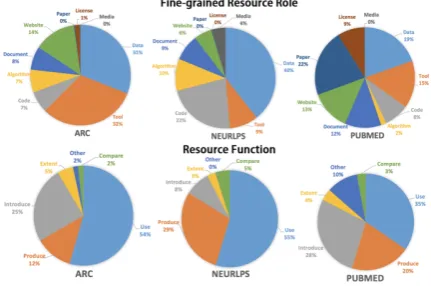
Figure 2: The distributions of resource role and func-tion types in different data sources.
notated SciRes dataset of 3,088 data samples. All the function and role types along with their statis-tics are shown in Table 2 and Table 3.
re-search about NLP applications in the ARC. While the more theoretical NeurlPS has least Tools but most Algorithm and Data citations. Instead of the packaged software, the papers from NeurlPS prefer the implementations in codebases. Further-more, due to the difference of article formats and writing styles in different domains, the papers in the field of bioinformatics from the PubMed tend to link papers by in-line hyperlinks in bodytexts while the papers from the ARC and the NeurlPS tend to cite papers in reference lists. For the resource functions, we can see that the papers from the NeurlPS tend to produce or release more new resources while the papers from the ARC and the PubMed tend to introduce more resources as background to support their works. We as-sume the difference in the resource function is be-cause that the research from the NeurlPS are more theory-based and often put forward new method-ologies, whereas the research from the ARC and the PubMed are more comprehensive and contain more application-oriented works which tend to re-view many related resources.
4 Classification Model
To identify the resource role types and the re-source function types for the rere-source citations, we apply a multi-task learning framework, called
SciResCLF to jointly classify the 1-st category roles, the 2-nd category roles and the functions by sharing the resource context representations as classification features. Figure 3 shows an overall architecture of our SciResCLF framework.
Based on our SciRes dataset, many challenges make the classification task not easy. First, it is important to parse, encode and model the seman-tic information in the resource citation contexts, which are relatively short texts having no more than 5 sentences. Second, as the examples shown in Figure 1, by observing the data samples we find in most cases some key nominals or verbs located nearby the citations can imply the role and func-tion types of the resources (e.g. the nearest verb before a resource citation such as ”use”, ”apply” or ”adopt” often indicates the function of Use). For this reason, the relative positions of the words in the sequence is very significant information to be considered in our task. Furthermore, due to the limited labeled data most neural-based mod-els with a large number of parameters can not be trained well.Therefore, effective methods for
solv-ing these particular challenges need to be devel-oped for this new scientific resource classification task.
From the SciRes dataset we can find that there is a strong correlation between the role type and the function type for a resource citation in its con-text. To better incorporate the associated informa-tion, for our classification task we adopt a multi-task setup, which has been proven effective in the ScienceIE problems (Augenstein et al.,2017;
Luan et al.,2018). Recently, the pre-trained lan-guage models, such as ELMo (Peters et al.,2018), OpenAI GPT (Radford, 2018), and BERT ( De-vlin et al., 2018), have shown their effectiveness to alleviate the effort of feature engineering. Espe-cially, BERT has achieved excellent results in text classification problems such as sentiment analysis (Sun et al., 2019;Xu et al., 2019) and document classification (Adhikari et al., 2019). Based on previous works, our framework also takes advan-tage of the pre-trained BERT model to learn textualized representations for the resource con-texts, as shown in Figure 3. To adapt BERT to our classification tasks, followingDevlin et al.(2018) we first get the hidden state corresponding to the
[CLS] input token. Then the hidden representa-tion h is passed into three separate softmax lay-ers:L1st role=sof tmax(W1h+b1),L2nd role=
sof tmax(W2h+b2),Lf unc =sof tmax(W3h+
b3), where W1, W2, W3 ∈ Rrh, h1, h2, h3 ∈ R
andrhis the size of the hidden dimension. So that
given the word sequence input of a resource con-text, the total lossLCLF is defined as a weighted
sum of the cross entropy loss of the three multino-mial classification tasks:
LCLF =αL1st role+βL2nd role+γLf unc (1)
5 Recommendation Model
To show a practical application scenario of mod-eling the role and function for scientific resource citations, we further address a new resource rec-ommendation task. The problem takes the scien-tific text sentences about an indexed resource as a query and aims to predict the hyperlink of a pos-sible on-line resource to fill the citation blank of a resource context. We first give the formalized definition for the resource recommendation task. The input is the word sequence of a resource con-text C = {wn−l, ..., wn−1, wn, wn+1, ..., wn+r},
in which wn is a placeholder “[URL]” of the
Figure 3: The overall architecture of the SciResCLF and the SciResREC.
left to the hyperlink andr is the length of the se-quence right to the hyperlink. To eliminate the information of the original resource citation, we mask the resource names mentioned in the re-source context. So that the rere-source hyperlink can only be determined by the other words related to the target resource from the context query. The output is a ranking list, which contains the top N possible predictions from the resource hyperlink space.
For this task, we develop a framework, called
SciResREC to predict the resource hyperlinks by learning information of the resource contexts and benefiting from the classification results of the SciResCLF. Figure 3 also shows a high-level overview of the SciResREC framework. For each input resource context sequence, we first apply the SciResCLF to respectively get the output re-sults of the 1-st category role classifier, the 2-nd category role classifier and the function classifier. To incorporate the role and function information, the three classification labels are used as features for predicting the resource hyperlinks. In SciRes-REC, we use the same pre-trained BERT encoder to learn context representations. Then the hidden outputh[CLS]is concatenated with the three label representations, which is passed to a non-linear layer with the ReLU activation function. Hence the recommendation task is transformed into a multi-class classification problem which maps the context feature vectors into the resource hyperlink space.
6 Experiments
6.1 Data and Metrics
Methods 1st-category Roles 2nd-category Roles Functions F1-micro F1-macro F1-micro F1-macro F1-micro F1-macro
AvrgEmbed+LR 0.733 0.732 0.453 0.462 0.534 0.475
AvrgEmbed+SVM 0.691 0.690 0.429 0.447 0.550 0.466
FastText 0.694 0.692 0.489 0.472 0.638 0.471
CNN 0.649 0.647 0.450 0.313 0.618 0.498
RCNN 0.697 0.697 0.430 0.407 0.621 0.517
LSTM 0.607 0.605 0.413 0.393 0.508 0.399
LSTM+AT 0.706 0.705 0.502 0.483 0.715 0.551
LSTM+ATmulti-task 0.735 0.734 0.532 0.540 0.754 0.577 SciResCLFsingle-task 0.772 0.772 0.672 0.685 0.795 0.640
+joint 1st role - - 0.666 0.667 0.823 0.668
+joint 2nd role 0.759 0.760 - - 0.805 0.675
+joint function 0.778 0.778 0.673 0.671 -
[image:7.595.112.485.61.214.2]-SciResCLFmulti-task 0.784 0.783 0.706 0.709 0.817 0.715
Table 4: Comparison results of SciResCLF for the three classification tasks.
placeholder. And the words of resource name are masked with a “[MASK]” token. Finally we get a training set of 2,910 samples and a testing set of 235 samples. To evaluate the predicted ranking list, we report the Precision@Top3 and the MAP metrics.
6.2 Baselines and Setups
For the classification task, we compare the SciResCLF with widely used context classifica-tion approaches on the SciRes: Average Em-bedding + LR/SVM, two machine learning al-gorithms, logistic regression (LR) and SVM, using the average of word embeddings as in-put; FastText, an implementation for FastText of Joulin et al. (2017); CNN, an implementa-tion for TextCNN ofKim(2014);RCNN, an im-plementation for a recurrent convolutional neu-ral network of Lai et al. (2015); LSTM, a 3-layer structure with input word embeddings, a bidirectional LSTM layer and a softmax output layer; LSTM+AT, using the attention mecha-nism to LSTM; andLSTM+ATmulti-task, using LSTM+AT to jointly learn the three tasks.
For the recommendation task, we compare our SciResREC with theRandom Forest (RF) classi-fier, which is robust to overfitting even with large numbers of features. For the RF classifier, we use two types of features: BoW+TFIDF, the 20,000 most frequent words from the training set are se-lected and the TFIDF of each word is used as fea-tures; N-grams+TFIDF, the TFIDF of the most frequent 20,000 N-grams (up to 5-grams).
Our BERT encoder is based on Googles refer-ence implementation10 (TensorFlow 1.12.0). For
10https://github.com/google-research/
bert
1st Roles F1 2nd Roles F1 Functions F1
Material 0.787 Paper 0.902 Use 0.870 Method 0.793 License 0.870 Produce 0.861 Supplement 0.769 Media 0.846 Introduce 0.824 Data 0.765 Other 0.716 Code 0.742 Compare 0.667 Tool 0.680 Extend 0.353 Document 0.592
Algorithm 0.539 Website 0.448
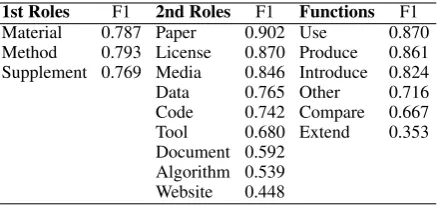
Table 5: Results (F1-score) on each category predicted by the best model for each of the three tasks.
training, we begin with the BERT-Base model (un-cased, 12-layer, 768-hidden, 12-heads, 110M pa-rameters) and then fine-tune the model on our training sets for the three classification tasks. The maximum word sequence length is 128; the learn-ing rate is set to 5e-5 and all other defaults set-tings are used. For the recommendation model, the feature embedding dimension of role labels and function labels is 32, which are initialized at random and the hidden size is set to 64. For all the baselines, we use the word embeddings pre-trained on our large-scale scientific corpus, which is a full-text collection of 40 thousand research pa-pers. And we stop the training when we found the best result in the developing set.
6.3 Results and Discussions
Classification Results
[image:7.595.310.529.254.357.2]Methods Precision@Top3 MAP RF(BoW+TFIDF) 0.438 0.275 RF(N-grams+TFIDF) 0.449 0.306
SciResREC 0.489 0.597
[image:8.595.319.512.59.213.2]-Function feature 0.471 0.569 -Role 2nd feature 0.420 0.539 -Role 1st feature 0.399 0.497
Table 6: The Precision@Top3 and the MAP results for the ranking list predicted by SciResREC.
analysis, we note that most neural-based mod-els are inferior to the traditional machine learn-ing methods, which is perhaps due to the lim-ited labeled datasets. While our model benefiting from the BERT encoder, which is pre-trained on vast amounts of text and fine-tuned on our task-specific, show an effective solution to the data limitation. We also see that the LSTM performs better when the attention layer introduced. It in-dicates the attention mechanism, which is suffi-cient used in the transformer structure of BERT, is significant to learn which words of a sequence are more important for determining the labels in our classification tasks. And the position embed-dings in BERT is also effective to learn the rel-ative positions between the resource citation and other words. By comparing the results between different joint models, we can get some interest-ing findinterest-ings about the relationships between the resource roles and the resource functions. First, the general role and the fine-grained role can not benefit each other, which is perhaps because the high-level constraints can reduce the intclass rors but meanwhile introduce more intra-class er-rors. When introducing the function information, the results for the general role will improve while the fine-grained role will slightly drop off. More-over, jointly learning the two-level role informa-tion can observably enhance the results for func-tion classificafunc-tion. And considering the complex interaction among the three tasks, the multi-task model achieves the best performance.
The resulting function classifier is sufficient to be applied to the entire ARC dataset. Nonetheless, errors remain. Consider the following example:
To give their network a better initialization, they learn word embeddings ... Theyreleasedtheir 50-dimensional word embeddings (vocabulary size 130K) under the name SENNA.<CITE>,
[image:8.595.87.275.61.134.2]which is notably a review of others’ work and the correct function is Introduce. While our model mistakes it toProducecaused by a higher
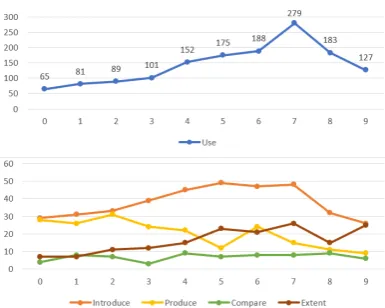
Figure 4: The revolution of resource functions in ten years starting from the first appearance.
attention score of the word “released”. This case inspires us that the dependency parsing can also be considered in the future research.
Recommendation Results
As Table 6 shows, our SciResREC framework outperforms the two baselines. An ablation test suggests that each feature component of our model contributes to the final performance, which indi-cates the information of role and function are help-ful for understanding the scientific resources. And we can observe that the feature of 2-nd category role label has the largest impact on performance indicating that capturing fine-grained role types is important for recognizing specific resources.
Resource Evolution Analysis
7 Conclusion and Future Work
We introduce a novel task ofmodeling the role and function for on-line resource citations in scientific literature. For this task we first create an annota-tion scheme, collect a large-scale corpus and con-struct a manually labeled dataset. And we pro-pose a multi-task model to jointly classify the role and function types based on the resource contexts. By incorporating the associated information, our SciResCLF framework effectively improves the performance across all tasks. Moreover, we pro-pose a resource recommendation task and develop the SciResREC framework using the predicted la-bels as features. Our frameworks can contribute to build more powerful search and recommenda-tion systems for scientific on-line resources. For future work, we will try using pre-trained BERT for scientific domain such as the SciBERT ( Belt-agy et al.,2019) and explore using our frameworks to help more tasks such as the evaluation, predic-tion and knowledge graph construcpredic-tion for scien-tific resources.
8 Acknowledgements
This work was supported by the National Key R&D Program of China (No. 2017YFB1002101), the Joint Advanced Research Foundation of China Electronics Technology Group Corporation (CETC) (No.6141B08010102), and National Nat-ural Science Foundation of China (No. U1636203, No. 61602490).
References
Ashutosh Adhikari, Achyudh Ram, Raphael Tang, and Jimmy Lin. 2019. Docbert: Bert for document clas-sification.CoRR, abs/1904.08398.
Isabelle Augenstein, Mrinal Das, Sebastian Riedel, Lakshmi Vikraman, and Andrew McCallum. 2017. Semeval 2017 task 10: Scienceie - extracting keyphrases and relations from scientific publica-tions. InSemEval@ACL.
Iz Beltagy, Arman Cohan, and Kyle Lo. 2019. Scibert: Pretrained contextualized embeddings for scientific text. ArXiv, abs/1903.10676.
Guillermo de la Calle, Miguel Garc´ıa-Remesal, Ste-fano Chiesa, Diana de la Iglesia, and Victor Maojo. 2009. Biri: a new approach for automatically dis-covering and indexing available public bioinformat-ics resources from the literature. BMC Bioinformat-ics, 10:320 – 320.
Jacob Devlin, Ming-Wei Chang, Kenton Lee, and Kristina Toutanova. 2018. Bert: Pre-training of deep bidirectional transformers for language understand-ing.CoRR, abs/1810.04805.
Geraint Duck, Goran Nenadic, Andy Brass, David L. Robertson, and Robert Stevens. 2012. bionerds: exploring bioinformatics database and software use through literature mining. InBMC Bioinformatics.
Geraint Duck, Goran Nenadic, Andy Brass, David L. Robertson, and Robert Stevens. 2014. Extracting patterns of database and software usage from the bioinformatics literature. InBioinformatics.
Geraint Duck, Goran Nenadic, Michele Filannino, Andy Brass, David L. Robertson, and Robert Stevens. 2016. A survey of bioinformatics database and software usage through mining the literature. In PloS one.
Qi He, Daniel Kifer, Jian Pei, Prasenjit Mitra, and C. Lee Giles. 2011. Citation recommendation with-out author supervision. InWSDM.
Qi He, Jian Pei, Daniel Kifer, Prasenjit Mitra, and C. Lee Giles. 2010. Context-aware citation recom-mendation. InWWW.
Wenyi Huang, Saurabh Kataria, Cornelia Caragea, Prasenjit Mitra, C. Lee Giles, and Lior Rokach. 2012. Recommending citations: translating papers into references. InCIKM.
Wenyi Huang, Zhaohui Wu, Liang Chen, Prasenjit Mi-tra, and C. Lee Giles. 2015. A neural probabilistic model for context based citation recommendation. InAAAI.
Armand Joulin, Edouard Grave, Piotr Bojanowski, and Tomas Mikolov. 2017. Bag of tricks for efficient text classification. InEACL.
David Jurgens, Srijan Kumar, Raine Hoover, Daniel A. McFarland, and Daniel Jurafsky. 2018. Measuring the evolution of a scientific field through citation frames. TACL, 6:391–406.
Yoon Kim. 2014. Convolutional neural networks for sentence classification. InEMNLP.
Siwei Lai, Liheng Xu, Kang Liu, and Jun Zhao. 2015. Recurrent convolutional neural networks for text classification. InAAAI.
Maria Liakata, Shyamasree Saha, Simon Dob-nik, Colin R. Batchelor, and Dietrich Rebholz-Schuhmann. 2012. Automatic recognition of con-ceptualization zones in scientific articles and two life science applications. InBioinformatics.
Yi Luan, Mari Ostendorf, and Hannaneh Hajishirzi. 2017. Scientific information extraction with semi-supervised neural tagging. InEMNLP.
Matthew E. Peters, Mark Neumann, Mohit Iyyer, Matt Gardner, Christopher Clark, Kenton Lee, and Luke Zettlemoyer. 2018. Deep contextualized word rep-resentations.
Alec Radford. 2018. Improving language understand-ing by generative pre-trainunderstand-ing.
Chi Sun, Luyao Huang, and Xipeng Qiu. 2019. Utilizing bert for aspect-based sentiment analy-sis via constructing auxiliary sentence. CoRR, abs/1903.09588.
Jie Tang and Jing Zhang. 2009. A discriminative ap-proach to topic-based citation recommendation. In PAKDD.
Simone Teufel, Advaith Siddharthan, and Tidhar Dan. 2006. Automatic classification of citation function. In Proc. 2006 Conference on Empirical Methods in Natural Language Processing, Sydney, Australia, pages 103–110.
Hu Xu, Bing Liu, Lei Shu, and Philip S. Yu. 2019. Bert post-training for review reading comprehen-sion and aspect-based sentiment analysis. CoRR, abs/1904.02232.
Yasunori Yamamoto and Toshihisa Takagi. 2007. Ore-fil: an online resource finder for life sciences. BMC Bioinformatics, 8:287 – 287.