Proceedings of the 2019 Conference on Empirical Methods in Natural Language Processing and the 9th International Joint Conference on Natural Language Processing, pages 2988–2999,
2988
Weakly Supervised Multilingual Causality Extraction from Wikipedia
Chikara Hashimoto
Yahoo Japan Corporation
1-3 Kioicho, Chiyoda-ku, Tokyo 102-8282, Japan
Abstract
We present a method for extracting causality knowledge from Wikipedia, such as Protec-tionism → Trade war, where the cause and effect entities correspond to Wikipedia arti-cles. Such causality knowledge is easy to ver-ify by reading corresponding Wikipedia arti-cles, to translate to multiple languages through Wikidata, and to connect to knowledge bases derived from Wikipedia. Our method ex-ploits Wikipedia article sections that describe causality and the redundancy stemming from the multilinguality of Wikipedia. Experiments showed that our method achieved precision and recall above 98% and 64%, respectively. In particular, it could extract causalities whose cause and effect were written distantly in a Wikipedia article. We have released the code and data for further research.
1 Introduction
Much of the world consists of entities that causally depend on each other. Therefore, causality
knowl-edge, e.g.,Protectionism→Trade war,1is useful
for many tasks such as why-QA (Oh et al.,2017),
reading comprehension (Berant et al.,2014), and
event prediction (Radinsky et al.,2012).
Although many methods have been proposed
for causality extraction from text (Ning et al.,
2018; Gao et al., 2018; Kruengkrai et al., 2017;
Rehbein and Ruppenhofer, 2017; Dunietz et al.,
2017; Hidey and McKeown, 2016; Zhao et al.,
2016; Hashimoto et al., 2014, 2012; Do et al.,
2011;Riaz and Girju,2010;Abe et al.,2008), they have rarely addressed three issues that are impor-tant for constructing a causality knowledge base
(CKB). First, we should be able toverifyextracted
causalities, so that the CKB can sustain the
credi-bility of its information.2 Second, it would be
de-1
In this paper,A→Bdenotes thatAcausesB.
2The verifiability in this paper means that one can verify extracted causalities with credible sources of information.
sirable to easilytranslatethe CKB to multiple
lan-guages, to avoid duplicating the construction effort for different languages. Third, it would also be
de-sirable to automaticallyconnectthe CKB to other
knowledge bases (KBs), to bring together KB con-struction efforts in various communities and thus maximize their synergistic effect.
Therefore, we propose a method for extracting causalities from Wikipedia by using cause and ef-fect entities that correspond to Wikipedia articles;
for example, forTobacco→Lung cancer, English
Wikipedia has articles titled Tobacco and Lung
cancer. Such causalities satisfy the above three
desiderata. First, we can easilyverifysuch
causal-ities, because Wikipedia articles tend to credibly
attest them; for example, theTobaccoarticle states
that inhaling its smoke can cause Lung cancer.3
In contrast, knowledge from other sources such as the web text tends to be difficult to verify, owing to a deluge of false information. Second,
causal-ities extracted from Wikipedia can be translated
trivially to multiple languages, because Wikidata (Vrandeˇci´c and Kr¨otzsch,2014), a free, multilin-gual KB, provides links among Wikipedia arti-cles on the same subject in different languages.
Third, it is easy toconnectcausalities whose cause
and effect are the topics of Wikipedia articles to other KBs derived from Wikipedia, e.g.,
Free-base (Bollacker et al., 2008), DBpedia (Lehmann
et al., 2009), Knowledge Graph (Singhal, 2012),
YAGO2 (Hoffart et al., 2013), and Wikidata. In
addition, Wikidata also provides links to external KBs, which connect the causalities to those KBs.
Because our task is to identify causal relations between entities that are the topics of Wikipedia articles, a simple solution would be to use
re-lation extraction (RE) methods (Vashishth et al.,
2018;Zhang et al.,2018,2017;Zhou et al.,2016;
Tobacco
From Wikipedia, the free encyclopedia
Tobaccois a product prepared from … Contents
1. Etymology 2. Harmful effects of tobacco 3. References
Etymology
The English word "tobacco" originates from …
Harmful effects of tobacco Inhaling tobacco smoke can cause lung cancer…
Lung cancer
From Wikipedia, the free encyclopedia
Lung cancer, also known as lung carcinoma … Contents
1. Signs and symptoms 2. Causes 3. References
Signs and symptoms Signs and symptoms which may suggest …
Causes
[image:2.595.73.290.63.156.2]Tobaccosmoking is by far the main contributor
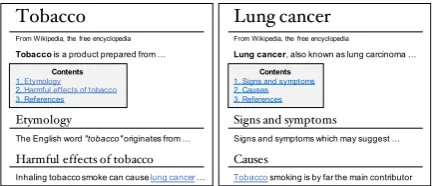
Figure 1: Sections that describe causality in Wikipedia:
Harmful effects of tobaccoandCauses. We can extract
Tobacco→Lung cancerfrom these sections.
Lin et al., 2016; Wang et al., 2016; Cai et al.,
2016; Shen and Huang, 2016). Most RE meth-ods, however, identify relations between entities co-occurring in a sentence (with exceptions such asQuirk and Poon, 2017; Peng et al., 2017) and cannot deal with a large portion of our test data
(67.3%, as we detail in §3.2), because the cause
and effect entities in the data tend to appear dis-tantly in a Wikipedia article. This is reasonable given that the subject of an encyclopedia article would not typically be repeated throughout the ar-ticle, as the author may expect readers to know that the whole article is about the subject.
We aim to extract causalities from Wikipedia re-gardless of whether their cause and effect co-occur in a sentence by training a causality classifier from causality instances whose cause and effect may appear distantly. Here, we face two problems:
Lack of labeled data: For the learning of the
causality classifier, there is no data marking causes and effects in Wikipedia articles, and manually creating such data would be laborious. A possible
solution would be distant supervision (Mintz et al.,
2009) using external KBs to mark relevant entities
in articles. Because Wikipedia evolves rapidly, however, relying on such KBs would make the re-sulting CKB obsolete. Therefore, how can we in-stantly acquire such data directly from Wikipedia?
Lack of redundancy: An encyclopedia tends to
avoid redundancy in text, which many knowledge extraction methods rely on to reliably estimate the
probability of extracted knowledge (Christensen
et al., 2011; Downey et al., 2005). Therefore, how can we reliably estimate the probability of a causality extracted from Wikipedia?
For the lack of labeled data, we can accurately extract hundreds of causalities by harnessing the property of Wikipedia that some articles have
sec-tions describing relevant causalities. For example,
as shown in Fig.1, theLung cancer article has a
section namedCausesthat mentionsTobacco, and
theTobaccoarticle has a section named Harmful effects of tobaccothat mentionsLung cancer.
Ac-cordingly, we can extractTobacco→Lung cancer
and then use it for the learning of the classifier. All the supervision we need is a handful of keywords
for such sections, e.g.,causesandeffects.
For the lack of redundancy, we exploit another
kind of redundancy stemming from the
multilin-guality of Wikipedia: the same subject may be described by articles in different languages; for
example, Tobaccois described in 112 languages.
We thus use a data source consisting of Wikipedia
articles in nine languages: English (en), German
(de), French (fr), Spanish (es), Italian (it),
Por-tuguese (pt), Swedish (sv), Dutch (nl), and
Pol-ish (pl). This requires our method to be language
independent. For these nine languages, however, the only required linguistic analysis is detection of word boundaries, i.e., white space. This simplicity has an advantage of allowing our method to parse Wikipedia quickly to keep the CKB up to date.
We evaluated our method by using the relation triples in Wikidata, which represents a causality by
either ahas causeor ahas effectrelation (§3). Our
method achieved precision and recall above 98%
and 64%, respectively, rivaling anoraclerelation
extractor that perfectly detected the causality
be-tween entities co-occurring in a sentence. We
also confirmed that the multilingual redundancy of Wikipedia was effective: using more languages led to significantly better performances.
Our contributions are five-fold. (1) We
pro-posed the three desiderata for CKBs:
verifia-bility, translatability, and connectivity. (2) We
presented the ideas of exploiting the
causality-describing sections and multilingual redundancy
of Wikipedia. (3) Based on these ideas, we pro-posed a weakly-supervised, multilingual causality extraction method. (4) We evaluated our method in relatively large-scale settings. (5) We have
re-leased the code and data from this study (§6).4
In this paper we focus on causality extraction. We will present how to construct the CKB from causalities extracted by our method in future.
In this study, we define a causality A→ B
ac-cording to Wikipedia and Wikidata. Specifically,
Causality
Entities CausalitiesSeed Seed Causalitieswith Contexts
§2.1 §2.2 §2.3
Causality Classifier
[image:3.595.77.287.61.112.2]§2.4
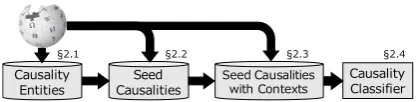
Figure 2: Overview of our method. Numbers indicate sections that describe corresponding components.
A→ Bif Wikipedia describesAas causingB
ei-ther explicitly or implicitly, or ifA(B) has thehas
effect(has cause) relation toB(A) in Wikidata.
2 Proposed Method
Our method learns a causality classifier that, given
an entity pair(e1, e2), determines ife1→e2holds.
The entities are Wikidata identifiers (IDs) having at least one corresponding Wikipedia article. For
example, Q1566 is the Wikidata ID forTobacco,
which is described in Wikipedia in 112 languages.
Figure2shows the learning process; the method
identified entities that tend to participate in
causal-ity (§2.1), extracted seed causalities between such
entities from causality-describing sections as
il-lustrated in Fig. 1 (§2.2), extracted the contexts
of the seed causalities from articles in multiple
languages (§2.3), and finally learned the classifier
from the multilingual contexts of the seeds (§2.4).
The resulting classifier thus takes(e1, e2)as
in-put, examines the multilingual contexts ofe1 and
e2, and determines ife1→e2 holds.
The Python code that accompanies this paper is
an implementation of our method (§6).
2.1 Causality Entity Extraction
Some entities, e.g., Tobacco, are more likely to
participate in causality than others, e.g.,A (the
al-phabet letter). We call themcausality entities. To accurately extract seed causalities in the next step, we first extracted causality entities by identifying
articles that had causality-describing sections:
To-bacco and Lung cancer in Fig. 1 were thus re-garded as causality entities.
To identify causality-describing sections, we manually prepared a handful of keywords that tended to appear in the titles of such sections for
the nine languages:en,de,fr,es,it,pt,sv,nl, and
pl. This was the only supervision of our method.
Specifically, we choseCause,Causes,Effect, and
Effects as such keywords for en and translated them to the other languages by reference to
Wik-tionary.5 We have released these keywords (§6).
We then extracted causality entities from the Wikipedia dump of each language and kept only those entities that appeared in more than one lan-guage. The identify of an entity across languages
could be confirmed by Wikidata IDs; e.g.,Tobacco
(en) andTabaco(es) both correspond to Q1566.
2.2 Seed Causality Extraction
A seed causality is an entity pair (e1, e2) such
thate1 appears in a causality-describing section,
whose title containsCauseorCauses(in the case
ofen), in the article corresponding toe2; and such
thate2 appears in a causality-describing section,
whose title contains Effector Effects, in the
arti-cle corresponding toe1. For instance,Tobacco→
Lung cancerin Fig.1is a seed causality, as it sat-isfies the above condition.
We extracted seed causalities in this way, kept only those that appeared in more than one language, and consequently acquired 879 seed causalities from the nine languages. We have also
released the seed causalities (§6).
2.3 Seed Causality Context Extraction
As illustrated in Fig. 3, for each entity in a seed
causality, we extracted its contexts from articles in multiple languages as features for the classifier.
The context window was up to 100 words to the left and right of each target entity. When a sec-tion title appeared in a context window, we shrank the window to the section title position so that the window would not cross the section boundary.
We restricted the articles from which contexts
were extracted as follows. Fore1 →e2, the
con-text ofe1 (e2) was extracted from the article that
corresponded toe2(e1). For example, forTobacco
→ Lung cancer, the context of Tobacco was
ex-tracted only from theLung cancerarticle, and that
of Lung cancer was extracted only from the To-bacco article. This reduced the processing time and helped extract only highly relevant contexts for a target causality. We extracted the contexts directly from the Wikipedia source texts with all markups kept intact, because those markups may have helped the classifier, and parsing the source texts would have slowed the process. In addition,
we replaced e1 and e2 in the extracted contexts
with the special symbols CAUSE and EFFECT .
Tobacco
From Wikipedia, the free encyclopedia
Tobaccois a product prepared from …
Contents
1. Etymology
2. Harmful effects of tobacco
3. References
Etymology
The English word "tobacco" originates from …
Harmful effects of tobacco
Inhaling tobacco smoke can cause lung cancer…
Lung cancer
From Wikipedia, the free encyclopedia
Lung cancer, also known as lung carcinoma …
Contents
1. Signs and symptoms 2. Causes 3. References
Signs and symptoms
Signs and symptoms which may suggest …
Causes
Tobaccosmoking is by far the main contributor
English Wikipedia there is sufficient evidence that involuntary smoking (exposure to secondhand or ‘environmental’ CAUSE smoke) causes EFFECT in humans.
French Wikipedia la cause la plus fr´equente de
EFFECT est l’exposition chronique `a la fum´ee de [[#tabagisme|
CAUSE ]]
Spanish Wikipedia
algunos tipos de c´ancer se encuentran directamente relacionados con el
CAUSE , como es el caso del [[ EFFECT ]] y otros c´anceres del tracto respiratorio
Figure 3: Seed causality context extraction from Wikipedia articles of multiple languages.
We also removed line-break characters to extract contexts from across multiple lines.
For each seed causality, we concatenated all the contexts from multiple languages. For context
ex-traction, we used only four languages —en,de,fr,
andes— because they had the broadest coverage.
We also removed infoboxes from articles before context extraction, because we used Wikidata’s triples for evaluation, and some of those have been
transcribed into infoboxes.6 This was for fairness
rather than methodological considerations.
2.4 Learning Classifier
For learning of the causality classifier, we used the seed causalities as positive instances. In con-trast, negative (non-causality) instances were en-tity pairs such that the article corresponding to one entity had a link to the article corresponding to the other entity. For example, the article on
Barack Obamahas a link to the article onHillary Clinton, and hence, Barack Obama → Hillary Clinton could be used as a negative instance. In this way, we could obtain sensible negative in-stances, meaning that they were not totally ran-dom pairs but were semantically related to each other in some way. We obtained the same num-ber (879) of negative instances as positive ones and similarly extracted their multilingual contexts; thus, we trained the classifier with 1,758 instances.
We used fastText (Joulin et al., 2016), a
lin-ear text classifier that averages word embeddings and makes a prediction based on the averaged em-beddings, as the causality classifier because of its speed and accuracy. Among its hyperparameters, we tuned only the number of epochs and the
learn-ing rate, as detailed in§3.2. We did not use
pre-trained word embeddings for the classifier to min-imize its dependence on external resources.
Although there would be more sophisticated ap-proaches to modeling the multilingual contexts ex-tracted from Wikipedia, we intentionally adopted the very simple modeling in this paper in order to
6https://www.wikidata.org/wiki/ Wikidata:WikiProject_Infoboxes
show that even such a simple method could de-liver good performances by using the multilingual contexts of Wikipedia. We will develop more so-phisticated models in future.
3 Experiments
Using relation triples in Wikidata (§3.1), we
eval-uated our method by comparing it with various
baselines (§3.2). We also measured the
effective-ness of using multiple languages (§3.3).
We can summarize the results as follows. Our method (1) extracted causality with precision and recall above 98% and 64%, respectively; it (2) ri-valed the performance of an oracle relation extrac-tor that worked sentence-wise; and it (3) effec-tively used multiple languages.
3.1 Test Data
Our experiments were based on labeled data de-rived from Wikidata, which has various relation
triples (e1, rel, e2), where e1 and e2 are
enti-ties (“item identifiers” in Wikidata terms, such as
Q1566) between which the relationrel (a
“prop-erty” in Wikidata terms, such ashas cause) holds.
In short, we used triples whose relations were
either has cause orhas effect as positive
(causal-ity) instances and those with other relations as negative (non-causality) instances. Because we aimed to extract causalities that were easy to verify by reading individual Wikipedia articles, we re-stricted the triples to those whose component enti-ties co-occurred in an article. Specifically, we used only triples such that the article corresponding to one entity had a link to the article corresponding to the other entity in at least one language. Con-sequently, we obtained 1,524 positive instances and the same number of negative instances, giving 3,048 instances in total.
The data was in no way easy to classify, because all the negative instances were not random pairs but had semantic relations that are as natural and common as causality. For example, in Wikidata,
World War I (Q361) and theParis Peace
the has effectrelation with the latter. In contrast,
World War I and theGerman invasion of Belgium
(Q5551414) do not show causality, because they
have asignificant eventrelation between them.
The data accompany the paper (§6).
3.2 Performance of Proposed Method
Experimental Settings for Proposed Method
In this section, we denote our proposed method as
PROP. In the experiments, it extracted
multilin-gual contexts for each relation triple in the data,
as described in§2.3. The data were used only for
testing. Training was conducted using the
auto-matically acquired seed causalities (§2).
Hyperparameter tuning for PROP was based
on five-fold cross validation using the seed causal-ities so that we could maximize the F1 score on them. We only tuned the number of epochs and the learning rate of fastText; the former was cho-sen from 30, 50, 70, and 100, while the latter was chosen from 0.3, 0.5, 0.7, and 1.0. As a result, they were set to 100 and 1.0, respectively. The other fastText parameters were set to default values.
We used the default fastText threshold for clas-sification. We conducted 10 runs and averaged the performance scores (accuracy, precision, re-call, and F1) for evaluation.
Compared Methods
We evaluated the performance of PROP by
com-paring it with the following baseline methods
de-scribed below: SECTION, INFOBOX, RELATED,
and ORACLERE.
SECTION This was simply the method of seed
causality extraction described in §2.2, which
ex-tracted 879 causalities from Wikipedia. This was
intended to evaluate two questions. The first
was how well our idea of exploiting causality-describing sections in Wikipedia worked on its
own. The second question was how much PROP
improved the results, as it used the classifier
trained on the output of the SECTIONmethod.
INFOBOX This method extracted causality from
the infoboxes in Wikipedia articles in the nine lan-guages. Some infoboxes contain information on
causality; for example, the article onCandidiasis
has an infobox with the fieldCauses, whose value
isCandida, which indicatesCandida→
Candidi-asis. For the INFOBOX method to identify such
causality-describing fields in infoboxes, we used
the same set of keywords that PROPused to
iden-tify causality-describing sections. As discussed in
§2.3, some Wikidata triples have been transcribed
into infoboxes, which should give the INFOBOX
method an advantage over PROP, as PROPwas
for-bidden to use infoboxes.
RELATED This method regarded an entity pair
whose entities were semantically related to each other as a causality, because such relatedness has
been shown to imply causality (Do et al., 2011;
Riaz and Girju, 2010). Specifically, this method
used a semantic relatedness defined as1−sr(a, b),
wheresr(a, b)is a Wikipedia-link-based distance
measure that was proposed byMilne and Witten
(2008) and has been widely used (Lee et al.,2015).
The measure is defined
sr(a, b) = log(max(|A|,|B|))−log(|A∩B|)
log(|W|)−log(min(|A|,|B|)) ,
whereaandbare the two articles (entities) of
in-terest,AandB are the sets of all articles that link
to a andb, respectively, and W is the entire set
of Wikipedia articles. To classify entity pairs, we set a threshold for the relatedness score so that we
could maximize F1 on the training data for PROP
(§2.4). The threshold value ranged from 0.00 to
1.00 at intervals of 0.01. We used the link
struc-ture ofenWikipedia because it is the largest one.
ORACLE RE This method used anoracle
rela-tion extractor that, given two entities that co-occur in a sentence, never fails to determine whether they have a causal relation. For other pairs, whose component entities did not co-occur in a sentence, this method uniformly guessed that they had no
causal relation. We used en Wikipedia for OR
-ACLE RE because it has the broadest coverage.
We segmented articles into sentences with spaCy,7
which accurately recognizes sentence boundaries through dependency parsing. This method would show the upper-bound performance for our task of typical RE methods that work sentence-wise. This was an ambitious baseline given the
perfor-mances of state-of-the-art RE methods: Vashishth
et al.(2018) achieved a top-100 precision of 84%
on the New York Time corpus (Riedel et al.,2010);
Wang et al.(2016) achieved an F1 score of 88% on
Acc Prec Rec F1 SECTION 50.56 100.00 1.12 2.21 INFOBOX 53.71 100.00 7.41 13.81 RELATED 68.86 66.23 76.97 71.20 ORACLERE 75.89 100.00 51.77 68.22 PROP 81.45 98.28 64.02 77.53
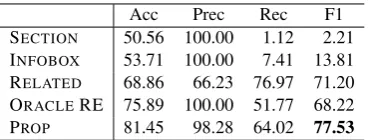
Table 1: Performance results of the compared methods.
Results
Table1lists the accuracy (Acc), precision (Prec),
recall (Rec), and F1 of the compared methods.
The SECTION method achieved 100%
preci-sion, which indicates that our technique of exploit-ing causality-describexploit-ing sections in Wikipedia
could accurately extract causalities. As the
method’s recall indicates, however, it covered only a small portion of our target causalities.
The INFOBOXmethod also achieved 100%
pre-cision, though its coverage was also quite limited.
The RELATEDmethod exhibited the highest
re-call, but the precision was unacceptably low for the subsequent manual labor that would be re-quired to construct the CKB.
The ORACLE RE method achieved 100%
pre-cision by design. Its recall was rather low because
67.3% of the entity pairs in the data (§3.1)
con-sisted of entities that did NOT co-occur in a sen-tence. This means that most RE methods that work sentence-wise will miss a large portion of causali-ties, regardless of their accuracy.
Finally, PROP achieved the best F1 score,
though its recall still had room for improvement.
The fact that PROPoutperformed the baselines,
es-pecially ORACLERE, clearly shows the
effective-ness of our method.
3.3 Language Ablation Test
We also examined the effect of using more lan-guages for extracting contexts by comparing the
performance of the following variations of PROP:
PROP, PROPen.de.f r, PROPen.de.es, PROPen.f r.es, PROPen, PROPen.de, PROPen.f r, and PROPen.es.
Unlike PROP, which useden,de,fr, andesfor
ex-tracting multilingual contexts, the others used only the languages indicated by the subscript language
symbols. For example, PROPen.de used only en
anddeWikipedia articles.
For each variation of our method, we conducted 10 runs and averaged the resulting performance scores for evaluation.
7https://spacy.io/
Acc Prec Rec F1 PROPen.de.f r.es 81.45 98.28 64.02 77.53
PROPen.de.f r 80.54 98.16 62.24 76.18∗
PROPen.de.es 80.82 98.65 62.49 76.51∗
PROPen.f r.es 79.20 98.14 59.52 74.10∗
PROPen.de 79.92 99.21 60.32 75.26
PROPen.f r 78.39 98.32 57.76 72.77
PROPen.es 77.91 98.91 56.45 71.88
PROPen 76.43 98.91 53.45 69.40
Table 2: Results of language ablation tests. PROP is denoted as PROPen.de.f r.es for clarity. ∗ and
indi-cate statistically significant differences from the perfor-mances of PROPen.de.f r.es and PROPen, respectively
(paired t-test:p <0.01).
Table 2 summarizes the results of the ablation
tests. The upper half of the table indicates that
removing one language from PROPtended to
de-grade its performance, while the lower half
indi-cates that adding one language to PROPen tended
to improve its performance. From these results, we conclude that using multilingual contexts is ef-fective for causality extraction from Wikipedia.
3.4 Analysis
We first examine cases in which PROPsucceeded
and then analyze its error cases.
Causalities whose cause and effect entities co-occur in a sentence tend to have phrases indicat-ing the causal relation between them, which helps
identify the relation. For example, forAdipsia→
Hypernatremia, there is the following sentence:
(1) Adipsiamay be seen in conditions such as
di-abetes insipidus and mayresult in
hyperna-tremia.
For causalities whose cause and effect do not co-occur in a sentence, it is likely that their causal relation are only indicated by multi-line texts or the structure of Wikipedia article. For example, forHormone therapy→Cancer pain, there is the
following list item in theCausesection of the
arti-cle ofCancer pain:
(2) hormone therapy, which sometimes causes
pain flares;
AlthoughCancer painis not written explicitly in
the item, we can guess that the pain flare refers
to Cancer pain, because this list item is part of
the contents of theCausesection of the article of
[image:6.595.318.516.62.166.2]because pieces of Wikipedia source text that rep-resent this kind of structure can be included in the window of the multilingual contexts and because all contexts are extracted from the articles that cor-respond to either the cause or the effect.
Regarding PROP’s error analysis, we focus here
on its false-negative errors, as it achieved high pre-cision while its recall had room for improvement. Such errors were mostly due to the lack of evi-dence of causality; in some cases, even though the cause and effect entities both appear in an article, it does not indicate their causal relation. For
ex-ample, forPsoriasis→Woronoff ’s ring, the cause
is only mentioned as a list item in theSee also
sec-tion of the effect entity’s article inenWikipedia.
Other false-negatives included entity pairs for which not only causality but other relations hold.
For example, for International University Sports
Federation→Universiade, both thehas effectand theorganizerrelations hold. These tend to be cases in which the Wikipedia article describes the cause asorganizing(instead ofcausing) the effect.
4 Discussion
4.1 Three Desiderata for CKB
In §1 we discussed the desiderata for the CKB:
verifiability, translatability, and connectivity. In this section we consider how well the causalities
extracted by PROPsatisfied the desiderata.
Verifiability
We examined 100 samples from the causalities in
the data (§3.1) that PROP correctly classified as
causalities (i.e., true positives) to measure their verifiability. In other words, we examined how many of them consisted of cause and effect entities between which we could easily identify causal-ity by reading their individual Wikipedia
arti-cles. Causalities that were not described in en
Wikipedia were regarded as unverifiable, because we assumed that our target users could understand only English. Of the 100 samples, 19 were not
written inenWikipedia.
As a result, 62.0% of the samples were veri-fiable. If we ignore those 19 samples that were
not written in en Wikipedia, 76.5% of the
sam-ples were verifiable. For example, forOnchocerca
volvulus → Onchocerciasis, the article on On-chocerca volvulushas the following sentence:
(3) Onchocerca volvulus is a nematode that
causesonchocerciasis.
We thus conclude that causalities extracted by
PROPtend to be verifiable.
Translatability
We next examined the number of languages to which each true-positive causality was translated, by using Wikidata’s links among Wikipedia arti-cles on the same subject in different languages. We targeted each of the nine languages. We re-garded each causality as translated to a language if its cause and effect were both translated.
As a result, 74.9% of the causalities were trans-lated to more than one language, which
indi-cates that the causalities extracted by PROP tend
to exhibit a high degree of translatability. Fur-thermore, 16.5% were translated to all nine
lan-guages, including, e.g., Chemotherapy →
Vom-iting (Q974135 → Q127076) and Treaty of Ver-sailles→World War II(Q8736→Q362).
Connectivity
We also examined how many of the true positives were connected to external KBs. We first listed all
external IDs,8which Wikidata uses to identify
ex-ternal KBs such as Freebase, IMDb, and ISBN-13,
with a lookup function in Wikidata,9 resulting in
3,695 external IDs. We then made a table to map each Wikidata ID to the external IDs to which it is connected. With the table we counted the number of true-positive causalities whose cause and effect entities shared at least one external ID.
Consequently, 72.3% of the true-positives were
connected to external KBs. For example,Diabetes
mellitus → Cataract was connected to 19 KBs
such as MeSH,10 Freebase, and BabelNet (
Nav-igli and Ponzetto, 2012). We thus conclude that
causalities extracted by PROPindicate a high
de-gree of connectivity.
4.2 Independence of Languages
We designed PROP to be language independent
so that we could exploit multilingual redundancy. Unfortunately, unintended language dependence might arise as we use more languages. We are cur-rently aware that we will need tokenizers if we use languages for which word boundaries are not as explicit as in the nine languages here, e.g., Chinese and Japanese. It will thus be a future challenge to
8
https://www.wikidata.org/wiki/ Wikidata:Identifiers
9
https://www.wikidata.org/wiki/ Special:ListProperties
use many more languages while keeping PROPas language independent as possible.
4.3 Independence of External KBs
We also designed PROP not to rely on external
KBs so that we could easily keep the CKB up to date with Wikipedia. If we relaxed this design pol-icy, we would be able to use the triples in Wikidata as additional training data for our classifier. We thus plan to explore this direction of research.
Another external resource that is useful for
PROP would be pre-trained word vectors (
Bo-janowski et al., 2017). We evaluated PROPen+,
which is the same as PROPen except that it
used pre-trained word vectors.11 The pre-trained
word vectors slightly improved the performance;
PROPen+achieved a F1 of 69.51, while PROPen’s
F1 was 69.40.
5 Related Work
5.1 Causality Extraction
Causality extraction methods can be classified with regard to what constitutes cause and effect: noun phrases, verb phrases, or clauses. The
noun-phrase type, e.g.,global warming→malaria
epi-demic, has mostly been addressed by RE methods,
as we discuss in§5.2. The verb-phrase type, e.g.,
get fired →live on unemployment insurance, has
been extracted by various methods (Ning et al.,
2018;Gao et al.,2018;Rehbein and Ruppenhofer,
2017;Kruengkrai et al., 2017; Hashimoto et al.,
2015,2014,2012;Do et al.,2011;Riaz and Girju,
2010;Abe et al.,2008). The clause type, e.g., I hid the car key→She’s mad, has also been
stud-ied (Dunietz et al., 2017). Other types include
causal embeddings (Sharp et al.,2016), which can
be used for causal question answering (Oh et al.,
2017). We focused here on the noun-phrase type
because noun phrases can be components of verb phrases and clauses, and hence, our work may also contribute to the extraction of other types.
Another standpoint of classifying causality ex-traction is the information source, e.g.,
newspa-pers (Khoo et al., 1998), the web (Kruengkrai
et al., 2017), parallel corpora (Hidey and
McK-eown, 2016),12 images (Gao et al., 2018), and
videos (Fire and Zhu, 2016). We used Wikipedia
11We used two million word vectors trained with sub-word information on Common Crawl available athttps:// fasttext.cc/docs/en/english-vectors.html. 12Precisely, the task of Hidey and McKeown (2016) is identifying linguistic cues that indicate causality.
articles in multiple languages because they tend to be more credible than other sources, and be-cause they allowed us to exploit multilingual re-dundancy.
Wikipedia articles in multiple languages also provide causalities that tend to satisfy the three
desiderata discussed in§1, which is the novel
per-spective that we proposed and that many previous studies lacked. In addition, we proposed a novel method that is better suited for extracting such causalities than previous methods were.
5.2 Relation Extraction
In SemEval-2007 Task4 (Girju et al., 2007) and
SemEval-2010 Task 8 (Hendrickx et al., 2010),
the target relations included “Cause-Effect”; our study is also relevant to methods for those tasks (Lee et al., 2019; Wang et al., 2016; Shen and Huang, 2016;Cai et al., 2016;Xu et al., 2016). Other methods based on RE also addressed
causal-ity (Kim and Myaeng, 2016; De Saeger et al.,
2011,2009;Schoenmackers et al.,2010).
Although our method can be regarded as a rela-tion extractor, it is different from the above meth-ods because it is particularly tailored to causality extraction from Wikipedia. For this task, it is im-portant to extract relation instances whose compo-nent entities do not co-occur in a sentence.
More recent studies have addressed inter
-sentential RE for specialized domains (
Noriega-Atala et al., 2018; Quirk and Poon, 2017; Peng et al.,2017), andMandya et al.(2018) constructed a large-scale dataset for this task. Hence, we plan to incorporate these approaches into our method.
5.3 Knowledge Extraction from Wikipedia
Knowledge extraction from Wikipedia in general is also relevant to our study. Although there have
been studies on extracting class concepts (Pasca,
2018), trivia (Tsurel et al., 2017), taxonomies
(Flati et al.,2014), infobox contents (Wang et al.,
2013), and various semantic relations (Wu and
Weld,2010), among other things, causality
extrac-tion from Wikipedia has rarely been addressed as
far as we are aware. Hidey and McKeown(2016)
addressed the extraction of linguistic markers indi-cating causality from Wikipedia, but those
mark-ers were not causalitiesper se.
5.4 Temporal Relation Extraction
Researchers have noticed that causality
2006) share some properties and can complement
each other (Ning et al., 2018;Mirza and Tonelli,
2016;Bethard and Martin, 2008). In the future, we will also explore the possibility of exploiting temporal relation extraction methods for our task.
6 Accompanying Code and Data
We hereby release the Python code to im-plement our method, including modules for
generating relevant data, with step-by-step
instructions. We also release the following
data sets: (a) the keywords for identifying
causality-describing sections (§2.1), (b) the
seed causalities (§2.2), and (c) the test data
(§3.1). The code and data will be available at
https://research-lab.yahoo.co.jp/ people/chikara_hashimoto.html.
Note that 98.1% of the seed causalities are not included in Wikidata as causality, and they can in-crease Wikidata causalities by about 19.8%.
7 Conclusion
We have proposed a weakly supervised method for extracting causality from Wikipedia articles in multiple languages. The causalities extracted
by our method tend to be easy to verify,
trans-lateto multiple languages, and connect to
exter-nal KBs. Our key idea is to exploit the
causality-describing sections and multilingual redundancy
of Wikipedia. Our method achieved precision and recall above 98% and 64%, respectively, and it could even extract causalities whose cause and ef-fect entities did not co-occur in a sentence.
References
Shuya Abe, Kentaro Inui, and Yuji Matsumoto. 2008.
Two-phased event relation acquisition: Coupling the relation-oriented and argument-oriented approaches. InProceedings of the 22nd International Conference on Computational Linguistics (COLING), pages 1– 8.
Jonathan Berant, Vivek Srikumar, Pei-Chun Chen, Abby Vander Linden, Brittany Harding, Brad Huang, Peter Clark, and Christopher D. Manning. 2014. Modeling biological processes for reading comprehension. InProceedings of the 2014 Con-ference on Empirical Methods in Natural Language Processing (EMNLP), pages 1499–1510.
Steven Bethard and James H. Martin. 2008. Learn-ing semantic links from a corpus of parallel tem-poral and causal relations. In Proceedings of the
46th Annual Meeting of the Association for Compu-tational Linguistics on Human Language Technolo-gies (ACL-HLT), pages 177–180.
Piotr Bojanowski, Edouard Grave, Armand Joulin, and Tomas Mikolov. 2017. Enriching word vectors with subword information. Transactions of the Associa-tion for ComputaAssocia-tional Linguistics, 5:135–146.
Kurt Bollacker, Colin Evans, Praveen Paritosh, Tim Sturge, and Jamie Taylor. 2008. Freebase: a col-laboratively created graph database for structuring human knowledge. InSIGMOD Conference, pages 1247–1250.
Rui Cai, Xiaodong Zhang, and Houfeng Wang. 2016.
Bidirectional recurrent convolutional neural network for relation classification. In Proceedings of the 54th Annual Meeting of the Association for Compu-tational Linguistics (ACL), pages 756–765.
Janara Christensen, Mausam, Stephen Soderland, and Oren Etzioni. 2011. An analysis of open informa-tion extracinforma-tion based on semantic role labeling. In
Proceedings of the Sixth International Conference on Knowledge Capture, pages 113–120.
Stijn De Saeger, Kentaro Torisawa, Jun’ichi Kazama, Kow Kuroda, and Masaki Murata. 2009. Large scale relation acquisition using class dependent pat-terns. InThe Ninth IEEE International Conference on Data Mining (ICDM), pages 764–769.
Stijn De Saeger, Kentaro Torisawa, Masaaki Tsuchida, Jun’ichi Kazama, Chikara Hashimoto, Ichiro Ya-mada, Jong-Hoon Oh, Istv´an Varga, and Yulan Yan. 2011. Relation acquisition using word classes and partial patterns. In Proceedings of the 2011 Con-ference on Empirical Methods in Natural Language Processing (EMNLP), pages 825–835.
Quang Xuan Do, Yee Seng Chan, and Dan Roth. 2011. Minimally supervised event causality iden-tification. InProceedings of the Conference on Em-pirical Methods in Natural Language Processing (EMNLP), pages 294–303.
Doug Downey, Oren Etzioni, and Stephen Soderland. 2005.A probabilistic model of redundancy in infor-mation extraction. InIJCAI-05, Proceedings of the Nineteenth International Joint Conference on Artifi-cial Intelligence, pages 1034–1041.
Jesse Dunietz, Lori Levin, and Jaime Carbonell. 2017.
Automatically tagging constructions of causation and their slot-fillers.Transactions of the Association for Computational Linguistics (TACL), 5:117–133.
Tiziano Flati, Daniele Vannella, Tommaso Pasini, and Roberto Navigli. 2014. Two is bigger (and better) than one: the wikipedia bitaxonomy project. In Pro-ceedings of the 52nd Annual Meeting of the Asso-ciation for Computational Linguistics (ACL), pages 945–955.
Qiaozi Gao, Shaohua Yang, Joyce Chai, and Lucy Van-derwende. 2018. What action causes this? towards naive physical action-effect prediction. In Proceed-ings of the 56th Annual Meeting of the Association for Computational Linguistics (ACL), pages 934– 945.
Roxana Girju, Preslav Nakov, Vivi Nastase, Stan Sz-pakowicz, Peter Turney, and Deniz Yuret. 2007.
Semeval-2007 task 04: Classification of semantic re-lations between nominals. InProceedings of the 4th International Workshop on Semantic Evaluations, pages 13–18.
Chikara Hashimoto, Kentaro Torisawa, Stijn De Saeger, Jong-Hoon Oh, and Jun’ichi Kazama. 2012. Excitatory or inhibitory: A new semantic orientation extracts contradiction and causality from the web. InProceedings of the 2012 Joint Confer-ence on Empirical Methods in Natural Language Processing and Computational Natural Language Learning (EMNLP-CoNLL), pages 619–630.
Chikara Hashimoto, Kentaro Torisawa, Julien Kloetzer, and Jong-Hoon Oh. 2015. Generating event causal-ity hypotheses through semantic relations. In Pro-ceedings of the Twenty-Ninth AAAI Conference on Artificial Intelligence (AAAI), pages 2396–2403.
Chikara Hashimoto, Kentaro Torisawa, Julien Kloetzer, Motoki Sano, Istv´an Varga, Jong-Hoon Oh, and Yu-taka Kidawara. 2014. Toward future scenario gener-ation: Extracting event causality exploiting semantic relation, context, and association features. In Pro-ceedings of the 52nd Annual Meeting of the Asso-ciation for Computational Linguistics (ACL), pages 987–997.
Iris Hendrickx, Su Nam Kim, Zornitsa Kozareva, Preslav Nakov, Diarmuid ´O. S´eaghdha, Sebastian Pad´o, Marco Pennacchiotti, Lorenza Romano, and Stan Szpakowicz. 2010. Semeval-2010 task 8: Multi-way classification of semantic relations be-tween pairs of nominals. In Proceedings of the 5th International Workshop on Semantic Evaluation, SemEval ’10, pages 33–38.
Christopher Hidey and Kathy McKeown. 2016. Iden-tifying causal relations using parallel wikipedia ar-ticles. In Proceedings of the 54th Annual Meet-ing of the Association for Computational LMeet-inguistics (ACL), pages 1424–1433.
Johannes Hoffart, Fabian M. Suchanek, Klaus Berberich, and Gerhard Weikum. 2013. Yago2: A spatially and temporally enhanced knowledge base from wikipedia. Artif. Intell., 194:28–61.
Armand Joulin, Edouard Grave, Piotr Bojanowski, and Tomas Mikolov. 2016. Bag of tricks for efficient text classification.arXiv preprint arXiv:1607.01759.
Christopher S.G. Khoo, Jaklin Kornfilt, Sung Hyon Myaeng, and Robert N. Oddy. 1998. Automatic ex-traction of cause-effect information from newspaper text without knowledge-based inferencing. Literary and Linguistic Computing, 13:177–186.
Jinho Kim and Sung-Hyon Myaeng. 2016. Discov-ering relations to augment a web-scale knowledge base constructed from the web. In Proceedings of the 6th International Conference on Web Intelli-gence, Mining and Semantics (WIMS), pages 16:1– 16:12.
Canasai Kruengkrai, Kentaro Torisawa, Chikara Hashimoto, Julien Kloetzer, Jong-Hoon Oh, and Masahiro Tanaka. 2017. Improving event causal-ity recognition with multiple background knowl-edge sources using multi-column convolutional neu-ral networks. In Proceedings of the Thirty-First AAAI Conference on Artificial Intelligence (AAAI), pages 3466–3473.
Joohong Lee, Sangwoo Seo, and Yong Suk Choi. 2019. Semantic relation classification via bidirec-tional lstm networks with entity-aware attention us-ing latent entity typus-ing.
Joonseok Lee, Ariel Fuxman, Bo Zhao, and Yuanhua Lv. 2015. Leveraging knowledge bases for contex-tual entity exploration. InProceedings of the 21th ACM SIGKDD International Conference on Knowl-edge Discovery and Data Mining, KDD ’15, pages 1949–1958.
Jens Lehmann, Chris Bizer, Georgi Kobilarov, S¨oren Auer, Christian Becker, Richard Cyganiak, and Se-bastian Hellmann. 2009.DBpedia - a crystallization point for the web of data.Journal of Web Semantics, 7(3):154–165.
Yankai Lin, Shiqi Shen, Zhiyuan Liu, Huanbo Luan, and Maosong Sun. 2016. Neural relation extraction with selective attention over instances. In Proceed-ings of the 54th Annual Meeting of the Association for Computational Linguistics (ACL), pages 2124– 2133.
Angrosh Mandya, Danushka Bollegala, Frans Coenen, and Katie Atkinson. 2018. A dataset for inter-sentence relation extraction using distant supervi-sion. InProceedings of the Eleventh International Conference on Language Resources and Evaluation (LREC).
Inderjeet Mani, Marc Verhagen, Ben Wellner, Chong Min Lee, and James Pustejovsky. 2006.
David Milne and Ian H. Witten. 2008. An effec-tive, low-cost measure of semantic relatedness ob-tained from Wikipedia links. InProceedings of the Twenty-Third AAAI Conference on Artificial Intelli-gence (AAAI), pages 25–30.
Mike Mintz, Steven Bills, Rion Snow, and Dan Juraf-sky. 2009. Distant supervision for relation extrac-tion without labeled data. InProceedings of the 47th Annual Meeting of the ACL and the 4th IJCNLP of the AFNLP, pages 1003–1011.
Paramita Mirza and Sara Tonelli. 2016. Catena: Causal and temporal relation extraction from natural lan-guage texts. In Proceedings of the 26th Inter-national Conference on Computational Linguistics (COLING), pages 64–75.
Roberto Navigli and Simone Paolo Ponzetto. 2012.
Babelnet: The automatic construction, evaluation and application of a wide-coverage multilingual se-mantic network. Artificial Intelligence, 193:217– 250.
Qiang Ning, Zhili Feng, Hao Wu, and Dan Roth. 2018.
Joint reasoning for temporal and causal relations. In
Proceedings of the 56th Annual Meeting of the Asso-ciation for Computational (ACL), pages 2278–2288.
Enrique Noriega-Atala, Paul Douglas Hein, Shrad-dha Satish Thumsi, Zechy Wong, Xia Wang, and Clayton Thomas Morrison. 2018. Inter-sentence relation extraction for associating biological con-text with events in biomedical con-texts. In IEEE In-ternational Conference on Data Mining Workshops (ICDM), pages 722–731.
Jong-Hoon Oh, Kentaro Torisawa, Canasai Kru-engkrai, Ryu Iida, and Julien Kloetzer. 2017.
Multi-column convolutional neural networks with causality-attention for why-question answering. In
Proceedings of the Tenth ACM International Con-ference on Web Search and Data Mining (WSDM), pages 415–424.
Marius Pasca. 2018. Finding needles in an encyclo-pedic haystack: Detecting classes among wikipedia articles. InProceedings of the 2018 World Wide Web Conference (WWW), pages 1267–1276.
Nanyun Peng, Hoifung Poon, Chris Quirk, Kristina Toutanova, and Wen-tau Yih. 2017. Cross-sentence n-ary relation extraction with graph lstms. Transac-tions of the Association for Computational Linguis-tics, 5:101–115.
Chris Quirk and Hoifung Poon. 2017. Distant super-vision for relation extraction beyond the sentence boundary. InProceedings of the 15th Conference of the European Chapter of the Association for Com-putational Linguistics (EACL), pages 1171–1182.
Kira Radinsky, Sagie Davidovich, and Shaul Markovitch. 2012. Learning causality for news events prediction. InProceedings of the 2012 World Wide Web Conference (WWW), pages 909–918.
Ines Rehbein and Josef Ruppenhofer. 2017. Catch-ing the common cause: Extraction and annotation of causal relations and their participants. In Proceed-ings of the 11th Linguistic Annotation Workshop, pages 105–114.
Mehwish Riaz and Roxana Girju. 2010. Another look at causality: Discovering scenario-specific contin-gency relationships with no supervision. In Pro-ceedings of the 4th IEEE International Conference on Semantic Computing (ICSC), pages 361–368.
Sebastian Riedel, Limin Yao, and Andrew McCallum. 2010. Modeling relations and their mentions with-out labeled text. InProceedings of the 2010 Euro-pean Conference on Machine Learning and Knowl-edge Discovery in Databases: Part III, ECML PKDD’10, pages 148–163.
Stefan Schoenmackers, Jesse Davis, Oren Etzioni, and Daniel Weld. 2010. Learning first-order horn clauses from web text. InProceedings of the 2010 Conference on Empirical Methods in Natural Lan-guage Processing (EMNLP), pages 1088–1098.
Rebecca Sharp, Mihai Surdeanu, Peter Jansen, Pe-ter Clark, and Michael Hammond. 2016. Creating causal embeddings for question answering with min-imal supervision. InProceedings of the 2016 Con-ference on Empirical Methods in Natural Language Processing (EMNLP), pages 138–148.
Yatian Shen and Xuanjing Huang. 2016. Attention-based convolutional neural network for semantic re-lation extraction. InProceedings of COLING 2016, the 26th International Conference on Computational Linguistics: Technical Papers, pages 2526–2536.
Amit Singhal. 2012. Introducing the knowledge graph: Things, not strings. Corporate blog.
David Tsurel, Dan Pelleg, Ido Guy, and Dafna Shahaf. 2017. Fun facts: Automatic trivia fact extraction from wikipedia. InProceedings of the Tenth ACM International Conference on Web Search and Data Mining (WSDM), pages 345–354.
Shikhar Vashishth, Rishabh Joshi, Sai Suman Prayaga, Chiranjib Bhattacharyya, and Partha Talukdar. 2018.
Reside: Improving distantly-supervised neural rela-tion extracrela-tion using side informarela-tion. In Proceed-ings of the 2018 Conference on Empirical Methods in Natural Language Processing (EMNLP), pages 1257–1266.
Denny Vrandeˇci´c and Markus Kr¨otzsch. 2014. Wiki-data: A free collaborative knowledge base. Commu-nications of the ACM, 57:78–85.
Zhigang Wang, Zhixing Li, Juanzi Li, Jie Tang, and Jeff Z. Pan. 2013. Transfer learning based cross-lingual knowledge extraction for wikipedia. InProceedings of the 51st Annual Meeting of the Association for Computational Linguistics (ACL), pages 641–650.
Fei Wu and Daniel S. Weld. 2010. Open information extraction using wikipedia. InProceedings of the 48th Annual Meeting of the Association for Compu-tational Linguistics (ACL), pages 118–127.
Yan Xu, Ran Jia, Lili Mou, Ge Li, Yunchuan Chen, Yangyang Lu, and Zhi Jin. 2016. Improved relation classification by deep recurrent neural networks with data augmentation. InProceedings of the 26th Inter-national Conference on Computational Linguistics (COLING), pages 1461–1470.
Yuhao Zhang, Peng Qi, and Christopher D. Manning. 2018. Graph convolution over pruned dependency trees improves relation extraction. InProceedings of the 2018 Conference on Empirical Methods in Nat-ural Language Processing (EMNLP), pages 2205– 2215.
Yuhao Zhang, Victor Zhong, Danqi Chen, Gabor An-geli, and Christopher D. Manning. 2017. Position-aware attention and supervised data improve slot filling. InProceedings of the 2017 Conference on Empirical Methods in Natural Language Processing (EMNLP), pages 35–45.
Sendong Zhao, Ting Liu, Sicheng Zhao, Yiheng Chen, and Jian-Yun Nie. 2016. Event causality extrac-tion based on connectives analysis. Neurocomput-ing, 173(P3):1943–1950.