Towards Securing Biometric Templates using Self
Generated Dynamic Helper Data
Aditya Abhyankar and Stephanie Schuckers
Abstract— Biometric information is irrevokable and hence
can-not be compromised. With the advent of applications requiring transmission of biometric information using public networks, for personal authentication, it has become necessary to embed strong security in the system. Vulnerability assessment plays a key role in improving the security of any security system by identifying the potential vulnerabilities and proposing countermeasures to mitigate the threats posed by them. In this work self-generated and dynamic helper data based system is proposed to encrypt the biometric templates. Biometric information is statistically learned and probabilistic matching is performed to discriminate genuine from imposters. We call this system as One Time Biometric Transformation (OTBT) system. The system was tested using CASIA iris database and for probabilistic matching an EER of 1
.96% is achieved. Strength analysis of the system for three
different challenging databases is also presented.
Index Terms— Biometrics, Secured Templates, Encryption,
Probabilistic matching, Vulnerability.
I. INTRODUCTION
As technology and services have developed in the mod-ern world, for human transactions, faster, reliable and more secured personal identification is required. Secure applica-tions requiring biometric authentication over distributed open networks are desired to be able to withstand attacks at two different levels, communication level attacks and database level attacks. The security framework design of biometric systems should be able to address system level vulnerability issues and serves as the motivation for this work [1], [2].
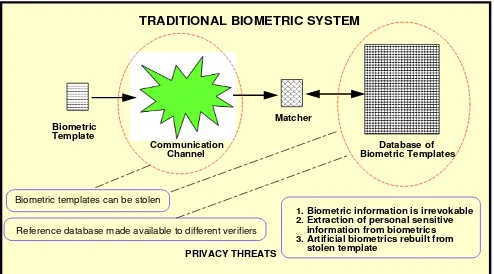
As any other authentication system, biometric authentica-tion system funcauthentica-tions in two phases, enrolment phase and authentication phase. Typical vulnerabilities associated with the traditional biometric system is shown in figure (1). During the enrolment phase, biometric characteristics of an individual is acquired using a biometric sensor or a biometric scanner. Features are extracted from these biometric traits and are saved in the form of a template. During authentication, similar procedure is repeated and again a template is generated to match with the templates in the database.
In this framework attacks are possible at two levels, namely communication level and database level. Also, the nature of these attacks is twofold. First stolen information can be used for authentication resulting in a security breach. ’Security’
The work was supported by NSF IUCRC Center For Identification Tech-nology Research (CITeR), WV, USA. This work was also partially funded by University of Pune BCUD research grant Eng−111.
A. Abhyankar is with the Vishvakarma Institute of Information Technology, Pune, India. He is also associated with Clarkson University, NY, USA, and Government College of Engineering, Pune, India.
S. Schuckers is with the Clarkson University, NY, USA. She is also associated with West Virginia University, WV, USA.
TRADITIONAL BIOMETRIC SYSTEM
Biometric Template
Communication Channel
Matcher
Database of Biometric Templates
Biometric templates can be stolen
Reference database made available to different verifiers
1. Biometric information is irrevokable 2. Extraction of personal sensitive information from biometrics 3. Artificial biometrics rebuilt from stolen template
[image:1.612.315.562.175.312.2]PRIVACY THREATS
Fig. 1. Traditional biometric system. Biometric samples are collected and converted into biometric templates. These templates can be sent over communication channel. At the receiving end the template is matched with the other templates stored in the database of authentic users. Various attack points are clearly shown in the figure.
threat here is referred to as threat to the application (online banking) and not the user. Second, the original biometric may be regenerated from the stolen information resulting in a privacy threat.
The shift from password based authentication systems to the biometric authentication systems now includes privacy threats due to the personal and ‘irrevocable’ nature of the biometrics. Classifying the vulnerability as ‘privacy-related’ or ‘security’ gives an a method of separating the two threats and thus better assess the vulnerabilities.
A. Comparison of existing systems
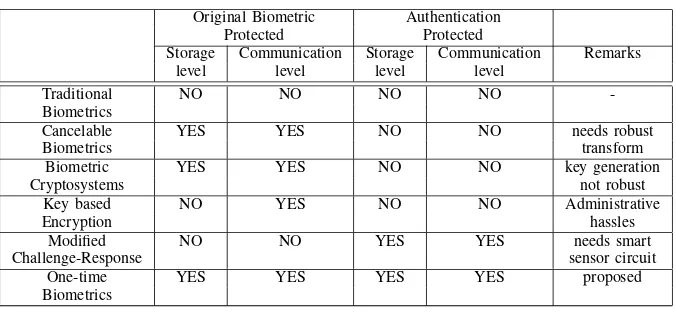
Template protection systems, as discussed earlier, improve biometric security either by a non-linear (non-invertible) trans-form or by deriving/binding a cryptographic secret from/to the biometric features. Template communication protection systems achieve the goal of securing the communication channel by generating dynamic information to be sent on the communication channel from encoder(feature extractor) to the decoder(matcher). This dynamic information could be gener-ated by changing the keys for encryption, by including time stamps or by changing the challenge for every authentication session. The following table summarizes the techniques in terms of the protection they provide against these threats at the two levels.
PROPOSED ENCRYPTION SCHEME
Biometric Template Biometric Representations Chaotic Mixing Encrypted Template mixture Encrypted Template mixture Communication Channel Biometric Representations Trained HMM Iterative BSS FUZZY MATCHER Database of Learnt Parameters Statistical LearningActs like transformation and helper data is continuously
updated, producing self generated dynamic helper data
No use of stolen information
Fig. 2. Proposed system with the encoder which combines stored learned statistical representations and chaotic mixing and with the decoder which combines blind source separation with hidden Markov model.
TABLE I
COMPARATIVE ANALYSIS OF PROPOSED SCHEME WITH EXISTING SCHEMES.
Original Biometric Authentication
Protected Protected
Storage Communication Storage Communication Remarks
level level level level
Traditional NO NO NO NO
-Biometrics
Cancelable YES YES NO NO needs robust
Biometrics transform
Biometric YES YES NO NO key generation
Cryptosystems not robust
Key based NO YES NO NO Administrative
Encryption hassles
Modified NO NO YES YES needs smart
Challenge-Response sensor circuit
One-time YES YES YES YES proposed
Biometrics
Proposed One-time biometrics is the only attempt, to the best of our information, that proposes to combine both the techniques by finding a suitable one-time transform generator [1].
In this work, we attempt to address these four aspects of vulnerabilities in a unique biometric system. The advantage of this system is that the information stored (if stolen) can not be used for authentication (security threat) or to regenerate the original biometric (privacy threat). The dynamic and self-generating system is based on a combination of blind source separation and hidden Markov model for decoding. Iris
recognition is used to demonstrate this approach in this paper.
II. DYNAMIC REPRESENTATION BASED BIOMETRIC AUTHENTICATION SYSTEM
The schematic of the designed system is shown in figure (2). The communication channel divides the system into two parts. The one on the left side of the communication channel is called as the encoder, while the right side of the communication channel depicts the decoder.
[image:2.612.138.476.439.595.2]• tampering of biometric information at the sensor level
• or at the enrolment or verification stage
This research is not focused on studying physics of the devices and protecting raw biometric data, rather we focus on the security of the biometric templates, which are the features extracted from the biometric information.
• The designed system requires two databases, one at
the encoder (template generation) end and other at the decoder (matcher) end. The encoder database contains the statistical learned templates known as ‘representations’. The decoder database contains theα,βparameters or the forward and backward probabilities of a trained hidden Markov model.
• Dynamic representation based biometric authentication
system is a method where ‘self-generated dynamic helper data’ derived from the biometric itself is used to trans-form both at the encoder and the decoder end.
• A hidden Markov model is used to match the
recon-structed representations at the decoder end. HMM in this case uses multiresolution probability distributions to model the state output probabilities at different resolu-tions.
• Consistent features are required to be extracted for the
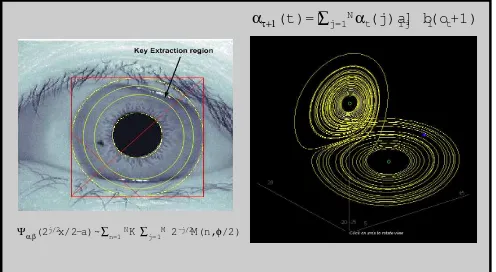
generation of ‘dynamic helper data’. In this design, iris modality was used to generate the features [4]. The region of the biometric image to generate these features is selected based on the following factors as shown in the figure (3).
– Region in the central part of the iris – Region with minimum occlusion
– Region not affected by the pupil dilations – Region with minimum noisy elements
– Region that can be precisely selected every time – Region with complex epigenetic structure and
ran-dom characteristics
ατ+1(t)=[∑j=1Nαt(j)aij] bi(ot+1)
[image:3.612.314.563.248.385.2]Ψα,β(2j/2x/2-a)~∑n=1NK ∑j=1M2-j/2M(n,φ/2)
Fig. 3. Generation of dynamic helper data. From the central iris region maximally consistent keys are generated. The free fall plot of the key information guarantees the stochastic nature of the keys.
A. Encoder enrolment
During the enrollment phase at the encoder, a set of training images from the user are acquired to perform statistical
template learning [5]. Prior to the statistical template learn-ing stage, they are encoded uslearn-ing a biorthogonal wavelet encoder. Biorthogonal wavelet encoding of iris is used to generate templates for iris recognition in [6], [7], [8]. A lifting technique is used to construct the biorthogonal filters allowing faster implementation of wavelet transform. Only difference between the implementation presented in [6], [9] and the implementation used in this study is the quantization of the wavelet coefficients is intentionally avoided. Statistical template learning of these coefficients is performed at different number of orientations (greater than 1) resulting in a set of representations Ri, i ={1,2, , n} where n is the number of representations. Each set refers to a different orientation at which learning takes place. These are stored in the encoder database for future use.
Training Images
Biorthogonal Wavelet Encoding
Statistical
Template Learning Template Representations
ENCODER DATABASE
Fig. 4. Encoder Enrolment. Training images are generated through biorthog-onal wavelet scheme. Through statistically learnt patterns biometric represen-tations are prepared. These formulate the encoder database.
The learning methodology closely follows the structure given in [5]. As in [5] the joint distribution of wavelet coefficients of pattern template is a function of state variables.
q={ai, mi, s}, s= (s1, ..., sN)T
The main modification we have over [5] is, state variables are projected on orthogonal planes. This is to accommodate the fact that the inter coefficient distribution is not always independent (e.g. scaling issues), which also justifies the use of HMM at the decoder end. Thus, the likelihood of the observation depends on these orthogonal spaces.
B. Decoder enrolment
[image:3.612.52.300.495.631.2]Feature Extraction Biorthogonal Wavelet Encoding Encoding Modified Template Representations Chaotic Mixing
+
+
A U T H E T I C A T I O N Template Representations Mixing Conditions f(EDi,V,) K EDi ViFig. 5. Encoder Authentication. Chaotically mixed and dynamically linked stream of information is generated, which can be sent over public communi-cation channel.
class definition function. Parameter λ0 is extracted from the
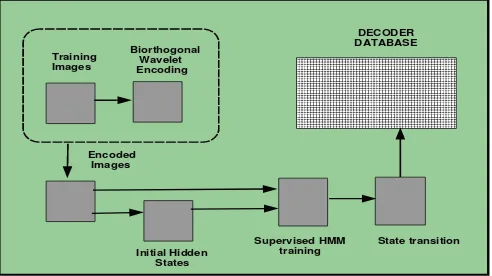
basis wavelet function used to encode images and provided along with the observation sequences to train the HMM model. The result of the training is the forward and backward probabilities of the HMM, known asαandβparameters which are stored in the decoder database. The representations are not stored in the decoder database.
C. Encoder authentication
Every time the user accesses the system, his biometric information is acquired. This acquired biometric is used to generate the encoder helper data K. The biorthogonal encoded image and the stored representations Ri are used to generate modified representations R0i. The encoder database is updated
with these modified representations R0i, every time the user
[image:4.612.51.299.56.194.2]accesses the system. This makes the system dynamic since its stored representations continually change. As we will see, the stored parameters in the decoder database will change in tandem. Training Images Biorthogonal Wavelet Encoding Encoded Images Supervised HMM training DECODER DATABASE Initial Hidden States State transition
Fig. 6. Decoder Enrolment. This is achieved through supervised Hidden Markov Model (HMM) training. Generated state transition matrices formulate the decoder database.
The next steps form the procedure for generating the chaotic data. All the modified representations are used to generate EDiby performing orthogonal convolution with the generated features K. Now, corresponding to each of the representations,
decoder helper dataVi is generated by orthogonal convolution of EDi and the generated features K. A mixing condition is derived from the modified representations and given as input to the chaotic mixer. Other inputs to the chaotic mixer areEDi and Vi. Output of this chaotic mixer is a random bitstream with embedded Vi and mixed representations. Locations of the embedded decoder helper data Vi in the chaotic mixture is known prior at the decoder end. Vi is required at the decoder end to separate and match the chaotically mixed representations.
D. Decoder authentication
The chaotic mixture is received by the decoder. This decoder consists of two components working in tandem for a fixed number of iterations. The first component is the blind source separator (BSS) and the second component is the trained hidden Markov model (HMM). BSS tries to separate out the representations from the mixture and gives the estimated repre-sentationsR00
i to the HMM. HMM with the help of the decoder helper data Vi and the stored α and β parameters perform the probabilistic match on the estimated representations R00
i. If the match score is above a certain threshold, the user is authenticated. If it is below the threshold, they are fed back to the BSS. In this whole process of separating and matching the representations, theαandβ parameters are modified and updated in the decoder database.
Probabilistic Matching update DECODER DATABASE f(EDi,Vi) Vi R'i
BSS HMM > Th
NO
YES
Fig. 7. Decoder Authentication. Blind Source Separator (BSS) and Hidden Markov Model (HMM) work in tandem to separate the mixed entities, which are then matched in a fuzzy way to make a decision.
The state distribution probability is obtained by looking at the output sequences simultaneously at different resolutions. Since we used the wavelet framework, the obtained output sequence is scalable, and hence helps in studying the si-multaneous responses for varying scales. If ξ1 represents the
2D space spanning the first iris class and ξn represents the 2D space spanning the nth iris class. We modify the output probability sequence from [10] as,
P(O/λ) = X
all q,l T
Y
t=1
aqt−1qtωqtltΩqtlt(V(Ot)) (1)
[image:4.612.313.563.386.524.2] [image:4.612.53.299.505.643.2]applied and posterior probabilities are calculated, as all the spaces are defined and known. These steps are borrowed from [10] and we get the modifiedaij from [10] as,
aij=
PT
t=1ξ 0
t(i, j)
PT−1
t=1
P
g∈S(O(t))Vt(i, g)
(2)
where meaning of all the terms is as given in [10].
The decision is taken using the fuzzy classifier. The genuine user will have the embedded presentation across all the spaces, as against that the imposter (may be a time stamp variant or channel blocker), will have the presentation only across that particular space in terms of time(attempts) or frequency. So the fuzzy rule which assigns the participation value to all the candidates is as follows:
S(Ot) =
{1,2, ...G−1}, genuine
{G}, imposter (3)
III. RESULTS
A. Basic Testing
To test our prototype system, we used the CASIA iris database [11]. The biorthogonal encoding as presented in [6] is used to represent iris information. The keys are generated from the most consistent iris regions as discussed. CASIA database consists of 756 images, 108 classes and thus has 8 images coming from each class [11]. Out of 8 images 6 are used for training and remaining 2 are used for testing. The proposed probabilistic system is used for matching. In addition, for comparison, matching is performed using the conventional template matching system for the stored representations. The inter and intra class distributions are shown in figure (8). The traditional template matching fails for the designed system and a high EER of66.3%is obtained. Using probabilistic matching EER of 1.96% is obtained.
∑ig= (V(ot)-uig)(V(ot)-uig)T/∑t 2 T(o,q) V't(i,g)
Inter-class
Intra-class EER=66.3%
wig= sumt 2 T(o,g)V't(i,g)/∑h=1G∑t 2 T(o,h) V't(i,h)
Inter-class
Intra-class EER=1.96%
[image:5.612.334.543.497.548.2]TRADITIONAL MATCHING PROBABILISTIC MATCHING
Fig. 8. Inter class and Intra class centroids and information distribution. Traditional matching gives an Equal Error Rate (EER) of 66.3%. The proposed probabilistic matching produces better EER of1
.9%.
B. Strength Analysis
The basic testing provided the base results indicating the proof of concept, however to strengthen our analysis, an extensive experimentation was performed on vivid database.
The first data set (db1 from hereon) is a data set of gray scale iris digital images provided by the Chinese Academy of Sciences (CASIA). The database consists of 756 gray scale images coming out of 108 distinct classes and 7 images of each eye. The data was collected from 80 subjects in two sessions with a one month gap between the two sessions [11]. The second data set (dataset2 from hereon) contains iris images collected at University of Bath, UK. The data set consists of 1000 high-quality eye images taken from 50 eyes (left and right) of 25 subjects. The images are compressed by the JPEG2000 codec at 0.5 bpp and have a resolution of 1280×960.
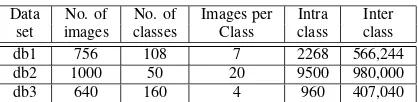
The third data set (db3 from hereon) consists of iris images collected at Clarkson University, USA. This data was collected from80subjects in one session with4images each of left and right eye for each subject. Thus, a total of640images from160 classes are used for analysis. This data set is an uncontrolled data set and is collected using Oki Irispass-h hand held device (model EQ5009A). No extra care is taken to control the quality and illumination of the iris information.
The data sets together form diverse iris representations in terms of sex and ethnicity and conditions under which iris information was captured. The CASIA data set is one of the oldest and widely used and predominantly has iris data from Asians, while the data collected at the WVU has angular deformations and mostly contains iris images of Caucasians. For the data collected at Clarkson University and West Virginia University, protocols for data collection from the subjects were followed that were approved by the West Virginia University and Clarkson University Institutional Review Boards (IRB). Db3 has challenging iris images because of the uncontrolled and non-ideal conditions during iris capture respectively. The profiles of the databases used are represented in Table II.
TABLE II DATA SET: PROFILES
Data No. of No. of Images per Intra Inter set images classes Class class class
db1 756 108 7 2268 566,244
db2 1000 50 20 9500 980,000
db3 640 160 4 960 407,040
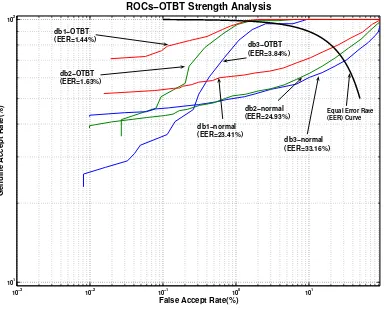
The results are shown in figure (9). The conventional matcher produces an Equal Error Rate (EER) of 23.41% for db1. This EER gets improvised to 1.44% using the proposed method for db1. Conventional matcher produces EERs of 24.93% and33.16% for db2 and db3 respectively. Using the proposed OTBT scheme these EERs are improved to 1.63% and3.84%for db2 and db3 respectively. This demonstrates an ability of the OTBT system to generate consistent keys and transcode the information in noisy conditions.
IV. CONCLUSION
10−3 10−2 10−1 100 101 101
102
False Accept Rate(%)
Genuine Accept Rate(%)
ROCs−OTBT Strength Analysis
db1−OTBT (EER=1.44%)
db2−OTBT (EER=1.63%)
db3−OTBT (EER=3.84%)
db1−normal (EER=23.41%)
db2−normal (EER=24.93%)
db3−normal (EER=33.16%)
[image:6.612.93.477.62.372.2]Equal Error Rate (EER) Curve
Fig. 9. Receiver Operating Characteristics (ROC) curves. ROCs for db1, db2 and db3 for conventional and proposed method are presented. A distinct improvement in terms of EER is seen for all the databases.
and fuzzy classifier for decoding. In terms of securing the online application (e-banking) at authentication system and communication levels, the designed system is a step ahead of other existing systems through the use of self-generated helper data to generate and match the dynamic representations.
The advantages of the secure biometric authentication based on dynamic representations can thus be summarized as:
• Stored information in the database cannot be used to
authenticate or obtain original biometric signal
• Transmitted information from encoder to decoder cannot
be used to authenticate or obtain original biometric signal
• Matcher does not give information helpful in hill climbing
attack
• Generated representations are ‘dynamic’
More research is needed to model communication and database level attacks (replay, noise, etc) to further demon-strate the ability of this system to withstand common biometric vulnerabilities.
ACKNOWLEDGMENT
The work was funded by NSF IUCRC Center For Identi-fication Technology Research (CITeR), USA. This work was also partially funded by University of Pune BCUD research grant Eng−111.
REFERENCES
[1] N. Ratha, “Enhancing security and privacy in biometrics-based authen-tication systems,”IBM systems journal, vol. 40, pp. 614–6134, 2001. [2] D. Osten, H. Carim, M. Arneson, and B. Blan, “Biometrics, personal
authentication system,”US Patent #5,719,950, Feb 1998.
[3] U. Uludag, S. Pankanti, S. Prabhakar, and A. K. Jain, “Biometric cryptosystems: Issues and challenges,”Proceedings of the IEEE, vol. 92, no. 6, 2004.
[4] J. Daugman, “High confidence visual recognition of persons by a test of statistical independence.”IEEE Transactions on Pattern Analysis and Machine Intelligence, vol. 15, no. 11, 1993.
[5] C. Scott and R. Nowak, “Templar: A wavelet-based framework for pattern learning and analysis,”IEEE Transactions on Signal Processing, vol. 52, no. 8, pp. 2264–2274, 2004.
[6] A. Abhyankar, L. Hornak, and S. Schuckers, “Bi-orthogonal wavelet based iris recognition,”SPIE, Defence and Security Symposium, p. 5406, 2005.
[7] S. A. C. Schuckers, N. A. Schmid, A. Abhyankar, V. Dorairaj, C. K. Boyce, and L. A. Hornak, “On techniques for angle compensation in nonideal iris recognition,” IEEE Transactions on Systems, Man, and Cybernetics, Part B, vol. 37, no. 5, pp. 1176–1190, 2007.
[8] A. Abhyankar and S. A. C. Schuckers, “A novel biorthogonal wavelet system for off-angle iris recognition,”Pattern Recognition, vol. 43, no. 3, pp. 987–1007, 2010.
[9] A. Abhyankar and S. Schuckers, “Iris quality assessment and bi-orthogonal wavelet based encoding for recognition,”Pattern Recogni-tion, vol. 42, no. 9, pp. 1878–1894, 2009.
[10] S. Furui, “Speaker independent isolated word recognition using dynamic features of speech spectrum,”IEEE Transactions on Acoust.,Speech and Signal Process, vol. 34, no. 1, pp. 52–59, 1986.