Semantic Pattern Learning Through Maximum Entropy-based WSD
technique
Maximiliano Saiz-Noeda Depto. de Lenguajes y Sistemas Inform´aticos Universidad de Alicante
Alicante, Spain [email protected]
Armando Su´arez Depto. de Lenguajes y Sistemas Inform´aticos Universidad de Alicante
Alicante, Spain [email protected]
Manuel Palomar Depto. de Lenguajes y Sistemas Inform´aticos Universidad de Alicante
Alicante, Spain [email protected]
Abstract
This paper describes a Natural Lan-guage Learning method that extracts knowledge in the form of semantic pat-terns with ontology elements associated to syntactic components in the text. The method combines the use of EuroWord-Net’s ontological concepts and the cor-rect sense of each word assigned by a Word Sense Disambiguation(WSD) module to extract three sets of pat-terns: subject-verb, verb-direct object and verb-indirect object. These sets
de-fine the semantic behaviour of the main textual elements based on their syntac-tic role. On the one hand, it is shown that Maximum Entropy models applied to WSD tasks provide good results. The evaluation of the WSD module has re-vealed a accuracy rate of 64% in a pre-liminary test. On the other hand, we ex-plain how an adequate set of semantic or ontological patterns can improve the success rate of NLP tasks such us pro-noun resolution. We have implemented both modules in C++ and although the evaluation has been performed for En-glish, their general features allow the treatment of other languages like Span-ish.
This paper has been partially supported by the Spanish Government (CICYT) project number TIC2000-0664-C02-02.
1 Introduction
Semantic patterns, as defined in this method,
con-figure a system to add a new information source to Natural Language Processing (NLP) tasks. To obtain these semantic patterns, it is necessary to count on different tools. On the one hand, a full parser must make a syntactic analysis of the text. This parsing will allow the selection of the differ-ent syntactic functional elemdiffer-ents such as subject, direct object (DObj) and indirect object (IObj). On the other hand, a WSD tool must provide the correct sense in order to ensure the appropriate selection of the ontological concept associated to each word. Finally, with the parsing and the cor-rect sense of each word, the pattern extraction method will form and store ontological pairs that define the semantic behaviour of each sentence.
2 Full parsing
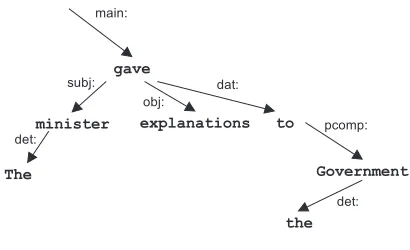
The analyzer used for this work is the Conexor’s FDG Parser (Pasi Tapanainen and Timo J¨arvinen, 1997). This parser tries to provide a build depen-dency tree from the sentence. When this is not possible, the parser tries to build partial trees that often result from unresolved ambiguity. One vi-sual example of this dependency trees is shown in Figure 1 where the parsing tree of sentence (1) is illustrated.
(1) The minister gave explanations to the Government.
0
1 The the det:>2 @DN> DET SG/PL 2 minister minister subj:>3 @SUBJ N NOM SG 3 gave give main:>0 @+FMAINV V PAST 4 explanations explanation obj:>3 @OBJ N NOM PL
5 to to dat:>3 @ADVL PREP
6 the the det:>7 @DN> DET SG/PL 7 Government government pcomp:>5 @<P N NOM SG/PL
[image:2.612.79.284.155.280.2]. .
[image:2.612.311.524.541.630.2]Figure 2: FDG Analyser’s output example
Figure 1:Parsing tree
names, lexico-syntactic function labels and parts of speech (fourth column). Figure 1 shows the parsing tree related to this output. These elements are enough for the pattern extraction method to be applied to NLP tasks.
Regarding to the evaluation of the parser, the authors report an average precision and recall of 95% and 88% respectively in the detection of the correct head. Furthermore, they report a precision rate between 89% and 95% and a recall rate be-tween 83% and 96% in the selection of the func-tional dependencies.
3 WSD based on Maximum Entropy
A WSD module is applied to this parser’s output, in order to select the correct sense of each entry.
Maximum Entropy(ME) modeling is a frame-work for integrating information from many het-erogeneous information sources for classification (Manning and Sch¨utze, 1999). This WSD sys-tem is based on conditional ME probability mod-els. The system implements a supervised learn-ing method consistlearn-ing of the buildlearn-ing of word sense classifiers through training on a semanti-cally tagged corpus. A classifier obtained by means of a ME technique consist of a set of
parameters or coefficients estimated by an opti-mization procedure. Each coefficient associates a weight to one feature observed in the training data. A feature is a function that gives infor-mation about some characteristic in a context as-sociated to a class. The basic idea is to obtain the probability distribution that maximizes the en-tropy, that is, maximum ignorance is assumed and nothing apart of training data is considered. As advantages of ME framework, knowledge-poor features applying and accuracy can be mentioned; ME framework allows a virtually unrestricted ability to represent problem-specific knowledge in the form of features (Ratnaparkhi, 1998).
Let us assume a set of contexts and a set of classes . The function
that performs the classification in a condi-tional probability model chooses the class with the highest conditional probability:
. The features have the form ex-pressed in equation (1), where is some ob-servable characteristic1. The conditional proba-bility is defined as in equation (2) where are the parameters or weights of each feature, and is a constant to ensure that the sum of probabilities for each possible class in this context is equal to 1.
if and
otherwise
(1)
(2)
The features defined on the present system are, 1This is the kind of features used in the system due to it is
basically, collocations of content words and POS tags of function words around the target word. With only this information the system obtains re-sults comparable to other well known methods or systems. For training, DSO sense tagged English corpus (Hwee Tou Ng and Hian Beng Lee, 1996) is used. The DSO corpus is structured infiles con-taining tagged examples of some word. The tags correspond to the correct sense in WordNet 1.5 (FellBaum, 1998). The examples were extracted from articles of the Brown Corpus and Wall Street Journal.
The implemented system has three main mod-ules: the Feature Extractor (FE), the General-ized Iterative Scaling (GIS), and the Classifi ca-tion module. Each word has its own ME model, that is, there will be a distinct classifier for each one. The FE module automatically defines the features to be observed on the training corpus de-pending on the classes (senses) defined in Word-Net for a word. The GIS module performs the parameter estimation. Finally, the Classification module uses this set of parameters in order to dis-ambiguate new occurrences of the word.
3.1 Evaluation and results
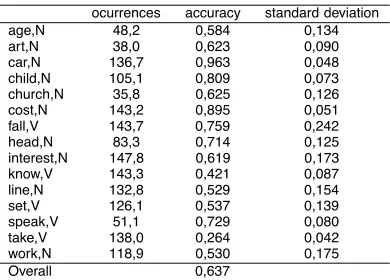
Some evaluation results over a few terms of the aforementioned corpus are presented in Table 1. The system was trained with features that inform of content words in the sentence context ( ,
, , , ), multi-word
expres-sions ( , ,
, , , , ,
, , , , ), and POS
tags ( , , , , , ). For each
word, the training set is divided in 10 folds, 9 for training and 1 for evaluation; ten tests were accomplished using a different fold for evaluation in each one (10-fold cross-validation). The accuracy results are the average accuracy on the ten tests for a word.
Results comparison with previous work is
dif-ficult because there is different approaches to the WSD task (knowledge based methods, supervised and unsupervised statistical methods...) (Mihal-cea and Moldovan, 1999) and many of them focus on a different set of words and sense definitions. Furthermore, the training corpus seems to be crit-ical to the application of the learning to a specific
ocurrences accuracy standard deviation
age,N 48,2 0,584 0,134
art,N 38,0 0,623 0,090
car,N 136,7 0,963 0,048
child,N 105,1 0,809 0,073
church,N 35,8 0,625 0,126
cost,N 143,2 0,895 0,051
fall,V 143,7 0,759 0,242
head,N 83,3 0,714 0,125
interest,N 147,8 0,619 0,173
know,V 143,3 0,421 0,087
line,N 132,8 0,529 0,154
set,V 126,1 0,537 0,139
speak,V 51,1 0,729 0,080
take,V 138,0 0,264 0,042
work,N 118,9 0,530 0,175
[image:3.612.318.513.12.152.2]Overall 0,637
Table 1:Evaluation results from DSO-WSJ
domain (Escudero et al., 2000b).
In the experiment presented here, the selection of the target words and the corpus used are the same that (Escudero et al., 2000a) where a Boost-ing method is proposed. In this paper a com-parison between some WSD methods is shown. Boosting is the most successful method with a 68.1 % accuracy. Our method obtains lower ac-curacy but this is afirst implementation and a bet-ter feature selection is expected to improve our results.
4 Semantic Pattern Learning
Once the WSD phase has been performed, the semantic pattern extraction module can be ex-ecuted. This module extracts head word pairs with subject-verb, verb-DObjand verb-IObjroles in the sentence and convert them into patterns formed by ontological concepts extracted from EuroWordNet.
4.1 EuroWordNet’s ontology
EuroWordNet (Vossen, 2000) is a multilingual lexical database representing semantic relations among basic concepts for West European lan-guages. In our case, we are going to work with isolated WordNets, it means, we won’t take ad-vantage of its multilingual feature, although we will use the ontology defined on it.
EuroWordnet’s ontology consists of 63 higher-level concepts and distinguishes three types of en-tities:
space, e.g.: vehicle, animal, substance, ob-ject.
2ndOrderEntity: any Static Situation (prop-erty, relation) or Dynamic Situation, which cannot be grasped, heard, seen, felt as an in-dependent physical thing. They can be lo-cated in time and occur or take place rather than exist, e.g.: happen, be, have, begin, end, cause, result, continue, occur..
3rdOrderEntity: any unobservable proposi-tion which exists independently of time and space. They can be true or false rather than real. They can be asserted or denied, remem-bered or forgotten, e.g.: idea, thought, infor-mation, theory, plan.
These ontological concepts, associated to each synset from EuroWordNet, give semantic proper-ties to these synsets that can be used, as we will see in the nexts sections, for improving the in-formation source in Natural Language Processing tasks.
4.2 The Learning Process
From each clause, the module extracts the verb and (if exists) its subject, its direct object and its indirect object. With these elements, three pos-sible pairs can be formed using the verb and the noun head of the aforementioned syntactic com-ponents. The verb head and the noun head are looked up in EuroWordNet’s ontology using the correct sense previously selected. This query gen-erates three possible ontological pairs that define, for each clause, the semantic concept associated to the main syntactic elements.
Sentence (2) corresponds to a fragment ex-tracted from a training corpus in English.
(2) The minister gave explanations to the Government .
As shown in section 2, the output of the parser generates the next functional entities:
Verb: give
Subject head: minister D.Obj. head: explanations I.Obj. head: Government
The superscripts indicate the correct sense in EuroWordNet for each word. After consulting EuroWordNet the semantic patterns formed are:
Subj|V: Human,Occupation|Communication V|DObj: Communication|Agentive,Mental V|IObj: Communication|Group,Human
These patterns will be stored in their corre-spondingfiles in order to be consulted later by the NLP task.
This process is completely automatic and the error rate in the pattern extraction come from the aforementioned errors in the WSD and parsing phases.
This strategy defined just as it has been done is, in principle, a little bit naive. Obviously, this is the single basis for the approach, but depend-ing on the application, it can be combined with more sophisticated methods to improve its effec-tiveness. In this way, it is possible to make more elaborated combinations of ontological concepts to form new branches in the ontology defined by EuroWordNet.
5 Applying the method to anaphora resolution
Since the aforementioned semantic patterns re-veal the semantic behaviour of the main textual elements, this Natural Language learning process can be applied to any task that involves text un-derstanding.
One possible application in this way could be the anaphora resolution problem, one of the most active research areas in Natural Language Pro-cessing.
The reference to an entity is generally called an anaphor (e.g. a pronoun), and the entity to which the anaphor refers is its referent or antecedent. For instance, in the sentence“John ate an apple. He was hungry”, the pronoun heis the anaphor and it refers to the antecedentJohn.
Traditionally, some of the most relevant ap-proaches to solve anaphora have been those called poor-knowledge approaches. They use limited knowledge (lexical, morphological and syntactic information sources) for the detection of the cor-rect antecedent. These proposals have report high success rates for English (89.7%) (Mitkov, 1998) and for Spanish (83%) (Ferr´andez et al., 1999). Taking this basis, it is possible to improve the re-sults of a resolution method adding other sources such us semantic, pragmatic, world-knowledge or indeed statistical information.
We have explored the use of semantic informa-tion extracted from an ontology and its applica-tion to the anaphora resoluapplica-tion proccess. This ad-ditional source has give good results on restricted texts (Azzam et al., 1998). Nevertheless, its ap-plication on unrestricted texts has not been so sat-isfactory, mainly due to the lack of adequate and available lexical resources. Due to this, we con-sider that the pattern learning can complement the semantic source in order to establish additional criteria in the antecedent selection. In addition, we believe that an adequate selection of patterns can improve the success rate in anaphora resolu-tion on unrestricted texts.
Each pattern contributes a compatibility feature between two syntactic elements. The whole set of patterns is a knowledge tool that can be con-sulted in order to define the compatibility between a pronoun and a candidate according to their syn-tactic role (subject, direct object and indirect ob-ject) and their relation with the verb. So, looking up the concepts associated to the antecedents of the pronoun and the verb, and using the syntac-tic relation between the pronoun and its verb, the semantic patterns can provide a compatibility de-gree to help the selection of the antecedent. A method oriented to anaphora resolution that uses these kinds of patterns extracted from two on-tologies is detailed in (Saiz-Noeda and Palomar, 2000).
The benefit of this approach is shown in a
clas-sical example shown in (3).
(3) [The monkey] climbed [the tree] to get [a coconut] when [the sun] was rising. It was ripe.
In this example, there are four possible an-tecedents of the pronoun ’it’. Basing the reso-lution only in morpho-syntactic information, it is not possible to solve it correctly. None of the can-didates would be rejected regarding to their mor-phological features (all of them are masculine and singular). The classical approaches would deter-mine that ’the monkey’, for having the same sub-ject role as the pronoun, or ’the sun’, for being the closest to the pronoun, could be the correct antecedent. Nevertheless, it is clear that the cor-rect one in this case is ’the coconut’. Only a se-mantic pattern applied to this method could give additional information to solve it correctly.
If we would extract ontological concepts for all the candidates, we would be able to compare the compatibility degree with the pronoun. One pos-sible output could be the one in next table:
Subject concept verb monkey animal be ripe tree plant be ripe coconut fruit be ripe
sun star be ripe
Examining this table it is easy to notice that, when applying this additional information, the suggestion of the system would be the correct an-tecedent, mainly based on a good previous pattern learning.
6 Conclusions and outstanding work
In this paper we have presented a semantic pat-tern learning system driven by a WSD method based on Maximum Entropy models. These se-mantic patterns have been applied to the anaphora resolution through the construction of ontological patterns. The adding of this pattern learning im-prove, as it can be seen, the anaphora resolution process. We have pointed out the main advan-tages of this approach comparing it with other.
The WSD method is based on conditional Max-imum Entropy probability models. It is a super-vised learning method that uses a semantically annotated corpus for training. ME models are used in order to estimate functions that performs a sense classification of nouns, verbs and adjec-tives. The learning phase has been made with simple features with no deep linguistic knowl-edge. Preliminary results indicate that the accu-racy of the model is comparable to other learning methods.
The main problem in the addition of this kind of knowledge is the lack of appropriate resources to deal with these tasks. In our research work we are trying to apply these techniques both in En-glish and Spanish. The WSD method have been mainly developed in English, but one of our main goals is the design of a complete anaphora reso-lution system for Spanish. In this way, the main problem is the short available resources regarding to semantically tagged corpora in Spanish (unlike in English). This lack affects the correct devel-opment of tasks belonging to the research line shown in this paper, such us the pattern learn-ing and the anaphora resolution. Nevertheless, this shortage opens the door to new research lines that join English resources and multilingual tech-niques for the generation of patterns in other lan-guages from the learned English patterns.
References
Saliha Azzam, Kevin Humphreys, and Robert Gaizauskas. 1998. Coreference Resolution in a
Multilingual Information Extraction System. In
Proceedings of the Workshop on Linguistic Coref-erence. First Language Resources and Evaluation Conference (LREC’98)., pages 74–78.
Gerard Escudero, Lluis M`arquez, and German Rigau.
2000a. Boosting applied to word sense disambigua-tion. InProceedings of the 12th Conference on Ma-chine Learning ECML2000, Barcelona, Spain.
Gerard Escudero, Lluis M`arquez, and German Rigau. 2000b. On the portability and tuning of supervised
word sense disambiguation systems. In
Proceed-ings of the Joint Sigdat Conference on Empirical Methods in Natural Language Processing and Very Large Corpora, Hong Kong, China.
Christiane FellBaum. 1998. WordNet, an electronic
lexical database. Fellbaum, C. eds. MIT Press.
Antonio Ferr´andez, Manuel Palomar, and Lidia Moreno. 1999. An empirical approach to
Span-ish anaphora resolution. Machine Traslation,
14(3/4):191–216.
Graeme Hirst. 1981. Anaphora in Natural Language
Understanding. Springer-Verlag, Berlin.
Hwee Tou Ng and Hian Beng Lee. 1996. Integrat-ing Multiple Knowledge Sources to Disambiguate Word Senses: An Exemplar-Based Approach. In
Proceedings of the 34th Annual Meeting of the As-sociation for Computational Linguistics, ACL 1996.
Christopher D. Manning and Hinrich Sch¨utze. 1999.
Foundations of Statistical Natural Language Pro-cessing. The MIT Press, Cambridge, Mas-sachusetts.
Rada Mihalcea and Dan I. Moldovan. 1999. A
method for word sense disambiguation of
unre-stricted text. In Proceedings of the 37th Annual
Meeting of the Association for Computational Lin-guistic, pages 152–158, College Park, Maryland, USA, June.
Ruslan Mitkov. 1998. Robust pronoun resolution
with limited knowledge. In Proceedings of the
36th Annual Meeting of the Association for Com-putational Linguistics and 17th International Con-ference on Computational Linguistics (COLING-ACL’98), pages 869–875, Montreal (Canada), Au-gust.
Ruslan Mitkov. 2001. Outstanding issues in anaphora
resolution. In Proceedings of the Second
Inter-national Conference on Intelligent Text Processing and Computational Linguistics CICLing2001., Lec-tures Notes In Computer Science. Springer-Verlag, pages 110–125, Mexico City (Mexico), February. Springer Verlag.
Pasi Tapanainen and Timo J¨arvinen. 1997. A
non-projective dependency parser. In Proceedings of
the Fifth Conference on Applied Natural Language Processing, pages 64–71, April.
Adwait Ratnaparkhi. 1998. Maximum Entropy
Maximiliano Saiz-Noeda and Manuel Palomar. 2000. Semantic Knowledge-driven Method to Solve Pronominal Anaphora in Spanish. In Springer Ver-lag, editor,NLP’2000 Filling the gap between the-ory and practice, Lectures Notes In Artificial In-telligence. Springer-Verlag, pages 204–211, Patras, Greece, June.
Piek Vossen. 2000. EuroWordNet: a Multilingual
Database with WordNets in 8 languages.The ELRA