Adaptor Grammars for Learning Non-Concatenative Morphology
Jan A. Botha and Phil Blunsom Department of Computer Science
University of Oxford Oxford, OX1 3QD, UK
{jan.botha,phil.blunsom}@cs.ox.ac.uk
Abstract
This paper contributes an approach for expressing non-concatenative morphological phenomena, such as stem derivation in Semitic languages, in terms of a mildly context-sensitive grammar formalism. This offers a convenient level of modelling ab-straction while remaining computationally tractable. The nonparametric Bayesian frame-work of adaptor grammars is extended to this richer grammar formalism to propose a prob-abilistic model that can learn word segmenta-tion and morpheme lexicons, including ones with discontiguous strings as elements, from unannotated data. Our experiments on He-brew and three variants of Arabic data find that the additional expressiveness to capture roots and templates as atomic units improves the quality of concatenative segmentation and stem identification. We obtain 74% accuracy in identifying triliteral Hebrew roots, while performing morphological segmentation with an F1-score of 78.1.
1 Introduction
Unsupervised learning of morphology is the task of acquiring, from unannotated data, the intra-word building blocks of a language and the rules by which they combine to form words. This task is of interest both as a gateway for studying language acquisition in humans and as a way of producing morphological analyses that are of practical use in a variety of nat-ural language processing tasks, including machine translation, parsing and information retrieval.
A particularly interesting version of the morphol-ogy learning problem comes from languages that use templatic morphology, such as Arabic, He-brew and Amharic. These Semitic languages de-rive verb and noun stems by interspersing abstract
rootmorphemes into templaticstructures in a non-concatenative way. For example, the Arabic root k·t·b can combine with the template (i-a) to derive the noun stem kitab (book). Established morpho-logical analysers typically ignore this process and simply view the derived stems as elementary units (Buckwalter, 2002), or their account of it coincides with a requirement for extensive linguistic knowl-edge and hand-crafting of rules (Finkel and Stump, 2002; Schneider, 2010; Altantawy et al., 2010). The former approach is bound to suffer from vocabu-lary coverage issues, while the latter clearly does not transfer easily across languages. The practical appeal of unsupervised learning of templatic mor-phology is that it can overcome these shortcomings. Unsupervised learning ofconcatenative morphol-ogy has received extensive attention, partly driven by the MorphoChallenge (Kurimo et al., 2010) in re-cent years, but that is not the case for root-templatic morphology (Hammarstr¨om and Borin, 2011).
In this paper we present a model-based method that learns concatenative and root-templatic mor-phology in a unified framework. We build on two disparate strands of work from the literature: Firstly, we apply simple Range Concatenating Grammars (SRCGs) (Boullier, 2000) to parse contiguous and discontiguous morphemes from an input string. These grammars aremildly-context sensitive(Joshi, 1985), a superset of context-free grammars that retains polynomial parsing time-complexity. Sec-ondly, we generalise the nonparametric Bayesian learning framework ofadaptor grammars(Johnson et al., 2007) to SRCGs.1 This should also be
rel-1
Our formulation is in terms of SRCGs, which are equiv-alent in power to linear context-free rewrite systems (Vijay-Shanker et al., 1987) and multiple context-free grammars (Seki et al., 1991), all of which are weaker than (non-simple) range concatenating grammars (Boullier, 2000).
evant to other applications of probabilistic SRCGs, e.g. in parsing (Maier, 2010), translation (Kaesham-mer, 2013) and genetics (Kato et al., 2006).
In addition to unannotated data, our method re-quires as input a minimal set of high-level grammar rules that encode basic intuitions of the morphology. This is where there would be room to become very language specific. Our aim, however, is not to obtain a best-published result in a particular language, but rather to create a method that is applicable across a variety of morphological processes. The specific rules used in our empirical evaluation on Arabic and Hebrew therefore contain hardly any explicit lin-guistic knowledge about the languages and are ap-plicable across the family of Semitic languages.
2 A powerful grammar for morphology
Concatenative morphology lends itself well to an analysis in terms of finite-state transducers (FSTs) (Koskenniemi, 1984). With some additional effort, FSTs can also encode non-concatenative morphol-ogy (Kiraz, 2000; Beesley and Karttunen, 2003; Cohen-Sygal and Wintner, 2006; Gasser, 2009). De-spite this seeming adequacy of regular languages to describe morphology, we see two main shortcom-ings that motivate moving further up the Chom-sky hierarchy of formal languages: first is the is-sue of learning. We are not aware of successful at-tempts at inducing FST-based morphological analy-sers in an unsupervised way, and believe the chal-lenge lies in the fact that FSTs do not offer a conve-nientway of expressing prior linguistic intuitions to guide the learning process. Secondly, an FST com-posed of multiple machines might capture morpho-logical processes well and excel at analysis, but in-terpretability of its internal operations are limited.
These shortcomings are overcome for concate-native morphology by context-free adaptor gram-mars, which allowed diverse segmentation models to be formulated and investigated within a single framework (Johnson et al., 2007; Johnson, 2008; Sirts and Goldwater, 2013). In principle, that cov-ers a wide range of phenomena (typical example language in parentheses): affixal inflection (Czech) and derivation (English), agglutinative derivation (Turkish, Finnish), compounding (German). Our agenda here is to extend that approach to include non-concatenative processes such as root-templatic
derivation (Arabic), infixation (Tagalog) and cir-cumfixation (Indonesian). In this pursuit, an ab-straction that permits discontiguous constituents is a highly useful modelling tool, but requires looking beyond context-free grammars.
An idealised generative grammar that would cap-ture all the aforementioned phenomena could look like this:
Word→(Pre∗Stem Suf∗)+ (1) e.g. Englishun+accept+able
Stem|Pre|Suf→Morph (2)
Stem→intercal(Root,Template) (3) e.g. Arabic derivationk·t·b + i·a⇒kitab(book)
Stem→infix(Stem,Infix) (4) e.g. Tagalogsulat(write)⇒sumulat(wrote)
Stem→circfix(Stem,Circumfix) (5) e.g. Indonesianpercaya(to trust)
⇒ kepercayaan(belief)
where the symbols (excluding Word and Stem) im-plicitly expand to the relevant terminal strings. The bold-faced “functions” combine the potentially dis-contiguous yields of the argument symbols into sin-gle contiguous strings, e.g. infix(s·ulat, um) pro-duces stemsumulat.
Taken by themselves, the first two rules are sim-ply a CFG that describes word formation as the concatenation of stems and affixes, a formulation that matches the underlying grammar of Morfessor (Creutz and Lagus, 2007), a well-studied unsuper-vised model.
The key aim of our extension is that we want the grammar to capture a discontiguous string like k·t·b as a single constituent in a parse tree. This leads to well-understood problems in probabilistic grammars (e.g. what is this rule’s probability?), but also corre-sponds to the linguistic consideration that k·t·b is a proper morpheme of the language (Prunet, 2006).
3 Simple range concatenating grammars
SRCG-rule operates on vectors of ranges in contrast to the way a CFG-rule operates on single ranges (spans). In other words, a non-terminal symbol in an SRCG (CFG) derivation can dominate a subset (substring) of terminals in an input string.
3.1 Formalism
An SRCG G is a tuple (N, T, V, P, S), with finite sets of non-terminals (N), termi-nals (T) and variables (V), with a start sym-bol S ∈ N. A rewrite rule p ∈ P of rank
r = ρ(p) ≥ 0 has the formA(α1, . . . , αψ(A)) →
B1(β1,1, . . . , β1,ψ(B1)) . . . Br(βr,1, . . . , βr,ψ(Br)),
where each α, β ∈ (T ∪ V)∗, and ψ(A) is the number of arguments a non-terminalA has, called itsarity. By definition, the start symbol has arity 1. Any variable v ∈ V appearing in a given rule must be used exactly once on each side of the rule. Terminating rules are written with as the right-hand side and thus have rank 0.
Arange is a pair of integers (i, j) denoting the substring wi+1. . . wj of a string w = w1. . . wn. A non-terminal becomesinstantiatedwhen its vari-ables are bound to ranges through substitution. Vari-ables within an argument imply concatenation and therefore have to bind to adjacent ranges.
An instantiated non-terminal A0 is said to de-rive if the consecutive application of a sequence of instantiated rules rewrite it as. A string w is within the language defined by a particular SRCG iff the start symbolS, instantiated with the exhaus-tive range(0, wn), derives.
An important distinction with regard to CFGs is that, due to the instantiation mechanism, the order-ing of non-terminals on the right-hand side of an SRCG rule is irrelevant, i.e. A(ab) → B(a)C(b)
andA(ab) → C(b)B(a)are the same rule.2 Con-sequently, the isomorphisms of any given SRCG derivation tree all encode the same string, which is uniquely defined through the instantiation process.
3.2 Application to morphological analysis
A fragment of the idealised grammar schema from the previous section (§2) can be rephrased as an SRCG by writing the rules in the newly introduced
2Certain ordering restrictions over the variableswithin an argument need to hold for an SRCG to indeed be asimpleRCG (Boullier, 2000).
Word(wakitabi)
Suf(i)
i Stm(kitab)
Template(i,a) Root(k,t,b)
Pre(wa)
a
[image:3.612.327.521.64.159.2]w k i t a b
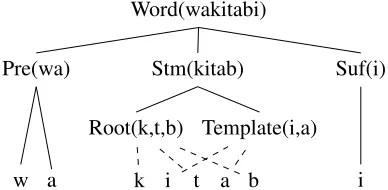
Figure 1: Example derivation forwakitabi(and my book) using the SRCG fragment from§3.2. CFGs cannot capture such crossing branches.
notation, and supplying a definition of theintercal
function as simply another rule of the grammar, with instantiation forw=kitab shown below:
Word(abc)→Pre(a)Stem(b)Suf(c)
Stem(abcde)→Root(a, c, e)Template(b, d),
Stem(h0..1i,h1..2i,h2..3i,h3..4i,h4..5i) →Root(h0..1i,h2..3i,h4..5i)
Template(h1..2i,h3..4i)
Given an appropriate set of grammar rules (as we present in§5), we can parse an input string to ob-tain a tree as shown in Figure 1. The overlapping branches of the tree demonstrate that this grammar captures something a CFG could not. From the parse tree one can read off the word’s root morpheme and the template used.
Although SRCGs specify mildly context-sensitive grammars, each step in a derivation is context-free – a node’s expansion does not depend on other parts of the tree. This property implies that a recogni-tion/parsing algorithm can have a worst-case time complexity that is polynomial in the input lengthn,
O(n(ρ+1)ψ) for arity ψ and rank ρ, which reduces toO(n3ψ)for a binarised grammar. To capture the maximal case of a root with k −1 characters and
kdiscontiguous templatic characters forming a stem would require a grammar that has arityψ=k. For Arabic, which has up to quadriliteral roots(k = 5), the time complexity would be O(n15).3 This is a daunting proposition for parsing, but we are careful
to set up our application of SRCGs in such a way that this is not too big an obstacle:
Firstly, our grammars are defined over the char-acters that make up a word, and not over words that make up a sentence. As such, the input length n
would tend to be shorter than when parsing full sen-tences from a corpus.
Secondly, we do type-based morphological analy-sis, a view supported by evidence from Goldwater et al. (2006), so each unique word in a dataset is only ever parsed once with a given grammar. The set of word types attested in the data sources of interest here is fairly limited, typically in the tens of thou-sands. For these reasons, our parsing and inference tasks turn out to be tractable despite the high time complexity.
4 Learning
4.1 Probabilistic SRCG
The probabilistic extension of SRCGs is similar to the probabilistic extension of CFGs, and has been used in other guises (Kato et al., 2006; Maier, 2010). Each ruler ∈ P has an associated probability θr
such that P
r∈PAθr = 1. A random string in
the language of the grammar can then be obtained through a generative procedure that begins with the start symbolSand iteratively expands it until deriv-ing: At each step for some current symbolA, a rewrite ruler is sampled randomly fromPA in ac-cordance with the distribution over rules and used to expand A. This procedure terminates when no further expansions are possible. Of course, expan-sions need to respect the range concatenating and or-dering constraints imposed by the variables in rules. The expansions imply a chain of variable bindings going down the tree, and instantiation happens only when rewriting intos but then propagates back up the tree.
The probabilityP(w, t)of the resulting treetand terminal stringwis the productQ
rθr over the
se-quence of rewrite rules used. This generative proce-dure is a conceptual device; in practice, one would care about parsing some input string under this prob-abilistic grammar.
4.2 PYSRCAG
A central property of the generative procedure un-derlying probabilistic SRCGs is the fact that each
expansion happens independently, both of the other expansions in the tree under construction and of any other trees. To some extent, this flies in the face of the reality of estimating a grammar from text, where one would expect certain sub-trees to be used repeat-edly across different input strings.
Adaptor grammars weaken this independence as-sumption by allowing whole subtrees to be reused during expansion. Informally, they act as a cache of tree fragments whose tendency to be reused during expansion is governed by the choice of adaptor func-tion. Following earlier applications of adaptor gram-mars (Johnson et al., 2007; Huang et al., 2011), we employ the Pitman-Yor process (Pitman, 1995; Pit-man and Yor, 1997) as adaptor function.
A Pitman-Yor Simple Range Concatenat-ing Adaptor Grammar (PYSRCAG) is a tuple
G= (GS, M,a,b,α), where GS is a probabilistic SRCG as defined before and M ⊆ N is a set of adapted non-terminals. The vectors a and b, indexed by the elements of M, are the discount and concentration parameters for each adapted non-terminal, witha∈[0,1], b≥0. αare parameters to Dirichlet priors on the rule probabilitiesθ.
PYSRCAG defines a generative process over a set of treesT. Unadapted non-terminalsA0 ∈ N \M
are expanded as before (§4.1). For each adapted non-terminal A ∈ M, a cache CA is maintained for storing the terminating tree fragments expanded from A earlier in the process, and we denote the fragment corresponding to thei-th expansion ofA
as zi. In other words, the sequence of indices zi
is the assignment of a sequence of expansions of
A to particular tree fragments. Given a cache CA
that has n previously generated trees comprising
munique trees each usedn1, . . . , nm times (where
n =P
knk), the tree fragment for the next
expan-sion ofA,zn+1, is sampled conditional on the pre-vious assignmentsz<according to
zn+1|z<∼ (n
k−a
n+b ifzn+1 =k∈[1, m] ma+b
n+b ifzn+1 =m+ 1,
wherea and b are those elements of a and b cor-responding toA. The first case denotes the situa-tion where a previously cached tree is reused for this
n+ 1-th expansion of A; to be clear, this expands
tree being generated are subject to further expan-sion. The second case by-passes the cache and ex-pandsAaccording to the rulesPAand rule
probabil-itiesθA of the underlying SRCGGS. Other caches
CB(B ∈ M) may come into play during those
expansions of the descendants of A; thus a PYS-RCAG can define a hierarchical stochastic process. Both cases eventually result in a terminating tree-fragment for A, which is then added to the cache, updating the countsn, nzn+1and potentiallym.
The adaptation does not affect the string language ofGS, but it maps the distribution over trees to one that is distributed according to the PYP.
The invariance of SRCGs trees under isomor-phism would make the probabilistic model deficient, but we side-step this issue by requiring that grammar rules are specified in a canonical way that ensures a one-to-one correspondence between the order of nodes in a tree and of terminals in the yield.
4.3 Inference under PYSRCAG
The inference procedure under our model is very similar to that of CFG PY-adaptor grammars, so we restate the central aspects here but refer the reader to the original article by Johnson et al. (2007) for further details. First, one may integrate out the adaptors to obtain a single distribution over the set of trees generated from a particular non-terminal. Thus, the joint probability of a particular sequencez for the adapted non-terminalAwith cached counts
(n1, . . . , nm)is
P Y(z|a, b) =
Qm
k=1(a(k−1) +b)
Qnk−1
j=1 (j−a)
Qn−1 i=0(i+b)
.
(6) Taking all the adapted non-terminals into account, the joint probability of a set of full treesT under the grammarGis
P(T|a,b,α) = Y A∈M
B(αA+fA) B(αA)
P Y(z(T)|a,b),
(7) wherefA is a vector of the usage counts of rules
r∈PA acrossT, and B is the Euler beta function. The posterior distribution over a set of strings w is obtained by marginalising (7) over all trees that havew as their yields. This is intractable to compute directly, so instead we use MCMC tech-niques to obtain samples from that posterior using a
component-wise Metropolis-Hastings sampler. The sampler works by visiting each stringwin turn and drawing a new tree for it under a proposal grammar
GQand randomly accepting that as the new analysis forwaccording to the Metropolis-Hastings accept-reject probability. As proposal grammar, we use the analogous approximation of ourG as Johnson et al. used for PCFGs, namely by taking a static snapshot
GQ of the adaptor grammar where additional rules rewrite adapted non-terminals as the terminal strings of their cached trees. Drawing a sample from the proposal distribution is then a matter of drawing a random tree from the parse chart ofwunderGQ.
Lastly, the adaptor hyperparameters a and b are modelled by placing flat Beta(1,1) and vague
Gamma(10,0.1) priors on them, respectively, and inferring their values using slice sampling (Johnson and Goldwater, 2009).
5 Modelling root-templatic morphology
We start with a CFG-based adaptor grammar4 that models words as a stem and any number of prefixes and suffixes:
Word→Pre∗ Stem Suf∗ (8)
Pre|Stem|Suf→Char+ (9)
This fragment can be seen as building on the stem-and-affix adaptor grammar presented in (Johnson et al., 2007) for morphological analysis of English, of which a later version also covers multiple affixes (Sirts and Goldwater, 2013). In the particular case of Arabic, multiple affixes are required to handle the at-tachment of particles and proclitics onto base words. To extend this to complex stems consisting of a root with three radicals we have rules like the fol-lowing:
Stem(abcdef g)→R3(b, d, e)T4(a, c, e, g) (10) Stem(abcdef)→R3(a, c, e)T3(b, d, f) (11) Stem(abcde)→R3(a, c, e)T2(b, d) (12) Stem(abcd)→R3(a, c, d)T1(b) (13) Stem(abc)→R3(a, b, c) (14) 4
The actual rules include certain permutations of these, e.g. rule (13) has a variant R3(a, b, d)T1(c). In unvocalised text, the standard written form of Modern Standard Arabic (MSA), it may happen that the stem and the root of a word form are one and the same. So while rule (14) may look trivial, it ensures that in such cases the radicals are still captured as de-scendants of the non-terminal category R3, thereby making their appearance in the cache.
A discontiguous non-terminal An is rewritten through recursion on its arity down to 1, i.e. An(v1, . . . , vn)→Al(v1, . . . , vn−1)Char(vn)with
base case A1(v) → Char(v),where Char rewrites all individual terminals as , vi are variables and
l=n−1.5 Note that although we provide the model with two sets of discontiguous non-terminals R and T, we do not specify their mapping onto the actual terminal strings; no subdivision of the alphabet into vowels and consonants is hard-wired.
6 Experiments
We evaluate our model on standard Arabic, Quranic Arabic and Hebrew in terms of segmentation quality and lexicon induction ability. These languages share various properties, including morphology and lexi-cal cognates, but are sufficiently different so as to require manual intervention when transferring rule-based morphological analysers across languages. A key question in this evaluation is therefore whether an appropriate instantiation of our model success-fully generalises across related languages.
6.1 Data sets
Our models are unsupervised and therefore learn from raw text, but their evaluation requires anno-tated data as a gold-standard and these were derived6 as follows:
Arabic (MSA) We created the dataset BWby syn-thesising 50k morphotactically correct word types from the morpheme lexicons and consistency rules supplied with the Buckwalter Arabic Morphological
5Including the arity as part of the non-terminal symbol names forms part of our convention here to ensure that the grammar contains no cycles, a situation which would compli-cate inference under PYSRCAG.
6
Our data preprocessing scripts are obtainable from
http://github.com/bothameister/pysrcag-data.
Types Stems Roots m/w c/w
BW 48428 24197 4717 2.3 6.4 BW0 48428 30891 4707 2.3 10.7 QU0 18808 12021 1270 1.9 9.9
HEB 5231 3164 492 2.1 6.7
Table 1: Corpus statistics, including average number of morphemes (m/w) and characters (c/w) per word, and total surface-realised roots of length 3 or 4.
Analyser (BAMA).7 This allowed control over the word shapes, which is important to focus the evalu-ation, while yielding reliable segmentation and root annotations. BWhas no vocalisation; we denote the correspondingvocaliseddataset as BW0.
Quranic Arabic We extracted the roughly 18k word types from a morphologically analysed version of the Quran (Dukes and Habash, 2010). As an ad-ditional challenge, we left all given diacritics intact for this dataset, QU0.
Hebrew We leveraged the Hebrew CHILDES database as an annotated resource (Albert et al., 2013) and were able to extract 5k word types that feature at least one affix to use as dataset HEB. The corrected versions of words marked as non-standard child language were used, diacritics were dropped, and we conflated stressed and unstressed vowels to overcome inconsistencies in the source data.
6.2 Models
We consider two classes of models. The first is the strictly context-free adaptor grammar for morphemes as sequences of characters using rules (8)-(9), which we denote as Concat and
MConcat, where the latter allows multiple pre-fixes/suffixes in a word. These serve as baselines for the second class in which non-concatenative rules are added. MTplandTpl denote the canonical
ver-7
sions with stems as shown in the set of rules above, and we experiment with a variantTpl3Ch that al-lows the non-terminal T1 to be rewritten as up to three Char symbols, since the data indicate there are cases where multiple characters intervene between the radicals of a root.
These models exclude rule (10), which we include only in the variantTpl+T4. Lastly,TplR4is the ex-tension of Tpl+T4 to include a stem-forming rule that usesR4.
As external baseline model we used Morfessor
(Creutz and Lagus, 2007), which performs decently in morphological segmentation of a variety of lan-guages, but only handles concatenation.
6.3 Method
The MCMC samplers converged within a few hun-dred iterations and we collected 100 posterior ples after 900 iterations of burn-in. Collected sam-ples, each of which is a set of parse trees of the input word types, are used in two ways:
First, by averaging over the samples we can es-timate the joint probability of a word typew and a parse treetunder the adaptor grammar, conditional on the data and the model’s hyperparameters. We take the most probable parse of each word type and evaluate the implied segmentation against the gold standard segmentation. Likewise, we evaluate the implied lexicon of stems, affixes and roots against the corresponding reference sets. It should be em-phasised that using this maximally probable analy-sis is aimed at simplifying the evaluation set-up; one could also extract multiple analyses of a word since the model defines a distribution over them.
The second method abstracts away from individ-ual word-types and instead averages over the union of all samples to obtain an estimate of the probabil-ity of a stringsbeing generated by a certain category (non-terminal) of the grammar. In this way we can obtain a lexicon of the morphemes in each category, ranked by their probability under the model.
6.4 Inducing Morpheme Lexicons
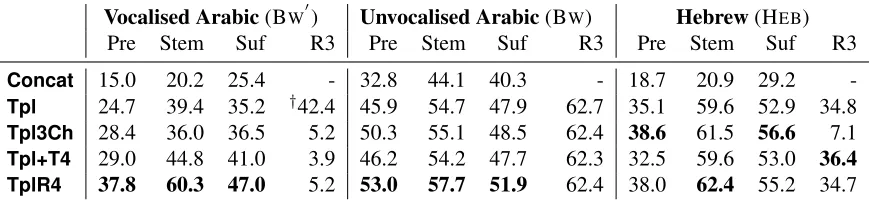
The quality of each induced lexicon is measured with standard set-based precision and recall with re-spect to the corresponding gold lexicon. The results are summarised by balanced F-scores in Table 2.
The main result is that all our models capable of
forming complex stems obtain a marked improve-ment in F-scores over the baseline concatenative adaptor grammar, and the margin of improvement grows along with the expressivity of the complex-stem models tested. This applies across prefix, complex-stem and suffix categories and across our datasets, with the exception of QU0, which we elaborate on in§6.5. Stem lexicons of Arabic were learnt with rel-atively constant precision (∼70%), but modelling complex stems broadened the coverage by about 3000 stems over the concatenative model (against a reference set of 24k stems). On vocalised Arabic, the improvements for stems are along both dimen-sions. In contrast, affix lexicons for both BW and BW0 are noisy and the models all generate greedily to obtain near perfect recall but low precision.
On our Hebrew data, which comprises only 5k words, the gains in lexicon quality from modelling complex stems tend to be larger than on Arabic. This is consistent with our intuition that an appropriate, richer Bayesian prior helps overcome data sparsity.
Extracting a lexicon of roots is rendered challeng-ing by the unsupervised nature of the model as the labelling of grammar symbols is ultimately arbitrary. Our simple approach was to regard a character tuple parsed under category R3 as a root. This had mixed success, as demonstrated by the outlier scores in Ta-ble 2. In the one case where it was obvious that T3 had been been co-opted for the role, we report the F-score obtained on the union of R3 and T3 strings.
Soft decisions The preceding set-based evaluation imposes hard decisions about category membership. But adaptor grammars are probabilistic by definition and should thus also be evaluated in terms of prob-abilistic ability. One method is to turn the model predictions into a binary classifier of strings us-ing Receiver-Operator-Characteristic (ROC) theory. We plot the true positive rate versus the false pos-itive rate for each prediction lexiconLτ containing
Vocalised Arabic(BW0) Unvocalised Arabic(BW) Hebrew(HEB)
Pre Stem Suf R3 Pre Stem Suf R3 Pre Stem Suf R3
Concat 15.0 20.2 25.4 - 32.8 44.1 40.3 - 18.7 20.9 29.2
-Tpl 24.7 39.4 35.2 †42.4 45.9 54.7 47.9 62.7 35.1 59.6 52.9 34.8
Tpl3Ch 28.4 36.0 36.5 5.2 50.3 55.1 48.5 62.4 38.6 61.5 56.6 7.1
[image:8.612.90.525.63.163.2]Tpl+T4 29.0 44.8 41.0 3.9 46.2 54.2 47.7 62.3 32.5 59.6 53.0 36.4 TplR4 37.8 60.3 47.0 5.2 53.0 57.7 51.9 62.4 38.0 62.4 55.2 34.7
Table 2: Morpheme lexicon induction quality. F1-scores for lexicons induced from the most probable parse of each different dataset under each models.†42.4 was obtained by taking the union of R3 and T3 items to match the way the model used them (see§6.4).
BW0 BW QU0 HEB
Morfessor 55.57 40.04 44.34 24.20
Concat 47.36 64.22 19.64 60.05
Tpl 60.42 71.91 22.53 77.26
Tpl3Ch 60.52 72.20 25.72 77.41
Tpl+T4 64.49 71.59 24.81 77.14
TplR4 74.54 73.66 - 78.14
Table 3: Segmentation quality in SBF1. The QU0
results are for the correspondingM*models .
Our models with complex stem formation im-prove over the baseline on the AUC metric too. We include the ROC plots for Hebrew stem and root in-duction in Figure 2, along with the roots the model was most confident about (Table 4).
6.5 Morphological Analysis per Word Type
In this section we turn to the analyses our models assign to each word type. Two aspects of interest are the segmentation into sequential morphemes and the identification of the root.
Our intercalating adaptor grammars consistently obtain large gains in segmentation accuracy over the baseline concatenative model, across all our datasets (Table 3). We measure segmentation quality as seg-ment border F1-score(SBF) (Sirts and Goldwater, 2013), which is the F-score over word-internal seg-mentation points of the predicted analysis with re-spect to the gold segmentation.
Of the two MSA datasets, the vocalised version BW0 presents a more difficult segmentation task as its words are on average longer and feature 31k unique contiguous morphemes, compared to the 24k in BWfor the same number of words. It should thus
benefit more from additional model expressivity, as
is reflected in the increase of 10 SBF when adding theTplR4rule to the other triliteral ones.
The best triliteral root identification accuracy (on a per-word basis) was found for HEB(74%) and BW
(67%).8,9Refer to Figure 3 for example analyses. An interesting aspect of these results is that tem-platic rules may aid segmentation quality without necessarily giving perfect root identification. Mod-elling stem substructure allows any regularities that give rise to a higher data likelihood to be picked up. The low performance on the Quran demands fur-ther explanation. All our adaptor grammars severely oversegmented this data, although the mistakes were not uniformly distributed. Most of the performance loss is on the 79% of words that have 1-2 phemes. On the remaining words (having 3-5 mor-phemes), our models recover and approach the Mor-fessor baseline (MConcat: 32.7 ,MTpl3Ch: 38.6).
Preliminary experiments on BW had indicated that adaptation of (single) affix categories is crucial for good performance. Our multi-affixing models used on QU0 lacked a further level of adaptation for
composite affixes, which we suspect as a contribut-ing factor to the lower performance on that dataset. This remains to be confirmed in future experiments, but would be consistent with other observations on the role of hierarchical adaptation in adaptor gram-mars (Sirts and Goldwater, 2013). The trend that intercalated rules improve segmentation (compared to the concatenative grammar) remains consistent
8
When excluding cases where root equals stem, root identi-fication on BWis 55%. Those cases are still not trivial, since words without roots also exist.
0.0 0.1 0.2 0.3 0.4 0.5 0.6 0.7 0.8 0.9 1.0
False Positive Rate
0.0 0.1 0.2 0.3 0.4 0.5 0.6 0.7 0.8 0.9 1.0
True Positive Rate
TplR4 (0.84) Tpl+T4 (0.83) Concat (0.63) random (0.5)
(a) Stems
0.0 0.1 0.2 0.3 0.4 0.5 0.6 0.7 0.8 0.9 1.0
False Positive Rate
0.0 0.1 0.2 0.3 0.4 0.5 0.6 0.7 0.8 0.9 1.0
True Positive Rate
TplR4 (0.77) Tpl+T4 (0.77) random (0.5)
[image:9.612.100.523.62.265.2](b) Triliteral roots
Figure 2: ROC curves for predicting the stem and root lexicons for the HEBdataset. The area under each curve (AUC), as computed with the trapezium rule, is given in parentheses.
across datasets, despite the lower absolute perfor-mance on QU0.
The performance of the Morfessor baseline was quite mixed. Contrary to our expectations, it per-forms best on the “harder” BW0, worst on the
ar-guably simpler HEB and struggled less than the adaptor grammars on QU0.
One factor here is that it learns according to a grammar with multiple consecutive affixes and stems, whereas all our experiments (except on QU0) presupposed single affixes. This biases the evalua-tion slightly in our favour, but works in Morfessor’s favour on the QU0 data which is annotated with mul-tiple affixes.
7 Related work
The distinctive feature of our morphological model is that it jointly addresses root identification and morpheme segmentation, and our results demon-strate the mutual benefit of this.
In contrast, earlier unsupervised approaches tend to focus on these tasks in isolation.
In unsupervised Arabic segmentation, the para-metric Bayesian model of (Lee et al., 2011) achieves F1-scores in the high eighties by incorporating sen-tential context and inferred syntactic categories, both of which our model forgoes, although theirs has no account of discontiguous root morphemes.
Root Example instances
1. sprX G ˇsapˇaˇr.ti te.ˇsapˇrˇ ye.ˇsapˇrˇ .u
B sipur.im hixˇstapˇxaˇr t
2. lbsX G ˇlabˇaSˇ.t li.ˇlˇboSˇ ti.ˇlˇbeSˇ.i
B le haxˇlˇbiSˇ ti txˇlab ˇˇS.i
3. ptxX G pˇaˇtaˇx.ti ti.pˇtˇ eˇx.i
B li.pˇˇtoaˇx nixpˇtˇ aˇx.at
5. !al× B ya.!al.u maˇ xˇ!aˇl.a ˇ!aˇcˇlxan it
Table 4: Top Hebrew roots hypothesised byTpl+T4. Numbers indicate position when ranked by model probability. (G)ood and (B)ad instances from the corpus are given with morpheme boundaries marked: true positive (.), false negative ( ) and false positive (x). Hypothesised root characters are bold-faced, while accent (ˇ) marks gold root characters.
Previous approaches to Arabic root identifica-tion that sought to use little supervision typically constrain the search space of candidate characters within a word, leveraging pre-existing dictionar-ies (Darwish, 2002; Boudlal et al., 2009) or rule constraints (Elghamry, 2005; Rodrigues and ´Cavar, 2007; Daya et al., 2008).
Word
Suf
k m Stem
s t A r Pre
w l>
wl >stAr km X
Pre(w l)...Stem...Suf(k m)
X2s t·r
R3s·t·r
R1
r
R2s·t
R1
t
R1
s
T2>·A
T1
A
T1
>
(a)Concat&Tpl+T4, “wl>stArkm” (BW)
Word
Stem
n o t i l l A Pre
l i d a
li danotillAX
Pre(l i)...Stem(danotill) ...Suf(A)
T4o·a·i·l
T1
l
T3o·a·i
T1
i
T2o·a
T1
a
T1
o
R4d·n·t·l
R1
l
R3d·n·t
R1
t
R2d·n
R1
n
R1
d
(b)Concat&TplR4, “lidanotillA” (BW
0
[image:10.612.89.535.65.183.2])
Figure 3: Parse trees produced for words in the two standard Arabic datasets that were incorrectly segmented by the baseline grammar. The templatic grammars correctly identified the triliteral and quadriliteral roots, also fixing the segmentation of (a). In (b), the templatic grammar improved over the baseline by finding the correct prefix but falsely posited a suffix. Unimportant subtrees are elided for space, while the yields of discontiguous constituents are indicated next to their symbols, with dots marking gaps. Crossing branches are not drawn but should be inferrable. Root characters are bold-faced in the reference analysisX. The non-terminal X2 in (a) is part of a number of implementation-specific helper rules that ensure the appropriate handling of partly contiguous roots.
makes experimentation with other phenomena easy. Recent work by Fullwood and O’Donnell (2013) goes some way toward jointly dealing with non-concatenative and non-concatenative morphology in the unsupervised setting, but their focus is limited to in-flected stems and does not handle multiple consecu-tive affixes. They analyse the Arabic verb stem (e.g. kataba “he wrote”) into a templatic bit-string denot-ing root and non-root characters (e.g. r-r-r-) along with a root morpheme (e.g. ktb) and a so-called residue morpheme (e.g. aaa). Their nonparamet-ric Bayesian model induces lexicons of these en-tities and achieves very high performance on tem-plates. The explicit formulation of templates allevi-ates the labelling ambiguity that hampered our eval-uation (§6.4), but we believe their method of anal-ysis can be simulated in our framework using the appropriate SRCG-rules.
Learning root-templatic morphology is loosely re-lated to morphological paradigm induction (Clark, 2001; Dreyer and Eisner, 2011; Durrett and DeN-ero, 2013). Our models do not represent templatic paradigms explicitly, but it is interesting to note that preliminary experiments with German indicate that our adaptor grammars pick up on the past participle forming circumfix in ab+ge+spiel+t(played back).
8 Conclusion and Outlook
We presented a new approach to modelling non-concatenative phenomena in morphology using
sim-ple range concatenating grammars and extended adaptor grammars to this formalism. Our experi-ments show that this richer model improves morpho-logical segmentation and morpheme lexicon induc-tion on different languages in the Semitic family.
Various avenues for future work present them-selves. Firstly, the lightly-supervised, meta-grammar approach to adaptor meta-grammars (Sirts and Goldwater, 2013) can be extended to this more powerful formalism to lessen the burden of defin-ing the “right” grammar rules by hand, and possi-bly boost performance. Secondly, the discontigu-ous constituents learnt with our framework can be used as features in other downstream applications. Especially in low-resource languages, the ability to model non-concatenative phenomena (e.g. circum-fixing, ablaut, etc.) can play an important role in re-ducing data sparsity for tasks like word alignment and language modelling. Finally, the PYSRCAG presents another way of learning SRCGs in general, which can thus be employed in other applications of SRCGs, including syntactic parsing and translation.
Acknowledgements
References
Aviad Albert, Brian MacWhinney, Bracha Nir, and Shuly Wintner. 2013. The Hebrew CHILDES corpus: tran-scription and morphological analysis. Language Re-sources and Evaluation, pages 1–33.
Mohamed Altantawy, Nizar Habash, Owen Rambow, and Ibrahim Saleh. 2010. Morphological Analysis and Generation of Arabic Nouns: A Morphemic Func-tional Approach. InProceedings of LREC, pages 851– 858.
Kenneth R Beesley and Lauri Karttunen. 2003. Fi-nite state morphology, volume 18. CSLI publications Stanford.
Abderrahim Boudlal, Rachid Belahbib, Abdelhak Lakhouaja, Azzeddine Mazroui, Abdelouafi Meziane, and Mohamed Bebah. 2009. A Markovian approach for Arabic Root Extraction. The International Arab Journal of Information Technology, 8(1):91–98. Pierre Boullier. 2000. A cubic time extension of
context-free grammars.Grammars, 3(2-3):111–131.
Tim Buckwalter. 2002. Arabic Morphological Ana-lyzer. Technical report, Linguistic Data Consortium, Philedelphia.
Alexander Clark. 2001. Learning Morphology with Pair Hidden Markov Models. InProceedings of the ACL Student Workshop, pages 55–60.
Yael Cohen-Sygal and Shuly Wintner. 2006. Finite-state registered automata for non-concatenative mor-phology.Computational Linguistics, 32(1):49–82. Mathias Creutz and Krista Lagus. 2007. Unsupervised
models for morpheme segmentation and morphology learning.ACM Transactions on Speech and Language Processing, 4(1):1–34.
Kareem Darwish. 2002. Building a shallow Arabic morphological analyzer in one day. InProceedings of the ACL Workshop on Computational Approaches to Semitic Languages, pages 47–54. Association for Computational Linguistics.
Ezra Daya, Dan Roth, and Shuly Wintner. 2008. Identifying Semitic Roots: Machine Learning with Linguistic Constraints. Computational Linguistics, 34(3):429–448.
Markus Dreyer and Jason Eisner. 2011. Discovering Morphological Paradigms from Plain Text Using a Dirichlet Process Mixture Model. InProceedings of EMNLP, pages 616–627, Edinburgh, Scotland. Kais Dukes and Nizar Habash. 2010. Morphological
An-notation of Quranic Arabic. InProceedings of LREC. Greg Durrett and John DeNero. 2013. Supervised
Learn-ing of Complete Morphological Paradigms. In Pro-ceedings of NAACL-HLT, pages 1185–1195, Atlanta, Georgia, June. Association for Computational Lin-guistics.
Khaled Elghamry. 2005. A Constraint-based Algorithm for the Identification of Arabic Roots. In Proceed-ings of the Midwest Computational Linguistics Collo-quium. Indiana University. Bloomington, IN.
Raphael Finkel and Gregory Stump. 2002. Generating Hebrew verb morphology by default inheritance hier-archies. InProceedings of the ACL Workshop on Com-putational Approaches to Semitic Languages. Associ-ation for ComputAssoci-ational Linguistics.
Michelle A. Fullwood and Timothy J. O’Donnell. 2013. Learning non-concatenative morphology. In Proceed-ings of the Workshop on Cognitive Modeling and Com-putational Linguistics, pages 21–27, Sofia, Bulgaria. Association for Computational Linguistics.
Michael Gasser. 2009. Semitic morphological analysis and generation using finite state transducers with fea-ture strucfea-tures. InProceedings of EACL, pages 309– 317. Association for Computational Linguistics. Daniel Gildea. 2010. Optimal Parsing Strategies for
Lin-ear Context-Free Rewriting Systems. InProceedings of NAACL, pages 769–776. Association for Computa-tional Linguistics.
Sharon Goldwater, Thomas L. Griffiths, and Mark John-son. 2006. Interpolating Between Types and Tokens by Estimating Power-Law Generators. InAdvances in Neural Information Processing Systems, Volume 18. Harald Hammarstr¨om and Lars Borin. 2011.
Unsuper-vised Learning of Morphology. Computational Lin-guistics, 37(2):309–350.
Yun Huang, Min Zhang, and Chew Lim Tan. 2011. Nonparametric Bayesian Machine Transliteration with Synchronous Adaptor Grammars. InProceedings of ACL (Short papers), pages 534–539.
Mark Johnson and Sharon Goldwater. 2009. Improving nonparameteric Bayesian inference: Experiments on unsupervised word segmentation with adaptor gram-mars. InProceedings of NAACL-HLT, pages 317–325. Association for Computational Linguistics.
Mark Johnson, Thomas L. Griffiths, and Sharon Gold-water. 2007. Adaptor Grammars: A Framework for Specifying Compositional Nonparametric Bayesian Models. InAdvances in Neural Information Process-ing Systems, volume 19, page 641. MIT.
Mark Johnson. 2008. Unsupervised word segmentation for Sesotho using Adaptor Grammars. InProceedings of ACL Special Interest Group on Computational Mor-phology and Phonology (SigMorPhon), pages 20–27. Association for Computational Linguistics.
Miriam Kaeshammer. 2013. Synchronous Linear Context-Free Rewriting Systems for Machine Trans-lation. InProceedings of the Workshop on Syntax, Se-mantics and Structure in Statistical Translation, pages 68–77, Atlanta, Georgia. Association for Computa-tional Linguistics.
Yuki Kato, Hiroyuki Seki, and Tadao Kasami. 2006. Stochastic Multiple Context-Free Grammar for RNA Pseudoknot Modeling. InProceedings of the Inter-national Workshop on Tree Adjoining Grammar and Related Formalisms, pages 57–64.
George Anton Kiraz. 2000. Multitiered Nonlinear Mor-phology Using Multitape Finite Automata: A Case Study on Syriac and Arabic. Computational Linguis-tics, 26(1):77–105, March.
Kimmo Koskenniemi. 1984. A general computational model for word-form recognition and production. In
Proceedings of the 10th international conference on Computational Linguistics, pages 178–181. Associa-tion for ComputaAssocia-tional Linguistics.
Mikko Kurimo, Sami Virpioja, Ville T. Turunen, Graeme W. Blackwood, and William Byrne. 2010. Overview and Results of Morpho Challenge 2009. In
Multilingual Information Access Evaluation I. Text Re-trieval Experiments, volume 6241 ofLecture Notes in Computer Science, pages 578–597. Springer Berlin / Heidelberg.
Yoong Keok Lee, Aria Haghighi, and Regina Barzilay. 2011. Modeling syntactic context improves morpho-logical segmentation. InProceedings of CoNLL. Wolfgang Maier. 2010. Direct Parsing of
Discon-tinuous Constituents in German. InProceedings of the NAACL-HLT Workshop on Statistical Parsing of Morphologically-Rich Languages, pages 58–66. Asso-ciation for Computational Linguistics.
Jim Pitman and Marc Yor. 1997. The Two-Parameter Poisson-Dirichlet Distribution Derived from a Stable Subordinator. The Annals of Probability, 25(2):855– 900.
Jim Pitman. 1995. Exchangeable and partially exchange-able random partitions. Probability Theory and Re-lated Fields, 102:145–158.
Jean-Franc¸ois Prunet. 2006. External Evidence and the Semitic Root.Morphology, 16(1):41–67.
Paul Rodrigues and Damir ´Cavar. 2007. Learning Arabic Morphology Using Statistical Constraint-Satisfaction Models. In Elabbas Benmamoun, editor,Perspectives on Arabic Linguistics: Proceedings of the 19th Ara-bic Linguistics Symposium, pages 63–75, Urbana, IL, USA. John Benjamins Publishing Company.
Nathan Schneider. 2010. Computational Cognitive Morphosemantics: Modeling Morphological Compo-sitionality in Hebrew Verbs with Embodied
Construc-tion Grammar. InProceedings of the Annual Meeting of the Berkeley Linguistics Society, Berkeley, CA. Hiroyuki Seki, Takashi Matsumura, Mamoru Fujii, and
Tadao Kasami. 1991. On multiple context-free gram-mars. Theoretical Computer Science, 88(2):191–229. Kairit Sirts and Sharon Goldwater. 2013.
Minimally-Supervised Morphological Segmentation using Adap-tor Grammars.Transactions of the ACL.